Category Archives: Career Development

Career Development

Word of Mouth, Social Media Expand Silicon Valley Networking with a Purpose

Networking with a Purpose

A professional development collaboration among Cisco, Citrix, eBay, EMC, Ericsson, Intel, Oracle, and other Silicon Valley technology companies using the IEEE model of “Birds of A Feather” discussion topics was introduced in a previous blog post.

IEEE

Anna Van Rijswijk, formerly of Cisco, developed this program based on survey data indicating that unstructured professional networking can feel awkward, stressful, and uncomfortable to many potential and actual participants.

Anna Van Rijswijk

Anna Van Rijswijk

Networking with a Purpose format provides structure and focus found in Speed Networking, Tom Jaffee’s business-focused adaptation of Rabbi Yaacov Deyo’s Speed Dating to enable members of his congregation to meet potential life partners. Yaacov Deyo

A Columbia alumnus, Jaffee noted that “at business functions, people often find themselves spending too much time with a small group rather than establishing multiple contacts throughout the function.”

Tom Jaffee

Tom Jaffee

To provide a solution, he built a company that offers events to increase chances that participants will make valuable business connections, much like the no-cost, self-organizing alternative, Networking with a Purpose.

Word of Mouth Marketing (WOMM) and social media mentions on Networking with a Purpose LinkedIn Group, Twitter (#SVBOF), and Facebook dramatically increased demand for registration at Silicon Valley Networking with a Purpose in-person events, and no-cost tickets typically “sell out” within minutes of posting the event invitation. WOMMA

The fifth Networking with a Purpose event is scheduled for Wednesday 20 November 2013 at eBay in San Jose, California, with popular discussion topics including:

  • Enhancing Personal Brand
  • Communicating Upward
  • Career Planning and Accountability
  • Design Thinking
  • Sketchnoting and Graphic Facilitation
  • Think Big, Play Big
  • Work Life Integration
  • Salary Negotiation
  • Office Feng Shui
  • iPhoneography

Silicon AlleyOrganizers have received strong post-event ratings from participants and have been contacted by colleagues in Silicon Alley – New York City – who wish to replicate this approach to professional networking.

-*How do you expand, cultivate and contribute to your professional network?Networking with a Purpose Best Kept Secret

->Follow-share-like http://www.kathrynwelds.com and @kathrynwelds

RELATED POSTS:

©Kathryn Welds

Symbolic Practice Improves Memorization, Performance

Edward Warburton

Edward Warburton

Expert ballet dancers are skilled performing artists with strong non-verbal communication competencies.
In addition, they are efficient learners of complex three-dimensional sequences, who master cognitively-challenging novel tasks under time constraints and with high expectations of quality performance.

Margaret Wilson

Margaret Wilson

Symbolic practice of these demanding tasks through “marking” can improve performance and reduce the mental strain of learning, mastering, and performing at an expert level, and may be applicable to enhancing other types of performance.

Molly Lynch

Molly Lynch

Former professional ballet dancer Edward Warburton of University of California, Santa Cruz collaborated with UCSC colleague Margaret Wilson  and their counterparts at University of California, Irvine, Molly Lynch and Shannon Cuykendall to investigate the impact of dancers performing an abbreviated version of  choreography during rehearsal by “marking” to conserve energy and to aid recall of complex routines.
One example is marking using a finger rotation to represent a turn.

Shannon Cuykendall

Shannon Cuykendall

Warburton and team compared the quality of performances by dancers who rehearsed by “marking” and by performing the full choreography.

Guided by the “embodied cognitive-load hypothesis,” they reasoned that if marking provided only reduced physical effort, then there should be no difference in the quality of performance between marking and full-effort rehearsals.

In contrast, they found that the performances rehearsed by “marking” were superior, suggesting that marking’s symbolic practice provides cognitive as well as physical benefits.
Marking reduced the cognitive load during rehearsal to allow more effective memory encoding.

David Kirsh

David Kirsh

David Kirsh, University of California San Diego further investigated the assertion that “dance is embodied thought” and that the body is an instrument of cognition by collecting video and interview data as University of Cambridge research fellow Wayne McGregor’s Random Dance company developed a new choreographic sequence.

Wayne McGregor

Wayne McGregor

Kirsh reported that marking was more effective than mental simulation without symbolic movement in enhancing performance.
He noted that marking is “physical thinking,” a simplified representational vehicle for thought, and a form of thinking because it is a:

  • Gestural language for encoding aspects of a target movement
  • Way to prime neural systems involved in the target movement
  • Method to increase precision in mentally projecting aspects of the target movement.

External representations like marking, diagrams, illustrations, instructions reinforce memory through other sensory channels like vision or audition, providing “scaffolding” to enhance recall.

These varied symbolic representations also enhance cognitive power because they:

  • Reduce the “costs” of making inferences and thoughts
  • Are a shared thought “object”
  • Create lasting referents
  • Facilitate repeat representation at other times and places
  • May be more intuitive than cognitive representations
  • Enable information encoding and “projection” to form complex thought structures

Warburton and team suspect that other symbolic rehearsal techniques like whispering, gesturing, and sub-vocalizing could provide similar performance improvements in other areas such as language learning, and are currently investigating these applications.

-*How effective have you found symbolic representations in reducing “cognitive load” and improving performance?

RELATED POSTS:

->*Follow-share-like www.kathrynwelds.com and @kathrynwelds

Twitter:  @kathrynwelds
Blog: – Kathryn Welds | Curated Research and Commentary
Google+
LinkedIn Open Group Psychology in Human Resources (Organisational Psychology)
Facebook Notes:

©Kathryn Welds

Working with Ambiguity at Work

Leading during uncertain business conditions” and “tolerating ambiguity” are explicitly-sought skills in Silicon Valley position descriptions.
These competencies are crucial to navigate frequent, sometimes surprising restructurings and layoffs.

Rolf Wank

Rolf Wank

In contrast, employees outside the U.S. enjoy greater job certainty and worker protection in some countries, as outlined in Ruhr-Universität Bochum researcher Rolf Wank’s survey of typical German employment relationships .

He summarized “work-arounds” to Gremany’s current system that might require employees to develop skills in working with more ambiguous employment agreements.

Frank Shipper

Frank Shipper

Tolerance for Ambiguity has been measured in a scale developed by Frank Shipper of Salisbury University, adapted from earlier work by Stanley Budner, then of New York State Psychiatric Institute.
Similarly, David Wilkinson of Oxford drew on his background in UK military and police organizations to propose Modes of Leadership based on varying developmental, perceptual, and cognitive styles of ambiguity tolerance:

  • Mode One – Technical Leaders manage ambiguity by ignoring, denying, or creating premature, inaccurate or false “certainty”
    They tend to be risk averse and are more directive in leading others
  • Mode Two – Cooperative Leaders seek to “disambiguate uncertainty” and build teams to mitigate risk
  • Mode Three – Collaborative Leaders prefer consensual alignment among team values and execution goals through explicit team discussion
  • Mode Four – Generative Leaders use ambiguity to find opportunity by drawing on “emotional resilience” and continuous learning.
David Wilkinson

David Wilkinson

In 2008, Wilkinson began investigating two additional leadership modes for inclusion in this framework.
He also posited an “ambiguity continuum” among risk, ambiguity, vagueness, uncertainty and chaos.

Creative scientists and artists have long understood the importance of the ambiguous “incubation” period when solutions germinate.

Albert Einstein

Albert Einstein

Albert Einstein, known for his breakthrough insights in physics, argued for imagining solutions when the present situation is unclear:

°         Logic will get you from A to B. Imagination will take you everywhere

°         Imagination is everything. It is the preview of life’s coming attractions

°         Imagination is more important than knowledge. For while knowledge defines all we currently know and understand, imagination points to all we might yet discover and create

Richard Diebenkorn

Richard Diebenkorn

Painter Richard Diebenkorn of UCLA echoed Einstein’s sentiment in several entries in Notes to Myself on Beginning a Painting, in which he coached himself to risk, tolerate uncertainty, and persist in the search for solutions: 

°         Attempt (sic) what is not certain. Certainty may or may not come later. It may then be a valuable delusion.

°         Do search. But in order to find other than what is searched for.

Rainer Maria Rilke

Rainer Maria Rilke

The spirit of Diebenkorn’s advice to himself was codified decades earlier by poet and novelist Rainer Maria Rilke in his oft-quoted Letters to a Young Poet.

…Try to love the questions themselves…
Don’t search for the answers, which could not be given to you now, because you would not be able to live them….
Someday far in the future, you will gradually, without even noticing it, live your way into the answer.

Both creative artists and business leaders recognize the crucial importance of working with and through ambiguous conditions to produce breakthrough solutions.

°         What approaches help you tolerate ambiguity?
°         How can ambiguity tolerance be increased?

RELATED POSTS:

©Kathryn Welds


Recasting Unattainable Goals into Refreshed Options

Several previous posts have showcased research findings linking perseverance and persistence with expert performance and career advancement.

Faizel Mohidin
Faizel Mohidin
Faizel Mohidin SMART goal mind map

Mind Map expert Faizel Mohidin shared an augmented understanding of SMART goals in a compelling graphic that showcases the necessity of goal achievability.

Goals may become unattainable due to:

  • Lack of opportunity (older than usual childbearing age, divorce)
  • Negative life event (death of a spouse, job loss)
  • Lack of resources (insufficient time, health, or money), or
  • Unattractive opportunity cost
Carsten Wrosch
Carsten Wrosch
Michael Scheier
Michael Scheier

Concordia University’ s Carsten Wrosch collaborated with Michael Scheier of Carnegie Mellon University, University of British Columbia’s Gregory Miller, Richard Schulz  of University of Pittsburgh, and University of Miami’s Charles Carver to examine disengagement from unattainable, goals, reengagement with more achievable goals, and subjective well-being among 280 volunteers in three studies.

Gregory Miller
Gregory Miller
Richard Schulz
Richard Schulz

Participants rated their ease in stopping focus on unattainable goals, and the amount of effort they invested in alternate achievable goals, along with multiple measures of physical and mental well-being.

They found that people who disengaged from unattainable goals and reengaged with attainable goals reported higher subjective well-being, lower stress, fewer intrusive thoughts about personal issues, and feeling more control in life circumstances than those who persisted with objectively unattainable goals.

Jutta Heckhausen
Jutta Heckhausen
Charles Carver
Charles Carver

Wrosh built on these findings that goal disengagement and reengagement can increase self-efficacy and emotional self-regulation by collaborating with Jutta Heckhausen of University of California, Irvine and Wake Forest University’s William Fleeson, to investigate the special case of women approaching and past the usual age of childbearing.

William Fleeson
William Fleeson

Their observations led them to propose an “action-phase model of developmental regulation,” in which people close to a developmental deadline like end of fertility, focus on “goal pursuit.”

In contrast, people past a developmental deadline without attaining a time-limited goal tend to focus on “disengagement and self-protection.”

This research suggests tempering advice to “never give up” with an assesssment of goal feasibility to decide whether to disengage, then reengage with a more achievable aspiration.

-*What approaches expedite disengagement from an unattainable goal and reengagement  with a revised, achievable objective?

RELATED POSTS:

©Kathryn Welds

Role Pioneers May Encounter “The Glass Cliff”

Sally Ride

Sally Ride

Marissa Mayer

Marissa Mayer

Holding a role usually occupied by the other gender can lead to significant media coverage, such as Sally Ride’s selection as an astronaut or Marissa Mayer’s appointment as CEO of Yahoo while in the later stages of her first pregnancy.

However, incumbents of roles usually held by people of the other gender can evoke harsh judgments about competence and suitability for leadership roles, according to Yale’s Victoria Brescoll and Erica Dawson with Eric Luis Uhlmann of HEC Paris.

Victoria Brescoll

Victoria Brescoll

This effect was most noticeable when both male and female leaders in “gender-incongruous” roles made minor errors in experimental studies.
Both male and female evaluators judged minor mistakes as indicators of role incompetence when male and female leaders held jobs typically performed by the other gender.

Erica Dawson

Erica Dawson

Brescoll, Dawson and Uhlmann suggested that “gender-incongruous” roles are seen as “ambiguous” by observers, leading to uncertainty, and negative assessments to “restore implicit order.”
The team referred to this rater bias as the “glass cliff effect.”

The researchers concluded that “the high status and senior leadership achieved by both men and women in gender-incongruent roles is fragile, vulnerable and unstable.”

Eric Luis Uhlmann

Eric Luis Uhlmann

This effect may be due to both the role’s gender incongruity and high status.
An earlier blog post highlighted Alison Fragale’s demonstration that higher status individuals are judged more harshly than lower status people when they make the same mistakes.

Alison Fragale

Alison Fragale

Her team at University of North Carolina found that observers in two experiments attributed greater intentionality, malevolence, self-concern to the actions of high status wrongdoers – and recommended harsher punishment for the same actions that earned lower status people “the benefit of the doubt.”

Although Brescol, Dawson and Uhlmann did not offer recommendations to mitigate the risks of being a pioneer in holding non-traditional job roles, Fragale’s team found that high status wrongdoers could protect from the impact of subsequent mistakes by demonstrating, warmth and concern for others and engaging in charitable giving.

Other strategies to consider include:

  • Cultivating strong executive alliances and sponsorship
  • Assembling a risk mitigation team to provide expert messaging during a crisis, focusing on external attributions of the error
  • Balancing demonstrated competence with the “humanness” of a small error
  • Offering plans for future action unrelated to the error to demonstrate decisive leadership and action-orientation.

-*What approaches are most effective to mitigate “The Glass Cliff”?

RELATED POSTS:
Women’s Likeability – Competence Dilemma: Overcoming the Backlash Effect


©Kathryn Welds

Does Workplace Co-Location Increase Collaboration and Innovation?

John Chambers

John Chambers

In 2009, Cisco CEO John Chambers asserted that “the face-to-face meeting is a dinosaur,” and he demonstrated his point in a Telepresence-enabled company meeting from Bangalore, India with his fellow executive, Marthin de Beer, in San Jose, California.

Marthin de Beer

Marthin de Beer

Marisa Mayer of Yahoo seems not to agree with Chambers’ premise.

Her highly-publicized decision to require remote workers to work on-site every day in Yahoo offices received mixed reviews from advocates of flexible work practices such as ROWE (Results-Only Work Environment).

Marissa Mayer

Marissa Mayer

Mayer argued that co-location will enable Yahoos to more effectively collaborate and innovate.

-*What is the evidence for – or against – her assertion?

Eduardo Salas

Eduardo Salas

A decade ago, in 2003, a meta-analysis of face-to-face meetings’ impact on group cohesiveness, task commitment, authority, communication noted the one benefit of virtual meetings: “status-equalizing impact of computer-supported cooperative work … enables greater participation by women, minorities and other traditionally lower status groups.

Florida Maxima Corporation’s James Driskell collaborated with Paul Radtke, Naval Air Warfare Center Training Systems Division and University of Central Florida’s Eduardo Salas summarized often-conflicting findings on the impact of virtual teams  and concluded that interaction in virtual environments requires consideration of the type of task that the team is performing.
Agile software development is an example of a process that originally assumed – and required –  team member co-location.

Sandeep Joshi

Sandeep Joshi

Microsoft trainer Sandeep Joshi offered an alternate model to co-location for Agile development, and argued that some tasks in the Agile development process are suitable for remote work by distributed teams.
Because more than half of respondents to VersionOne’s 2012 State of Agile survey said they use Agile with co-located and distributed teams, or plan to do so in the future, Joshi advocates maintaining collaborative, co-located design processes to capitalize on group interaction, then “de-Agilizing” the process to enable individual coding before re-convening to evaluate the work in “rapid turns.”

Karen Sobel-Lojeski

Karen Sobel-Lojeski

Distance is not only physical, according to SUNY Stony Brook’s Karen Sobel-Lojeski. 
She conceptualizes three types of virtual distance:

  • Affinity (culture and background differences like ethnicity, educational background, past familiarity, shared vision, and commitment that affect team productivity and cohesiveness
  • Operational (type and frequency of communication)
  • Physical (geographic separation)

Richard Reilly

Richard Reilly

She collaborated with Richard Reilly of Stevens Institute of Technology on two books that explored perceived distance among co-workers, which can be reduced or increased by communication technology.

They argue that virtual distance changes the ways people learn, perform, and develop relationships with others in the workplace.

Like Joshi, they advocate analyzing the nature of the tasks and existing interpersonal relationships among team members before mandating co-location, virtual, or blended work arrangements.

Sobel-Lojeski and Reilly conclude that important workplace competencies are traversing boundaries, glocalization, and authenticity, leading to what they call “techno-dexterity” required for effective leadership in a wired world.

Among the drawbacks of co-location are increased work interruptions, which can reduce productivity and cognitive performance.

Alessandro Acquisti

Alessandro Acquisti

Carnegie Mellon University’s Alessandro Acquisti and  Eyal Pe’er  demonstrated decreased cognitive task performance after electronic interruptions and task-shifts similar to responding to a mobile phone call, text message or email.

More than 135 volunteers read a short document and answered questions about the content.
One third of the participants completed this portion of the experiment and served as the control group.

Eyal Pe'er

Eyal Pe’er

The remaining individuals were told they “might be contacted for further instructions” via instant message.

This alerted group completed a similar reading comprehension test, and half of this group actually received instant messages, whereas the other half didn’t receive the anticipated notices.

Both interrupted groups provided 20% less accurate responses than the control group, suggesting a significant cost to interruptions and task shifting.

However, when the interrupted group performed the similar task a second time, this group reduced the under-performance by 6%.
Those who were warned of an interruption that never came improved by 43 percent, and even outperformed the control test takers who were left alone.

Acquisti and Pe’er suggested that people may develop compensatory strategies to manage the performance impact of interruptions.

Gloria Mark

Gloria Mark

Likewise, University of California, Irvine’s Gloria Mark with Daniela Gudith and Ulrich Klocke of Germany’s Humboldt University reported that a typical office worker is interrupted about every 3-11 minutes and requires an average of 23-25 minutes to return to the original task.

Daniela Gudith

Daniela Gudith

Volunteers worked faster when they anticipate interruptions, particularly those who measured high on openness to experience and high on need for personal structure.
However, participants reported increased stress, higher workload, greater frustration, more time pressure and effort when they increased work speed.

Ulrich Klocke

Ulrich Klocke

These findings provide equivocal support for Mayer’s anticipated benefits from workplace co-location.
Her team may experience increased stress due to interruptions, task-shifting, and noise, in addition to any personal concerns about lengthy commutes and work-life balance.

This inference was supported in research by Harvard’s Leslie Perlow, who studied engineers working in an open-space environment.
These highly-skilled knowledge workers reported frequent interruptions and reduced productivity.

Leslie Perlow

Leslie Perlow

Perlow offered these engineers a recommendation:  Pre-scheduled interruption-free “quiet time”.
She found that this intervention led to increased productivity.

Catherine Kerr

Catherine Kerr

Similarly, Catherine Kerr of Brown University suggests that the impact of frequent task-shifts in open work environments can be mitigated by mindfulness meditation as brain training to enable increased attentional focus by attending to breathing.

Workplace inclusion and diversity issues add to questions of whether co-location actually increases innovation, collaboration, and productivity.
Pew Research Center reported that working mothers were more concerned with having a flexible schedule whereas working fathers placed more importance on having a high-paying job.

When employees actually use increasingly-available flexible work options, including job-sharing, telecommuting, and compressed work weeks, they may experience adverse career impacts.

Joan Williams

Joan Williams

Jennifer Glass

Jennifer Glass

Joan Williams, founding director of the Center for Work-Life Law at the University of California, Hastings College of the Law with  University of Iowas’ Jennifer Glass, Shelley Correll of Stanford and University of Toronto’s Jennifer Berdahl reported that men who take leave from work after the birth of a child were more likely to be penalized and less likely to get promoted or receive raises.

Shelley Correll

Shelley Correll

Jennifer Berdahl

Jennifer Berdahl

In addition, they found that women using flexible work arrangements receive differing feedback from others depending on their socioeconomic statusAffluent women were encouraged to stay at home, whereas less affluent women were more likely to be counseled not to have children.

Despite John Chamber’s death-of-face-to-face meetings assessment and recent findings by Kenneth Matos and Ellen Galinsky of the Families and Work Institute, Cisco Systems executives seem aligned with Mayer’s advocacy for in-person collaboration.

Kenneth Matos

Kenneth Matos

During a recent preview of renovated office buildings featuring “Collaborative Work Spaces,” Cisco business leaders asserted that the layout is intended to increase collaboration and attract recent graduates and other “younger talent” by “projecting a hip, innovative image in the work environment.”
They noted that this arrangement is actually more costly than offices and cubicles despite accommodating more workers in the same amount of space.

Ellen Galinsky

Ellen Galinsky

Past research suggest costs to adopting computer-mediated work processes, yet these technologies have improved, become more prevalent, and workers have become more skilled in their use.
Further, virtual collaboration enables workplace participation by people who might require flexible schedules, and reduces the environmental impact, cost, and perceived stress of commuting.

-*How is your productivity affected by physical proximity to your co-workers?
-*How do you manage distractions in open office environments?

——–

RELATED POSTS:

Twitter:  @kathrynwelds
Blog: – Kathryn Welds | Curated Research and Commentary
Google+
LinkedIn Open Group Psychology in Human Resources (Organisational Psychology)
Facebook Notes:

©Kathryn Welds

Leadership Roles Reduce Perceived Stress

Animal studies suggest that high status roles are associated with lower stress levels, but fewer human studies that show a causal connection between status and health.

Hannah Kuper

Hannah Kuper

Geoffrey Rose

Geoffrey Rose

The longitudinal Whitehall Studies of British Civil servants suggest that lower status individuals had higher stress and poorer health outcomes that higher status workers, according to Geoffrey Rose of London School of Hygiene and Tropical Medicine and University College London’s  Hannah Kuper and Michael Marmot.

Columbia University’s Modupe Akinola collaborated with Wendy Berry Mendes of the University of California, San Francisco, to re-examine the relationship between organizational status and health outcomes.

Michael Marmot

Michael Marmot

Akinola and Mendes asked police officers to rate their status relative to their colleagues and to other people in the United States.
Then, each volunteer participated in a stressful role-play used by many police departments to help decide which officers should get a promotion.

In this scenario, the officer was asked to placate a disgruntled citizen, played by an actor, who claimed that another officer had verbally and physically abused him.

Modupe Akinola

Modupe Akinola

Researchers measured each heart rates, blood circulation, and testosterone levels as measures of “thriving” stress response or “adaptive” stress response to the role-play.

Officers’ perceptions of their social status were significantly associated with their style of stress response.
Those with higher self-perceived status were more likely to have an adaptive stress response.

Wendy Berry Mendes

Wendy Berry Mendes

In a related study, Akinola and Mendes placed civilian volunteers in high-status or low-status roles to play a complicated, fast-paced video game with a partner.
The researchers again measured participants’ cardiovascular responses and testosterone levels during the task.
Findings with civilians mirrored those with police officers:  Participants placed in the higher-status leader role had more adaptive hormonal and cardiovascular reactions during the high-pressure task.

Those assigned higher status leader roles:

  • Performed more quickly and accurately than supporters
  • Allocated more resources to their partners
  • Expressed more positive perceptions of partners.

Opposite trends prevails for those in lower-status supporter roles:   They had less adaptive responses to the stressful task, did not perform as well on the task, and evaluated the leader more negatively.

Akinola and Mendes suggest that managers may be able to mitigate these negative effects of followership by suggesting paths to workplace advancement.

However, some individual contributors may be more interested in flexible work practices, salary, and time off, than career advancement.
Managers may foster greater employee engagement by tailoring rewards and recognitions to individual priorities.

-*How are role status and stress levels related in your work environment?

RELATED POSTS:

©Kathryn Welds

“Grit” Rivals IQ and EQ to Achieve Goals

Emotional intelligence has been demonstrated to be a better predictor of achievement and performance than measure of intelligence. 

Angela Duckworth

Angela Duckworth

One important component of Emotional Intelligence (EQ) is perseverance, the consistent, sustained and focused application of talent and effort over time, University of Pennsylvania’s Angela Duckworth.  

Christopher Peterson

Christopher Peterson

She refers to this perseverance and passion for long-term goals as “grit” in her research with West Point cadets and Scripps National Spelling Bee contestants, in collaboration with University of Michigan’ Christopher Peterson and Michael Matthews and Dennis Kelly of United States Military Academy, West Point.

Grit was not related to IQ but was highly correlated with “Conscientiousness,” a personality trait described in the Five Factor Model of Personality.
It was also a better predictor of “success” as measured by retention at West Point, and advancement in the National Spelling Bee.

Michael Matthews

Michael Matthews

In addition, “grittier” participants:

  • Achieved higher levels of education
  • Had fewer job switches and career changes
  • Earned higher school grades than their peers, despite having lower standardized test scores measuring intelligence and achievement
  • Devoted more hours to deliberate practice (defined as individual word study and memorization for spelling bee contestants).

Teri Kirby

Teri Kirby

K. Anders Ericcson

K. Anders Ericcson

The most effective deliberate practice was rated as the least pleasurable, and “grittier” individuals did more of this effort in Duckworth’s expanded study with Teri Kirby, Eli Tsukayama, Heather Berstein,  then of Penn with K. Anders Ericsson of Florida State University.

Heather Berstein

Heather Berstein

Practice activities rated as more pleasurable and less effortful, like reading for pleasure, being quizzed by their parents, contributed less to spelling performance.

Paul Tough

Paul Tough

Parents and educators found responded enthusiastically to Paul Tough’s popularized summary of “grit” research in his book advising parents and teachers how to help young people develop grit, curiosity, conscientiousness, and optimism.
He “gritty” attributes highly correlated with successful academic and career performance.

Duckworth expanded the investigation of grit to include “explanatory style”, seen in individuals’ propensity to explain events from optimistic or pessimistic perspectives.
Explanatory style is evaluated according to whether the individual considers event causes as:

  • Personal (Internal vs. External cause or influence)
  • Permanent (Stable vs. Unstable)
  • Pervasive (Global vs. Local/Specific)

Optimistic explanatory style is characterized by external, unstable, local / specific explanations, whereas pessimistic styles include internal, stable, global attributions.

Duckwork and team found that novice teachers with more optimistic explanatory styles rated themselves higher in both grit and life satisfaction, and these high ratings were associated with better work effectiveness, as evaluated at the end of the school year.

Eli Tsukayama

Eli Tsukayama

Katherine Von Culin

Katherine Von Culin

Her students, Katherine Von Culin and Eli Tsukayama “unpacked” grit and found different difference in motivation and beliefs for grit’s two components:  perseverance vs passion.
Among more than 300 volunteers, they found that perseverance and passion had different meaning, pleasure, and engagement orientations to happiness and implicit beliefs about willpower.

Carol Dweck

Carol Dweck

The research team is evaluating the relationship between “grit” and “growth mindset,” introduced by Stanford’s Carol Dweck to signify viewing failures and setbacks as opportunities to learn and improve, rather than a permanent lack of ability.

ell

ell

Dweck, with Lisa Blackwell, then of Columbia and University of Western Ontario’s Kali Trzesniewski demonstrated the impact of growth mindset and positive explanatory style on school motivation and achievement.

In addition, Duckworth and team are considering ability to delay gratification as a component of grit, since it has been associated with greater self-control and life accomplishment.

More grit may not always lead to greater accomplishment.
Duckworth and team speculate that grittier individuals may be:

  • More vulnerable to the “sunk-cost fallacy
  • Less open to information that contradicts their present beliefs
  • Handicapped by judgment and decision-making biases
  • Likely to new opportunities because they are tenaciously focused on the original goal.

Emilia Lahti

Emilia Lahti

Duckworth‘s colleague at Penn, Emilia Lahti is leading research on grit’s Finnish cousin, “Sisu,” implying perseverance, bravery and stamina, and should report her findings by the end of 2013.

Assess your “grittiness” with the research team’s survey.

-*How accurately does your score reflect your view of your grittiness, perseverance?

-*How do you develop grit in yourself and others?

RELATED POSTS:

©Kathryn Welds

Power of “Powerless” Speech, but not Powerless Posture

Assertive speech is assumed to signal competence and power, pre-requisites to status, power, and leadership in the U.S. workplace.

Alison Fragale

Alison Fragale

However, University of North Carolina’s Alison Fragale demonstrated that warmth trumps competence in collaborative team work groups.

Fragale studied “powerless speech,” which has been believed to make a person seem tentative, uncertain, and less likely to be promoted to expanded workplace roles.
She defined “powerless speech” as including:

  • Hesitation: “Well” or “Um”, as known as “clutter words”
  • Tag questions: “Don’t you think?”
  • Hedges: “Sort of” or “Maybe”
  • Disclaimers: “This may be a bad idea, but … “
  • Formal addresses:“Yes, sir” or “Yes, ma’am”

In collaboration-based work teams, “powerless” speech characteristics are significantly associated with being promoted, gaining status and power.
Interpersonal warmth and effective team skills are valued more than dominance and ambition by team members and those selecting leaders for these teams.

Paul Hersey

Paul Hersey

In contrast, “powerful” speech does not feature these characteristics, is more effective when the task or group is independent and people are expected to work alone.

Ken Blanchard

Ken Blanchard

As in Paul Hersey and Ken Blanchard’s Situational Leadership, Fragale concludes that communication style should be tailored to group characteristics.

Li Huang

Li Huang

Likewise, INSEAD’s Li Huang  and Columbia’s Adam Galinsky with Lucia Guillory of Northwestern University demonstrated the impact of “powerful” body language – also called “playing big” –  on perceived power.

Adam Galinsky

Adam Galinsky

Although assuming “larger” postures is associated with credibility and authority, some situations benefit from assuming “smaller”, less powerful postures to establish warmth or to acknowledge another’s higher status.

Lucia Guillory

Lucia Guillory

As noted in an earlier post, Women Get More Promotions With “Behavioral Flexibility”, careful self-observation and behavioral flexibility based on situational requirements are effective foundations to establish group leadership.

-*How do you monitor and adapt “powerless” speech to work situations?

RELATED POSTS:

©kathrynwelds

Equal Pay Act’s Fiftieth Anniversary: Progress but no Parity

Equal Pay Act 1963

Equal Pay Act 1963

When U.S. President John F. Kennedy signed the Equal Pay Act in 1963, women earned 59 cents for every $1 earned by a man.

Today women are up to 77 cents on the dollar, according to the U.S. Equal Employment Opportunity Commission Chair Jacqueline Berrien.
She noted that the wage discrepancy is even larger for African American women and Latinas.

Jacqueline Berrien

Jacqueline Berrien

Women MBAs graduating from top U.S. business schools in 2012 fared slightly better than the national average, with 2012 Stanford alumnae earning just 79 cents for every $1 earned by a male grads, according to Bloomberg Businessweek’s annual surveys of 24,716 recent MBA graduates from each year’s top 30 U.S. business schools since 2002.
Given the substantial investment of time, money, and effort in obtaining these advanced degrees, women graduates may question this Return on Investment (ROI).

Women from the MBA classes of 2012 averaged 7.3 percent less than their male counterparts with average salaries of $105,059.
This wage disparity is more than triple the 2.2 percent gap women MBAs experienced in 2012 on average earnings of $83,404.

The survey considered pay differences by industries and found women lagged behind men in pay in eight of 11 sectors in 2012, including accounting, finance, marketing, and operations.
The gap has increased across industries since 2002, even in non-finance fields like information technology and entrepreneurship.

The largest pay differential was in highly-compensated financial fields like venture capital and private equity field, where women earned only 82.5¢ for every dollar men made — about 10 ¢ less on the dollar than in 2002.
In contrast, consulting offered the closest pay parity in 2012, with women earning 99¢ for every dollar of male classmates’ salaries.

Women earned more than men in three industries: human resources, non-profits, and investment banking.

The first two industries tend to attract more women and be lower-paid than other fields.

EEOCBerrien, of the EEOC, opined that with the current backsliding in parity progress, the gender pay gap is predicted to close in another 44 years, in 2057 — provided that there is no further deterioration of pay equity advancement.

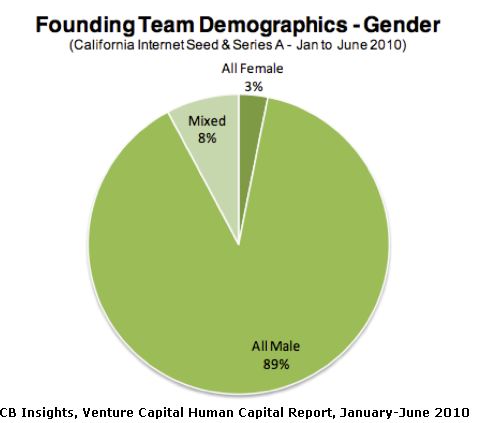
CB Insights reported that in California from January-June 2010:CI Insights Founder Gender - 2010

  • 89 percent of series A and seed-funded companies had all male founders, compared with only 8 percent that had founders of both genders, and just 3 percent of businesses with all female founders
  • 82 percent of company founders were white, compared to 18 percent that were Asian or Pacific Islander

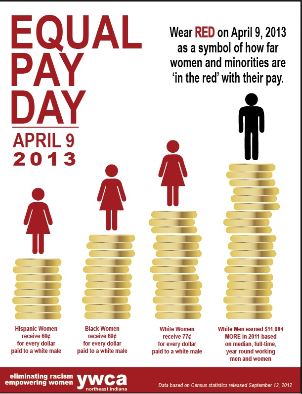
Equal Pay DayThe 2013 Silicon Valley Index, compiled by economic think tank Joint Venture Silicon Valley found significant income disparities by race in addition to gender from 2009-2011:

  • African-American residents’ income dropped 18%, compared to a 4% decrease across the U.S.
  • Hispanic resident’ income decreased 5%, similar to the rest of California

Catherine Bracy

Catherine Bracy

Catherine Bracy observed that the average woman in Silicon Valley, California’s “economic powerhouse”, earns 49 cents for every dollar men make in Silicon Valley, when averaging incomes of African American and Hispanic women residents.

NerdWallet analyzed data from the U.S. Census for 366 metro areas to determine the lowest pay gaps for women in small, medium, and large cities, and concluded that on balance, Silicon Valley was one of the “best places for women to work.”

Wage discrepancy in one of the U.S.’s most economically viable areas, whether around the national average or well below, demonstrates that 50 years after the Equal Pay Act, the average female worker in the U.S. is far from earning an equal wage.

Happy Anniversary, Equal Pay Act of 1963, and Many Happy Returns of the day for at least 44 years, until women’s pay may be equal across industries and geographies.

RELATED POSTS:

Twitter:    @kathrynwelds
Blog: – Kathryn Welds | Curated Research and Commentary    
Google+:
LinkedIn Open Group Psychology in Human Resources (Organisational Psychology)
Facebook Notes:

©Kathryn Welds