Laughter May Not Be “The Best Medicine”

Robin Ferner

Robin Ferner

Laughter has its serious side,” according to University of Birmingham’s Robin Ferner and Jeffrey Aronson of University of Oxford, despite author Norman Cousins’ anecdotal account of managing pain of his debilitating form of arthritis by watching Marx Brothers comedies, rest, and vitamin C.

Jeffrey Aronson

Jeffrey Aronson

Although laughter can feel good and has been advocated for its health benefits, Ferner and Aronson noted that “pathological” laughter can be caused by medical disorders including:

  • Amyotrophic lateral sclerosis
  • Cerebral tumors
  • Epilepsy
  • Multiple sclerosis.
Norman Cousins

Norman Cousins

Similarly, they noted many medical disorders result from laughter, including

Laughter Literature ReviewThis last “side effect” they noted was “promoting brand preference,” in a study by Radboud University Nijmegen’s Madelijn Strick, Rob Holland, Rick van Baaren, and Ad van Knippenberg, who investigated “how humor breaks resistance to influence.”

Madelijn Strick

Madelijn Strick

Strick and team concluded that “resistance” causes negative brand associations, but humor in advertisements provides cognitive distraction that prevents negative brand associations and increases positive brand impressions due to positive emotional engagement.
Together, these cognitive and emotional effects promote brand preference.

Laughter’s health benefits in addition to its commercial value, have been documented for decades, and include reduced:

Rob Holland

Rob Holland

Other documented health benefits include increased:

Rick van Baaren

Rick van Baaren

Benefit have been documented across countries and cultures: Both Indians and Canadians reported greater emotional well-being when they laughed to moderate levels, according to Hunaid Hasan and Tasneem Fatema Hasan, then of Mahatma Gandhi Mission’s Medical College.

Team Hasan compared more than 350 adults from Aurangabad, India, with the same number of adults from Mississauga, Canada on demographics, typical amount of laughter, lifestyle, subjective well-being, life satisfaction, emotional well-being, and health dimensions.

Ad van Knippenberg

Ad van Knippenberg

In India, moderate levels of laughter were linked to greatest well-being and life satisfaction, with low levels and high levels showing no effect.

Canadians also greatest benefits associated with moderate laughter, but higher levels of laughter were associated with negative effects.
The Hasan and Hasan team attributed this result to Canada’s higher prevalence of bronchial asthma, which may be precipitated or exacerbated by extreme laughter.

These research findings suggest that more laughter is “not always better” and may require “titrated doses” to extract benefits while minimizing documented “risks.”

-*How do you capitalize on laughter’s benefits while minimizing “the risks”?

RELATED POSTS:

Follow-share-like http://www.kathrynwelds.com and @kathrynwelds

Twitter  @kathrynwelds
Blog – Kathryn Welds | Curated Research and Commentary  
Google+
LinkedIn Open Group Psychology in Human Resources (Organisational Psychology)
Facebook Notes:

©Kathryn Welds

Emotional Awareness Enables Focus, Risk-taking Even When “Stressed”

Jeremy Yip

Jeremy Yip

Greater emotional understanding enables people to quell the “incidental emotion” of anxiety while they focus on decisions, according to Wharton’s Jeremy Yip and Stéphane Côté of University of Toronto.

Stéphane Côté

Stéphane Côté

Incidental emotions that influence decision-making have been called “the affect heuristic” by University of Oregon’s Paul Slovic, Melissa Finucane of the East-West Center, Ohio State’s Ellen Peters, and Donald MacGregor, then of Decision Research.

Paul Slovic

Paul Slovic

People with greater emotional intelligence can separate unpleasant thoughts and feelings from decision making and are less likely to show the affect heuristic bias in risky decisions.

Sigmund Freud

Sigmund Freud

Sigmund Freud considered this ability to separate unpleasant thoughts and feelings as a defense mechanism deployed unconsciously to reduce anxiety and preserve self-esteem.
He called this experience “isolation,” contrasted with “compartmentalization,” which he defined as separating unpleasant emotions from each other.

Roy Baumeister

Roy Baumeister

Florida State’s Roy F. Baumeister, with Karen Dale then of Case Western, and Baruch College’s Kristin L. Sommer, documented recent studies that demonstrate “isolation” as a defense mechanism or coping strategy to contain negative feelings, “emotional contagion,” and “spillover.”

John Mayer

John Mayer

Yip and Côté demonstrated the relationship among emotional intelligence, evoked anxiety and propensity to make riskier choices in their lab studies of more than 100 volunteers, who completed the Mayer-Salovey-Caruso Emotional Intelligence Test developed by Yale’s Peter Salovey and David R. Caruso with John D. Mayer of University of New Hampshire.

David R Caruso

David R Caruso

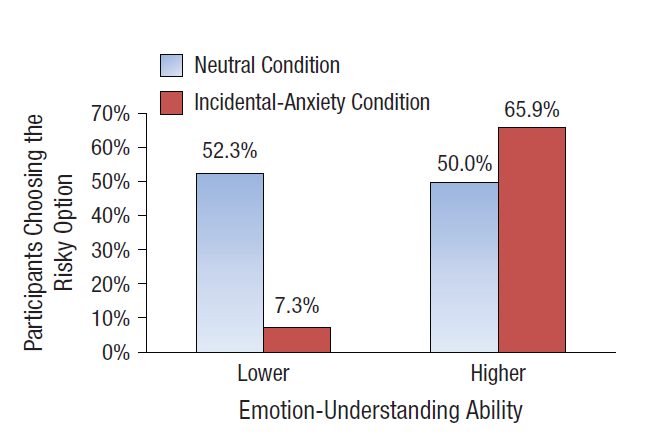
One group received an anxiety-provoking assignment:  One minute to prepare a videotaped speech shown to peers studying “academic and social standing” at the university.
The other group was given a less stressful assignment:  Prepare a grocery list.

Volunteers in both groups could choose their compensation for participating in the study: Receive $1, or take a one in 10 chance to receive $10.

Melissa Finucane

Melissa Finucane

For those given the stressful speech-writing task, people who scored higher on emotional intelligence chose the riskier option to receive $10 three times as often as those who scored lower on emotional intelligence.

In contrast, volunteers who completed the low-stress task made similar choices for compensation no matter the level of emotional intelligence.

Ellen Peters

Ellen Peters

However, people can learn emotional awareness skills to enable mental focus and contain unrelated incidental emotions, according to related studies by Yip and Côté.

They demonstrated this ability to contain anxiety when some volunteers in the speech-writing task were told they “might feel worried” because making a speech is an anxiety-producing task.
Other speech-creators received no further instructions.

Kristin Sommer

Kristin Sommer

Yip and Côté “primed” no emotion among some grocery list-creators by saying that they “may feel no emotion” or no instructions.
Participants were then primed to separate their emotions from their decision-making by being told that their emotions were irrelevant to their decisions.

 Volunteers read information about the benefits of receiving flu injections and consequences of no inoculation during flu season.
Then participants were given the option to register for nearby flu injection clinic.

The reminder that emotions were irrelevant to decisions changed previous results, by increasing the frequency that participants with lower emotional awareness chose the riskier option of not attending the flu injection clinic.

 The findings suggest that adults can reduce emotional bias in decision-making by explicitly identifying emotions and separating them from critical thinking processes

Questions that enable people to separate emotions, thoughts, and decisions include:

  • How do I feel right now?
  • What is causing me to feel that way?
  • And are my feelings relevant to the decision I need to make?

-*How do you avoid the affect heuristic when making decisions?

RELATED POSTS:

©Kathryn Welds

Paradoxical Bias against Innovative Ideas in the Workplace

Jennifer Mueller

Jennifer Mueller

Managers’ implicit attitudes and cognitive “mindset” during proposal presentations can bias organizational decision-makers against innovative solutions without their awareness, according to University of San Diego’s Jennifer Mueller with Shimul Melwani of University of North Carolina and Cornell University’s Jack Goncalo.

Shimul Melwani

Shimul Melwani

Mueller and team pointed out a paradox:  Most managers say they want innovative solutions to workplace issues from team members, yet often reject these creative ideas to reduce risk and uncertainty.

The team asked volunteers to rate a running shoe equipped with nanotechnology that improved fit and reduced potential to develop blisters.

Jack Goncalo

Jack Goncalo

They “primed” some participants toward increased uncertainty in this task by telling them that there were many potential answers to a problem.
In contrast, they cued another group with reduced uncertainty by instructing them that a problem required a single solution.

When volunteers who said they favored creative ideas experienced uncertainty, they preferred concepts of practicality on an implicit word association test, and associated “creativity” with negative concepts including “vomit,” “poison” and “agony.”

Uncertain participants also rated the shoe as significantly less creative than those in the more structured condition, suggesting that were less able to recognize a creative idea and held an unconscious “negative bias against creativity.”

Cheryl Wakslak

Cheryl Wakslak

In more recent work, Mueller collaborated with University of Southern California’s Cheryl Wakslak and Viswanathan Krishnan with University of California, San Diego to expand the idea assessment scenario with two ideas that were independently rated as “creative,” and two ideas judged “not creative.”

Vish Krishnan

Vish Krishnan

Mueller, Wakslak and Krishnan cued some participants to consider “why” in evaluating creative ideas, to evoke broad, abstract thinking, and “high-level construal.
They instructed other volunteers to think about “how” creative idea works, to stimulate narrow focus on practical details and logistics, and “low-level construal.”

Although participants in both groups rated two non-creative ideas similarly, those who adopted a “high-level construal” or a “why” mindset recognized creative ideas more often than those using the “how” mindset.

As an idea’s degree of creativity increases, uncertainty also increases about its feasibility, acceptability, and practicality.
This increased risk may reduce evaluators’ willingness to accept and advocate for an innovative idea, even when objective evidence is presented to validate a creative idea.

To mitigate the paradoxical rejection of creative ideas, organizational leaders can ask team members to consider “why” when creative evaluating proposals to enable “big picture” thinking and a broader construal level.

-*How do you encourage innovative solutions to work challenges?

Follow-share-like http://www.kathrynwelds.com and @kathrynwelds

RELATED POSTS:

Twitter  @kathrynwelds
Blog – Kathryn Welds | Curated Research and Commentary  
Google+
LinkedIn Open Group Psychology in Human Resources (Organisational Psychology)
Facebook Notes:

©Kathryn Welds

Time of Day Affects Problem Solving Abilities

People differ in their circadian rhythms, which determine times of greatest mental alertness, reflected in body temperature differences.

James A Horne

James A Horne

Morningness” describes people who awaken easily and are most alert early in the morning, whereas “eveningness” refers to “night owls” who awaken later and feel most alert late in the day, according to Loughborough University’s James A. Horne and colleague O. Östberg, who developed a self-report questionnaire to distinguish these these temporal preferences.

Mareike Wieth

Mareike Wieth

Creative problem solving is more effective at “non-optimal” times of day for both “morning people” and “night people,” according to Albion College’s Mareike B. Wieth and Rose T. Zacks of Michigan State University.

Rose Zacks

Rose Zacks

They studied volunteers who solved insight problems and analytic problems at their optimal or non-optimal time of day and found consistently better performance on insight problem-solving during non-optimal times, but no consistent effect for analytic problem solving.

During non-optimal times, people may be more distractible, less focused and more able to consider diverse information, alternatives, and interpretations.
These conditions can enable innovative thinking and creativity.

William Hrushesky

William Hrushesky

William Hrushesky, formerly of University of South Carolina, argued that “timing is everything” in medical treatment, and Wieth and Zacks’ findings suggest suggests that working at “off-peak” times is effective for tasks that require creative thinking rather than analytic rigor.

-*How do you sequence your work tasks to enhance performance during “non-optimal” and “peak” times of day?

Follow-share-like http://www.kathrynwelds.com and @kathrynwelds

RELATED POSTS:


Twitter  @kathrynwelds
Blog – Kathryn Welds | Curated Research and Commentary  
Google+
LinkedIn Open Group Psychology in Human Resources (Organisational Psychology)
Facebook Notes:

©Kathryn Welds

Music Preferences Indicate Personality Traits

Besides individual aesthetic preferences, people may prefer musical genres to “regulate” mood or express self-image.

-*Does personality style shape musical preferences?
-*Does preferred music affect personality?

Peter Jason Rentfrow

Peter Jason Rentfrow

University of Cambridge’s Peter Jason Rentfrow and Samuel Gosling uncovered four music-preference dimensions when they analyzed music preferences of more than 3,500 individuals in six studies:

  • Reflective and Complex
  • Intense and Rebellious
  • Upbeat and Conventional
  • Energetic and Rhythmic

These music-preference categories were related to cognitive abilities like verbal IQ and attitudes like political orientation in addition to Big Five personality dimensions.

In other studies, Rentfrow and Gosling found that musical preference accurately predicted Big Five personality traits including “Openness to Experience”, Extraversion, and Emotional Stability among strangers when they asked same-sex and opposite-sex volunteers with an average age of 18  to “get to know each other” over 6 weeks.

Rentfrow and Gosling found significant correlations between musical genre preferences and Big Five personality characteristics:

  • Blues: High self-esteem, creative, outgoing, gentle, at ease
  • Jazz: High self-esteem, creative, outgoing, at ease, intellectual
  • Classical: High self-esteem, creative, introvert, at ease
  • Rap: High self-esteem, outgoing
  • Opera: High, gentle self-esteem, creative
  • Country and Western: Hardworking, outgoing, emotionally stable
  • Reggae: High self-esteem, creative, not hardworking, outgoing, gentle, at ease
  • Dance: Creative, outgoing, not gentle
  • Indie: Low self-esteem, creative, not hard working, not gentle
  • Bollywood: Creative, outgoing
  • Rock/heavy metal: Low self-esteem, creative, not hard-working, gentle, at ease, not outgoing,
  • Chart Pop: High self-esteem, hardworking, outgoing, gentle, not creative, not at ease
  • Soul: High self-esteem, creative, outgoing, gentle, at ease
  • Vocals: Extraverted
Marvin Zuckerman

Marvin Zuckerman

Additional support for the relationship between music preference and personality characteristics came from University of Melbourne’s David Rawlings and Vera Ciancarelli in their study correlating responses on University of Delaware’s Patrick Little and Marvin Zuckerman‘s Music Preference Scale and the NEO Personality Inventory (Revised).

Individuals who scored high on extraversion and women tended to prefer
“Popular Music
” and those who scored high on “Openness to Experience” showed strong “Breadth of Musical Preference.”

This study related “sensation seeking” to musical preferences and confirmed speculation that people who seek greater levels of environmental stimulation through auditory, visual, gustatory, and other experiences tend to like complex, intense music.

High scorers on Sensation Seeking Scale form V preferred Rock music and but not Soundtrack music and those who scored high on Thrill and Adventure Seeking subscale and Experience Seeking subscale liked Folk and Classical music in addition to Rock music.
As might be expected, participants who scored high on the Disinhibition subscale liked Rock but not Religious or Soundtrack music.

Hans Eysenck

Hans Eysenck

“Extraversion” has been related to “sensation seeking” in Hans Eysenck’s seminal research.
Southern Illinois University’s Stephen J. Dollinger demonstrated that people who report behaviors and traits associated with extraversion tend to prefer Jazz, which has “high arousal properties” and those who endorse “excitement seeking” behaviors said they prefer Hard Rock music.

Stephen Dollinger

Stephen Dollinger

These generalizations may change as people age, so Nazarene University College’s Kelley Schwartz and Gregory Fouts of University of Calgary examined 164 adolescents’ music preferences in relation to personality dimensions and developmental issues.

Gregory Fouts

Gregory Fouts

Those who preferred music with “heavy” or “light” qualities reported personality and developmental difficulties, but those who preferred “eclectic” music reported no personality or developmental concerns.

Schwartz and Fouts concluded that adolescents prefer music that reflects personality characteristics and developmental challenges, supporting Renfrow and Gosling’s caveat that results for adult musical preferences may not reflect the same personality characteristics among people in other age groups.

Taken together, these findings on personality trends related to musical preferences among adolescents and adults suggest that when people master specific developmental issues, music relevant to those challenges may no longer be appealing, and preferences may change.

-*To what extent do you prefer music that “regulates” your mood and productivity?

-*How accurately can you infer people’s personality traits from their musical preferences?

Please follow-share-like www.kathrynwelds.com and @kathrynwelds

RELATED POSTS:

Twitter  @kathrynwelds
Blog – Kathryn Welds | Curated Research and Commentary  
Google+
LinkedIn Open Group Psychology in Human Resources (Organisational Psychology)
Facebook Notes

©Kathryn Welds

Emotional Music Can Lead to Biased Judgments

Joydeep Bhattacharya

Joydeep Bhattacharya

Emotions elicited by music influence can influence and even bias visual judgments, according to University of London’s Nidhya Logeswaran and Joydeep Bhattacharya.

They presented volunteers with short excerpts of “happy” music or “sad” music, then showed neutral, “happy,” and “sad” faces.
When people listened to a “happy” music, they were more likely to perceive faces as “happy” even when the face was neutral.
Similarly, the “priming” with “sad” music was associated with more ratings of faces as “sad,” even if they were neutral.

The team also observed the effects of musical “priming” in electrophysiological measures of brain potential components within 100 milliseconds after the faces were presented, suggesting rapid neuronal information processing.

Even if listeners’ perceptions and judgments can be biased by emotional music, listeners do not experience the precise emotions they hear in music.

Kiyoshi Furukawa

Kiyoshi Furukawa

Listeners can identify strong emotions conveyed by music, but do not experience the same degree or type of emotion, according to Tokyo University of the Arts’s Ai Kawakami and Kiyoshi Furukawa, who collaborated with University of Tokyo’s Kentaro Katahira and Kazuo Okanoya.

Kazuo Okanoya

Kazuo Okanoya

Kawakami and team distinguished “perceived emotion” from “felt emotion” in response to music, and presented two pieces of “sad” music (Mikhail Glinka’s “La Séparation” in F minor) and one piece of “happy” music to 44 volunteers, both musicians and non-musicians.

Mikhail Glinka

Mikhail Glinka

Participants rated their perceived emotions and felt emotions in response to each musical selection using 62 descriptions on a scale from 0 (not at all) to 4 (very much).
Although participants recognized the “sad” music’s negative emotions, most reported feeling “romantic,” and “blithe,” rather than negative or unpleasant.

Muzak

Muzak

“Muzak” (now Mood Media) audio in workplaces can evoke emotional responses that may lead to biased business decisions.

As long ago as the 1950s, concerned American citizens claimed that Muzak practiced “brainwashing” with its planned musical sequences in quarter-hour segments.

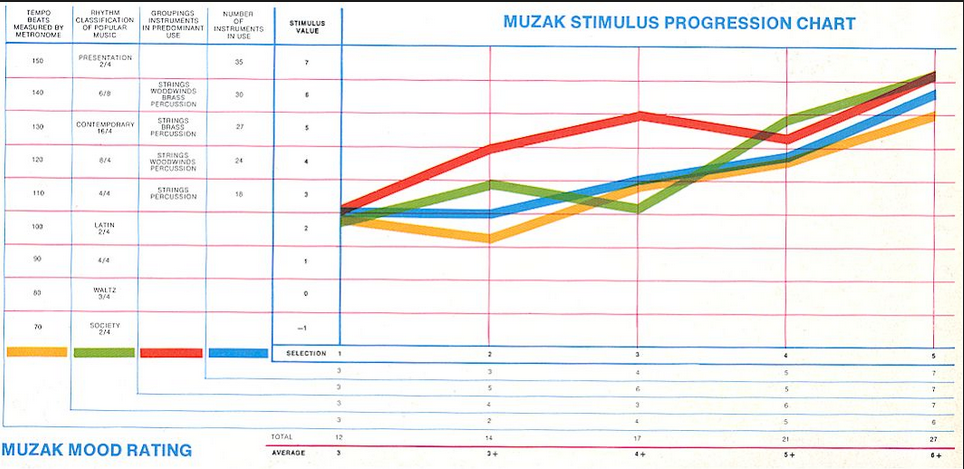
Muzak Stimulus ProgressionMuzak’s playlist is synchronized to time of day to “increase energy” at predicted low-energy times based on its patented “Stimulus Progression.
These 15-minute sequences feature about six songs with varying “stimuli values,” based on tempo, rhythm, instrumentation and orchestra size.
The next 15-minute period features silence.
Mood Media
Over a 24-hour period, tunes with higher “stimulus value” are played when people are typically “lethargic” – 11 a.m. and 3 p.m., and slower songs are played “after lunch” and at the end of the work day.
Muzak claimed that this programming “increases morale and productivity at workplaces, increase sales at supermarkets, and even dissuade potential shoplifting at department stores.”

The emotional tone of music may bias other cross-sensory judgments.
Adrian C. North, working at University of Leicester and Herriott Watt University, tested the effect of music in a supermarket on wine selections and olfactory/gustatory judgments wine’s properties.

North ensured that French accordian music or German Bierkeller brass band music were played on alternating days for two weeks at the supermarket.
French wines and German wines had similar prices and their order on the shelf was changed each day.

After 82 shoppers selected wines, an interviewer asked customers to complete a questionnaire about the purchase, including:

  • Preference for French or German wines
  • Extent to which the music brought to mind France or Germany
  • Degree to which the music influenced specific wine selection.

The results from 44 shoppers suggest that music influenced shoppers’ wine selections:  More French wine was sold when French music played (40 bottles of French wine vs 8 bottles of German wine), and more German wine was sold when German music played (22 bottles of German wine vs 12 bottles of French wine).

North concluded that barely audible music can implicitly, unconsciously affect thoughts, perceptions, decisions, and even buying action.

Charles Areni

Charles Areni

Music can trigger thoughts similar to the music’s mood, context, or speed, according to the Preference-for-prototypes model proposed by Macquarie University’s Charles Areni and David Kim of Texas Tech.

-*When have your judgments and performance been altered by ambient music?

Follow-share-like http://www.kathrynwelds.com and @kathrynwelds

RELATED POSTS:

©Kathryn Welds

Listening to Music Increases Endurance, Reduce Perceived Discomfort in Physical Exercise

Costas Karageorghis

Costas Karageorghis

Listening to up-tempo music synchronized to low- or moderate-intensity exercise can distract from fatigue and discomfort and reduce oxygen consumption, according to Sheffield Hallam University’s CJ Bacon and TR Myers, and Brunel University’s Costas Karageorghis.

They found that cyclists who listened to synchronous up-tempo music used 7% less oxygen than those who cycled in silence.

Peter C Terry

Peter C Terry

Listening to music synchronized with exercise elevates mood, increases endurance, reduces perceived effort and increases metabolic efficiency, according to University of South Queensland’s Peter C. Terry, who collaborated with Karageorghis to produce a comprehensive review of psychophysical effects of music in sport and exercise.

Karageorghis collaborated with Brunel colleagues Denis A. Mouzourides, Tariq A. Sasso, Daley J. Morrish, and Carolyn L. Walley with David-Lee Priest of University of East Anglia,  to conclude that “
motivational qualities of music have considerable bearing on how long participants might endure a repetitive activity and their feelings during the task.”

David-Lee Priest

David-Lee Priest

They pointed to the public health and social implications of their findings when they asserted that “motivational synchronous music may serve as an important tool to underpin current initiatives of Western governments to improve public health and lessen the financial burdens on public health services.”

Follow-share-like http://www.kathrynwelds.com and @kathrynwelds

-*How do you use music to enable task persistence?

RELATED POSTS:

Twitter  @kathrynwelds
Blog – Kathryn Welds | Curated Research and Commentary  
Google+
LinkedIn Open Group Psychology in Human Resources (Organisational Psychology)
Facebook Notes:

©Kathryn Welds

Does Music Training Improve Other Skills?

Considerable research indicates that training in music theory and performance is associated with better performance on quantitative, reasoning, visual, and motor tasks, but recent findings offer a counterpoint.

Leonid Perlovsky

Leonid Perlovsky

Among the evidence supporting the benefits of musical training, De Rochebelle School (C.S.D.D)’s Arnaud Cabanac collaborated with Leonid Perlovsky of Harvard University, Canadian Air Force Research Laboratory’s Marie-Claude Bonniot-Cabanac, and Michel Cabanac of Laval University to report that student musicians earned better grades than peers and performed better on a more stressful, complicated tasks.

Michel Cabanac

Michel Cabanac

German Institute for Economic Research (DIW Berlin)’s Adrian Hille and Jürgen Schupp, also of Free University of Berlin (FUB), concurred that long-term music training during childhood and youth affects cognitive skills development, school grades.

Adrian Hille

Adrian Hille

They examined data from the German Socio-Economic Panel (SOEP) and found that adolescents with music training have better cognitive skills and school grades and were 15 percent more likely to report planning to attend a university.

In addition, these young musicians were more conscientious, open and ambitious across socio-economic statuses.
These improvements in cognitive and non-cognitive skills were more than twice as great as the contribution of sports, theater or dance training and participation.

Sylvain Moreno

Sylvain Moreno

Preschool children, too, demonstrated enhanced performance on a measure of verbal intelligence after participating in an interactive computerized music training, according to Rotman Research Institute’s Sylvain Moreno with University of Toronto colleagues E. Glenn Schellenberg and Tom Chau, who collaborated with York University’s Ellen Bialystok, Raluca Barac, and Nicholas J. Cepeda.  

They reported that after just 20 days of this computer-based music training, these children showed improvement on verbal tasks, and related changes in functional brain plasticity during an executive-function task.

Frances Rauscher

Frances Rauscher

Musical training was associated with better performance on auditory discrimination and fine motor tasks among children who had three years or more musical instrument training, according to University of Wisconsin’s Frances H. Rauscher with Gordon L. Shaw, and Catherine N. Ky of University of California, Irvine.

Marie Forgeard

Marie Forgeard

Children who received at least three years of instrumental music training outperformed their control counterparts on auditory discrimination abilities and fine motor skills, vocabulary and nonverbal reasoning skills in studies by University of Pennsylvania’s Marie Forgeard, with Andrea Norton, and Gottfried Schlaug of Harvard Medical School’s and Boston College’s Ellen Winner.

These performance enhancements were associated with duration of musical training, but Forgeard’s team did not replicate earlier findings of enhanced  spatial skills, phonemic awareness, and mathematical abilities.

In a sample of music listeners instead of music learners, National Cheng Kung University’s Pei-Luen Tsai and colleagues found that stroke patients in Taiwan showed improved visual attention while listening to classical music, compared with white noise and silence.

Samuel Mehr

Samuel Mehr

Despite this affirmative evidence, Samuel Mehr of Harvard University, who plays saxophone, flute, bassoon, oboe, and clarinet, found no evidence of a cognitive benefit when young children receive music lessons.

With Harvard colleagues Adena Schachner, Rachel C. Katz, and Elizabeth S. Spelke, Mehr conducted two Randomized Control Trials (RCT) with four year old preschool children to evaluate the cognitive effects of music classes, compared with non-musical visual arts instruction or to a no instruction.

After six weeks, the team evaluated children’s skills in:

  • Spatial-navigational reasoning
  • Visual form analysis
  • Numerical discrimination
  • Receptive vocabulary.
Adena Schachner

Adena Schachner

Although their initial findings suggested improved performance for children who received musical training, the team was unable to replicate the finding.
The team found a small positive effect of music instruction on intelligence in only one study.

They reported that children who participated in music classes performed no better than those with visual arts or no classes on any assessment.

Elizabeth Spelke

Elizabeth Spelke

Mehr and team concluded that before asserting cognitive benefits of music training, it is essential to:

-*What benefits on performance in other areas have you observed among people who have musical training?

-*How do you evaluate conflicting evidence for and against musical training’s impact on cognitive performance?

 Follow-share-like http://www.kathrynwelds.com and @kathrynwelds

RELATED POSTS:

Still Fulfilling Your New Year’s Resolutions?

-*Did New Year’s Resolutions fade as quickly as the month of January?

Katherine Milkman

Katherine Milkman

If so, University of Pennsylvania Katherine Milkman has a recommendation to resume the good intentions toward goals: “Nudges”—small environmental interventions that can shift behavior to increase adherence to challenging commitments, whether at work or in personal life.

Hengchen Dai

Hengchen Dai

Milkman collaborated with Wharton colleague Hengchen Dai and Harvard’s Jason Riis to investigate “temporal turning points” – moments that feel like a new beginning, like New Year’s Day or beginning a new job or school.

Jason Riis

Jason Riis

Milkman, Riis, and Dai reported several examples of the “fresh start effect”:  They found that the number of online Google searches for the term “diet” increase following temporal landmarks like the beginning of a new week, month, year, or semester; a birthday or a holiday.
The largest increase—82% above the baseline—occurred immediately after New Year’s Day for nine years they studied.

Similarly, the number of gym visits of 12,000 undergraduates over 18 months increased in January, then declined, with smaller increases at the beginning of each week, each month, and each term.

 This pattern also occurred among 43,000 participants in a goal-setting website, stickK, over 30 months.

Members can set goals and contractually agree to consequences for failing to attain them, such as community sanctions to monetary payments to disliked organizations.
The greatest number of contracts—145% above the average rate—were signed at the beginning of the New Year, and more contracts were signed at the beginning of each week.

Richard Thaler

Richard Thaler

Commitments to pursue and return to goals increase after these “notational boundary,” described by Richard Thaler of University of Chicago.
A temporally-triggered “fresh start” can compensate for limited willpower and persistence by giving people a chance to restart their commitments.

Besides “temporal turning points,” self-designed “nudges” can be contingency plans for a specific corrective action when confronted with the temptation to deviate from the goal path: “Whenever situation x arises, I will initiate the goal-directed response y.”

Peter Gollwitzer

Peter Gollwitzer

New York University’s Peter Gollwitzer calls these mitigation plans “implementation intentions,” which result in better adherence to goal-directed efforts when developed before tempting situational cues.

Stephen Ciccone

Stephen Ciccone

The stock market’s “January Effect” of better-than-average performance early in the year may result from the “fresh start” phenomenon, although Stephen J. Ciccone of University of New Hampshire argues that it may be more affected by investor optimism and the “false hope syndrome.”

Janet Polivy

Janet Polivy

University of Toronto’s Janet Polivy and C. Peter Herman describe the “false hope syndrome’s” unrealistic expectations about the likely speed, amount, ease, and consequences of self-change attempts, and subsequent disappointment of these optimistic aspirations.

Ciccone found that investor sentiment, as measured by the University of Michigan’s Index of Consumer Confidence, peaks in January and suggested that optimistic bid up stock prices of firms with higher levels of uncertainty.

C. Peter Herman

C. Peter Herman

Typically, these firms are unable to meet the optimistic expectations, and disappoint investors when they under-perform.
However, this pattern continues each year, probably due to the combined impact of  “fresh start effect” and the “false hope syndrome.”

Unrealistic optimism has been well-documented in overestimates of personal abilities, future performance and the impact of achieving goals, as well as underestimates of the time and effort to achieve goals.

Jeffrey Jensen Arnett

Jeffrey Jensen Arnett

Jeffrey Jensen Arnett of Clark University found that both 200 adolescents and more than 200 adults held optimistic biases regarding the risks of smoking even though the strong majorities of smokers and nonsmokers in these groups agreed that smoking is addictive and causes death for “most people” who smoke.

However, the adolescent and adult smokers doubted that they would die from smoking even if they smoked for 30 or 40 years, and most adolescents believed that they “could smoke for a few years and then quit.”

Roger Buehler

Likewis Roger Buehler

Likewise, most people underestimate time required to complete tasks, called “planning fallacy”  by Wilfred Laurier University’s Roger Buehler, Dale Griffin of University British Columbia and University of Waterloo’s Michael Ross.

Dale Griffin

Dale Griffin

They found that 465 volunteers:

  • Underestimated their own but not others’ completion times for academic and nonacademic tasks
  • Focused on future plans rather than comparing with similar past experiences when making completions time estimates
  • Attributed their past errors in predicting completion times to external, transient, and specific factors, implying less personal accountability for misjudgments.
Mike Ross

Mike Ross

Volunteers were able to eliminate their bias toward inaccurately optimistic estimates when they explicitly considered connect relevant past experiences to inform current estimates.

Fiona Jones

Fiona Jones

The optimism bias can be reduced by setting modest, attainable goals, according to University of Leeds’ Fiona Jones and Adrian Coggins with Peter Harris of University of Sussex and University of Hertfordshire’s Hilary Waller.

They compared 119 volunteers’ expectations about their participation in a twelve-week-long exercise course and their actual attendance, and found that participants who set smaller goals were more likely to achieve and maintain the goal behavior over time.

-*How effective are “temporal turning points” to initiate and re-start positive behaviors toward your goals?
-*How do you guard against optimism bias and “false hope syndrome” in planning and executing toward your goals?

RELATED POSTS:

Twitter  @kathrynwelds
Blog – Kathryn Welds | Curated Research and Commentary  
Google+
LinkedIn Open Group Psychology in Human Resources (Organisational Psychology)
Facebook Notes:

©Kathryn Welds


Women’s Multitasking Skill Linked to Neural Network Patterns

Diane Halpern

Diane Halpern

Differences between men’s and women’s performance on cognitive tasks, particularly mathematics and science have been observed for decades, with men generally excelling at motor and spatial tasks and women excelling in memory and social cognition tasks.

Camilla Benbow

Camilla Benbow

Claremont McKenna College’s Diane F. Halpern led an extensive review of these performance differences with Camilla P. Benbow of Vanderbilt University, University of Missouri‘s David C. Geary, Ruben C. Gur of University of Pennsylvania, Janet Shibley Hyde and Morton Ann Gernsbacher of University of Wisconsin. 

David Geary

David Geary

Their evidence “provided no single or simple answer” to contrasting skills by gender but a comprehensive brain imaging study of more than 400 males and more than 500 females between ages 8 and 22 years, provides evidence for popular observations.

Madhura Ingalhalika

Madhura Ingalhalika

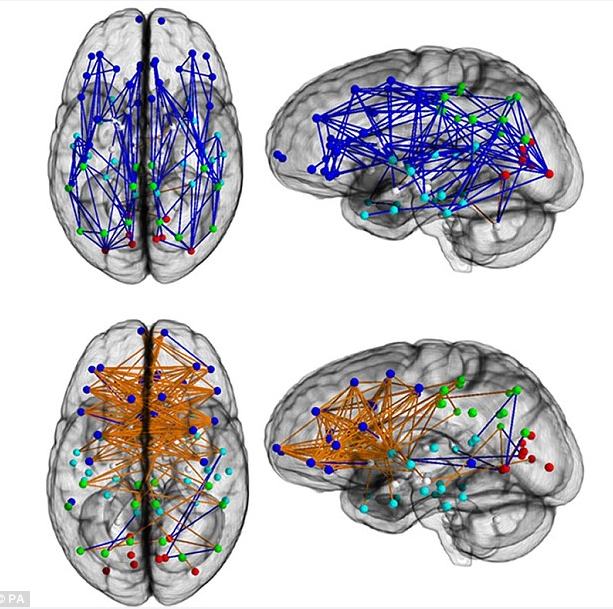
Using diffusion tensor imaging, University of Pennsylvania’s Madhura Ingalhalikar, Alex Smith, Drew Parker, Theodore D. Satterthwaite, Mark A. Elliott, Kosha Ruparel, Raquel E. Gur, Ruben C. Gur and Ragini Verma with Hakon Hakonarson of Children’s Hospital of Philadelphia, demonstrated that male and female brains differ in the network of neural connections.
Known as the “structural connectome,” these connections between neural structures were described by Indiana University’s Olaf Sporns, who reviewed imaging techniques to visualize their activity.

Ted Satterthwaite

Ted Satterthwaite

These gender-linked structural differences result in differing competencies.
Ingalhalikar’s team observed that male brains structures show more connections within the front and back of the brain hemisphere in the supratentorial region.

Olaf Sporns

Olaf Sporns

This area connects perception and coordinated action and enables males’ skill in quickly perceiving and applying information to a single complex task, spatial reasoning, and learning motor skills.

Ingalhalikar connectomeIn contrast, female brains contain more neural connections between hemispheres in supratentorial regions. 
This connection pattern enables females to recall faces and execute multiple complex tasks simultaneously more easily than males due the increased neural connections between analytical and intuitive processing modes.

Dardo Tomasi

Dardo Tomasi

Building on earlier work on these differences by Brookhaven National Lab’s Dardo Tomasi and Nora D. Volkow of National Institute on Drug Abuse, Ingalhalikar’s team found these differences were reversed in the cerebellar connections, where male brains showed greater intrahemispheric connectivity and female brains demonstrated more interhemispheric connections.

Nora Volkow

Nora Volkow

These structural differences lead to different development for girls and boys from an early age, and result in significant, less modifiable differences by adolescence and adulthood. 

Frequently-observed differences in male and female performance are rooted in different neural connection patterns by gender.

 -*What exceptions have you seen to findings of women’s skill in multitasking and social insight, and men’s competence in spatial reasoning and motor skill acquisition?

RELATED POSTS:

Follow-share-like http://www.kathrynwelds.com and @kathrynwelds

Twitter  @kathrynwelds
Blog – Kathryn Welds | Curated Research and Commentary  
Google+
LinkedIn Open Group Psychology in Human Resources (Organisational Psychology)
Facebook Notes

©Kathryn Welds