Category Archives: Resilience

Resilience

Managing Workplace Interruptions

Edward Sykes

Edward Sykes

Most office workers spend an average of two hours a day doing unplanned tasks, according to Sheridan Institute’s Edward Sykes.
These work interruptions are associated with:

Quintus Jett

Unplanned tasks decrease productivity and are characterized by:

  • Intrusions – Unplanned interactions initiated by others: Synchronous communication including instant message, phone call, or a coworkers visiting to talk,
  • Distractions – Unplanned focus change from a task to environmental conditions like other conversations,
  • Breaks – Unscheduled task stoppage to rest, visit the restroom, have a meal,
  • Discrepancy Detection – Unplanned task stoppage to correct errors or redirect work effort toward a revised objective.

Jennifer George

Unplanned workplace interruptions are increasingly prevalent due to rising incidence of:

  • Open and collaborative workspaces,
  • Technological interruptions,
  • Meetings.
Sheldon Cohen

Sheldon Cohen

Open space floor plans increase unplanned interruptions, perceived stress, and “cognitive fatigue,” due to greater noise levels and reduced privacy for employees.
These factors also reduce employees’ job satisfaction, found Carnegie Mellon’s Sheldon Cohen and E. M. De Croon and team of University of Amsterdam.

Julie Renneker

Julie Renneker

Synchronous communications are more disruptive than asynchronous communications, which allow response at a convenient time and mitigate the negative impact of task-shifting on cognitive load and stress level, noted University of Texas’s Julie Rennecker and Lindsey Godwin, now of Champlain College.

Greg Oldham

Greg Oldham

Strategies to mitigate the impact of work disruptions include time management and boundary setting, according to Tulane’s Greg Oldham, Carol Kulik of University of South Australia and Florida State University’s Lee Stepina.
 They suggested that employees:

Carol Kulik

Carol Kulik

-“Batch” communication to check email and returning phone calls at specified intervals,

-Block technology pop-ups, alerts, sounds to avoid startling interruptions,

James Tyler

James Tyler

-Organize tasks around energy peaks, with tasks requiring the most effort and concentration earlier in the workday and after a break, also advocated by Purdue’s James Tyler and Kathleen Burns of University of Wisconsin,

Kathleen Burns

Kathleen Burns

-Take active breaks, such as walking outside to breathe outdoor air,

John Aiello

John Aiello

-Schedule interruption-free intervals, to increase perceived control over interruptions and reduce stress, also cited by Duke’s Andrew Carton and John Aiello of Rutgers,

-Create “work-arounds” for open space floor plans by:
.Installing higher cubicle dividers,
.Providing noise-cancelling headphones,
.Offering white noise machines to reduce ambient notice,
.Designating reservable private work rooms for audio privacy,

-Reduce meeting frequency to focus on issues that require group discussion, consensus, commitment.

A counterpoint argument is that task interruptions provide benefits, proposed by  Jett and George.
The argued that unplanned and planned interruptions :

  • Prevent widespread rework when employees alert colleagues to a work discrepancy or error,
  • Increase productivity during repetitive or well-learned tasks that may lead to boredom, errors, or lost task focus.

-*How do you reduce the negative impact of workplace interruptions?

RELATED POSTS:

©Kathryn Welds


Do Women Advance in Careers More Slowly than Men?

Herminia Ibarra

Herminia Ibarra

Men received 15% more promotions than women, according to a Catalyst Benchmarking Survey.

Similar numbers of “high potential” women and men were selected for lateral moves to other parts of the business.
However, men but not women, received promotions after the career-developing lateral moves.

Nancy M. Carter

Nancy M. Carter

Women’s developmental lateral moves were substitutes for actual career advancement, suggested INSEAD’s Hermina Ibarra with Nancy M. Carter and Christine Silva of Catalyst.
Similarly, women receive social accounts – or explanations – as substitutes for salary increases.

Virginia Valian

Virginia Valian

Hunter College’s Virginia Valian suggested that implicit bias may explain men’s performance is consistently overrated while women’s accomplishments are underrated by coworkers, bosses and themselves, .
Resulting discrepancies in opportunity accrue over time to create large gaps in advancement, she asserted.

In addition, women are typically evaluated in relation to a “masculine” standard of leadership, reported Catalyst’s earlier research.
Three consequences of this rating standard undermine leadership and advancement opportunities:

  • Extreme Perceptions, in which women are attributed behavioral excesses, such as “toughness” or “niceness,”
  • High Competence Threshold, when women leaders are held to higher standards and receive lower and fewer rewards than men,
  • Competent but Disliked, when women may be perceived either as “competent” or “likeable” but not both.
Phyllis Tharenou

Phyllis Tharenou

Family structure can accelerate or slow career progress in unexpected ways.
Both “post traditional” mothers who have employed spouses, and “traditional” fathers whose wives are engaged in childcare only, more rapidly advanced in private sector careers than women and men with other family configurations, reported Phyllis Tharenou of Flinders University.
Somewhat surprisingly, non-parent women and men, and unmarried fathers  advanced more slowly in their careers.

Employment disruption, such as maternity leave or layoff, did not impair career advancement for women and men, but the industry sector was associated with differing rates of career advancement.

Alice Eagly

Alice Eagly

In a separate analysis, Tharenou noted that the strongest predictors of advancing in management were managerial aspirations and masculinity.
Women were more likely to advance when they received career encouragement and when organizational hierarchies included both women and men.

To explain these career advancement rate discrepancies, University of Massachusetts’ Alice H. Eagly and Linda L. Carli of Wellesley suggested that women encounter a career labyrinth rather than a glass ceiling.

Linda Carli

Linda Carli

Differences in career advancement rates may be narrowed by sponsorship rather than mentorship, argued Catalyst and Center for Talent Innovation.
Male advocates can support female sponsees by focusing attention on the challenges women face at work and can advocate for organizational processes and structures that normalize equivalent competence in women and men.

  • What type of “career encouragement” enable women to advance in careers at a rate similar to men?

RELATED POSTS:

©Kathryn Welds

Perceived Diversity = “Like Me”

Christopher Bauman

Christopher Bauman

Judgments of “diversity” are rarely completely objective:
People tend to rate a group as “diverse” when it includes members of the evaluator’s race, found University of California, Irvine’s Christopher W. Bauman, Sophie Trawalter of University of Virginia and UCLA’s Miguel M. Unzueta.

Sophie Trawalter

Sophie Trawalter

Almost 1900 volunteers from diverse racial groups rated headshots of a fictional company’s six-person management team for its “ethnically diversity”:

  • Caucasian team” included six white headshots (100% white),
  • Asian team” showed four white and two Asian people (mirroring the 66% majority of white people in the U.S.),
  • Black team” featured four white and two black people (66% white),
  • Asian + Black” team had four white, one black, and one Asian person (66% white).
Miguel Unzueta

Miguel Unzueta

Members of racial minority groups rated leadership groups as “more diverse” when they included members of their own racial group rather than members of other racial minority groups.

Participants rated groups as it “less racially diverse” when they did not include at least one member of their own racial group.
This “in-group representation effect” was stronger for African Americans than for Asian Americans.

In another study, more than 1,000 volunteers read news articles about the prevalence of prejudice, then provided ratings.
They showed no “in-group representation effect,” suggesting that reading about how another minority group suffers from prejudice reduced raters’ self-referential evaluation bias.

These results indicate that people’s expectations affect perceptions of diversity.
Priming awareness and empathy for similar experiences encountered by other groups reduced in-group biases.

Jim Sidanius

Jim Sidanius

African Americans are often judged as experiencing:

Lower social status,

More negative stereotypes,

More discrimination, reported Harvard’s Jim Sidanius and Felicia Pratto of University of Connecticut.

Felicia Pratto

Felicia Pratto

In contrast, Asian Americans tend to be attributed higher status so report less discrimination than other racial minority groups.

Andrea Romero

Andrea Romero

Despite this advantage, Asian Americans have a lower return on their investment in education than Whites, even though they achieve higher levels of education and income than other racial minority groups, reported University of Arizona’s Andrea Romero with Robert Roberts of University of Texas and another group led by UT colleague Myrtle P. Bell with David A. Harrison and Mary E. McLaughlin.

Myrtle P Bell

Myrtle P Bell

Higher levels of “diversity” have been linked to greater:

Valerie Purdie-Vaughns

Valerie Purdie-Vaughns

These findings were confirmed in studies by Columbia’s Valerie Purdie-Vaughns and Ruth Ditlmann, Claude M. Steele of Stanford, University of British Columbia’s Paul G. Davies and Jennifer Randall Crosby of Williams College and separate work by UCLA’s Jaana Juvonen and Sandra Graham with University of California Davis’s Adrienne Nishina 

Jaana Juvonen

Jaana Juvonen

Diversity is “in the eye of the beholder” because a team may appear more diverse to raters when the group’s composition aligns with the observers’ own characteristics.

-*How do you reduce personal in-group biases based on individual expectations and experiences?


RELATED POSTS:

Twitter  @kathrynwelds
Facebook Notes

©Kathryn Welds


Male Peer Raters Discount Women’s Expertise in Science, Engineering

J Stuart Bunderson

J Stuart Bunderson

Problem-solving work groups and individual career development benefit from accurate recognition and deployment of expertise.

Nancy DiTomaso

Nancy DiTomaso

People who are perceived as experts by team members, regardless of their actual expertise, have a number of career advantages, found Washington University’s J. Stuart Bunderson:

  • Greater influence in group decision-making,
  • More opportunities to perform,
  • Great opportunity for team leadership roles.
D Randall Smith

D Randall Smith

In addition, peer evaluations of expertise frequently contribute to individual rewards, compensation, and advancement, noted Rutgers’ Nancy DiTomaso, D. Randall Smith and George F. Farris with Corinne Post of Pace University and New Jersey Institute of Technology ‘s Rene Cordero.

Melissa Thomas-Hunt

Melissa Thomas-Hunt

Teams benefit when they accurately identify and use group members’ expertise because they perform more effectively and produce higher quality work products, found Cornell’s Melissa C. Thomas-Hunt, Tonya Y. Ogden of Washington University, and Stanford’s Margaret A. Neale.

Aparna Joshi

Aparna Joshi

However, women in science and engineering do not have equal opportunities to fully use their expertise in work groups, and to receive commensurate rewards, reported Penn State’s Aparna Joshi.

George Farris

George Farris

She obtained peer ratings and longitudinal research productivity data for 500 scientists and engineers and found that women’s technical expertise was undervalued by male colleagues in peer ratings.

Rene Cordero

Rene Cordero

Male and female raters assigned different importance to education when evaluating team members’ expertise.
Women’s ratings were correlated with the target person’s education level, but males evaluators considered educational attainment less than male gender in assigning highest ratings for expertise.

As a result, women’s highest ratings went to those with the highest education level, whereas men’s top evaluations were assigned to other men, no matter their education level.

Margaret Neale

Margaret Neale

Women received significantly lower expertise evaluations than men, and men evaluated highly educated women more negatively than female raters who assessed their peers.

These findings suggest that male peers discount women’s educational achievements and are unlikely to effectively use women’s expertise, to the detriment of team work output as well as individual recognition.

-*How do you ensure that your expertise is recognized and applied in work groups?


RELATED POSTS:

Twitter  @kathrynwelds
Facebook Notes

©Kathryn Welds

Developing Executive Self Awareness to Enhance Leadership Impact

Vicki Swisher

Lack of self-awareness among organizational leaders is pervasive and costly, according to Korn Ferry’s Vicky Swisher and Evelyn Orr.
They studied executives using the FYI: For Your Insight assessment tool, based on research from FYI for Insight: 21 Leadership Characteristics for Success and 5 That Will Get You Fired.

Evelyn Orr

Evelyn Orr

Executives’ most significant blind spots were:

• Making tough people calls,
• Demonstrating personal flexibility, adapting approaches to new circumstances.

Similarly,  the top leadership problems were:
• Not inspiring employees, not building talent,
• “Too narrow”, relying on deep expertise without broadening perspective.

Leaders vastly underestimated their effectiveness in “managing up”, suggesting that they focused more on their next promotion, rather than on developing their employees.

Joe Luft

Joe Luft

Lack of self-awareness can be reduced by using a “Reality Check” including:

o Feedback from others to provide “early warning” of difficulty.
However, this requires that evaluators are willing to provide candid observations, despite widespread discomfort in providing corrective feedback.

o Self-reflection concerning effective and ineffective behaviors, documented in a personal journal for review.

Harry Ingham

Harry Ingham

Executives learned most to enhance leadership skills and self-reflection from on-the-job experiences, distantly followed by learning from other people.
Structured trainings are least effective and most costly approaches to enhance leadership cognitive, emotional, motivational, self-awareness, and learning agility capabilities.

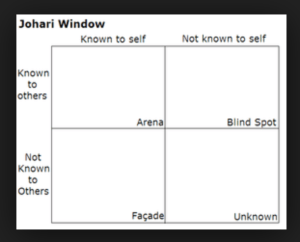
These leadership development processes reduce individual blind spots, portrayed by San Francisco State University’s Joe Luft and Harry Ingham of National Training Labs in The JoHari Windowjohari-window

Korn Ferry’s Michael M. Lombardo and Robert W. Eichinger provided additional executive development recommendations based on research in FYI: For your Improvement, A Development and Coaching Guide(3rd Edition).

-*How do you increase your self-awareness at work and reduce your “blind spots” about yourself and others?

Twitter: @kathrynwelds
Google+:
Facebook Notes

©Kathryn Welds

How Much Positive Feedback Counterbalances Criticism?

Sandra Mashihi

Sandra Mashihi

Does 360-degree feedback do more harm than good?
Envisia’s Kenneth Nowack and Sandra Mashihi provided “evidence-based answers”:

Kenneth Nowack

Kenneth Nowack

Poorly-designed 360-degree feedback assessments and interventions can increase disengagement and contribute to poor individual and team performance.

Individuals can “experience strong discouragement and frustration” when feedback is not as affirming as anticipated.
In addition, negatively-perceived information may be discounted and disregarded.

John Gottman

John Gottman

The ratio of positive to negative feedback may determine whether it is incorporated and used.
University of Washington’s John Gottman and Pepper Schwartz found that well-functioning marriages have a 5:1 ratio of positive to negative feedback.

A positive-negative ratio of 3:1 in 360-feedback sessions encouraged enhanced individual and team performance, individual workplace engagement, effectiveness, and emotional “flourishing,” according to University of North Carolina’s Barbara Frederickson and Marcial Losada of University of Michigan.

Barbara Fredrickson

Barbara Fredrickson

Proportions of negative feedback and interactions that exceed these ratios can interfere with insight and motivation and diminish willingness to engage in work-related practice and performance effectiveness.
Fredrickson suggested that this 3:1 ratio of positive to negative feedback is a “tipping point.”

Naomi Eisenberger

Naomi Eisenberger

When people are overloaded with negative feedback, neurophysiologic pathways associated with physical pain are triggered, reported UCLA’s Naomi Eisenberger and Matthew Lieberman collaborating with Kipling Williams of Macquarie University.

Zhansheng Chen

Zhansheng Chen

This effect was corroborated when volunteers reported higher levels of physical pain and demonstrated diminished performance on a cognitively-demanding task, in research by Williams, University of Hong Kong’s Zhansheng Chen, Julie Fitness of Macquarie University, and University of New South Wales’s Nicola C. Newton.

“Titrating” negative feedback in 360 degree evaluations within recommended ratios can enable recipients to more effectively assimilate and execute recommendations.

-*What ratios of positive to negative feedback do you apply in helping others improve performance?

Twitter: @kathrynwelds
Google+
Facebook

©Kathryn Welds

Empathy Paradox:  Similar Adversity Reduces Compassion

Many intuitively believe that people are more empathic toward those who experience difficulties they also encountered.

Ervin Staub

Ervin Staub

This linkage between challenging life experiences and subsequent empathy was posited by University of Massachusetts’s Ervin Staub and Joanna Vollhardt of Clark University, and confirmed in experiments by Northeastern’s Daniel Lim and David DiSteno.

Daniel Lim

Daniel Lim

However, this connection is more complicated, found Northwestern’s Rachel Ruttan and Loran Nordgren with Mary-Hunter McDonnell of Wharton.

Rachel Ruttan

Rachel Ruttan

The team exposed volunteers to people who expressed dejection in enduring a hardship such as bullying or unemployment.

Participants who recalled similar past hardships remembered them as less distressing than they were originally experienced, and were more likely to harshly judge others in similar circumstances for their difficulties in enduring the situation.

Antonin Scalia

Antonin Scalia

In fact, volunteers who previously coped with severe bullying felt less — not more — compassion for current bullying victims.

Likewise, those who had faced greater difficulty with unemployment had less empathy for people who were currently jobless.

This confirms the “tough love” approach implied in the late U.S. Supreme Court Justice Antonin Scalia’s directive to Americans dismayed with the 2000 election outcome: “Get over it!”

Mary-Hunter McDonnell

Mary-Hunter McDonnell

However, when the the volunteers’ adversity experiences differed from the current suffers’ difficulties, participants were more compassionate.

The “empathy gap” emerged only when survivors of similar hardships showed less understanding for current suffers.

  • -*How do you reduce the “empathy gap” in workplace situations?

    Related Posts:

Self-Distancing Pronouns Use Can Increase Self-Management

Ethan Kross

Ethan Kross

Despite years of popular guidance to use self-statements for difficult conversations with partners, spouses, and bosses, research argues for using self-distancing alternatives to manage stress and increase self-control.

Emma Bruehlman-Senecal

Emma Bruehlman-Senecal

University of Michigan’s Ethan Kross, Jiyoung Park, Aleah Burson, Adrienne Dougherty, Holly Shablack, and Ryan Bremner with Emma Bruehlman-Senecal and Ozlem Ayduk of University of California, Berkeley, plus Michigan State’s Jason Moser studied more than 580 people’s ability to self-regulate reactions to social stress by using different ways of referring to the self during introspection.

LeBron James

LeBron James

One example of variations in self-reference is LeBron James’ statement, One thing I didn’t want to do was make an emotional decision. I wanted to do what’s best for LeBron James and to do what makes LeBron James happy.”

The team demonstrated that using non-first-person pronouns (such as “he” or “she”)  and one’s own name (rather than “I”) during introspection enhanced self-distancing, or focusing on the self from a distant perspective.

Stephen Hayes

Stephen Hayes

Distancing, also called “decentering” or “self as context,” allows people to observe and accept their feelings, according to University of Nevada’s Steven Hayes, Jason Luoma, Akihiko Masuda and Jason Lillis collaborating with Frank Bond of University of London.

Ozlem Ayduk

Ozlem Ayduk

Self-distancing verbalizations were associated with less distress and less maladaptive “post-event processing  (reviewing performance) when delivering a speech without sufficient time to prepare, and when seeking to make a good first impression on others.
Post-event processing can lead to increased social anxiety, noted Temple University’s Faith Brozovich and Richard Heimberg.

Faith Brozovich

Faith Brozovich

They found that participantsexperienced less global negative affect and shame after delivering a speech without sufficient preparation time, and engaged in less post-event processing.

Adrienne Dougherty

People who talked about themselves with non-first person pronouns also performed better in speaking and impression-formation social tasks, according to ratings by observers.

Participants who used self-distancing language appraised future stressors as less threatening, and they more effectively reconstrued experiences for greater coping, insight, and closure, in another study by Kross and Ayduk.

Ryan Bremner

Ryan Bremner

People with elevated scores on measures of depression or bipolar disorder experienced less distress when applying a self-distanced visual perspective as they contemplated emotional experiences, noted Kross and Ayduk, collaborating with San Francisco State University’s David Gard, Patricia Deldin of University of Michigan, and Jessica Clifton of University of Vermont.

David Gard

Using second-person pronouns (“you”) seems to be a self-distancing strategy when people reflect on situations that involve self-control, noted University of North Carolina’s Ethan Zell, Amy Beth Warriner of McMaster University and University of Illinois’s Dolores Albarracín.

Ethan Zell

These findings demonstrate that small changes in self-referencing words during introspection significantly increase self-regulation of thoughts, feelings, and behavior during social stress experiences.

Self-distancing references may help people manage depression and anger about past and anticipated social anxiety.

Dolores Albarracín

-*What impact do you experience when you use “self-distancing language”?

-*How do you react when you hear others using “self-distancing language,” like referring to “you” when speaking about their own experience?

Related Posts:

Twitter:  @kathrynwelds
Google+
Facebook

©Kathryn Welds

“Honest Confidence” Enables Performance, Perceived Power

Confidence mobilizes people’s performance and increases others’ perceptions of competence, likeability, and persuasiveness – but may lead to careless errors that undermine performance.

David Dunning

David Dunning

Women and men show significantly different levels of confidence, with cascading effects on performance and participation in specific occupations.

For example women tend to underestimate their performance in scientific reasoning, but actually perform about equally to men, found Cornell’s David Dunning and Washington State University psychologist Joyce Ehrlinger in their investigation of women’s low representation in Science, Technology, Engineering, and Mathematics (STEM) academic programs and work roles.
They concluded that women underestimate their performance, based on lower levels of confidence.

Joyce Ehrlinger

Joyce Ehrlinger

In a related tasks, Dunning and Ehrlinger invited these volunteers to participate in a science competition for prizes.
Women were less likely to accept the invitation than men, also attributed to lower confidence in their capabilities in scientific tasks.
The researchers pointed to low confidence as a source of women’s proportionally lower participation in Science, Technology, Engineering, and Mathematics (STEM) job roles.

Jessica Kennedy

Jessica Kennedy

Confidence – even unjustified confidence – seems to lead  observers to perceive assured individuals as competent, high status leaders, found Wharton’s  Jessica A. Kennedy, Cameron Anderson of University of California at Berkeley, and Don A. Moore.

Cameron Anderson

Cameron Anderson

They asked more than 240 students to estimate their confidence in identifying “historical” names and events, which included real and bogus entries.
Some participants said they could identify items that were actually fake, indicating that they believed – or wanted to convey – they knew more than they actually did.

Don A Moore

T Don A Moore

Then, Kennedy and team asked participants to rate each other based on status in the group.
Volunteers who said they could identify the most fraudulent items were rated as most prominent in the group, suggesting that confidence, even false confidence, contributes to perceived status.
The team suggested that overconfident volunteers genuinely believed their self-assessments, their confidence persuaded their peers of their task skill and commitment to the group’s success.

Ernesto Reuben

Ernesto Reuben

Honest overconfidence,” was also observed by Ernesto Reuben of Columbia, Paola Sapienza of Northwestern University, and University of Chicago’s Luigi Zingales, in their finding that men rated their performance on a set of math problems to be about 30 percent better than it was, whereas women underestimated their performance.

Carol Dweck

Carol Dweck

The power of honest and unjustified confidence may be rooted in childhood socialization patterns, observed Stanford’s Carol Dweck:  Boys’ mistakes are attributed to a lack of effort (whereas)…girls … see mistakes as a reflection of their deeper qualities.”
These different types of feedback lead men to attribute negative outcomes to external factors like unfairly difficult task, but women attribute undesirable results to their personal qualities like low ability.

Confidence is reflected in employees’ willingness to speak in work settings, and those who speak more than others are considered dominant.
However, women who exert authority by speaking more than others, even when they are in senior organizational levels, may alienate others and be seen as less capable.

Victoria Brescoll

Victoria Brescoll

Yale’s Victoria Brescoll found that even senior-level women hesitate to speak as much senior-level men due to anticipated negative reaction from others.

These concerns were validated by Brescolls investigation of men’s and women’s rating of a fictitious female CEO who talked more than other people.
Both women and men evaluated the female CEO as significantly less competent and less suited to leadership than a male CEO who talked for the same amount of time.
However, when the female CEO was described as talking less than others, participants rated her as significantly more competent.

Roger Shepard

Roger Shepard

Similarly, a high-power male who talked much less was evaluated as incompetent and undeserving of leadership, just like the high-power female who spoke more than average.
Brescoll suggested that these reactions are associated with stereotypic gender expectations.

Roger Shepard-Jacqueline MetzlerAs a result, women are unlikely to increase confidence, perceived status and power by speaking and behaving like men because this approach would violate gender stereotype expectations, leading to a “backlash” effect.

Zachary Estes

Zachary Estes

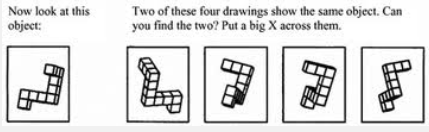
However, when women are “primed” to experience confidence, they performed better on 3D rotation spatial tasks in Roger Shepard and Jacqueline Metzler’s Mental Rotations Test, reported University of Warwick’s Zachary Estes and Sydney Felker, then of University of Georgia Health Center.

In one set of tests, women and men performed similarly when women and men again completed each item and reported their:
Confidence level in their answers,
-Whether they would change their responses if given the opportunity.

Women’s performance dropped below previous scores whereas men’s increased significantly when they elected to change answers.
Second-guessing” and “over-thinking” eroded women’s confidence which affected their scores.

Albert Bandura

Albert Bandura

People who have a strong sense of efficacy focus their attention on analyzing and figuring out solutions to problems, whereas those beset with self-doubts of their efficacy tend to turn their attention inwardly and become self-preoccupied with evaluative concerns when their efforts prove unsuccessful,” explained Stanford’s Albert Bandura and Forest Jourdan.

Robert K Merton

Robert K Merton

However, both men and women significantly improved their scores after they were told that they achieved high scores on the previous test irrespective of actual score.
This finding demonstrates the performance-enhancing effect of positive expectancy, and replicated “The Rosenthal Effect,” or “self-fulfilling prophecy,” described by Robert K. Merton of Columbia.

Jeffrey Vancouver

Jeffrey Vancouver

Confidence may have performance-eroding effects despite much previous research documenting performance-enhancing effects, according to Ohio University’s Jeffrey Vancouver and Charles Thompson, with University of Cincinnati’s E. Casey Tischner, and Dan Putka of Human Resources Research Organization.

Dan Putka

Dan Putka

They primed confidence or “self-efficacy” among half the participants in an analytic game, and found that those who received positive feedback about their performance didn’t perform as well in the next game, and were more likely to make logical errors.

Vancouver and team suggested that participants whose confidence was artificially-inflated tended to apply less mental effort to challenging tasks before attempting the next item.

Fortunately, actual skill trumps inflated confidence.
Women considering technical training and careers may be reassured by Kennedy and team’s observation that, “…Acting capable was beneficial, but actually being capable was better.”

However, these findings suggest that women aspiring to STEM careers are likely to be more effective when they create a “hybrid” style of communication and professional presence, drawing on behaviors that demonstrate confidence, competence, and proactivity without violating gender-linked expectations.

-*How do you capitalize on the performance-enhancing effects of confidence without alienating others or reducing future performance efforts?


RELATED POSTS:

©Kathryn Welds

Perceived Physical Attractiveness Shapes Views of Social Hierarchies

Nielsen Product SpendingCosmetic surgery is the fastest-growing medical expenditure in the U.S, and Americans spend more on personal grooming than on reading material.

Even during the recession of 2008, Americans spent at least $200 billion on products and services to enhance their appearances, according to Stanford’s Margaret Neale and Peter Belmi, now of University of Virginia.

Margaret Neale

Margaret Neale

Personal appearance and attractiveness have been linked with likeability, perceived competence, income and more, and Neale and Belmi found further connections between people’s self-perceived attractiveness and their attitudes toward social inequality and hierarchies.

Attractiveness Bias2The team asked participants to write about a time when they felt more attractive or less attractive, and then indicate whether they agreed with statements such as, “Some groups of people are simply inferior to other groups,” and “Lower wages for women and ethnic minorities simply reflect lower skill and education level.”

The researchers found that people who think they are attractive also think they have greater social standing, and believe that people are entitled to their social position based on their personal (“dispositional”) qualities.

Occupy 99As a result, people who rate themselves as attractive generally feel that people in lower social strata are there due to their characteristics or behaviors.
These beliefs are associated with less willingness to donate money to a social equality non-profit organization (the Occupy movement).

Peter Belmi

Peter Belmi

By contrast, people who thought they were less attractive also thought they belonged to a lower-status social group, and rejected existing social hierarchies.
They attributed unequal social status to external factors often beyond the full control of those in less prestigious social groups. One example is lack of access to quality education.

Unlike self-perceptions of attractiveness, empathy and integrity were not related to people’s views of their social class and others’ place in society.

-*How have you seen appearance affect acceptance or organizational hierarchy and philanthropic giving?

RELATED POSTS:

©Kathryn Welds