Category Archives: Neuroscience

Neuroscience

Spreading Good News Feels Good, Especially When It’s About You

Christian Science Monitor has long provided a counterpoint to mainstream media’s “If it bleeds, it leads” approach to providing shocking, scandalous, depressing, or scary news.

Jonah Berger

Jonah Berger

Wharton’s Jonah Berger and Katharine Milkman found that the Christian Science Monitor might have a savvy business model:  they found that good news spreads more widely than bad.

Word of Mouth Marketing AssociationMembers of the Word of Mouth Marketing Organization: Take note…

Katherine Milkman

Katherine Milkman

Berger and Milkman evaluated a random sample of 3,000 of more than 7,500 articles published in the New York Times online from August 2008 to February 2009.

They judged each article’s “popularity” based on number of times it was forwarded to others, after controlling for online publication time, section, and degree of promotion on the home page.
Independent readers rated each article for practical value or surprise, and ratio of positive vs negative emotion words in each news item.

Most-forwarded posts were positive, funny, exciting and featuring intellectually challenging topics, like science, that “inspire awe” (“admiration and elevation in the face of something greater than the self”).

Readers shared articles that typically provoke negative emotions like anger and anxiety, but not sadness.
-*Why this bias against sending “downer” messages?

Emily Falk

Emily Falk

Michigan’s Emily Falk, with UCLA colleagues Sylvia Morelli, B. Locke Welborn, Karl Dambacher,and Matthew Lieberman found that people consider what appeals to others, possibly as a means of building relationships, indicated by increased activation in brain regions (temporoparietal junction, or TPJ and dorsomedial prefrontal cortex) associated with “social cognition,” or thoughts about other people, measured by fMRI.

When those regions were activated, people were more likely to talk about the idea with enthusiasm, and the idea would spread by word-of-mouth.

Falk noted that the team mapped  brain regions “associated with ideas that are likely to be contagious and are associated with being a good ‘idea salesperson.'”
She plans to use these brain maps “to forecast what ideas are likely to be successful and who is likely to be effective at spreading them.”

Diana Tamir

Diana Tamir

People also like to spread good news about themselves.
Diana Tamir and Jason Mitchell, then of Harvard, illustrated that brain regions associated with reward (mesolimbic dopamine system, including the nucleus accumbens and ventral tegmental area) are activated when people share information about themselves.

Jason Mitchell

Jason Mitchell

Self-disclosure is so pleasurable that people will sacrifice monetary rewards for this opportunity.

Mor Naaman

Mor Naaman

In fact, Rutgers’ Mor Naaman with Jeffrey Boase, now at Ryerson University and Chih-Hui Lai, now of University of Akron found that 80 percent of Twitter users tweet primarily about themselves.
One reason may be that people say more positive things when they’re talking to a bigger audience, like Twitter followers, according to Berger’s research suggests. As a result, social media users are likely to convey positive information about themselves.

Jeffrey Boase

Jeffrey Boase

However, this positive self-presentation may not result in a positive mood if communicators spend longer on social media platforms like Facebook.
Hui-Tzu Grace Chou and Nicholas Edge of Utah Valley University found that those with longer visits to Facebook say they are less happy than their Facebook Friends.

They found that Facebook users tend to form biased judgment based on easily-recalled examples (availability heuristic) and erroneously attribute positive Facebook content to others’ personality, rather than situational factors (correspondence bias), especially for those they do not know personally.

Hanna Krasnova

Hanna Krasnova

Corroborated by Humboldt-Universität zu Berlin’s Hanna Krasnova and her team from Technische Universität Darmstadt, these researchers observed “invidious emotions” and “envy” among people who spend longer time on Facebook.

These findings have relevance to members of the Word of Mouth Marketing Organization: Spread the good word – or at least the emotional word – and spend less time on Facebook and other social media that might invite social comparison and the potential for envious dissatisfaction.

-*How you build “buzz” via “Word of Mouth”?

RELATED POSTS:

Twitter:   @kathrynwelds
Blog: – Kathryn Welds | Curated Research and Commentary
Google+:
LinkedIn Open Group Psychology in Human Resources (Organisational Psychology)
Facebook Notes:

©Kathryn Welds

Compassion Training Surpasses Empathy Training to Reduce Stress

Susanne Leiberg

Susanne Leiberg

Compassion training has positive effects on mood and health, and University of Zurich’s Susanne Leiberg, Olga Klimecki, Tania Singer demonstrated that it can actually change the brain’s functioning, and related emotions and behaviors.

Olga Klimecki

Olga Klimecki

Klimecki, Leiberg, Singer, now at Max Planck Institute collaborated with Claus Lamm of University of Vienna to examine the impact of compassion training on brain activity in response to observing another person’s distress.

Tania Singer

Tania Singer

A frequent experience in daily life, most people experience distress, or empathy, when observing another’s distress, due to activation of the brain’s “mirror” neurons.

Claus Lamm

Claus Lamm

In contrast, compassion is concern with others’ suffering coupled with the desire to alleviate the other person’s pain, and can exist without actually experiencing the other persons’ distress through empathy.

The researchers evaluated whether personal distress be transformed into compassion, a useful coping strategy for those in health care professions, and in caretaking roles.
They developed the Socio-affective Video Task to measure neural and subjective responses to witnessing the distress of others.

Most volunteers experienced initial empathic negative feelings and activations in the brain’s pain empathy areas, the anterior insula and anterior medial cingulate cortex, when they observed the distress of others.
However, the volunteers who completed compassion training experienced less negative emotion, and more positive feelings when witnessing others in distress, related to increased activity in brain areas associated with positive emotion and affiliation:  the medial orbitofrontal cortex, putamen, pallidum, and ventral tegmental area.

In contrast, control group volunteers who received memory training did not have more positive emotions, and participants in empathy training actually experienced more negative feelings.

The studies suggest that compassion training can be an effective coping strategy when observing or supporting others in distress, and the mental discipline of compassion training can increase positive emotion more effectively than memory training or empathy training.

Besides changing the brain and related feelings, compassion training triggered more “prosocial” behavior, including helping and cooperating.

This researcher team developed the Zurich Prosocial Game (ZPG) to validly assess helping behaviors in light of reciprocity, helping cost, and distress cues influences.
Volunteers who had received short-term compassion training increased their helping behaviors in the game, but this was not true for volunteers who received short-term memory training.

Charles Raison

Charles Raison

Emory University’s Charles Raison advocated compassion training as a better day to deal with “enemies,” whether globally or interpersonally.
He collaborated with Emory colleagues including Geshe Lobsang Tenzin Negi, who developed Cognitive-Based Compassion Training (CBCT) and Sheetal Reddy of Atlanta’s Children’s Healthcare of Atlanta, to evaluate the impact of compassion training with youth in foster care.

Geshe Lobsang Tenzin Negi

Geshe Lobsang Tenzin Negi

The team considered whether these participants, who had suffered maltreatment, experienced improved psychosocial functioning after twice-weekly Cognitive-Based Compassion Training (CBCT) for six weeks compared with young people assigned to the “wait-list-no treatment” group.

Researchers found no difference in measured functioning, but young people who practiced compassion more frequently reported greater hopefulness and ability to deal with life stressors, and decreased generalized anxiety.

These findings suggest that compassion training can improve stress management, mood, and cooperation.

-*How have you seen compassion training affect feelings and behaviors?

RELATED POSTS:

©Kathryn Welds


Cognitive Value of Handwriting in the Digital Era

-*Is handwriting passé in the Digital Era?
-*Has keyboarding eclipsed pen and paper?

Virginia Berninger

Virginia Berninger

University of Washington’s Virginia Berninger with Robert Abbott, Amy Augsburger, and Noelia Garcia argue that handwriting provides valuable cognitive training, and advantages in expressive speed, fluency, and productivity.

Robert Abbott

Robert Abbott

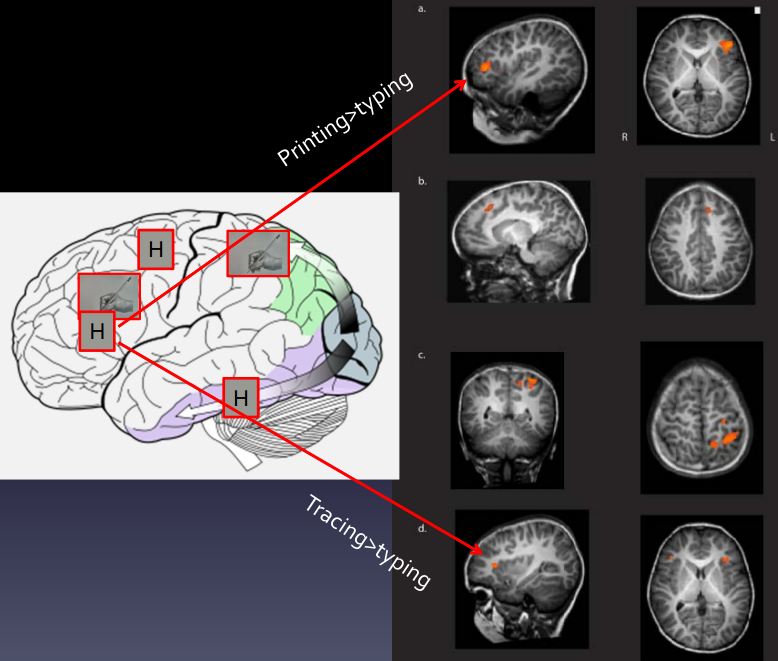
Berninger’s team conducted brain scans and found that the brain’s thinking, language, and “working memory” regions are more activated when handwriting letters than when typing.

This change in brain activation occurs because handwriting letters generally requires more than one sequential stroke, rather than selecting a letter key during typing, according to Berninger.

Berninger’s studies demonstrated students in grades two, four and six wrote more words more quickly and expressed more ideas when writing essays by hand versus with a keyboard.

Karin James

Karin James

Karin Harman James’s research using an fMRI at Indiana University confirms the benefits of handwriting.

Isabel Gauthier

Isabel Gauthier

With Isabel Gauthier of Vanderbilt University, she showed alphabet letters to children before and after they received letter-learning instruction.

Participants who practiced printing by hand showed more enhanced and “adult-like” the neural activity than those who had simply looked at letters.
James suggested that adults may show similar neural activity benefits when learning a new graphically-different language, such as Mandarin, or symbol systems for mathematics, music and chemistry.

Marieke Longcamp

Marieke Longcamp

Université de la Méditerranée’s Marieke Longcamp,  Céline Boucard, Jean-Claude Gilhodes and Jean-Luc Velay  with Jean-Luc Anton, Muriel Roth, and Bruno Nazarian of Hôpital de La Timone, Marseille, France demonstrated other neural benefits of handwriting: Movements memorized when learning how to handwrite enabled adults to more effectively recognize graphic shapes and letters.

Steve Graham

Steve Graham

Steve Graham, now of Arizona State University, with Michael Hebert, now of University of Nebraska, demonstrated that handwriting is still associated with improved classroom performance, even when most classrooms and students type on computers.

Sian Beilock

Sian Beilock

Besides enhancing academic achievement, writing can be a coping tool, according to University of Chicago’s Sian Beilock.
She reported that bright students managed test anxiety by writing about their anxieties to “off-load” them.

Jill Mateo

Jill Mateo

Beilock collaborated with Andrew Mattarella-Micke, Jill Mateo, Neil Albert and Katherine Foster of University of Chicago, and Vanderbilt University’s Marci DeCaro, Robin Thomas of Miami University, and Megan Kozak of Pace University to study students as they derived solutions to challenging math problems.

Robin Thomas

Robin Thomas

The team confirmed that those who performed well on the math problems said that they did not have math anxiety, whereas low performers said they were anxious about math performance.
A less expected finding was that both high performers and low performers had the stress hormone, cortisol, in their saliva.

Although both groups experienced measurable stress, the performance outcome was mediated by the calm or anxious “mindset,” suggesting that performance can be enhanced through managing anxiety and expectations.
Writing by hand helped participants boost performance by reducing anxiety and freeing  working memory to focus on the math problems.

P. Murali Doraiswamy

P. Murali Doraiswamy

Handwriting practice may be valuable for adults as well as children, according to P. Murali Doraiswamy of Duke University, who suggested that handwriting practice may be a useful treatment to stabilize cognitive losses in aging.

 -*How often do you use handwriting and printing instead of typing on a keyboard?

RELATED POSTS:

©Kathryn Welds

Neuronal Recordings Suggest “Free Will” Might be “Free Won’t”

Itzhak Fried

Itzhak Fried

People may think they consciously control their actions and performance, but findings from UCLA’s Itzhak Fried and Roy Mukamel with Gabriel Kreiman of Harvard challenged conventional assumptions about “conscious intention” and “free will. ”

Roy Mukamel

Roy Mukamel

Fried, Mukamel, and Kreiman adopted Benjamin Libet’s procedure to assess “free will” at University of California, San Francisco, using intracranial recordings to identify neuron activity that precedes and predicts volunteers’ decision to move a finger.

Gabriel Kreiman

Gabriel Kreiman

Volunteers, who had electrodes implanted in their brains to record early indicators of seizures, pressed a button when they chose and indicated the clock’s hand position when they decided to press the button.

Libet’s process marks the time a voluntary action occurred, and the volunteer’s report of when the decision to act was completed.
These data points enabled researchers to identify specific neurons that were active during the time around the conscious decision to act and the completed action.

Benjamin Libet

Benjamin Libet

About a quarter of neurons in the frontal lobe’s supplementary motor area (responsible for motor activity coordination) and the anterior cingulate cortex (which directs attention and motivation) changed activity before volunteers said they wanted to press the button.

Spontaneous, voluntary acts were initiated in the cerebrum about 200 milliseconds before the person was consciously aware of the ‘decision’ to act, and researchers predicted with greater than 80 percent accuracy whether a movement had occurred and when the decision to make it happened.

Libet’s team suggested that unconscious brain processes, which are more rapid than conscious decision-making (“free will”), are the instigators of volitional acts.
However, these researchers also proposed that “free will” is more accurately described as “free won’t” because conscious volition can exercise “veto power” over intentions to act.

Kreiman extended this research to better understand loss of voluntary movement in Parkinson’s disease when he pre-empted volunteers’ movements after observing brain activation in the supplementary motor area and the anterior cingulate cortex.
StopHe activated a “stop” sign on a screen in front of each volunteer before the person actually moved, and reported that his volunteers frequently said, ”That was weird. It was like you read my mind.”

Nalini Ambady

Nalini Ambady

These brain studies complement Stanford professor Nalini Ambady’s work at Harvard University on “thin slicing”, or the experience of “knowing before you know.”
Also described as “intuition” or “unconscious cognitive processing,” these findings suggest that the conscious mind is the last to know when we make a decision.

-*How do you manage the discrepancy between unconscious mental processes and conscious awareness of them?

RELATED POSTS:

Twitter:  @kathrynwelds
Blog: |Kathryn Welds |Curated Research and Commentary
Google+:
LinkedIn Open Group Psychology in Human Resources (Organisational Psychology)
Facebook Notes:

©Kathryn Welds

Interpersonal Envy in Competitive Organizations

Workplace envy is rarely discussed, although it is a logical outcome of competition for scarce resources:  Recognition, advancement, power, reputation, compensation in explicit or implicit organizational “tournaments.”

Jayanth Narayanan

Jayanth Narayanan

National University of Singapore’s Jayanth Narayanan, Kenneth Tai, and Daniel McAllister broached the near-taboo of workplace envy as an inevitable outgrowth of social comparison and related “cognitive dissonance” in attempting to self-regulate or return to emotional and equity “homeostasis.”

Daniel McAllister

Daniel McAllister

They differentiated malicious envy from benign envy and argue that the latter can drive performance through emulating admired outcomes.

This process, called firgun in Hebrew, is characterized by happiness, envy, and support of others, and is positively related to organizational success.
Mudita in Buddhist texts, refers to similar feelings of vicarious joy at another’s success and good fortune.

Hidehiko Takahashi

Hidehiko Takahashi

Narayan and team posit that envy is pain at another’s good fortune, and Hidehiko Takahashi’s team at Japan’s National Institute of Radiological Sciences demonstrated that the social-emotional pain of envy is a variation of the physical pain experience.

Their fMRI study found that the emotional pain of workplace envy is physically manifested in activation of the brain’s anterior cingulate cortex.

Nathan DeWall

Nathan DeWall

As such, Nathan DeWall of University of Kentucky and colleagues reported that Tylenol™ reduces behavioral and neural responses associated with social pain in two fMRI studies.

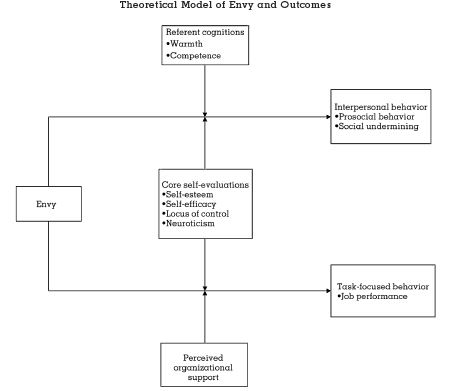
Narayanan argues that envy exerts its differential effect on workplace behavior through each individual’s specific:

  • Core self-evaluations (self-esteem, self-efficacy, locus of control, and neuroticism),
  • Referent cognitions” regarding warmth, likeability, and competence of the envied  person
  • Perceived organizational support

Workplace envy, they argue, can affect:

  • Social undermining
  • Prosocial behavior
  • Job performance

Narayanan and team proposed that those with higher self-esteem are less prone to negative workplace behaviors when experiencing on-the-job envy.

They propose that people are less likely to socially undermine the envied individual when the envied person is viewed as both warm-likeable and competent.

Similarly, they suggest that people who think their organization values them and their work, and supports their work and career development efforts are less likely to decrease job performance when envious at work.

Chade-Meng Tan

Chade-Meng Tan

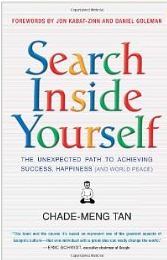
Search Inside YourselfGoogle’s Jolly Good Fellow ChadeMeng Tan proposes the mindfulness-based program “Search Inside Yourself” (SIY) as a way to self-manage workplace envy and other painful social experiences, by developing skills in:

  • Trained attention
  • Self-knowledge and self-mastery
  • Creating useful mental habits.

-*How do you manage workplace envy when you notice it in yourself or others?

RELATED POSTS:

©Kathryn Welds

Genes Influence Investment Risk-Taking: Implications for Taking Career Risks?

Camelia Kuhnen

Camelia Kuhnen

Brian Knutson

Brian Knutson

Camelia Kuhnen, then of Stanford with her Stanford colleague Brian Knutson and Vanderbilt’s Gregory Samanez-Larkin posit a small but meaningful genetic basis to risk-averse financial investing, providing a biological basis for findings that women hedge fund managers outperformed male counterparts.

Volunteers with two short serotonin transporter genes (5-HTTLPR) reported that they tend to worry, and this pattern was associated with chosing less risky investment choices.

Gregory Samanez-Larkin

Gregory Samanez-Larkin

“Short allele carriers” also showed higher levels of the personality trait “neuroticism,” but no significant difference in cognitive skills, education, or financial status.
Kuhnen estimates that less than 30 percent of variance in risk-taking is attributable to short 5-HTTLPR, and the remaining difference is derived from experience, culture, education, and social environment.

Kuhnen and Knutson reported the neural basis of financial risk taking using event-related fMRI.
They observed that the nucleus accumbens was activated before volunteers made risky choices and made risk-seeking mistakes.
In contrast, they found that the anterior insula was activated before risk-free choices and risk-aversion mistakes.

They proposed that different neural circuits are associated with differing emotions as volunteers anticipate gain or loss associated with financial choices.
This emotional activation “signature” can lead to specific investment choices, favoring or avoiding risk, and may lead to investing mistakes.

In unpublished research, Kuhnen found that short-allele carriers showed increased anxiety before making a decision in a trial-and-error risk discovery task, but reacted no differently than long-allele carriers when they observed a negative outcome.

She noted that volunteers differ in how they anticipate and react to a potential decision before they make it rather that in their reactions to actual outcomes of investment decisions.

Joan Chiao

Joan Chiao

Kuhnen, now at Northwestern collaborated with Northwestern colleague Joan Chiao to investigate the impact of both the 5-HTTLPR gene and the DRD4, gene, which regulates dopamine transmission.
These genes and their related neurotransmitters have been linked to emotional behavior, anxiety and addiction.

Their research replicated Kuhnen’s earlier finding that individuals with two short 5-HTTLPR alleles take 28% less risk than people with other combinations, and they demonstrated that the double DRD4 7 allele carriers took 25% more risk than people with other combinations.
They conclude that serotonin is associated with risk-averse investment choices, whereas dopamine is associated with riskier choices.

Kuhnen and Chiao argue that risky investment behavior shares commonalities with other risky behaviors like drug use, gambling, unsafe sex, dangerous physical and social pursuits, and more.

-*How do you determine the right amount of risk to undertake in career development and financial investing?

Related Posts

©Kathryn Welds

Resilient Performance Enhanced by Warmth, Touch

John Bargh

John Bargh

Idit Shalev

Idit Shalev

John Bargh of Yale and Idit Shalev now of Ben Gurion University found a bi-directional causal relationship between physical warmth and social warmth.

They used social affiliation as a proxy for social warmth; Loneliness and interpersonal rejection were examples of social coldness.

Results from their four studies concluded that feelings of social warmth or coldness can be induced by experiences of physical warmth or coldness, and vice versa.

In addition, Bargh and Shalev demonstrated that volunteers unconsciously self-regulated feelings of social warmth by applying physical warmth.

This type of self-regulation is a form of exerting control over the environment and managing feelings.
Self-management strategies reinforce people’s perception that they have some control over choices and environment.

Paul Zak

Paul Zak

Kerstin Uvnas-Moberg

Kerstin Uvnas-Moberg

Paul Zak and Kerstin Uvnas Moberg argue that touch can be another self-regulation strategy because it activates the vagus nerve and the release of oxytocin, resulting in increased feelings of interpersonal warmth, compassion, and collaboration.

Both of these self-management strategies – inducing warmth and engaging in touch – can increase task performance and reduce the likelihood that people will experience depression.

Carl Honore

Carl Honore

Martin Seligman

Martin Seligman

Canadian Journalist Carl Honore provided evidence in Martin Seligman’s important finding in studies of “learned helplessness,” that when people have a sense of control – whether real or a “positive illusion” – it can have a salutary effect on performance and mood.

-*How do you self-regulate performance and mood?

The Slow FixMartin Seligman-HelplessnessRelated Posts

Twitter:   @kathrynwelds
Google+:
Blog: – Kathryn Welds | Curated Research and Commentary 
LinkedIn Open Group Psychology in Human Resources (Organisational Psychology)
Facebook Notes:

©Kathryn Welds

How Sure are You of Your “Memories”? Suggestibility, Insertion, and Construction of Recall

Elizabeth Loftus

Elizabeth Loftus

Experimental psychologist, Elizabeth Loftus investigated memory and its quirks, such as mistaken eyewitness testimony and “repressed memory” of pedophilia in laboratory and naturalistic settings for nearly 40 years.

William Saletan

William Saletan

William Saletan of Slate replicated one of Loftus’s experiments in memory insertion by using digitally-altered photos by developing five images of events that did not actually occur:

  • Sen. Joe Lieberman voting to convict President Clinton at his impeachment trial
  • Vice President Cheney rebuking Sen. John Edwards in their debate for mentioning Cheney’s lesbian daughter
  • President Bush relaxing at his ranch with Roger Clemens during Hurricane Katrina
  • Hillary Clinton using Jeremiah Wright in a 2008 TV ad
  • President Obama shaking hands with Iranian President Mahmoud Ahmadinejad

These images were mixed with photos of actual events:

  • 2000 Presidential election recount in Florida
  • Colin Powell’s prewar assessment of Iraq’s weapons of mass destruction
  • 2005 congressional vote to intervene in the Terri Schiavo’s “right-to-die” case.

Each participant viewed three true incidents and one randomly selected fake incident, and was asked whether the subject remembered each one.
Next, each volunteer was informed that one of the incidents was false and was asked select the fake.

Slate’s results replicated the trend observed by Loftus:  Fewer than half of the volunteers correctly detected fake photos and many “misremembered” fake photos by giving detailed explanations of their recollections of events that did not actually occur and photos that did not exist before the experiment.

Frederic Bartlett

Frederic Bartlett

The findings validate psychologist Frederic Bartlett’s claim wrote almost a century ago at Cambridge University:

Remembering is not the re-excitation of innumerable fixed, lifeless and fragmentary traces.
It is an imaginative reconstruction, or construction, built out of the relation of our attitude towards a whole active mass of organized past reactions or experience.

Rosalind Cartwright

Rosalind Cartwright

More recently, sleep researcher Rosalind Cartwright summarized Bartlett’s point by concluding that “Memory is never a precise duplicate of the original… it is a continuing act of creation,” and artist Austin Kleon translated these concepts into current vernacular:  “you are a mash-up of what you let into your life.”

Austin Kleon

Austin Kleon

Philippa Perry

Philippa Perry

British psychotherapist Philippa Perry points to the logical conclusion from these observations in advising, “Be careful which stories you expose yourself to. … The meanings you find, and the stories you hear, will have an impact on how optimistic you are…

-*How do you monitor the accuracy of your memories?
-*How do you detect “memory mash-ups”?
-*How do you select the experiences from which you form memories?

Related Posts:

Twitter:   @kathrynwelds
Google+
Blog
: – Kathryn Welds | Curated Research and Commentary 
LinkedIn Open Group Diversity
Facebook Notes:

©Kathryn Welds

Beware of Seeking, Acting on Advice When Anxious, Sad

Just as wise grandmothers advise, it’s best to avoid decisions when upset, anxious, or sad.

Maurice Schweitzer

Maurice Schweitzer

Maurice Schweitzer and Alison Wood Brooks of Wharton validated Grandmother Wisdom in eight experiments that demonstrated anxiety’s impact on lowering self-confidence, impairing information processing, and impeding ability to distinguish advice from neutral advisors and those with a conflict of interest.

Alison Wood Brooks

Alison Wood Brooks

They found that people experiencing anxiety tend to seek advice and act on it, but they are less able to differentiate poor advice from valid recommendations, and these results are applicable to making decisions about crucial medical treatment, financial investments, or even guidance counseling.

The team evoked anxious feeling among volunteers by presenting potentially frightening film clips and music, and asked them to judge a person’s weight based on a photograph or number of coins in a jar or solve a complex math problem.

Participants were offered money for correct judgments, and the opportunity to receive advice from others when they were uncertain.
Those who heard the scary music or saw the alarming film clip rated themselves as less confident of their decision, and were more likely to ask others for advice.
These effects were not observed when volunteers were shown a film clip that could provoke anger.

Schweitzer and Brooks concluded that people vary in their receptivity to advice based on:

  • Advisor’s characteristics, such as expertise, consistent with Cialdini’s observation

    Robert Cialdini

    Robert Cialdini

  • Perceived difficulty of the decision
  • Decision maker’s emotional state when receiving advice

The researchers advised decision-makers to:

  • Monitor their internal states for anxiety
  • Use feedback from multiple sources when making important decisions
  • Work toward developing increased self-confidence
  • Evoke calm state, often possible with systematic breathing or mindful attention and equanimity

Catherine Hartley

Catherine Hartley

Catherine Hartley, then of New York University and Elizabeth Phelps of New York University contributed to the neuroeconomic analysis of anxiety’s impact on decision- making when they reported that brain structures responsible for regulating fear and anxiety are also involved in economic decision-making under uncertain conditions.

Elizabeth Phelps

Elizabeth Phelps

Specifically, the amygdala is crucial in learning, experiencing, and regulating both fear and anxiety and it is also implicated in decision-making in situations of potential loss.
The prefrontal cortex is specialized in controlling fear and is also involved in decisions containing risk elements.

Hartley and Phelps suggest that techniques for altering fear and anxiety may also improve economic decisions-making.

Rajagopal Raganathan

Rajagopal Raganathan

Rajagopal Raghunathan, then of New York University and Michel Tuan Pham of Columbia University demonstrated the same connection between anxiety and making decisions about gambling and job selection.

Michel Tuan Pham

Michel Tuan Pham

They conducted three experiments and found that sad individuals select high risk / high-reward gambling and job options, whereas anxious individuals are biased in favor of low-risk / low-reward options.

Raghunathan and Pham posit that anxiety tends to motivate people to reduce uncertainty whereas sadness moves people to replace rewards.
They suggest suggesting two different decision biases related to mood states.

Raghunathan and Pham add to Schweitzer and Brooks’s recommendations for mitigating decision bias:

  • “Monitor feelings”
  • Consider alternate options
  • Speculate on future moods and preferences if each option were selected: “What would I feel better about . . .?

-*How do you mitigate the potential decision bias when anxious or sad?

Related posts:
Memorable Business Stories: Ideas and Numbers
Business Influence as “Enchantment”

  • ©Kathryn Welds

Health Benefits of Positive Emotions, Outlook

Barbara Fredrickson

Barbara Fredrickson

Barbara Frederickson of University of North Carolina posits that negative emotions aid human survival by narrowing and limiting people’s perceived range of possible actions, whereas positive emotions enhance survival by “broadening and building” options for action.

She detailed her lab-based research in Positivity: Top-Notch Research Reveals the 3 to 1 Ratio That Will Change Your Life and her talk at UC Berkeley Greater Good Science CenterPositivity

Her lab’s findings suggest that positive thinking expands awareness and perception of the surrounding world, so can lead to innovative solutions to problems.

She suggests intentionally implementing a “broaden-and-build” approach to emulate this expanded view: Choose a degree of focus and perspective depending on requirements.

For example, to garner more clout in a discussion, she suggests involving more people who will provide support.
Similarly, to mitigate negative thinking or “tunnel vision,” think more broadly by viewing “the big picture.”

Rosabeth Moss Kanter of Harvard Business School referred this perceptual shift as “zooming in” and “zooming out”, depending on the perspective requires.

Rosabeth Moss Kanter

Rosabeth Moss Kanter

Frederickson found that people who experience positive thinking are:

* Healthier
* More generous
* More productive
* Bounce back from adversity more quickly
* Are better managers of people
* Live longer
than those with a bleaker outlook.

Fredrickson’s research implies that positive emotions can mitigate the cardiovascular effects of negative emotions and stress.

In these activated conditions, people generally have increased heart rate, higher blood sugar, greater immunosuppression.
These conditions tax physical systems and can lead to life-threatening illnesses like coronary disease.

To mitigate these negative health consequences, Fredrickson recommends observing positive emotional experiences of joy, gratitude, serenity, interest, hope, pride, amusement, inspiration, awe, and love.
Besides noticing these experiences, she advocates writing and meditating about these to increase grateful awareness.

In addition, Frederickson echoes common wisdom:

  • Spend time in nature to appreciate the natural world
  • Develop interests
  • Invest time in relationships
  • Reduce exposure to negative news
  • Practice kindness
  • Dispute negative thoughts and replace them with more positive, realistic thoughts.

Frederickson extends her research agenda on positive emotions in her latest book, Love 2.0: How Our Supreme Emotion Affects Everything We Feel, Think, Do, and Become. Love 2-0

She broadens the concept of love to suggest that love – or an intense connection – occurs when people share positive emotion.
This lead to alignment between people’s biochemistries,  particularly the release of oxytocin and vagal nerve functioning.
Related emotions and behaviors synchronize and mirror each other, resulting in shared interest in mutual well-being  in a three-phase  “positivity resonance.”

She argues that love “literally changes your mind.
It expands your awareness of your surroundings, even your sense of self.
The boundaries between you and not-you – what lies beyond your skin – relax and become more permeable.
While infused with love, you see fewer distinctions between you and others.”

Fredrickson argues that this intense connection requires physical presence, and cannot be replaced by existing digital media — reinforcing her recommendation to invest in relationships with others.

-*What practices enable you to cultivate and sustain positive emotions?

Related posts:

Twitter:  @kathrynwelds
Google+:
Blog: – Kathryn Welds | Curated Research and Commentary

LinkedIn Open Group Psychology in Human Resources (Organisational Psychology)
Facebook Notes:

©Kathryn Welds