Category Archives: Working Women

Working Women

When Do Women Talk More than Men?

Women talk more than men.
Women talk less than men.

-*Which is true?

It depends.

Kay Deaux

Kay Deaux

Social context and expectations determine when females talk more than males, according to NYU’s Kay Deaux and Brenda Major of University of California Santa Barbara.

Brenda Major

Brenda Major

One investigation used electronic audio monitoring devices (digital “sociometers”) to identify gender associated with talk volume during a work collaboration project, and during lunchtime social conversations at work. This study was conducted by Harvard’s Jukka-Pekka Onnela and Sebastian Schnorf, with David Lazer of Northeastern and MIT colleagues Benjamin N. Waber and Sandy Pentland.

Jukka-Pekka Onnela

Jukka-Pekka Onnela

During the work project women talked significantly more than men, except when groups included seven or more people.
In contrast, women spoke less than men in larger groups during the work project.  
In addition, women sat closer to other women in larger project groups.

Sebastian Schnorf

Sebastian Schnorf

During social conversations, women talked the same amount as men, and more than men when the group was large.
Group size is associated with women’s verbal participation in groups depending on the task focus vs. social focus.

Matthias Mehl

Matthias Mehl

These findings support earlier reports of equal verbal participation by women and men by University of Arizona’s Matthias R. Mehl, collaborating with Simine Vazire of Washington University in St. Louis. Their collaborators included University of Connecticut’s Nairán Ramírez-Esparza, with Richard B. Slatcher of Wayne State and University of Texas’s James W. Pennebaker.
This team analyzed voice recordings from more than 390 participants, and concluded that women and men both spoke about 16,000 words per day.

David Lazer

David Lazer

Women in large group social settings spoke more than women in collaborative work projects, found Onnela’s team.
The strongest difference in gender participation related to relationship strength and group size.

Scott E. Page

Scott E. Page

These results have implications for work groups that develop problem solutions and innovations.
Contributions from all women and men in diverse work groups
are required to produce the largest number and most innovative solutions, according to Loyola University’s Lu Hong and Scott E. Page.
They found that diverse work groups produce superior solutions compared with homogenous groups, even if groups were composed of uniformly top performers.

In fact, a group’s “general collective intelligence factor” is most closely associated with:

  • Proportion of females in the group,
  • Average social sensitivity of group members,
  • Equal conversational turn-taking.
Anita Wooley Williams

Anita Wooley Williams

This “collective intelligence factor” was not related to the average or maximum individual intelligence of group members, found Carnegie Mellon’s Anita Williams Woolley, Christopher F. Chabris of Union College, with MIT colleagues Sandy Pentland, Nada Hashmi, and Thomas W. Malone.

Women can apply these insights by increasing verbal participation at work to establish visibility and credibility, while contributing to group performance.

-*How do you determine your degree of verbal contribution in work groups?


RELATED POSTS:

Leader Self-Efficacy Beliefs Determine Impact of Challenging Work Assignments

Stephen Courtright

Stephen Courtright

“High potential” employees often receive “stretch assignments” to expand their organizational knowledge, skills, and contacts.

Amy Colbert

Amy Colbert

Personal leadership self-efficacy (LSE) expectations about ability to deliver successful outcomes determine the actual results, reported Texas A&M’s Stephen H. Courtright, Amy E. Colbert of University of Iowa, and Daejeong Choi of University of Melbourne in their study of more than 150 managers and 600 directors at a Fortune 500 financial services company.

Daejeong Choi

Daejeong Choi

Individuals develop self efficacy, according to Stanford’s Albert Bandura, in response to:

  • Personal accomplishments and mastery,
  • Observing others’ behaviors, experiences, and outcomes,
  • Corrective feedback from others via coaching and mentoring,
  • Mood and physiological factors.

Albert Bandura

Albert Bandura

Bandura proposed that people’s expectations about their personal efficacy determines whether they:

  • Use coping behavior when encountering difficulties,
  • Apply exceptional effort in meeting challenges,
  • Persist for long periods when encountering obstacles.

These behaviors lead to the “virtuous cycle” of increased self-efficacy beliefs.

Laura Paglis Dwyer

Laura Paglis Dwyer

A measure of leadership self-efficacy (LSE), developed by University of Evansville’s Laura L. Paglis Dwyer and Stephen G. Green of Purdue University, evaluates a leader’s skill in:

  • Direction-setting,
  • Gaining followers’ commitment,
  • Overcoming obstacles to change.

Sean Hanna

Sean Hanna

Two additional Leader Self Efficacy characteristics were proposed by United States Military Academy’s Sean T. Hannah with Bruce Avolio, Fred Luthans, and Peter D. Harms of University of Nebraska:

  • Agency,” characterized by intentionally initiating action and exerting positive influence,
  • Confidence.

Jesus Tanguma

Jesus Tanguma

Women demonstrated significantly lower leadership self-efficacy beliefs than men in research by University of Houston’s Michael J. McCormick, Jesús Tanguma
, and Anita Sohn López-Forment.

However, these lower leadership self-efficacy beliefs can be modified with training, coaching, mentoring, and cognitive restructuring practice.

Courtright’s team reinforced that beliefs result from previous experiences can determine future outcomes, suggesting the importance of monitoring and managing these self-efficacy beliefs.

-*How do you maintain robust Leadership Self-Efficacy expectations even after disappointments and setbacks?

RELATED POSTS:

©Kathryn Welds

Women Board Members + Strong Shareholder Protections = Higher Financial Performance

Kris Byron

Kris Byron

The relationship between women on corporate Boards of Directors and company positive financial results is mixed, according to Syracuse University’s Kris Byron and Corinne Post of Lehigh University.

Corinne Post

Corinne Post

They conducted a meta-analysis of 140 existing studies and found that women on corporate boards was related to positive financial outcomes in countries with stronger shareholder protections.

Richard Gentry

Companies with women on Boards and subject to rigorous shareholder protections reported higher accounting returns or firm profitability, noted University of Mississippi’s Richard Gentry and Wei Shen of Arizona State University.

Wei Shen

Women on Boards of Directors provide “diversity of thought and experience” and tolerate less financial risk.
As a result, they made stronger efforts to monitor the firms and to ensure strategy execution, leading to superior financial results,according to Byron and Post.

Kathleen Eisenhardt

Kathleen Eisenhardt

The team drew on Agency Theory, proposed by Stanford’s Kathleen Eisenhardt, suggesting that Boards of Directors are “information systems” used by key stakeholders to verify organizational behavior.

Amy Hillman

Amy Hillman

Directors’ individual cognitive frames, derived from their diverse values and experiences, influence these systems, according to  Arizona State’s Amy Hillman and Thomas Dalziel of University of Cincinnati.

However, diverse cognitive frames yield more favorable organizational outcomes only when teams “engage in mutual and collective interaction [and] share information, resources, and decisions.

This means that women Board members affect group decision-making and financial performance when other Board members are willing to consider their diverse perspectives and experiences.

Thomas Dalziel

Thomas Dalziel

Strong shareholder protections provide “an information-processing stimulus that motivates (Boards) to leverage the decision-making resources (i.e., knowledge, experience and values) that women bring,” asserted Byron and Post.
They concluded that strong financial outcomes occur in companies with women on their Boards of Directors in countries with strong shareholder protections.

Byron and Post’s analysis illustrates that diverse perspectives provide benefit only when they are solicited and considered in a context of regulatory oversight.

-*When have you observed diverse perspectives associated with increased profitability and performance?

RELATED POSTS:

©Kathryn Welds

Do Women Advance in Careers More Slowly than Men?

Herminia Ibarra

Herminia Ibarra

Men received 15% more promotions than women, according to a Catalyst Benchmarking Survey.

Similar numbers of “high potential” women and men were selected for lateral moves to other parts of the business.
However, men but not women, received promotions after the career-developing lateral moves.

Nancy M. Carter

Nancy M. Carter

Women’s developmental lateral moves were substitutes for actual career advancement, suggested INSEAD’s Hermina Ibarra with Nancy M. Carter and Christine Silva of Catalyst.
Similarly, women receive social accounts – or explanations – as substitutes for salary increases.

Virginia Valian

Virginia Valian

Hunter College’s Virginia Valian suggested that implicit bias may explain men’s performance is consistently overrated while women’s accomplishments are underrated by coworkers, bosses and themselves, .
Resulting discrepancies in opportunity accrue over time to create large gaps in advancement, she asserted.

In addition, women are typically evaluated in relation to a “masculine” standard of leadership, reported Catalyst’s earlier research.
Three consequences of this rating standard undermine leadership and advancement opportunities:

  • Extreme Perceptions, in which women are attributed behavioral excesses, such as “toughness” or “niceness,”
  • High Competence Threshold, when women leaders are held to higher standards and receive lower and fewer rewards than men,
  • Competent but Disliked, when women may be perceived either as “competent” or “likeable” but not both.

Phyllis Tharenou

Phyllis Tharenou

Family structure can accelerate or slow career progress in unexpected ways.
Both “post traditional” mothers who have employed spouses, and “traditional” fathers whose wives are engaged in childcare only, more rapidly advanced in private sector careers than women and men with other family configurations, reported Phyllis Tharenou of Flinders University.
Somewhat surprisingly, non-parent women and men, and unmarried fathers  advanced more slowly in their careers.

Employment disruption, such as maternity leave or layoff, did not impair career advancement for women and men, but the industry sector was associated with differing rates of career advancement.

Alice Eagly

Alice Eagly

In a separate analysis, Tharenou noted that the strongest predictors of advancing in management were managerial aspirations and masculinity.
Women were more likely to advance when they received career encouragement and when organizational hierarchies included both women and men.

To explain these career advancement rate discrepancies, University of Massachusetts’ Alice H. Eagly and Linda L. Carli of Wellesley suggested that women encounter a career labyrinth rather than a glass ceiling.

Linda Carli

Linda Carli

Differences in career advancement rates may be narrowed by sponsorship rather than mentorship, argued Catalyst and Center for Talent Innovation.
Male advocates can support female sponsees by focusing attention on the challenges women face at work and can advocate for organizational processes and structures that normalize equivalent competence in women and men.

  • What type of “career encouragement” enable women to advance in careers at a rate similar to men?

RELATED POSTS:

©Kathryn Welds

Motherhood Pay Penalty, Fatherhood Bonus

Michelle Budig

Michelle Budig

Having children increases men’s salaries by more than 6% and decreases women’s earnings by more than 4%, according to University of Massachusetts’ Michelle Budig.

Low-income women were most affected by the “motherhood pay penalty,” whereas low-income men were least affected.
In the U.S., this trend has massive impact because more than 70% of mothers are employed, according to the U.S. Bureau of Labor Statistics, and more than 40% of these mothers are the primary wage earner, reported the Pew Research Center.

Marital status and parenting situation significantly affect average salaries:  Married mothers in the U.S. earn 76 cents – 82 cents for every $1.00 earned by men.
In contrast, unmarried women with no children earn salaries more similar to men:  96 cents for every dollar a man earns,  according to the U.S. Bureau of Labor Statistics’ 1979 – 2006 National Longitudinal Surveys of Youth.
Low-income women fared worse: They lost 6 percent in wages per child, significantly higher penalty than average-income women experience.

Melissa J. Hodges

Melissa J. Hodges

Highly educated white and Latino men in professional jobs benefitted most from having children whereas less educated, unmarried African-American men working in manual labor jobs received less salary advantage, noted Boston University’s Melissa Hodges and Budig of UMASS.

Sara Harkness

Sara Harkness

In the U.S., the average gender pay gap has been decreasing, but the parenthood pay gap is increasing, reported University of Connecticut’s Sara Harkness and Jane Waldfogel of Columbia University.

Jane Waldfogel

Jane Waldfogel

Their findings confirmed the impact of marital status on parents’ salaries:  Single mothers earned just over 83 cents compared to a single father’s US salary dollar.
Married mothers with at least one child under age 18 fared worse:  They earned 76 cents for each dollar earned by a married father.

One source of this wage difference may be hiring discrimination against mothers, argued Stanford’s Shelley J. Correll and Stephen Benard of Indiana University, when they sent  identical fictitious résumés to hundreds of employers.

Shelley Correll

Shelley Correll

Half the male and female “candidates” indicated membership in a parent-teacher association, whereas the remaining male and female credentials indicated no community involvement with a school.

Female résumés that included PTA membership were half as likely to be contacted for an interview, compared with female qualifications without this involvement.
In contrast, male résumés with this volunteer activity were contacted for interviews slightly more frequently than those that did not.

Stephen Benard

Stephen Benard

Correll and Benard also asked volunteers to act as “employers” and determine the salary for “job applicants.”
On average, participants offered mothers an average of $11,000 less than childless women and $13,000 less than fathers.

However, socioeconomic strata can buffer the motherhood penalty: Women in the top 10 percent of earners lost no income when they had children, and those in the top 5 percent received bonuses, similar to men.

Kate Krause

Kate Krause

Women least able to afford salary decreases experience the largest pay penalty for motherhood.
This inequity can be minimized with measures suggested  Deborah J. Anderson, then of University of Arizona with Melissa Binder and Kate Krause of University of New Mexico:

-Flexible work arrangements (ROWE), although some research indicates that this type of flexibility can result in lower salaries,

-Widely-available, affordable, high-quality childcare.

These recommendations remain aspirational goals in many organizations, and until these structures are available to most employees, this pay differential may persist.

    • To what extent have you seen men’s careers benefit from becoming a parent?

RELATED POSTS:


Comparative Rankings May Reduce Gender Bias in Career Advancement

Iris Bohnet

Iris Bohnet

An “evaluation nudge” is a decision framing aid that may reduce biased judgments in hiring, promotion, and job assignments, according to Harvard’s Iris Bohnet, Alexandra van Geen, and Max H. Bazerman.

Alexandra van Geen

Alexandra van Geen

They recommended that organizations evaluate multiple employees simultaneously rather than each person independently.
This approach differs from “Stack Ranking” (“Rank and Yank”), advocated by GE’s Jack Welch and critiqued by many.

Multiple simultaneous evaluations are frequently used for hiring decisions, but less frequently when considering employee candidates for developmental job assignments and promotions.

Max Bazerman

Max Bazerman

Bazerman and Sally B. White, then of Northwestern with George F. Loewenstein of Carnegie Mellon demonstrated preference reversals between joint and separate evaluation.

George F. Loewenstein

George F. Loewenstein

Lack of comparison information in separate evaluation typically leads people to rely on internal referents as decision norms. These internal criteria may be biased preferences, according to Princeton’s Nobel laureate Daniel Kahneman and Dale T. Miller of Stanford.

Dale T. Miller

Dale T. Miller

Lack of comparative referents also can lead evaluators to rely on easily calibrated attributes, found University of Chicago’s Christopher K. Hsee.
Both of these mental shortcuts can systematically exclude members of under-represented groups.

Christopher K. Hsee

Christopher K. Hsee

Another problem is the “want/should” battle of emotions and preferences, outlined by Bazerman and Ann E. Tenbrunsel of Notre Dame, with Duke’s Kimberly A. Wade-Benzoni in their provocatively titled article, “Negotiating with Yourself and Losing.”

Ann E. Tenbrunsel

Ann E. Tenbrunsel

They argue that the want self” tends to dominate when deciding on a single option because there’s less information and less need to justify the decision.
In contrast, the more analytic “should self” is activated by the need to explain decision rationales.

Kimberly Wade-Benzoni

Kimberly Wade-Benzoni

Bohnet’s team asked more than 175 volunteer “employees” to perform a math task or a verbal task, then 554 “employer” evaluators (44% male, 56% female) received information on “employees’” past performance, gender, and the average past performance for all “employees.”

“Employers” were paid based on their “employees’’” performance in future tasks, similar to managerial incentives in many organizations.
Consequently, “employers” were rewarded for selecting people they considered effective performers.
Based on information about “employee” performance, evaluators decided to:

  • “Hire” the “employees,” or
  • Recommend the “employees” to perform the task in future, or
  • Return “employees” to the pool for random assignment to an employer.

Keith E. Stanovich

Keith E. Stanovich

The Harvard team found that “employers” who evaluated “employees” in relation to each other’s performance were more likely to select employees based on past performance, rather than relying on irrelevant criteria like gender.

Richard F. West

Richard F. West

In contrast, more than 50% of “employers” evaluated each candidate separately without reference to other “employees,” selected under-performing people for advancement.
Only 8% of employers selected under-performers when comparing “employees” to each other, and multiple raters for multiple candidates also tended to select the higher performing “employees.”

Team Bohnet suggested that people have two distinct and situation-specific modes of thinking, “System 1” and “System 2,” illustrated by University of Toronto’s Keith E. Stanovich and Richard F. West of James Mason University.

Keith Stanovich-Richard West System 1- System 2 ThinkingThese cognitive patterns can lead evaluators to select incorrect decision norms, leading to biased outcomes.

Decision tools like the “evaluative nudge” decision-framing can reduce bias in hiring and promotion decisions, leading to a more equitable workplace opportunity across demographic groups.

-*What other evaluation procedures can reduce unconscious bias in performance appraisal and career advancement selection processes?

Related Posts:

©Kathryn Welds

Male Peer Raters Discount Women’s Expertise in Science, Engineering

J Stuart Bunderson

J Stuart Bunderson

Problem-solving work groups and individual career development benefit from accurate recognition and deployment of expertise.

Nancy DiTomaso

Nancy DiTomaso

People who are perceived as experts by team members, regardless of their actual expertise, have a number of career advantages, found Washington University’s J. Stuart Bunderson:

  • Greater influence in group decision-making,
  • More opportunities to perform,
  • Great opportunity for team leadership roles.

D Randall Smith

D Randall Smith

In addition, peer evaluations of expertise frequently contribute to individual rewards, compensation, and advancement, noted Rutgers’ Nancy DiTomaso, D. Randall Smith and George F. Farris with Corinne Post of Pace University and New Jersey Institute of Technology ‘s Rene Cordero.

Melissa Thomas-Hunt

Melissa Thomas-Hunt

Teams benefit when they accurately identify and use group members’ expertise because they perform more effectively and produce higher quality work products, found Cornell’s Melissa C. Thomas-Hunt, Tonya Y. Ogden of Washington University, and Stanford’s Margaret A. Neale.

Aparna Joshi

Aparna Joshi

However, women in science and engineering do not have equal opportunities to fully use their expertise in work groups, and to receive commensurate rewards, reported Penn State’s Aparna Joshi.

George Farris

George Farris

She obtained peer ratings and longitudinal research productivity data for 500 scientists and engineers and found that women’s technical expertise was undervalued by male colleagues in peer ratings.

Rene Cordero

Rene Cordero

Male and female raters assigned different importance to education when evaluating team members’ expertise.
Women’s ratings were correlated with the target person’s education level, but males evaluators considered educational attainment less than male gender in assigning highest ratings for expertise.

As a result, women’s highest ratings went to those with the highest education level, whereas men’s top evaluations were assigned to other men, no matter their education level.

Margaret Neale

Margaret Neale

Women received significantly lower expertise evaluations than men, and men evaluated highly educated women more negatively than female raters who assessed their peers.

These findings suggest that male peers discount women’s educational achievements and are unlikely to effectively use women’s expertise, to the detriment of team work output as well as individual recognition.

-*How do you ensure that your expertise is recognized and applied in work groups?


RELATED POSTS:

Twitter  @kathrynwelds
Facebook Notes

©Kathryn Welds

Gender-Neutral Language Associated with Greater Gender Wage Parity

Lucas van der Velde

Lucas van der Velde

Nations that use gender-neutral languages have a smaller Gender Wage Gap (GWG) than countries with clear gender differentions in their languages, reported University of Warsaw’s Lucas van der Velde, Joanna Tyrowicz, and Joanna Siwinska.

Gender-Neutral Language

Gender-Neutral Language

The team evaluated Yale linguists Benjamin Whorf and Edward Sapir’s hypothesis that linguistic categories influence perception, thinking, and behavior by examining data from the World Atlas of Linguistic Structures to determine whether the primary language spoken in a given country had a “sex-based gender system” of grammar rules like gender-specific noun and pronouns.

Benjamin Whorf

Benjamin Whorf

For example, French language links specific nouns to genders, whereas English generally uses different pronouns for men and women (“his” and “hers”) — despite the increasing use of “they” to indicate an individual of either gender, not a group of people.
In contrast, Mandarin and Finnish languages “have no system of gender identification.”

The researchers analyzed whether the primary language contained expressions that celebrate one gender while disparaging another, and compared these findings with estimates for Gender Wage Disparities (GWD) in more than 50 countries from 117 studies published between 2005 and 2014.

Benjamin Whorf

The gender wage gap may be driven by some deep societal features stemming from such basic social codes as language,” they concluded, supporting the Sapir-Whorf Hypothesis.

Katarzyna Bojarska

Katarzyna Bojarska

Gender cues are implicitly and unconsciously used to decode a message’s full meaning in addition to its semantic content, suggested University of Gdańsk’s Katarzyna Bojarska.

She argued that when gender is not clearly specified, unconscious cognitive processing attempts to plausibly reconstruct missing gender information with non-semantic cues.

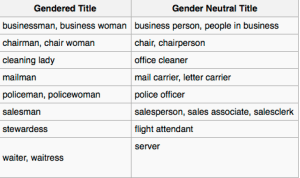
Gender Neutral Occupational Titles

Gender Neutral Occupational Titles

These findings suggest that countries that favor policies to reduce disparate earnings by gender can enable this goal by providing early training to set children’s expectations of gender equality, particularly in countries using a gendered language,

-*To what extent has your workplace adopted gender-inclusive language?

-*How does your organization’s use of gendered language relate to its wage parity practices?

Related Posts:

Twitter:  @kathrynwelds
Google+
Facebook

©Kathryn Welds

“Honest Confidence” Enables Performance, Perceived Power

Confidence mobilizes people’s performance and increases others’ perceptions of competence, likeability, and persuasiveness – but may lead to careless errors that undermine performance.

David Dunning

David Dunning

Women and men show significantly different levels of confidence, with cascading effects on performance and participation in specific occupations.

For example women tend to underestimate their performance in scientific reasoning, but actually perform about equally to men, found Cornell’s David Dunning and Washington State University psychologist Joyce Ehrlinger in their investigation of women’s low representation in Science, Technology, Engineering, and Mathematics (STEM) academic programs and work roles.
They concluded that women underestimate their performance, based on lower levels of confidence.

Joyce Ehrlinger

Joyce Ehrlinger

In a related tasks, Dunning and Ehrlinger invited these volunteers to participate in a science competition for prizes.
Women were less likely to accept the invitation than men, also attributed to lower confidence in their capabilities in scientific tasks.
The researchers pointed to low confidence as a source of women’s proportionally lower participation in Science, Technology, Engineering, and Mathematics (STEM) job roles.

Jessica Kennedy

Jessica Kennedy

Confidence – even unjustified confidence – seems to lead  observers to perceive assured individuals as competent, high status leaders, found Wharton’s  Jessica A. Kennedy, Cameron Anderson of University of California at Berkeley, and Don A. Moore.

Cameron Anderson

Cameron Anderson

They asked more than 240 students to estimate their confidence in identifying “historical” names and events, which included real and bogus entries.
Some participants said they could identify items that were actually fake, indicating that they believed – or wanted to convey – they knew more than they actually did.

Don A Moore

T Don A Moore

Then, Kennedy and team asked participants to rate each other based on status in the group.
Volunteers who said they could identify the most fraudulent items were rated as most prominent in the group, suggesting that confidence, even false confidence, contributes to perceived status.
The team suggested that overconfident volunteers genuinely believed their self-assessments, their confidence persuaded their peers of their task skill and commitment to the group’s success.

Ernesto Reuben

Ernesto Reuben

Honest overconfidence,” was also observed by Ernesto Reuben of Columbia, Paola Sapienza of Northwestern University, and University of Chicago’s Luigi Zingales, in their finding that men rated their performance on a set of math problems to be about 30 percent better than it was, whereas women underestimated their performance.

Carol Dweck

Carol Dweck

The power of honest and unjustified confidence may be rooted in childhood socialization patterns, observed Stanford’s Carol Dweck:  Boys’ mistakes are attributed to a lack of effort (whereas)…girls … see mistakes as a reflection of their deeper qualities.”
These different types of feedback lead men to attribute negative outcomes to external factors like unfairly difficult task, but women attribute undesirable results to their personal qualities like low ability.

Confidence is reflected in employees’ willingness to speak in work settings, and those who speak more than others are considered dominant.
However, women who exert authority by speaking more than others, even when they are in senior organizational levels, may alienate others and be seen as less capable.

Victoria Brescoll

Victoria Brescoll

Yale’s Victoria Brescoll found that even senior-level women hesitate to speak as much senior-level men due to anticipated negative reaction from others.

These concerns were validated by Brescolls investigation of men’s and women’s rating of a fictitious female CEO who talked more than other people.
Both women and men evaluated the female CEO as significantly less competent and less suited to leadership than a male CEO who talked for the same amount of time.
However, when the female CEO was described as talking less than others, participants rated her as significantly more competent.

Roger Shepard

Roger Shepard

Similarly, a high-power male who talked much less was evaluated as incompetent and undeserving of leadership, just like the high-power female who spoke more than average.
Brescoll suggested that these reactions are associated with stereotypic gender expectations.

Roger Shepard-Jacqueline MetzlerAs a result, women are unlikely to increase confidence, perceived status and power by speaking and behaving like men because this approach would violate gender stereotype expectations, leading to a “backlash” effect.

Zachary Estes

Zachary Estes

However, when women are “primed” to experience confidence, they performed better on 3D rotation spatial tasks in Roger Shepard and Jacqueline Metzler’s Mental Rotations Test, reported University of Warwick’s Zachary Estes and Sydney Felker, then of University of Georgia Health Center.

In one set of tests, women and men performed similarly when women and men again completed each item and reported their:
Confidence level in their answers,
-Whether they would change their responses if given the opportunity.

Women’s performance dropped below previous scores whereas men’s increased significantly when they elected to change answers.
Second-guessing” and “over-thinking” eroded women’s confidence which affected their scores.

Albert Bandura

Albert Bandura

People who have a strong sense of efficacy focus their attention on analyzing and figuring out solutions to problems, whereas those beset with self-doubts of their efficacy tend to turn their attention inwardly and become self-preoccupied with evaluative concerns when their efforts prove unsuccessful,” explained Stanford’s Albert Bandura and Forest Jourdan.

Robert K Merton

Robert K Merton

However, both men and women significantly improved their scores after they were told that they achieved high scores on the previous test irrespective of actual score.
This finding demonstrates the performance-enhancing effect of positive expectancy, and replicated “The Rosenthal Effect,” or “self-fulfilling prophecy,” described by Robert K. Merton of Columbia.

Jeffrey Vancouver

Jeffrey Vancouver

Confidence may have performance-eroding effects despite much previous research documenting performance-enhancing effects, according to Ohio University’s Jeffrey Vancouver and Charles Thompson, with University of Cincinnati’s E. Casey Tischner, and Dan Putka of Human Resources Research Organization.

Dan Putka

Dan Putka

They primed confidence or “self-efficacy” among half the participants in an analytic game, and found that those who received positive feedback about their performance didn’t perform as well in the next game, and were more likely to make logical errors.

Vancouver and team suggested that participants whose confidence was artificially-inflated tended to apply less mental effort to challenging tasks before attempting the next item.

Fortunately, actual skill trumps inflated confidence.
Women considering technical training and careers may be reassured by Kennedy and team’s observation that, “…Acting capable was beneficial, but actually being capable was better.”

However, these findings suggest that women aspiring to STEM careers are likely to be more effective when they create a “hybrid” style of communication and professional presence, drawing on behaviors that demonstrate confidence, competence, and proactivity without violating gender-linked expectations.

-*How do you capitalize on the performance-enhancing effects of confidence without alienating others or reducing future performance efforts?


RELATED POSTS:

©Kathryn Welds

Price of Job “Flexibility” for Women: Lower Salaries

Claudia Goldin

Claudia Goldin

Women in professions noted for their schedule and location “flexibility” are shortchanged with smaller paychecks than men in equivalent roles, according to Harvard’s Claudia Goldin.
She analyzed higher-paying occupations, and validated the frequently-cited finding that women earn an average of 71 percent of men’s wages after controlling for age, race, hours and education.

In addition, Goldin found significant differences related to flexibility in work schedule or location or ability of colleagues to substitute for each other.
For example, women financial specialists earned 66 percent of men’s pay in the same field, but women pharmacists earned 91 percent of their male colleagues’ salaries.  Goldin-Womens salaries as percentage of mens

Comparable salaries were reported for male and female tax preparers, ad sales agents and human resources specialists, attributable to workers’ ability to substitute for each other.
Among medical professions, obstetricians and “hospitalists” have introduced “interchangeability” with trusted colleagues.

This difference is explained by higher pay for roles that require longer hours, physical presence for “office face time,” and 24×7 availability, known as “non-linear” occupations.

In these fields, like law and investment banking, women typically work fewer hours and earn less than men:  A lawyer who works 80 hours a week at a large corporate law firm earns more than double one who works 40 hours a week as an in-house counsel at a smaller business.

Francine Blau

Francine Blau

In contrast, women and men in “linear” occupations such as pharmacists, computer hardware engineers, and computer software engineers, report similar number of hours worked and earn equivalent incomes:  A pharmacist who works 40 hours a week generally earns double the salary of a pharmacist who works 20 hours a week, and as a result, the pay gap for pharmacists is one of the smallest.

Lawrence Kahn

Lawrence Kahn

The U.S. reports relatively larger gender-based pay gap than other advanced countries, found Cornell’s Francine Blau and Lawrence M. Kahn, and they attributed this wage disparity to “the very high level of U.S. wage inequality.

Uri Gneezy

Uri Gneezy

Another explanation for this discrepancy was that men in competitive environments improve their performance, but when women’s performance remains about the same as in non-competitive situations with they challenge men, reported University of California San Diego’s Uri Gneezy, Muriel Niederle of Stanford and Aldo Rustichini of University of Minnesota.

Muriel Niederle

Muriel Niederle

In contrast, women’s performance increased when they competed with women, suggesting that women are willing and able to compete, but may not experience the enhancing effect of the workplace “tournament.”  

Aldo Rustichini

Aldo Rustichini

This gender difference in competitive environments may explain women’s under-representation in Science, Technology, Engineering, and Mathematics (STEM) academic programs and job roles.
Supporting this hypothesis is the finding that competition and lack of mentor and peer support are linked to women’s voluntary exit from engineering programs, according to Goodman Research Group’s Irene F. Goodman with Christine M. Cunningham and Cathy Lachapelle of Boston Museum of Science.

Irene Goodman

Irene Goodman

These organizational climate factors have been tied to decreased feelings of competence, confidence, and optimism, reported University of North Carolina’s Beril Ülkü-Steiner and Beth Kurtz-Costes, with C. Ryan Kinlaw of Marist College, and these can undermine women’s work performance.

 Beth Kurz-Costes

Beth Kurz-Costes

Wage parity is more likely for those who optimize performance during cross-gender competition and select roles with a high degree of “interchangeability” and “linearity” between hours worked and salaries.

C Ryan Kinlaw

C Ryan Kinlaw

Another solution for those who prefer to earn more than average for their occupation is to work longer hours and more continuously throughout their careers.

-*How can women increase performance with competing with men?

-*What occupations have a “linear” relationship between hours worked and compensation?

Follow-share-like http://www.kathrynwelds.com and @kathrynwelds

RELATED POSTS:

Twitter @kathrynwelds
BlogKathryn Welds | Curated Research and Commentary

Google+
Facebook Notes

©Kathryn Welds