Category Archives: Leadership

Leadership

Role Pioneers May Encounter “The Glass Cliff”

Sally Ride

Sally Ride

Marissa Mayer

Marissa Mayer

Holding a role usually occupied by the other gender can lead to significant media coverage, such as Sally Ride’s selection as an astronaut or Marissa Mayer’s appointment as CEO of Yahoo while in the later stages of her first pregnancy.

However, incumbents of roles usually held by people of the other gender can evoke harsh judgments about competence and suitability for leadership roles, according to Yale’s Victoria Brescoll and Erica Dawson with Eric Luis Uhlmann of HEC Paris.

Victoria Brescoll

Victoria Brescoll

This effect was most noticeable when both male and female leaders in “gender-incongruous” roles made minor errors in experimental studies.
Both male and female evaluators judged minor mistakes as indicators of role incompetence when male and female leaders held jobs typically performed by the other gender.

Erica Dawson

Erica Dawson

Brescoll, Dawson and Uhlmann suggested that “gender-incongruous” roles are seen as “ambiguous” by observers, leading to uncertainty, and negative assessments to “restore implicit order.”
The team referred to this rater bias as the “glass cliff effect.”

The researchers concluded that “the high status and senior leadership achieved by both men and women in gender-incongruent roles is fragile, vulnerable and unstable.”

Eric Luis Uhlmann

Eric Luis Uhlmann

This effect may be due to both the role’s gender incongruity and high status.
An earlier blog post highlighted Alison Fragale’s demonstration that higher status individuals are judged more harshly than lower status people when they make the same mistakes.

Alison Fragale

Alison Fragale

Her team at University of North Carolina found that observers in two experiments attributed greater intentionality, malevolence, self-concern to the actions of high status wrongdoers – and recommended harsher punishment for the same actions that earned lower status people “the benefit of the doubt.”

Although Brescol, Dawson and Uhlmann did not offer recommendations to mitigate the risks of being a pioneer in holding non-traditional job roles, Fragale’s team found that high status wrongdoers could protect from the impact of subsequent mistakes by demonstrating, warmth and concern for others and engaging in charitable giving.

Other strategies to consider include:

  • Cultivating strong executive alliances and sponsorship
  • Assembling a risk mitigation team to provide expert messaging during a crisis, focusing on external attributions of the error
  • Balancing demonstrated competence with the “humanness” of a small error
  • Offering plans for future action unrelated to the error to demonstrate decisive leadership and action-orientation.

-*What approaches are most effective to mitigate “The Glass Cliff”?

RELATED POSTS:
Women’s Likeability – Competence Dilemma: Overcoming the Backlash Effect


©Kathryn Welds

Executives with Daughters and Sisters: More Generous?

Michael Dahl

Michael Dahl

Cristian Dezső

Cristian Dezső

Male CEOs paid employees more after the birth of their first child when it is a daughter, but paid employees an average of $100 less annually after the birth of a son, according to Michael Dahl of Aalborg University with University of Maryland’s Cristian Dezső and David Gaddis Ross of Columbia Business School in their study of more than 10,000 Danish companies between 1996 and 2006.

David Gaddis Ross

David Gaddis Ross

Female employees typically received higher wages after the birth the CEO’s first child of either gender, and were less adversely-affected than their male colleagues by wage decreases after the birth of CEOs’ children.

Paul Van Lange

Paul Van Lange

People with more sisters tended to show more generous “pro-social” behaviors in laboratory studies of 600 volunteers who played a simulation game requiring decisions about resource-sharing with strangers, according to Paul Van Lange of Free University in Amsterdam with colleagues Ellen De Bruin, Wilma Otten, and Jeffrey Joireman of Washington State University.

Jeffrey Joireman

Jeffrey Joireman

Alice Eagly at Northwestern University suggests that men with sisters are significantly more likely to help others, based on her meta-analysis of 172 research studies.

Alice Eagly

Alice Eagly

In addition, she noted that men tend to help women more than other men.

Men behaved more generously when the cost was minimal in a modified dictator game, according to James Andreoni at the University of California, San Diego and Lise Vesterlund at the University of Pittsburgh.

James Andreoni

James Andreoni

In contrast, they noticed that women demonstrated greater generosity when the cost was high.

Lise Vesterlund

Lise Vesterlund

Andreoni and Vesterlund suggest that men are more responsive to price changes when mens “demand curves for altruism” cross those of women.
As a result, in this lab simulation, men behaved either extremely generously or selfishly, but women shared gains more equally.

Women’s direct presence on corporate boards – rather than their influence as sisters or daughts –  was correlated with increased economic value, according to Dezső  and Ross’s evaluation of the S&P 1,500 firms’ financial performance between 1992 and 2006.
Boards that included women generated an average of 1 percent more economic value – more than $40 million each – when the firm’s strategy is focused on innovation.

-*What corporate impact have you seen of male executives with daughters and sisters?

RELATED POSTS

Twitter:    @kathrynwelds
Blog: – Kathryn Welds | Curated Research and Commentary
Google+
LinkedIn Open Group Psychology in Human Resources (Organisational Psychology)
Facebook Notes:

©Kathryn Welds

Leadership Roles Reduce Perceived Stress

Animal studies suggest that high status roles are associated with lower stress levels, but fewer human studies that show a causal connection between status and health.

Hannah Kuper

Hannah Kuper

Geoffrey Rose

Geoffrey Rose

The longitudinal Whitehall Studies of British Civil servants suggest that lower status individuals had higher stress and poorer health outcomes that higher status workers, according to Geoffrey Rose of London School of Hygiene and Tropical Medicine and University College London’s  Hannah Kuper and Michael Marmot.

Columbia University’s Modupe Akinola collaborated with Wendy Berry Mendes of the University of California, San Francisco, to re-examine the relationship between organizational status and health outcomes.

Michael Marmot

Michael Marmot

Akinola and Mendes asked police officers to rate their status relative to their colleagues and to other people in the United States.
Then, each volunteer participated in a stressful role-play used by many police departments to help decide which officers should get a promotion.

In this scenario, the officer was asked to placate a disgruntled citizen, played by an actor, who claimed that another officer had verbally and physically abused him.

Modupe Akinola

Modupe Akinola

Researchers measured each heart rates, blood circulation, and testosterone levels as measures of “thriving” stress response or “adaptive” stress response to the role-play.

Officers’ perceptions of their social status were significantly associated with their style of stress response.
Those with higher self-perceived status were more likely to have an adaptive stress response.

Wendy Berry Mendes

Wendy Berry Mendes

In a related study, Akinola and Mendes placed civilian volunteers in high-status or low-status roles to play a complicated, fast-paced video game with a partner.
The researchers again measured participants’ cardiovascular responses and testosterone levels during the task.
Findings with civilians mirrored those with police officers:  Participants placed in the higher-status leader role had more adaptive hormonal and cardiovascular reactions during the high-pressure task.

Those assigned higher status leader roles:

  • Performed more quickly and accurately than supporters
  • Allocated more resources to their partners
  • Expressed more positive perceptions of partners.

Opposite trends prevails for those in lower-status supporter roles:   They had less adaptive responses to the stressful task, did not perform as well on the task, and evaluated the leader more negatively.

Akinola and Mendes suggest that managers may be able to mitigate these negative effects of followership by suggesting paths to workplace advancement.

However, some individual contributors may be more interested in flexible work practices, salary, and time off, than career advancement.
Managers may foster greater employee engagement by tailoring rewards and recognitions to individual priorities.

-*How are role status and stress levels related in your work environment?

RELATED POSTS:

©Kathryn Welds

Power of “Powerless” Speech, but not Powerless Posture

Assertive speech is assumed to signal competence and power, pre-requisites to status, power, and leadership in the U.S. workplace.

Alison Fragale

Alison Fragale

However, University of North Carolina’s Alison Fragale demonstrated that warmth trumps competence in collaborative team work groups.

Fragale studied “powerless speech,” which has been believed to make a person seem tentative, uncertain, and less likely to be promoted to expanded workplace roles.
She defined “powerless speech” as including:

  • Hesitation: “Well” or “Um”, as known as “clutter words”
  • Tag questions: “Don’t you think?”
  • Hedges: “Sort of” or “Maybe”
  • Disclaimers: “This may be a bad idea, but … “
  • Formal addresses:“Yes, sir” or “Yes, ma’am”

In collaboration-based work teams, “powerless” speech characteristics are significantly associated with being promoted, gaining status and power.
Interpersonal warmth and effective team skills are valued more than dominance and ambition by team members and those selecting leaders for these teams.

Paul Hersey

Paul Hersey

In contrast, “powerful” speech does not feature these characteristics, is more effective when the task or group is independent and people are expected to work alone.

Ken Blanchard

Ken Blanchard

As in Paul Hersey and Ken Blanchard’s Situational Leadership, Fragale concludes that communication style should be tailored to group characteristics.

Li Huang

Li Huang

Likewise, INSEAD’s Li Huang  and Columbia’s Adam Galinsky with Lucia Guillory of Northwestern University demonstrated the impact of “powerful” body language – also called “playing big” –  on perceived power.

Adam Galinsky

Adam Galinsky

Although assuming “larger” postures is associated with credibility and authority, some situations benefit from assuming “smaller”, less powerful postures to establish warmth or to acknowledge another’s higher status.

Lucia Guillory

Lucia Guillory

As noted in an earlier post, Women Get More Promotions With “Behavioral Flexibility”, careful self-observation and behavioral flexibility based on situational requirements are effective foundations to establish group leadership.

-*How do you monitor and adapt “powerless” speech to work situations?

RELATED POSTS:

©kathrynwelds

Productivity and Work Motivation Affected by Meaning, Challenge, Mastery, Ownership

Small gestures and verbalizations by managers and organizations can have a large impact on employee productivity, motivation, engagement, and retention – for better or worse.

Dan Ariely

Dan Ariely

Dan Ariely’s research at Duke University showed the small changes in task design dramatically increase or diminish persistence, satisfaction, and commitment to tasks.

The good news is that by simply looking at something that somebody has done, scanning it and saying ‘uh huh,’ [you] dramatically improve people’s motivations…. The bad news is that ignoring the performance of people is almost as bad as shredding their effort in front of their eyes. …,” according to Ariely.

Ariely’s lab experiments found that volunteers valued and liked their work product more when they worked hard and managed obstacles to produce it.
In addition, most people believed, often inaccurately, that other observers shared their positive view of their work product,

His research concluded that people seek meaning, challenge, and ownership in their work, and that these elements can increase work motivation and persistence.

Viktor Frankl

Viktor Frankl

Holocaust survivor and psychiatrist Viktor Frankel articulated this existential perspective in his examination of the critical role that meaning played in the enabling survivors of concentration camp prisoners in Man’s Search for Meaning.

In the less extreme circumstances of the workplace, finding and assigning meaning to work efforts enables people to persist in complex tasks to achieve satisfaction in mastering challenges.

Rosabeth Moss Kanter

Rosabeth Moss Kanter

Harvard’s Rosabeth Moss Kanter concurred that both meaning and mastery are productivity drivers, and to these she added a social dimension, membership, and a distant runner-up, money.

Frederick Herzberg

Frederick Herzberg

In contrast, one of the early though leaders in business management, psychologist Frederick Herzberg, developed a classic formulation of motivational factors contrasted with “hygiene factors.”

Frederick Herzberg - Motivation-Hygiene factorsHis two-factor theory of motivation did not include meaning or money as driving job satisfaction or productivity.

Shawn Achor, formerly of Harvard, argues that happiness is the most important work productivity lever.

Shawn Achor

Shawn Achor

To support his contention, he cited research findings that happy workforces increase an organization’s sales by 37 percent, productivity by 31 percent and accuracy on tasks by 19 percent.

Whether you work for mainly for meaning, money, or other motivations, you may agree that an ideal workplace and manager would foster all of these contributors to employee engagement and productivity.

-*What is the most important work motivator for you?
-*How have you seen managers increase employee engagement and performance through words and actions?

Related Posts

Twitter:  @kathrynwelds
Blog |Kathryn Welds| Curated Research and Commentary
Google+:
LinkedIn Open Group Psychology in Human Resources (Organisational Psychology)
Facebook Notes:

©Kathryn Welds

Interpersonal Envy in Competitive Organizations

Workplace envy is rarely discussed, although it is a logical outcome of competition for scarce resources:  Recognition, advancement, power, reputation, compensation in explicit or implicit organizational “tournaments.”

Jayanth Narayanan

Jayanth Narayanan

National University of Singapore’s Jayanth Narayanan, Kenneth Tai, and Daniel McAllister broached the near-taboo of workplace envy as an inevitable outgrowth of social comparison and related “cognitive dissonance” in attempting to self-regulate or return to emotional and equity “homeostasis.”

Daniel McAllister

Daniel McAllister

They differentiated malicious envy from benign envy and argue that the latter can drive performance through emulating admired outcomes.

This process, called firgun in Hebrew, is characterized by happiness, envy, and support of others, and is positively related to organizational success.
Mudita in Buddhist texts, refers to similar feelings of vicarious joy at another’s success and good fortune.

Hidehiko Takahashi

Hidehiko Takahashi

Narayan and team posit that envy is pain at another’s good fortune, and Hidehiko Takahashi’s team at Japan’s National Institute of Radiological Sciences demonstrated that the social-emotional pain of envy is a variation of the physical pain experience.

Their fMRI study found that the emotional pain of workplace envy is physically manifested in activation of the brain’s anterior cingulate cortex.

Nathan DeWall

Nathan DeWall

As such, Nathan DeWall of University of Kentucky and colleagues reported that Tylenol™ reduces behavioral and neural responses associated with social pain in two fMRI studies.

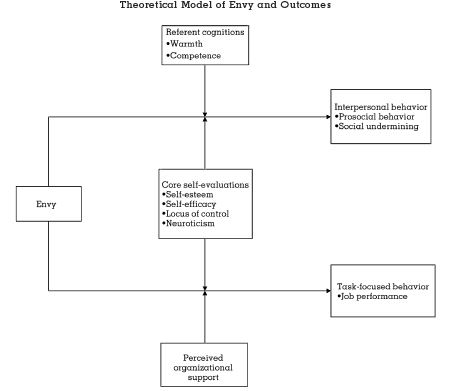
Narayanan argues that envy exerts its differential effect on workplace behavior through each individual’s specific:

  • Core self-evaluations (self-esteem, self-efficacy, locus of control, and neuroticism),
  • Referent cognitions” regarding warmth, likeability, and competence of the envied  person
  • Perceived organizational support

Workplace envy, they argue, can affect:

  • Social undermining
  • Prosocial behavior
  • Job performance

Narayanan and team proposed that those with higher self-esteem are less prone to negative workplace behaviors when experiencing on-the-job envy.

They propose that people are less likely to socially undermine the envied individual when the envied person is viewed as both warm-likeable and competent.

Similarly, they suggest that people who think their organization values them and their work, and supports their work and career development efforts are less likely to decrease job performance when envious at work.

Chade-Meng Tan

Chade-Meng Tan

Search Inside YourselfGoogle’s Jolly Good Fellow ChadeMeng Tan proposes the mindfulness-based program “Search Inside Yourself” (SIY) as a way to self-manage workplace envy and other painful social experiences, by developing skills in:

  • Trained attention
  • Self-knowledge and self-mastery
  • Creating useful mental habits.

-*How do you manage workplace envy when you notice it in yourself or others?

RELATED POSTS:

©Kathryn Welds

Gender Differences and Diversity in Corporate Interaction Styles, Financial Outcomes

Gender makes a difference in interaction styles on corporate boards, and the ratio of women to men on these boards is linked to corporate financial performance.

Interaction Styles

Gregory McQueen

Gregory McQueen

Chris Bart

Chris Bart

McMaster University’s Chris Bart and Gregory McQueen of Western University of Health Sciences surveyed 600 board directors (75% male) and found that men tended to base corporate decisions on tradition, rules, and regulations, whereas women tended to ask questions to develop more solution options, cooperate, and consider the interests of all stakeholders.

Nanette Fondas

Nanette Fondas

Nanette Fondas, then of Duke University, and Susan Sassalos, now of Edison International found that women on corporate boards influence other board members to act more “civilized” and “sensitive to other perspectives.”

Val Singh

Val Singh

In the same vein, Cranfield University’s Val Singh reported that women on corporate boards also reduce ‘game playing’ among board members.

Siri Terjesen

Siri Terjesen

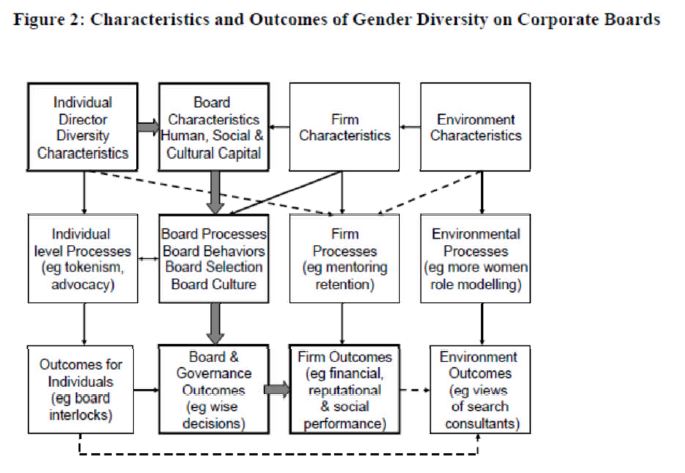
With Siri Terjesen of Indiana University and Cranfield University’s Ruth Sealy, Singh evaluated existing research on corporate board gender diversity to develop a model of analysis by:Val Singh - Gender Diversity on Corporate Boards Model

  • Individual
  • Board
  • Firm
  • Industry and Environment

Financial Performance:

Nancy Carter

Nancy Carter

Catalyst’s Nancy Carter and Lois Joy with Harvey Wagner of University of North Carolina and Michigan State University’s Sriram Narayanan found that Fortune 500 boards with 3 or more women report:

Harvey Wagner

Harvey Wagner

compared to boards with more men.

Nick Wilson

Nick Wilson

Nick Wilson and Ali Altanlar of Leeds University added another financial indicator affected by gender ratios on boards.

Ali Altanlar

Ali Altanlar

In their analysis of 17,000 UK companies that went insolvent in 2008, Wilson and Altanlar reported even one female board director reduces bankruptcy risk by 20%.

Pepperdine University’s Roy D. Adler studied 200 companies among the Fortune 500 to mine data from 1980 through 2001 and reported results consistent with the Catalyst investigation.

Roy Adler

Roy Adler

Adler and team identified the firms that had a record of promoting women to high levels and compared their profit performance to the median performance of Fortune 500 firms in the same industries.

The researchers separately compared profits as a percentage of sales, of revenues and of assets and found that for 2001, the 25 firms with the strongest record of promoting women to high organizational levels outperformed the industry medians with:

  • 34 percent higher revenue
  • 18 percent higher assets
  • 69 percent higher equity.

The 10 firms with the very best records of promoting women showed greater profits than competitors, and results were confirmed in subsequent studies in 2004 through 2008.
Adler and team noted that the odds of all 18 financial measures favoring women are 262,114 to 1, suggesting that these findings were not random errors.

Cristian Dezso

Cristian Dezso

Likewise, University of Maryland’s Cristian Dezső and David Ross of Columbia University found that companies with one or more women in top management  close to CXO level perform better than other companies, based on their assessment of the largest 1,500 public US companies from 1992 to 2006.

Sheryl Sandberg

Sheryl Sandberg

Sheryl Sandberg isn’t the only one to ask “Why so few?” in corporate and government leadership roles, particularly when these results consistently point to the financial benefits of more women in top decision-making roles.

AAUW

AAUW

American Association of University Women asked the same question about women in Science, Technology, Engineering, and Mathematics roles, and concluded that there remains a large gap in equal gender representation in leadership roles and in technical careers – and this discrepancy comes at the price of financial performance and organizational climate.

  • Where have you observed work group interaction differences depending on the ratio of women?
  • What financial impacts have you observed for organizations with women in top leadership roles?
    Level of Analysis Model

RELATED POSTS:

Twitter: @kathrynwelds
Google+
Blog
: – Kathryn Welds | Curated Research and Commentary 
LinkedIn Open Group Psychology in Human Resources (Organisational Psychology)
Facebook Notes:

©Kathryn Welds

ROI of Effective Managers

Dilbert and Pointy-Haired Boss

Dilbert and Pointy-Haired Boss

Inept managers cause stress, cynical posting of Dilbert cartoons, and foment incredulous recounting of unparalleled cluelessness.
However, the all-too-rare effective manager delivers a creditable Return on Investment.

Edward Lazear

Edward Lazear

Stanford’s Edward Lazear and Kathryn Shaw collaborated with Christopher Stanton, now of of University of Utah to study the impact of nearly 2000 supervisors on more than 23,000 employees’ output productivity in a large  services firm.

Kathryn Shaw

Kathryn Shaw

They found that although there is substantial variation in managerial quality, as measured by their effect on worker productivity, the skillful managers in this workplace improved productivity by 10 percent.

Christopher Stanton

Christopher Stanton

Lazear, Shaw and Stanton demonstrated that replacing managers rated in the lower 10% of boss quality by employee output with managers in the upper 10%, the resulting increase in team total output is about the same amount as adding one worker to a nine member team.

In addition, effective managers are associated with increased productivity among both top-rated workers and the lowest-performing workers, with greater performance increases among the firm‘s top performers.

The researchers noted that employees’ peers had negligible impact on productivity measures, so they concluded that productivity increases are significantly influenced by managerial behaviors.

These findings point to the importance of hiring skilled managers and improving or removing unskilled managers to drive productivity and associated profit.

As a result, pre-employment assessment and managerial training industries are required to demonstrate efficacy in selecting already-skilled managers, and transforming less-skilled managers into top performing supervisors.

Some argue that developing managerial skill is a long-term behavior change because many of the interpersonal behaviors of effective managers have long-standing characterological roots.

For example, Lazear reported that the best managers in this large sample demonstrated humility and a sense of humor in their efforts to teach and motivate employees.
These attitudes develop over years, and may not be amenable to short-term training interventions.

Randy Hodson

Randy Hodson

Randy Hodson of Ohio State University conducted an ethnographic study of “worker citizenship behavior”, including level of work effort, absenteeism, and employee engagement.

He found “manager citizenship behavior” has the greatest impact on employee engagement, work effort, and employee’s related productivity.
These management behaviors include:

  • Leadership practices
  • Communication style
  • Commitment to worker job security
  • Providing appropriate work supplies and tools to achieve workers’ output requirements
  • Absence of “management abuse.”

Managers who respected worker rights and maintained an effective, productive environment for workers  had workers who invested more efforts in work and achieved greater productivity, besides having a better relationship with each other and with bosses.

Watson Wyatt TowersWatson Wyatt’s WorkUSA 2009 survey of 13,000 full-time U.S. workers across all job levels and in all major industries that organizations with highly engaged employees had:

The report found waning employee engagement over job tenure:  Employee engagement is highest in the first six months on the job, and is more than 11 percent higher during that “honeymoon period” than for longer-tenure employees.
Employee engagement drops nine percent after the first six months on the job, and continues to decline.

Watson Wyatt’s regression analysis of these data found that this 11% decline in employee engagement has the same expected impact on employee productivity as a decline of assets per employee of nearly 0.6 percent.

To offset the impact on productivity, a typical firm would need to invest more than $2,700 per employee.

A similar regression analysis controlled for industry, firm size and capital intensity and estimated that 11% decline in engagement is associated with a 1.7 percent reduction in market value.
For the typical S&P 500 firm, this decreased expected market value could be $216 million, suggesting that managerial behavior is a critical determinant of productivity and ultimate market value.

The challenge for top management is to evaluate sustained improvement in managerial behavior attributable to managerial learning and development interventions, to ensure Return on Investment for managerial development.

-*What managerial attitudes and behaviors have you seen increase employee productivity?

Related Post

Twitter:  @kathrynwelds
Google+:
Blog: – Kathryn Welds | Curated Research and Commentary
LinkedIn Open Group Psychology in Human Resources (Organisational Psychology)
Facebook Notes:

©Kathryn Welds

Mastering the Power Sandwich with Skillful Upward Influence

David Bradford

David Bradford

Employees’ advancement in organizations is based on preventing problems before they develop, and pre-emptively uncovering opportunities to add value, according to Stanford’s David Bradford and Allan R. Cohen of Babson College in Influencing Up.

Allan Cohen

Allan Cohen

Complementing their Influence without Authority, they distilled common-sense win-win approaches to influence those over whom one has no formal authority or control: one’s manager and others higher in the hierarchy.

Influencing UpOrganizational power discrepancies can be accentuated when the employee is female or a member of a minority group.
Cohen and Bradford’s suggest six elements to reduce power differences, and improve influence and negotiation outcomes:

  • Clarify needs and priorities
  • Consider others as potential partners rather than adversaries
  • Establish trustworthiness by sharing information and develop understanding of the other’s perspective, concerns, and “care-abouts” — empathy in a business setting
  • Determine reciprocal value exchange in “currencies” that matter to others: information, budget, removing obstacles, brokering agreements, support
  • Gain access to others by showcasing your potential value exchange
  • Negotiate a win-win outcome
Robert Cialdini

Robert Cialdini

Bradford and Cohen’s work complements influential research by Stanford colleagues Margaret Neale and Deborah Gruenberg, as well as Robert Cialdini’s classic investigation of influence.

Roger Fisher

Roger Fisher

William Ury

William Ury

Their emphasis on crafting a win-win negotiated outcome echoes earlier work by Roger Fisher and William Ury in Getting to Yes and Linda Babcock’s consideration of negotiation challenges faced by women and minority group members in the workplace.

-*How do you manage the Power Sandwich, requiring skillful 360 degree influence in your organization?

Related Posts:

Twitter:  @kathrynwelds
Google+:
Blog: – Kathryn Welds | Curated Research and Commentary
LinkedIn Open Group
Facebook Notes:

©Kathryn Welds

Women Hedge Fund Managers Outperform Male Counterparts

Meredith Jones

Meredith Jones

Meredith Jones of Rothstein Kass, reported  that female hedge fund managers significantly outperform their male counterparts in Women in Alternative Investments: Building Momentum in 2013 and Beyond .
In the third quarter of 2012, women scored a net return of 8.95% compared to a 2.69% net return overall on the HFRX Global Hedge Fund Index.

Given women’s superior contribution to profitability, they would seem qualified for leadership roles in organizations seeking to maximize financial returns.
However, women hold fewer than 20% of top jobs in “alternate investment” organizations, according to 366 senior women in hedge funds, private equity, and venture capital.

Respondents attribute this low representation of women in executive roles to:

  • Low interest in remaining in this “alternate investment” sector due to limited opportunities for work-life balance.
    More than 18% of respondents said they wanted to work part-time or flex-time.
  • Few positions available for skilled women to establish a strong performance record.

Similar issues were discussed in Women’s Post-Business School Work-Life Issues .

Jones of Rothstein Kass suggested that some of women’s effectiveness is based on their greater patience and risk-averseness so they are “…potentially better able to escape market downturns and volatility.”

She continued, “…if women do in fact have a different, more risk-averse investing profile, then at least theoretically, their returns, particularly in difficult markets, should be higher than those of their male counterparts.”  

Kelly Easterling

Kelly Easterling

Kelly Easterling and Camille Asaro, also of Rothstein Kass, contributed to the report, which found women’s assessment of their most important professional assets:

  • Professional networks
  • Strong personal and support networks
  • Strategic career planning
  • Willingness to take considered risks
Jean Brittingham

Jean Brittingham

Jean Brittingham of The Smart Girls Way posited additional correlates of women’s effective financial performance:

  • Systems-thinking skills
  • Seeking balance between work and life
  • Caring more about solutions than who gets credit
  • Strong collaboration competencies
  • Persistence when “passionate about something”
Camille Asaro

Camille Asaro

The Rothstein Kass report noted that some U.S. states have mandates for diversity in their asset management firms, and observed an increase in state public pension plans with stated or implied preference for women-owned investment managers.

-*In which industries have you observed women delivering equal or better results than male counterparts?

Related posts

Twitter:  @kathrynwelds
Google+
Blog: – Kathryn Welds | Curated Research and Commentary 

LinkedIn Open Group Psychology in Human Resources (Organisational Psychology)
Facebook Notes

©Kathryn Welds