Category Archives: Resilience

Resilience

Leadership Roles Reduce Perceived Stress

Animal studies suggest that high status roles are associated with lower stress levels, but fewer human studies that show a causal connection between status and health.

Hannah Kuper

Hannah Kuper

Geoffrey Rose

Geoffrey Rose

The longitudinal Whitehall Studies of British Civil servants suggest that lower status individuals had higher stress and poorer health outcomes that higher status workers, according to Geoffrey Rose of London School of Hygiene and Tropical Medicine and University College London’s  Hannah Kuper and Michael Marmot.

Columbia University’s Modupe Akinola collaborated with Wendy Berry Mendes of the University of California, San Francisco, to re-examine the relationship between organizational status and health outcomes.

Michael Marmot

Michael Marmot

Akinola and Mendes asked police officers to rate their status relative to their colleagues and to other people in the United States.
Then, each volunteer participated in a stressful role-play used by many police departments to help decide which officers should get a promotion.

In this scenario, the officer was asked to placate a disgruntled citizen, played by an actor, who claimed that another officer had verbally and physically abused him.

Modupe Akinola

Modupe Akinola

Researchers measured each heart rates, blood circulation, and testosterone levels as measures of “thriving” stress response or “adaptive” stress response to the role-play.

Officers’ perceptions of their social status were significantly associated with their style of stress response.
Those with higher self-perceived status were more likely to have an adaptive stress response.

Wendy Berry Mendes

Wendy Berry Mendes

In a related study, Akinola and Mendes placed civilian volunteers in high-status or low-status roles to play a complicated, fast-paced video game with a partner.
The researchers again measured participants’ cardiovascular responses and testosterone levels during the task.
Findings with civilians mirrored those with police officers:  Participants placed in the higher-status leader role had more adaptive hormonal and cardiovascular reactions during the high-pressure task.

Those assigned higher status leader roles:

  • Performed more quickly and accurately than supporters
  • Allocated more resources to their partners
  • Expressed more positive perceptions of partners.

Opposite trends prevails for those in lower-status supporter roles:   They had less adaptive responses to the stressful task, did not perform as well on the task, and evaluated the leader more negatively.

Akinola and Mendes suggest that managers may be able to mitigate these negative effects of followership by suggesting paths to workplace advancement.

However, some individual contributors may be more interested in flexible work practices, salary, and time off, than career advancement.
Managers may foster greater employee engagement by tailoring rewards and recognitions to individual priorities.

-*How are role status and stress levels related in your work environment?

RELATED POSTS:

©Kathryn Welds

Juggling as Brain Training

The physical skill of juggling can change the brain’s structure and function for the better, and may be a recommended therapy for brain injuries.

Bogdan Draganski

Bogdan Draganski

Volker Busch

Volker Busch

Bogdan Draganski, now of University of Lausanne collaborated with University of Regensburg colleagues Volker Busch, Ulrich Bogdahn, and Gerhard Schuierer, and Arne May, now of University of Hamburg  with Christian Gaser of University of Jena, to visualize brain plasticity among volunteers who learned to juggle.

Ulrich Bogdahn

Ulrich Bogdahn

Volunteers showed transient and selective structural changes in the left parietal lobe’s posterior cortex  and bilateral central temporal areas brain, areas associated with processing and storing complex visual motion on used whole-brain magnetic-resonance imaging.

Gerhard Schuierer

Gerhard Schuierer

This study demonstrates that the brain’s macroscopic structure can change based on stimuli like juggling, rather than being limited to functional changes in the cortex.

Arne May

Arne May

May and Gaser collaborated with University of Hamburg colleagues Janina Boyke, Joenna Driemeyer, and Christian Büchel in related research.

Christian Gaser

Christian Gaser

This time, they trained 25 people with an average age of 60 years in juggling for 12 weeks, and 25 control group volunteers were not trained.

Christian Büchel

Christian Büchel

The team conducted three MRI brain scans for each participant:

  • Before juggling practice
  • After 3 months of juggling
  • After another 3 months of no juggling.

Jugglers showed significant increase in the brain’s “gray matter,” nerve cells’ bodies responsible for information processing, located in the hippocampus (memory formation), bilateral nucleus accumbens (reward systems that may lead to action) and visual cortext’s middle temporal area.

Without practice during the three months after the training, none of the volunteers retained their ability to juggle and their gray matter declined to pre-training levels.

This suggests the value of continued practice in physical and cognitive skills to maintain brain structure and function.

Jan Scholz

Jan Scholz

University of Oxford’s Jan Scholz, Miriam Klein-FlüggeTimothy E.J. Behrens, and Heidi Johansen-Berg extended this research to demonstrate that people who learn to juggle also increased “white matter” containing axons that connect different cells, not just gray matter.

 The Oxford team conducted baseline brain scans using diffusion tensor imaging to reveal  white matter structure for 24 young men and women volunteers, who later practiced juggling for half an hour a day for six weeks.

Miriam Klein-Flügge

Miriam Klein-Flügge

The researchers compared brain scans of 24 non-juggling volunteers and found that the volunteer jugglers increased white matter in the parietal lobe’s intraparietal sulcus, which integrates vision and reaching and grasping in the periphery of vision.
Even less-skilled jugglers had similar increases in white matter, attributed to amount of time devoted to practice.

Heidi Johansen-Berg

Heidi Johansen-Berg

In contrast, the non-jugglers showed no changes in white matter after the six week period, suggesting value in practicing juggling to develop the brain’s structure and functioning to enable rapid, coordinated movement and body positioning.

Brain scans taken after four weeks without juggling practice showed that the new white matter remained and the amount of gray matter increased, showing some skill retention in the absence of consistent practice.

-*What physical skills do you develop as brain training?

RELATED POSTS:

Twitter:    @kathrynwelds
Blog: Kathryn Welds | Curated Research and Commentary 
Google+:
LinkedIn Open Group Psychology in Human Resources (Organisational Psychology)
Facebook Notes:

©Kathryn Welds

Compassion Training Surpasses Empathy Training to Reduce Stress

Susanne Leiberg

Susanne Leiberg

Compassion training has positive effects on mood and health, and University of Zurich’s Susanne Leiberg, Olga Klimecki, Tania Singer demonstrated that it can actually change the brain’s functioning, and related emotions and behaviors.

Olga Klimecki

Olga Klimecki

Klimecki, Leiberg, Singer, now at Max Planck Institute collaborated with Claus Lamm of University of Vienna to examine the impact of compassion training on brain activity in response to observing another person’s distress.

Tania Singer

Tania Singer

A frequent experience in daily life, most people experience distress, or empathy, when observing another’s distress, due to activation of the brain’s “mirror” neurons.

Claus Lamm

Claus Lamm

In contrast, compassion is concern with others’ suffering coupled with the desire to alleviate the other person’s pain, and can exist without actually experiencing the other persons’ distress through empathy.

The researchers evaluated whether personal distress be transformed into compassion, a useful coping strategy for those in health care professions, and in caretaking roles.
They developed the Socio-affective Video Task to measure neural and subjective responses to witnessing the distress of others.

Most volunteers experienced initial empathic negative feelings and activations in the brain’s pain empathy areas, the anterior insula and anterior medial cingulate cortex, when they observed the distress of others.
However, the volunteers who completed compassion training experienced less negative emotion, and more positive feelings when witnessing others in distress, related to increased activity in brain areas associated with positive emotion and affiliation:  the medial orbitofrontal cortex, putamen, pallidum, and ventral tegmental area.

In contrast, control group volunteers who received memory training did not have more positive emotions, and participants in empathy training actually experienced more negative feelings.

The studies suggest that compassion training can be an effective coping strategy when observing or supporting others in distress, and the mental discipline of compassion training can increase positive emotion more effectively than memory training or empathy training.

Besides changing the brain and related feelings, compassion training triggered more “prosocial” behavior, including helping and cooperating.

This researcher team developed the Zurich Prosocial Game (ZPG) to validly assess helping behaviors in light of reciprocity, helping cost, and distress cues influences.
Volunteers who had received short-term compassion training increased their helping behaviors in the game, but this was not true for volunteers who received short-term memory training.

Charles Raison

Charles Raison

Emory University’s Charles Raison advocated compassion training as a better day to deal with “enemies,” whether globally or interpersonally.
He collaborated with Emory colleagues including Geshe Lobsang Tenzin Negi, who developed Cognitive-Based Compassion Training (CBCT) and Sheetal Reddy of Atlanta’s Children’s Healthcare of Atlanta, to evaluate the impact of compassion training with youth in foster care.

Geshe Lobsang Tenzin Negi

Geshe Lobsang Tenzin Negi

The team considered whether these participants, who had suffered maltreatment, experienced improved psychosocial functioning after twice-weekly Cognitive-Based Compassion Training (CBCT) for six weeks compared with young people assigned to the “wait-list-no treatment” group.

Researchers found no difference in measured functioning, but young people who practiced compassion more frequently reported greater hopefulness and ability to deal with life stressors, and decreased generalized anxiety.

These findings suggest that compassion training can improve stress management, mood, and cooperation.

-*How have you seen compassion training affect feelings and behaviors?

RELATED POSTS:

©Kathryn Welds


“Grit” Rivals IQ and EQ to Achieve Goals

Emotional intelligence has been demonstrated to be a better predictor of achievement and performance than measure of intelligence. 

Angela Duckworth

Angela Duckworth

One important component of Emotional Intelligence (EQ) is perseverance, the consistent, sustained and focused application of talent and effort over time, University of Pennsylvania’s Angela Duckworth.  

Christopher Peterson

Christopher Peterson

She refers to this perseverance and passion for long-term goals as “grit” in her research with West Point cadets and Scripps National Spelling Bee contestants, in collaboration with University of Michigan’ Christopher Peterson and Michael Matthews and Dennis Kelly of United States Military Academy, West Point.

Grit was not related to IQ but was highly correlated with “Conscientiousness,” a personality trait described in the Five Factor Model of Personality.
It was also a better predictor of “success” as measured by retention at West Point, and advancement in the National Spelling Bee.

Michael Matthews

Michael Matthews

In addition, “grittier” participants:

  • Achieved higher levels of education
  • Had fewer job switches and career changes
  • Earned higher school grades than their peers, despite having lower standardized test scores measuring intelligence and achievement
  • Devoted more hours to deliberate practice (defined as individual word study and memorization for spelling bee contestants).
Teri Kirby

Teri Kirby

K. Anders Ericcson

K. Anders Ericcson

The most effective deliberate practice was rated as the least pleasurable, and “grittier” individuals did more of this effort in Duckworth’s expanded study with Teri Kirby, Eli Tsukayama, Heather Berstein,  then of Penn with K. Anders Ericsson of Florida State University.

Heather Berstein

Heather Berstein

Practice activities rated as more pleasurable and less effortful, like reading for pleasure, being quizzed by their parents, contributed less to spelling performance.

Paul Tough

Paul Tough

Parents and educators found responded enthusiastically to Paul Tough’s popularized summary of “grit” research in his book advising parents and teachers how to help young people develop grit, curiosity, conscientiousness, and optimism.
He “gritty” attributes highly correlated with successful academic and career performance.

Duckworth expanded the investigation of grit to include “explanatory style”, seen in individuals’ propensity to explain events from optimistic or pessimistic perspectives.
Explanatory style is evaluated according to whether the individual considers event causes as:

  • Personal (Internal vs. External cause or influence)
  • Permanent (Stable vs. Unstable)
  • Pervasive (Global vs. Local/Specific)

Optimistic explanatory style is characterized by external, unstable, local / specific explanations, whereas pessimistic styles include internal, stable, global attributions.

Duckwork and team found that novice teachers with more optimistic explanatory styles rated themselves higher in both grit and life satisfaction, and these high ratings were associated with better work effectiveness, as evaluated at the end of the school year.

Eli Tsukayama

Eli Tsukayama

Katherine Von Culin

Katherine Von Culin

Her students, Katherine Von Culin and Eli Tsukayama “unpacked” grit and found different difference in motivation and beliefs for grit’s two components:  perseverance vs passion.
Among more than 300 volunteers, they found that perseverance and passion had different meaning, pleasure, and engagement orientations to happiness and implicit beliefs about willpower.

Carol Dweck

Carol Dweck

The research team is evaluating the relationship between “grit” and “growth mindset,” introduced by Stanford’s Carol Dweck to signify viewing failures and setbacks as opportunities to learn and improve, rather than a permanent lack of ability.

ell

ell

Dweck, with Lisa Blackwell, then of Columbia and University of Western Ontario’s Kali Trzesniewski demonstrated the impact of growth mindset and positive explanatory style on school motivation and achievement.

In addition, Duckworth and team are considering ability to delay gratification as a component of grit, since it has been associated with greater self-control and life accomplishment.

More grit may not always lead to greater accomplishment.
Duckworth and team speculate that grittier individuals may be:

  • More vulnerable to the “sunk-cost fallacy
  • Less open to information that contradicts their present beliefs
  • Handicapped by judgment and decision-making biases
  • Likely to new opportunities because they are tenaciously focused on the original goal.
Emilia Lahti

Emilia Lahti

Duckworth‘s colleague at Penn, Emilia Lahti is leading research on grit’s Finnish cousin, “Sisu,” implying perseverance, bravery and stamina, and should report her findings by the end of 2013.

Assess your “grittiness” with the research team’s survey.

-*How accurately does your score reflect your view of your grittiness, perseverance?

-*How do you develop grit in yourself and others?

RELATED POSTS:

Twitter:    @kathrynwelds
Blog: – Kathryn Welds | Curated Research and Commentary 
Google+:
LinkedIn Open Group Psychology in Human Resources (Organisational Psychology)
Facebook Notes:

©Kathryn Welds

Natural Environments Enhance “Vitality” and Reduce Stress

Vigor, enthusiasm, positive emotions, and calm energy are characteristics of “vitality,” and have been associated with improved health outcomes and stress management.

Richard Ryan

Richard Ryan

The subjective experience of “vitality” can be increased being outside, particularly in a natural environment, according to  by University of Rochester’s Richard Ryan and Louis Mistretta , Netta Weinstein, now of University of Essex,  McGill’s Jessey Bernstein and  Kirk Warren Brown  of Virginia Commonwealth University with Concordia’s  Marylène Gagné.

Netta Weinstein

Netta Weinstein

The team asked volunteers to complete surveys and diaries, in addition to participating in experiments comparing reactions to being outdoors vs indoors during physical activity and viewing nature scenes vs buildings on volunteers’ subjective “vitality.”

Jessey Bernstein

Jessey Bernstein

These five studies suggest the positive impact of being outdoors and around natural elements on subjective vitality, even when the effects of physical activities or social interactions are controlled.

Kirk Warren Brown

Kirk Warren Brown

Most office workers can attest to the team’s findings, that visiting nature has restorative, energizing effects, and enables a fresh perspective on challenges.
Nevertheless, most office workers have difficulty leaving work in leaving climate-controlled environments for much-needed breaks.

Marylene Gagne

Marylene Gagne

Weinstein and Ryan extended these findings with University of Essex’s Andrew Przybylski, and found that besides providing “vitality”, energy, and stress management, volunteers who were “immersed in natural settings” reported more caring, generous attitudes toward others.
They valued their aspirations to help and connect with others and make generous decisions more than self-interested aspirations for financial success and admiration.

Andrew Przybylski

Andrew Przybylski

Weinstein and team suggested that viewing and experiencing nature and natural settings increases individuals’ sense of personal autonomy to pursue interests while reducing pressures, fears, and social expectations.

These studies suggest the importance of scheduled outdoor breaks from work activities, and thoughtful urban planning that incorporates green spaces and natural environments:  “…full contact with nature can have humanizing effects….to the extent our links with nature are disrupted, we may also lose some connection with each other.”

-*How do you integrate exposure to outdoor and natural setting with your work day?

RELATED POSTS:

©Kathryn Welds

Cognitive Value of Handwriting in the Digital Era

-*Is handwriting passé in the Digital Era?
-*Has keyboarding eclipsed pen and paper?

Virginia Berninger

Virginia Berninger

University of Washington’s Virginia Berninger with Robert Abbott, Amy Augsburger, and Noelia Garcia argue that handwriting provides valuable cognitive training, and advantages in expressive speed, fluency, and productivity.

Robert Abbott

Robert Abbott

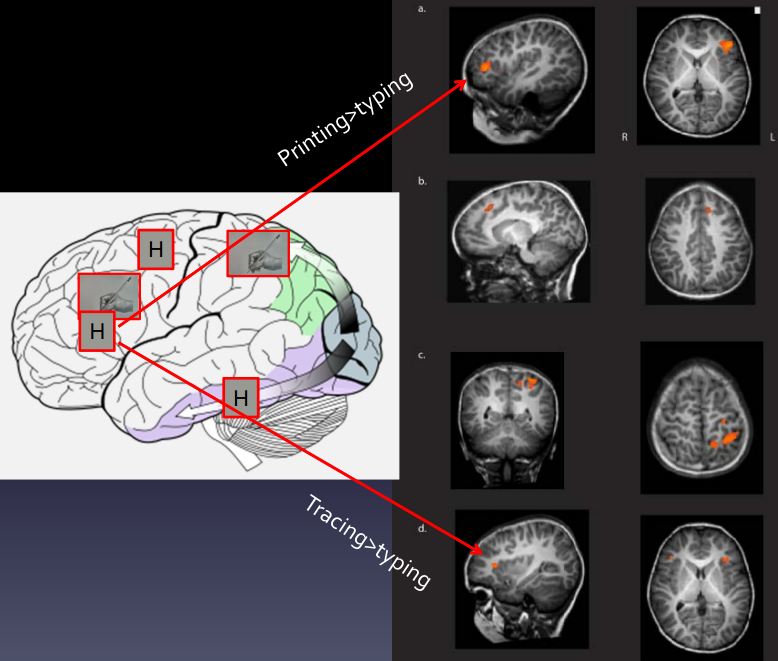
Berninger’s team conducted brain scans and found that the brain’s thinking, language, and “working memory” regions are more activated when handwriting letters than when typing.

This change in brain activation occurs because handwriting letters generally requires more than one sequential stroke, rather than selecting a letter key during typing, according to Berninger.

Berninger’s studies demonstrated students in grades two, four and six wrote more words more quickly and expressed more ideas when writing essays by hand versus with a keyboard.

Karin James

Karin James

Karin Harman James’s research using an fMRI at Indiana University confirms the benefits of handwriting.

Isabel Gauthier

Isabel Gauthier

With Isabel Gauthier of Vanderbilt University, she showed alphabet letters to children before and after they received letter-learning instruction.

Participants who practiced printing by hand showed more enhanced and “adult-like” the neural activity than those who had simply looked at letters.
James suggested that adults may show similar neural activity benefits when learning a new graphically-different language, such as Mandarin, or symbol systems for mathematics, music and chemistry.

Marieke Longcamp

Marieke Longcamp

Université de la Méditerranée’s Marieke Longcamp,  Céline Boucard, Jean-Claude Gilhodes and Jean-Luc Velay  with Jean-Luc Anton, Muriel Roth, and Bruno Nazarian of Hôpital de La Timone, Marseille, France demonstrated other neural benefits of handwriting: Movements memorized when learning how to handwrite enabled adults to more effectively recognize graphic shapes and letters.

Steve Graham

Steve Graham

Steve Graham, now of Arizona State University, with Michael Hebert, now of University of Nebraska, demonstrated that handwriting is still associated with improved classroom performance, even when most classrooms and students type on computers.

Sian Beilock

Sian Beilock

Besides enhancing academic achievement, writing can be a coping tool, according to University of Chicago’s Sian Beilock.
She reported that bright students managed test anxiety by writing about their anxieties to “off-load” them.

Jill Mateo

Jill Mateo

Beilock collaborated with Andrew Mattarella-Micke, Jill Mateo, Neil Albert and Katherine Foster of University of Chicago, and Vanderbilt University’s Marci DeCaro, Robin Thomas of Miami University, and Megan Kozak of Pace University to study students as they derived solutions to challenging math problems.

Robin Thomas

Robin Thomas

The team confirmed that those who performed well on the math problems said that they did not have math anxiety, whereas low performers said they were anxious about math performance.
A less expected finding was that both high performers and low performers had the stress hormone, cortisol, in their saliva.

Although both groups experienced measurable stress, the performance outcome was mediated by the calm or anxious “mindset,” suggesting that performance can be enhanced through managing anxiety and expectations.
Writing by hand helped participants boost performance by reducing anxiety and freeing  working memory to focus on the math problems.

P. Murali Doraiswamy

P. Murali Doraiswamy

Handwriting practice may be valuable for adults as well as children, according to P. Murali Doraiswamy of Duke University, who suggested that handwriting practice may be a useful treatment to stabilize cognitive losses in aging.

 -*How often do you use handwriting and printing instead of typing on a keyboard?

RELATED POSTS:

©Kathryn Welds

Equal Pay Act’s Fiftieth Anniversary: Progress but no Parity

Equal Pay Act 1963

Equal Pay Act 1963

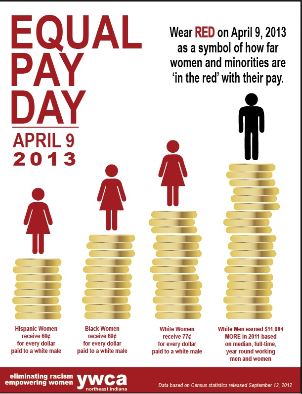
When U.S. President John F. Kennedy signed the Equal Pay Act in 1963, women earned 59 cents for every $1 earned by a man.

Today women are up to 77 cents on the dollar, according to the U.S. Equal Employment Opportunity Commission Chair Jacqueline Berrien.
She noted that the wage discrepancy is even larger for African American women and Latinas.

Jacqueline Berrien

Jacqueline Berrien

Women MBAs graduating from top U.S. business schools in 2012 fared slightly better than the national average, with 2012 Stanford alumnae earning just 79 cents for every $1 earned by a male grads, according to Bloomberg Businessweek’s annual surveys of 24,716 recent MBA graduates from each year’s top 30 U.S. business schools since 2002.
Given the substantial investment of time, money, and effort in obtaining these advanced degrees, women graduates may question this Return on Investment (ROI).

Women from the MBA classes of 2012 averaged 7.3 percent less than their male counterparts with average salaries of $105,059.
This wage disparity is more than triple the 2.2 percent gap women MBAs experienced in 2012 on average earnings of $83,404.

The survey considered pay differences by industries and found women lagged behind men in pay in eight of 11 sectors in 2012, including accounting, finance, marketing, and operations.
The gap has increased across industries since 2002, even in non-finance fields like information technology and entrepreneurship.

The largest pay differential was in highly-compensated financial fields like venture capital and private equity field, where women earned only 82.5¢ for every dollar men made — about 10 ¢ less on the dollar than in 2002.
In contrast, consulting offered the closest pay parity in 2012, with women earning 99¢ for every dollar of male classmates’ salaries.

Women earned more than men in three industries: human resources, non-profits, and investment banking.
The first two industries tend to attract more women and be lower-paid than other fields.

EEOCBerrien, of the EEOC, opined that with the current backsliding in parity progress, the gender pay gap is predicted to close in another 44 years, in 2057 — provided that there is no further deterioration of pay equity advancement.

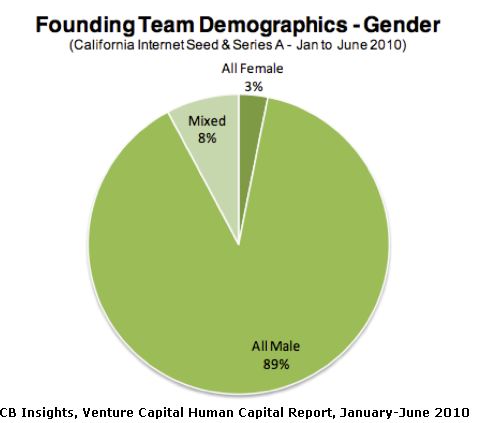
CB Insights reported that in California from January-June 2010:CI Insights Founder Gender - 2010

  • 89 percent of series A and seed-funded companies had all male founders, compared with only 8 percent that had founders of both genders, and just 3 percent of businesses with all female founders
  • 82 percent of company founders were white, compared to 18 percent that were Asian or Pacific Islander

Equal Pay DayThe 2013 Silicon Valley Index, compiled by economic think tank Joint Venture Silicon Valley found significant income disparities by race in addition to gender from 2009-2011:

  • African-American residents’ income dropped 18%, compared to a 4% decrease across the U.S.
  • Hispanic resident’ income decreased 5%, similar to the rest of California
Catherine Bracy

Catherine Bracy

Catherine Bracy observed that the average woman in Silicon Valley, California’s “economic powerhouse”, earns 49 cents for every dollar men make in Silicon Valley, when averaging incomes of African American and Hispanic women residents.

NerdWallet analyzed data from the U.S. Census for 366 metro areas to determine the lowest pay gaps for women in small, medium, and large cities, and concluded that on balance, Silicon Valley was one of the “best places for women to work.”

Wage discrepancy in one of the U.S.’s most economically viable areas, whether around the national average or well below, demonstrates that 50 years after the Equal Pay Act, the average female worker in the U.S. is far from earning an equal wage.

Happy Anniversary, Equal Pay Act of 1963, and Many Happy Returns of the day for at least 44 years, until women’s pay may be equal across industries and geographies.

RELATED POSTS:

Twitter:    @kathrynwelds
Blog: – Kathryn Welds | Curated Research and Commentary    
Google+:
LinkedIn Open Group Psychology in Human Resources (Organisational Psychology)
Facebook Notes:

©Kathryn Welds

Harvard B-School Women “Lean Out” of the Workforce?

First HBS Women

First HBS Women

Women were first admitted to Harvard Business School in 1963, and 50 years later, women are not 50% of the students at HBS.
They trail at 42% for the currently-admitted class, up from the 40% at the time of this survey.

Robin Ely

Robin Ely

Robin Ely of Harvard conducted a survey of of 3,786 women and 2,655 men HBS graduates and found that more than 70% of alumnae are in the paid workforce, and 56% work full time.

Of the 10% of alumnae ages 31 to 47 who “lean out” to care for children full time, only 3% said they planned not to return to return.

HBS 50Ely argues that rather than leaning out, women are actually pushed out or pulled out of the workforce:

“…a whole set of experiences … look less like women opting out, and more like women being pushed out, by organizations that demand a 24/7 work schedule…Women are being pulled out by a culture that promulgates a compelling—some might say guilt-inducing—image of mothering that is hard to live up to while you are trying to hold a job.”

Among women working part-time, three-fourths are engaged in pro bono and volunteer efforts, suggesting that these women continue to have demanding schedules.
More than 63% of the women report regular or significant volunteer commitments, with 67% of those caring for children full-time reporting substantial volunteer activity.

HBS WomenYounger women with two or more children are less likely to be in the workforce than those with no children: 37% for parents vs 9% for the non-parents.

And among the younger cohort of Gen X’ers, 13% of women are working part-time, contrasted with 2% of Gen X men.

At the other end of the age-experience spectrum, another type of “age-approriate opting out” was reported by 43% of female graduates ages 48-66 no longer working full-time.
In contrast, only 28% of men in the same age range were not longer employed, reinforcing previous findings that men work both more hours per year and more years over their careers, leading to higher overall career earnings.

More than 84% of female respondents acknowledged “taking leaves or reducing work hours” hold back women from career advancement.

HBS RestroomThe second most-cited impediment to career advancement for women was “prioritizing family over work,” according to 82% of the female respondents.

Most alumnae reported organizational factors limit women’s advancement:

  • Lack of senior female role models
  • Inhospitable corporate cultures
  • Lack of supportive environments

Fewer than half of the women under the age of 67 report being satisfied with their professional accomplishments or opportunities for career growth.
In contrast, the majority of men agree that their work is meaningful and satisfying.

Drew Gilpin Faust

Drew Gilpin Faust

Harvard’s President Drew Gilpin Faust noted that, women are not equally represented in top leadership roles, echoing statistics showcased by HBS grad Sheryl Sandberg.
She share that women:

  • Comprise 4 percent of Fortune 500 Company CEOs
  • Lead fewer than 10 percent of America’s venture capital firms
  • Hold 26 percent of US full professorships
  • Serve in 20 percent of top US government jobs
Sheryl Sandberg

Sheryl Sandberg

Ely believes that organizations, women, and families will benefit from recruiting and hiring women who have opted out of full-time work but now want to resume their careers, because today’s graduates can expect to live nearly a century.

This change in hiring practices can increase use of top talent while reducing the substantial regret and dissatisfaction many HBS women experienced in their career trajectories.

As one highly-educated, highly-skilled women reflected on her sense of under-utilization and under-employment in a large global organization: “I don’t want to have to go home and vacuum to feel like I’ve accomplished something.”

Organizational policy can increase firms’ profitability, competitiveness, and innovation by deploying top talent across generations and genders, and this HBS study points to one source of potential talent.

-*What actions should individual women and organizations implement to increase the utilization of skilled women’s talents in the workplace?

Related Post

Women’s Post-Business School Work-Life Issues

Twitter:  @kathrynwelds
Blog: Kathryn Welds |Curated Research and Commentary
Google+:
LinkedIn Open Group Psychology in Human Resources (Organisational Psychology)
Facebook Notes: 

©Kathryn Welds

Innovators’s Personality Characteristics and Shibumi Principles Drive Innovation

Øyvind Martinsen

Øyvind Martinsen

BI Norwegian Business School’s Øyvind Martinsen identified components of creative personalities as key attributes for innovative problem solving in business organizations.

Martinsen’s study of 481 people included two groups of students in creative fields: advertising and performing artists,  and a control group of lecturers and managers.

He found that creative individuals differed from the control groups in several dimensions:

  • Have an active imagination, “associative orientation”, an “experimental attitude”
  • Value originality, are comfortable rebelling against rules, standards, and systems
  • Demonstrate high motivation to succeed
  • Become absorbed in creative work
  • Are ambitious Desire recognition, fame
  • Adapt, reimagine, rebrand, and flex to meet current demands and realities
  • Express anxiety, worry, volatile emotions  
  • Demonstrate less concern, friendliness and sensitivity to others
  • Tend to be more critical of others

Martinsen says that a less creative individuals can increase this capacity when their work environments encourage rule-bending and free thought, so organizations can modify policies and practices to convey acceptance of exploration.

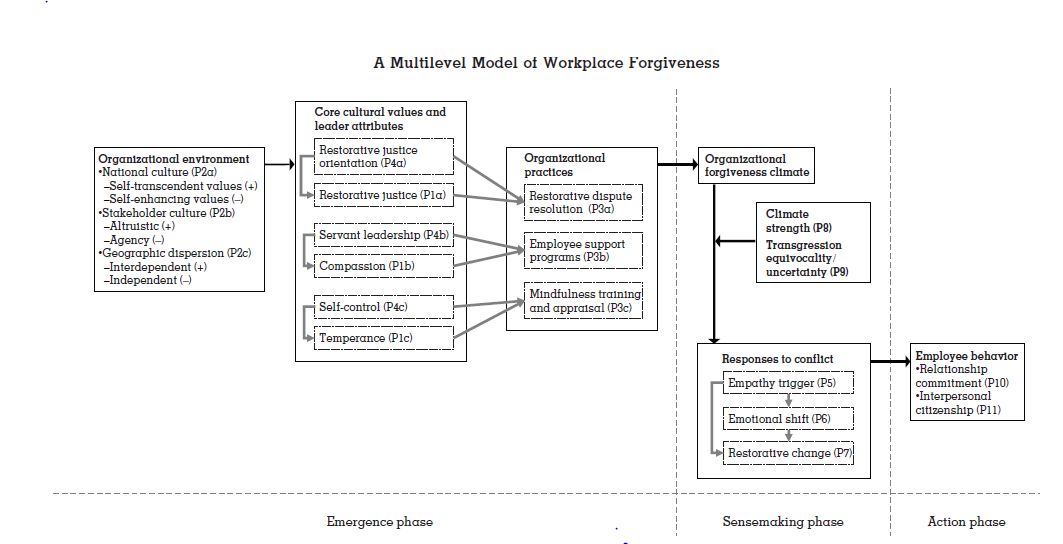
Employees are often urged to take chances by innovating solutions, but sometimes these Ryan Fehr - Workplace Forgiveness Modelincubation efforts may not result in a commercial success — and organizations may not “forgive” the investment of time and money in speculative efforts.

University of Washington’s Ryan Fehr with Michele Gelfand of University of Maryland suggest that organizations should establish the conditions for innovation and for accepting that experimentation may provide “lessons learned” even when efforts cannot be brought to market.

Ryan Fehr

Ryan Fehr

Their research investigated “forgiving organizations” that expand the individual practice of workplace compassion and mindfulness to an institutional level.

Michele Gelfand

Michele Gelfand

Fehr and Gelfand propose a “sensemaking” organizational model based on restorative justice, temperance, and compassion to cultivate the climate of fearless innovation and confident exploration in high-support organizations, which benefit from process and product breakthroughs and related financial rewards.

Matthew May

Matthew May

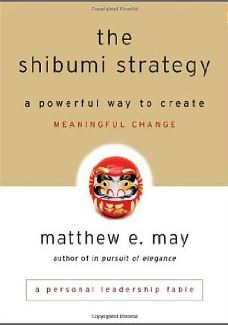
Matthew May explored a multi-faced exemplar of innovation, Shibumi,   imperfectly defined as “effortless effectiveness”, simply-expressed complexity, flawed perfection.

Baldassarre Castiglione

Baldassarre Castiglione

Shibumi shares some qualities with Baldassare Castiglione’s idea of “sprezzatura,” or making “whatever one does or says seem effortless, and almost unpremeditate,” Shibumi, says May, is typically achieved through an innovation-change management sequence of:

  • Commitment
  • Preparation
  • Struggle
  • Breakthrough
  • Transformation
Trevanian

Trevanian

Film scholar Rodney William Whitaker, who wrote under the pseudonym Trevanian, opined that “Shibumi has to do with great refinement underlying commonplace appearances,” and architect Sarah Susanka observed that “…shibumi evolves out of a process of complexity, though none of this complexity shows in the result…to meet a particular design challenge.”

Sarah Susanka

Sarah Susanka

May illustrated examples of familiar Japanese management principles including Hoshin (goal alignment) and Kaizen (continuous improvement), with less familiar principles:

  • Kata (patterns of effective behavior)
  • Genchi genbutsu (observation)
  • Hansei (reflection).

Matthew May-The Shibumi StrategyInnovation and creative problem-solving in any field can benefit from attention to Shibumi’s seven principles:

  • Austerity – Less is more
    Koko” suggests restraint, sparseness, and intentional omission, and ‘Is/isn’t analysis” provides the focus and clarity to exclude elements beyond a designated scope

    Antoine de Saint-Exupéry

    Antoine de Saint-Exupéry

    Antoine de Saint Exupery captured this principle in his view that “Perfection is achieved not when there is nothing left to add, but when there is nothing left to take away.”

In another book, May offered 4 Ss of “elegant”, innovative, and austere solutions:

  • Symmetry” to help solve problems of structure, order, and aesthetics
  • Seduction” for creative engagement
  • Subtraction” for problems of economy
  • Sustainability” for a process or solution that is both repeatable and lasting
  • Simplicity
    Kanso” signals the “enoughness” of streamlined utility, based on prioritization, understatement, and order for the central purpose.
  • Naturalness
    Shizen” points to the paradox of intentional artlessness, or balancing nature’s randomness and patterns with intentional curation.
  • Subtlety
    Yugen” refers to the tension between stagnation of precision in contrast with nature’s growth.
    One example is Steve Jobs building anticipation through restrained information release.
  • Asymmetric Imperfection
    Fukinsei points to the symmetry of nature through its counterpoint:  Asymmetrical and incomplete representations that encourage the viewer’s participation to “complete the incomplete.”Gestalt Art
    Gestalt
    researchers and artists demonstrated increased visual impact when participants co-create and collaborate in the innovation effort.
  • Change Routine Thinking and Actions
    Datsuzoku suggests a break from routine, such as adopting free-spirited Carnival demeanor at the annual masked Fasching in German-speaking countries.Fasching
    Breaking patterns enables breakthrough innovation and creative resourcefulness.
  • Active Stillness, Dynamic Tranquility
    Seijaku is serenity in the midst of activity and provides context of datsuzoku, transcendence of conventional ideas and traditional usage, leading to surprise, astonishment, and freedom to create.
    “Doing nothing” in mindfulness practice can be provide unconscious incubation for eventual creative syntheses to solve complex design issues, and increase self-awareness, focus, and attention.
    Individuals who wish to become more creative even in more confining organizations have reported success by adopting mindfulness meditation based on conscious breathing.
    In addition mindfulness practice can enhance resilience to accept critique in the creative process.

-*How do you establish the individual and organizational conditions for innovations?
-*How do organizations become “forgiving”?

RELATED POSTS:

Twitter:   @kathrynwelds
BlogKathryn Welds |Curated Research and Commentary
Google+:
LinkedIn Open Group Psychology in Human Resources (Organisational Psychology)
Facebook Notes:

©Kathryn Welds

What Do (Executive) Women (and Men) Want? Accenture Uncovers Priorities

Martha Bernays Freud-Sigmund Freud

Martha Bernays Freud-Sigmund Freud

Accenture’s online survey of 4,100 business executive women and men born between 1946 and 1994 from medium to large organizations across 33 countries sought to answer the updated version of Sigmund Freud’s question: “What do women want?”

Conducted in November 2012, the survey’s margin of error is +/-2 percent, with at least 100 respondents from each country, except Denmark, Finland, Norway and Sweden where the combined number totaled 200.

It provides some answers:  Women’s – and men’s top priorities in defining career success are:

  • Work-life balance
  • Money
  • Recognition
  • Autonomy
Frederick Herzberg

Frederick Herzberg

This finding contradicts Frederick Herzberg’s theory that people are less motivated by “hygiene factors” like work-life balance and money than “motivation factors” like recognition and autonomy.

In contrast to Yahoo’s much-publicized ban on working remotely, 80 percent of male and female respondents reported that having flexibility in their work schedule is extremely or very important to work-life balance and more than three-quarters (78 percent) agree technology enables them to be more flexible with their schedules.

This is an important value statement in light of landmark findings that lack of flexibility and control in work environments has been associated with poorer health indicators and status than roles with greater flexibility

Hannah Kuper

Hannah Kuper

Hannah Kuper and Michael Marmot of University College London analyzed health outcomes of British civil service workers in the Whitehall I and II studies and found employees with least control over their work lives, typically associated with lower employment grade and lower social class, consistently had the poorest well-being and the highest mortality rates.

Michael Marmot

Michael Marmot

Marmot with other researchers who analyzed Whitehall study data, including Geoffrey Rose, surmise that not having discretion over how a task is accomplished, underutilizing skills, lack of clarity and predictability in job role can lead to job stress and physical indicators like abnormal heart rate and blood pressure, increased blood cortisol.

Erin Kelly

Erin Kelly

Phyllis Moen

Phyllis Moen

More than half of all respondents said they declined a job due to concerns about its impact on work-life balance, also reported by Erin Kelly and Phyllis Moen of University of Minnesota, suggesting that Yahoo’s policy could lead to significant attrition over time.

To realize monetary goals, the majority of respondents – 49 percent of women and 57 percent of men – had asked for or negotiated a pay raise, and four out of five respondents who negotiated a pay raise received one.

These rates represent a substantial increase over the year before in which 44 percent of women and 48 percent of men reported asking for a pay increase.
Notably, the percentage of men requesting more money increased considerably more than the percentage of women in that year period.

Linda Babcock

Linda Babcock

This result is more encouraging than Linda Babcock’s finding that women tend not to ask for raises, and tend not to receive them when they do ask.

Sheryl Sandberg

Sheryl Sandberg

Even Sheryl Sandberg wasn’t inclined to negotiate for her salary when offered the role as COO of Facebook until she forcefully urged by her husband and brother-in-law, she revealed on 60 Minutes while promoting Lean In.

The Accenture study may demonstrate a changing trend for the better:  Almost half of all respondents reported that they had asked for a promotion, suggesting greater willingness to advocate for themselves to achieve the second priority, monetary reward.

-*How well do Accenture’s findings reflect your career priorities?

Related Posts

Twitter:    @kathrynwelds
Google+:
Blog: – Kathryn Welds | Curated Research and Commentary 
LinkedIn Open Group Psychology in Human Resources (Organisational Psychology)

Facebook Notes:

©Kathryn Welds