Category Archives: Business Communication

Business Communication

Body Language Conveys Emotions more Intelligibly than Facial Expressions

Paul Ekman

Paul Ekman

Numerous studies, pioneered by Paul Ekman of University of California, San Francisco, argue that facial expressions provide an accurate, consistent, universal “tell” to underlying emotions.

However, body language more accurately conveys intense emotions than facial Ekman Emotion Stock photoexpressions, according to Hebrew University’s Hillel Aviezer,Yaacov Trope of NYU, and Princeton University’s Alexander Todorov.

Three groups of 15 people judged intense emotions, including pain, pleasure, victory, defeat, grief and joy, portrayed in stock photographs of:

  • facial expressions alone or
  • body language alone or
  • both facial and body expressions.
Hillel Aviezer

Hillel Aviezer

Volunteers assigned more accurate inferences of pictured emotion based on body language, alone or combined with facial expressions, than judgments based on facial context alone.

These results challenge presumption that the face best communicates feeling, yet most participants believe that they rely on facial expression was their most important cue in making inferences.

Yaacov Trope

Yaacov Trope

More than half the volunteers reported that they use facial expression to judge underlying emotions, a bias labeled “illusory facial affect” by Aviezer and team.

Some participants did not view the photos, but heard a description of the content.
The vast majority – 80 percent – said they “would” rely solely on the face when determining the emotion.
The remainder said they would consider the face and body together, yet not one participant indicated that body language alone would be the most important guide to emotion.

Alexander Todorov

Alexander Todorov

Another experiment presented volunteers with altered photos that combined one intense emotional expressed in the face with an opposing “peak” emotion portrayed by the body language.
Volunteers more often judged the emotion associated with the body, although they thought that facial expression was more indicative of underlying emotional experience.

A different condition demonstrated that most participants provided inaccurate judgments of six emotional states portrayed by faces alone:  They judged positive facial expressions as negative more frequently than the actual negative expressions.

Aviezer, Trope, and Todorov argue that facial expressions can be ambiguous and subjective when viewed without the context of body, particularly during intense emotional expressions.

Jamin Halberstadt

Jamin Halberstadt

Jamin Halberstadt of University of Otago explained Team Aviezer’s findings by noting “…bodily context is the expression of emotion…the face reveals a general intensity of feeling but doesn’t communicate what the person is feeling exactly. The body is where the valid information comes from during intense feelings.”

Piotr Winkielman

Piotr Winkielman

His expertise is based on earlier research with University of California at San Diego’s Piotr Winkielman, Paula Niedenthal of University of Wisconsin and University of Clermont-Ferrand’s Nathalie Dalle.
They demonstrated the important role of expectancy in reading, experiencing, and recalling emotions expressed by ambiguous facial photographs.

Paula Niedenthal

Paula Niedenthal

Halberstadt’s team used electromyography (EMG) to evaluate volunteers’ muscle mimicry responses and memory of photos portraying ambiguous faces when associated with emotion labels like “angry” or “happy”, and when the same photos were presented without labels.

Nathalie Dalle

Nathalie Dalle

Participants displayed more EMG activity associated with smiling when they viewed faces labeled “happy” than “angry,” and remembered faces labeled “happy” as happier than faced coded “angry” even though the photographed expressions were ambiguous.

When participants spontaneously mimicked emotions labeled with a specific affect label, they were more likely to remember this emotion.
Since the photos were ambiguous, this recall represents memory bias, based on expecting, then mirroring an expected emotion. 

SPOT-Dept Homeland SecBody language’s greater accuracy than facial expression as a measure of emotion, has important implications for mission critical interrogation and security-screening techniques.

One example is the U.S. Transportation Security Administration’s Screening of Passengers by Observation Techniques (SPOT) program, which was based on Ekman’s facial expression research, but did not account for bodily expression as an indicator of underlying emotion.

Team Aviezer’s findings argue that emotion-screening procedures, as well as everyday workplace interactions, should evaluate both cues from both the body and the face to form most accurate judgments of others’ likely emotional states.  

-*Which cues do you find most helpful in judging other people’s emotional states when interacting with them?

Please follow-share-like www.kathrynwelds.com and @kathrynwelds

RELATED POSTS:

Twitter:  @kathrynwelds
Blog: – Kathryn Welds | Curated Research and Commentary
Google+ google.com/+KathrynWelds
LinkedIn Open Group Psychology in Human Resources (Organisational Psychology)
Facebook Notes:

©Kathryn Welds

Gender Differences in Emotional Expression: Smiling

Previous blog posts have outlined dilemmas women face in being seen as competent yet  “likeable” in negotiations.

Deborah Gruenfeld

Deborah Gruenfeld

Deborah Gruenfeld of Stanford and researcher Carol Kinsey Goman note that women can increase perceived authority. if they smile when situationally-appropriate instead of consistently.

Simine Vazire

Simine Vazire

They imply that observers assign different interpretations to women’s smiles than to men’s smiles.
Washington University in St. Louis’s
Simine Vazire teamed with Laura Naumann of University of California, Berkeley, University of Cambridge’s Peter Rentfrow, and Samuel Gosling of University of Texas to investigate gender differences in the meaning of smiling behavior.   

Jacob Miguel Vigil

Jacob Miguel Vigil

They drew on University of New Mexico professor Jacob Miguel Vigil‘s theory that emotional behaviors promote attraction and aversion, based on others’ perceived:

  • Power to provide resources or harm (dominant, masculine behaviors)
  • Trustworthiness to reciprocate altruism (submissive, feminine)
Laura Naumann

Laura Naumann

Vazire’s team reported that women’s smiles signal positive affect and warmth, which are seen as “trustworthiness cues” in Vigil’s model, and typically attract fewer, but closer relationships.
Gruenfeld and Goman argue that women’s smiling also signals low power in negotiation situations and interpersonal interactions.

Peter Rentfrow

Peter Rentfrow

In contrast, smiling among men indicates confidence and lack of self-doubt, seen as “capacity cues” to the ability to either help or hurt others.
These expressions usually attract numerous, but less-intimate relationships while
conveying a key element of power, self-assurance.

Samuel Gosling

Samuel Gosling

Team Vazire’s research validated Gruenfeld’s and Goman’s hypothesis that observers interpreted women’s smiles differently than men’s, even if the underlying, subjective emotional experience is similar.

Their work supports  Gruenfeld’s and Goman’s recommendation that women balance smiling, a signal of interpersonal warmth, with powerful non-verbal behaviors to achieve best outcomes in negotiations and workplace performance.

-*How has smiling helped establish your warmth?
-*When has smiling undermined your credibility and power?

->Follow-share-like http://www.kathrynwelds.com and @kathrynwelds

RELATED POSTS:

©Kathryn Welds

Word of Mouth, Social Media Expand Silicon Valley Networking with a Purpose

Networking with a Purpose

A professional development collaboration among Cisco, Citrix, eBay, EMC, Ericsson, Intel, Oracle, and other Silicon Valley technology companies using the IEEE model of “Birds of A Feather” discussion topics was introduced in a previous blog post.

IEEE

Anna Van Rijswijk, formerly of Cisco, developed this program based on survey data indicating that unstructured professional networking can feel awkward, stressful, and uncomfortable to many potential and actual participants.

Anna Van Rijswijk

Anna Van Rijswijk

Networking with a Purpose format provides structure and focus found in Speed Networking, Tom Jaffee’s business-focused adaptation of Rabbi Yaacov Deyo’s Speed Dating to enable members of his congregation to meet potential life partners. Yaacov Deyo

A Columbia alumnus, Jaffee noted that “at business functions, people often find themselves spending too much time with a small group rather than establishing multiple contacts throughout the function.”

Tom Jaffee

Tom Jaffee

To provide a solution, he built a company that offers events to increase chances that participants will make valuable business connections, much like the no-cost, self-organizing alternative, Networking with a Purpose.

Word of Mouth Marketing (WOMM) and social media mentions on Networking with a Purpose LinkedIn Group, Twitter (#SVBOF), and Facebook dramatically increased demand for registration at Silicon Valley Networking with a Purpose in-person events, and no-cost tickets typically “sell out” within minutes of posting the event invitation. WOMMA

The fifth Networking with a Purpose event is scheduled for Wednesday 20 November 2013 at eBay in San Jose, California, with popular discussion topics including:

  • Enhancing Personal Brand
  • Communicating Upward
  • Career Planning and Accountability
  • Design Thinking
  • Sketchnoting and Graphic Facilitation
  • Think Big, Play Big
  • Work Life Integration
  • Salary Negotiation
  • Office Feng Shui
  • iPhoneography

Silicon AlleyOrganizers have received strong post-event ratings from participants and have been contacted by colleagues in Silicon Alley – New York City – who wish to replicate this approach to professional networking.

-*How do you expand, cultivate and contribute to your professional network?Networking with a Purpose Best Kept Secret

->Follow-share-like http://www.kathrynwelds.com and @kathrynwelds

RELATED POSTS:

©Kathryn Welds

Does Workplace Co-Location Increase Collaboration and Innovation?

John Chambers

John Chambers

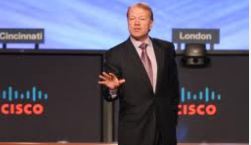
In 2009, Cisco CEO John Chambers asserted that “the face-to-face meeting is a dinosaur,” and he demonstrated his point in a Telepresence-enabled company meeting from Bangalore, India with his fellow executive, Marthin de Beer, in San Jose, California.

Marthin de Beer

Marthin de Beer

Marisa Mayer of Yahoo seems not to agree with Chambers’ premise.

Her highly-publicized decision to require remote workers to work on-site every day in Yahoo offices received mixed reviews from advocates of flexible work practices such as ROWE (Results-Only Work Environment).

Marissa Mayer

Marissa Mayer

Mayer argued that co-location will enable Yahoos to more effectively collaborate and innovate.

-*What is the evidence for – or against – her assertion?

Eduardo Salas

Eduardo Salas

A decade ago, in 2003, a meta-analysis of face-to-face meetings’ impact on group cohesiveness, task commitment, authority, communication noted the one benefit of virtual meetings: “status-equalizing impact of computer-supported cooperative work … enables greater participation by women, minorities and other traditionally lower status groups.

Florida Maxima Corporation’s James Driskell collaborated with Paul Radtke, Naval Air Warfare Center Training Systems Division and University of Central Florida’s Eduardo Salas summarized often-conflicting findings on the impact of virtual teams  and concluded that interaction in virtual environments requires consideration of the type of task that the team is performing.
Agile software development is an example of a process that originally assumed – and required –  team member co-location.

Sandeep Joshi

Sandeep Joshi

Microsoft trainer Sandeep Joshi offered an alternate model to co-location for Agile development, and argued that some tasks in the Agile development process are suitable for remote work by distributed teams.
Because more than half of respondents to VersionOne’s 2012 State of Agile survey said they use Agile with co-located and distributed teams, or plan to do so in the future, Joshi advocates maintaining collaborative, co-located design processes to capitalize on group interaction, then “de-Agilizing” the process to enable individual coding before re-convening to evaluate the work in “rapid turns.”

Karen Sobel-Lojeski

Karen Sobel-Lojeski

Distance is not only physical, according to SUNY Stony Brook’s Karen Sobel-Lojeski. 
She conceptualizes three types of virtual distance:

  • Affinity (culture and background differences like ethnicity, educational background, past familiarity, shared vision, and commitment that affect team productivity and cohesiveness
  • Operational (type and frequency of communication)
  • Physical (geographic separation)
Richard Reilly

Richard Reilly

She collaborated with Richard Reilly of Stevens Institute of Technology on two books that explored perceived distance among co-workers, which can be reduced or increased by communication technology.

They argue that virtual distance changes the ways people learn, perform, and develop relationships with others in the workplace.

Like Joshi, they advocate analyzing the nature of the tasks and existing interpersonal relationships among team members before mandating co-location, virtual, or blended work arrangements.

Sobel-Lojeski and Reilly conclude that important workplace competencies are traversing boundaries, glocalization, and authenticity, leading to what they call “techno-dexterity” required for effective leadership in a wired world.

Among the drawbacks of co-location are increased work interruptions, which can reduce productivity and cognitive performance.

Alessandro Acquisti

Alessandro Acquisti

Carnegie Mellon University’s Alessandro Acquisti and  Eyal Pe’er  demonstrated decreased cognitive task performance after electronic interruptions and task-shifts similar to responding to a mobile phone call, text message or email.

More than 135 volunteers read a short document and answered questions about the content.
One third of the participants completed this portion of the experiment and served as the control group.

Eyal Pe'er

Eyal Pe’er

The remaining individuals were told they “might be contacted for further instructions” via instant message.

This alerted group completed a similar reading comprehension test, and half of this group actually received instant messages, whereas the other half didn’t receive the anticipated notices.

Both interrupted groups provided 20% less accurate responses than the control group, suggesting a significant cost to interruptions and task shifting.

However, when the interrupted group performed the similar task a second time, this group reduced the under-performance by 6%.
Those who were warned of an interruption that never came improved by 43 percent, and even outperformed the control test takers who were left alone.

Acquisti and Pe’er suggested that people may develop compensatory strategies to manage the performance impact of interruptions.

Gloria Mark

Gloria Mark

Likewise, University of California, Irvine’s Gloria Mark with Daniela Gudith and Ulrich Klocke of Germany’s Humboldt University reported that a typical office worker is interrupted about every 3-11 minutes and requires an average of 23-25 minutes to return to the original task.

Daniela Gudith

Daniela Gudith

Volunteers worked faster when they anticipate interruptions, particularly those who measured high on openness to experience and high on need for personal structure.
However, participants reported increased stress, higher workload, greater frustration, more time pressure and effort when they increased work speed.

Ulrich Klocke

Ulrich Klocke

These findings provide equivocal support for Mayer’s anticipated benefits from workplace co-location.
Her team may experience increased stress due to interruptions, task-shifting, and noise, in addition to any personal concerns about lengthy commutes and work-life balance.

This inference was supported in research by Harvard’s Leslie Perlow, who studied engineers working in an open-space environment.
These highly-skilled knowledge workers reported frequent interruptions and reduced productivity.

Leslie Perlow

Leslie Perlow

Perlow offered these engineers a recommendation:  Pre-scheduled interruption-free “quiet time”.
She found that this intervention led to increased productivity.

Catherine Kerr

Catherine Kerr

Similarly, Catherine Kerr of Brown University suggests that the impact of frequent task-shifts in open work environments can be mitigated by mindfulness meditation as brain training to enable increased attentional focus by attending to breathing.

Workplace inclusion and diversity issues add to questions of whether co-location actually increases innovation, collaboration, and productivity.
Pew Research Center reported that working mothers were more concerned with having a flexible schedule whereas working fathers placed more importance on having a high-paying job.

When employees actually use increasingly-available flexible work options, including job-sharing, telecommuting, and compressed work weeks, they may experience adverse career impacts.

Joan Williams

Joan Williams

Jennifer Glass

Jennifer Glass

Joan Williams, founding director of the Center for Work-Life Law at the University of California, Hastings College of the Law with  University of Iowas’ Jennifer Glass, Shelley Correll of Stanford and University of Toronto’s Jennifer Berdahl reported that men who take leave from work after the birth of a child were more likely to be penalized and less likely to get promoted or receive raises.

Shelley Correll

Shelley Correll

Jennifer Berdahl

Jennifer Berdahl

In addition, they found that women using flexible work arrangements receive differing feedback from others depending on their socioeconomic statusAffluent women were encouraged to stay at home, whereas less affluent women were more likely to be counseled not to have children.

Despite John Chamber’s death-of-face-to-face meetings assessment and recent findings by Kenneth Matos and Ellen Galinsky of the Families and Work Institute, Cisco Systems executives seem aligned with Mayer’s advocacy for in-person collaboration.

Kenneth Matos

Kenneth Matos

During a recent preview of renovated office buildings featuring “Collaborative Work Spaces,” Cisco business leaders asserted that the layout is intended to increase collaboration and attract recent graduates and other “younger talent” by “projecting a hip, innovative image in the work environment.”
They noted that this arrangement is actually more costly than offices and cubicles despite accommodating more workers in the same amount of space.

Ellen Galinsky

Ellen Galinsky

Past research suggest costs to adopting computer-mediated work processes, yet these technologies have improved, become more prevalent, and workers have become more skilled in their use.
Further, virtual collaboration enables workplace participation by people who might require flexible schedules, and reduces the environmental impact, cost, and perceived stress of commuting.

-*How is your productivity affected by physical proximity to your co-workers?
-*How do you manage distractions in open office environments?

——–

RELATED POSTS:

Twitter:  @kathrynwelds
Blog: – Kathryn Welds | Curated Research and Commentary
Google+
LinkedIn Open Group Psychology in Human Resources (Organisational Psychology)
Facebook Notes:

©Kathryn Welds

Spreading Good News Feels Good, Especially When It’s About You

Christian Science Monitor has long provided a counterpoint to mainstream media’s “If it bleeds, it leads” approach to providing shocking, scandalous, depressing, or scary news.

Jonah Berger

Jonah Berger

Wharton’s Jonah Berger and Katharine Milkman found that the Christian Science Monitor might have a savvy business model:  they found that good news spreads more widely than bad.

Word of Mouth Marketing AssociationMembers of the Word of Mouth Marketing Organization: Take note…

Katherine Milkman

Katherine Milkman

Berger and Milkman evaluated a random sample of 3,000 of more than 7,500 articles published in the New York Times online from August 2008 to February 2009.

They judged each article’s “popularity” based on number of times it was forwarded to others, after controlling for online publication time, section, and degree of promotion on the home page.
Independent readers rated each article for practical value or surprise, and ratio of positive vs negative emotion words in each news item.

Most-forwarded posts were positive, funny, exciting and featuring intellectually challenging topics, like science, that “inspire awe” (“admiration and elevation in the face of something greater than the self”).

Readers shared articles that typically provoke negative emotions like anger and anxiety, but not sadness.
-*Why this bias against sending “downer” messages?

Emily Falk

Emily Falk

Michigan’s Emily Falk, with UCLA colleagues Sylvia Morelli, B. Locke Welborn, Karl Dambacher,and Matthew Lieberman found that people consider what appeals to others, possibly as a means of building relationships, indicated by increased activation in brain regions (temporoparietal junction, or TPJ and dorsomedial prefrontal cortex) associated with “social cognition,” or thoughts about other people, measured by fMRI.

When those regions were activated, people were more likely to talk about the idea with enthusiasm, and the idea would spread by word-of-mouth.

Falk noted that the team mapped  brain regions “associated with ideas that are likely to be contagious and are associated with being a good ‘idea salesperson.'”
She plans to use these brain maps “to forecast what ideas are likely to be successful and who is likely to be effective at spreading them.”

Diana Tamir

Diana Tamir

People also like to spread good news about themselves.
Diana Tamir and Jason Mitchell, then of Harvard, illustrated that brain regions associated with reward (mesolimbic dopamine system, including the nucleus accumbens and ventral tegmental area) are activated when people share information about themselves.

Jason Mitchell

Jason Mitchell

Self-disclosure is so pleasurable that people will sacrifice monetary rewards for this opportunity.

Mor Naaman

Mor Naaman

In fact, Rutgers’ Mor Naaman with Jeffrey Boase, now at Ryerson University and Chih-Hui Lai, now of University of Akron found that 80 percent of Twitter users tweet primarily about themselves.
One reason may be that people say more positive things when they’re talking to a bigger audience, like Twitter followers, according to Berger’s research suggests. As a result, social media users are likely to convey positive information about themselves.

Jeffrey Boase

Jeffrey Boase

However, this positive self-presentation may not result in a positive mood if communicators spend longer on social media platforms like Facebook.
Hui-Tzu Grace Chou and Nicholas Edge of Utah Valley University found that those with longer visits to Facebook say they are less happy than their Facebook Friends.

They found that Facebook users tend to form biased judgment based on easily-recalled examples (availability heuristic) and erroneously attribute positive Facebook content to others’ personality, rather than situational factors (correspondence bias), especially for those they do not know personally.

Hanna Krasnova

Hanna Krasnova

Corroborated by Humboldt-Universität zu Berlin’s Hanna Krasnova and her team from Technische Universität Darmstadt, these researchers observed “invidious emotions” and “envy” among people who spend longer time on Facebook.

These findings have relevance to members of the Word of Mouth Marketing Organization: Spread the good word – or at least the emotional word – and spend less time on Facebook and other social media that might invite social comparison and the potential for envious dissatisfaction.

-*How you build “buzz” via “Word of Mouth”?

RELATED POSTS:

Twitter:   @kathrynwelds
Blog: – Kathryn Welds | Curated Research and Commentary
Google+:
LinkedIn Open Group Psychology in Human Resources (Organisational Psychology)
Facebook Notes:

©Kathryn Welds

Power of “Powerless” Speech, but not Powerless Posture

Assertive speech is assumed to signal competence and power, pre-requisites to status, power, and leadership in the U.S. workplace.

Alison Fragale

Alison Fragale

However, University of North Carolina’s Alison Fragale demonstrated that warmth trumps competence in collaborative team work groups.

Fragale studied “powerless speech,” which has been believed to make a person seem tentative, uncertain, and less likely to be promoted to expanded workplace roles.
She defined “powerless speech” as including:

  • Hesitation: “Well” or “Um”, as known as “clutter words”
  • Tag questions: “Don’t you think?”
  • Hedges: “Sort of” or “Maybe”
  • Disclaimers: “This may be a bad idea, but … “
  • Formal addresses:“Yes, sir” or “Yes, ma’am”

In collaboration-based work teams, “powerless” speech characteristics are significantly associated with being promoted, gaining status and power.
Interpersonal warmth and effective team skills are valued more than dominance and ambition by team members and those selecting leaders for these teams.

Paul Hersey

Paul Hersey

In contrast, “powerful” speech does not feature these characteristics, is more effective when the task or group is independent and people are expected to work alone.

Ken Blanchard

Ken Blanchard

As in Paul Hersey and Ken Blanchard’s Situational Leadership, Fragale concludes that communication style should be tailored to group characteristics.

Li Huang

Li Huang

Likewise, INSEAD’s Li Huang  and Columbia’s Adam Galinsky with Lucia Guillory of Northwestern University demonstrated the impact of “powerful” body language – also called “playing big” –  on perceived power.

Adam Galinsky

Adam Galinsky

Although assuming “larger” postures is associated with credibility and authority, some situations benefit from assuming “smaller”, less powerful postures to establish warmth or to acknowledge another’s higher status.

Lucia Guillory

Lucia Guillory

As noted in an earlier post, Women Get More Promotions With “Behavioral Flexibility”, careful self-observation and behavioral flexibility based on situational requirements are effective foundations to establish group leadership.

-*How do you monitor and adapt “powerless” speech to work situations?

RELATED POSTS:

©kathrynwelds

Productivity and Work Motivation Affected by Meaning, Challenge, Mastery, Ownership

Small gestures and verbalizations by managers and organizations can have a large impact on employee productivity, motivation, engagement, and retention – for better or worse.

Dan Ariely

Dan Ariely

Dan Ariely’s research at Duke University showed the small changes in task design dramatically increase or diminish persistence, satisfaction, and commitment to tasks.

The good news is that by simply looking at something that somebody has done, scanning it and saying ‘uh huh,’ [you] dramatically improve people’s motivations…. The bad news is that ignoring the performance of people is almost as bad as shredding their effort in front of their eyes. …,” according to Ariely.

Ariely’s lab experiments found that volunteers valued and liked their work product more when they worked hard and managed obstacles to produce it.
In addition, most people believed, often inaccurately, that other observers shared their positive view of their work product,

His research concluded that people seek meaning, challenge, and ownership in their work, and that these elements can increase work motivation and persistence.

Viktor Frankl

Viktor Frankl

Holocaust survivor and psychiatrist Viktor Frankel articulated this existential perspective in his examination of the critical role that meaning played in the enabling survivors of concentration camp prisoners in Man’s Search for Meaning.

In the less extreme circumstances of the workplace, finding and assigning meaning to work efforts enables people to persist in complex tasks to achieve satisfaction in mastering challenges.

Rosabeth Moss Kanter

Rosabeth Moss Kanter

Harvard’s Rosabeth Moss Kanter concurred that both meaning and mastery are productivity drivers, and to these she added a social dimension, membership, and a distant runner-up, money.

Frederick Herzberg

Frederick Herzberg

In contrast, one of the early though leaders in business management, psychologist Frederick Herzberg, developed a classic formulation of motivational factors contrasted with “hygiene factors.”

Frederick Herzberg - Motivation-Hygiene factorsHis two-factor theory of motivation did not include meaning or money as driving job satisfaction or productivity.

Shawn Achor, formerly of Harvard, argues that happiness is the most important work productivity lever.

Shawn Achor

Shawn Achor

To support his contention, he cited research findings that happy workforces increase an organization’s sales by 37 percent, productivity by 31 percent and accuracy on tasks by 19 percent.

Whether you work for mainly for meaning, money, or other motivations, you may agree that an ideal workplace and manager would foster all of these contributors to employee engagement and productivity.

-*What is the most important work motivator for you?
-*How have you seen managers increase employee engagement and performance through words and actions?

Related Posts

Twitter:  @kathrynwelds
Blog |Kathryn Welds| Curated Research and Commentary
Google+:
LinkedIn Open Group Psychology in Human Resources (Organisational Psychology)
Facebook Notes:

©Kathryn Welds

Gender Differences and Diversity in Corporate Interaction Styles, Financial Outcomes

Gender makes a difference in interaction styles on corporate boards, and the ratio of women to men on these boards is linked to corporate financial performance.

Interaction Styles

Gregory McQueen

Gregory McQueen

Chris Bart

Chris Bart

McMaster University’s Chris Bart and Gregory McQueen of Western University of Health Sciences surveyed 600 board directors (75% male) and found that men tended to base corporate decisions on tradition, rules, and regulations, whereas women tended to ask questions to develop more solution options, cooperate, and consider the interests of all stakeholders.

Nanette Fondas

Nanette Fondas

Nanette Fondas, then of Duke University, and Susan Sassalos, now of Edison International found that women on corporate boards influence other board members to act more “civilized” and “sensitive to other perspectives.”

Val Singh

Val Singh

In the same vein, Cranfield University’s Val Singh reported that women on corporate boards also reduce ‘game playing’ among board members.

Siri Terjesen

Siri Terjesen

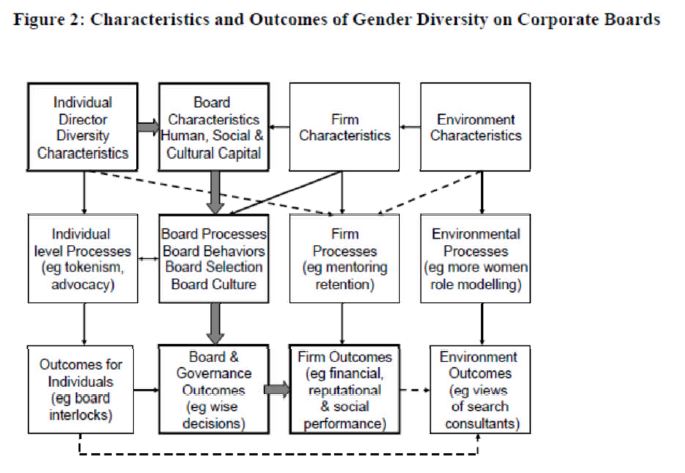
With Siri Terjesen of Indiana University and Cranfield University’s Ruth Sealy, Singh evaluated existing research on corporate board gender diversity to develop a model of analysis by:Val Singh - Gender Diversity on Corporate Boards Model

  • Individual
  • Board
  • Firm
  • Industry and Environment

Financial Performance:

Nancy Carter

Nancy Carter

Catalyst’s Nancy Carter and Lois Joy with Harvey Wagner of University of North Carolina and Michigan State University’s Sriram Narayanan found that Fortune 500 boards with 3 or more women report:

Harvey Wagner

Harvey Wagner

compared to boards with more men.

Nick Wilson

Nick Wilson

Nick Wilson and Ali Altanlar of Leeds University added another financial indicator affected by gender ratios on boards.

Ali Altanlar

Ali Altanlar

In their analysis of 17,000 UK companies that went insolvent in 2008, Wilson and Altanlar reported even one female board director reduces bankruptcy risk by 20%.

Pepperdine University’s Roy D. Adler studied 200 companies among the Fortune 500 to mine data from 1980 through 2001 and reported results consistent with the Catalyst investigation.

Roy Adler

Roy Adler

Adler and team identified the firms that had a record of promoting women to high levels and compared their profit performance to the median performance of Fortune 500 firms in the same industries.

The researchers separately compared profits as a percentage of sales, of revenues and of assets and found that for 2001, the 25 firms with the strongest record of promoting women to high organizational levels outperformed the industry medians with:

  • 34 percent higher revenue
  • 18 percent higher assets
  • 69 percent higher equity.

The 10 firms with the very best records of promoting women showed greater profits than competitors, and results were confirmed in subsequent studies in 2004 through 2008.
Adler and team noted that the odds of all 18 financial measures favoring women are 262,114 to 1, suggesting that these findings were not random errors.

Cristian Dezso

Cristian Dezso

Likewise, University of Maryland’s Cristian Dezső and David Ross of Columbia University found that companies with one or more women in top management  close to CXO level perform better than other companies, based on their assessment of the largest 1,500 public US companies from 1992 to 2006.

Sheryl Sandberg

Sheryl Sandberg

Sheryl Sandberg isn’t the only one to ask “Why so few?” in corporate and government leadership roles, particularly when these results consistently point to the financial benefits of more women in top decision-making roles.

AAUW

AAUW

American Association of University Women asked the same question about women in Science, Technology, Engineering, and Mathematics roles, and concluded that there remains a large gap in equal gender representation in leadership roles and in technical careers – and this discrepancy comes at the price of financial performance and organizational climate.

  • Where have you observed work group interaction differences depending on the ratio of women?
  • What financial impacts have you observed for organizations with women in top leadership roles?
    Level of Analysis Model

RELATED POSTS:

Twitter: @kathrynwelds
Google+
Blog
: – Kathryn Welds | Curated Research and Commentary 
LinkedIn Open Group Psychology in Human Resources (Organisational Psychology)
Facebook Notes:

©Kathryn Welds

What is Your Signature Story in Behavioral Interviews?

Behavioral interviews require advance preparation for both the interviewer and the job applicant, in contrast to the frequently unplanned volley of unstructured Q&A intended to assess candidate fit and potential effectiveness in a work role.

Tom Janz

Tom Janz

Behavioral Interviews, developed by Tom Janz, now Chief Scientist at peopleassessments.com, ask job candidates to provide examples of past behaviors in specific situations deemed relevant to the target role.

The questions are typically framed as an invitation to tell a story about a situation, a challenge, the candidate’s action or solution, and the outcome:

  • Give an example of an occasion when you used logic to solve a problem
  • Think of a goal you reached and tell me how you achieved it
  • Describe a decision you made that was unpopular and how you implemented it
  • Tell me about a time you went “above and beyond the call of duty
  • When was the last time you handled interruptions to your schedule?  How did you do it?
  • When and how did you convince a team to work on a project they didn’t like?
  • Provide an example of handling a difficult situation with a co-worker
  • Tell me about how you worked effectively under pressure

Sometimes the questions are structured to explicitly request that the candidate reply in the “STAR” format:

  • Situation
  • Task
  • Action
  • Results

Candidates increase odds of memorably and skillfully conveying relevant qualifications by preparing “Signature Stories” – theirs alone – to demonstrate how they resourcefully and innovatively:

  • Solved challenging problems
  • Improved strained work relationships
  • Met deadlines and budget
  • Applied “Lessons Learned”
  • Initiated transformational change
  • Demonstrated courage and integrity
Gary Oliphant

Gary Oliphant

Besides being noticed and remembered, signature stories told in behavioral interviews can help both the candidate and interviewer evaluate whether the fit between the role requirements and the candidate’s skills would likely lead to strong future performance.

Becky Oliphant

Becky Oliphant

Evidence for the predictive validity of signature stories told in behavioral interviews was provided by Gary Oliphant and Becky Oliphant of Stetson University with Katharine Hansen of quintcareers.com in their evaluation of 10 Gallup Organization “Life Themes” relevant to loan sales.
From these signature stories, the researchers accurately predicted post-hire performance and retention at a large financial sales organization.

Katharine Hansen

Katharine Hansen

Stories are 22 times more memorable than facts or figures alone,” contends Jennifer Aaker of Stanford, and she offers four elements that increase the impact of signature stories:

  • Goal: Defines a clear purpose and Call to Action, conveying what the listener should think, feel, do
  • Interest: Attracts focused attention by using a “hook” of surprising truth, visual effect, unusual problem-solving approach
  • Caring: Establishes empathic emotional connection with the storyteller’s challenge and journey to reach a meaningful goal
  • Memorable: Makes the story compelling, unforgettable, “re-tellable” and worth “going viral.”
Jennifer Aaker

Jennifer Aaker

Aaker suggests testing stories by asking others to what extent the story:

  • Changed the listener’s perspective
  • Resonated with the listener’s experiences, values, interests
  • Delivered “Moments of insight”
  • Had incomprehensible, inconsistent, or disjointed parts

She says that the mark of an effective “signature story” is that “others look at you differently” and the story moves you closer to a goal.

-*How do you craft dramatic, memorable Signature Stories to illustrate your values and capabilities?

RELATED POSTS:

Twitter:  @kathrynwelds
Google+:
Blog: – Kathryn Welds | Curated Research and Commentary 
LinkedIn Open Group Psychology in Human Resources (Organisational Psychology)
Facebook Notes:

©Kathryn Welds

ROI of Effective Managers

Dilbert and Pointy-Haired Boss

Dilbert and Pointy-Haired Boss

Inept managers cause stress, cynical posting of Dilbert cartoons, and foment incredulous recounting of unparalleled cluelessness.
However, the all-too-rare effective manager delivers a creditable Return on Investment.

Edward Lazear

Edward Lazear

Stanford’s Edward Lazear and Kathryn Shaw collaborated with Christopher Stanton, now of of University of Utah to study the impact of nearly 2000 supervisors on more than 23,000 employees’ output productivity in a large  services firm.

Kathryn Shaw

Kathryn Shaw

They found that although there is substantial variation in managerial quality, as measured by their effect on worker productivity, the skillful managers in this workplace improved productivity by 10 percent.

Christopher Stanton

Christopher Stanton

Lazear, Shaw and Stanton demonstrated that replacing managers rated in the lower 10% of boss quality by employee output with managers in the upper 10%, the resulting increase in team total output is about the same amount as adding one worker to a nine member team.

In addition, effective managers are associated with increased productivity among both top-rated workers and the lowest-performing workers, with greater performance increases among the firm‘s top performers.

The researchers noted that employees’ peers had negligible impact on productivity measures, so they concluded that productivity increases are significantly influenced by managerial behaviors.

These findings point to the importance of hiring skilled managers and improving or removing unskilled managers to drive productivity and associated profit.

As a result, pre-employment assessment and managerial training industries are required to demonstrate efficacy in selecting already-skilled managers, and transforming less-skilled managers into top performing supervisors.

Some argue that developing managerial skill is a long-term behavior change because many of the interpersonal behaviors of effective managers have long-standing characterological roots.

For example, Lazear reported that the best managers in this large sample demonstrated humility and a sense of humor in their efforts to teach and motivate employees.
These attitudes develop over years, and may not be amenable to short-term training interventions.

Randy Hodson

Randy Hodson

Randy Hodson of Ohio State University conducted an ethnographic study of “worker citizenship behavior”, including level of work effort, absenteeism, and employee engagement.

He found “manager citizenship behavior” has the greatest impact on employee engagement, work effort, and employee’s related productivity.
These management behaviors include:

  • Leadership practices
  • Communication style
  • Commitment to worker job security
  • Providing appropriate work supplies and tools to achieve workers’ output requirements
  • Absence of “management abuse.”

Managers who respected worker rights and maintained an effective, productive environment for workers  had workers who invested more efforts in work and achieved greater productivity, besides having a better relationship with each other and with bosses.

Watson Wyatt TowersWatson Wyatt’s WorkUSA 2009 survey of 13,000 full-time U.S. workers across all job levels and in all major industries that organizations with highly engaged employees had:

The report found waning employee engagement over job tenure:  Employee engagement is highest in the first six months on the job, and is more than 11 percent higher during that “honeymoon period” than for longer-tenure employees.
Employee engagement drops nine percent after the first six months on the job, and continues to decline.

Watson Wyatt’s regression analysis of these data found that this 11% decline in employee engagement has the same expected impact on employee productivity as a decline of assets per employee of nearly 0.6 percent.

To offset the impact on productivity, a typical firm would need to invest more than $2,700 per employee.

A similar regression analysis controlled for industry, firm size and capital intensity and estimated that 11% decline in engagement is associated with a 1.7 percent reduction in market value.
For the typical S&P 500 firm, this decreased expected market value could be $216 million, suggesting that managerial behavior is a critical determinant of productivity and ultimate market value.

The challenge for top management is to evaluate sustained improvement in managerial behavior attributable to managerial learning and development interventions, to ensure Return on Investment for managerial development.

-*What managerial attitudes and behaviors have you seen increase employee productivity?

Related Post

Twitter:  @kathrynwelds
Google+:
Blog: – Kathryn Welds | Curated Research and Commentary

LinkedIn Open Group Psychology in Human Resources (Organisational Psychology)

Facebook Notes:

©Kathryn Welds