Tag Archives: Career Development

Career Development

Power Tactics for Better Negotiation

Selena Rezvani

Selena Rezvani

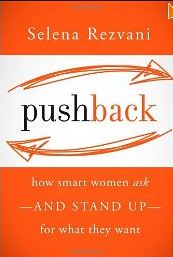
Selena Rezvani points to research documenting women’s tendency to negotiate for salaries, promotions – and even task-sharing in relationships, less often than men in Pushback: How Smart Women Ask–and Stand Up–for What They Want
Her book offers guidelines to speak up assertively while developing the resilience and “thick skins” many in sales have mastered.

These recommendations echo those suggested in research studies and popular articles, and perhaps more Machiavellian, realistic, and perhaps disconcerting come from one of her endorsers, Stanford University Graduate School of Business Professor Jeffrey Pfeffer.

Jeffrey Pfeffer

Jeffrey Pfeffer

He analyzes individual power dynamics in corporate hierarchies, and offers recommendations to acquire and use power in Power: Why Some People Have It—and Others Don’t 

Power-Jeffrey PfefferIn Rezvani’s book, Pfeffer notes that “Power is about 20% conferred and 80% taken.
Good things don’t come to those who wait; they come to those who ask, negotiate, and push.
For women—or men—to get what they deserve, they must get over the platitudes and attitudes that hold them bac
k.”

Pfeffer debunks the hopeful idea that the world is fair and just,  and counsels those seeking to have the power to “get things done” to promote themselves, avoid giving up or delegating power, but instead,  give up the wish to be well-liked.

Because the work world is not fair, Pfeffer says that intelligence, performance, and likeability alone are not the most important factors in advancing in an organization.
Instead, he argues that ambition, energy, and focus drive key power behaviors:

  • Self-promotion and seeking organizational visibility
  • Building relationships, networking, and supporting the immediate manager
    Cultivating a reputation for control and authority by managing information and first impressions (halo effect, attention decrement, cognitive discounting, self-fulfilling prophecy, biased assimilation)
  • Embodying powerful demeanor in speech, dress, posture

Useful skills in acquiring power are:

  • Self-reflection and self-knowledge
  • Confidence and self-assurance
  • Ability to “read” others by empathically understanding their perspectives
  • Capacity to tolerate and remain calm in conflict

Although power is valuable to enable execution and results, there are downsides and “prices to pay” for having and using power.
Often, the costs of power are not fully considered or anticipated by those who aspire to it, so Pfeffer usefully suggests the following drawbacks of power:

  • Loss of privacy due to public scrutiny
  • Loss of autonomy
  • Necessary investment of time and effort that might be spent in other ways, such as with family, maintaining a healthy lifestyle, pursuing non-work interests
  • Trust, confidentiality, conflict-of-interest, ethical dilemmas
  • Possible intoxication with power as an “addictive drug”

Kathleen Kelly Reardon

Kathleen Kelly Reardon

It's All PoliticsPfeffer’s Stanford University colleague, Kathleen Kelly Rearson shares specific examples of skillful, modulated application of power in her book, It’s all Politics.

-*How do you ask for what you want at work?

-*What power tactics do you employ to influence your negotiation outcomes?

RELATED POSTS

©Kathryn Welds

Questions to Discover, Communicate Personal Mission, Brand

Tina Su

Tina Su, former software engineer at Amazon.com and author of Think Simple Now: A Moment of Clarity blog, shared self- assessment questions that have helped her and others focus on life purpose and mission.

From these, she developed a personal vision “to ‘never work again’, by living a life following one’s inner calling, exploring one’s potential, generating massive value, and living fully in every moment.”

• What activities, people, events, hobbies, projects make you smile?
• What have been your favorite activities in the past?
• What have been your favorite activities now?
• What makes you feel great about yourself?
• Who inspires you: family, friends, authors, artists, leaders, historical figures?
• Which qualities inspire you?
• What are your natural skills, abilities, gifts?
• For what do people ask your advice, help?
• What would you teach?
• What would you regret not fully doing in your life?
• What would you regret not being in your life?
• When you are 90 years old, what achievements will matter most?
• What achievements relationships will matter most?
• What are your 3-6 deepest values?
• What were some challenges, difficulties and hardships you’ve overcome or are in the process of overcoming?
• How did you do it?
• What causes do you strongly believe in or have personal meaning for you?
• What message would you like to effectively convey to a large group of people?
• How can you use your talents, resources, passions and values to serve, to help, to contribute to people, beings, causes, organization, environment?

The answers to these questions can answer the questions addressed in a personal mission statement, as Tina demonstrated in her bold direction.
• What do I want to do?
• Who do I want to help?
• What is the result? What value will I create?

Randall Hansen

Randall Hansen

Randall Hansen offers a different, but compatible The Five-Step Plan for Creative Personal Mission Statements.
• Identify Past Successes
• Identify Core Values
• Identify Contributions
• Identify Goals
• Write Mission Statement

Like any self-assessment process, developing a personal mission statement is an investment of time and attention spanning several days or weeks.

-*What questions have been more revealing in developing your personal brand?

LinkedIn Open Group Brazen Careerist
Twitter: @kathrynwelds
Google+
Facebook Notes:
Blog: – Kathryn Welds | Curated Research and Commentary

©Kathryn Welds

Thoughts Change Bodies, Bodies Change Minds, Roles Shape Hormones

Deborah Gruenfeld, formerly of Stanford Graduate School of Business, studied the impact of non-verbal behavior on perceptions of power.

Deborah Gruenfeld

Deborah Gruenfeld

She reported that people who “occupy space” are viewed as more dominant and powerful by others.

See Related Posts:

She demonstrated that non-verbal behavior like erect, “space-occupying” postures and selective smiling affect the way the person executing these behavior feels about his or her personal power, competence, and mood.

“Power postures” affect secretion of hormones associated with dominance (testosterone) and stress (cortisol).

Effective leaders and recently promoted leaders show a hormone profile of high testosterone and low cortisol, indicating high dominance and low stress.

Individuals in low power role have low testosterone and high cortisol, and this trend is more common among women.

Posture can make a large difference in how people view themselves, how others see them, and their opportunities and outcomes.

Before a job interview or stressful interaction, a “big power posture”  can increase confidence and performance.

-*What is your emotional response to people who assume a “big power posture” at work?
-*How do you feel when you occupy more space in professional settings?

©Kathryn Welds

Authoritative Non-Verbal Communication for Women in the Workplace

Carol Kinsey Goman

Carol Kinsey Goman

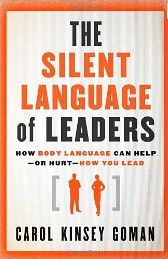
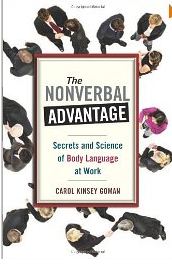
Carol Kinsey Goman has integrated research on the impact of non-verbal behavior on workplace outcomes for women in two books:

The Silent Language of Leaders: How Body Language Can Help–or Hurt–How You Lead

The Nonverbal Advantage: Secrets and Science of Body Language at Work

She notes that all business leaders need to establish interpersonal warmth and likability balanced with authority, power, and credibility.

Women have been viewed as likeable, but lacking authority, so Goman suggests the following behavior changes:

• Focusing eye contact in business situations on the conversation partner’s forehead and eyes instead of eyes and mouth, which is more appropriate for social situations

• Limit the number of head tilts and head nods, which may signal empathy and encouragement, but may be interpreted as submissive and lacking authority

 Occupy space: Stand tall with erect posture and head, and a wider stance hold your head high.  Claim territory with belongings.

• Keep your hands on your lap or on the conference table where they can be seen to limit nervous hand gestures such as rubbing hands, grabbing arms, touching neck, tossing hair, leaning forward.

  • Use authoritative hand gestures:

o Show palms when indicating openness and inclusiveness

o “Steeple” fingers by touching fingertips with palms separated to indicate precision

o Turn hands palms-down to signal confidence and certainty

o Keep gestures at waist height or above. Drop the pitch at the end of each sentence to make an authoritative statement. Avoid raising tone at the end of a sentence when not asking a question, as this may be interpreted as uncertain or submissive.

• Smile selectively and appropriately to maintain both likeability and authority

• “Learn to interrupt,” advised former U.S. Secretary of State Madeleine Albright. ”
Like occupying physical space, occupy “air-space.”

• Moderate emotional expressiveness, movement, and animation to signal authority and composure

• Cultivate a firm handshake, with palm-to-palm contact and that the web of your hand (the skin between your thumb and first finger) touching the web of the other person’s. Face the person squarely, look in the eyes, smile, and greet the person.

Goman stated that women generally excel at accurately read the body language of others, and this can be an advantage in intuitively grasping underlying issues in a meeting or during a negotiation.

-*How do you cultivate both credibility and likeability in work relationships?

See related posting on Olivia Fox Cabane’s discussion of non-verbal contributors to “charisma

RELATED POST:

Deborah Gruenfeld‘s discussion of power non-verbal behaviors

©Kathryn Welds

Silicon Valley Venture Capitalist’s Leadership Credo for Growing Businesses, Careers

Ann Winblad

Ann Winblad

Ann Winblad is one of the most prominent, yet low-profile venture capitalists and among a minority of women venture capitalists – about 11 percent of today’s VCs.

She co-founded Open Systems, an accounting software company in 1976, then co-founded Venture Capital firm Hummer Winblad Venture Partners, which invests more than $1 billion in software companies.

Hummer Winblad She offers recommendations for women and men investing in businesses, careers, and themselves:

• Seek risk and fail fast to enable rapid course-correction
• Strive to be more resilient than strong
• Adapt as quickly as possible
• Place greater value on learning from all sources over formal education
• Exercise intellectual curiosity and stamina
• Tolerate ambiguity and lack of experts during high-growth periods
• Look for possibility in the “half-full glass”
• State assumptions and build on those of others
• Cultivate honesty and transparency

-*Which of Winblad’s recommendations have you seen practiced by the most effective organizational leaders and entrepreneurs you know?

LinkedIn Open Group: Women in Technology (Sponsored by EMC)
Twitter: @kathrynwelds
Google+
Facebook Notes:
Blog: – Kathryn Welds | Curated Research and Commentary   

©Kathryn Welds

Non-Verbal Behaviors that Signal “Charisma”

Olivia Fox Cabane

Olivia Fox Cabane

Olivia Fox Cabane defines charismatic behaviors as managing internal states and beliefs through self-awareness, emotional self-management to focus on others and “make them feel good,” in her book, The Charisma Myth: How Anyone Can Master the Art and Science of Personal Magnetism.

She identified four types of “charisma:”

o Focus: Presence, listening intently, confidence
o Visionary: Belief, confidence, inspires others
o Kindness: Warmth, confidence, eye contact, compassion/self-compassion, gratitude, goodwill, enable others to feel important and heard through asking open-ended questions, redirecting focus to other with question about opinion
o Authority: Power, status, confidence, appearance/clothing, “take up space” posture, reduce number of non-verbal reassurances (nodding)

Her book considers three key contributors to “charisma”:

o Presence – mindful attention, patient listening, avoiding interruption

o Power – appearance, clothing, occupy space, positive wording (avoid “don’t”), placebo effect

o Warmth – chin down, eye contact, Duchenne smile (mouth corners, eye corners), gratitude, compassion, appreciation to counteract “hedonic adaptation”

In an interview, Fox Cabane offered three “quick fixes” to amplify perceived “charisma”:

• Lower the intonation of your voice at the end of your sentences (no Valley Girl talk…)
• Reduce the speed and rapidity of nodding
• Pause for two seconds before you speak

She offered a number of self-management and communication tips, including a review of Cognitive Behavior Modification practices:

o Destigmatize Discomfort-Dedramatize
o Neutralize Negativity by disputing thoughts
o Rewrite Reality with cognitive reappraisal-reframing

Other reminders include:

• Increasing resilience by expanding the personal “comfort zone”
• Employing mental rehearsal through visualization
• Adopting equanimity, “radical acceptance”, calm
• Increasing impressions of similarity by increasing subtle mirroring of phrases, posture, gestures (such as handshake)
.Investigating appropriate attire, match level of formality/informality
o Delivering value: entertainment, information, good feeling
o Inhaling through nose to avoid anxious, breathless sound
o Using as few words as possible; be succinct; illustrate with imagery, metaphor, analogy, story, compelling statistics relevant to the listener
o Expressing appreciation for specific help, influence; identify positive impact, and context in which it came to mind
o Avoiding verbal “distractors”: “um”, “ah”, “you know”
o Breathing to avoid self-generated anxiety: ”Pause-Breathe-Slow Down”

-*Which elements of Power, Presence, and Warmth have you observed among the most “charismatic” people you know?

©Kathryn Welds

Remaining Workplace Challenges after 1970 Newsweek Sex-Discrimination Lawsuit

As recently as 2006, a young female journalist at Newsweek observed that men received higher-profile assignments and better opportunities, at higher salaries.
She learned that decades earlier, women Newsweek staffers brought the first sex discrimination lawsuit in the media industry concerning the same issues.

Lynn Povich

Lynn Povich

Lynn Povich, one of the original Newsweek staffers, recounts the incident in its larger social context, in The Good Girls Revolt: How the Women of Newsweek Sued their Bosses and Changed the Workplace 

Their complaint to the Equal Employment Opportunity Commission was filed on the same day that Newsweek ran a cover story on “Women in Revolt,” March 16, 1970.

Women staffers charged that they had been “systematically discriminated against in both hiring and promotion and forced to assume subsidiary role” due entirely to their gender.

As viewers enjoy the quaint period elements of the Mad Men-era workplace, Povich’s book illustrates that significant remnants of this discriminatory culture persists today.

-*What continuing workplace inequities have you observed in the past year?
-*What are effective ways to respond to differential workplace opportunities and treatment?

LinkedIn Open Group Catalyst
Twitter: @kathrynwelds
Google+
Facebook Notes:
Blog: – Kathryn Welds | Curated Research and Commentary

©Kathryn Welds

Toys, Books, and Kits Attract Girls to Engineering

The small number of women role models in Science, Technology, Engineering, and Mathematics (STEM) careers is widely recognized.

Debbie Sterling

Debbie Sterling

Debbie Sterling, a Stanford-educated engineer, is among a group of educators and entrepreneurs developing toys, books, games, and kits to attract girls to technical careers.

She introduced books and construction toys for girls centered on a fictional role model, Goldie, in response to her experience of collaborating mostly with men during her studies of product design in Stanford’s mechanical engineering department.

The first book, intended for girls, ages 5 to 9, is called GoldieBlox and the Spinning Machine. Goldie lives in “her engineering house with gears and moving parts everywhere,” five character figurines (including Nacho the dog and Benjamin Cranklin the cranky cat), and a construction toy, featuring a pegboard, wheels, axles, blocks, a crank, a ribbon, and washers.

Goldie creates a “spinning machine” for her dog, who enjoys chasing his tail and yelling out random words in Spanish, by deconstructing a ballerina music box and reverse engineering it. Girls can create their own spinning toys with as they read through the story.

Her next products include books with a pulley system elevator, a parade float, circuits and gears, and an eBook where Goldie learns to code.

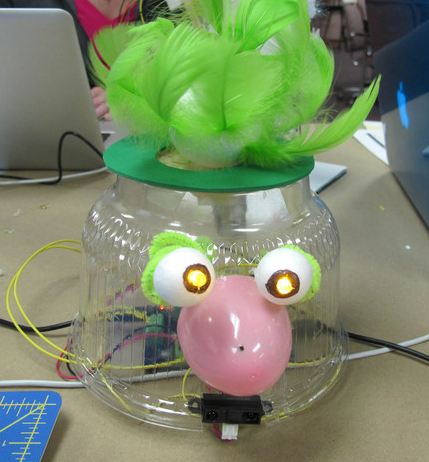
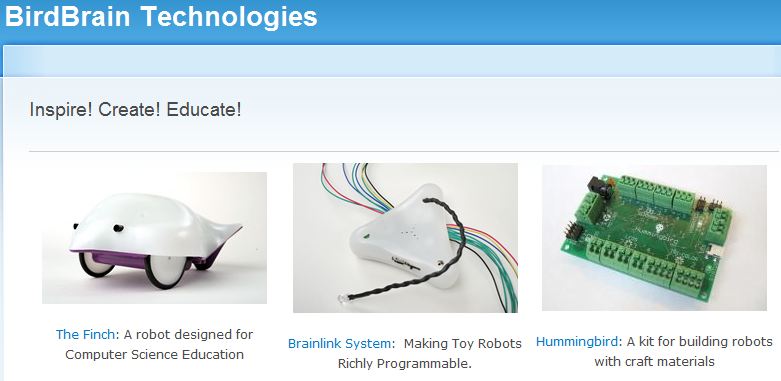
Another product intended to increase girls’ skill and confidence in working with technology is Hummingbird, an educational robotics kit.
Developed at Carnegie Mellon University’s Robotics Institute’s Arts and Bots program, spin-off startup BirdBrain Technologies, showcases robotics with craft materials and text to communicate thoughts, feelings, or ideas.

The kit includes a control board, lights, sensors, and motors.
Students (usually ages 11 and up) program their creations on a computer by dragging and dropping icons, so they don’t have to learn computer languages.

Students have experimented with making a robot from cardboard wrapped in tin foil that can twirl, flash lights, and even impersonate the Star Wars robot, R2D2.
Another project was a dragon made of paper and popsicle sticks that flaps its wings and hisses.
Others crafted a robotic arm with muscles made of cast-off pantyhose.

Pennsylvania students analyzed poetry, then created animated scenes for poems using the kit.
Elsewhere high school students created kinetic sculptures with sensors that detect environmental changes and respond with movement.
Others built a “coin monster” for the school’s ancient coin exhibit.

Emily Hamner

Emily Hamner

Research Associate Emily Hamner and Tom Lauwers, the founder of BirdBrain Technologies conducted workshops to learn girls’ goals and interests in making robots.
They learned that girls are most interested in creating robots that can tell stories, dance, communicate, and interact with people.

Hamner and Lauwers’ goal is to enable young people “to create whatever they can imagine,” to inspire students’ interest in STEM careers, and to increase their “understanding and confidence in using the technology.”

-*What toys and games have you seen increase young people’s interest in Science, Technology, Engineering, and Mathematics activities?

LinkedIn Open Group Women in Technology (sponsored by EMC)
Twitter: @kathrynwelds
Google+
Facebook Notes:
Blog: – Kathryn Welds | Curated Research and Commentary

©Kathryn Welds

Career Resilience in Managing Job Loss, Unexpected Changes

Mary Lynn Pulley

Mary Lynn Pulley

Mary Lynn Pulley, a Center for Creative Leadership adjunct faculty member and author of Losing Your Job – Reclaiming Your Soul: Stories of Resilience, Renewal, and Hope, shares practical recommendations to respond to change or hardship:

Resilience enables people to recover from adversity and is characterized by some of the same attributes as Emotional Intelligence:

• Flexibility
• Durability
• Optimism
• Openness to learning.

The flipside of resilience is burnout, fatigue, malaise, depression, defensiveness and cynicism.

Pulley asserts that resilience can be developed by modifying thoughts to broaden personal outlook and adapt to change.
The second step is modifying actions based on modified attitudes, beliefs, and concepts.

She suggests developing resilience by:

Embracing continuous learning
• Learn and apply new skills to more adapt more quickly during changes
Finding purpose
• Develop a “personal why” to provide meaning and context to work
• Take responsibility to direct your personal and career development
• Separate who your self-definition and core identity from your work tasks and job title. “Who you are is not just what you do.”

Cultivating relationships
• Maintain personal and professional relationships for support and feedback, to develop perspective, achieve goals, deal with hardships

Questioning and modifying self-definition and career
• Reassess awareness of personal skills, talents and interests, and personal narrative
• Consider new work opportunities to align with current skills
• Practice new behavioral competencies to align with current situational requirements

Re-thinking money
• Live within your means to remain flexible during unexpected change

Keeping a journal
• The Center for Creative Leadership suggests that writing in “learning journals” or “reflection journals” enables reflection, self-awareness, learning, adaptability, and insight.

Three recommended journal sections include:
1. Event or experience
Describe the occurrence in factual, objective, quantifiable terms:
Who? What? When? Where? How? Why?

2. Reaction
Describe your reaction to the event in factual, objective, quantifiable terms. What did you want to do in response to the event?
What did you actually do?
What were your thoughts?
What were your feelings?

3. Lessons
What did you learn from the event and from your reaction to it?
What did the event suggest as a development area?
What common reaction patterns occur in similar situations?
What different reactions patterns have occurred in the past?
What do these different reactions suggest about progress in developing resilience?

The Center for Creative Leadership suggests that learning comes “reflecting on the doing,” and not just on the “doing” of specific actions.

-*Which of Pulley’s recommendations seem most applicable and feasible to rebound from unbidden changes, like job loss?

LinkedIn Open Group Brazen Careerist
Twitter: @kathrynwelds
Google+:
Facebook Notes:
Blog: – Kathryn Welds | Curated Research and Commentary

©Kathryn Welds

Glass Elevator and Nine Principles for Personal Branding, Career Impact

Ora Shtull

Ora Shtull

Ora Shtull points to the small number of women leading Fortune 500 companies to argue that women can benefit from adopting nine practices to enhance personal branding.

Her book, The Glass Elevator – A Guide to Leadership Presence for Women on the Rise, focuses on: The Glass Elevator

• High-impact communication through asking strategic questions,

• Practicing confident body language in posture, body position, and vocal projection,

• Listening to learn and understand,

• Developing a collaborative relationship with your manager,

• Partnering with team members and direct reports to deliver results,

• Expanding your network by being likable and generous,

• Asking for what you want and creating “win-win” proposals,

• Sharing your differentiators,

• Adopting a positive outlook, even if at first it’s “as-if.”

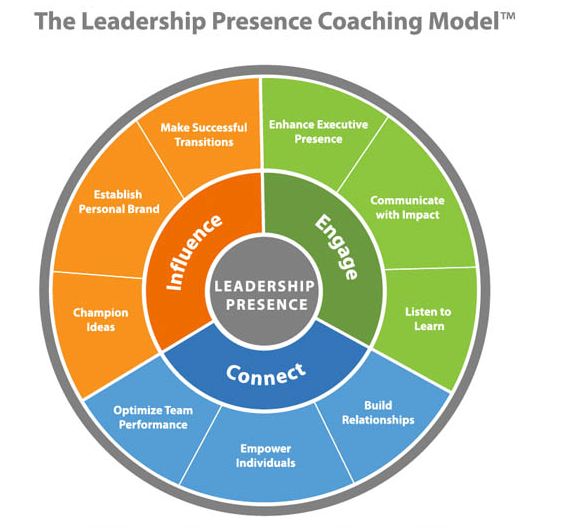
Shtull developed a comprehensive Leadership Presence Coaching model based on the principles of Influence-Engage-Connect.

-*Which of Shtull’s recommendations have most helped you ride the “Glass Elevator”?

Related Posts:

©Kathryn Welds