Enabling Neurodiversity in the Workplace with Early Detection, Intervention

Eugene Edgar

Eugene Edgar

Reading and related language and information processing skills are crucial for effective academic and occupational performance.
For example, people with reading difficulties face challenges in completing education, securing post-college employment and advancing in careers, found University of Washington’s Phyllis Levine and Eugene Edgar.

However, early detection and intervention can equip people for effective performance in school and work situations by practicing required skills and learn problem solving skills to manage these information processing differences.

Kineret Sharfi

Kineret Sharfi

People with learning disabilities including reading difficulties face significant challenges: They are significantly less likely to attend 4-year college programs or graduate, noted Haifa University’s Kineret Sharfi and Sara Rosenbaum.

David Goldstein

David Goldstein

Similar results were reported separately in a study of U.S. high school graduates from classes of 1985-1990, interviewed in the next 5 year, by De Paul University’s Christopher Murray, with Donald E. Goldstein, Steven Nourse and Eugene Edgar of University of Washington.

Tomer Einat

Tomer Einat

Of even greater concern is that learning disabilities (LD) including low reading skills, were significantly associated with ADHD, school dropout age, and onset of criminal activity among Israeli-born prisoners, according to Bar-Ilan University Tomer Einat and Amela Einat of Tel-Hai Academic College.

Michelle Patterson

Michelle Patterson

Further, these information processing challenges were also prevalent among homeless adults in Canada, reported Simon Fraser University’s Michelle Patterson, Akm Moniruzzaman, and Julian M. Somers with Charles James Frankish of University of British Columbia.

Travis White-Schwoch

Travis White-Schwoch

For those with years of practice in reading, Northwestern’s Travis White-Schwoch noted that learning to read is a chief developmental milestone with lifelong consequences.”
His research colleagues Kali Woodruff Carr, Elaine C. Thompson, Samira Anderson, Trent Nicol, Steven G. Zecker, Ann R. Bradlow and Nina Kraus added “… an ongoing challenge has been to identify candidates for intervention at a young-enough age.

Kali Woodruff Carr

Kali Woodruff Carr

However, it’s possible to identify potential reading difficulty is possible as early as age three.
This early awareness can enable early remediation efforts including skill-building in phonics, sound blending, phonograms, and close listening for comprehension and memorization, suggested among multi-media interventions and practice processes by Johns Hopkins’ Crystal Kelly and Linda Campbell.

Travis White-Schwoch 2White Schwoch’s team asked 112 children ages 3 – 14 years to detect consonants while in a noisy environment.
These children selected and watched a movie in separate booths while wearing electroencephalograms (EEG) and headphones, which provided “babbling” (semantically anomalous English sentences) in the right ear and “da” sounds in the left ear as the movie’s audio played .

Samira Anderson

Samira Anderson

The group accurately predicted that children with higher scores on a test understanding sounds that make up words and sentences (“phonological awareness”) were were more able to quickly and accurately detect the “da” sound.
Similarly, higher performance on phonological awareness predicted higher scores on a literacy test a year later among 37 four year old pre-reading children.

Trent Nicol

Trent Nicol

Neurodiversity” at work is a more frequent topic in popular business publications, public policy and diversity efforts, so it’s essential to understand the complexity of acquiring information processing skills, and the adverse consequences for those who don’t master these capabilities.

Steven Zecker

Steven Zecker

As a result, progressive workplaces enable greater inclusion of these different abilities by offering skill enhancement opportunities for those whose reading difficulties affect their ability to perform their work responsibilities.

-*How do you enable people with neurodiversity to optimally perform in the workplace?

Follow-share-like http://www.kathrynwelds.com and @kathrynwelds

Related Posts:

Twitter: @kathrynwelds
Google+

LinkedIn Groups Psychology in Human Resources (Organisational Psychology)
Facebook

Blog: – Kathryn Welds | Curated Research and Commentary

©Kathryn Welds

Reduce Rumination, Stress by Taking a Walk in Nature, Viewing Animals

More than 50% of people live in urban environments and most have relatively infrequent contact with nature, according to research published by the United Nations.

Theo Lorenc

Theo Lorenc

One consequence is that many urban dwellers with decreased exposure to nature report “changes in psychological functioning” including ruminative thoughts – repetitive thoughts about negative aspects of the self – and depressed feelings, found University College London’s Theo Lorenc, Mark Petticrew, and Steven Cummins with Stephen Clayton of University of Central Lancaster, and David Neary of University of Manchester, University of Liverpool’s Margaret Whitehead, Hilary Thomson of University of Glasgow,  University of York’s Amanda Jayne Sowden, and Adrian Renton of University of East London.

Stephen Clayton

Stephen Clayton

Contact with nature can affect cognitive performance as well as emotional experience: Children living in urban environments with consistent views of nature outside their windows, performed better on:

  • Working memory (backward digit span, backward alphabet span),
  • Impulse inhibition (matching familiar figures task),
  • Selective attention (Stroop color-word task),
  • Concentration (Necker Cube pattern control task), reported by University of Illinois Urbana-Champaign’s Andrea Faber Taylor, Frances Kuo, and William C. Sullivan.
Andrea Faber Taylor

Andrea Faber Taylor

Urban environments are thought to require substantial top-down voluntary attentional control to filter relevant from irrelevant stimuli.
At the same time, built landscapes can deplete cognitive resources, worsening performance on tasks requiring focused attention, noted University of Uppsala’s Terry HartigGary W. Evans of University of California, Irvine with Marlis Mang of Planning & Design Solutions.

Terry Hartig

Terry Hartig

Walking for 90 minutes in nature reduced ruminationblood flow, and neural activity in the subgenual prefrontal cortex (sgPFC), reported Stanford’s Gregory N. Bratman, Kevin S. Hahn, Gretchen C. Daily, and James J. Gross with J. Paul Hamilton of Laureate Institute for Brain Research.
This brain area has been linked to self-focused behavioral withdrawal and rumination among both healthy and depressed people.

Gregory Bratman

Gregory Bratman

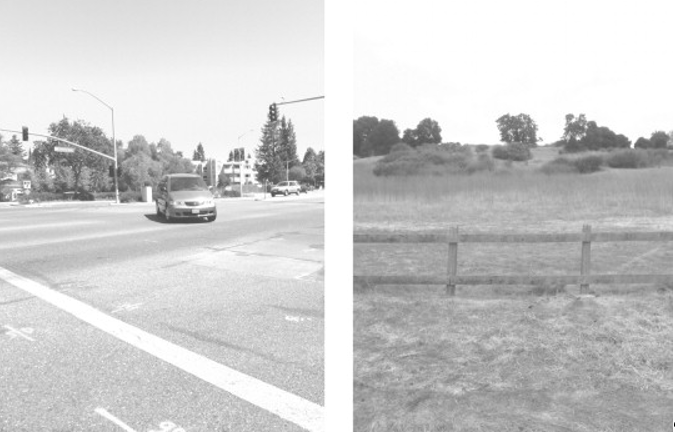
More than 35 volunteers rated their proneness to ruminate with negative thoughts, then half walked alone for 90-minutes without music through undeveloped open space hills through grassland with scattered shrubs and oak trees along a paved path.
They were told to take ten photographs of “whatever captured their attention” to disguise the study’s hypotheses.

Urban vs Rural Walks

Kevin Hahn

Kevin Hahn

Remaining participants walked alone without music down a busy, paved six-lane road with traffic for the same time period.

Following the walks, volunteers again rated their likelihood to repeatedly think negative thoughts.
They also completed a brain scan and cognitive and emotional assessment instruments including:

Lee Anna Clark

Lee Anna Clark

Positive and Negative Affect Scale (PANAS) developed by Southern Methodist University’s David Watson, with Lee Anna Clark and Auke Tellegen of University of Minnesota,

Backward digit span, developed by David Wechsler of Bellevue Hospital,

Jin Fan

Jin Fan

Attention Network Task (ANT- executive attention subtest), developed by Mount Sinai’s Jin Fan, Bruce D. McCandliss and John Fossella of Cornell, Yale’s Jonathan I. Flombaum and Michael I. Posner of University of Oregon,

Rumination-Reflection Questionnaire (RRQ) by Ohio State’s Paul Trapnell and Jennifer Campbell, including items like “I often reflect on episodes of my life that I should no longer concern myself with”),

Nash Unsworth

Nash Unsworth

Operation Span Task (OSPAN) developed by Georgia Tech’s Nash Unsworth, Richard Heitz and and Randall Engle with Josef Schrock o Marysville College,

State-Trait Anxiety Inventory (STAI), developed by University of South Florida’s Charles D. Spielberger, 

Visuospatial working memory (change detection), developed by University of Iowa’s Steven J. Luck and Edward K. Vogel,

Thinking in a Second Languages Reduces Decision Bias 

Boaz Keysar

Boaz Keysar

People who can think in a foreign language are more able to rationally analyze risk compared with evaluating risk in their native language, found University of Chicago’s Boaz Keysar, Sayuri L. Hayakawa, and Sun Gyu An.

Sayuri Hayakawa

Sayuri Hayakawa

When volunteers analyzed risks presented in their native language, they were risk-averse when considering potential gains and more risk- tolerant when considering possible losses.
However, they were did not show this risk assessment bias when they considered the same risks vs rewards in a foreign language.
Using a foreign language reduced loss aversion and increased acceptance of hypothetical and real bets with positive expected values.

Micheline Favreau

Micheline Favreau

This effect could occur because foreign languages are typically processed more slowly than in a native tongue, leading to more deliberate cognitive processing, argued Concordia University’s Micheline Favreau and Norman Segalowitz.

Norman Segalowitz

Norman Segalowitz

Foreign language processing generally requires greater cognition-intensive systematic, analytical effort, leading to increased emotional and cognitive distance than in a native tongue, suggested Princeton’s Daniel Kahneman in his distinction between Thinking Fast and Slow.

Stefano Puntoni

Stefano Puntoni

Even when people fully understand language nuances including colloquialisms, impolite words, terms of endearment and reproach, they react less emotionally in a foreign language, according to self-report and electrodermal measurements, found Erasmus University’s Stefano Puntoni, Bart de Langhe of University of Colorado, and Cornell’s Stijn M.J. van Osselaer.
As a result, more than half the participants preferred the riskier option presented in a foreign language instead of the native tongue.

Richard Thaler

Richard Thaler

This finding confirmed participants’ tendency toward myopic risk aversion, or greater sensitivity to losses when thinking and acting in their native languagedescribed by University of Chicago’s Richard Thaler, Amos Tversky of Stanford, Princeton’s Kahneman, and Alan Schwartz of University of Illinois.

Amos Tversky

Amos Tversky

Among more than 140 native Korean speakers and more than 100 English speakers in Paris, Keysar’s team confirmed the same pattern of enhanced deliberation and reduced framing effects in a foreign language in hypothetical low-loss, high-gain bets.
Just 57 percent of Korean-speaking participants accepted bets offered in Korean, contrasted with 67 percent when offered in English, suggesting heightened deliberation in a second language.

Daniel Kahneman

Daniel Kahneman

Likewise, more than 50 English-speaking volunteers who spoke Spanish as a second language received $15 in $1 bills, which could be kept or bet on a coin toss.
For every lost toss, participants lost $1.
However, if they won, they kept the $1 and earned another $1.50, a significant return on the chance bet.
When conducted in participants’ native English language, 54% accepted bets, whereas when presented in Spanish, 71% agreed to bet.

Alan Schwartz

Alan Schwartz

“They take more bets in a foreign language because they…are less affected by the typically exaggerated aversion to losses … People who routinely make decisions in a foreign language rather than their native tongue might be less biased in their savings, investment, and retirement decisions, as a result of reduced myopic loss aversion” wrote Keysar and colleagues.

-*How do you reduce “myopic risk aversion” in your native language?

Follow-share-like http://www.kathrynwelds.com and @kathrynwelds

Related Posts:

Twitter: @kathrynwelds
Google+
LinkedIn Groups Psychology in Human Resources (Organisational Psychology)
Facebook

Blog: – Kathryn Welds | Curated Research and Commentary

©Kathryn Welds

Change Future Time Perspective to Reduce Procrastination

Neil Lewis

Neil Lewis

Future events seemed more “proximal” or occurring sooner when volunteers considered in days rather than months or years.

This shift in perspective made the Future Self and the future event seem more tangible and connected to the Present Self, enabling participants to begin progress toward distant goals, according to University of Michigan’s Neil Lewis and Daphna Oyserman of the University of Southern California.

Daphna Oyserman

Daphna Oyserman

Many people know the dilemma between purchasing expensive clothes now instead of putting the money into retirement savings or between enjoying dessert now when “swimsuit season” is just weeks away.
This pull between current rewards and costs vs future events and required efforts was labeled temporal discounting by Stanford’s Kacey Ballard and Brian Knutson.

Kacey Ballard

Kacey Ballard

People may not act when considering future events like retirement because they focus more on whether to take action in the present.
In contrast, people tend to concentrate how to act when faced with imminent situations requiring attention, according to temporal construal theory, described by NYU’s Yaacov Trope and Nira Liberman.

Yaacov Trope

Yaacov Trope

Further, people may not act when an anticipated Future Self seems incongruous or disconnected with the Present Self, found Williams College’s Kris Kirby with Nancy Petry of University of Vermont and Virginia Tech’s Warren Bickel.

Nancy Petry

Nancy Petry

When volunteers have begun preparing for the future, such as a work presentation, saving for a home, retirement, or children’s education, they saw metrics implying when a future event will occur.

More than 160 volunteers considered six scenarios — three with time metrics and three without.
For the time-metric situations, participants imagined that they were shopping, studying, or carrying out other tasks in preparation for future events — a birthday party, presentation, wedding, exam — and were asked to report how long it would be until those events occurred.

Warren Bickel

Warren Bickel

When participants considered time in the smaller of two possible units, the event seemed closer – an average of 29.7 days sooner when considered in days instead of months and an average of 8.7 months sooner when considered in months instead of years.

In other Lewis and Oyserman studies, more than 1100 participants in the U.S. indicated when they should start saving for a future scenario such as a child’s college education, measured either as 18 years or 6,570 days.

Nira Liberman

Nira Liberman

People who realized that this event would arrive within days planned to start saving four times sooner than those who thought that educational expenditures were years away, even when controlling for income, age, and self-control.

In contrast, when participants hadn’t begun preparing for an expected future event, they considered metrics as implying when they should start preparing.

This difference in time perspective can affect whether people achieve future goals that require consistent, long-term investments of time, effort, and money.
In fact, Oyserman argues that changing time perspective is  “… a new way to think about reaching goals that does not require willpower and is not about having character or caring.

Brian Knutson

Brian Knutson

Since the majority of people do not save save sufficient financial resources for required future expenditures, changing time metrics to more granular measures can make both future goals and one’s Future Self more aligned with the Present Self.

-*How do you align Future Self with Present Self when working toward future goals?

Follow-share-like http://www.kathrynwelds.com and @kathrynwelds

Related Posts:

Twitter: @kathrynwelds
Google+
LinkedIn Groups Psychology in Human Resources (Organisational Psychology)
Facebook
Blog: – Kathryn Welds | Curated Research and Commentary

©Kathryn Welds


Peer-Rated Personality Traits Predict Longevity

Joshua Jackson

Joshua Jackson

Self-rated personality traits and ratings by others effectively predicted mortality risk, according to Washington University’s Joshua J. Jackson, working with James J. Connolly and Madeleine M. Leveille of Connolly Consulting to collaborate with Vanderbilt University’s S. Mason Garrison and Touro University Seamus L. Connolly.
In fact, and friends’ ratings were even better predictors of longevity than were self-reports of personality,

E. Lowell Kelly

E. Lowell Kelly

The team used 75 years of data beginning in 1935 from Kelly/Connolly Longitudinal Study on Personality and Aging (KCLS), along with mortality information across 75 years, developed by University of Michigan’s E. Lowell Kelly and James J. Conley.

Robert McCrae

Robert McCrae

Both study participants and their close friends rated volunteers’ personality traits, “Big Five” traits—conscientiousness, extroversion, agreeableness, neuroticism and openness—described by NIH’s Robert McCrae and Paul Costa.

James Connolly

James Connolly

Male participants seen by their friends as more conscientious and open lived longer, whereas friend-rated emotional stability and agreeableness predicted longevity for women.
Men’s self-ratings of personality traits were somewhat accurate predictors of lifespan, but not women’s self-reports.

Mason Garrison

Mason Garrison

Jackson’s group noted that friends’ ratings were more reliable predictors because multiple evaluations were aggregated rather than relying on a single self-rating.
In addition, “…friends may see something that you miss; they may have some insight that you do not….people may be biased or miss certain aspects of themselves and we are not able to counteract that because there is only one you, only one self-report.

David Yeager

David Yeager

Comparing self-reports with multi-rater reports, University of Pennsylvania’s Angela Duckworth and David Scott Yeager of University of Texas Austin concluded that  “…each approach is imperfect in its own way.

These findings reinforce the importance of multi-rater feedback to provide insight into long-standing personality trends affecting health status.
This increased self-awareness can help people increase conscientious self-care, optimism, agreeableness, and calm stability to enhance long term health status.

-*How have you helped others improve health status by modifying personality styles?

Follow-share-like http://www.kathrynwelds.com and @kathrynwelds

Related Posts:

Twitter:@kathrynwelds
Google+LinkedIn Groups Psychology in Human Resources (Organisational Psychology)
Facebook
Blog: – Kathryn Welds | Curated Research and Commentary

©Kathryn Welds

Managing Collective Emotions Affects Leader Reputation, Impact

Gustave Le Bon

Gustave Le Bon

People in groups and crowds demonstrate collective affect, according to Gustave Le Bon, who asserted that individuals in these contexts collectively act with “impulsiveness, irritability, incapacity to reason, the absence of judgment of the critical spirit, the exaggeration of sentiments…” even if these are not their usual individual behaviors.

Adolph Hitler

Adolph Hitler

Well before the rise of charismatic leader Adolph Hitler, Le Bon claimed that “…an individual immersed for some length of time in a crowd soon finds himself…. in a special state, which much resembles the state of fascination in which the hypnotized individual finds himself in the hands of the hypnotizer.

One way to evaluate individual and collective affect is through facial expressions because they provide information about how others understand people and events.
As a result, these non-verbal cues enable people to tailor responses to individuals and groups they encounter.

Peter Salovey

Peter Salovey

Tailoring interaction style based on observing others is a key element of Emotional Intelligence, described by Yale’s Peter Salovey and Daisy Grewal as accurately perceiving others’ emotional states and effectively responding with emotionally-charged interpersonal situations.

Daisy Grewal

Daisy Grewal

This is also an essential leadership skill because it enables awareness of sentiments that may be out of others’ awareness or that they may consciously try to suppress to align with prevailing organizational cultures — particularly those that do not encourage emotional awareness and expression.

Hillary Anger Elfenbein

Hillary Anger Elfenbein

Consequently, accurate perception of others’ emotions is related to effectively managing interpersonal relationships according to University of California, Berkeley’s Hillary Elfenbein and to subordinates’ ratings of managers as transformational leaders in research by Depaul University’s Robert S. Rubin, David C. Munz of Saint Louis University and Cleveland State University’s William H. Bommer.

However, accurate perception of group sentiment is difficult because many people narrow attention to a few individuals and to focus in detail on them, leading to perceptual bias of collective “tunnel vision.”

Takahiko Masuda

Takahiko Masuda

As a result, much information in social context, including the group’s prevailing emotional tone, may be filtered out, noted University of Alberta’s Takahiko Masuda, Phoebe C. Ellsworth of University of Michigan, Wake Forest University’s Batja Mesquita, Janxin Leu of University of Washington, Hokkaido University’s Shigehito Tanida, and Ellen Van de Veerdonk of University of Amsterdam.

Executives and leaders must decode and attend to collective emotions because they often cannot develop individual relationships with each of their many stakeholders and when addressing group emotions including:

Phoebe Ellsworth

Phoebe Ellsworth

  • Employees’ collective anxiety about corporate restructuring, mergers, divestitures, and reductions in force,
  • Consumers’ collective anger,
  • Board of Directors members’ lack of support.
Jennifer George

Jennifer George

Positive collective emotions tend to be over-estimated, and linked to greater customer service and lower absenteeism, reported Texas A & M’s Jennifer George.
In contrast, negative collective emotions like envy are easily under-estimated, and associated with lower group performance and satisfaction by reducing group potency and cohesion in research by University of Kentucky’s Michelle Duffy and Jason Shaw.

Michelle Duffy

Michelle Duffy

A leader’s ability to respond effectively to patterns of shared emotions during strategic organizational change and other emotionally turbulent organizational processes depends on the leader’s ability to widen the “emotional aperture.”

Emotional Aperture 1Like a camera’s aperture adjustment for increased depth of field, emotional aperture refers to ability to recognize the mix of positive and negative emotional experiences in a team, workgroup or business unit.

This “setting change” can bring into focus both nearby individuals and more distantly scattered groups of people.
Likewise, adjusting the emotional aperture involves moving an information-processing focus from individual emotional experiences to a group’s collective emotional composition.

David Matsumoto

David Matsumoto

Although ability to recognize individual emotional expression has been measured by instruments like the Brief Affect Recognition Testthis tool doesn’t evaluate perception and recognition of collective affect.

Jeffrey Sanchez-Burkes

Jeffrey Sanchez-Burkes

To address this limitationUniversity of Michigan’s Jeffrey Sanchez-Burks and Caroline A. Bartel of University of Texas collaborating with Vanderbilt University’s Laura Rees and Quy Huy of INSEAD developed an Emotional Aperture Measure (EAM).

EAM analyzes a person’s ability to accurately perceive a group’s collective emotions in short video clips of employee groups before and after an organizational event.
Next, participants estimate the proportion of rapid individual positive and negative reactions among group members.
Feedback from this instrument can increase perceiver accuracy through heightened awareness.

Caroline Bartel

Caroline Bartel

Sanchez-Burks contacted direct reports of a global sample of high-ranking managers and requested online evaluations of the manager’s leadership performance.
Three studies demonstrated that collective affect recognition requires a distinct information processing style, differing from perceiving individual emotion.

Laura Rees

Laura Rees

Managers’ EAM performance was significantly correlated with direct reports’ perception of managers’ “transformational leadership” behaviors, suggesting that this ability to accurately perceive group emotion can significantly influence stakeholder impressions and opinions.

People can open their emotional aperture through attention to collective emotions, and may influence prevailing negative group affect by asking the positive minority to share optimistic sentiments with the skeptical majority.
This dialog can increase trust and shared perspectives that may move negative sentiment to become more positive.

Quy Huy

Quy Huy

Leaders who increase the range of their “emotional aperture” can increase followers’ alignment with strategic direction to increase the likelihood to effective execution and change impact.

Try the Emotional Aperture Measure to see your results.Emotional Aperture Measure

-*How do you read the “emotional tone” of a group?

Related Posts:

©Kathryn Welds

Debiasing Decisions: Combat Confirmation Bias, Overconfidence Bias

Philip Meißner

Philip Meißner

Cognitive and behavioral biases can contribute to “blind spots” in decision-making, leading to less effective outcomes.
To improve decision outcomes, University of Marburg ’s Philip Meißner, Torsten Wulf of HHL Leipzig Graduate School of Management and HEC’s Olivier Sibony proposed a systematic checklist to identify potential decision derailment based on bias, along with rapid remedies.

Torsten Wulf

Torsten Wulf

They argues that two types of bias contribute to most decisions that lead to undesirable results:

  • Confirmation bias, the unconscious tendency to believe new information that is consistent with existing beliefs and recent experiences, and to discount contradictory data,
  • Overconfidence bias, the out-of-awareness likelihood to overestimate one’s skills, insights, and judgment.
    This leads to increased risk-taking based on illusory sureness of the decision and ability to mitigate adverse outcomes.

Olivier Sibony

Olivier Sibony

Previously, Lovallo and Sibony articulated four related decision biases:

  • Pattern-recognition biases, countered by changing the “angle of vision,”
  • Action-oriented biases, mitigated by recognizing uncertainty,
  • Interest biases, minimized by explicitly highlighting these interests,
  • Social biases, reduced by depersonalizing debate.

Debiasing techniques such as checklists, can limit the negative effects of biases in decision-making by offering a disciplined, comprehensive analysis of downside risks and by systematically considering multiple viewpoints.

Atul Gawande

Atul Gawande

However, effectively implementing checklists requires consistent discipline, noted Harvard’s Atul Gawande, who cited examples of partial adherence leading to costly oversights and failures.

One approach, suggested by Princeton’s Daniel Kahneman and Gary Klein of McKinsey, is a “premortem.”
Decision makers imagine that the decision has failed and analyze sources and reasons for adverse outcomes, to more thoroughly assess points of failure and possible mitigation strategies.
Formal scenario-planning is another way to expose assumptions underlying a plan, as well as a competitor’s priorities and potential strategy.

Massimo Garbuio

Massimo Garbuio

Using a variety of debiasing techniques significantly increased the Return on Investment (ROI) in a study by University of Sydney’s Massimo Garbuio and Dan Lovallo and Olivier Sibony of HEC.
As a result, Michael Birshan, Ishaan Nangia, and Felix Wenger of McKinsey, argued that debiasing techniques should be embedded in formal organizational decision-making processes, particularly for high-impact, repetitive decisions.

Michael Birshan

Michael Birshan

Decision biases may be out of awareness, or unconscious, so it’s more effective to evaluate the process of developing a proposal, rather than focusing only on the content and merits of a proposal.

Decision-making safeguards can be built into standard analysis processes by including questions to expose:

  • Multiple data sources,
  • Diverse opinions and perspectives,
  • Downside risk,
  • Potential negative outcomes for company, industry, and broader ecosystem.

Daniel Kahneman

Daniel Kahneman

Proposals are considered ready for a decision only when multiple perspectives are available to mitigate confirmation bias and risk analysis is available to reduce overconfidence bias.
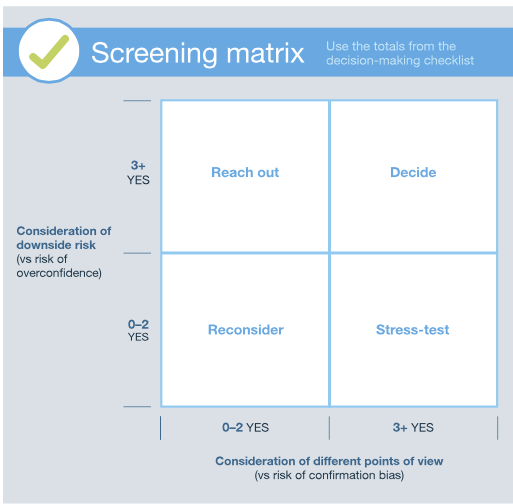
Responses to decision checklist questions can be quantified to indicate one of four action steps, according to Daniel Kahneman:

  • Decide, based on inclusion of robust safeguards against both confirmation bias and overconfidence bias,
  • Screening MatrixReach out, suggesting the need for gathering additional perspectives, opinions, and perspectives to prevent narrow assumptions to reduce confirmation bias.
    The Vanishing-Options Test, proposed by Stanford’s Chip Heath and Dan Heath of Duke University, can generate new ideas by imagining that none of the current proposals are available.
  • Stress-test, by conducting a pre-mortem or analysis by external devil’s advocate or provocateur to reduce overconfidence risk by.
  • Reconsider when both more perspectives and risk analysis are required to reduce both overconfidence bias and confirmation bias.
    This screening matrix helps reduce related decision-making biases:
  1. Self-interest Bias
    -To what extent is the proposal motivated by self-interest?

Ishaan Nangia

Ishaan Nangia

Recommendation
-Assess for over-optimism

  1. Affect Heuristic
    -How strong is the team’s emotional attachment to a specific proposal?
    -To what extent were risks and costs fully considered for both preferred and non-preferred options?

Recommendations
-Assess for strongly-preferred outcomes
-Reintroduce analysis of all options

  1. Groupthink
    -How many dissenting opinions were analyzed?
    -How adequately were all options explored?
    -Was dissent discouraged? 

Felix Wenger

Felix Wenger

Recommendations
-Encourage substantive disagreements as a valuable part of the decision process
-Solicit dissenting views from members of the recommending team, through private meetings

4. Saliency Bias
     -To what extent are decisions made based on a potentially incomparable, but memorable success?
     -What about the proposed analogy is comparable to the current situation?
     -What are relevant examples from less successful companies? What happened in those cases?

Decision Making QuestionsRecommendation
-Carefully scrutinize analogies’ similarity to the current decision situation
Solicit additional analogies using reference class forecasting:

.Select reference class,
.Assess distribution of outcomes,
.Intuitively estimate project’s position in distribution,
.Assess estimate’s reliability,
.Correct intuitive estimate.

  1. Confirmation Bias
    -What viable alternatives were included with the preferred recommendation?
    -At what stage in the decision analysis were alternatives discarded?
    -What efforts were undertaken to seek information to disconfirm the main assumptions and hypotheses?

Recommendation
-Request two additional alternatives to the main recommendation, including analysis of benefits and drawbacks
-Acknowledge unknowns, risks

  1. Availability Bias

    Max Bazerman

    Max Bazerman

    If you had more time to gather date, what information would you seek?, asked Harvard’s Max Bazerman
    -How can you access similar data now?

Recommendation
-Use checklists to ensure comprehensive analysis of data required for each decision type

  1. Anchoring Bias
    -What data sources are used to analyze decision?
    -Which data are estimates? By whom? If so, from which data were estimates extrapolated?
    -To what extent could there be:
  • Unsubstantiated numbers?
  • Extrapolation from non-equivalent previous situations?
  • Attraction to specific anchors?

Recommendations
-Present data from other sources, benchmarks, or models
-Request new analysis

8. Halo Effect
     -To what extent does the analysis team expect that a person, organization, or approach previously successful in one context will be equally effective in different situation?

Phil Rosenzweig

Phil Rosenzweig

Recommendations
-Question potentially inaccurate inferences
-Solicit additional comparable examples
-Question attributions of success and failure to leaders’ personalities instead of chance factors, advised IMD’s Phil Rosenzweig.

9. Sunk-Cost Fallacy, Endowment Effect
     -To what extent are recommenders attached to past decisions?

Recommendation
Disregard past expenditures when considering future costs and revenues

  1. Overconfidence, Planning Fallacy, Optimistic Biases, Competitor Neglect
    -To what extent is the comparison case unwarrantedly optimistic?

Recommendation
-Adopt an outside view by using relevant simulations or war games

  1. Disaster Neglect
    -To what extent is the worst case scenario realistically and sufficiently negative?
    -How was the worst case generated?
    -To what extent does the worst case consider competitors’ likely responses?
    -What other scenarios could occur?

Recommendation
-Conduct a premortem, suggested by Gary Klein of Applied Research Associates:  Imagine the worst case scenario occurred, then propose likely causes, mitigations   

  1. Loss Aversion
    -To what extent is the evaluation and decision team risk averse?

Recommendation
-Realign incentives to share responsibility for the risk or to reduce risk

  1. Planning Fallacy focuses only on the current case while ignoring similar projects’ history and statistical generalization from related cases.
    -To what extent does the analysis rely on “top-down, outside-view” comparisons to similar projects?
    -Did the evaluators use a “bottom-up, inside-view” to estimate time required for each step?

Recommendation
-Statistically analyze a broad range of similar cases to avoid over-estimates from “top-down, outside-view” approaches and underestimates from “bottom-up, inside-view”
-Differentiate accurate forecasts from ambitious targets

  1. Loss aversion
    -To what extent are evaluators more concerned with avoiding loss than achieving gains?
    – How concerned are evaluators with being held responsible for a failed project?
    -To what extent has the organization specified acceptable risk levels?

Recommendation
-Seek risk tolerance guidelines from organizational leaders.

Decision-making tools like checklists can significantly reduce unconscious biases, provided that they are consistently and systematically applied.

-*What strategies have you found most helpful in reducing biases in decision-making?

Follow-share-like http://www.kathrynwelds.com and @kathrynwelds

Related Posts:

Twitter:  @kathrynwelds
Google+LinkedIn Groups Psychology in Human Resources (Organisational Psychology)
Facebook
Blog:  Kathryn Welds | Curated Research and Commentary

©Kathryn Welds


Cynical Beliefs Linked to Lower Earnings, Poorer Health

Olga Stavrova

Olga Stavrova

People who hold cynical beliefs about human nature and the world have lower incomes than those with a more optimistic view, found University of Cologne’s Olga Stavrova and Daniel Ehlebracht.

Cynical beliefs are measured by statements including:

  • “I think most people would lie to get ahead,”
  • “It’s safer to trust nobody,”
  • “Most people will use somewhat unfair reasons to gain profit or an advantage rather than lose it.”

Daniel Ehlebracht

Daniel Ehlebracht

People who agree with these ideas may avoid cooperation, trust and collaboration with others and while focusing on monitoring, control, and preventing potential exploitation.

Volunteers who endorsed these self-protective behaviors and cynical beliefs reported lower personal income than people who demonstrate greater trust and interpersonal collaboration in studies using a representative sample of Americans between 1986 and 2012, and replicated with a representative German group between 2003 and 2012.

Robert McCrae

Robert McCrae

A related study showed that income-suppressing cynical beliefs are not associated with enduring personality characteristic measured by Robert McCrae of NIH and Paul Costa’s Big Five personality dimensions.

In addition, lower earnings were not explained by cynical individuals’ poorer health, lower education, and greater agreement with items that measure neuroticism and introversion.

Paul Costa

Paul Costa

However, some cynical beliefs are justified by the local environment, such as in counties with low levels of charitable giving, high homicide rates and high overall societal cynicism levels.
Survey data from 41 countries showed that people in these contexts who held cynical beliefs did not have lower personal income than those with more optimistic views.

Anna-Maija Tolppanen

Anna-Maija Tolppanen

Holding cynical beliefs about people was also associated with greater risk of dementia and death among the elderly in a study over 8 to 10 years, according to University of Eastern Finland’s Elisa NeuvonenMinna Rusanen, Anna-Maija Tolppanen, collaborating with Alina Solomon of University of Kuopio, Flinders University’s Tiina Laatikainen, with Tiia Ngandu of Finland’s National Institute for Health and Welfare, Hilkka Soininen of Hospital District of North Karelia, and Kuopio University Hospital’s Miia Kivipelto.

Alina Solomon

Alina Solomon

The team measured cynical distrust with the Cook-Medley Hostility Scale (CMHS) by University of Minnesota’s Walter Cook and Donald Medley, and cognitive status using screening, clinical phase, and differential diagnosis using the Diagnostic and Statistical Manual of Mental Disorders, 4th Edition (DSM-IV) criteria for more than 1450 people.

People with highest level of cynical distrust had higher risk of dementia after the researchers controlled for confounding factors including:

  • Age,
  • Gender,
  • Systolic blood pressure,
  • Total cholesterol,
  • Fasting glucose,
  • Body mass index,
  • Socioeconomic background,
  • Smoking,
  • Alcohol use,
  • Self-reported health,
  • Apolipoprotein E (APOE).

Tiina Laatikainen

Tiina Laatikainen

People with highest levels of cynical distrust were three times more likely to develop dementia than people with low levels of cynicism, even when Neuvonen’s team controlled for effects of dementia risk, including high blood pressure, high cholesterol and smoking.

Tiia Ngandu

Tiia Ngandu

This finding supports suggestions that people who are more open and optimistic have a lower risk for dementia.

Hilary Tindle

Hilary Tindle

In related findings, positive expectations about the future, and trait optimism were associated with reduced rates of coronary heart disease (CHD) and mortality in postmenopausal women, reported University of Pittsburgh’s Hilary A. Tindle, Yue-Fang Chang, Lewis H. Kuller, Greg J. Siegle, Karen A. Matthews, collaborating with Harvard’s JoAnn E. Manson, Jennifer G. Robinson of University of Iowa, and University of Massachusetts’ Milagros C. Rosal.

Michael Scheier

Michael Scheier

More than 97,250 white and black women with no signs of cancer and cardiovascular disease completed the Life Orientation Test–Revised (LOT-R) by Carnegie Mellon’s Michael Scheier and Charles Carver of University of Miami, plus the Cook Medley Questionnaire’s cynicism subscale.

Charles Carver

Charles Carver

Women who scored in the top quartile for optimism had lower age-adjusted rates of Coronary Heart Disease (CHD) and total mortality.
Black women with this optimistic perspective also had significantly less cancer-related mortality.

In contrast, those who scored in the top quartile for cynical hostility had significantly higher rates of CHD and total mortality, reinforcing the value of cultivating a positive viewpoint.

Hilkka Soininen

Hilkka Soininen

Likewise, individuals with the highest cynical distrust measured by Cook-Medley Hostility Scale had higher risk of dementia after adjusting for confounding factors including socioeconomic position, lifestyle, alcohol use, and health status, found Neuvonen’s team.

Financial, physical, and cognitive well-being can be enhanced by cultivating optimism and trust and reducing cynicism.

-*How do you increase and sustain optimism, trust, and collaboration?

Follow-share-like http://www.kathrynwelds.com and @kathrynwelds

Related Posts:

Twitter:  @kathrynwelds
Google+LinkedIn Groups Psychology in Human Resources (Organisational Psychology)
Facebook
Blog: – Kathryn Welds | Curated Research and Commentary

©Kathryn Welds

Power, Confidence Enhance Performance Under Pressure    

Sonia K. Kang

Sonia K. Kang

Role-based power can affect performance in pressure-filled situations, but has less impact on lower pressure environments, according to University of Toronto’s Sonia K. Kang, Adam D. Galinsky of Columbia University, University of California, Berkeley’s Laura J. Kray and Aiwa Shirako of Google.

Kang’s team assigned more than 130 volunteers to same-gender pairs in three negotiations experiments.
Half the participants acted as a “recruiter” (high-power role) or as a “job candidate” (low-power role) in negotiating salary, vacation time, and related benefits.

Adam Galinsky

Adam Galinsky

Volunteers were told that performance either reflected negotiation ability or was unrelated to ability.
Participants in high power roles tended to perform better under pressure when they were told their negotiation performance was an accurate reflection of ability.
Kang attributed this result to participants’ higher expectations for success based on the higher power role.

Job candidates who thought their negotiation performance indicated their skill level performed significantly worse than those who thought that the exercise was a learning experience unrelated to their negotiating capabilities.

Claude Steele

Claude Steele

Results were similar to Claude Steele of Stanford’s findings for stereotype threat and stereotype uplift, in which individuals from marginalized groups perform less effectively than members of higher-power groups, linked to negative self-attributions and expectations.
Low-power negotiators counteracted underperformance when they self-affirmed their performance.

Laura Kray

Laura Kray

Kang and team concluded that “relative power can act as either a toxic brew (stereotype/low-power threat) or a beneficial elixir (stereotype/high-power lift) for performance… (because) performance in high pressure situations is closely related to expectations of behavior and outcome… Self-affirmation is a way to neutralize … threat.

Aiwa Shirako

Aiwa Shirako

In another experiment, 60 male MBA students were paired as the “buyer” or “seller” of a biotechnology plant.
The sellers held a more powerful role in this situation, and were more assertive, reflected by negotiating a higher selling price, when they thought performance reflected ability.
In contrast, buyers performed worse when they thought negotiating performance reflected ability.

Kang’s team extended this scenario with 88 MBA students (33 male pairs and 11 female pairs), who were told the exercise would gauge their negotiating skills.
Before the negotiation, half of the participants wrote for five minutes about their most important negotiating skill, while the remaining half wrote about their least important negotiating skill.

Buyers who completed the positive self-affirmation performed significantly better in negotiating a lower sale price for the biotechnology plant, effectively reducing the power differences between the buyer and seller.

Based on these findings, Kang advocates writing self-affirmations rather than simply reflecting on positive self-statements about job skills and positive traits to enhance confidence and performance.

-*How do you mitigate differences in role-based power and confidence when performing under pressure?

Related Posts:

©Kathryn Welds

Three Approaches to Identifying a Career Path

-*What’s the best way to find your professional path?

Mark Savickas

Mark Savickas

Career interventions have evolved over the past 70 years from individual differences assessment to occupational development to current emphasis on life planning.
Vocational guidance was supplanted by “career education,” focused on fulfilling developmental tasks and adapting to occupational requirements.
More recently, “career counseling” built on the preceding approaches by considering each individual as the designer and author of a career path.

Mark Savickas of Northeast Ohio Medical University traced this incremental change, and noted that “each time that society has changed the prevalent form of employment, psychology has changed its methods of career intervention to help people deal with new identity issues and lifestyle problems.”

John Holland

John Holland

Early attempts to help people find their occupational paths focused on matching six personality prototypes incorporating six related value types with six associated vocational categories, thanks to John Holland of Johns Hopkins, who developed the Self Directed Search assessment.

Holland's Six Career Themes

Holland’s Six Career Themes

Individual were seen as “actors” who needed to match individual differences with occupations that best fit these characteristics.

John Crites

John Crites

Next came an emphasis on careers as a developmental challenge that requires adaptation and training to develop new attitudes, beliefs, and competencies that foster their vocational adaptation.

Donald Super

Donald Super

People were seen as “agents” striving to develop into an occupational role, with insight from assessments including the Career Maturity Inventory by University of Maryland’s John Crites and Career Development, Assessment, and Counseling (C-DAC) conceived by Donald Super of University of Connecticut.

Careers are currently seen as a “narrative construction” or a “life design project” drawing on emotion valence, autobiographical career stories and life themes that suggest professional construction and reconstruction.

Individuals are seen as “authors” of their career narrative in context of a life story.
Savickas developed this constructivist perspective to serve “workers in societies that have de-standardized the life course and de-jobbed employment” after applying Holland’s individual differences approach and developmental views of Crites and Super.

Three Career Development Approaches

Three Career Development Approaches


Paul Hartung

Paul Hartung

To enable this career narrative, Savickas and Northeast Ohio Medical University colleague Paul Hartung developed a structured career interview.
This “Autobiographical Workbook” asks people to share stories about self, identity, and career, including inquiries about role models, favorite magazines, how they made important decisions, and what their parents wanted for their lives to uncover prevailing interests, values, concerns, and precipitants to action.Career Construction Interview

Ludwig Wittgenstein

Ludwig Wittgenstein

This approach helps people “envision how to use work to actively master what they passively suffer” and “fit work into life rather than life into work” by collecting stories about “…how a person constructed a career, then deconstructs and reconstructs these stories into an identity narrative, and finally co-constructs intentions that lead to action in the real world.
Narrative Construction and Life Design perspectives echo Ludwig Wittgenstein’s observation that problems are solved not by giving information but by rearranging what we already know.

In this collection and rearrangement process, Savickas sees the individual as a career architect whereas a career consultant is like a carpenter who suggests recombinations in light of current needs and future goals while respecting interests, values, and strengths.

This process also enables new perspectives on more productive approaches to past challenges when encountered in future contexts, working around obstacles, and drawing on past examples of competence and self-efficacy.

  • Which perspective on career development most guided your selection of work paths?

Related Posts:

©Kathryn Welds