Category Archives: Working Women

Working Women

Role Pioneers May Encounter “The Glass Cliff”

Sally Ride

Sally Ride

Marissa Mayer

Marissa Mayer

Holding a role usually occupied by the other gender can lead to significant media coverage, such as Sally Ride’s selection as an astronaut or Marissa Mayer’s appointment as CEO of Yahoo while in the later stages of her first pregnancy.

However, incumbents of roles usually held by people of the other gender can evoke harsh judgments about competence and suitability for leadership roles, according to Yale’s Victoria Brescoll and Erica Dawson with Eric Luis Uhlmann of HEC Paris.

Victoria Brescoll

Victoria Brescoll

This effect was most noticeable when both male and female leaders in “gender-incongruous” roles made minor errors in experimental studies.
Both male and female evaluators judged minor mistakes as indicators of role incompetence when male and female leaders held jobs typically performed by the other gender.

Erica Dawson

Erica Dawson

Brescoll, Dawson and Uhlmann suggested that “gender-incongruous” roles are seen as “ambiguous” by observers, leading to uncertainty, and negative assessments to “restore implicit order.”
The team referred to this rater bias as the “glass cliff effect.”

The researchers concluded that “the high status and senior leadership achieved by both men and women in gender-incongruent roles is fragile, vulnerable and unstable.”

Eric Luis Uhlmann

Eric Luis Uhlmann

This effect may be due to both the role’s gender incongruity and high status.
An earlier blog post highlighted Alison Fragale’s demonstration that higher status individuals are judged more harshly than lower status people when they make the same mistakes.

Alison Fragale

Alison Fragale

Her team at University of North Carolina found that observers in two experiments attributed greater intentionality, malevolence, self-concern to the actions of high status wrongdoers – and recommended harsher punishment for the same actions that earned lower status people “the benefit of the doubt.”

Although Brescol, Dawson and Uhlmann did not offer recommendations to mitigate the risks of being a pioneer in holding non-traditional job roles, Fragale’s team found that high status wrongdoers could protect from the impact of subsequent mistakes by demonstrating, warmth and concern for others and engaging in charitable giving.

Other strategies to consider include:

  • Cultivating strong executive alliances and sponsorship
  • Assembling a risk mitigation team to provide expert messaging during a crisis, focusing on external attributions of the error
  • Balancing demonstrated competence with the “humanness” of a small error
  • Offering plans for future action unrelated to the error to demonstrate decisive leadership and action-orientation.

-*What approaches are most effective to mitigate “The Glass Cliff”?

RELATED POSTS:
Women’s Likeability – Competence Dilemma: Overcoming the Backlash Effect


©Kathryn Welds

Executives with Daughters and Sisters: More Generous?

Michael Dahl

Michael Dahl

Cristian Dezső

Cristian Dezső

Male CEOs paid employees more after the birth of their first child when it is a daughter, but paid employees an average of $100 less annually after the birth of a son, according to Michael Dahl of Aalborg University with University of Maryland’s Cristian Dezső and David Gaddis Ross of Columbia Business School in their study of more than 10,000 Danish companies between 1996 and 2006.

David Gaddis Ross

David Gaddis Ross

Female employees typically received higher wages after the birth the CEO’s first child of either gender, and were less adversely-affected than their male colleagues by wage decreases after the birth of CEOs’ children.

Paul Van Lange

Paul Van Lange

People with more sisters tended to show more generous “pro-social” behaviors in laboratory studies of 600 volunteers who played a simulation game requiring decisions about resource-sharing with strangers, according to Paul Van Lange of Free University in Amsterdam with colleagues Ellen De Bruin, Wilma Otten, and Jeffrey Joireman of Washington State University.

Jeffrey Joireman

Jeffrey Joireman

Alice Eagly at Northwestern University suggests that men with sisters are significantly more likely to help others, based on her meta-analysis of 172 research studies.

Alice Eagly

Alice Eagly

In addition, she noted that men tend to help women more than other men.

Men behaved more generously when the cost was minimal in a modified dictator game, according to James Andreoni at the University of California, San Diego and Lise Vesterlund at the University of Pittsburgh.

James Andreoni

James Andreoni

In contrast, they noticed that women demonstrated greater generosity when the cost was high.

Lise Vesterlund

Lise Vesterlund

Andreoni and Vesterlund suggest that men are more responsive to price changes when mens “demand curves for altruism” cross those of women.
As a result, in this lab simulation, men behaved either extremely generously or selfishly, but women shared gains more equally.

Women’s direct presence on corporate boards – rather than their influence as sisters or daughts –  was correlated with increased economic value, according to Dezső  and Ross’s evaluation of the S&P 1,500 firms’ financial performance between 1992 and 2006.
Boards that included women generated an average of 1 percent more economic value – more than $40 million each – when the firm’s strategy is focused on innovation.

-*What corporate impact have you seen of male executives with daughters and sisters?

RELATED POSTS

Twitter:    @kathrynwelds
Blog: – Kathryn Welds | Curated Research and Commentary
Google+
LinkedIn Open Group Psychology in Human Resources (Organisational Psychology)
Facebook Notes:

©Kathryn Welds

Does Workplace Co-Location Increase Collaboration and Innovation?

John Chambers

John Chambers

In 2009, Cisco CEO John Chambers asserted that “the face-to-face meeting is a dinosaur,” and he demonstrated his point in a Telepresence-enabled company meeting from Bangalore, India with his fellow executive, Marthin de Beer, in San Jose, California.

Marthin de Beer

Marthin de Beer

Marisa Mayer of Yahoo seems not to agree with Chambers’ premise.

Her highly-publicized decision to require remote workers to work on-site every day in Yahoo offices received mixed reviews from advocates of flexible work practices such as ROWE (Results-Only Work Environment).

Marissa Mayer

Marissa Mayer

Mayer argued that co-location will enable Yahoos to more effectively collaborate and innovate.

-*What is the evidence for – or against – her assertion?

Eduardo Salas

Eduardo Salas

A decade ago, in 2003, a meta-analysis of face-to-face meetings’ impact on group cohesiveness, task commitment, authority, communication noted the one benefit of virtual meetings: “status-equalizing impact of computer-supported cooperative work … enables greater participation by women, minorities and other traditionally lower status groups.

Florida Maxima Corporation’s James Driskell collaborated with Paul Radtke, Naval Air Warfare Center Training Systems Division and University of Central Florida’s Eduardo Salas summarized often-conflicting findings on the impact of virtual teams  and concluded that interaction in virtual environments requires consideration of the type of task that the team is performing.
Agile software development is an example of a process that originally assumed – and required –  team member co-location.

Sandeep Joshi

Sandeep Joshi

Microsoft trainer Sandeep Joshi offered an alternate model to co-location for Agile development, and argued that some tasks in the Agile development process are suitable for remote work by distributed teams.
Because more than half of respondents to VersionOne’s 2012 State of Agile survey said they use Agile with co-located and distributed teams, or plan to do so in the future, Joshi advocates maintaining collaborative, co-located design processes to capitalize on group interaction, then “de-Agilizing” the process to enable individual coding before re-convening to evaluate the work in “rapid turns.”

Karen Sobel-Lojeski

Karen Sobel-Lojeski

Distance is not only physical, according to SUNY Stony Brook’s Karen Sobel-Lojeski. 
She conceptualizes three types of virtual distance:

  • Affinity (culture and background differences like ethnicity, educational background, past familiarity, shared vision, and commitment that affect team productivity and cohesiveness
  • Operational (type and frequency of communication)
  • Physical (geographic separation)
Richard Reilly

Richard Reilly

She collaborated with Richard Reilly of Stevens Institute of Technology on two books that explored perceived distance among co-workers, which can be reduced or increased by communication technology.

They argue that virtual distance changes the ways people learn, perform, and develop relationships with others in the workplace.

Like Joshi, they advocate analyzing the nature of the tasks and existing interpersonal relationships among team members before mandating co-location, virtual, or blended work arrangements.

Sobel-Lojeski and Reilly conclude that important workplace competencies are traversing boundaries, glocalization, and authenticity, leading to what they call “techno-dexterity” required for effective leadership in a wired world.

Among the drawbacks of co-location are increased work interruptions, which can reduce productivity and cognitive performance.

Alessandro Acquisti

Alessandro Acquisti

Carnegie Mellon University’s Alessandro Acquisti and  Eyal Pe’er  demonstrated decreased cognitive task performance after electronic interruptions and task-shifts similar to responding to a mobile phone call, text message or email.

More than 135 volunteers read a short document and answered questions about the content.
One third of the participants completed this portion of the experiment and served as the control group.

Eyal Pe'er

Eyal Pe’er

The remaining individuals were told they “might be contacted for further instructions” via instant message.

This alerted group completed a similar reading comprehension test, and half of this group actually received instant messages, whereas the other half didn’t receive the anticipated notices.

Both interrupted groups provided 20% less accurate responses than the control group, suggesting a significant cost to interruptions and task shifting.

However, when the interrupted group performed the similar task a second time, this group reduced the under-performance by 6%.
Those who were warned of an interruption that never came improved by 43 percent, and even outperformed the control test takers who were left alone.

Acquisti and Pe’er suggested that people may develop compensatory strategies to manage the performance impact of interruptions.

Gloria Mark

Gloria Mark

Likewise, University of California, Irvine’s Gloria Mark with Daniela Gudith and Ulrich Klocke of Germany’s Humboldt University reported that a typical office worker is interrupted about every 3-11 minutes and requires an average of 23-25 minutes to return to the original task.

Daniela Gudith

Daniela Gudith

Volunteers worked faster when they anticipate interruptions, particularly those who measured high on openness to experience and high on need for personal structure.
However, participants reported increased stress, higher workload, greater frustration, more time pressure and effort when they increased work speed.

Ulrich Klocke

Ulrich Klocke

These findings provide equivocal support for Mayer’s anticipated benefits from workplace co-location.
Her team may experience increased stress due to interruptions, task-shifting, and noise, in addition to any personal concerns about lengthy commutes and work-life balance.

This inference was supported in research by Harvard’s Leslie Perlow, who studied engineers working in an open-space environment.
These highly-skilled knowledge workers reported frequent interruptions and reduced productivity.

Leslie Perlow

Leslie Perlow

Perlow offered these engineers a recommendation:  Pre-scheduled interruption-free “quiet time”.
She found that this intervention led to increased productivity.

Catherine Kerr

Catherine Kerr

Similarly, Catherine Kerr of Brown University suggests that the impact of frequent task-shifts in open work environments can be mitigated by mindfulness meditation as brain training to enable increased attentional focus by attending to breathing.

Workplace inclusion and diversity issues add to questions of whether co-location actually increases innovation, collaboration, and productivity.
Pew Research Center reported that working mothers were more concerned with having a flexible schedule whereas working fathers placed more importance on having a high-paying job.

When employees actually use increasingly-available flexible work options, including job-sharing, telecommuting, and compressed work weeks, they may experience adverse career impacts.

Joan Williams

Joan Williams

Jennifer Glass

Jennifer Glass

Joan Williams, founding director of the Center for Work-Life Law at the University of California, Hastings College of the Law with  University of Iowas’ Jennifer Glass, Shelley Correll of Stanford and University of Toronto’s Jennifer Berdahl reported that men who take leave from work after the birth of a child were more likely to be penalized and less likely to get promoted or receive raises.

Shelley Correll

Shelley Correll

Jennifer Berdahl

Jennifer Berdahl

In addition, they found that women using flexible work arrangements receive differing feedback from others depending on their socioeconomic statusAffluent women were encouraged to stay at home, whereas less affluent women were more likely to be counseled not to have children.

Despite John Chamber’s death-of-face-to-face meetings assessment and recent findings by Kenneth Matos and Ellen Galinsky of the Families and Work Institute, Cisco Systems executives seem aligned with Mayer’s advocacy for in-person collaboration.

Kenneth Matos

Kenneth Matos

During a recent preview of renovated office buildings featuring “Collaborative Work Spaces,” Cisco business leaders asserted that the layout is intended to increase collaboration and attract recent graduates and other “younger talent” by “projecting a hip, innovative image in the work environment.”
They noted that this arrangement is actually more costly than offices and cubicles despite accommodating more workers in the same amount of space.

Ellen Galinsky

Ellen Galinsky

Past research suggest costs to adopting computer-mediated work processes, yet these technologies have improved, become more prevalent, and workers have become more skilled in their use.
Further, virtual collaboration enables workplace participation by people who might require flexible schedules, and reduces the environmental impact, cost, and perceived stress of commuting.

-*How is your productivity affected by physical proximity to your co-workers?
-*How do you manage distractions in open office environments?

——–

RELATED POSTS:

Twitter:  @kathrynwelds
Blog: – Kathryn Welds | Curated Research and Commentary
Google+
LinkedIn Open Group Psychology in Human Resources (Organisational Psychology)
Facebook Notes:

©Kathryn Welds

Power of “Powerless” Speech, but not Powerless Posture

Assertive speech is assumed to signal competence and power, pre-requisites to status, power, and leadership in the U.S. workplace.

Alison Fragale

Alison Fragale

However, University of North Carolina’s Alison Fragale demonstrated that warmth trumps competence in collaborative team work groups.

Fragale studied “powerless speech,” which has been believed to make a person seem tentative, uncertain, and less likely to be promoted to expanded workplace roles.
She defined “powerless speech” as including:

  • Hesitation: “Well” or “Um”, as known as “clutter words”
  • Tag questions: “Don’t you think?”
  • Hedges: “Sort of” or “Maybe”
  • Disclaimers: “This may be a bad idea, but … “
  • Formal addresses:“Yes, sir” or “Yes, ma’am”

In collaboration-based work teams, “powerless” speech characteristics are significantly associated with being promoted, gaining status and power.
Interpersonal warmth and effective team skills are valued more than dominance and ambition by team members and those selecting leaders for these teams.

Paul Hersey

Paul Hersey

In contrast, “powerful” speech does not feature these characteristics, is more effective when the task or group is independent and people are expected to work alone.

Ken Blanchard

Ken Blanchard

As in Paul Hersey and Ken Blanchard’s Situational Leadership, Fragale concludes that communication style should be tailored to group characteristics.

Li Huang

Li Huang

Likewise, INSEAD’s Li Huang  and Columbia’s Adam Galinsky with Lucia Guillory of Northwestern University demonstrated the impact of “powerful” body language – also called “playing big” –  on perceived power.

Adam Galinsky

Adam Galinsky

Although assuming “larger” postures is associated with credibility and authority, some situations benefit from assuming “smaller”, less powerful postures to establish warmth or to acknowledge another’s higher status.

Lucia Guillory

Lucia Guillory

As noted in an earlier post, Women Get More Promotions With “Behavioral Flexibility”, careful self-observation and behavioral flexibility based on situational requirements are effective foundations to establish group leadership.

-*How do you monitor and adapt “powerless” speech to work situations?

RELATED POSTS:

©kathrynwelds

Equal Pay Act’s Fiftieth Anniversary: Progress but no Parity

Equal Pay Act 1963

Equal Pay Act 1963

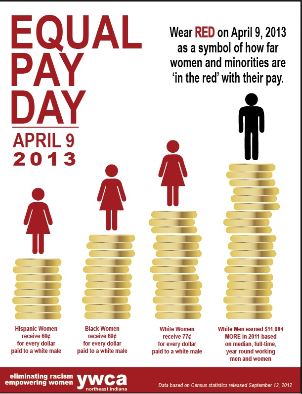
When U.S. President John F. Kennedy signed the Equal Pay Act in 1963, women earned 59 cents for every $1 earned by a man.

Today women are up to 77 cents on the dollar, according to the U.S. Equal Employment Opportunity Commission Chair Jacqueline Berrien.
She noted that the wage discrepancy is even larger for African American women and Latinas.

Jacqueline Berrien

Jacqueline Berrien

Women MBAs graduating from top U.S. business schools in 2012 fared slightly better than the national average, with 2012 Stanford alumnae earning just 79 cents for every $1 earned by a male grads, according to Bloomberg Businessweek’s annual surveys of 24,716 recent MBA graduates from each year’s top 30 U.S. business schools since 2002.
Given the substantial investment of time, money, and effort in obtaining these advanced degrees, women graduates may question this Return on Investment (ROI).

Women from the MBA classes of 2012 averaged 7.3 percent less than their male counterparts with average salaries of $105,059.
This wage disparity is more than triple the 2.2 percent gap women MBAs experienced in 2012 on average earnings of $83,404.

The survey considered pay differences by industries and found women lagged behind men in pay in eight of 11 sectors in 2012, including accounting, finance, marketing, and operations.
The gap has increased across industries since 2002, even in non-finance fields like information technology and entrepreneurship.

The largest pay differential was in highly-compensated financial fields like venture capital and private equity field, where women earned only 82.5¢ for every dollar men made — about 10 ¢ less on the dollar than in 2002.
In contrast, consulting offered the closest pay parity in 2012, with women earning 99¢ for every dollar of male classmates’ salaries.

Women earned more than men in three industries: human resources, non-profits, and investment banking.
The first two industries tend to attract more women and be lower-paid than other fields.

EEOCBerrien, of the EEOC, opined that with the current backsliding in parity progress, the gender pay gap is predicted to close in another 44 years, in 2057 — provided that there is no further deterioration of pay equity advancement.

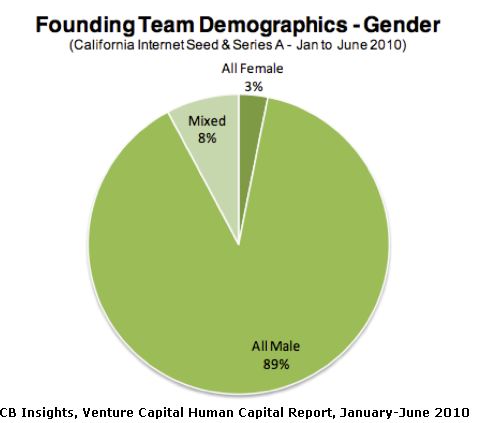
CB Insights reported that in California from January-June 2010:CI Insights Founder Gender - 2010

  • 89 percent of series A and seed-funded companies had all male founders, compared with only 8 percent that had founders of both genders, and just 3 percent of businesses with all female founders
  • 82 percent of company founders were white, compared to 18 percent that were Asian or Pacific Islander

Equal Pay DayThe 2013 Silicon Valley Index, compiled by economic think tank Joint Venture Silicon Valley found significant income disparities by race in addition to gender from 2009-2011:

  • African-American residents’ income dropped 18%, compared to a 4% decrease across the U.S.
  • Hispanic resident’ income decreased 5%, similar to the rest of California
Catherine Bracy

Catherine Bracy

Catherine Bracy observed that the average woman in Silicon Valley, California’s “economic powerhouse”, earns 49 cents for every dollar men make in Silicon Valley, when averaging incomes of African American and Hispanic women residents.

NerdWallet analyzed data from the U.S. Census for 366 metro areas to determine the lowest pay gaps for women in small, medium, and large cities, and concluded that on balance, Silicon Valley was one of the “best places for women to work.”

Wage discrepancy in one of the U.S.’s most economically viable areas, whether around the national average or well below, demonstrates that 50 years after the Equal Pay Act, the average female worker in the U.S. is far from earning an equal wage.

Happy Anniversary, Equal Pay Act of 1963, and Many Happy Returns of the day for at least 44 years, until women’s pay may be equal across industries and geographies.

RELATED POSTS:

Twitter:    @kathrynwelds
Blog: – Kathryn Welds | Curated Research and Commentary    
Google+:
LinkedIn Open Group Psychology in Human Resources (Organisational Psychology)
Facebook Notes:

©Kathryn Welds

Harvard B-School Women “Lean Out” of the Workforce?

First HBS Women

First HBS Women

Women were first admitted to Harvard Business School in 1963, and 50 years later, women are not 50% of the students at HBS.
They trail at 42% for the currently-admitted class, up from the 40% at the time of this survey.

Robin Ely

Robin Ely

Robin Ely of Harvard conducted a survey of of 3,786 women and 2,655 men HBS graduates and found that more than 70% of alumnae are in the paid workforce, and 56% work full time.

Of the 10% of alumnae ages 31 to 47 who “lean out” to care for children full time, only 3% said they planned not to return to return.

HBS 50Ely argues that rather than leaning out, women are actually pushed out or pulled out of the workforce:

“…a whole set of experiences … look less like women opting out, and more like women being pushed out, by organizations that demand a 24/7 work schedule…Women are being pulled out by a culture that promulgates a compelling—some might say guilt-inducing—image of mothering that is hard to live up to while you are trying to hold a job.”

Among women working part-time, three-fourths are engaged in pro bono and volunteer efforts, suggesting that these women continue to have demanding schedules.
More than 63% of the women report regular or significant volunteer commitments, with 67% of those caring for children full-time reporting substantial volunteer activity.

HBS WomenYounger women with two or more children are less likely to be in the workforce than those with no children: 37% for parents vs 9% for the non-parents.

And among the younger cohort of Gen X’ers, 13% of women are working part-time, contrasted with 2% of Gen X men.

At the other end of the age-experience spectrum, another type of “age-approriate opting out” was reported by 43% of female graduates ages 48-66 no longer working full-time.
In contrast, only 28% of men in the same age range were not longer employed, reinforcing previous findings that men work both more hours per year and more years over their careers, leading to higher overall career earnings.

More than 84% of female respondents acknowledged “taking leaves or reducing work hours” hold back women from career advancement.

HBS RestroomThe second most-cited impediment to career advancement for women was “prioritizing family over work,” according to 82% of the female respondents.

Most alumnae reported organizational factors limit women’s advancement:

  • Lack of senior female role models
  • Inhospitable corporate cultures
  • Lack of supportive environments

Fewer than half of the women under the age of 67 report being satisfied with their professional accomplishments or opportunities for career growth.
In contrast, the majority of men agree that their work is meaningful and satisfying.

Drew Gilpin Faust

Drew Gilpin Faust

Harvard’s President Drew Gilpin Faust noted that, women are not equally represented in top leadership roles, echoing statistics showcased by HBS grad Sheryl Sandberg.
She share that women:

  • Comprise 4 percent of Fortune 500 Company CEOs
  • Lead fewer than 10 percent of America’s venture capital firms
  • Hold 26 percent of US full professorships
  • Serve in 20 percent of top US government jobs
Sheryl Sandberg

Sheryl Sandberg

Ely believes that organizations, women, and families will benefit from recruiting and hiring women who have opted out of full-time work but now want to resume their careers, because today’s graduates can expect to live nearly a century.

This change in hiring practices can increase use of top talent while reducing the substantial regret and dissatisfaction many HBS women experienced in their career trajectories.

As one highly-educated, highly-skilled women reflected on her sense of under-utilization and under-employment in a large global organization: “I don’t want to have to go home and vacuum to feel like I’ve accomplished something.”

Organizational policy can increase firms’ profitability, competitiveness, and innovation by deploying top talent across generations and genders, and this HBS study points to one source of potential talent.

-*What actions should individual women and organizations implement to increase the utilization of skilled women’s talents in the workplace?

Related Post

Women’s Post-Business School Work-Life Issues

Twitter:  @kathrynwelds
Blog: Kathryn Welds |Curated Research and Commentary
Google+:
LinkedIn Open Group Psychology in Human Resources (Organisational Psychology)
Facebook Notes: 

©Kathryn Welds

Gender Differences and Diversity in Corporate Interaction Styles, Financial Outcomes

Gender makes a difference in interaction styles on corporate boards, and the ratio of women to men on these boards is linked to corporate financial performance.

Interaction Styles

Gregory McQueen

Gregory McQueen

Chris Bart

Chris Bart

McMaster University’s Chris Bart and Gregory McQueen of Western University of Health Sciences surveyed 600 board directors (75% male) and found that men tended to base corporate decisions on tradition, rules, and regulations, whereas women tended to ask questions to develop more solution options, cooperate, and consider the interests of all stakeholders.

Nanette Fondas

Nanette Fondas

Nanette Fondas, then of Duke University, and Susan Sassalos, now of Edison International found that women on corporate boards influence other board members to act more “civilized” and “sensitive to other perspectives.”

Val Singh

Val Singh

In the same vein, Cranfield University’s Val Singh reported that women on corporate boards also reduce ‘game playing’ among board members.

Siri Terjesen

Siri Terjesen

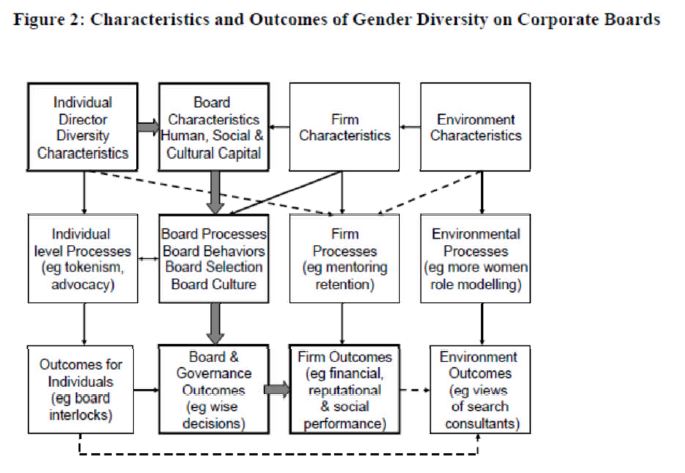
With Siri Terjesen of Indiana University and Cranfield University’s Ruth Sealy, Singh evaluated existing research on corporate board gender diversity to develop a model of analysis by:Val Singh - Gender Diversity on Corporate Boards Model

  • Individual
  • Board
  • Firm
  • Industry and Environment

Financial Performance:

Nancy Carter

Nancy Carter

Catalyst’s Nancy Carter and Lois Joy with Harvey Wagner of University of North Carolina and Michigan State University’s Sriram Narayanan found that Fortune 500 boards with 3 or more women report:

Harvey Wagner

Harvey Wagner

compared to boards with more men.

Nick Wilson

Nick Wilson

Nick Wilson and Ali Altanlar of Leeds University added another financial indicator affected by gender ratios on boards.

Ali Altanlar

Ali Altanlar

In their analysis of 17,000 UK companies that went insolvent in 2008, Wilson and Altanlar reported even one female board director reduces bankruptcy risk by 20%.

Pepperdine University’s Roy D. Adler studied 200 companies among the Fortune 500 to mine data from 1980 through 2001 and reported results consistent with the Catalyst investigation.

Roy Adler

Roy Adler

Adler and team identified the firms that had a record of promoting women to high levels and compared their profit performance to the median performance of Fortune 500 firms in the same industries.

The researchers separately compared profits as a percentage of sales, of revenues and of assets and found that for 2001, the 25 firms with the strongest record of promoting women to high organizational levels outperformed the industry medians with:

  • 34 percent higher revenue
  • 18 percent higher assets
  • 69 percent higher equity.

The 10 firms with the very best records of promoting women showed greater profits than competitors, and results were confirmed in subsequent studies in 2004 through 2008.
Adler and team noted that the odds of all 18 financial measures favoring women are 262,114 to 1, suggesting that these findings were not random errors.

Cristian Dezso

Cristian Dezso

Likewise, University of Maryland’s Cristian Dezső and David Ross of Columbia University found that companies with one or more women in top management  close to CXO level perform better than other companies, based on their assessment of the largest 1,500 public US companies from 1992 to 2006.

Sheryl Sandberg

Sheryl Sandberg

Sheryl Sandberg isn’t the only one to ask “Why so few?” in corporate and government leadership roles, particularly when these results consistently point to the financial benefits of more women in top decision-making roles.

AAUW

AAUW

American Association of University Women asked the same question about women in Science, Technology, Engineering, and Mathematics roles, and concluded that there remains a large gap in equal gender representation in leadership roles and in technical careers – and this discrepancy comes at the price of financial performance and organizational climate.

  • Where have you observed work group interaction differences depending on the ratio of women?
  • What financial impacts have you observed for organizations with women in top leadership roles?
    Level of Analysis Model

RELATED POSTS:

Twitter: @kathrynwelds
Google+
Blog
: – Kathryn Welds | Curated Research and Commentary 
LinkedIn Open Group Psychology in Human Resources (Organisational Psychology)
Facebook Notes:

©Kathryn Welds

What Do (Executive) Women (and Men) Want? Accenture Uncovers Priorities

Martha Bernays Freud-Sigmund Freud

Martha Bernays Freud-Sigmund Freud

Accenture’s online survey of 4,100 business executive women and men born between 1946 and 1994 from medium to large organizations across 33 countries sought to answer the updated version of Sigmund Freud’s question: “What do women want?”

Conducted in November 2012, the survey’s margin of error is +/-2 percent, with at least 100 respondents from each country, except Denmark, Finland, Norway and Sweden where the combined number totaled 200.

It provides some answers:  Women’s – and men’s top priorities in defining career success are:

  • Work-life balance
  • Money
  • Recognition
  • Autonomy
Frederick Herzberg

Frederick Herzberg

This finding contradicts Frederick Herzberg’s theory that people are less motivated by “hygiene factors” like work-life balance and money than “motivation factors” like recognition and autonomy.

In contrast to Yahoo’s much-publicized ban on working remotely, 80 percent of male and female respondents reported that having flexibility in their work schedule is extremely or very important to work-life balance and more than three-quarters (78 percent) agree technology enables them to be more flexible with their schedules.

This is an important value statement in light of landmark findings that lack of flexibility and control in work environments has been associated with poorer health indicators and status than roles with greater flexibility

Hannah Kuper

Hannah Kuper

Hannah Kuper and Michael Marmot of University College London analyzed health outcomes of British civil service workers in the Whitehall I and II studies and found employees with least control over their work lives, typically associated with lower employment grade and lower social class, consistently had the poorest well-being and the highest mortality rates.

Michael Marmot

Michael Marmot

Marmot with other researchers who analyzed Whitehall study data, including Geoffrey Rose, surmise that not having discretion over how a task is accomplished, underutilizing skills, lack of clarity and predictability in job role can lead to job stress and physical indicators like abnormal heart rate and blood pressure, increased blood cortisol.

Erin Kelly

Erin Kelly

Phyllis Moen

Phyllis Moen

More than half of all respondents said they declined a job due to concerns about its impact on work-life balance, also reported by Erin Kelly and Phyllis Moen of University of Minnesota, suggesting that Yahoo’s policy could lead to significant attrition over time.

To realize monetary goals, the majority of respondents – 49 percent of women and 57 percent of men – had asked for or negotiated a pay raise, and four out of five respondents who negotiated a pay raise received one.

These rates represent a substantial increase over the year before in which 44 percent of women and 48 percent of men reported asking for a pay increase.
Notably, the percentage of men requesting more money increased considerably more than the percentage of women in that year period.

Linda Babcock

Linda Babcock

This result is more encouraging than Linda Babcock’s finding that women tend not to ask for raises, and tend not to receive them when they do ask.

Sheryl Sandberg

Sheryl Sandberg

Even Sheryl Sandberg wasn’t inclined to negotiate for her salary when offered the role as COO of Facebook until she forcefully urged by her husband and brother-in-law, she revealed on 60 Minutes while promoting Lean In.

The Accenture study may demonstrate a changing trend for the better:  Almost half of all respondents reported that they had asked for a promotion, suggesting greater willingness to advocate for themselves to achieve the second priority, monetary reward.

-*How well do Accenture’s findings reflect your career priorities?

Related Posts

Twitter:    @kathrynwelds
Google+:
Blog: – Kathryn Welds | Curated Research and Commentary 
LinkedIn Open Group Psychology in Human Resources (Organisational Psychology)
Facebook Notes:

©Kathryn Welds

Results-Only Work Environments, Productivity, and Employee Engagement

Cali Ressler-Jody Thompson

Cali Ressler-Jody Thompson

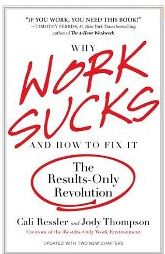
Why Work SucksJody Thompson and Cali Ressler proposed compensating employees based on outputs, rather than elapsed time, in a “Results-Only Work Environments (ROWE)” policy.

This management strategy evaluated “performance, not presence” practices at Best Buy and has been implemented at another large retailer, Gap.
Is this is a return to a “piece-work” approach of decades ago?
Or is it a performance management practice that emphasizes achieving targeted results?

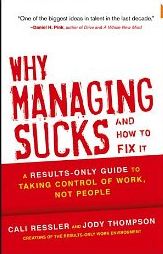
Why Managing SucksROWE  is being considered at such tech giants as Cisco Systems, in direct contrast to Yahoo’s recent call for employees to be present in offices.
The underlying goal of Yahoo’s “presentism” policy may be to increase innovative performance outputs, although the explanation provided to employees emphasized presence as a prerequisite for effective collaboration.

Widespread negative reaction to Yahoo’s on-site work policy, based on complaints that the policy:

  • Conveys lack of trust in employees
  • Undermines opportunities to manage complex work-life responsibilities
  • Places emphasis on “face time” rather than results
  • Leads to employee resentment and disengagement.
Erin Kelly

Erin Kelly

In contrast, University of Minnesota sociologists Erin Kelly and Phyllis Moen with University of Delaware’s Eric Tranby documented the positive impact of ROWE practices in their survey of more than 600 Best Buy employees before and after the program was implemented.

Phyllis Moen

Phyllis Moen

The researchers found turnover was reduced by 45 percent after they controlled for gender, job level, organizational tenure, job satisfaction, income adequacy, job security and turnover intentions.

Participants reported reduced stress and improved work-home interfaces by increasing employees’ schedule control, and reduced the “opting out” of the workforce due to personal commitments for both men and women.

Eric Tranby

Eric Tranby

Kelly, Moen, and Tranby opine that ROWE “moves us away from the “time cages” developed around the work day…ROWE challenges these taken-for-granted clockworks…our mantra is ‘change the workplace, not the worker’.

Rachelle Hill, also of University of Minnesota collaborated with Moen and Kelly in a related study that documented ROWE moderated turnover effects of negative home-to-work spillover, personal troubles, and physical symptoms.

-*What impacts – positive and negative – have you seen in “Performance, not Presence” workplace policies like ROWE?

RELATED POST

©Kathryn Welds

Genes Influence Investment Risk-Taking: Implications for Taking Career Risks?

Camelia Kuhnen

Camelia Kuhnen

Brian Knutson

Brian Knutson

Camelia Kuhnen, then of Stanford with her Stanford colleague Brian Knutson and Vanderbilt’s Gregory Samanez-Larkin posit a small but meaningful genetic basis to risk-averse financial investing, providing a biological basis for findings that women hedge fund managers outperformed male counterparts.

Volunteers with two short serotonin transporter genes (5-HTTLPR) reported that they tend to worry, and this pattern was associated with chosing less risky investment choices.

Gregory Samanez-Larkin

Gregory Samanez-Larkin

“Short allele carriers” also showed higher levels of the personality trait “neuroticism,” but no significant difference in cognitive skills, education, or financial status.
Kuhnen estimates that less than 30 percent of variance in risk-taking is attributable to short 5-HTTLPR, and the remaining difference is derived from experience, culture, education, and social environment.

Kuhnen and Knutson reported the neural basis of financial risk taking using event-related fMRI.
They observed that the nucleus accumbens was activated before volunteers made risky choices and made risk-seeking mistakes.
In contrast, they found that the anterior insula was activated before risk-free choices and risk-aversion mistakes.

They proposed that different neural circuits are associated with differing emotions as volunteers anticipate gain or loss associated with financial choices.
This emotional activation “signature” can lead to specific investment choices, favoring or avoiding risk, and may lead to investing mistakes.

In unpublished research, Kuhnen found that short-allele carriers showed increased anxiety before making a decision in a trial-and-error risk discovery task, but reacted no differently than long-allele carriers when they observed a negative outcome.

She noted that volunteers differ in how they anticipate and react to a potential decision before they make it rather that in their reactions to actual outcomes of investment decisions.

Joan Chiao

Joan Chiao

Kuhnen, now at Northwestern collaborated with Northwestern colleague Joan Chiao to investigate the impact of both the 5-HTTLPR gene and the DRD4, gene, which regulates dopamine transmission.
These genes and their related neurotransmitters have been linked to emotional behavior, anxiety and addiction.

Their research replicated Kuhnen’s earlier finding that individuals with two short 5-HTTLPR alleles take 28% less risk than people with other combinations, and they demonstrated that the double DRD4 7 allele carriers took 25% more risk than people with other combinations.
They conclude that serotonin is associated with risk-averse investment choices, whereas dopamine is associated with riskier choices.

Kuhnen and Chiao argue that risky investment behavior shares commonalities with other risky behaviors like drug use, gambling, unsafe sex, dangerous physical and social pursuits, and more.

-*How do you determine the right amount of risk to undertake in career development and financial investing?

Related Posts

©Kathryn Welds