Tag Archives: appearance

“Self-Packaging” and Appearance as Personal Brand Attributes

Napoleon Hill

Napoleon Hill

Al Ries

Al Ries

During the US economic Depression of the 1930s, motivational writer Napoleon Hill laid the foundation for personal positioning, described nearly forty-five years later by marketing executives Al Ries and Jack Trout in Positioning: The Battle for Your Mind.

By 1997, business writer Tom Peters introduced “personal branding” as self-packaging that communicates an individual’s accomplishments and characteristics, including appearance, as a “brand promise of value.”

Tom Peters

Self-packaging can be considered “the shell of who you are” whereas personal branding is “what sets you apart from the crowd.

Jim Kukral

Jim Kukral

These differentiators can include visible characteristics like attire, education, experience, expertise, sense of humour, and speaking style, according to Jim Kurkal and Murray Newlands.

Daniel Lair

Daniel Lair

University of Michigan’s Daniel Lair with Katie Sullivan of University of Utah, and Kent State’s George Cheney investigated components of personal branding, presentation, and packaging.

George Cheney

George Cheney

They found personal branding worth analysing for its complex rhetoric tactics that shape power relations by gender, age, race, and class.

Sylvia Ann Hewlett

Sylvia Ann Hewlett

Sylvia Ann Hewlett of the Center for Talent Innovation identified some of these power relationships and potential biases facing women and members of minority groups who are expected to demonstrate aspects of personal branding, including executive presence.

These analyses suggest that personal packaging and branding can significantly affect professional opportunities and outcomes.

-*What elements do you consider in “personal packaging” and personal appearance?

-*How do you mitigate possible bias based on expectations for personal appearance?

Related Posts

©Kathryn Welds

Executive Presence: “Gravitas,” Communication…and Appearance?

Professional advancement requires demonstrated knowledge, skill, and competence, coupled with perceived “cultural fit,“collaboration,” and “executive presence.”

Sylvia Ann Hewlett

Sylvia Ann Hewlett

These requirements appear prone to subjective definition and biased judgments.
What is “executive presence”? How is it measured?

Sylvia Ann Hewlett, CEO of Center for Talent Innovation, conducted 18 focus groups and 60 interviews to investigate behavioral and attitudinal aspects of Executive Presence (EP).

Perceived Executive Presence includes three components:Executive Presence

Gravitas” – Authoritative Behavior

    • Confidence, composure,
    • Decisiveness,
    • Integrity,
    • Emotional Intelligence: Self-awareness, self-regulation, interpersonal skills,
    • Personal reputation,
    • Vision for leadership,

Communication

    • Speaking skills:  Voice tone, articulation, grammatical speech conveying competence,
    • Presence,” “bearing,” “charisma” including assertiveness, humour, humility,
    • Ability to sense audience engagement, emotion, interests,

Appearance

    • Grooming, posture,
    • Physical attractiveness, average body weight,
    • Professional attire.
      According to Hewlett’s interviewees, “Executive Presence” accounts for more than a quarter of factors that determine a next promotion.

Harrison Monarth

How can Executive Presence be developed?

 Harrison Monarth suggested that Executive Presence behaviours can be cultivated with Image Management tactics including:

-Maintaining a positive personal reputation to influence others’ favourable perceptions and willingness to collaborate,

-Effectively managing online “brand”,

-Gaining followers online and in the “real world,”

-Influencing and persuading others,

-Demonstrating “Emotional Intelligence” through self-awareness, awareness of others (empathic insight), and regulating one’s own emotions.

He focused less on appearance than Hewlett and Stanford Law School’s Deborah Rhode, who summarized extensive research on Halo Effect and “The Beauty Bias”.

Deborah Rhode

Rhode estimated that annual world-wide investment in appearance was close to $USD 200 billion in 2010.
She contended that bias based on appearance influences career and life outcomes and is:

  • Is prevalent,
  • Infringes on individuals’ fundamental rights,
  • Compromises merit principles,
  • Reinforces negative stereotypes,
  • Compounds disadvantages facing members of non-dominant races, classes, and gender.

Executive Presence is widely recognized as a prerequisite for leadership roles, yet its components remained loosely-defined until Hewlett’s investigation and Rhode’s human rights analysis.

-*Which elements seem most essential to Executive Presence?

See related posts

©Kathryn Welds

How Much Does Appearance Matter?

Linda A. Jackson

Physically attractive people were evaluated as more intellectually competent and likeable in a meta-analysis by Michigan State University’s Linda A. Jackson, John E. Hunter, and Carole N. Hodge.

Nancy Etcoff

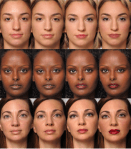
Similarly, women who wore cosmetics were rated more highly on attractiveness, competence, likeability and trustworthiness when viewed for as little as 250 milliseconds by participants in studies by Harvard’s Nancy L. Etcoff, Lauren E. Haley, and David M. House, with Shannon Stock of Dana-Farber Cancer Institute, and Proctor & Gamble’s Sarah A. Vickery.

Models without makeup, with natural, professional, “glamorous” makeup

However, when participants looked at the faces for a longer time, ratings for competence and attractiveness remained the same, but ratings for likeability and trustworthiness changed based on specific makeup looks.

Etcoff’s team concluded that cosmetics could influence automatic judgments because attractiveness “rivets attention and impels actions that help ensure the survival of our genes.”

Most people recognize the bias in assuming that attractive people are competent and that unattractive people are not, yet impression management remains crucial in the workplace and in the political arena.

-*Where have you seen appearance exert an influence in workplace credibility, decision-making and role advancement?

Related Posts

©Kathryn Welds


Plastic Surgery Changes Perceived Personality Traits

Michael J. Reilly

Michael J. Reilly

People often infer others’ personality attributes from visual cues, found Georgetown University Hospital’s Michael J. Reilly, Jaclyn A. Tomsic and Steven P. Davison, collaborating with Stephen J. Fernandez of MedStar Health Research Institute.
This facial profiling is cognitive shortcut that can lead to biased impressions and fewer professional and social opportunities for those unfavorably judged.

Jaclyn A. Tomsic

Jaclyn A. Tomsic

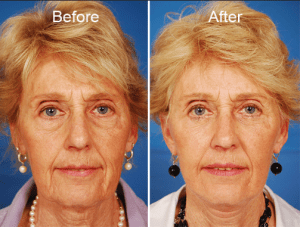
These researchers asked volunteers to evaluate photographs of 30 women shown with neutral facial expressions.

Each rater judged 10 images, including five (5) photographs before the person had plastic surgery procedures and five (5) images following surgical procedures:

  • Chin implant,
  • Eyebrow-lift,
  • Lower blepharoplasty (lower eye lift),
  • Upper blepharoplasty (upper eye lift),
  • Neck-lift,
  • Rhytidectomy (face-lift).

Michael Reilly-Preoperative-Postoperative photos

Raters were not informed that some people in the photos had plastic surgery procedures.

Evaluators assessed each photograph on a 7-point scale for perceived:

  • Aggressiveness,
  • Extroversion,
  • Likeability,
  • Risk-seeking,
  • Social skills,
  • Trustworthiness,
  • Attractiveness.

Michael Reilly - Pre-Post 2Raters assigned higher scores for likeability, social skills, and attractiveness to the images following plastic surgery compared with pre-surgery image ratings.

The researchers concluded that the eyes signal attractiveness and trustworthiness.

They noted that people who had lower eyelid surgery were rated significantly more attractive and trustworthy.

The team concluded that corner of the mouth indicates happy and surprised expressions and personality traits like extroversion.

Likewise, they reported that an upturned mouth and fullness in the cheeks can make a person look more intelligent and socially skilled.

In sum, they found that people who had a facelift procedure were rated significantly more likeable and socially skilled postoperatively.”

Volunteers in a different study attributed positive and negative personality traits to neutral faces when they perceived a similarity to standard positive and negative emotional expressions, reported Princeton’s Christopher P. Said and Alexander Todorov with Nicu Sebe of University of Trento.

Christopher P. Said

Christopher P. Said

This perceptual bias was demonstrated when volunteers attributed positive personality characteristics to faces with neutral expressions when some aspect of the face resembled typical facial expressions of happiness.

Similarly, neutral faces seen attributed negative personality characteristics when they had some similarities to displays of disgust and fear.

These trait inferences resulted from overgeneralization in emotion recognition systems.

Nicu Sebe

Nicu Sebe

 This error can lead to misattributed personality traits and biased impressions.

However, these inaccurate and biased judgments can become more favourable after plastic surgery.

-*To what extent do people’s personality traits seems different following plastic surgery?

-*How often are people treated differently following plastic surgery?

*What are ways to avoid confusing emotional expressions with personality traits?

Related Posts:

©Kathryn Welds

Defining “Executive Presence”

Sylvia Ann Hewlett

Sylvia Ann Hewlett

Communication, “Gravitas”, and Appearance were frequently-cited attributes of Executive Presence in a study by Sylvia Ann Hewlett of the Center for Talent Innovation.

Gavin Dagley

More characteristics of executive presence were identified in interviews with 34 professionals, conducted by Perspex Consulting’s Gavin Dagley and Cadeyrn J. Gaskin, formerly of Deakin University.

Caderyn Gaskin

Five “executive presence” qualities were observable during initial contact:

  • Status and reputation, similar to “gravitas” discussed by Hewitt,
  • Physical appearance, mentioned by Hewitt,
  • Confidence,
  • Communication ability, included in Hewitt’s “executive presence” triad,
  • Interpersonal engagement skills.

Five additional presence features emerged during repeated contacts:

  • Interpersonal integrity,
  • Values-in-action,
  • Intellect and expertise,
  • Outcome delivery,
  • Use of coercive power.

These qualities combine in different ways to form four presence “archetypes”:

  • Positive presence, based on favorable impressions of confidence, communication, appearance, and engagement skills plus favorable evaluations of values, intellect, and expertise,
  • Unexpected presence, linked to unfavorable impressions of confidence plus favorable evaluations of intellect, expertise, and values,
  • Unsustainable presence combines favorable impressions of confidence, status, reputation, communication, and engagement skills plus unfavorable evaluations of values and integrity,
  • “Dark presence” is associated with unfavorable perceptions of engagement skills plus unfavorable evaluations of values, integrity, and coercive use of power.

Philippe De Backer

Philippe De Backer

Another typology of executive presence characteristics was identified by Sharon V. Voros and Bain’s Philippe de Backer.
They prioritized elements in order of importance for life outcomes:

  • Focus on long term strategic drivers,
  • Intellect,
  • Charisma, comprised of confidence, intensity, commitment, care, concern and interest in others,
  • Communication skills,
  • Enthusiasm for work,
  • Cultural fit with organisation and team,
  • Poise,
  • Appearance.

Fred Luthans

Fred Luthans

University of Nebraska’s Fred Luthans and Stuart Rosenkrantz with Richard M. Hodgetts of Florida International University investigated the relationship between “executive presence” and career “success.”
These researchers observed nearly 300 managers across levels at large and small mainstream organizations when leaders:

  • Communicated,
  • Engaged in “traditional management” activities, including planning, decision making, controlling,
  • Managed human resource issues.

Richard Hodgetts

Richard Hodgetts

Communication and interpersonal skills, coupled with intentional networking and political acumen enabled some managers to rapidly advance in their organizations.

These rapidly-advancing managers were identified as “successful” leaders because they achieved a higher organizational level compared with their organizational tenure.
In contrast, “effective” managers demonstrated greater managerial skill than “successful” managers, but were not promoted as quickly.

Effective” managers spent most time managing employees’ activities including:

  • Motivating and reinforcing desired behaviours,
  • Managing conflict,
  • Hiring,
  • Training and developing team members,
  • Communicating by exchanging information,
  • Processing paperwork.

Stuart Rosenkrantz

Stuart Rosenkrantz

Subordinates of “effective” managers reported more:

  • Job satisfaction,
  • Organizational commitment,
  • Performance quality,
  • Performance quantity.

Differences in advancement and subordinate reactions to “successful” and “effective” managers were related to differing managerial behaviors.

Fred Luthans-Effective ManagersSuccessful” managers spent little time in managerial activities, but invested more effort in networking, socializing, politicking, and interacting with outsiders.
Their networking activities were most strongly related to career advancement but weakly associated with “effectiveness.”

Few managers were both “successful” and “effective”:
Only about 10% leaders were among the top third of successful managers and effective managers.
This suggests that effective managers who support employee performance may not be advance as rapidly as managers who prioritize their own career over their employees’ careers.

Gender differences in gravitas, communication, and political acumen may explain why men more often are seen as possessing “executive presence.”

Women who aspire to organizational advancement benefit from cultivating both gravitas and proactive networking to complement communication and interpersonal skills.

-*Which behaviors and characteristics are essential to “Executive Presence?”

Related Posts

©Kathryn Welds

Acknowledge Employer Appearance “Concerns” to Get Job Offer

Usually physically attractive people are positively evaluated by others. 
However, women applying for traditionally male jobs were less positively evaluated in search studies, and conclusions suggest that female gender coupled with attractive appearance seems to account for this disadvantage,

Madeline Heilman

Madeline Heilman

The “beauty is beastly effect” is a hiring bias favoring men or less attractive women for “masculine” jobs, described by Yale University’s Madeline E. Heilman and Lois R. Saruwatari.

Lois Suruwatari

Lois Suruwatari

They found that attractiveness was an advantage for men seeking managerial and non-managerial roles, but attractive women had an advantage only when seeking non-managerial roles.

Michelle Hebl

Michelle Hebl

Attractiveness can be considered a “stigma,” just as disability, gender, pregnancy, obesity, and race, suggested Rice University’s Michelle R. Hebl and Robert E. Kleck of Dartmouth College.
They reported that job seeks in these categories can reduce hiring biases by acknowledging the “stigmatising” characteristic during interviews.

Robert Kleck

Robert Kleck

Women who proactively addressed the employers conscious or unconscious concern about gender or appearance in a traditionally male role were rated higher in employment suitability in a study by University or Colorado’s Stefanie K. Johnson and Traci Sitzmann, with Anh Thuy Nguyen of Illinois Institute of Technology.

This proactive approach buffered the impact “hostile sexism” while increasing “benevolent sexism’s” link to employment suitability ratings.

Stefanie Johnson

Stefanie Johnson

Evaluators said they assumed that these candidates possessed more “masculine” traits than other female candidates, which they viewed as an advantage over possessing “feminine” traits at work.

These assessors were less likely to negatively evaluate women behaving in contrast to traditional gender role norms when these women address their appearance, avoiding frequently-observed gender norm “backlash.” 

Traci Sitzmann

Traci Sitzmann

-*How effective you found “pre-emptive objection-handling” in workplace negotiations?

RELATED POSTS:

©Kathryn Welds

Gender Transitions Show Gender Differences in Pay, Workplace Experience

People who change gender continue to use their education and experience at work. However, many of these people report that their compensation, degree of respect, and recognition at work changed following gender change.
This suggests that gender can directly affect compensation and workplace interactions.

Two Stanford professors’ personal experiences in gender transition were highlighted by University of Chicago’s Kristen Schilt.

Joan Roughgarden

Joan Roughgarden – Jonathan Roughgarden

Stanford’s Joan Roughgarden, was an evolutionary biologist for more than 25 years as Jonathan Roughgarden before she made her male-to-female (MTF) transition.
Known for her work integrating evolutionary theory with Christian beliefs (“theistic evolutionism”), she reported feeling less able to make bold conjectures and no longer had “the right to be wrong.”

Her experience contrasts with Stanford colleague, neurobiologist Ben Barres, who made scientific contributions as Barbara Barres until after he was 40.

Barbara Barres - Ben Barres

Barbara Barres – Ben Barres

After his female-to-male (FTM) transition, Ben delivered a lecture at Whitehead Institute, where an audience member commented, “Ben Barres gave a great seminar today, but, then, his work is much better than his sister’s.”

Schilt surveyed FTM and MTF to compare earnings and employment experiences before and after gender transitions with questions similar to 2002 Current Population Survey (CPS) survey items:

  • Last job before gender transition,
  • First job after gender transition,
  • Most recent job.

Kristen Schilt

Kristen Schilt

Female-to-male transsexuals (FTMs) reported that as men, they had more authority, reward, and respect in the workplace than they received as women, even when they remained in the same jobs.

Height and skin color affected potential advantages enjoyed by FTM.

Tall, white FTMs experienced greater benefits than short FTMs and FTMs of color.
In contrast, MTF reported reduced authority and pay, and often harassment and termination.

University of Illinois’s Donald McCloskey, for example, was told by his department chair “in jest” that he could expect a salary reduction when he became Deirdre McCloskey.

Deirdre McCloskey

Deirdre McCloskey

However, salary reduction was no joke for MTFs in Schilt’s survey sample.
Participants reported significant losses of 12% in hourly earnings after becoming female.

Additionally, MTFs transitioned on average 10 years later than FTMs, delaying the loss of financial advantages attributable to male gender.

FTMs, however, experienced no change in earnings or small positive increases up to 7.5% in earnings after transitioning to becoming men.

Any gender transition was associated with risks of harassment and discrimination, reported more frequently in “blue-collar” jobs, particularly for those with “non-normative” appearance and not consistently “passing” as the other gender.

These “naturalistic experiments” confirm continuing gender-based pay discrepancies.

-*To what extent have you observed these gender-linked differences in compensation and workplace credibility?

RELATED POSTS:

©Kathryn Welds

How Accurate are Personality Judgments Based on Physical Appearance?

Laura Naumann

People pictured in full-body photographs were evaluated by volunteers for likeability, self-esteem, loneliness, religiosity, and political orientation based on their photographed clothing and non-verbal behaviours. 

Simine Vazire

This study, conducted by Sonoma State University’s Laura Naumann, with Simine Vazire then of Washington University, teamed with University of Cambridge’s Peter Rentfrow, and Samuel Gosling of University of Texas, also investigated volunteers’ accuracy in judging Big Five personality traits (Openness, Conscientiousness, Extroversion, Agreeableness, and Neuroticism), proposed by Paul Costa and Robert McCrae of the U.S. National Institutes of Health

Peter Jason Rentfrow

These ratings were compared with evaluations by people acquainted the photographed person.

Samuel Gosling

Samuel Gosling

Observers’ judgments were accurate for extraversion, self-esteem, and religiosity when people were photographed in a standardized pose.
Raters were correct for additional personality traits when judging photographs in spontaneous informal poses.

Paul Costa

These findings suggest that candid photographs provide more accurate cues to some personality characteristics than planned poses.

Robert McCrae

Robert McCrae

Judgments based on clothing cues were associated with less accurate judgments of personality characteristics.
In contrast, facial expression and posture enabled observers to make more accurate judgments.

John Irving

John Irving

Observers can make accurate inferences about some personality characteristics based on visual cues, according to these findings.
Novelist John Irving’s A Prayer for Owen Meany noted that “Things often are as they appear. First impressions matter,” just as these researchers concluded.

-*How accurate are your judgments of personality traits for people you don’t already know?
-*How accurate are other people’s inferences about your personality traits?

RELATED POSTS:

©Kathryn Welds

Perceived Physical Attractiveness Shapes Views of Social Hierarchies

Nielsen Product SpendingCosmetic surgery is the fastest-growing medical expenditure in the U.S, and Americans spend more on personal grooming than on reading material.

Even during the recession of 2008, Americans spent at least $200 billion on products and services to enhance their appearances, according to Stanford’s Margaret Neale and Peter Belmi, now of University of Virginia.

Margaret Neale

Margaret Neale

Personal appearance and attractiveness have been linked with likeability, perceived competence, income and more, and Neale and Belmi found further connections between people’s self-perceived attractiveness and their attitudes toward social inequality and hierarchies.

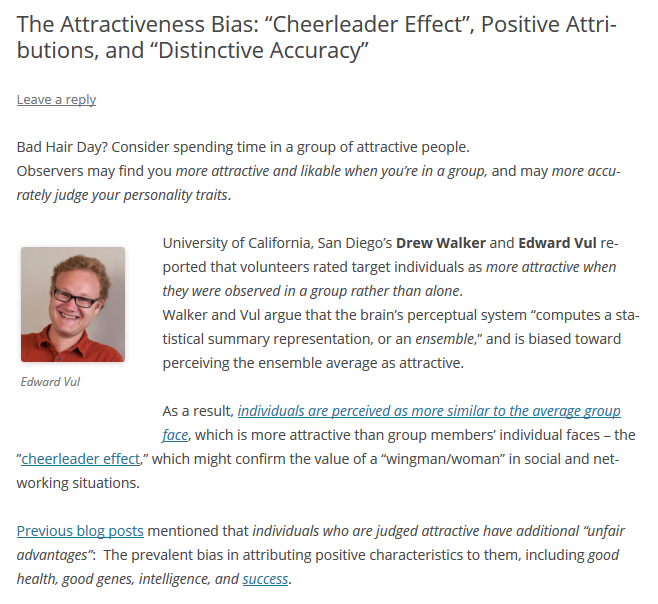
Attractiveness Bias2The team asked participants to write about a time when they felt more attractive or less attractive, and then indicate whether they agreed with statements such as, “Some groups of people are simply inferior to other groups,” and “Lower wages for women and ethnic minorities simply reflect lower skill and education level.”

The researchers found that people who think they are attractive also think they have greater social standing, and believe that people are entitled to their social position based on their personal (“dispositional”) qualities.

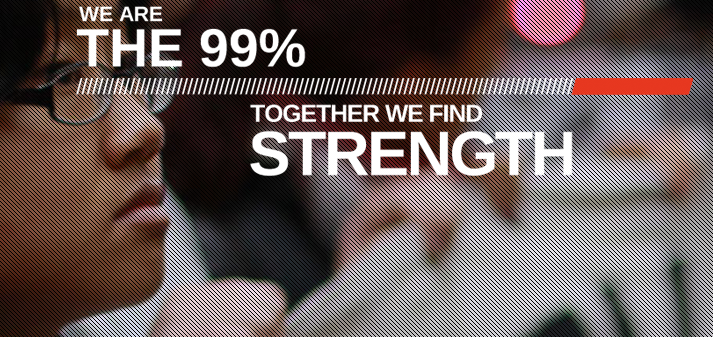
Occupy 99As a result, people who rate themselves as attractive generally feel that people in lower social strata are there due to their characteristics or behaviors.
These beliefs are associated with less willingness to donate money to a social equality non-profit organization (the Occupy movement).

Peter Belmi

Peter Belmi

By contrast, people who thought they were less attractive also thought they belonged to a lower-status social group, and rejected existing social hierarchies.
They attributed unequal social status to external factors often beyond the full control of those in less prestigious social groups. One example is lack of access to quality education.

Unlike self-perceptions of attractiveness, empathy and integrity were not related to people’s views of their social class and others’ place in society.

-*How have you seen appearance affect acceptance or organizational hierarchy and philanthropic giving?

RELATED POSTS:

©Kathryn Welds

Attractive Appearance Helps Men Gain Business Funding

Laura Huang

Laura Huang

Entrepreneurs create jobs and contribute to economic growth with early investment by financial backers who trust the perceived business proposal’s viability and the founders’ previous experience.

Alison Wood Brooks

Alison Wood Brooks

Additional implicit criteria for new venture-funding include gender and physical attractiveness, asserted Harvard’s Alison Wood Brooks, Laura Huang of Wharton, MIT’s Sarah Wood Kearney and Fiona E. Murray.

Sarah Wood Kearney

Sarah Wood Kearney

Brooks and colleagues enlisted 60 experienced investors to:

  • Evaluate videos of 90 randomly-selected presentations by entrepreneurs at three pitch contests in the US,
  • Comment on presenters’ appearance and effectiveness.

Fiona E. Murray

Fiona E. Murray

Male presenters who were rated more attractive were 36% more likely to receive funding than men judged as less attractive, but there was no difference in funding rates for women based on attractiveness ratings.

In a separate study, investors evaluated identical pitches delivered by a man or a woman, and rated male-narrated pitches as more persuasive, logical and fact-based compared with the same presentation delivered by a woman.

These finding suggest that financial backers favor attractive male entrepreneurs, leaving women entrepreneurs – attractive or not – at a disadvantage in creating new businesses, jobs, and economic growth.

This finding underscores financial backers’ preference for male entrepreneurs’ proposals, based on attractive men’s greater perceived persuasiveness than women or less attractive men.
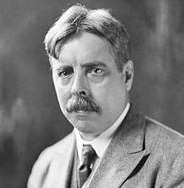
Edward Thorndike

Edward Thorndike

Previous blog posts have noted the “halo effect” of physical attractiveness leading to positive attributions of intelligence, competence, and likeability, originally described by Columbia’s Edward Thorndike.

Woods’ latest findings point to the double advantage enjoyed by attractive men seeking new venture funding.
Aspiring women entrepreneurs, on the other hand, continue to encounter significant unacknowledged disadvantages, not improved by physical attractiveness.

Eleanor Holly Buttner

Eleanor Holly Buttner

However, these findings were not confirmed by University of North Carolina’s E. Holly Buttner and Benson Rosen in their investigation of bank loan officers’ funding decisions.

Loan officers, who typically make funding decisions based on the business plan and interview with the entrepreneur, evaluated a:

  • Business plan or
  • Business plan plus a videotaped interview conducted by a loan officer with a male or female entrepreneur seeking a loan to start a business.

Benson Rosen

Benson Rosen

Bankers rated their likelihood of:

  • Recommending loan approval of the requested amount,
  • Making a counteroffer of a smaller amount, which they specified.

This study found no difference in funding decisions for male entrepreneurs compared with female entrepreneurs presenting the same business case.
In fact, loan officers made larger counteroffers to female entrepreneurs when considering both the business plan and the loan application interview.

Student volunteers’ loan funding decisions were compared with loan professionals, and the younger generation of lay people made larger counteroffers to the male entrepreneur instead of the female when they evaluated both the business plan and the loan interview,
Loan officers, in contrast, made significantly more cautious and conservative funding decisions than student participants.

Buttner and Benson recommended that female entrepreneurs ask to meet with loan officers to present their business proposals because this personal contact resulted in more successful funding of requested loans.

John Becker-Blease

John Becker-Blease

Another source of funding is “angel investors,” and Oregon State University’s John R. Becker-Blease and Jeffrey E. Sohl of University of New Hampshire found no difference in funding for male and female entrepreneurs.
They noted that women seek private investments substantially lower rates than men, but they are equally likely to receive investment.

However, when the “angels” are women, female entrepreneurs are more likely to seek financing and are as likely to receive the requested funding.
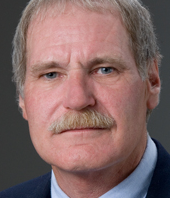
Jeffrey Sohl

Jeffrey Sohl

Women entrepreneurs may still face obstacles in starting new ventures,  a barrier shared with less attractive males.

-*How do you mitigate biases based on gender or attractiveness when asking for funding – for a business, initiative, or idea?

RELATED POSTS:

©Kathryn Welds