Executives with Daughters and Sisters: More Generous?

Michael Dahl

Michael Dahl

Cristian Dezső

Cristian Dezső

Male CEOs paid employees more after the birth of their first child when it is a daughter, but paid employees an average of $100 less annually after the birth of a son, according to Michael Dahl of Aalborg University with University of Maryland’s Cristian Dezső and David Gaddis Ross of Columbia Business School in their study of more than 10,000 Danish companies between 1996 and 2006.

David Gaddis Ross

David Gaddis Ross

Female employees typically received higher wages after the birth the CEO’s first child of either gender, and were less adversely-affected than their male colleagues by wage decreases after the birth of CEOs’ children.

Paul Van Lange

Paul Van Lange

People with more sisters tended to show more generous “pro-social” behaviors in laboratory studies of 600 volunteers who played a simulation game requiring decisions about resource-sharing with strangers, according to Paul Van Lange of Free University in Amsterdam with colleagues Ellen De Bruin, Wilma Otten, and Jeffrey Joireman of Washington State University.

Jeffrey Joireman

Jeffrey Joireman

Alice Eagly at Northwestern University suggests that men with sisters are significantly more likely to help others, based on her meta-analysis of 172 research studies.

Alice Eagly

Alice Eagly

In addition, she noted that men tend to help women more than other men.

Men behaved more generously when the cost was minimal in a modified dictator game, according to James Andreoni at the University of California, San Diego and Lise Vesterlund at the University of Pittsburgh.

James Andreoni

James Andreoni

In contrast, they noticed that women demonstrated greater generosity when the cost was high.

Lise Vesterlund

Lise Vesterlund

Andreoni and Vesterlund suggest that men are more responsive to price changes when mens “demand curves for altruism” cross those of women.
As a result, in this lab simulation, men behaved either extremely generously or selfishly, but women shared gains more equally.

Women’s direct presence on corporate boards – rather than their influence as sisters or daughts –  was correlated with increased economic value, according to Dezső  and Ross’s evaluation of the S&P 1,500 firms’ financial performance between 1992 and 2006.
Boards that included women generated an average of 1 percent more economic value – more than $40 million each – when the firm’s strategy is focused on innovation.

-*What corporate impact have you seen of male executives with daughters and sisters?

RELATED POSTS

Twitter:    @kathrynwelds
Blog: – Kathryn Welds | Curated Research and Commentary
Google+
LinkedIn Open Group Psychology in Human Resources (Organisational Psychology)
Facebook Notes:

©Kathryn Welds

Does Workplace Co-Location Increase Collaboration and Innovation?

John Chambers

John Chambers

In 2009, Cisco CEO John Chambers asserted that “the face-to-face meeting is a dinosaur,” and he demonstrated his point in a Telepresence-enabled company meeting from Bangalore, India with his fellow executive, Marthin de Beer, in San Jose, California.

Marthin de Beer

Marthin de Beer

Marisa Mayer of Yahoo seems not to agree with Chambers’ premise.

Her highly-publicized decision to require remote workers to work on-site every day in Yahoo offices received mixed reviews from advocates of flexible work practices such as ROWE (Results-Only Work Environment).

Marissa Mayer

Marissa Mayer

Mayer argued that co-location will enable Yahoos to more effectively collaborate and innovate.

-*What is the evidence for – or against – her assertion?

Eduardo Salas

Eduardo Salas

A decade ago, in 2003, a meta-analysis of face-to-face meetings’ impact on group cohesiveness, task commitment, authority, communication noted the one benefit of virtual meetings: “status-equalizing impact of computer-supported cooperative work … enables greater participation by women, minorities and other traditionally lower status groups.

Florida Maxima Corporation’s James Driskell collaborated with Paul Radtke, Naval Air Warfare Center Training Systems Division and University of Central Florida’s Eduardo Salas summarized often-conflicting findings on the impact of virtual teams  and concluded that interaction in virtual environments requires consideration of the type of task that the team is performing.
Agile software development is an example of a process that originally assumed – and required –  team member co-location.

Sandeep Joshi

Sandeep Joshi

Microsoft trainer Sandeep Joshi offered an alternate model to co-location for Agile development, and argued that some tasks in the Agile development process are suitable for remote work by distributed teams.
Because more than half of respondents to VersionOne’s 2012 State of Agile survey said they use Agile with co-located and distributed teams, or plan to do so in the future, Joshi advocates maintaining collaborative, co-located design processes to capitalize on group interaction, then “de-Agilizing” the process to enable individual coding before re-convening to evaluate the work in “rapid turns.”

Karen Sobel-Lojeski

Karen Sobel-Lojeski

Distance is not only physical, according to SUNY Stony Brook’s Karen Sobel-Lojeski. 
She conceptualizes three types of virtual distance:

  • Affinity (culture and background differences like ethnicity, educational background, past familiarity, shared vision, and commitment that affect team productivity and cohesiveness
  • Operational (type and frequency of communication)
  • Physical (geographic separation)
Richard Reilly

Richard Reilly

She collaborated with Richard Reilly of Stevens Institute of Technology on two books that explored perceived distance among co-workers, which can be reduced or increased by communication technology.

They argue that virtual distance changes the ways people learn, perform, and develop relationships with others in the workplace.

Like Joshi, they advocate analyzing the nature of the tasks and existing interpersonal relationships among team members before mandating co-location, virtual, or blended work arrangements.

Sobel-Lojeski and Reilly conclude that important workplace competencies are traversing boundaries, glocalization, and authenticity, leading to what they call “techno-dexterity” required for effective leadership in a wired world.

Among the drawbacks of co-location are increased work interruptions, which can reduce productivity and cognitive performance.

Alessandro Acquisti

Alessandro Acquisti

Carnegie Mellon University’s Alessandro Acquisti and  Eyal Pe’er  demonstrated decreased cognitive task performance after electronic interruptions and task-shifts similar to responding to a mobile phone call, text message or email.

More than 135 volunteers read a short document and answered questions about the content.
One third of the participants completed this portion of the experiment and served as the control group.

Eyal Pe'er

Eyal Pe’er

The remaining individuals were told they “might be contacted for further instructions” via instant message.

This alerted group completed a similar reading comprehension test, and half of this group actually received instant messages, whereas the other half didn’t receive the anticipated notices.

Both interrupted groups provided 20% less accurate responses than the control group, suggesting a significant cost to interruptions and task shifting.

However, when the interrupted group performed the similar task a second time, this group reduced the under-performance by 6%.
Those who were warned of an interruption that never came improved by 43 percent, and even outperformed the control test takers who were left alone.

Acquisti and Pe’er suggested that people may develop compensatory strategies to manage the performance impact of interruptions.

Gloria Mark

Gloria Mark

Likewise, University of California, Irvine’s Gloria Mark with Daniela Gudith and Ulrich Klocke of Germany’s Humboldt University reported that a typical office worker is interrupted about every 3-11 minutes and requires an average of 23-25 minutes to return to the original task.

Daniela Gudith

Daniela Gudith

Volunteers worked faster when they anticipate interruptions, particularly those who measured high on openness to experience and high on need for personal structure.
However, participants reported increased stress, higher workload, greater frustration, more time pressure and effort when they increased work speed.

Ulrich Klocke

Ulrich Klocke

These findings provide equivocal support for Mayer’s anticipated benefits from workplace co-location.
Her team may experience increased stress due to interruptions, task-shifting, and noise, in addition to any personal concerns about lengthy commutes and work-life balance.

This inference was supported in research by Harvard’s Leslie Perlow, who studied engineers working in an open-space environment.
These highly-skilled knowledge workers reported frequent interruptions and reduced productivity.

Leslie Perlow

Leslie Perlow

Perlow offered these engineers a recommendation:  Pre-scheduled interruption-free “quiet time”.
She found that this intervention led to increased productivity.

Catherine Kerr

Catherine Kerr

Similarly, Catherine Kerr of Brown University suggests that the impact of frequent task-shifts in open work environments can be mitigated by mindfulness meditation as brain training to enable increased attentional focus by attending to breathing.

Workplace inclusion and diversity issues add to questions of whether co-location actually increases innovation, collaboration, and productivity.
Pew Research Center reported that working mothers were more concerned with having a flexible schedule whereas working fathers placed more importance on having a high-paying job.

When employees actually use increasingly-available flexible work options, including job-sharing, telecommuting, and compressed work weeks, they may experience adverse career impacts.

Joan Williams

Joan Williams

Jennifer Glass

Jennifer Glass

Joan Williams, founding director of the Center for Work-Life Law at the University of California, Hastings College of the Law with  University of Iowas’ Jennifer Glass, Shelley Correll of Stanford and University of Toronto’s Jennifer Berdahl reported that men who take leave from work after the birth of a child were more likely to be penalized and less likely to get promoted or receive raises.

Shelley Correll

Shelley Correll

Jennifer Berdahl

Jennifer Berdahl

In addition, they found that women using flexible work arrangements receive differing feedback from others depending on their socioeconomic statusAffluent women were encouraged to stay at home, whereas less affluent women were more likely to be counseled not to have children.

Despite John Chamber’s death-of-face-to-face meetings assessment and recent findings by Kenneth Matos and Ellen Galinsky of the Families and Work Institute, Cisco Systems executives seem aligned with Mayer’s advocacy for in-person collaboration.

Kenneth Matos

Kenneth Matos

During a recent preview of renovated office buildings featuring “Collaborative Work Spaces,” Cisco business leaders asserted that the layout is intended to increase collaboration and attract recent graduates and other “younger talent” by “projecting a hip, innovative image in the work environment.”
They noted that this arrangement is actually more costly than offices and cubicles despite accommodating more workers in the same amount of space.

Ellen Galinsky

Ellen Galinsky

Past research suggest costs to adopting computer-mediated work processes, yet these technologies have improved, become more prevalent, and workers have become more skilled in their use.
Further, virtual collaboration enables workplace participation by people who might require flexible schedules, and reduces the environmental impact, cost, and perceived stress of commuting.

-*How is your productivity affected by physical proximity to your co-workers?
-*How do you manage distractions in open office environments?

——–

RELATED POSTS:

Twitter:  @kathrynwelds
Blog: – Kathryn Welds | Curated Research and Commentary
Google+
LinkedIn Open Group Psychology in Human Resources (Organisational Psychology)
Facebook Notes:

©Kathryn Welds

Leadership Roles Reduce Perceived Stress

Animal studies suggest that high status roles are associated with lower stress levels, but fewer human studies that show a causal connection between status and health.

Hannah Kuper

Hannah Kuper

Geoffrey Rose

Geoffrey Rose

The longitudinal Whitehall Studies of British Civil servants suggest that lower status individuals had higher stress and poorer health outcomes that higher status workers, according to Geoffrey Rose of London School of Hygiene and Tropical Medicine and University College London’s  Hannah Kuper and Michael Marmot.

Columbia University’s Modupe Akinola collaborated with Wendy Berry Mendes of the University of California, San Francisco, to re-examine the relationship between organizational status and health outcomes.

Michael Marmot

Michael Marmot

Akinola and Mendes asked police officers to rate their status relative to their colleagues and to other people in the United States.
Then, each volunteer participated in a stressful role-play used by many police departments to help decide which officers should get a promotion.

In this scenario, the officer was asked to placate a disgruntled citizen, played by an actor, who claimed that another officer had verbally and physically abused him.

Modupe Akinola

Modupe Akinola

Researchers measured each heart rates, blood circulation, and testosterone levels as measures of “thriving” stress response or “adaptive” stress response to the role-play.

Officers’ perceptions of their social status were significantly associated with their style of stress response.
Those with higher self-perceived status were more likely to have an adaptive stress response.

Wendy Berry Mendes

Wendy Berry Mendes

In a related study, Akinola and Mendes placed civilian volunteers in high-status or low-status roles to play a complicated, fast-paced video game with a partner.
The researchers again measured participants’ cardiovascular responses and testosterone levels during the task.
Findings with civilians mirrored those with police officers:  Participants placed in the higher-status leader role had more adaptive hormonal and cardiovascular reactions during the high-pressure task.

Those assigned higher status leader roles:

  • Performed more quickly and accurately than supporters
  • Allocated more resources to their partners
  • Expressed more positive perceptions of partners.

Opposite trends prevails for those in lower-status supporter roles:   They had less adaptive responses to the stressful task, did not perform as well on the task, and evaluated the leader more negatively.

Akinola and Mendes suggest that managers may be able to mitigate these negative effects of followership by suggesting paths to workplace advancement.

However, some individual contributors may be more interested in flexible work practices, salary, and time off, than career advancement.
Managers may foster greater employee engagement by tailoring rewards and recognitions to individual priorities.

-*How are role status and stress levels related in your work environment?

RELATED POSTS:

©Kathryn Welds

Reduce “Affective Forecasting” Errors

People often make “affective predictions” about choice of life partner, occupation, residence, yet most everyone makes small, but systematic errors in forecasting personal emotional responses.

These misjudgments can negatively affect personal health, happiness, financial well-being, and interpersonal relationships.

Kostadin Kushlev

Kostadin Kushlev

University of British Columbia’s Kostadin Kushlev and Elizabeth Dunn identified these decision biases, and noted that one of the most well-known and widely-occurring affective forecasting errors is impact bias, the tendency to overestimate the intensity of emotional responses to future positive and negative events.

Elizabeth Dunn

Elizabeth Dunn

In addition, Kushlev and Dunn reported that people tend to overestimate the duration of future emotional reactions, labeled durability bias.

Seymour Epstein

Seymour Epstein

Durability bias (focalism) can occur when people rely on the “rational system” for information processing, according to Seymour Epstein of University of Massachusetts.

His Cognitive-Experiential Self Theory proposes that the “rational system” is used to make affective forecasts using slow, analytic and abstract processing.

Seymour Epstein-CESTIn contrast, the “experiential system” of information processing is rapid, associative, holistic, and concrete.

Shifts between rational (“cold”) and experiential (“hot”) decision systems can cause another bias, “Empathy gap.”

Epstein posits that rational system processing can lead to imagining the event isolated from its broader context, which can underestimate its emotional impact.
This can lead to focus on and overvalue distinctive, observable characteristics. 

Immune neglect is a related error, when people underestimate their likelihood of later reinterpreting future events to reduce regret.

Underestimating the power of future physical states is another predictive error recognised in Alcoholics Anonymous guidance to analyse whether cravings occur when people experience “HALT” (“Hungry, Angry, Lonely, Tired”.)
Personality neglect,” is another error that occurs when people underestimate the influence of personal dispositions and characteristics. 

Roger Buehler

Roger Buehler

Expectations affect future emotions, according to Wilfrid Laurier University’s Roger Buehler, Vassili Spyropoulos and Kent C. H. Lam with Cathy McFarland of Simon Fraser University.  They found that those with positive expectations experience more positive present and future emotions. This optimism bias may provide protection and benefit to each individual’s “psychological immune system.”

Kristin Weger

People can reduce errors in predicting future emotions by evaluating expectations in comparison to actual experience during a “post-mortem” session to review “lessons learned,” found University of Alabama at Huntsville’s Kristin Weger and Sandra Carpenter.

-*How accurate are you in predicting your feelings about a specific choice or situation in the future?

-*How do you detect and mitigate bias in predicting your future emotional reactions?

-*What positive and negative impacts have you observed in affective forecasting errors?


RELATED POSTS:

©Kathryn Welds

Juggling as Brain Training

The physical skill of juggling can change the brain’s structure and function for the better, and may be a recommended therapy for brain injuries.

Bogdan Draganski

Bogdan Draganski

Volker Busch

Volker Busch

Bogdan Draganski, now of University of Lausanne collaborated with University of Regensburg colleagues Volker Busch, Ulrich Bogdahn, and Gerhard Schuierer, and Arne May, now of University of Hamburg  with Christian Gaser of University of Jena, to visualize brain plasticity among volunteers who learned to juggle.

Ulrich Bogdahn

Ulrich Bogdahn

Volunteers showed transient and selective structural changes in the left parietal lobe’s posterior cortex  and bilateral central temporal areas brain, areas associated with processing and storing complex visual motion on used whole-brain magnetic-resonance imaging.

Gerhard Schuierer

Gerhard Schuierer

This study demonstrates that the brain’s macroscopic structure can change based on stimuli like juggling, rather than being limited to functional changes in the cortex.

Arne May

Arne May

May and Gaser collaborated with University of Hamburg colleagues Janina Boyke, Joenna Driemeyer, and Christian Büchel in related research.

Christian Gaser

Christian Gaser

This time, they trained 25 people with an average age of 60 years in juggling for 12 weeks, and 25 control group volunteers were not trained.

Christian Büchel

Christian Büchel

The team conducted three MRI brain scans for each participant:

  • Before juggling practice
  • After 3 months of juggling
  • After another 3 months of no juggling.

Jugglers showed significant increase in the brain’s “gray matter,” nerve cells’ bodies responsible for information processing, located in the hippocampus (memory formation), bilateral nucleus accumbens (reward systems that may lead to action) and visual cortext’s middle temporal area.

Without practice during the three months after the training, none of the volunteers retained their ability to juggle and their gray matter declined to pre-training levels.

This suggests the value of continued practice in physical and cognitive skills to maintain brain structure and function.

Jan Scholz

Jan Scholz

University of Oxford’s Jan Scholz, Miriam Klein-FlüggeTimothy E.J. Behrens, and Heidi Johansen-Berg extended this research to demonstrate that people who learn to juggle also increased “white matter” containing axons that connect different cells, not just gray matter.

 The Oxford team conducted baseline brain scans using diffusion tensor imaging to reveal  white matter structure for 24 young men and women volunteers, who later practiced juggling for half an hour a day for six weeks.

Miriam Klein-Flügge

Miriam Klein-Flügge

The researchers compared brain scans of 24 non-juggling volunteers and found that the volunteer jugglers increased white matter in the parietal lobe’s intraparietal sulcus, which integrates vision and reaching and grasping in the periphery of vision.
Even less-skilled jugglers had similar increases in white matter, attributed to amount of time devoted to practice.

Heidi Johansen-Berg

Heidi Johansen-Berg

In contrast, the non-jugglers showed no changes in white matter after the six week period, suggesting value in practicing juggling to develop the brain’s structure and functioning to enable rapid, coordinated movement and body positioning.

Brain scans taken after four weeks without juggling practice showed that the new white matter remained and the amount of gray matter increased, showing some skill retention in the absence of consistent practice.

-*What physical skills do you develop as brain training?

RELATED POSTS:

Twitter:    @kathrynwelds
Blog: Kathryn Welds | Curated Research and Commentary 
Google+:
LinkedIn Open Group Psychology in Human Resources (Organisational Psychology)
Facebook Notes:

©Kathryn Welds

Spreading Good News Feels Good, Especially When It’s About You

Christian Science Monitor has long provided a counterpoint to mainstream media’s “If it bleeds, it leads” approach to providing shocking, scandalous, depressing, or scary news.

Jonah Berger

Jonah Berger

Wharton’s Jonah Berger and Katharine Milkman found that the Christian Science Monitor might have a savvy business model:  they found that good news spreads more widely than bad.

Word of Mouth Marketing AssociationMembers of the Word of Mouth Marketing Organization: Take note…

Katherine Milkman

Katherine Milkman

Berger and Milkman evaluated a random sample of 3,000 of more than 7,500 articles published in the New York Times online from August 2008 to February 2009.

They judged each article’s “popularity” based on number of times it was forwarded to others, after controlling for online publication time, section, and degree of promotion on the home page.
Independent readers rated each article for practical value or surprise, and ratio of positive vs negative emotion words in each news item.

Most-forwarded posts were positive, funny, exciting and featuring intellectually challenging topics, like science, that “inspire awe” (“admiration and elevation in the face of something greater than the self”).

Readers shared articles that typically provoke negative emotions like anger and anxiety, but not sadness.
-*Why this bias against sending “downer” messages?

Emily Falk

Emily Falk

Michigan’s Emily Falk, with UCLA colleagues Sylvia Morelli, B. Locke Welborn, Karl Dambacher,and Matthew Lieberman found that people consider what appeals to others, possibly as a means of building relationships, indicated by increased activation in brain regions (temporoparietal junction, or TPJ and dorsomedial prefrontal cortex) associated with “social cognition,” or thoughts about other people, measured by fMRI.

When those regions were activated, people were more likely to talk about the idea with enthusiasm, and the idea would spread by word-of-mouth.

Falk noted that the team mapped  brain regions “associated with ideas that are likely to be contagious and are associated with being a good ‘idea salesperson.'”
She plans to use these brain maps “to forecast what ideas are likely to be successful and who is likely to be effective at spreading them.”

Diana Tamir

Diana Tamir

People also like to spread good news about themselves.
Diana Tamir and Jason Mitchell, then of Harvard, illustrated that brain regions associated with reward (mesolimbic dopamine system, including the nucleus accumbens and ventral tegmental area) are activated when people share information about themselves.

Jason Mitchell

Jason Mitchell

Self-disclosure is so pleasurable that people will sacrifice monetary rewards for this opportunity.

Mor Naaman

Mor Naaman

In fact, Rutgers’ Mor Naaman with Jeffrey Boase, now at Ryerson University and Chih-Hui Lai, now of University of Akron found that 80 percent of Twitter users tweet primarily about themselves.
One reason may be that people say more positive things when they’re talking to a bigger audience, like Twitter followers, according to Berger’s research suggests. As a result, social media users are likely to convey positive information about themselves.

Jeffrey Boase

Jeffrey Boase

However, this positive self-presentation may not result in a positive mood if communicators spend longer on social media platforms like Facebook.
Hui-Tzu Grace Chou and Nicholas Edge of Utah Valley University found that those with longer visits to Facebook say they are less happy than their Facebook Friends.

They found that Facebook users tend to form biased judgment based on easily-recalled examples (availability heuristic) and erroneously attribute positive Facebook content to others’ personality, rather than situational factors (correspondence bias), especially for those they do not know personally.

Hanna Krasnova

Hanna Krasnova

Corroborated by Humboldt-Universität zu Berlin’s Hanna Krasnova and her team from Technische Universität Darmstadt, these researchers observed “invidious emotions” and “envy” among people who spend longer time on Facebook.

These findings have relevance to members of the Word of Mouth Marketing Organization: Spread the good word – or at least the emotional word – and spend less time on Facebook and other social media that might invite social comparison and the potential for envious dissatisfaction.

-*How you build “buzz” via “Word of Mouth”?

RELATED POSTS:

Twitter:   @kathrynwelds
Blog: – Kathryn Welds | Curated Research and Commentary
Google+:
LinkedIn Open Group Psychology in Human Resources (Organisational Psychology)
Facebook Notes:

©Kathryn Welds

Compassion Training Surpasses Empathy Training to Reduce Stress

Susanne Leiberg

Susanne Leiberg

Compassion training has positive effects on mood and health, and University of Zurich’s Susanne Leiberg, Olga Klimecki, Tania Singer demonstrated that it can actually change the brain’s functioning, and related emotions and behaviors.

Olga Klimecki

Olga Klimecki

Klimecki, Leiberg, Singer, now at Max Planck Institute collaborated with Claus Lamm of University of Vienna to examine the impact of compassion training on brain activity in response to observing another person’s distress.

Tania Singer

Tania Singer

A frequent experience in daily life, most people experience distress, or empathy, when observing another’s distress, due to activation of the brain’s “mirror” neurons.

Claus Lamm

Claus Lamm

In contrast, compassion is concern with others’ suffering coupled with the desire to alleviate the other person’s pain, and can exist without actually experiencing the other persons’ distress through empathy.

The researchers evaluated whether personal distress be transformed into compassion, a useful coping strategy for those in health care professions, and in caretaking roles.
They developed the Socio-affective Video Task to measure neural and subjective responses to witnessing the distress of others.

Most volunteers experienced initial empathic negative feelings and activations in the brain’s pain empathy areas, the anterior insula and anterior medial cingulate cortex, when they observed the distress of others.
However, the volunteers who completed compassion training experienced less negative emotion, and more positive feelings when witnessing others in distress, related to increased activity in brain areas associated with positive emotion and affiliation:  the medial orbitofrontal cortex, putamen, pallidum, and ventral tegmental area.

In contrast, control group volunteers who received memory training did not have more positive emotions, and participants in empathy training actually experienced more negative feelings.

The studies suggest that compassion training can be an effective coping strategy when observing or supporting others in distress, and the mental discipline of compassion training can increase positive emotion more effectively than memory training or empathy training.

Besides changing the brain and related feelings, compassion training triggered more “prosocial” behavior, including helping and cooperating.

This researcher team developed the Zurich Prosocial Game (ZPG) to validly assess helping behaviors in light of reciprocity, helping cost, and distress cues influences.
Volunteers who had received short-term compassion training increased their helping behaviors in the game, but this was not true for volunteers who received short-term memory training.

Charles Raison

Charles Raison

Emory University’s Charles Raison advocated compassion training as a better day to deal with “enemies,” whether globally or interpersonally.
He collaborated with Emory colleagues including Geshe Lobsang Tenzin Negi, who developed Cognitive-Based Compassion Training (CBCT) and Sheetal Reddy of Atlanta’s Children’s Healthcare of Atlanta, to evaluate the impact of compassion training with youth in foster care.

Geshe Lobsang Tenzin Negi

Geshe Lobsang Tenzin Negi

The team considered whether these participants, who had suffered maltreatment, experienced improved psychosocial functioning after twice-weekly Cognitive-Based Compassion Training (CBCT) for six weeks compared with young people assigned to the “wait-list-no treatment” group.

Researchers found no difference in measured functioning, but young people who practiced compassion more frequently reported greater hopefulness and ability to deal with life stressors, and decreased generalized anxiety.

These findings suggest that compassion training can improve stress management, mood, and cooperation.

-*How have you seen compassion training affect feelings and behaviors?

RELATED POSTS:

©Kathryn Welds


“Grit” Rivals IQ and EQ to Achieve Goals

Emotional intelligence has been demonstrated to be a better predictor of achievement and performance than measure of intelligence. 

Angela Duckworth

Angela Duckworth

One important component of Emotional Intelligence (EQ) is perseverance, the consistent, sustained and focused application of talent and effort over time, University of Pennsylvania’s Angela Duckworth.  

Christopher Peterson

Christopher Peterson

She refers to this perseverance and passion for long-term goals as “grit” in her research with West Point cadets and Scripps National Spelling Bee contestants, in collaboration with University of Michigan’ Christopher Peterson and Michael Matthews and Dennis Kelly of United States Military Academy, West Point.

Grit was not related to IQ but was highly correlated with “Conscientiousness,” a personality trait described in the Five Factor Model of Personality.
It was also a better predictor of “success” as measured by retention at West Point, and advancement in the National Spelling Bee.

Michael Matthews

Michael Matthews

In addition, “grittier” participants:

  • Achieved higher levels of education
  • Had fewer job switches and career changes
  • Earned higher school grades than their peers, despite having lower standardized test scores measuring intelligence and achievement
  • Devoted more hours to deliberate practice (defined as individual word study and memorization for spelling bee contestants).

Teri Kirby

Teri Kirby

K. Anders Ericcson

K. Anders Ericcson

The most effective deliberate practice was rated as the least pleasurable, and “grittier” individuals did more of this effort in Duckworth’s expanded study with Teri Kirby, Eli Tsukayama, Heather Berstein,  then of Penn with K. Anders Ericsson of Florida State University.

Heather Berstein

Heather Berstein

Practice activities rated as more pleasurable and less effortful, like reading for pleasure, being quizzed by their parents, contributed less to spelling performance.

Paul Tough

Paul Tough

Parents and educators found responded enthusiastically to Paul Tough’s popularized summary of “grit” research in his book advising parents and teachers how to help young people develop grit, curiosity, conscientiousness, and optimism.
He “gritty” attributes highly correlated with successful academic and career performance.

Duckworth expanded the investigation of grit to include “explanatory style”, seen in individuals’ propensity to explain events from optimistic or pessimistic perspectives.
Explanatory style is evaluated according to whether the individual considers event causes as:

  • Personal (Internal vs. External cause or influence)
  • Permanent (Stable vs. Unstable)
  • Pervasive (Global vs. Local/Specific)

Optimistic explanatory style is characterized by external, unstable, local / specific explanations, whereas pessimistic styles include internal, stable, global attributions.

Duckwork and team found that novice teachers with more optimistic explanatory styles rated themselves higher in both grit and life satisfaction, and these high ratings were associated with better work effectiveness, as evaluated at the end of the school year.

Eli Tsukayama

Eli Tsukayama

Katherine Von Culin

Katherine Von Culin

Her students, Katherine Von Culin and Eli Tsukayama “unpacked” grit and found different difference in motivation and beliefs for grit’s two components:  perseverance vs passion.
Among more than 300 volunteers, they found that perseverance and passion had different meaning, pleasure, and engagement orientations to happiness and implicit beliefs about willpower.

Carol Dweck

Carol Dweck

The research team is evaluating the relationship between “grit” and “growth mindset,” introduced by Stanford’s Carol Dweck to signify viewing failures and setbacks as opportunities to learn and improve, rather than a permanent lack of ability.

ell

ell

Dweck, with Lisa Blackwell, then of Columbia and University of Western Ontario’s Kali Trzesniewski demonstrated the impact of growth mindset and positive explanatory style on school motivation and achievement.

In addition, Duckworth and team are considering ability to delay gratification as a component of grit, since it has been associated with greater self-control and life accomplishment.

More grit may not always lead to greater accomplishment.
Duckworth and team speculate that grittier individuals may be:

  • More vulnerable to the “sunk-cost fallacy
  • Less open to information that contradicts their present beliefs
  • Handicapped by judgment and decision-making biases
  • Likely to new opportunities because they are tenaciously focused on the original goal.

Emilia Lahti

Emilia Lahti

Duckworth‘s colleague at Penn, Emilia Lahti is leading research on grit’s Finnish cousin, “Sisu,” implying perseverance, bravery and stamina, and should report her findings by the end of 2013.

Assess your “grittiness” with the research team’s survey.

-*How accurately does your score reflect your view of your grittiness, perseverance?

-*How do you develop grit in yourself and others?

RELATED POSTS:

Twitter:    @kathrynwelds
Blog: – Kathryn Welds | Curated Research and Commentary 
Google+:
LinkedIn Open Group Psychology in Human Resources (Organisational Psychology)
Facebook Notes:

©Kathryn Welds

Natural Environments Enhance “Vitality” and Reduce Stress

Vigor, enthusiasm, positive emotions, and calm energy are characteristics of “vitality,” and have been associated with improved health outcomes and stress management.

Richard Ryan

Richard Ryan

The subjective experience of “vitality” can be increased being outside, particularly in a natural environment, according to  by University of Rochester’s Richard Ryan and Louis Mistretta , Netta Weinstein, now of University of Essex,  McGill’s Jessey Bernstein and  Kirk Warren Brown  of Virginia Commonwealth University with Concordia’s  Marylène Gagné.

Netta Weinstein

Netta Weinstein

The team asked volunteers to complete surveys and diaries, in addition to participating in experiments comparing reactions to being outdoors vs indoors during physical activity and viewing nature scenes vs buildings on volunteers’ subjective “vitality.”

Jessey Bernstein

Jessey Bernstein

These five studies suggest the positive impact of being outdoors and around natural elements on subjective vitality, even when the effects of physical activities or social interactions are controlled.

Kirk Warren Brown

Kirk Warren Brown

Most office workers can attest to the team’s findings, that visiting nature has restorative, energizing effects, and enables a fresh perspective on challenges.
Nevertheless, most office workers have difficulty leaving work in leaving climate-controlled environments for much-needed breaks.

Marylene Gagne

Marylene Gagne

Weinstein and Ryan extended these findings with University of Essex’s Andrew Przybylski, and found that besides providing “vitality”, energy, and stress management, volunteers who were “immersed in natural settings” reported more caring, generous attitudes toward others.
They valued their aspirations to help and connect with others and make generous decisions more than self-interested aspirations for financial success and admiration.

Andrew Przybylski

Andrew Przybylski

Weinstein and team suggested that viewing and experiencing nature and natural settings increases individuals’ sense of personal autonomy to pursue interests while reducing pressures, fears, and social expectations.

These studies suggest the importance of scheduled outdoor breaks from work activities, and thoughtful urban planning that incorporates green spaces and natural environments:  “…full contact with nature can have humanizing effects….to the extent our links with nature are disrupted, we may also lose some connection with each other.”

-*How do you integrate exposure to outdoor and natural setting with your work day?

RELATED POSTS:

©Kathryn Welds

Cognitive Value of Handwriting in the Digital Era

-*Is handwriting passé in the Digital Era?
-*Has keyboarding eclipsed pen and paper?

Virginia Berninger

Virginia Berninger

University of Washington’s Virginia Berninger with Robert Abbott, Amy Augsburger, and Noelia Garcia argue that handwriting provides valuable cognitive training, and advantages in expressive speed, fluency, and productivity.

Robert Abbott

Robert Abbott

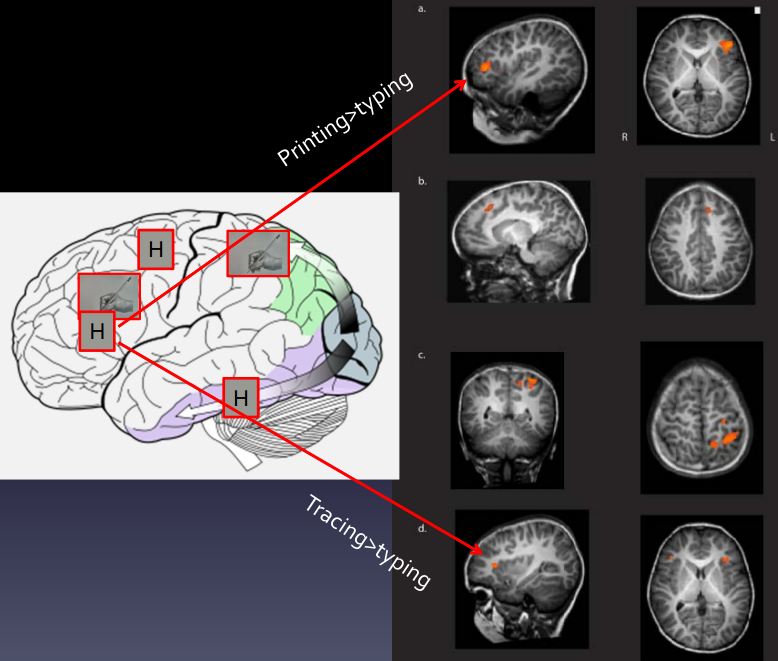
Berninger’s team conducted brain scans and found that the brain’s thinking, language, and “working memory” regions are more activated when handwriting letters than when typing.

This change in brain activation occurs because handwriting letters generally requires more than one sequential stroke, rather than selecting a letter key during typing, according to Berninger.

Berninger’s studies demonstrated students in grades two, four and six wrote more words more quickly and expressed more ideas when writing essays by hand versus with a keyboard.

Karin James

Karin James

Karin Harman James’s research using an fMRI at Indiana University confirms the benefits of handwriting.

Isabel Gauthier

Isabel Gauthier

With Isabel Gauthier of Vanderbilt University, she showed alphabet letters to children before and after they received letter-learning instruction.

Participants who practiced printing by hand showed more enhanced and “adult-like” the neural activity than those who had simply looked at letters.
James suggested that adults may show similar neural activity benefits when learning a new graphically-different language, such as Mandarin, or symbol systems for mathematics, music and chemistry.

Marieke Longcamp

Marieke Longcamp

Université de la Méditerranée’s Marieke Longcamp,  Céline Boucard, Jean-Claude Gilhodes and Jean-Luc Velay  with Jean-Luc Anton, Muriel Roth, and Bruno Nazarian of Hôpital de La Timone, Marseille, France demonstrated other neural benefits of handwriting: Movements memorized when learning how to handwrite enabled adults to more effectively recognize graphic shapes and letters.

Steve Graham

Steve Graham

Steve Graham, now of Arizona State University, with Michael Hebert, now of University of Nebraska, demonstrated that handwriting is still associated with improved classroom performance, even when most classrooms and students type on computers.

Sian Beilock

Sian Beilock

Besides enhancing academic achievement, writing can be a coping tool, according to University of Chicago’s Sian Beilock.
She reported that bright students managed test anxiety by writing about their anxieties to “off-load” them.

Jill Mateo

Jill Mateo

Beilock collaborated with Andrew Mattarella-Micke, Jill Mateo, Neil Albert and Katherine Foster of University of Chicago, and Vanderbilt University’s Marci DeCaro, Robin Thomas of Miami University, and Megan Kozak of Pace University to study students as they derived solutions to challenging math problems.

Robin Thomas

Robin Thomas

The team confirmed that those who performed well on the math problems said that they did not have math anxiety, whereas low performers said they were anxious about math performance.
A less expected finding was that both high performers and low performers had the stress hormone, cortisol, in their saliva.

Although both groups experienced measurable stress, the performance outcome was mediated by the calm or anxious “mindset,” suggesting that performance can be enhanced through managing anxiety and expectations.
Writing by hand helped participants boost performance by reducing anxiety and freeing  working memory to focus on the math problems.

P. Murali Doraiswamy

P. Murali Doraiswamy

Handwriting practice may be valuable for adults as well as children, according to P. Murali Doraiswamy of Duke University, who suggested that handwriting practice may be a useful treatment to stabilize cognitive losses in aging.

 -*How often do you use handwriting and printing instead of typing on a keyboard?

RELATED POSTS:

©Kathryn Welds