Category Archives: Leadership

Leadership

Men Negotiate More Assertively with Women Managers

Ekaterina Netchaeva

Ekaterina Netchaeva

Men volunteers negotiated more assertively with women in supervisory roles in laboratory tasks, compared with strategies they used with male supervisors, reported Bocconi University’s Ekaterina Netchaeva, Maryam Kouchaki of Northwestern University, and Washington State University’s Leah D. Sheppard.

Maryam Kouchaki

Maryam Kouchaki

This cross-gender negotiation trend was reduced when woman in supervisory roles demonstrated directness and proactivity (“administrative agency”) rather than self-promotion and power-seeking (“ambitious agency”).

Leah D. SheppardThe team told 52 male and 24 female volunteers that they would negotiate their salary at a new job in a computer exercise with a male or female hiring manager.

After the negotiation, participants completed an implicit threat test by identifying words that appeared on a computer screen for a fraction of a second in a variation of the Implicit Association Test developed by Harvard’s Mahzarin Banaji and Anthony Greenwald of University of Washington.
Participants who chose more threat-related words like “fear” or “risk,” were inferred to feel more threatened.

Mahzarin Banaji

Mahzarin Banaji

Male participants who negotiated with a female manager selected more threat-related words on implicit association test, and they negotiated for a higher salary ($49,400 average), compared to men negotiating with a male manager ($42,870 average).

Linda Babcock

Linda Babcock

The manager’s gender didn’t affect female participants, who negotiated a lower salary ($41,346 average), reflecting a common trend where women tend not to negotiate, or to negotiate less vigorously, as noted by Carnegie Mellon’s Linda Babcock and Hannah Riley Bowles of Harvard.

Anthony Greenwald

Anthony Greenwald

In another experimental task, more than 65 male volunteers decided how to share a $10,000 bonus with a male or female team member or with supervisor.
Male participants tended to equally divided the money with male or female team members, but reacted significantly differently with a female supervisor.

Men who endorsed more threat-related words chose to keep more money for themselves when the supervisor was female, compared with when they were paired with a male supervisor.

Hannah Riley Bowles

Hannah Riley Bowles

A related online survey of 226 male and 144 female volunteers found that male participants decided to keep a larger share of the $10,000 bonus when the female manager was described as ambitious or power-seeking, but responded significantly more favorably when the female supervisor was described as proactive or ambitious.
In the latter case, male volunteers offered approximately the same bonus amount to female managers.

This suggests that women managers with male direct-reports enhance these relationships by adopting a consciously direct leadership style, characterized by consistent communication, and proactive problem-solving.

Netchaeva’s group posits that women who adopt a direct, active leadership style reduce threat in cross-gender reporting relationships, and enable greater cooperation in bargaining and negotiation situations.

-*To what extend have you observed evidence of implicit threat responses in cross-gender workplace reporting relationships?

Follow-share-like http://www.kathrynwelds.com and @kathrynwelds

Related Posts:

©Kathryn Welds

Touch Can Increase Compliance, Persistence, Performance

Edward T. Hall

Edward T. Hall

Fifty years ago, Edward T. Hall, then of Illinois Institute of Technology, identified differences in interpersonal space ranging from intimate to personal to social to public, and inspired examination of acceptable interpersonal distance across cultures, genders, and organizations.

Circles of Interpersonal Space

Circles of Interpersonal Space

A decade later, Chris Kleinke, then of Wheaton College, expanded Hall’s work on “proxemics” as he explored the impact of close contact in public spaces, particularly non-intimate touching.

He found that in a relatively low-touch culture like the U.S., directing gaze and touch toward others increased their compliance with ambiguous requests in laboratory experiments.

Chris Kleinke

Chris Kleinke

Since then, this finding has been incorporated in sales, learning, healthcare, and other service settings based on evidence that touch increased performance when applied after a person initially agreed to a request, in research by Oakland University Jane C. Nannberg and Christine H. Hansen.

David Vaidis

David Vaidis

“Dosage” of touch had an additive effect when University of Paris’ David Vaidis and Severine Halimi-Falkowicz of University of Provence found that people who were touched two times persisted in lengthy tasks more than people who were touched once.

Likewise, University of Missouri’s Frank N. Willis and Helen K. Hamm found that touch contributed to compliance with challenging requests, especially in gaining agreement from people of the same gender as the requestor.

Séverine Halimi-Falkowicz

Séverine Halimi-Falkowicz

Another demonstration of influential touch was when female restaurant servers briefly touched customers on the hand or the shoulder while returning change from the bill payment.

These customers’ reactions were compared with other patrons who were not touched by the servers, in research by University of Mississippi‘s  April H. Crusco and Christopher G. Wetzel of Rhodes College.

Chris Wetzel

Chris Wetzel

They evaluated customers’ reactions to service, food, setting, and other elements of the dining experience with a restaurant survey as well as the gratuity amount, expressed as a percentage of the bill.

Customers who were touched on the hand or shoulder gave the server significantly larger gratuities than those who were not touched, and there was no significant difference between tips from customers who had been touched on the hand or the shoulder.

These findings confirm the influence of interpersonal touch in public commercial settings, and offer a reminder that non-intimate touching can increase cooperation and commitment to complete lengthy or challenging tasks.

-*How have you used interpersonal touch in public work situations to enable cooperation and performance?

Follow-share-like http://www.kathrynwelds.com and @kathrynwelds

Related Posts:

Twitter:  @kathrynwelds
Google+
LinkedIn Groups Psychology in Human Resources (Organisational Psychology)
Facebook
Blog: – Kathryn Welds | Curated Research and Commentary

©Kathryn Welds

Power Increases Responsibility, Generosity toward Future Generations

Leigh Plunkett Tost

Leigh Plunkett Tost

Power can increase future perspective, feelings of social responsibility, and intergenerational generosity toward others, according to University of Michigan’s Leigh Plunkett Tost, Kimberly A. Wade-Benzoni of Duke University, and University of Idaho’s Hana Huang Johnson.

Priscilla Chan, Mark Zuckerberg

Priscilla Chan, Mark Zuckerberg

Mark Zuckerberg and Pricilla Chan’s sizeable gift of Facebook stock on the occasion of their daughter’s birth is a recent example.

Katherine DeCelles

Katherine DeCelles

This finding contrasts previous reports that power tends to cause people to act in more self-interested ways with peers, particularly “in the presence of a weak moral identity,” according to University of Toronto’s Katherine DeCelles, D. Scott DeRue of University of Michigan, Harvard’s Joshua Margolis, and Tara L. Ceranic of University of San Diego.

Kimberly Wade-Benzoni

Kimberly Wade-Benzoni

Focusing on previous power experiences also was linked with a longer-term time perspective among more than 110 participants who wrote about a time they experienced power over others.
Volunteers in studies by Tost’s group reported greater willingness to allocate charitable donations to a cause with long-term benefits than one addressing an immediate need, compared with a matched group that didn’t write about a previous power experience.

Hana Huang Johnson

Hana Huang Johnson

In another task, more than 230 volunteers also wrote a power prime, then chose between allocating a $1,000 bonus to themselves or another participant now or a larger amount in the future.
Participants who recalled a power experience were more likely to allocate a greater future bonus to themselves and someone else.

Scott DeRue

Scott DeRue

Tost’s team suggested that people with intergenerational power typically feel responsible for ensuring others’ long-term interests, manifested in generous behavior to younger generations.
DeCelles’ findings suggest that moral identity may interact with intergenerational relations to influence people to act with less self-interest and greater altruism.

Joshua Margolis

Joshua Margolis

In additional studies, more than 160 participants were randomly assigned to influence tasks that other group members performed.
The controlling participants reported greater willingness to allocate more future lottery winnings to another group member compare with volunteers who did not control others’ assignments.

Sonya Lyubomirsky

Sonya Lyubomirsky

Many of these paradoxes of generosity and altruism are investigated through University of Notre Dame’s Science of Generosity initiative.
One promising project is led by University of California, Riverside’s Sonya Lyubomirsky, who explored “the how” and “myths” of happiness.

She currently investigates “ripple” and contagion effects of generosity propagation in work settings, and argues that performing generous acts makes the giver, receiver, connector, and observer happier.
In addition, she posits that workplace generosity promotes a positive workplace climate.

Tara Ceranic

Tara Ceranic

Feelings of power seem to invoke a sense of responsibility to ensure and enable others’ interests.
This insight can benefit non-profit organizations seeking increased donations by highlighting that those with decision-making authority have the power to shape the performance and outcomes of the generations to come.

-*To what extent do those with organizational power demonstrate a longer time perspective and willingness to enable the next generation’s well-being?

Follow-share-like http://www.kathrynwelds.com and @kathrynwelds

Related Posts:

Previous blog posts have outlined the varied positive effects of focusing on previous power experiences, and on time perspective’s relationship with investment choices.

Twitter:  @kathrynwelds
Google+LinkedIn Groups Psychology in Human Resources (Organisational Psychology)
Facebook
Blog: – Kathryn Welds | Curated Research and Commentary

©Kathryn Welds

Perception of CEOs’ Non Verbal Leadership Behaviors Affect IPO Valuations, Predict Financial Performance

Elizabeth Blankespoor

Elizabeth Blankespoor

Favorable first impressions of CEOs can affect new companies’ valuations and can predict near-term performance.

Perception of CEO non-verbal behavior during IPO road show presentations was associated with higher valuations at each IPO stage, found Stanford’s Elizabeth Blankespoor, Greg Miller of University of Michigan, and University of North Carolina’s Brad Hendricks.
These findings underscore the importance of road show presentations and presenters’ credibility to investors, underwriters, analyst, and financial media.

Greg Miller

Greg Miller

Blankespoor’s team noted that for most investors, the road show is the first time they see the CEO in the two-week interval between setting the initial proposed price and determining the final offer price.
As a result, Blankespoor and colleagues posit “a tight link between perceptions and valuation.”

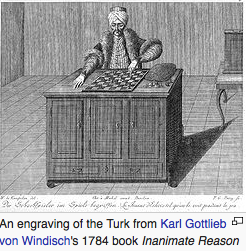
Participants in their investigation were hired through Amazon’s Mechanical Turk, a crowdsourcing task website, to view videotapes of CEOs presenting IPO roadshow, then to rate the speakers for competence, attractiveness, and trustworthiness.

Brad Hendricks

Brad Hendricks

At least 40 people viewed each series of 30-second video clips from 224 actual road show presentations between 2011 and 2013, with modified audio to muffle words while retaining vocal pitch and rhythm.

After controlling for other factors that could affect stock price like CEO age, experience, and education, companies with higher-rated CEOs on a composite score of competence, attractiveness, and trustworthiness ratings received a larger price increase for the proposed offering price and the revised price for secondary markets.

Mechanical TurkFor each 5% increase in CEO composite perception score, the final market price was 11% higher, and CEO perceived competence and attractiveness had a significant impact on firm valuation.
However, trustworthiness alone had no effect.

These initial perceptions also correlated with companies’ early performance, based on stock prices up to 12 months after the IPO, suggesting that “…investors … glean real additional information about the CEO from … nonverbal behavior and … perceptions of management are signals for firm value.”

Gotham Research GroupBloggers as well as traditional media outlets are important arbiters of CEO reputation.
In a commissioned analysis of 10 well-known institutional bloggers by the Gotham Research Group, perceptions of CEO authenticity were significantly related to bloggers’ evaluations of CEO competence and performance.

Candor, bluntness, fearlessness, specificity, plain words, examples from stories, warmth, frequent contact with customers and employees, and acknowledging challenges and worthy competitors are all essential to setting a credible tone, according to this report.

Weber ShandwickIn fact, Public Relations firm Weber Shandwick noted that 49% of company reputation is attributed to CEO reputation, and 60% of market value is attributed to company reputation.
Perception of a CEO, the firm argues, has significant influence on market value, underscoring empirical findings by Blankespoor’s team.

-*What non-verbal behaviors and attributes signal “leadership” and “executive presence” to you?

Follow-share-like http://www.kathrynwelds.com and @kathrynwelds

Related Posts:

Twitter:  @kathrynwelds
Google+LinkedIn Groups Psychology in Human Resources (Organisational Psychology)
Facebook
Blog: – Kathryn Welds | Curated Research and Commentary

©Kathryn Welds


Collaboration Can Encourage Corruption, Lying

Damon Jones

Damon Jones

Many corporations encourage collaboration and make it part of culture statements and annual performance reviews.
Cisco Systems, for example, defined collaboration as “working across boundaries, building teams, managing conflict, earning trust, and recognizing good performance,” part of the CLEAD performance management and development system.

Mark Greenberg

Mark Greenberg

Ability to collaborate develops in childhood and is associated with positive life outcomes, demonstrated in a two decade longitudinal study of more than 750 Americans from kindergarten into adulthood by Penn State’s Damon Jones, Mark Greenberg and Daniel Max Crowley.

Daniel Max Crowley

Daniel Max Crowley

They found that kindergartners whose teachers rated them highly on social competence dimensions including:

Ori Weisel

Ori Weisel

Although collaborative settings may boost honesty due to increased observability, accountability, University of Nottingham’s Ori Weisel and Shaul Shalvi of Ben-Gurion University of the Negev showed that collaboration among equals can trigger corruption by lying, misreporting, and exaggerating performance.

Shaul Shalvi

Shaul Shalvi

They experimentally evaluated performance between 280 partners on a die rolling task for which they earned cash.
Player A privately rolled a die and reported the result to player B, who then privately rolled and reported the result.
Both players were paid only if they both reported the same results — for example, if both reported rolling “6”, each earned €6.

Robert S Feldman

Robert S Feldman

Players tended to inflate potential profit by misreporting actual outcomes, demonstrated by the proportion of reported matches.
The probability of rolling the same number in each round was one in six, or an average of 3.33 times in 20 rounds.
However, teams reported an average of 16.3 matches—nearly five times the expected number, demonstrating likely misrepresentation to achieve financial payoff.

Participants also lied even when they did not benefit, provided their partner benefitted.
Wiesel and Shalvi explained that “people are willing to pay the moral cost of lying even if they don’t stand to get any material benefit—the only benefit is the joy of collaboration.

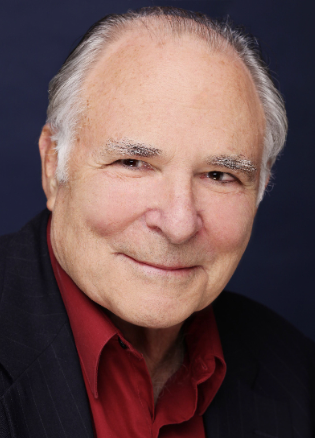
Paul Ekman

Paul Ekman

When partners’ payoffs were not aligned, they were less likely to inaccurately report performance.
This finding suggests that participants were more likely to engage in “corrupt collaboration” when lying was financially advantageous to themselves and their partners.

Lying, one component of “corrupt collaboration,” occurs many times each day, according to University of Massachusetts’ Robert Feldman.
In fact, he found that two people getting acquainted lied an average of three times in ten minutes.

James Tyler

James Tyler

However, lying may not be detected in collaborative situations.
Feldman asserts that “no single or even combination of verbal or nonverbal behaviors accurately indicate when a person is lying… Most people have no better than a coin-flip chance of telling a lie from the truth….And many of the cues we think are associated with lying are unrelated to deception.”
This view is more pessimistic than  Paul Ekman’s contention that lying can be detected.

Andreas Reichert

Andreas Reichert

Besides being potentially difficult to detect in collaborative situations, lying can be contagious.
For example, volunteers were more likely to engage in their own deceptive behavior toward others as a result of being duped, in research by Purdue’s James M. Tyler, Robert S. Feldman of University of Massachusetts with Andreas Reichert of University of Konstanz.

Greg Willard

Greg Willard

Corrupt collaboration practices like lying may persist due to financial and other benefits.
In fact, people who lie also demonstrated more confidence, higher  achievement goals, positive affect, and composure during a stressful mock job interview scenario by Harvard’s Greg Willard and Richard Gramzow of Syracuse University.

However, when liars knew that their embellishments would be verified, their performance – and their prevarications – were reduced over time.
This finding suggests that visible monitoring seem to curb the potential downsides of collaboration in the workplace.

Richard Gramzow

Richard Gramzow

Despite collaboration’s purported positive effects on innovation, this teamwork approach can be accompanied by a side effect of enabling willful and reckless “corruption”, lying, and exaggeration.
However, this darker side of collaboration can be reduced by verifying the trust instilled in others.

-*How have you maximized the benefit of collaboration and team work while reducing the likelihood of developing “corrupt collaboration”?

Follow-share-like http://www.kathrynwelds.com and @kathrynwelds

Related Posts:

 Twitter: @kathrynwelds
Google+
LinkedIn Groups Psychology in Human Resources (Organisational Psychology)
Facebook

Blog: – Kathryn Welds | Curated Research and Commentary

©Kathryn Welds

Managing Collective Emotions Affects Leader Reputation, Impact

Gustave Le Bon

Gustave Le Bon

People in groups and crowds demonstrate collective affect, according to Gustave Le Bon, who asserted that individuals in these contexts collectively act with “impulsiveness, irritability, incapacity to reason, the absence of judgment of the critical spirit, the exaggeration of sentiments…” even if these are not their usual individual behaviors.

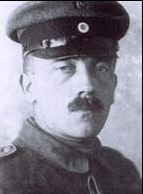
Adolph Hitler

Adolph Hitler

Well before the rise of charismatic leader Adolph Hitler, Le Bon claimed that “…an individual immersed for some length of time in a crowd soon finds himself…. in a special state, which much resembles the state of fascination in which the hypnotized individual finds himself in the hands of the hypnotizer.

One way to evaluate individual and collective affect is through facial expressions because they provide information about how others understand people and events.
As a result, these non-verbal cues enable people to tailor responses to individuals and groups they encounter.

Peter Salovey

Peter Salovey

Tailoring interaction style based on observing others is a key element of Emotional Intelligence, described by Yale’s Peter Salovey and Daisy Grewal as accurately perceiving others’ emotional states and effectively responding with emotionally-charged interpersonal situations.

Daisy Grewal

Daisy Grewal

This is also an essential leadership skill because it enables awareness of sentiments that may be out of others’ awareness or that they may consciously try to suppress to align with prevailing organizational cultures — particularly those that do not encourage emotional awareness and expression.

Hillary Anger Elfenbein

Hillary Anger Elfenbein

Consequently, accurate perception of others’ emotions is related to effectively managing interpersonal relationships according to University of California, Berkeley’s Hillary Elfenbein and to subordinates’ ratings of managers as transformational leaders in research by Depaul University’s Robert S. Rubin, David C. Munz of Saint Louis University and Cleveland State University’s William H. Bommer.

However, accurate perception of group sentiment is difficult because many people narrow attention to a few individuals and to focus in detail on them, leading to perceptual bias of collective “tunnel vision.”

Takahiko Masuda

Takahiko Masuda

As a result, much information in social context, including the group’s prevailing emotional tone, may be filtered out, noted University of Alberta’s Takahiko Masuda, Phoebe C. Ellsworth of University of Michigan, Wake Forest University’s Batja Mesquita, Janxin Leu of University of Washington, Hokkaido University’s Shigehito Tanida, and Ellen Van de Veerdonk of University of Amsterdam.

Executives and leaders must decode and attend to collective emotions because they often cannot develop individual relationships with each of their many stakeholders and when addressing group emotions including:

Phoebe Ellsworth

Phoebe Ellsworth

  • Employees’ collective anxiety about corporate restructuring, mergers, divestitures, and reductions in force,
  • Consumers’ collective anger,
  • Board of Directors members’ lack of support.
Jennifer George

Jennifer George

Positive collective emotions tend to be over-estimated, and linked to greater customer service and lower absenteeism, reported Texas A & M’s Jennifer George.
In contrast, negative collective emotions like envy are easily under-estimated, and associated with lower group performance and satisfaction by reducing group potency and cohesion in research by University of Kentucky’s Michelle Duffy and Jason Shaw.

Michelle Duffy

Michelle Duffy

A leader’s ability to respond effectively to patterns of shared emotions during strategic organizational change and other emotionally turbulent organizational processes depends on the leader’s ability to widen the “emotional aperture.”

Emotional Aperture 1Like a camera’s aperture adjustment for increased depth of field, emotional aperture refers to ability to recognize the mix of positive and negative emotional experiences in a team, workgroup or business unit.

This “setting change” can bring into focus both nearby individuals and more distantly scattered groups of people.
Likewise, adjusting the emotional aperture involves moving an information-processing focus from individual emotional experiences to a group’s collective emotional composition.

David Matsumoto

David Matsumoto

Although ability to recognize individual emotional expression has been measured by instruments like the Brief Affect Recognition Testthis tool doesn’t evaluate perception and recognition of collective affect.

Jeffrey Sanchez-Burkes

Jeffrey Sanchez-Burkes

To address this limitationUniversity of Michigan’s Jeffrey Sanchez-Burks and Caroline A. Bartel of University of Texas collaborating with Vanderbilt University’s Laura Rees and Quy Huy of INSEAD developed an Emotional Aperture Measure (EAM).

EAM analyzes a person’s ability to accurately perceive a group’s collective emotions in short video clips of employee groups before and after an organizational event.
Next, participants estimate the proportion of rapid individual positive and negative reactions among group members.
Feedback from this instrument can increase perceiver accuracy through heightened awareness.

Caroline Bartel

Caroline Bartel

Sanchez-Burks contacted direct reports of a global sample of high-ranking managers and requested online evaluations of the manager’s leadership performance.
Three studies demonstrated that collective affect recognition requires a distinct information processing style, differing from perceiving individual emotion.

Laura Rees

Laura Rees

Managers’ EAM performance was significantly correlated with direct reports’ perception of managers’ “transformational leadership” behaviors, suggesting that this ability to accurately perceive group emotion can significantly influence stakeholder impressions and opinions.

People can open their emotional aperture through attention to collective emotions, and may influence prevailing negative group affect by asking the positive minority to share optimistic sentiments with the skeptical majority.
This dialog can increase trust and shared perspectives that may move negative sentiment to become more positive.

Quy Huy

Quy Huy

Leaders who increase the range of their “emotional aperture” can increase followers’ alignment with strategic direction to increase the likelihood to effective execution and change impact.

Try the Emotional Aperture Measure to see your results.Emotional Aperture Measure

-*How do you read the “emotional tone” of a group?

Related Posts:

©Kathryn Welds

Debiasing Decisions: Combat Confirmation Bias, Overconfidence Bias

Philip Meißner

Philip Meißner

Cognitive and behavioral biases can contribute to “blind spots” in decision-making, leading to less effective outcomes.
To improve decision outcomes, University of Marburg ’s Philip Meißner, Torsten Wulf of HHL Leipzig Graduate School of Management and HEC’s Olivier Sibony proposed a systematic checklist to identify potential decision derailment based on bias, along with rapid remedies.

Torsten Wulf

Torsten Wulf

They argues that two types of bias contribute to most decisions that lead to undesirable results:

  • Confirmation bias, the unconscious tendency to believe new information that is consistent with existing beliefs and recent experiences, and to discount contradictory data,
  • Overconfidence bias, the out-of-awareness likelihood to overestimate one’s skills, insights, and judgment.
    This leads to increased risk-taking based on illusory sureness of the decision and ability to mitigate adverse outcomes.

Olivier Sibony

Olivier Sibony

Previously, Lovallo and Sibony articulated four related decision biases:

  • Pattern-recognition biases, countered by changing the “angle of vision,”
  • Action-oriented biases, mitigated by recognizing uncertainty,
  • Interest biases, minimized by explicitly highlighting these interests,
  • Social biases, reduced by depersonalizing debate.

Debiasing techniques such as checklists, can limit the negative effects of biases in decision-making by offering a disciplined, comprehensive analysis of downside risks and by systematically considering multiple viewpoints.

Atul Gawande

Atul Gawande

However, effectively implementing checklists requires consistent discipline, noted Harvard’s Atul Gawande, who cited examples of partial adherence leading to costly oversights and failures.

One approach, suggested by Princeton’s Daniel Kahneman and Gary Klein of McKinsey, is a “premortem.”
Decision makers imagine that the decision has failed and analyze sources and reasons for adverse outcomes, to more thoroughly assess points of failure and possible mitigation strategies.
Formal scenario-planning is another way to expose assumptions underlying a plan, as well as a competitor’s priorities and potential strategy.

Massimo Garbuio

Massimo Garbuio

Using a variety of debiasing techniques significantly increased the Return on Investment (ROI) in a study by University of Sydney’s Massimo Garbuio and Dan Lovallo and Olivier Sibony of HEC.
As a result, Michael Birshan, Ishaan Nangia, and Felix Wenger of McKinsey, argued that debiasing techniques should be embedded in formal organizational decision-making processes, particularly for high-impact, repetitive decisions.

Michael Birshan

Michael Birshan

Decision biases may be out of awareness, or unconscious, so it’s more effective to evaluate the process of developing a proposal, rather than focusing only on the content and merits of a proposal.

Decision-making safeguards can be built into standard analysis processes by including questions to expose:

  • Multiple data sources,
  • Diverse opinions and perspectives,
  • Downside risk,
  • Potential negative outcomes for company, industry, and broader ecosystem.

Daniel Kahneman

Daniel Kahneman

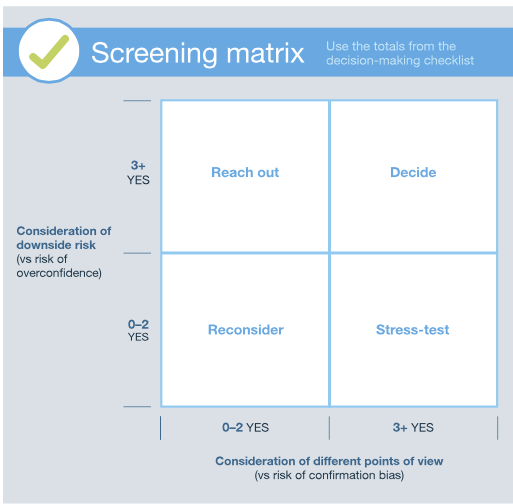
Proposals are considered ready for a decision only when multiple perspectives are available to mitigate confirmation bias and risk analysis is available to reduce overconfidence bias.
Responses to decision checklist questions can be quantified to indicate one of four action steps, according to Daniel Kahneman:

  • Decide, based on inclusion of robust safeguards against both confirmation bias and overconfidence bias,
  • Screening MatrixReach out, suggesting the need for gathering additional perspectives, opinions, and perspectives to prevent narrow assumptions to reduce confirmation bias.
    The Vanishing-Options Test, proposed by Stanford’s Chip Heath and Dan Heath of Duke University, can generate new ideas by imagining that none of the current proposals are available.
  • Stress-test, by conducting a pre-mortem or analysis by external devil’s advocate or provocateur to reduce overconfidence risk by.
  • Reconsider when both more perspectives and risk analysis are required to reduce both overconfidence bias and confirmation bias.
    This screening matrix helps reduce related decision-making biases:
  1. Self-interest Bias
    -To what extent is the proposal motivated by self-interest?

Ishaan Nangia

Ishaan Nangia

Recommendation
-Assess for over-optimism

  1. Affect Heuristic
    -How strong is the team’s emotional attachment to a specific proposal?
    -To what extent were risks and costs fully considered for both preferred and non-preferred options?

Recommendations
-Assess for strongly-preferred outcomes
-Reintroduce analysis of all options

  1. Groupthink
    -How many dissenting opinions were analyzed?
    -How adequately were all options explored?
    -Was dissent discouraged? 

Felix Wenger

Felix Wenger

Recommendations
-Encourage substantive disagreements as a valuable part of the decision process
-Solicit dissenting views from members of the recommending team, through private meetings

4. Saliency Bias
     -To what extent are decisions made based on a potentially incomparable, but memorable success?
     -What about the proposed analogy is comparable to the current situation?
     -What are relevant examples from less successful companies? What happened in those cases?

Decision Making QuestionsRecommendation
-Carefully scrutinize analogies’ similarity to the current decision situation
Solicit additional analogies using reference class forecasting:

.Select reference class,
.Assess distribution of outcomes,
.Intuitively estimate project’s position in distribution,
.Assess estimate’s reliability,
.Correct intuitive estimate.

  1. Confirmation Bias
    -What viable alternatives were included with the preferred recommendation?
    -At what stage in the decision analysis were alternatives discarded?
    -What efforts were undertaken to seek information to disconfirm the main assumptions and hypotheses?

Recommendation
-Request two additional alternatives to the main recommendation, including analysis of benefits and drawbacks
-Acknowledge unknowns, risks

  1. Availability Bias

    Max Bazerman

    Max Bazerman

    If you had more time to gather date, what information would you seek?, asked Harvard’s Max Bazerman
    -How can you access similar data now?

Recommendation
-Use checklists to ensure comprehensive analysis of data required for each decision type

  1. Anchoring Bias
    -What data sources are used to analyze decision?
    -Which data are estimates? By whom? If so, from which data were estimates extrapolated?
    -To what extent could there be:
  • Unsubstantiated numbers?
  • Extrapolation from non-equivalent previous situations?
  • Attraction to specific anchors?

Recommendations
-Present data from other sources, benchmarks, or models
-Request new analysis

8. Halo Effect
     -To what extent does the analysis team expect that a person, organization, or approach previously successful in one context will be equally effective in different situation?

Phil Rosenzweig

Phil Rosenzweig

Recommendations
-Question potentially inaccurate inferences
-Solicit additional comparable examples
-Question attributions of success and failure to leaders’ personalities instead of chance factors, advised IMD’s Phil Rosenzweig.

9. Sunk-Cost Fallacy, Endowment Effect
     -To what extent are recommenders attached to past decisions?

Recommendation
Disregard past expenditures when considering future costs and revenues

  1. Overconfidence, Planning Fallacy, Optimistic Biases, Competitor Neglect
    -To what extent is the comparison case unwarrantedly optimistic?

Recommendation
-Adopt an outside view by using relevant simulations or war games

  1. Disaster Neglect
    -To what extent is the worst case scenario realistically and sufficiently negative?
    -How was the worst case generated?
    -To what extent does the worst case consider competitors’ likely responses?
    -What other scenarios could occur?

Recommendation
-Conduct a premortem, suggested by Gary Klein of Applied Research Associates:  Imagine the worst case scenario occurred, then propose likely causes, mitigations   

  1. Loss Aversion
    -To what extent is the evaluation and decision team risk averse?

Recommendation
-Realign incentives to share responsibility for the risk or to reduce risk

  1. Planning Fallacy focuses only on the current case while ignoring similar projects’ history and statistical generalization from related cases.
    -To what extent does the analysis rely on “top-down, outside-view” comparisons to similar projects?
    -Did the evaluators use a “bottom-up, inside-view” to estimate time required for each step?

Recommendation
-Statistically analyze a broad range of similar cases to avoid over-estimates from “top-down, outside-view” approaches and underestimates from “bottom-up, inside-view”
-Differentiate accurate forecasts from ambitious targets

  1. Loss aversion
    -To what extent are evaluators more concerned with avoiding loss than achieving gains?
    – How concerned are evaluators with being held responsible for a failed project?
    -To what extent has the organization specified acceptable risk levels?

Recommendation
-Seek risk tolerance guidelines from organizational leaders.

Decision-making tools like checklists can significantly reduce unconscious biases, provided that they are consistently and systematically applied.

-*What strategies have you found most helpful in reducing biases in decision-making?

Follow-share-like http://www.kathrynwelds.com and @kathrynwelds

Related Posts:

Twitter:  @kathrynwelds
Google+LinkedIn Groups Psychology in Human Resources (Organisational Psychology)
Facebook
Blog:  Kathryn Welds | Curated Research and Commentary

©Kathryn Welds


Reinventing Performance Management to Reduce Bias: Strengths, Future Focus, Frequent Feedback

Steven Scullen

Steven Scullen

Most performance management systems set goals at the beginning of the year and determine variable compensation by rating accomplishment of those objectives.

These evaluations typically are considered in lengthy “consensus meetings” in which managers discuss the performance of hundreds of people in relation to their peers – sometimes called “stack ranking,” or more cynically “rank-and-yank.”

Michael Mount

Michael Mount

These year-end ratings don’t provide “in-the-moment” and “real-time” feedback about actual performance as it happens, so may be less useful in improving performance.

Assessing skills produces inconsistent data based on raters’ own skills in that competency and the value they attach to each performance objective, leading to unconscious bias.

Maynard Goff

Maynard Goff

This risk to performance rating validity was demonstrated by Drake University’s Steven Scullen, Michael Mount of University of Iowa, and Korn Ferry’s Maynard Goff, who considered 360 degree performance evaluations by two bosses, two peers, and two subordinates for nearly 4500 managers.

They found that three times as much rating variance was explained by individual raters’ idiosyncratic evaluation choices, rather than actual performance.

Manual London

Manual London

Sources of bias include halo error, leniency error, and organizational perspective based on current role, suggested by SUNY’s Manuel London and James Smither of LaSalle University, and validated by Scullen’s team.

These findings led the researchers to conclude “Most of what is being measured by the ratings is the unique rating tendencies of the rater. Thus ratings reveal more about the rater than they do about the ratee,” replicating similar findings by University of Georgia’s Charles Lance, Julie LaPointe and Amy Stewart.

Ashley Goodall

Ashley Goodall

To mitigate these biases in Deloitte’s performance management system, Ashley Goodall of Deloitte Services LP engaged Marcus Buckingham, formerly of The Gallup Organization, to analyze existing practices and develop an empirically-validated approach.

Goodall and Buckingham calculated the total annual hours required to conduct performance ratings using the existing process and found that managers invested 2 million hours a year.
This finding confirmed that one goal in revising the process was to increase speed and efficiency.

Marcus Buckingham

Marcus Buckingham

In addition, Goodall and Buckingham sought to increase the meaningfulness of performance management by focusing on discussions about future performance and careers rather than on the appraisal process.

They concluded a performance management system should be characterized by:

  • Reliable performance data, controlling for idiosyncratic rater effects,
  • Speed to administer,
  • Ability to recognize performance,
  • Personalization: “One-size-fits-one”,
  • Considering actions to take in response to data,
  • Continuous learning and improvement.

Deloitte logoDeloitte conducted a separate controlled study of 60 high-performing teams including almost 1300 employees representing all parts of the organization compared with an equal number of employees from an equivalent sample to determine questionnaire items that differentiate high- and lower-performing teams.

They found that performance and related compensation allocations could be more accurately based on managers’ statements about their intended future actions toward each employee rather than asking about team members’ skills.

Several items accounted for the vast majority of response variation between top performing groups and others, particularly At work, I have the opportunity to do what I do best every day.”

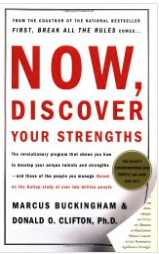
Now Discover Your StrengthsBusiness units whose employees said they “strongly agree” with this item were substantially more likely to be more productive, earn high customer satisfaction scores, and experience low employee turnover.

Other powerful predictors of performance were:

  • I have the chance to use my strengths every day,
  • My coworkers are committed to doing quality work,
  • The mission of our company inspires me.

Deloitte’s revised performance management system asks team leaders to rate four items on a 5-point scale from “strongly agree” to “strongly disagree” or yes-no at the end of every project or once a quarter:

  • Given what I know of this person’s performance, and if it were my money, I would award this person the highest possible compensation increase and bonus [measures overall performance and unique value],
  • Given what I know of this person’s performance, I would always want him or her on my team [measures ability to work well with others],
  • This person is at risk for low performance [identifies problems that might harm the customer or the team],
  • This person is ready for promotion today [measures potential].

These responses provide a performance snapshot that informs but doesn’t completely determine compensation.
Other factors include project assignment difficulty and contributions other than formal projects, evaluated by a leader who knows each individual personally or by a group considering data across several groups.

In addition, every team leader prioritizes once-weekly “check-ins” with each employee to ensure that priorities are clear and progress toward them is consistent.

Strengthfinder 2.0

Strengthfinder 2.0

Goodall and Buckingham opined that “radically frequent check-ins are a team leader’s killer app to recognize, see, and fuel performance,” in addition to using a self-assessment tool that identifies each team members’ strengths and enables sharing with teammates, team leader, and the organization.

These three “interlocking rituals” of the weekly check-in, quarterly or project-end performance snapshot, and annual compensation decision enable a shift from retrospective view of performance to more “real-time” coaching to support performance planning and enhancement.

Deloitte’s approach seeks a “big data“ view of each person’s organizational performance and contribution rather than the “simplicity” of a small data view summarized in a single stack-rank number.

-*How do you develop a “Big Data” view of people’s performance?

-*How do you enable continuous, “in-the-moment” performance feedback instead of once-a-year retrospective view?

Follow-share-like http://www.kathrynwelds.com and @kathrynwelds

Related Posts:

Twitter:  @kathrynwelds
Google+
LinkedIn Groups Psychology in Human Resources (Organisational Psychology)
Facebook
Blog: – Kathryn Welds | Curated Research and Commentary

©Kathryn Welds

Four Leadership Behaviors Differentiate Top Performing Organizations

Ralph M. Stogdill

Ralph M. Stogdill

Effective leadership is a critical part of organizational health and growth and an important driver of shareholder returns, according to Ohio State’s Ralph M. Stogdill with McKinsey’s Aaron De Smet, Bill Schaninger, with Matthew Smith.

Bill Schaninger

Bill Schaninger

Consistent with this report, more than 90 percent of CEOs said they plan to increase investment in leadership development because they see it as their single most important human-capital issue, reported McKinsey’s Claudio Feser, Fernanda Mayol, and Ramesh Srinivasan.
However, only 43 percent of CEOs reported confidence that leadership training investments will render an acceptable ROI.

McKinsey Organizational Health Index Top Leadership Qualities

To more accurately target developable leadership behaviors associated with superior organizational performance, McKinsey identified 20 critical leadership traits then surveyed 189,000 people in 81 organizations of varying sizes across industries.

Claudio Feser

Claudio Feser

They segmented organizations by leadership effectiveness measured by McKinsey’s Organizational Health Index, and focused on companies in the top quartile and bottom quartile.

The team reported that four skills closely correlate with effective leadership and explained 89 percent of the variance in leadership effectiveness between top-performing organizations and lowest-performing organizations:

  • Effective problem solving by gathering, analyzing, and considering information before taking a decision,
  • Operating with a strong results orientation, developing and communicating a vision and setting objectives to efficiently achieve results,
  • Seeking different perspectives by monitoring trends affecting organizations and the external environment and by encouraging employees to suggest improvements,
  • Supporting others by demonstrating authenticity and sincere interest in colleagues to build trust and help others manage challenges.

Ramesh Srinivasan

Ramesh Srinivasan

A related post outlines other findings of top leadership competencies required for optimal organizational performance, including “Big Eight Competencies” described by Lominger’s Voices® 360˚ Assessment:

• Dealing with Ambiguity
• Creativity
• Innovation Management
• Strategic Agility
• Planning
• Motivating Others
• Building Effective Teams
• Managing Vision and Purpose.

-*Which leadership behaviors do you find most imperative?

Follow-share-like http://www.kathrynwelds.com and @kathrynwelds

RELATED POSTS:

Twitter  @kathrynwelds
Blog – Kathryn Welds | Curated Research and Commentary
Google+
LinkedIn Open Group Psychology in Human Resources (Organisational Psychology)
Facebook Notes

©Kathryn Welds

Individual Talent Surplus Can Reduce Team Performance 

Roderick Swaab

Roderick Swaab

More talent on a team doesn’t always increase team performance, particularly when team member must coordinate their efforts.

In fact, status conflicts based on talent differences can undermine team coordination during hand-offs for interdependent tasks, found INSEAD’s Roderick I. Swaab and Michael Schaerer, with Eric M. Anicich and Adam Galinsky of Columbia and VU University Amsterdam’s Richard Ronay.

Michael Schaerer

Michael Schaerer

Swaab and colleagues confirmed that most people believe there is a linear relationship between talent and performance:  They expect that more talent is consistently associated with improved performance.

However, the research team found an exception to this presumed rule when they analyzed National Basketball Association and Major League Baseball team and player data from 2002 through 2012.

They evaluated team performance in interdependent game tasks in basketball, a “zero sum game” because when one player shoots other players lose the opportunity to shoot at that time.
As a result, basketball players must coordinate efforts to position team members for as many shots as possible in a limited time.

Richard Ronay

Richard Ronay

In contrast, Swaab’s group studied independent sports performance in baseball.
In this game, players hit the ball in an assigned order and one player’s turn at bat does not eliminate another player’s turn to hit.
Further, each baseball player may hit a home run independent of other teammates’ batting skill, so each individual’s talent additively contributes to the team outcome.

Adam Galinsky

Adam Galinsky

Swaab’s team found that more talent is not associated with better performance when team members needed to coordinate interdependent tasks, as in basketball.
They called this the “too-much-talent effect”:  “When teams need to come together, more talent can tear them apart.”
In this case, they concluded that role differentiation is essential for optimal performance during interdependent tasks to ensure diverse capabilities in addition to willingness to collaborate.

Boris Groysberg

Boris Groysberg

This finding can be generalized to business organizations, which may experience decreased team performance if highly talented team members are unable to collaborate on interdependent tasks.
In addition, a surplus of top talent can undermine an organization’s profitability due to the high cost of attracting and hiring “stars.”

This “too-much-talent” effect was also demonstrated among Wall Street sell-side equity research analysts by Harvard Business School’s Boris Groysberg and Jeffrey T. Polzer with Hillary Anger Elfenbein of Washington University.

Hillary Anger Elfenbein

Hillary Anger Elfenbein

Increasing the number of talented analysts increased the firm’s overall performance to a point, then more stars actually decreased performance.
This effect was especially prominent when strong performers were concentrated in a small number of sectors.

As in professional sports, this “too-much-talent” effect could reflect a suboptimal integration and collaboration among analysts with similar expertise, controlling for individual performance, department size or specialization, or firm prestige.

Jennifer R. Overbeck

Jennifer R. Overbeck

Laboratory studies with volunteers confirm observations of the “too-much-talent” effect among professional athletes and Wall Street analysts, in research by University of Utah’s Jennifer R. Overbeck, Joshua Correll, and Bernadette Park.

They concluded that task groups need a few high-status members as leaders, and many more member-followers to contribute and implement work while supporting group direction.

Arthur Colman

Arthur Colman

When this “status sorting” is not explicit, Overbeck and team noted that a differentiated status hierarchy will evolve as status-seeking members vie for authority.
In rare cases, status sorting must be implemented through organizational design and responsibility definition, echoing earlier observations by University of California San Francisco’s Arthur D. Colman and W. Harold Bexton of the A.K. Rice Institute.

  • How have you managed “too-much-talent” effect in organizations?
  • To what extent do you encourage “status sorting” in your organization?

Follow-share-like http://www.kathrynwelds.com and @kathrynwelds

RELATED POSTS:

Twitter  @kathrynwelds
Blog – Kathryn Welds | Curated Research and Commentary
Google+
LinkedIn Open Group Psychology in Human Resources (Organisational Psychology)|
Facebook Notes

©Kathryn Welds