Category Archives: Behavior Change

Behavior Change

Evidence-Based Stress Management – Music – Part 4 of 5

Many people intuitively turn to music when they want to regulate energy and mood.

Valorie Salimpoor

Valorie Salimpoor

Listening to music evokes sympathetic nervous system activity, a sign of emotional arousal measured by changes in heart rate, respiration, electrodermal activity, body temperature, and blood volume pulse, according to Rotman Research Institute’s Valorie Salimpoor, McGill’s Mitchel Benovoy, Gregory Longo, Jeremy Cooperstock, and Robert Zatorre.

Mitchel Benovoy

Mitchel Benovoy

The researchers asked twenty-six participants to select and listen to “pleasurable” music and researchers selected “neutral” music for participants based.
Pleasure ratings and emotional arousal measures were strongly related, and those who did not experience pleasure also showed no significant increases in emotional arousal.

Gregory Longo

Gregory Longo

This finding suggests that listening to preferred music can be used as a mood-enhancement and stress management approach.

Lori Gooding

Lori Gooding

Kentucky University’s Lori Gooding and Olivia Yinger validated music’s stress management benefits for surgical patients.
They found that listening to music can reduce anxiety, subjective pain, and requests sedative medication following surgery.

Olivia Yinger

Olivia Yinger

Slow music expedited relaxation and reduced pain, suggesting that music tempo, rhythm and volume can contribute to reduced anxiety, improved treatment experiences, with lower medical costs in medical intensive care units.

Nick Perham

Nick Perham

Besides managing stress, listening to background music before task performance can increase attention and memory by evoking arousal and positive mood, according to Nick Perham and Joanne Vizard, then of University of Wales Institute Cardiff.

Joann Vizard

Joann Vizard

However, listening to music during a task decreased serial recall among adult volunteers, again pointing to the value of listening to music before but not during tasks that require acute concentration.

Kristie Young

Kristie Young

Beyond passively listening to music, performing music by singing during a complex task can decrease performance.
Monash University’s Genevieve Hughes and Kristie Young with Christina Rudin-Brown of Transport Canada found that singing while performing complex, attention-requiring task increases mental workload and distraction.

Christina Rudin-Brown

Christina Rudin-Brown

They asked participants to learn the lyrics two popular songs, then sing them while operating a simulated car during a 6.6 km urban trip with four speed zones and encountering expected and unexpected traffic events.

Volunteers who sang while “driving” scanned their visual field less often, focused on the area directly ahead (“cognitive tunnelling”), and were less aware of potential hazards during a peripheral detection task (PDT).
However, singing reduced “driving” speed and enabled volunteers to maintain position in their “lanes.”

Efforts to compensate for the increased mental workload associated with singing and listening to music appeared ineffective, suggesting that listening to music during complex tasks impairs performance.

Jim Blascovich

Jim Blascovich

In contrast to performance-disrupting impact  of listening to music while performing complex tasks, SUNY Buffalo’s Karen Allen with Jim Blascovich of University of California, Santa Barbara reported that surgeons worked more quickly and accurately when they listened to preferred music, and physical stress was reduced, indicated by cardiac and electrodermal autonomic responses, hemodynamic measures.
Those who listened to no music did not perform as quickly and accurately as those who listened to their preferred music.

Stress-reducing and performance impacts of music appear related to both personal musical preferences, and musical temp and genre.

Leigh Riby

Leigh Riby

Northumbria University’s Leigh Riby found that “uplifting” music can boost mental alertness, attention and memory.

Volunteers pressed a keyboard space bar when a green square appeared on screen but not when they saw different-colored circles and squares under two conditions: in silence and while listening “uplifting” concertos (Vivaldi’s Four Seasons).

Riby measured brain activity with an EEG and found that participants responded accurately more quickly when listening to the ”uplifting” Spring concerto in contrast to performing with no music or the slower, more somber Autumn concerto.
The Spring concert “seemed to give rise to particular imagery in the brain and evoke positive, contented feelings which translated into higher levels of cognitive functioning,” according to Riby.

The underlying mechanism of music’s effects on attention, concentration, and performance is dopamine release in response to music that elicited “chills” or ‘‘musical frisson” — changes in skin conductance, heart rate, breathing, and temperature that were correlated with pleasurability ratings of the music.

Alain Dagher

Alain Dagher

Salimpoor and her McGill team, including Kevin Larcher and Alain Dagher, used PET and fMRI brain imaging techniques to measure anticipation and consumption of music as a reward, and demonstrated that volunteers who listen to preferred, “pleasurable” music experience greater release of dopamine, which is associated with emotional arousal and pleasurability ratings.

This is one of the first demonstrations that an abstract, cognitive, non-tangible reward can lead to dopamine release, and that different brain circuits are involved in anticipating (caudate) and experiencing (nucleus accumbens) musical tension and resolution.

Teresa Lesiuk

Teresa Lesiuk

University of Miami’s Teresa Lesiuk reported improved task speed, performance, and new ideas with information technology specialists who listened to preferred music.

She attributed these positive effects to reduced stress and improved mood, and found that people who were moderately skilled at their jobs benefited most, but experts experience no benefit.
Consistent with findings that music can be a distraction in cognitively-demanding tasks, novices found that music undermined performance.

Amit Sood

Amit Sood

When people’s minds wander, music can help focus on the present moment, according to Amit Sood of Mayo Clinic, who advocates music’s value in developing and reinforcing Mindful Attention – another approach to managing stress.

 -*When does music in the workplace reduce stress? Increase performance?

->Follow-share-like www.kathrynwelds.com and @kathrynwelds

RELATED POSTS

Motivation to Manage Stress

Mindful Attention (Part 2)

Social Support (Part 3)

Music (Part 4)

Nature

Sleep

Organizational Roles, Practices

Look for related posts on:

  • Vitamins and Probiotcs (Part 1)
  • Mindful Attention (Part 2)
  • Social Support (Part 3)
  • Physical Exercise (Part 5)

Twitter:  @kathrynwelds
Blog: – Kathryn Welds | Curated Research and Commentary
Google+:
LinkedIn Open Group Psychology in Human Resources (Organisational Psychology)
Facebook Notes:

©Kathryn Welds

Evidence-Based Stress Management – Social Support – Part 3 of 5

George Vaillant

George Vaillant

Personal relationships and social support have been shown to buffer the negative effects of stress inside and outside the workplace, according to George Vaillant, then of Harvard, with colleagues SE MeyerKenneth Mukamal, and Stephen Soldz.

Kenneth Mukamal

Kenneth Mukamal

They evaluated data from a 50-year prospective multivariate study of 223 men and found that engaging with others during a stressful event improves mood, but withdrawing from others increases anxiety, depression, and stress.
In this sample, friends seemed more important than closeness to spouse and to children for sustained physical health.

Lawrence Fisher

Lawrence Fisher

Social  relationships that buffer stress and anxiety include family closeness and connectedness, problem-focused family coping skills, clear family organization, explicit decision making, and direct communication  according to University of California, San Francisco’s Lawrence Fisher and Karen Weihs of University of Arizona.

Stephen Soldz

Stephen Soldz

In contrast, lack of social connections can increase both stress and susceptibility to disease agents due to alterations in the neuroendocrine system, according to Vaillant and team.

Karen Weihs

Karen Weihs

Undermining relationship characteristics include hostility, criticism, and blame within the family; family perfectionism and rigidity; and psychopathology, according to Fisher and Weihs.

Stress-reducing social support can come from animal companions, according to SUNY Buffalo’s Karen AllenBarbara Shykoff, and Joseph Izzo, who demonstrated that “nonevaluative social support” from animal companions reduces blood pressure in response to mental stress.

Joseph Izzo

Joseph Izzo

Forty-eight hypertensive volunteers were assigned to random comparison groups:  One group had animal companions in addition to an anti-hypertensive medication (angiotensin-converting-enzyme inhibitor or ACE inhibitor) and the other group received medication only.

Before participants received medication, volunteerss in both groups had similar physical responses to stress, measured by blood pressure, heart rate, and plasma renin activity.

Allen, Shykoff, and Izzo monitored these physical indicators after experimental mental stressors (serial subtraction and speech), compared with baseline measures.
They found that although medication alone lowers resting blood pressure, social support from animal companions was associated with lower blood pressure in response to mental stress.

Mark Ellenbogen

Mark Ellenbogen

Like some other stress management recommendations, this research-based finding requires willingness, and commitment to engage with others when it may seem easier and more appealing to be alone.

Oxytocin may promote seeking social support when experiencing stress and the impulse to withdraw from others, shown in research by Concordia University’s Mark Ellenbogen and Christopher Cardoso.

Christopher Cardoso

Christopher Cardoso

They demonstrated that oxytocin can increase a person’s trust in others following social rejection.
Volunteers received oxytocin nasal spray or a placebo, then experienced experimentally-induced social rejection when confederates challenged, interrupted, and ignored the participants.

Volunteers who inhaled oxytocin before the experimental social rejection and who reported greater distress on mood and personality questionnaires also said they generally invest greater trust in other people.
In contrast, oxytocin had no effect on trust among volunteers who were not bothered by the evoked social rejection.

These findings suggest that oxytocin may help individuals experiencing stress access the benefits of social support and may become an additional stress management option.

-*How can workplaces enable social support for employees experiencing stress?

RELATED POSTS

Motivation to Manage Stress

Mindful Attention (Part 2)

Social Support (Part 3)

Music (Part 4)

Nature

Sleep

Organizational Roles, Practices

Look for related posts on:

  • Vitamins and Probiotcs (Part 1)
  • Mindful Attention (Part 2)
  • Music (Part 4)
  • Physical Exercise (Part 5)

Follow-share-like www.kathrynwelds.com and @kathrynwelds

Twitter:  @kathrynwelds
Blog: – Kathryn Welds | Curated Research and Commentary
Google+:
LinkedIn Open Group Psychology in Human Resources (Organisational Psychology)
Facebook Notes:

©Kathryn Welds

Evidence-Based Stress Management – Mindful Attention – Part 2 of 5

Workplace stress reduces employees’ ability to concentrate and pay attention to work, but mindfulness training can enhance these skills while reducing stress.

Matthew Killingsworth

Matthew Killingsworth

Inattentiveness and distraction are both frequent and unpleasant, according to Harvard’s Matthew Killingsworth and Daniel Gilbert.
They surveyed more than 2,000 adults, who reported that 47 percent of the time, their focus was not on their current activities.
In addition, these volunteers reported being less happy when distracted.

Lee Ann Cardaciotto

Lee Ann Cardaciotto

Another way to measure distraction and attentiveness is The Philadelphia Mindfulness Scale, developed by La Salle University’s Lee Ann Cardaciotto and James Herbert, Evan Forman, Ethan Moitra, and Victoria Farrow of Drexel University.
This tool provides a baseline measure of potential need for stress management and mindfulness training, and can demonstrate impact of training.

Jon Kabat-Zinn

Jon Kabat-Zinn

Current approaches to stress management training are typically based on Jon Kabat-Zinn’s Mindfulness-Based Stress Reduction (MBSR), which trains participants to focus on breathing, which slows respiration and heart rate, and triggers the “relaxation response.”

Wendy Hasenkamp

Wendy Hasenkamp

Using these frameworks, Emory’s Wendy Hasenkamp, Christine Wilson-Mendenhall, Erica Duncan, and Lawrence Barsalou investigated the neurological activity during distraction and mind-wandering experiences using fMRI scans of 14 meditators.

Participants focused on breathing and pressed a button when they realized their minds were wandering, then returned focus to the breathing.
Scans pinpointed active brain regions before, during, or after the button press.

Erica Duncan

Erica Duncan

Hasenkamp and team proposed four intervals in a cognitive cycle, based on button-pressing patterns:

  • Mind wandering (default mode activity), controlled by the medial prefrontal cortex, leading to  self-focused thoughts
  • Awareness of mind wandering (attentional subnetworks)
  • Shifting of attention (executive subnetworks)
  • Sustained attention (executive subnetworks).
Lawrence Barsalou

Lawrence Barsalou

These experienced meditators disengaged attention and deactivated medial prefrontal cortex more quickly after identifying mind-wandering, suggesting that their mindfulness practice helped them voluntarily shift from perseverative, ruminating thoughts.
They demonstrated increased connectivity between default mode and attention brain regions, enabling less default mode activity while meditating.

Britta Hölzel

Britta Hölzel

Besides reducing stress, mindfulness meditation trains attention, improves working memory, fluid intelligence, introspection, and standardized test scores, according to Britta Hölzel team at Harvard and Justus Liebig Universität Giessen.
In addition, mindfulness meditation has shown beneficial results in comprehensive treatment of post-traumatic stress disorder, anxiety, depression, and sexual dysfunction.

Fadel Zeidan

Fadel Zeidan

Hölzel’s group conducted anatomical magnetic resonance (MR) images for 16 volunteers with no previous mindfulness meditation experience before and after they participated in the 8-week training program.
Gray matter concentration increased in the meditators’ left hippocampus, posterior cingulate cortex, temporo-parietal junction, and cerebellum, areas responsible for learning and memory processes, emotion regulation, self-referential processing, and perspective taking.

Further support for mindfulness meditation’s value in reducing perceived stress and anxiety comes from Wake Forest Baptist Medical Center’s Fadel Zeidan.
His study identified brain areas activated and deactivated during meditation and participants reported that anxiety decreased by 39 percent during practice.

Norman Farb

Norman Farb

Mindfulness meditation training modifies the way people experience themselves over time and in the present moment, according to University of Toronto’s Norman Farb and six collaborators.
The team used functional magnetic resonance imaging (fMRI) to examine monitoring of two self-reference processes:  Focus on enduring traits (’narrative’ focus) or momentary experience (’experiential’ focus).

They compared participants with no previous meditation experience, and volunteers who completed an 8-week mindfulness meditation training to increase attention on the present.

Herbert Benson

Herbert Benson

Brain scans of inexperienced and experienced meditators differed significantly in tasks that required these two forms of self-awareness: the self across time and in the present moment.
These two experiences are usually integrated but can be dissociated through mindfulness attention training.
Results suggest that mindfulness training enables people to focus on the present moment without the distraction of intrusive, ruminative thoughts which can increase stress.

Manoj Bhasin

Manoj Bhasin

Mindfulness-based stress management has significant long term effects by modifying gene expression.
Harvard’s Herbert Benson, who led research on “the relaxation response” almost four decades ago, along with colleagues including Harvard’s Manoj Bhasin and Abbott Northwestern Hospital Jeffery Dusek and four others, assert that meditation evokes “a specific genomic response that counteracts the harmful genomic effects of stress.”

Jeffrey Dusek

Jeffrey Dusek

Genes associated with inflammation and stress are less active and those involved in energy metabolism, mitochondrial function, insulin secretion and telomere maintenance are activated.

Bhasin, Dusek and team measured peripheral blood transcriptome in experienced and inexperienced meditators before and after they listened to a relaxation response-inducing tape or a health education message.

Both short-term and long-term practitioners showed significant temporal gene expression changes with a greater effect among the experienced meditators.

This and other research evidence supports the effectiveness of mindfulness attention training as a stress management practice.
Mindful attention training enables people to voluntarily control body processes like respiration and heart rate, which reduces perceived stress.
The practice can induce calm thoughts that reciprocally reduce the physical expressions of stress.

Jonathan Smallwood

Jonathan Smallwood

Like other stress management techniques, this practice requires willingness and commitment to take full advantage of benefits demonstrated in lab studies.

If efforts to cultivate mindfulness falter, mind-wandering or “self-generated thoughts” can be channeled away from self-referential worries to enable creativity problem-solving and planning.

Jessica Andrews-Hanna

Jessica Andrews-Hanna

Max Planck Institute’s Jonathan Smallwood and Jessica Andrews-Hanna of University of Colorado argue that “a wandering mind helps project past and future selves.”

Thomas Suddendorf

Thomas Suddendorf

Similarly, University of Queensland’s Thomas Suddendorf and Michael Corballis of University of Auckland posit that this hindsight and foresight enables experience and memory integration into a sense of self through this “mental time travel.” 

Michael Corballis

Michael Corballis

University of California, Santa Barbara’s Benjamin Baird collaborated with Jonathan Smallwood and four colleagues to evaluate the impact of mind-wandering on a creativity task during a demanding task, rest, or an undemanding task.

Benjamin Baird

Benjamin Baird

They found that engaging in an undemanding task during an incubation period led to substantial performance improvements, suggesting the value of mind-wandering to develop creative solutions.

Although mindfulness training has been reliably associated with effective stress management, even moments of mind-wandering can be channeled to productive ends in creative problem-solving.

-*How applicable are mindfulness attention training practice for workplace stress?

Follow-share-like www.kathrynwelds.com and @kathrynwelds

RELATED POSTS

Motivation to Manage Stress

Mindful Attention (Part 2)

Social Support (Part 3)

Music (Part 4)

Nature

Sleep

Organizational Roles, Practices

Look for related posts on:

  • Vitamins and Probiotcs (Part 1)
  • Social Support (Part 3)
  • Music (Part 4)
  • Physical Exercise (Part 5)

Twitter:  @kathrynwelds
Blog: – Kathryn Welds | Curated Research and Commentary
Google+:
LinkedIn Open Group Psychology in Human Resources (Organisational Psychology)
Facebook Notes:

©Kathryn Welds

Evidence-Based Stress Management – Vitamins, Probiotics – Part 1 of 5

The majority of U.S. adults experience significant anxiety and stress each day, often compounded by the use of multiple electronic devices, cognitive overload, and “social comparison” when participating in social media.

Amy Arnsten

Amy Arnsten

General stress and anxiety can negatively affect work performance because it can undermine prefrontal cognitive abilities and eventually lead to architectural changes in prefrontal dendrites, according to Yale’s Amy Arnsten.

John Medina of Seattle University concurred, noting that prefrontal cortex structural damage occurs when catecholamines and glucocorticoids are released during stress experiences.

John Medina

John Medina

He amplified Arnsten’s findings by linking these substances to declines in processing language and math, working memory, and attention regulation as well as to increased fear conditioning and memory for negative emotional states.

Stress management recommendations abound, and this series of five blog posts reviews research evidence supporting suggestions that usually require commitment and willpower, such as eliminating multi-tasking and reducing internet usage.

Michael Roizen

Michael Roizen

If reducing media usage is an unappealing prospect, heavy users can cite  Michael Roizen‘s findings at Cleveland Clinic, that the internet can be a vehicle for stress management.
He reported that internet-based stress management programs are effective.

Two familiar nutritional suggestions have been reconfirmed in recent research:  Include vitamins as well as probiotics (beneficial bacteria) found in fermented foods such as yoghurt, kefir, sauerkraut, tempeh, soft cheese, miso, sourdough bread, sour pickles or supplements.

Bonnie Kaplan

Bonnie Kaplan

University of Calgary’s Bonnie Kaplan validated claims that vitamin and mineral supplements can enhance mental energy, manage stress, enhance mood and reduce fatigue for those prone to anxiety and depression as well as for healthy adults.

Kaplan found that among 97 adults with diagnosed mood disorders, higher vitamin and mineral intake over three days were significantly correlated with enhanced mood, better mental functioning and reduced stress.

Sara-Jayne Long

Sara-Jayne Long

David Benton

David Benton

Similarly, Sara-Jayne Long and David Benton of University of Swansea showed that people who took a multivitamin pill for a month experienced a 68 percent reduction in anxiety and perceived stress, but not depression, fatigue or confusion, in their meta-analytic review.
Supplements containing high doses of B vitamins may be more effective in improving mood states.

Kirsten Tillisch

Kirsten Tillisch

Kirsten Tillisch of UCLA and 10 collaborators demonstrated the cognitive benefits of eating foods containing probiotics.
Tillisch and team reported that women who regularly consumed probiotics in yogurt showed altered brain function in managing stress and anxiety both while in a resting state and in response to an emotion-recognition task.

Participants were women between ages 18 and 55, divided into three groups who consumed different dietary products:

  • Yogurt containing a mix of several probiotics twice a day for four weeks
  • Dairy product that looked and tasted like the yogurt but contained no probiotics
  • No fermented milk product

Functional Magnetic Resonance Imaging (fMRI) scans before and after the four-week study and found that women who consumed the probiotic yogurt were better able to modulate experimentally-induced anxiety and stress.

Participants showed decreased activity in the insula when they viewed a series of pictures of people with angry or frightened faces and matched them to other faces showing the same emotions.
In addition, volunteers had somatosensory cortex activity during the emotional reactivity task, demonstrating better stress coping.

During the resting brain scan, participants in each group showed differing activity patterns in the brainstem’s periaqueductal grey area and the prefrontal cortex, confirming the impact of dietary change on signals to and from the intestine to the brain.

Probiotics were associated with enhanced stress management, with the benefits popularized by journalist Michael Pollan.

For those unenthusiastic about foods containing probiotics, supplements may complement vitamins in a stress-containment program.

-*How effective have you found probiotics, vitamins, and reduced internet usage to manage stress?
-*What approaches do you use to initiate and sustain habit change for stress management?

RELATED POSTS

Motivation to Manage Stress

Mindful Attention (Part 2)

Social Support (Part 3)

Music (Part 4)

Nature

Sleep

Organizational Roles, Practices

Look for related posts on:

  • Mindful Attention (Part 2)
  • Social Support (Part 3)
  • Music (Part 4)
  • Physical Exercise (Part 5)

    Follow-share-like www.kathrynwelds.com and @kathrynwelds

Twitter:  @kathrynwelds
Blog: – Kathryn Welds | Curated Research and Commentary
Google+:
LinkedIn Open Group Psychology in Human Resources (Organisational Psychology)
Facebook Notes:

©Kathryn Welds

Symbolic Practice Improves Memorization, Performance

Edward Warburton

Edward Warburton

Expert ballet dancers are skilled performing artists with strong non-verbal communication competencies.
In addition, they are efficient learners of complex three-dimensional sequences, who master cognitively-challenging novel tasks under time constraints and with high expectations of quality performance.

Margaret Wilson

Margaret Wilson

Symbolic practice of these demanding tasks through “marking” can improve performance and reduce the mental strain of learning, mastering, and performing at an expert level, and may be applicable to enhancing other types of performance.

Molly Lynch

Molly Lynch

Former professional ballet dancer Edward Warburton of University of California, Santa Cruz collaborated with UCSC colleague Margaret Wilson  and their counterparts at University of California, Irvine, Molly Lynch and Shannon Cuykendall to investigate the impact of dancers performing an abbreviated version of  choreography during rehearsal by “marking” to conserve energy and to aid recall of complex routines.
One example is marking using a finger rotation to represent a turn.

Shannon Cuykendall

Shannon Cuykendall

Warburton and team compared the quality of performances by dancers who rehearsed by “marking” and by performing the full choreography.

Guided by the “embodied cognitive-load hypothesis,” they reasoned that if marking provided only reduced physical effort, then there should be no difference in the quality of performance between marking and full-effort rehearsals.

In contrast, they found that the performances rehearsed by “marking” were superior, suggesting that marking’s symbolic practice provides cognitive as well as physical benefits.
Marking reduced the cognitive load during rehearsal to allow more effective memory encoding.

David Kirsh

David Kirsh

David Kirsh, University of California San Diego further investigated the assertion that “dance is embodied thought” and that the body is an instrument of cognition by collecting video and interview data as University of Cambridge research fellow Wayne McGregor’s Random Dance company developed a new choreographic sequence.

Wayne McGregor

Wayne McGregor

Kirsh reported that marking was more effective than mental simulation without symbolic movement in enhancing performance.
He noted that marking is “physical thinking,” a simplified representational vehicle for thought, and a form of thinking because it is a:

  • Gestural language for encoding aspects of a target movement
  • Way to prime neural systems involved in the target movement
  • Method to increase precision in mentally projecting aspects of the target movement.

External representations like marking, diagrams, illustrations, instructions reinforce memory through other sensory channels like vision or audition, providing “scaffolding” to enhance recall.

These varied symbolic representations also enhance cognitive power because they:

  • Reduce the “costs” of making inferences and thoughts
  • Are a shared thought “object”
  • Create lasting referents
  • Facilitate repeat representation at other times and places
  • May be more intuitive than cognitive representations
  • Enable information encoding and “projection” to form complex thought structures

Warburton and team suspect that other symbolic rehearsal techniques like whispering, gesturing, and sub-vocalizing could provide similar performance improvements in other areas such as language learning, and are currently investigating these applications.

-*How effective have you found symbolic representations in reducing “cognitive load” and improving performance?

RELATED POSTS:

->*Follow-share-like www.kathrynwelds.com and @kathrynwelds

Twitter:  @kathrynwelds
Blog: – Kathryn Welds | Curated Research and Commentary
Google+
LinkedIn Open Group Psychology in Human Resources (Organisational Psychology)
Facebook Notes:

©Kathryn Welds

Recasting Unattainable Goals into Refreshed Options

Several previous posts have showcased research findings linking perseverance and persistence with expert performance and career advancement.

Faizel Mohidin

Faizel Mohidin

Faizel Mohidin SMART goal mind mapMind Map expert Faizel Mohidin shared an augmented understanding of SMART goals in a compelling graphic that showcases the necessity of goal achievability.

Goals may become unattainable due to:

  • Lack of opportunity (older than usual childbearing age, divorce)
  • Negative life event (death of a spouse, job loss)
  • Lack of resources (insufficient time, health, or money), or
  • Unattractive opportunity cost
Carsten Wrosch

Carsten Wrosch

Michael Scheier

Michael Scheier

Concordia University’ s Carsten Wrosch collaborated with Michael Scheier of Carnegie Mellon University, University of British Columbia’s Gregory Miller, Richard Schulz  of University of Pittsburgh, and University of Miami’s Charles Carver to examine disengagement from unattainable, goals, reengagement with more achievable goals, and subjective well-being among 280 volunteers in three studies.

Gregory Miller

Gregory Miller

Richard Schulz

Richard Schulz

Participants rated their ease in stopping focus on unattainable goals, and the amount of effort they invested in alternate achievable goals, along with multiple measures of physical and mental well-being.

They found that people who disengaged from unattainable goals and reengaged with attainable goals reported higher subjective well-being, lower stress, fewer intrusive thoughts about personal issues, and feeling more control in life circumstances than those who persisted with objectively unattainable goals.

Jutta Heckhausen

Jutta Heckhausen

Charles Carver

Charles Carver

Wrosh built on these findings that goal disengagement and reengagement can increase self-efficacy and emotional self-regulation by collaborating with Jutta Heckhausen of University of California, Irvine and Wake Forest University’s William Fleeson, to investigate the special case of women approaching and past the usual age of childbearing.

William Fleeson

William Fleeson

Their observations led them to propose an “action-phase model of developmental regulation,” in which people close to a developmental deadline like end of fertility, focus on “goal pursuit.”

In contrast, people past a developmental deadline without attaining a time-limited goal tend to focus on “disengagement and self-protection.”

This research suggests tempering advice to “never give up” with an assesssment of goal feasibility to decide whether to disengage, then reengage with a more achievable aspiration.

-*What approaches expedite disengagement from an unattainable goal and reengagement  with a revised, achievable objective?

RELATED POSTS:

Twitter:    @kathrynwelds
Blog: – Kathryn Welds | Curated Research and Commentary
Google+:
LinkedIn Open Group Psychology in Human Resources (Organisational Psychology)
Facebook Notes:

©Kathryn Welds

Juggling as Brain Training

The physical skill of juggling can change the brain’s structure and function for the better, and may be a recommended therapy for brain injuries.

Bogdan Draganski

Bogdan Draganski

Volker Busch

Volker Busch

Bogdan Draganski, now of University of Lausanne collaborated with University of Regensburg colleagues Volker Busch, Ulrich Bogdahn, and Gerhard Schuierer, and Arne May, now of University of Hamburg  with Christian Gaser of University of Jena, to visualize brain plasticity among volunteers who learned to juggle.

Ulrich Bogdahn

Ulrich Bogdahn

Volunteers showed transient and selective structural changes in the left parietal lobe’s posterior cortex  and bilateral central temporal areas brain, areas associated with processing and storing complex visual motion on used whole-brain magnetic-resonance imaging.

Gerhard Schuierer

Gerhard Schuierer

This study demonstrates that the brain’s macroscopic structure can change based on stimuli like juggling, rather than being limited to functional changes in the cortex.

Arne May

Arne May

May and Gaser collaborated with University of Hamburg colleagues Janina Boyke, Joenna Driemeyer, and Christian Büchel in related research.

Christian Gaser

Christian Gaser

This time, they trained 25 people with an average age of 60 years in juggling for 12 weeks, and 25 control group volunteers were not trained.

Christian Büchel

Christian Büchel

The team conducted three MRI brain scans for each participant:

  • Before juggling practice
  • After 3 months of juggling
  • After another 3 months of no juggling.

Jugglers showed significant increase in the brain’s “gray matter,” nerve cells’ bodies responsible for information processing, located in the hippocampus (memory formation), bilateral nucleus accumbens (reward systems that may lead to action) and visual cortext’s middle temporal area.

Without practice during the three months after the training, none of the volunteers retained their ability to juggle and their gray matter declined to pre-training levels.

This suggests the value of continued practice in physical and cognitive skills to maintain brain structure and function.

Jan Scholz

Jan Scholz

University of Oxford’s Jan Scholz, Miriam Klein-FlüggeTimothy E.J. Behrens, and Heidi Johansen-Berg extended this research to demonstrate that people who learn to juggle also increased “white matter” containing axons that connect different cells, not just gray matter.

 The Oxford team conducted baseline brain scans using diffusion tensor imaging to reveal  white matter structure for 24 young men and women volunteers, who later practiced juggling for half an hour a day for six weeks.

Miriam Klein-Flügge

Miriam Klein-Flügge

The researchers compared brain scans of 24 non-juggling volunteers and found that the volunteer jugglers increased white matter in the parietal lobe’s intraparietal sulcus, which integrates vision and reaching and grasping in the periphery of vision.
Even less-skilled jugglers had similar increases in white matter, attributed to amount of time devoted to practice.

Heidi Johansen-Berg

Heidi Johansen-Berg

In contrast, the non-jugglers showed no changes in white matter after the six week period, suggesting value in practicing juggling to develop the brain’s structure and functioning to enable rapid, coordinated movement and body positioning.

Brain scans taken after four weeks without juggling practice showed that the new white matter remained and the amount of gray matter increased, showing some skill retention in the absence of consistent practice.

-*What physical skills do you develop as brain training?

RELATED POSTS:

Twitter:    @kathrynwelds
Blog: Kathryn Welds | Curated Research and Commentary 
Google+:
LinkedIn Open Group Psychology in Human Resources (Organisational Psychology)
Facebook Notes:

©Kathryn Welds

“Grit” Rivals IQ and EQ to Achieve Goals

Emotional intelligence has been demonstrated to be a better predictor of achievement and performance than measure of intelligence. 

Angela Duckworth

Angela Duckworth

One important component of Emotional Intelligence (EQ) is perseverance, the consistent, sustained and focused application of talent and effort over time, University of Pennsylvania’s Angela Duckworth.  

Christopher Peterson

Christopher Peterson

She refers to this perseverance and passion for long-term goals as “grit” in her research with West Point cadets and Scripps National Spelling Bee contestants, in collaboration with University of Michigan’ Christopher Peterson and Michael Matthews and Dennis Kelly of United States Military Academy, West Point.

Grit was not related to IQ but was highly correlated with “Conscientiousness,” a personality trait described in the Five Factor Model of Personality.
It was also a better predictor of “success” as measured by retention at West Point, and advancement in the National Spelling Bee.

Michael Matthews

Michael Matthews

In addition, “grittier” participants:

  • Achieved higher levels of education
  • Had fewer job switches and career changes
  • Earned higher school grades than their peers, despite having lower standardized test scores measuring intelligence and achievement
  • Devoted more hours to deliberate practice (defined as individual word study and memorization for spelling bee contestants).
Teri Kirby

Teri Kirby

K. Anders Ericcson

K. Anders Ericcson

The most effective deliberate practice was rated as the least pleasurable, and “grittier” individuals did more of this effort in Duckworth’s expanded study with Teri Kirby, Eli Tsukayama, Heather Berstein,  then of Penn with K. Anders Ericsson of Florida State University.

Heather Berstein

Heather Berstein

Practice activities rated as more pleasurable and less effortful, like reading for pleasure, being quizzed by their parents, contributed less to spelling performance.

Paul Tough

Paul Tough

Parents and educators found responded enthusiastically to Paul Tough’s popularized summary of “grit” research in his book advising parents and teachers how to help young people develop grit, curiosity, conscientiousness, and optimism.
He “gritty” attributes highly correlated with successful academic and career performance.

Duckworth expanded the investigation of grit to include “explanatory style”, seen in individuals’ propensity to explain events from optimistic or pessimistic perspectives.
Explanatory style is evaluated according to whether the individual considers event causes as:

  • Personal (Internal vs. External cause or influence)
  • Permanent (Stable vs. Unstable)
  • Pervasive (Global vs. Local/Specific)

Optimistic explanatory style is characterized by external, unstable, local / specific explanations, whereas pessimistic styles include internal, stable, global attributions.

Duckwork and team found that novice teachers with more optimistic explanatory styles rated themselves higher in both grit and life satisfaction, and these high ratings were associated with better work effectiveness, as evaluated at the end of the school year.

Eli Tsukayama

Eli Tsukayama

Katherine Von Culin

Katherine Von Culin

Her students, Katherine Von Culin and Eli Tsukayama “unpacked” grit and found different difference in motivation and beliefs for grit’s two components:  perseverance vs passion.
Among more than 300 volunteers, they found that perseverance and passion had different meaning, pleasure, and engagement orientations to happiness and implicit beliefs about willpower.

Carol Dweck

Carol Dweck

The research team is evaluating the relationship between “grit” and “growth mindset,” introduced by Stanford’s Carol Dweck to signify viewing failures and setbacks as opportunities to learn and improve, rather than a permanent lack of ability.

ell

ell

Dweck, with Lisa Blackwell, then of Columbia and University of Western Ontario’s Kali Trzesniewski demonstrated the impact of growth mindset and positive explanatory style on school motivation and achievement.

In addition, Duckworth and team are considering ability to delay gratification as a component of grit, since it has been associated with greater self-control and life accomplishment.

More grit may not always lead to greater accomplishment.
Duckworth and team speculate that grittier individuals may be:

  • More vulnerable to the “sunk-cost fallacy
  • Less open to information that contradicts their present beliefs
  • Handicapped by judgment and decision-making biases
  • Likely to new opportunities because they are tenaciously focused on the original goal.
Emilia Lahti

Emilia Lahti

Duckworth‘s colleague at Penn, Emilia Lahti is leading research on grit’s Finnish cousin, “Sisu,” implying perseverance, bravery and stamina, and should report her findings by the end of 2013.

Assess your “grittiness” with the research team’s survey.

-*How accurately does your score reflect your view of your grittiness, perseverance?

-*How do you develop grit in yourself and others?

RELATED POSTS:

©Kathryn Welds

Natural Environments Enhance “Vitality” and Reduce Stress

Vigor, enthusiasm, positive emotions, and calm energy are characteristics of “vitality,” and have been associated with improved health outcomes and stress management.

Richard Ryan

Richard Ryan

The subjective experience of “vitality” can be increased being outside, particularly in a natural environment, according to  by University of Rochester’s Richard Ryan and Louis Mistretta , Netta Weinstein, now of University of Essex,  McGill’s Jessey Bernstein and  Kirk Warren Brown  of Virginia Commonwealth University with Concordia’s  Marylène Gagné.

Netta Weinstein

Netta Weinstein

The team asked volunteers to complete surveys and diaries, in addition to participating in experiments comparing reactions to being outdoors vs indoors during physical activity and viewing nature scenes vs buildings on volunteers’ subjective “vitality.”

Jessey Bernstein

Jessey Bernstein

These five studies suggest the positive impact of being outdoors and around natural elements on subjective vitality, even when the effects of physical activities or social interactions are controlled.

Kirk Warren Brown

Kirk Warren Brown

Most office workers can attest to the team’s findings, that visiting nature has restorative, energizing effects, and enables a fresh perspective on challenges.
Nevertheless, most office workers have difficulty leaving work in leaving climate-controlled environments for much-needed breaks.

Marylene Gagne

Marylene Gagne

Weinstein and Ryan extended these findings with University of Essex’s Andrew Przybylski, and found that besides providing “vitality”, energy, and stress management, volunteers who were “immersed in natural settings” reported more caring, generous attitudes toward others.
They valued their aspirations to help and connect with others and make generous decisions more than self-interested aspirations for financial success and admiration.

Andrew Przybylski

Andrew Przybylski

Weinstein and team suggested that viewing and experiencing nature and natural settings increases individuals’ sense of personal autonomy to pursue interests while reducing pressures, fears, and social expectations.

These studies suggest the importance of scheduled outdoor breaks from work activities, and thoughtful urban planning that incorporates green spaces and natural environments:  “…full contact with nature can have humanizing effects….to the extent our links with nature are disrupted, we may also lose some connection with each other.”

-*How do you integrate exposure to outdoor and natural setting with your work day?

RELATED POSTS:

©Kathryn Welds

Equal Pay Act’s Fiftieth Anniversary: Progress but no Parity

Equal Pay Act 1963

Equal Pay Act 1963

When U.S. President John F. Kennedy signed the Equal Pay Act in 1963, women earned 59 cents for every $1 earned by a man.

Today women are up to 77 cents on the dollar, according to the U.S. Equal Employment Opportunity Commission Chair Jacqueline Berrien.
She noted that the wage discrepancy is even larger for African American women and Latinas.

Jacqueline Berrien

Jacqueline Berrien

Women MBAs graduating from top U.S. business schools in 2012 fared slightly better than the national average, with 2012 Stanford alumnae earning just 79 cents for every $1 earned by a male grads, according to Bloomberg Businessweek’s annual surveys of 24,716 recent MBA graduates from each year’s top 30 U.S. business schools since 2002.
Given the substantial investment of time, money, and effort in obtaining these advanced degrees, women graduates may question this Return on Investment (ROI).

Women from the MBA classes of 2012 averaged 7.3 percent less than their male counterparts with average salaries of $105,059.
This wage disparity is more than triple the 2.2 percent gap women MBAs experienced in 2012 on average earnings of $83,404.

The survey considered pay differences by industries and found women lagged behind men in pay in eight of 11 sectors in 2012, including accounting, finance, marketing, and operations.
The gap has increased across industries since 2002, even in non-finance fields like information technology and entrepreneurship.

The largest pay differential was in highly-compensated financial fields like venture capital and private equity field, where women earned only 82.5¢ for every dollar men made — about 10 ¢ less on the dollar than in 2002.
In contrast, consulting offered the closest pay parity in 2012, with women earning 99¢ for every dollar of male classmates’ salaries.

Women earned more than men in three industries: human resources, non-profits, and investment banking.
The first two industries tend to attract more women and be lower-paid than other fields.

EEOCBerrien, of the EEOC, opined that with the current backsliding in parity progress, the gender pay gap is predicted to close in another 44 years, in 2057 — provided that there is no further deterioration of pay equity advancement.

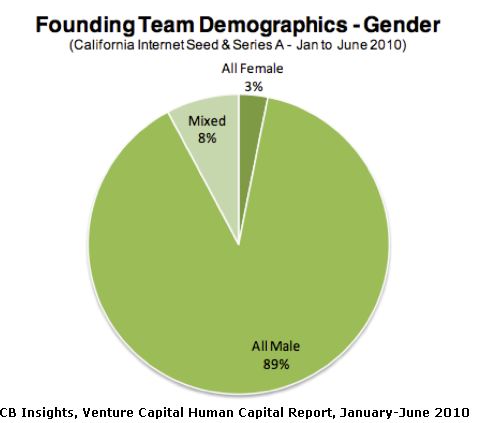
CB Insights reported that in California from January-June 2010:CI Insights Founder Gender - 2010

  • 89 percent of series A and seed-funded companies had all male founders, compared with only 8 percent that had founders of both genders, and just 3 percent of businesses with all female founders
  • 82 percent of company founders were white, compared to 18 percent that were Asian or Pacific Islander

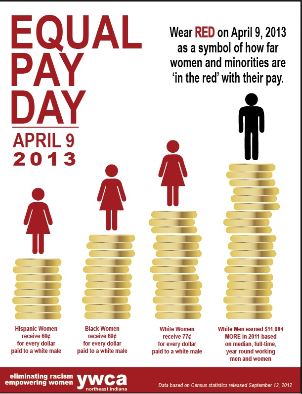
Equal Pay DayThe 2013 Silicon Valley Index, compiled by economic think tank Joint Venture Silicon Valley found significant income disparities by race in addition to gender from 2009-2011:

  • African-American residents’ income dropped 18%, compared to a 4% decrease across the U.S.
  • Hispanic resident’ income decreased 5%, similar to the rest of California
Catherine Bracy

Catherine Bracy

Catherine Bracy observed that the average woman in Silicon Valley, California’s “economic powerhouse”, earns 49 cents for every dollar men make in Silicon Valley, when averaging incomes of African American and Hispanic women residents.

NerdWallet analyzed data from the U.S. Census for 366 metro areas to determine the lowest pay gaps for women in small, medium, and large cities, and concluded that on balance, Silicon Valley was one of the “best places for women to work.”

Wage discrepancy in one of the U.S.’s most economically viable areas, whether around the national average or well below, demonstrates that 50 years after the Equal Pay Act, the average female worker in the U.S. is far from earning an equal wage.

Happy Anniversary, Equal Pay Act of 1963, and Many Happy Returns of the day for at least 44 years, until women’s pay may be equal across industries and geographies.

RELATED POSTS:

Twitter:    @kathrynwelds
Blog: – Kathryn Welds | Curated Research and Commentary    
Google+:
LinkedIn Open Group Psychology in Human Resources (Organisational Psychology)
Facebook Notes:

©Kathryn Welds