
BJ Fogg directs the Behavior Design Lab at Stanford University, leads Persuasion Boot Camps and wrote Persuasive Technology: Using Computers to Change What We Think and Do
He defines behavior change targets according to :
Type of change:
• Initiate new behavior
• Maintain existing behavior
• Increase behavior
• Decrease behavior
• Stop behavior
Frequency of change:
• Dot – One time behavior
• Span – Time-limited behavior
• Path – Continuing behavior
From this matrix, he identifies 15 ways to change behavior, and recommends designing behavior change as a “span” for time-limited behavior, like the Alcoholic Anonymous “One Day at a Time” credo.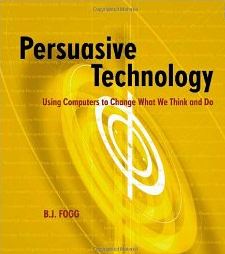
He evaluates behavior for ease vs. difficulty and motivation as high vs. low, and designs behaviors for ease and to capture moments of high motivation, to align with his assertion that “Behavior occurs in response to trigger at the same time as motivation + ability.”
Fogg notes that motivation is experienced in “waves”, and recommends seizing moments of high motivation to do “difficult” behaviors, and to capitalize on low motivation to do routine activities.
To enable the co-occurrence of motivation and ability, Fogg links behavior change to a reminder (also known as a “prompt”, “cue”, “call-to-action” or “trigger”) to “exceed the activation threshold.”
He suggests designing behavior change to existing behaviors according to the formula: “After xxx, I will yyyy”, such as “After I walk in the door, I will hang my keys on the hook.”
Fogg recommends reinforcing behavior change by celebrating successful behavior execution, and cited examples of people who tell themselves “I’m awesome” or actually pat themselves on the back.
©Kathryn Welds












 The Leader’s Guide to Storytelling: Mastering the Art and Discipline of Business Narrative
 Winning the Story Wars: Why Those Who Tell (and Live) the Best Stories Will Rule the Future









 Kathryn Welds, PhD | Curated Research + Commentary