Category Archives: Working Women

Working Women

Mastering the Power Sandwich with Skillful Upward Influence

David Bradford

David Bradford

Employees’ advancement in organizations is based on preventing problems before they develop, and pre-emptively uncovering opportunities to add value, according to Stanford’s David Bradford and Allan R. Cohen of Babson College in Influencing Up.

Allan Cohen

Allan Cohen

Complementing their Influence without Authority, they distilled common-sense win-win approaches to influence those over whom one has no formal authority or control: one’s manager and others higher in the hierarchy.

Influencing UpOrganizational power discrepancies can be accentuated when the employee is female or a member of a minority group.
Cohen and Bradford’s suggest six elements to reduce power differences, and improve influence and negotiation outcomes:

  • Clarify needs and priorities
  • Consider others as potential partners rather than adversaries
  • Establish trustworthiness by sharing information and develop understanding of the other’s perspective, concerns, and “care-abouts” — empathy in a business setting
  • Determine reciprocal value exchange in “currencies” that matter to others: information, budget, removing obstacles, brokering agreements, support
  • Gain access to others by showcasing your potential value exchange
  • Negotiate a win-win outcome
Robert Cialdini

Robert Cialdini

Bradford and Cohen’s work complements influential research by Stanford colleagues Margaret Neale and Deborah Gruenberg, as well as Robert Cialdini’s classic investigation of influence.

Roger Fisher

Roger Fisher

William Ury

William Ury

Their emphasis on crafting a win-win negotiated outcome echoes earlier work by Roger Fisher and William Ury in Getting to Yes and Linda Babcock’s consideration of negotiation challenges faced by women and minority group members in the workplace.

-*How do you manage the Power Sandwich, requiring skillful 360 degree influence in your organization?

Related Posts:

Twitter:  @kathrynwelds
Google+:
Blog: – Kathryn Welds | Curated Research and Commentary
LinkedIn Open Group
Facebook Notes:

©Kathryn Welds

Women’s Career Development: Contest and Sponsorship Paths to Advancement

Ines Wichert

Ines Wichert

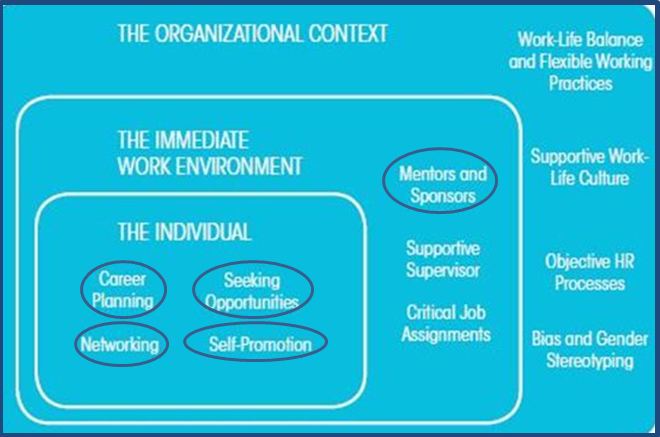
Ines Wichart of Kenexa High Performance Institute (KHPI), a subsidiary of IBM, proposed a model of women’s career development that focuses on:

  • The individual
  • The immediate work environment
  • The organizational context

She identified four behaviors that individuals can execute to increase the likelihood of career advancement:

  • Career planning 
  • Opportunity-seeking, Negotiation
  • Career-building networking; Mentoring-Sponsorship     
  • Skillful self-promotion
Ralph Turner

Ralph Turner

Kenexa Career Development Model-Individual Behaviors

Kenexa Career Development Model-Individual Behaviors

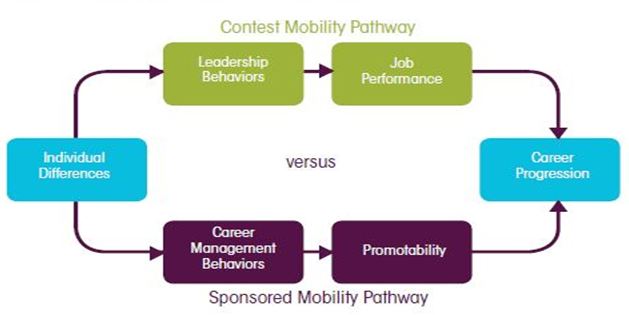
Within the domain of Career Planning, Ralph Turner, then of UCLA, proposed two ways that people advance their careers based on measures of promotions obtained and progression in the organizational hierarchy:

  • Contest Pathway is an open, merit-based system that enables career advancement by evaluating past accomplishments and impact

    Kenexa Career Progression Pathways- Contest and Sponsorship

    Kenexa Career Progression Pathways- Contest and Sponsorship

  • Sponsorship Pathway is a closed system in which candidates for advancement are chosen by senior leaders based “promotability” or “future potential“ to undertake and excel in future challenges
Henry Wadsworth Longfellow

Henry Wadsworth Longfellow

More than a century and a half ago, Henry Wadsworth Longfellow anticipated this distinction between the the contest and sponsorship pathways when he proposed how people assess  their performance:
We judge ourselves by what we feel capable of doing, while others judge us by what we have already done.”

Thomas Ng

Thomas Ng

Lillian Eby

Lillian Eby

More recent work by Thomas Ng and Kelly Sorensen, then of University of Georgia with their colleagues Lillian Eby and Daniel Feldman, found that women excel in the Contest Pathway, which requires:

Daniel Feldman

Daniel Feldman

  • Initiative
  • Risk-taking
  • Perseverance  
Amy Hurley Hanson

Amy Hurley Hanson

Jeffrey Sonnenfeld

Jeffrey Sonnenfeld

In contrast, Amy Hurley-Hanson of Chapman University and Yale’s Jeffrey Sonnenfeld  as well as Cranfield’s Susan Vinnicombe and Val Singh found that men tend to excel in the Sponsorship Pathway, based on:

Susan Vinnicombe

Susan Vinnicombe

  • Val Singh

    Val Singh

    Skillful networking

  • Visibility
  • Reputation for delivering outstanding results
  • Promoting accomplishments  
Philip Roth

Philip Roth

Philip Bobko

Philip Bobko

Another reason that women are not part of the Sponsorship Pathway as frequently as men is that women are less likely to be viewed as “promotable” even though men and women are rated equally effective as leaders, according to findings by Philip Roth of Clemson University, Kristen Purvis then of Cornell University, Philip Bobko of Gettysburg College.

  • How have you seen the Contest Pathway and the Sponsorship Pathway operate in your career advancement?
  • How do you “actively manage” your career toward advancement in the Contest Pathway or the Sponsorship Pathway?

Next: Women’s Career Development Model – Part 2 of 2Negotiation, Networking-Mentoring-Sponsorship, Skillful Self-Promotion

Related Posts

©Kathryn Welds

Women’s Career Development: Negotiation, Networking-Mentoring-Sponsorship, Skillful Self-Promotion

Kenexa Career Development Model-Individual Behaviors

Kenexa Career Development Model-Individual Behaviors

Part 1 of this post, Women’s Career Development: Career Planning, Career “Contest”, Sponsorship  highlighted Ines Wichart’s model of women’s career development with three levels and 11 components, based on her research as Kenexa High Performance Institute (KHPI), a subsidiary of IBM.

Ines Wichert

Ines Wichert

She outlined four behaviors that individuals can control or influence toward career advancement:

  • Career planning 
  • Opportunity-seeking, Negotiation
  • Career-building networking; Mentoring-Sponsorship    
  • Skillful self-promotion

The first segment of this two-part post considered facets of Career Planning and two independent paths to career advancement: Contest and Sponsorship routes.

Let’s consider the additional elements that respond to individual attention and efforts, including Opportunity-seeking while embracing risk.  

Susan Vinnicombe

Susan Vinnicombe

Val Singh

Val Singh

Highly effective career advancement opportunities include stretch assignments and on-the-job training.

Susan Vinnicombe and Val Singh of Cranfield University report that these development activities are most effective in building credibility, visibility, reputation as a capable, well-rounded leader.

However, their research found that women need more encouragement to take on challenging assignments than men, who are more likely to ask for these assignments.

Linda Babcock

Linda Babcock

Similarly, Linda Babcock reported that women tend to need encouragement to ask for promotions and salary increases.

Her research demonstrated that women are less likely to negotiate for their first salaries, unless they know that these are acceptable practices.

Manhattan CollegeAs a countermeasure, Babcock recommends negotiation practices demonstrated to mitigate negative perceptions by both men and women negotiation partners

Like Babcock, Mary Wade’s research at Manhattan College found that both men and women evaluated more negatively women who negotiated for salary using the same script as men.

Corinne Moss-Racusin

Corinne Moss-Racusin

Laurie Rudman

Laurie Rudman

Corinne Moss-Racusin and Laurie Rudman replicated this disconcerting finding at Rutgers University, leading to their formulation of “The Backlash Avoidance Model” (BAM)”.

According to this construct, women may demonstrate traditional gender role behaviors to mitigate “backlash” of negative reaction by men and women to “role discrepant” behaviors like asking for career advancement and commensurate compensation.

  • What approaches have been effective when you have asked for a salary increase or promotion?
         –How did you prepare?

         -How did you overcome objections?
  • When people ask you for a salary increase or promotion, what negotiation approaches have been most effective?
              -What have been least effective?

Wichart’s model of individual initiatives toward career advancement points to the importance of skillful professional networking, mentoring, and sponsorship.

National Center for Women and Information TechnologyNational Center for Women & Information Technology (NCWIT) reported that nearly half of technical women surveyed said they lack role models and mentors, and 84% said they lack sponsors.
The result is that these women are four times more likely to leave the current job role.

One reason that women’s professional networking efforts and seeking mentors may yield less effective career advancement than men:  Women tend to engage in professional networking for affiliation and emotional support with people close to their job level whereas men tend to network for career development with people significantly above the job level, according to Adelina Broadbridge of University of Stirling.University of Stirling

As a result of these differing approaches to professional networking, men may enjoy more rapid career advancement due to visibility and sponsorship.

Pamela Perrewe

Pamela Perrewe

F. Randy Blass

F. Randy Blass

In addition, women are likely to demonstrate less political understanding and insight because mentors are not sufficiently senior, according to Florida State University’s F. Randy Blass, Pamela Perrewe, and Gerald Ferris with Robyn Brouer of SUNY Buffalo.

Gerald Ferris

Gerald Ferris

Robyn Brouer

Robyn Brouer

Organizational support for formal and informal mentoring has been shown to increase employee engagement, satisfaction, and retention.

Therefore, organizations concerned with retaining talented women and minorities can increase the likelihood of keeping skilled employees by initiating structured mentoring programs and encouraging selective sponsorship.

  •  How have mentors and sponsors enabled your career moves?
  •  How do you decide who you are willing to mentor or sponsor?   

Previous posts have shared much current research and leading recommendations in building personal brand and practicing skillful self-promotion:

In light of the potential negative perceptions of women who showcase their accomplishments as they ask for salary increases and role advancement:

  •   How do you raise awareness of your accomplishments’ impact to avoid “backlash”?
  •   How do you define, develop, and communicate, “skillfully promote” your personal brand?

These research findings suggest three parting suggestions for women who want to Play Bigger:

  1. Question the thought that “I’m not ready yet.”
  2. Develop resilience and “a thick skin”:   If you are doing something innovative or important, you may draw both praise and criticism when you are noticed.
  3. Filter advice:  Implement recommendations that have “the ring of truth” and “resonate”;
    leave the rest.
  • What is the most helpful career advice you implemented?
  • What career advice have you decided not to implement?

Related Posts

©Kathryn Welds

Women Hedge Fund Managers Outperform Male Counterparts

Meredith Jones

Meredith Jones

Meredith Jones of Rothstein Kass, reported  that female hedge fund managers significantly outperform their male counterparts in Women in Alternative Investments: Building Momentum in 2013 and Beyond .
In the third quarter of 2012, women scored a net return of 8.95% compared to a 2.69% net return overall on the HFRX Global Hedge Fund Index.

Given women’s superior contribution to profitability, they would seem qualified for leadership roles in organizations seeking to maximize financial returns.
However, women hold fewer than 20% of top jobs in “alternate investment” organizations, according to 366 senior women in hedge funds, private equity, and venture capital.

Respondents attribute this low representation of women in executive roles to:

  • Low interest in remaining in this “alternate investment” sector due to limited opportunities for work-life balance.
    More than 18% of respondents said they wanted to work part-time or flex-time.
  • Few positions available for skilled women to establish a strong performance record.

Similar issues were discussed in Women’s Post-Business School Work-Life Issues .

Jones of Rothstein Kass suggested that some of women’s effectiveness is based on their greater patience and risk-averseness so they are “…potentially better able to escape market downturns and volatility.”

She continued, “…if women do in fact have a different, more risk-averse investing profile, then at least theoretically, their returns, particularly in difficult markets, should be higher than those of their male counterparts.”  

Kelly Easterling

Kelly Easterling

Kelly Easterling and Camille Asaro, also of Rothstein Kass, contributed to the report, which found women’s assessment of their most important professional assets:

  • Professional networks
  • Strong personal and support networks
  • Strategic career planning
  • Willingness to take considered risks
Jean Brittingham

Jean Brittingham

Jean Brittingham of The Smart Girls Way posited additional correlates of women’s effective financial performance:

  • Systems-thinking skills
  • Seeking balance between work and life
  • Caring more about solutions than who gets credit
  • Strong collaboration competencies
  • Persistence when “passionate about something”
Camille Asaro

Camille Asaro

The Rothstein Kass report noted that some U.S. states have mandates for diversity in their asset management firms, and observed an increase in state public pension plans with stated or implied preference for women-owned investment managers.

-*In which industries have you observed women delivering equal or better results than male counterparts?

Related posts

Twitter:  @kathrynwelds
Google+
Blog: – Kathryn Welds | Curated Research and Commentary 
LinkedIn Open Group Psychology in Human Resources (Organisational Psychology)
Facebook Notes

©Kathryn Welds

Leadership Qualities that Lead to the Corner Office?

Adam Bryant

Adam Bryant

Adam Bryant, deputy national editor at the New York Times interviewed more than 200 CEOs of top companies for his column, and distilled the leadership qualities that moved them to The Corner Office: Indispensable and Unexpected Lessons from CEOs on How to Lead and Succeed :

  • Passionate curiosity, deep engagement with questioning mind and a balance of analytical and creative competencies
  • Confidence based on facing adversity, knowing capabilities
  • Collaboration, ability to “read” and shape team dynamics
  • Ability to translate complex to simple explanations
  • Fearlessness in acting on considered risks  The Corner Office

These five characteristics augment qualities that might be considered “table stakes” – or “must-haves” for any leadership candidate:

  • Preparation
  • Patience
  • Navigating organizational obstacles  
  • Building a team of diverse members by galvanizing with a clear mission and spending time with members

Bryant argues that these behavioral competencies may be developed through attentive effort, but he acknowledges that some people have greater natural predisposition and aptitude for these “ways of being.”

Lois Frankel

Lois Frankel

Lois Frankel’s earlier book, Nice Girls Don’t Get the Corner Office: 101 Unconscious Mistakes Women Make That Sabotage Their Careers provided different recommendations for women seeking leadership roles, later empirically validated in research studies:

  • Act like a mature woman rather than a “girl”
  • Frame statements as assertions rather than questions
  • State and initiate a course of action, rather than waiting to request permissionNice Girls Dont Get The Corner

In contrast, Bryant particularly advises women to “meet as many people as possible and build relationships because serendipity and chance encounters can lead to unplanned opportunities.”

Research organizations like Catalyst and Center for Talent Innovation conduct social science research to investigate these behavioral and attitudinal recommendations.

CatalystBoth groups have questioned the applicability of mainstream recommendations in leadership development curricula when implemented by women, minorities and “people of color.”

Their continuing research agendas include analyzing the behavioral components of general recommendations such as “demonstrate gravitas” which the majority of top executives affirmed as “… critical for leadership. I can’t define it but I know if when I see it.”Center for Talent Innovation

These research organizations seek to more clearly define what these key executives see in critical leadership attributes like “gravitas” and to define them in replicable behavior terms.

-*Which leadership behaviors do you consider most important for any executive?
-*Which behavioral competencies are most crucial for aspiring women leaders?

Related posts:

©Kathryn Welds

Lean In: Sheryl Sandberg launches Book, Foundation to Advance Women in Organizational Leadership

Sheryl Sandberg

Sheryl Sandberg

Facebook COO Sheryl Sandberg distilled her calls-to-action from her much-viewed TED talk and 2011 Commencement address at Barnard College in her forthcoming book, Lean In: Women, Work and the Will to Lead, scheduled for release 11 March 2013.

She reviews why women in the U.S. hold few of the top leadership roles in organizations and government, and offers greater detail on her much-discussed encouragement to:

  • Think Big
  • Sit at the table
  • Don’t leave before you leave
  • Lean in
  • Be bold, be unafraid
  • Choose the right partner
  • Seek challenges and take risks required to pursue ambitious goals.
Sheryl Sandberg at Barnard

Sheryl Sandberg at Barnard

Sandberg draws on current findings from Stanford University’s Clayman Institute for Gender Research and other top research organizations to offer practical advice on negotiation techniques, mentorship, building a satisfying career, setting boundaries, and replacing the goal of “having it all” with a more achievable target.

Sheryl Sandberg at Clayman Institute

Sheryl Sandberg at Clayman Institute

Sandberg is currently establishing The Lean In Foundation in collaboration with the Clayman Institute and corporate partners, to provide:

  • Online community to share insights and tools,
  • Online lectures by recognized thought leaders to enhance critical career skills,
  • Career discussion circles for women, men, and organizations, so they can deploy women’s talents to solve society’s most challenging issues.

-*How far can you “lean in” without losing your balance?

Related Posts:

  • Self-managed career discussion circles

“Greenlight Group”: No-cost, Self-managed Support to Achieve Professional, Personal Goals

  • “Think Big, Play Big” at Cisco’s 2013 Women in Technology Forum:

“Everything is Negotiable:” Prepare, Ask, Revise, Ask Again

Twitter  @kathrynwelds
Google+
Blog
: – Kathryn Welds | Curated Research and Commentary 
LinkedIn Open Group Women in Technology (sponsored by EMC)
Facebook Notes:

©Kathryn Welds

“Birds of a Feather” brings together Silicon Valley women for Network Development

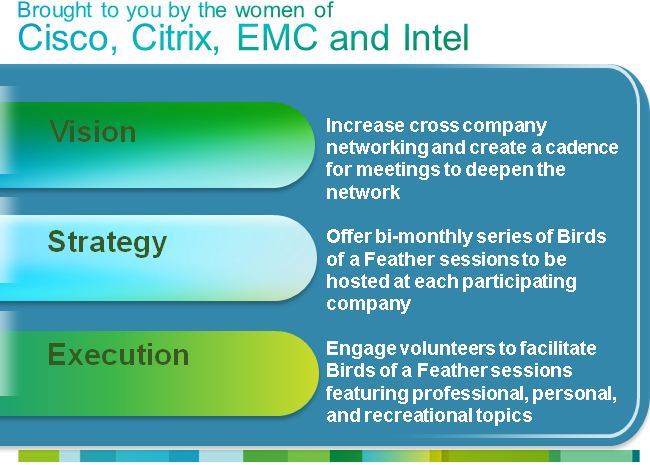
CiscoWomen of Cisco, Citrix, EMC, Intel come together on Thursday  17 January 2013 at Cisco Systems in San Jose, California, for the first of three “unconferences” to build professional relationships across technology companies. Citrix

EMCEach firm has an Employee Resource Group (ERG) focusing on career development and advancement for women in technical and non-technical roles, and each recognizes the value of building cross-organizational business networks and relationships.IntelWomen of Cisco-Citrix-EMC-Intel

Women of Intel (WIN) has been a leader by hosting annual events that bring together women from other local technology firms, and occasional efforts have brought together women from Google, Applied Materials, EMC, Intel, Yahoo, Cisco, IBM, Hewlett-Packard, Citrix, Symantec, Adobe, and other Silicon Valley technology companies.

Marylene Delbourg-Delphis

Marylene Delbourg-Delphis

In 2012, EMC and Cisco collaborated on an event designed to encourage longer-term relationships through small-group discussions of a talk by the versatile Marylene Delbourg-Delphis, serial tech entrepreneur, philosophy professor and fashion journalist.

Anna Van Rijswijk

Anna Van Rijswijk

Anna Van Rijswijk of Cisco, member of the EMC-Cisco planning team, expanded this concept to a multi-session series  and incorporated  a “Birds of a Feather” format, developed by the Internet Engineering Task Force (IETF) to denote initial meetings of members interested in a particular issue.

Olivia Shen Green

Olivia Shen Green

This  “Birds of a Feather” structure was  successfully launched in Cisco’s 2012 one-day event, Women in Technology Forum, attended by more than 1200 Cisco employees worldwide, and led by Cisco’s Olivia Shen Green, who shared principles for conducting an “unconference.”  Women In Techology Forum

The goal of the multi-company, multi-session “Birds of a Feather” networking event is to increase insight and resource-sharing on topics crucial to professional women’s career advancement in technology firms, while establishing and developing stronger cross-company resource networks.

Unconference GuidelinesDiscussion topics, facilitated by members of multiple sponsor companies, include:

  • Developing “personal brand”
  • Practicing superior communication skills,  “Executive Presence”
  • Striving toward Work – Life Balance
  • Establishing Peer Mentoring and “Greenlight Groups”
  • Developing technical skills
  • Best practices in design, innovation, and creative processes

Upcoming sessions in the spring of 2013 will hosted onsite at Citrix, EMC, and Intel, and will continue these themes.

-*How do you expand your professional network across companies in your industry and across professional roles?

Twitter:   @kathrynwelds
Google+:
Blog: – Kathryn Welds | Curated Research and Commentary 
LinkedIn Open Group Women in Technology (sponsored by EMC)
Facebook Notes

©Kathryn Welds

Companion Animals in the Workplace

Technology companies like Autodesk, Google, and Amazon made news when they permitted employees to bring companion dogs to work.Dog at work

This policy was viewed as an employee benefit or “perk”, but a recent study published in International Journal of Workplace Health Management indicates that bringing a companion dog to work can lower stress levels, increase productivity and make work more satisfying.

Centers for Disease Control and Prevention

In fact, the U.S. Centers for Disease Control and National Institutes of Health conclude that companion animals can lower individuals’ cholesterol, trigylcerides, blood pressure, heart rates,  weight, stress, risk of heart attack, social isolation, inactivity, and overall healthcare costs, all of which benefit organization’s operational costs.

National Institute of Health

Randolph Barker and collaborators from Virginia Commonwealth University examined a service-manufacturing-retail company in North Carolina with 550 employees and between 20 – 30 companion dogs.

Randolph Barker

Randolph Barker

Researchers measured 76 employees’ stress levels via surveys of attitudes toward animals in general and in the workplace.
Equal numbers of employees perceived dogs’ presence as increasing or decreasing work productivity.

Employees’ perceived stress levels, measured by cortisol in saliva samples, were significantly lower and job satisfaction was higher on days when dogs were present at work.

Companion dogs at work appeared to boost interpersonal communication, organizational engagement, and morale when employees who did not own dogs asking dog owners to interact with dogs or take them for a walk.

Considerable research around the globe suggests that the stress-reducing effect of companion dogs is tied to an increase in oxytocin when humans and dogs interact.

Kerstin Uvnas-Moberg

Kerstin Uvnas-Moberg

Kerstin Uvnas-Moberg of Uppsala University and author of The Oxytocin Factor: Tapping the Hormone of Calm, Love, And Healing, reported that women and their dogs experienced similar increases in oxytocin levels after ten minutes of friendly contact, and women’s oxytocin response was significantly correlated to the quality of the bond they reported in a survey taken prior to the interacting with their dogs.

The Oxytocin Factor

Likewise, JS Odendaal and RS Meintjes, then of Pretoria Technikon, showed that friendly contact between dogs and humans release oxytocin in both and Miho Nagasawa‘s team  at Azabu University found that amount of oxytocin among dog owners increased with the amount of time they shared eye contact with their dogs.

Suzanne C. Miller’s research group showed that oxytocin increased among women but not men after greeting their companion dog when returning home from work.

Christopher Honts

Christopher Honts

Christopher Honts and Matthew Christensen of Central Michigan University extended findings on stress reduction to evaluate trust, team cohesion and intimacy among teams collaborating on tasks when a well-trained, hypoallergenic dog was present.
During a collaborative creative thinking exercise, participants rated teammates higher on trust and teamwork than those without a dog.

Teams with a dog during the prisoner’s dilemma measure of trust and collaboration were 30% less likely to betray teammates accused of being co-conspirators in a hypothetical crime scenario.

Hiroshi Nittono

Hiroshi Nittono

Hiroshi Nittono and team at Hiroshima University demonstrated improved performance on problem-solving, attention, perceptual discrimination, and motor performance tasks after volunteers viewing images of baby animals compare with adult animals or food, reported in Public Library of Science .

Despite evidence that companion animals in the workplace reduce stress, increase perceptual and problem-solving capabilities and health indicators, barriers include:

  • Cultural objections to dogs and other animals
  • Allergies to companion animals
  • Animals without proper obedience and social skills training for the workplace

-*What do you think about potential financial and morale benefits of companions animals in the workplace?

Gromit

Gromit

<-Will this

Miss Sarah's Guide

Miss Fido Manners

be replaced with this? <—————>

Related Posts

Twitter: @kathrynwelds
Google+
LinkedIn Open Group Psychology in Human Resources (Organisational Psychology)
Facebook Notes
Blog: – Kathryn Welds | Curated Research and Commentary

©Kathryn Welds

Oxytocin Receptor Gene’s Link to Optimism, Self-Esteem, Coping with Stress

Shelley Taylor

Shelley Taylor

Shelley E. Taylor, distinguished professor at UCLA identified the oxytocin receptor gene (OXTR) link to optimism, self-esteem and “mastery” — the belief that one has control over one’s own life.
These three elements are required to manage stress and depression.

Reported in the Proceedings of the National Academy of Sciences (PNAS), she notes that oxytocin, a hormone that increases in response to stress, is associated with good social skills such as empathy and social behavior, especially under stress.

In one location on the oxytocin receptor gene, two variants occur:

•    “A” (adenine) variant, associated with increased sensitivity to stress, poorer social skills, depressive symptoms and worse mental health outcomes

•    “G” (guanine) variant, associated with optimism, self-esteem and mastery.

This effect was demonstrated in 326 volunteers, who completed measured by self-assessments and saliva samples for DNA analysis.
Those with two “A” nucleotides or one “A” and one “G” at this oxytocin receptor gene location, showed lower levels of optimism, self-esteem and mastery and higher levels of depressive symptoms than people with two “G” nucleotides,

Taylor notes that genes may predict behavior, but do not determine it because many environmental factors and other genes interact with oxytocin receptor gene variants in stress, coping, and emotional behaviors.

These findings suggest people who train themselves to appraise situations more optimistically, to see themselves more worthy, capable and competent, are able to improve ability to cope with stressful events.

Taylor’s book, The Tending Instinct: Women, Men, and the Biology of Relationships, outlines the importance of cultivating socially nurturing environments to mitigate genetic vulnerabilities.

She notes that “a mother’s tending can completely eliminate the potential effects of a gene; a risk for a disease can fail to materialize with nurturing, and a genetic propensity may lead to one outcome for one person and the opposite for another, based on the tending they received.”

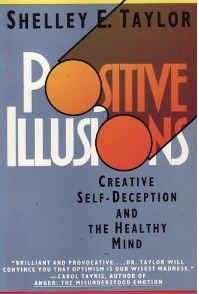
Her most influential work demonstrated a “self-enhancement bias” in her book, Positive Illusions: Creative Self-Deception and the Healthy Mind ,
she explained that “most people regard themselves, their circumstances, and the future as considerably more positive than is objectively likely…. These illusions are not merely characteristic of human thought; they appear actually to be adaptive, promoting rather than undermining good mental health.”

In contrast, Rick Hanson argues that a negative bias is more adaptive to survival than a positive bias.
He notes that negative stimuli produce more neural activity than do equally intense positive ones, and are perceived more easily and quickly: “The brain is like Velcro for negative experiences but Teflon for positive ones.”

His book, Just One Thing: Developing a Buddha Brain One Simple Practice at a Time, recommends meditation to tame automatic negative thoughts.

-*Where have you seen examples of “the tending instinct,” positive illusions and negative bias in the workplace?

See related posts on Hormones and Emotional Expression:
•    Oxytocin, Testoterone: Oxytocin Increases Empathic Work Relationships, Workplace Trust, Generosity
•    Cortisol, Testosterone: Thoughts Change Bodies, Bodies Change Minds, Roles Shape Hormones: “Faking Until It’s Real”

Twitter:  @kathrynwelds
Google+
LinkedIn Open Group Mindful Leadership
Facebook Notes 

Blog: – Kathryn Welds | Curated Research and Commentary

©Kathryn Welds

Doonesbury Celebrates Women’s Contributions to Work Groups via Thought Diversity and Emotional Intelligence

Doonesbury Celebrates Women’s Contributions to Work Groups via Thought Diversity and Emotional Intelligence

-* How have you seen women’s Emotional Intelligence applied in the workplace?