Category Archives: Working Women

Working Women

Implicit Discrimination Associated with Meritocratic Beliefs, Low Empathy

Michael Young

Michael Young

Americans more than other nationalities, embrace the idea of meritocracy – that rewards are distributed based on merit, a combination of ability + effort with success, described by University of London’s Michael Young with Sheri Kunovich of Southern Methodist University, and Ohio State’s Kazimierz M. Slomczynski.

Satya Nadella

Satya Nadella

Microsoft’s CEO, Satya Nadella, made headlines when asked his advice for women who are uncomfortable asking for a raise at the 2014 Grace Hopper Celebration of Women in Computing.
He told more than 12,000 women: “It’s not really about asking for a raise, but knowing and having faith that the system will give you the right raise … It’s good karma. It will come back.”

Although his response resulted in widespread criticism, he may have been referring to the social penalty women experience when negotiating for salary increases and promotions.

Hannah Riley Bowles

Hannah Riley Bowles

Harvard’s Hannah Riley Bowles with Linda Babcock and Lei Lai of Carnegie Mellon demonstrated this social penalty when they showed volunteers videos of men and women asking for a raise using identical scripts.
Participants agreed to give both genders a pay increase, but evaluated women as “too aggressive” and not someone they would want to work with.
However, men in these salary negotiation situations were seen as “likable.”

Emilio Castilla

Emilio Castilla

The unequal impact of merit-based compensation on minorities was demonstrated in MIT’s Emilio J. Castilla’s analysis of almost 9,000 employees in support roles at a large service-sector company.
The organization espoused commitment to diversity and had implemented a merit-based compensation system intended to reward high-level performance and equitably reward employees.

Lei Lai

Lei Lai

Despite these egalitarian goals, women, ethnic minorities, and non-U.S.-born employees received smaller increases in compensation compared with white men, despite holding the same jobs, having the same performance score, working in the same units for the same supervisors.

These results illustrated what he called the performance-reward bias – the need for minority groups “to work harder and obtain higher performance scores in order to receive similar salary increases to white men.”

Stephen Benard

Stephen Benard

With his Indiana University colleague, Stephen Benard, Castilla uncovered the paradox of meritocracy” – organizations that espouse meritocratic values awarded a larger monetary reward to male employees compared with equally performing female employees.

Despite their positive intentions and policies, these organizations perpetuated unequal evaluations and rewards across equally performing employee groups.

Eric Luis Uhlmann

Eric Luis Uhlmann

In fact, people who think they are the most objective exhibited greatest evaluation bias, found Northwestern’s Eric Luis Uhlmann and Geoffrey L. Cohen of University of Colorado.
They attributed this finding to overconfidence in objectivity, leading to lack of self-scrutiny and self-assessment of potential and implicit bias.

Corinne Moss-Racusin

Corinne Moss-Racusin

This bias was also demonstrated when volunteers provided significantly more positive evaluations of resumes were attributed to whites and men than identical resumes linked to minority-group members and women, reported by Yale’s Corinne A. Moss-Racusin, John F. Dovidio, Victoria L. Brescoll, Mark J. Graham, and Jo Handelsman.

John Dovidio

John Dovidio

Since egalitarian aspirations and performance management systems do not result in equitable reward distribution, MIT’s Castilla advocated increased transparency and accountability by creating a performance-reward committee to monitor compensation increases and to share information about pay segmented by gender, race, and nationality.
Five years after these changes were introduced in companies Castilla studied, he found that the demographic pay gap had disappeared.

Grit Hein

Grit Hein

Another way to reduce bias is to increase empathy, found Universität Bern’s Grit Hein, Jan B. Engelmann of Tinbergen Institute, and University of Zurich’s Philippe N. Tobler, with Marius C. Vollberg of University College London, in their study of 40 young men of Swiss or Balkan descent.

Participants and two research confederates received an electric charge on the back of the hand.
Next, one of the two confederates was attributed a typical Balkan name or a Swiss name, and was designated a “decision maker.”

Jan B. Engelmann

Jan B. Engelmann

Volunteers were then told they would receive “painful shocks,” but the “decision maker” could prevent this “by giving up money he would otherwise earn.”
Participants received help from the other person 15 times out of 20 trials, and received a shock five times.

Two new confederates, one with a Swiss name and one with a Balkan name, replaced the first two and the participant watched as one of them received the painful electrical pulses.
A brain scan measured the volunteers’s level of empathy for the person receiving the shock.

Philippe Tobler

Philippe Tobler

When the confederate with the Balkan minority name “helped” the participant avoid a shock by “sacrificing” a payoff, the volunteer’s brain scans demonstrated increased empathy for both the specific helper, and for other Balkan people.

The team interpreted this finding to suggest, “…empathy with an out-group member can be learned, and generalizes to other out-group individuals.”

If this trend can be replicated in the workplace by increasing organizational and managerial empathy for members of minority groups during the appraisal process, organizational rewards may be more equitably distributed.

-*How do you reduce bias in appraisal and reward processes?

Follow-share-like http://www.kathrynwelds.com and @kathrynwelds

Related Posts:

Twitter:  @kathrynwelds
Google+
LinkedIn Groups Psychology in Human Resources (Organisational Psychology)
Facebook
Blog: – Kathryn Welds | Curated Research and Commentary

©Kathryn Welds


Men Negotiate More Assertively with Women Managers

Ekaterina Netchaeva

Ekaterina Netchaeva

Men volunteers negotiated more assertively with women in supervisory roles in laboratory tasks, compared with strategies they used with male supervisors, reported Bocconi University’s Ekaterina Netchaeva, Maryam Kouchaki of Northwestern University, and Washington State University’s Leah D. Sheppard.

Maryam Kouchaki

Maryam Kouchaki

This cross-gender negotiation trend was reduced when woman in supervisory roles demonstrated directness and proactivity (“administrative agency”) rather than self-promotion and power-seeking (“ambitious agency”).

Leah D. SheppardThe team told 52 male and 24 female volunteers that they would negotiate their salary at a new job in a computer exercise with a male or female hiring manager.



After the negotiation, participants completed an implicit threat test by identifying words that appeared on a computer screen for a fraction of a second in a variation of the Implicit Association Test developed by Harvard’s Mahzarin Banaji and Anthony Greenwald of University of Washington.
Participants who chose more threat-related words like “fear” or “risk,” were inferred to feel more threatened.

Mahzarin Banaji

Mahzarin Banaji

Male participants who negotiated with a female manager selected more threat-related words on implicit association test, and they negotiated for a higher salary ($49,400 average), compared to men negotiating with a male manager ($42,870 average).

Linda Babcock

Linda Babcock

The manager’s gender didn’t affect female participants, who negotiated a lower salary ($41,346 average), reflecting a common trend where women tend not to negotiate, or to negotiate less vigorously, as noted by Carnegie Mellon’s Linda Babcock and Hannah Riley Bowles of Harvard.

Anthony Greenwald

Anthony Greenwald

In another experimental task, more than 65 male volunteers decided how to share a $10,000 bonus with a male or female team member or with supervisor.
Male participants tended to equally divided the money with male or female team members, but reacted significantly differently with a female supervisor.

Men who endorsed more threat-related words chose to keep more money for themselves when the supervisor was female, compared with when they were paired with a male supervisor.

Hannah Riley Bowles

Hannah Riley Bowles

A related online survey of 226 male and 144 female volunteers found that male participants decided to keep a larger share of the $10,000 bonus when the female manager was described as ambitious or power-seeking, but responded significantly more favorably when the female supervisor was described as proactive or ambitious.
In the latter case, male volunteers offered approximately the same bonus amount to female managers.

This suggests that women managers with male direct-reports enhance these relationships by adopting a consciously direct leadership style, characterized by consistent communication, and proactive problem-solving.

Netchaeva’s group posits that women who adopt a direct, active leadership style reduce threat in cross-gender reporting relationships, and enable greater cooperation in bargaining and negotiation situations.

-*To what extend have you observed evidence of implicit threat responses in cross-gender workplace reporting relationships?

Follow-share-like http://www.kathrynwelds.com and @kathrynwelds

Related Posts:

©Kathryn Welds

Women, Men, and Time: Differences in “Managing” a Limited Resource

Francis Wade

Francis Wade

Special thanks to Francis Wade of 2TimeLabs for his sharing his expertise.

Though women and men have the same amount of time, women seem to manage more time demands and have developed more skillful time practices to grapple with perceived “time scarcity,” according to detailed time-use studies by New South Wales’s Lyn Craig and Janeen Baxter of University of Queensland.

Lyn Craig

Lyn Craig

They found that working mothers invest more hours taking care of children and doing housework than their working husbands.

Arlie Hochschild

Arlie Hochschild

This finding validates the idea that women do a “Second Shift” of work – at home and at the office, described by University of California Berkeley’s Arlie Hochschild.

Brigid Schulte

Brigid Schulte

Personal anecdotes from of women stretched between “two shifts” validate these research findings, distilled in journalist Brigid Schulte’s popular Overwhelmed: Work, Love, and Play When No One Has the Time.

Therese Macan

Therese Macan

To grapple with time demands that may seem to outweigh available time resources, women typically engage in significantly more mechanical time management behaviors like planning, listing, and scheduling, found University of Missouri’s Therese Macan, Comila Shahani of Hofstra University and Robert Dipboye of University of South Florida, who developed the Time Management Behaviors (TMB) inventory

Abdülkadir Pehlivan

Abdülkadir Pehlivan

Many, but not all, gender differences appear to hold across countries and cultures:  Like Macan’s team, Karadeniz Technical University’s Abdülkadir Pehlivan noted that women use more listing, planning and programming than men.

In contrast, male volunteers said they feel more in charge of their time management behaviors, even when they don’t employ the same systematic time procedures as women.

Ranjita Misra

Ranjita Misra

However in a U.S. investigation, females reported better perceived “control” of time, based on using “mechanical” techniques like setting and prioritizing goals as well as planning, reported West Virginia University’s Ranjita Misra and Michelle McKean.
In addition, women said they organize tasks and workspaces more frequently than men.

Despite this efficiency, women paid a price with higher anxiety and lower leisure satisfaction, which may explain the need to develop improved practices.
Males, in contrast, reported more leisure activities and less anxiety.

Tanya Meade

Tanya Meade

In addition, Australian Time Organisation and Management Scale (ATOMS), developed by University of Western Sydney’s Tanya Covic Meade, B.J. Adamson, M. Lincoln and P.L. Kench revealed that 71% of women volunteers recognize this gender difference in time practices:  Women respondents and Meade’s team concluded that “females may be better at carrying out behavioral activities associated with time management, such as making lists and keeping a diary.”

Mark Trueman

Mark Trueman

Another study found that female student volunteers reported considerably greater use of time “management” skills than male students in a five-year investigation by Keele University’s Mark Trueman and James Hartley and in similar research by Al Ain University of Science and Technology Ahmad Saleh Al Khatib.

Nurten Kaya

Nurten Kaya

These gender differences also persisted in specific working environments such as nursing in University of Istanbul’s study by Hatice Kaya with Nurten Kaya, Aylin Öztürk Palloş, Leyla Küçük, which found that female students were able to manage their time better than male students.

Jale Eldeleklioglu

Jale Eldeleklioglu

Because time is a limited and valuable resource, Uludag University’s Jale Eldeleklioglu suggested the life skill of time “management” should begin at a young age in school: ” male students’ time management skills are not as developed as female students’ (so we need) more programs to reduce anxiety and improve students’ time management skills.

-*What differences have you observed in the ways that women and men interact with available time?

-*What practices have you found beneficial in managing time demands?

Follow-share-like http://www.kathrynwelds.com | @kathrynwelds

Follow-share-like www.2time-sys.com | http://perfect.mytimedesign.com |@fwade

Related Posts:

Twitter:  @kathrynwelds
Google+LinkedIn Groups Psychology in Human Resources (Organisational Psychology)
Facebook
Blog: – Kathryn Welds | Curated Research and Commentary

©Kathryn Welds


Low-Stakes Testing Improves Learning Retention, Retrieval

Henry L. Roediger III

Henry L. Roediger III

Few people enjoy having knowledge gaps exposed by formal testing, but those who receive this corrective feedback are more likely to retain information over time, according to studies by Washington University’s Henry L. Roediger III and Jeffrey D. Karpicke.

Mary Pyc

Mary Pyc

Their work confirms considerable previous research, and the idea that testing acts as a “meditator” to retrieve stored information, suggested by Kent State University’s Mary A. Pyc and Katherine A. Rawson.

Katherine A. Rawson

Katherine A. Rawson

Participants in Roediger and Karpicke’s investigation read texts and were tested by writing as much as they recalled of selected sections, rather than completing a multiple choice test or writing a critical thinking essay on the topic.
Volunteers recalled about 70 percent of the ideas they’d read, then re-read the
remaining passages that were not tested.

Jeffrey D. Karpicke

Jeffrey D. Karpicke

Delayed testing on both sets of readings occurred after two days or seven days, and volunteers were significantly more able to remember material on which they’d been tested.

Roediger and Karpicke noted that testing requires people to retrieve knowledge from memory, rather than merely acquire information as when reading or listening to a lecture.
The testing effect, also known as the retrieval practice effect, strengthens learning by embedding information in memory.

Karl Szpunar

Karl Szpunar

Most effective testing is integrated into learning with frequent, low-stakes checkpoints in contrast to less frequent, higher-stakes testing in the traditional British education system, they suggested.

Novall Y. Khan

Novall Y. Khan

Additionally, “interpolated testing” during learning activities enables people to sustain attention, reduce mind wandering, test anxiety, and perceived “cognitive load,” found Harvard’s Karl K. Szpunar, Novall Y. Khan, and Daniel L. Schacter.

Sarah L. Eddy

Sarah L. Eddy

The testing effect can benefit people who have previously under-performed relative to their peers, and are under-represented in courses, reported University of Washington’s Sarah L Eddy and Mary Pat Wenderoth with Sara E Brownell of Arizona State University.

Mary Pat Wenderoth

Mary Pat Wenderoth

They evaluated women’s academic achievement and participation in class discussions in more than 20 large university biology courses.

Sara E. Brownell

Sara E. Brownell

Unlike in science, technology, engineering, and mathematics, 60% of the students were women.
However, they responded to only 40% of questions posed by the instructor during classes, much less than their representation in the course.
In addition, these women achieved lower exam scores than men with similar overall academic performance.

Daniel Schachter

Daniel Schachter

However, when the researchers introduced frequent, low-stakes testing – even without providing test results – women’s information retention and accessing significantly improved.

Frequent low-stakes testing integrated into learning activities leads to longer-term information comprehension, retention, and application – and this frequent exposure to a sometimes-feared or disliked activity can reduce avoidant reactions.

-*How effective do you find frequent tests to increase recall and retention of learning materials?

Related Posts:

Twitter:  @kathrynwelds
Google+
LinkedIn Groups Psychology in Human Resources (Organisational Psychology)
Facebook
Blog: – Kathryn Welds | Curated Research and Commentary

©Kathryn Welds

Fewer Wedding Expenses, More Guests to Stay Married Longer

A persistent advertising campaign in the United States claims that “A Diamond is Forever” and provides more explicit guidance in the rhetorical question, “How else could two months’ salary last forever?”

Andrew M. Francis

Andrew M. Francis

Emory University’s Andrew M. Francis and Hugo M. Mialon evaluated the purported connection between wedding-related expenditures to duration of marriage based on a survey of more than 3,000 ever-married volunteers in the United States.

Hugo Mialon

Hugo Mialon

They conducted a number of statistical controls across nearly 40 demographic and relationship characteristics, and found that marriage duration in this widely varied group was inversely related to expenditures on engagement ring and wedding ceremony.

Francis and Mialon noted that the wedding industry is a big business in the U.S.:  More than $50 billion in 2014, and the average wedding cost in the U.S. during 2013 was an astonishing $29,858.

However, most people in the U.S. are unable to afford this lavish expenditure because it represents about 60% of the median U.S. household income.
Further, U.S. wages are increasing at a much slower rate than increases in average wedding costs, according to the U.S. Department of Labor – only about 2% over the last several years.

As a result, expenditures of this magnitude can induce stress and disagreements among people who make financial commitments beyond their capacity, and can be associated with shorter-duration marriages.

Support for this speculation comes Francis and Mialon’s finding that women who spent more than $20,000 on the wedding – well below the average, according to TheKnot.com – are 3.5 times more likely to divorce than those who spent between $5,000 and $10,000 – still a significant sum in relation to average annual income.
Likewise, men who spent between $2,000 and $4,000 on an engagement ring ended their marriages 30% more often than those who spent between $500 and $2,000.

Margaret Brinig

Margaret Brinig

Some expenditures may be anachronisms:  Engagement rings were originally a contractual assurance if the marriage promise was breached, noted University of Toronto’s Margaret F. Brinig.
It could be argued that there may be less current-day utility for this practice in light of no-fault divorce laws in many areas of the U.S.

Lee Cronk

Lee Cronk

Similarly, premarital gifts like a ring continuously worn contain visible “signaling properties” to indicate that a woman is “in contract” to wed, remarked Rutgers University’s Lee Cronk and Bria Dunham of Boston University.

Some wedding characteristics were associated with longer-enduring marriages:  People whose weddings had higher attendance had longer-lasting marriages, perhaps related to participants having a strong social network to provide support, encouragement, and reminders of wedding promises during the inevitable challenges of marriage.

Bria Dunham

“…Weddings associated with the lower likelihood of divorce are those that are relatively inexpensive but high in attendance,” noted Francis and Mialon.

People who went on a honeymoon, regardless of cost, also tended to stay with their spouses longer than those who did not, suggesting that this ritual may reinforce the interpersonal bond after a sometimes stressful but happy event.

  • What are other financial correlates of longer-lasting marriages and relationships?

RELATED POST:

Twitter  @kathrynwelds

Google+

Facebook Notes

©Kathryn Welds

Premium Pay to Attract Diverse Women Candidates?

Companies must pay more to attract and hire women from diverse backgrounds because there are few qualified female and nonwhite candidates – and because these candidates are highly sought by employers.

Deborah Ashton

Deborah Ashton

Myth or reality?, asks Deborah Ashton of Novant Health.

Myth: American women earned significantly less than men, so it is unlikely that diverse women enjoy a salary advantage over men.

In fact, women in the U.S. earned $0.82 for every $1.00 earned by American men in 2013, up from $0.79 the year before, according to the 2012 Bureau of Labor Statistics earnings survey.

Daryl G. Smith

Daryl G. Smith

Nana Osei-Kofi

Nana Osei-Kofi

More education may not result in higher or even equitable salaries for African-American, white, and Hispanic women: The gender pay gap actually increases as when these women complete higher education levels.
In fact, workers with the least education actually experienced the least pay gap, but they are rewarded with “equal opportunity poverty.”

Sandra Richard Mayo

Sandra Richard Mayo

Men, regardless of race or ethnicity, earn more than women of any race when education level is held constant, except for Asian women with at least a Bachelor’s degree, who earned more than African-American men – the lowest-earning group of men.

Caroline Turner

Caroline Turner

These data and related studies reviewed by Claremont Graduate University’s Daryl G. Smith, Nana Osei-Kofi of Oregon State University, Azusa Pacific University’s Sandra Richards Mayo,  and Caroline S. Turner of Arizona State University, do not support claims that most diverse female candidates are paid more than men.

Patricia White

Patricia White

Likewise, Patricia E. White of the U.S. National Science Foundation, found no evidence for “bidding wars” to attract, hire and retain diverse women job candidates.

The gap in pay equity continues, and affects women across all ethnic and racial categories, with particularly adverse impact on Hispanic and African-American women. Deborah Ashton Table 1

-*How frequently have you encountered the myth of salary premiums to attract qualified diverse women and men job candidates?

Follow-share-like

http://www.kathrynwelds.com and @kathrynwelds

RELATED POSTS:

Twitter @kathrynwelds
Blog: Kathryn Welds | Curated Research and Commentary
Google+
LinkedIn Open Group Psychology in Human Resources (Organisational Psychology)
Facebook Notes

©Kathryn Welds

Gender Bias in STEM Hiring Even When it Reduces Financial Returns  

Women are under-represented in Science, Technology, Engineering, and Mathematics (STEM) academic programs and professional roles, and some question whether this is a a result of personal preference, implicit bias, institutional barriers, or other factors,

Ernesto Reuben

Ernesto Reuben

To investigate, Columbia University’s Ernesto Reuben, Paola Sapienza of Northwestern University, and University of Chicago’s Luigi Zingales developed an experimental job market.
Both male and female candidates demonstrated equal skill in performing an arithmetic task, yet both female and male “hiring managers” were twice as like to hire comparable male candidateseven when the hiring managers earned less by hiring less qualified males.
*Even when participants had a financial incentive to choose the candidate with the greatest task-relevant skills, they chose less-qualified male candidates.

Paola Sapienza

Paola Sapienza

Reuben and team also found that when candidates were asked to report their performance on the task-related achievement test, men exaggerated their performance with “honest overconfidence.”
In contrast, women generally underreported their accomplishments, found University of Wisconsin’s Sylvia Beyer.

Luigi Zingales

Luigi Zingales

This gender-based bias in hiring decisions was reduced, but not eliminated when candidates’ previous performance was provided by a third party.

Sylvia Beyer

Sylvia Beyer

Some candidates were directed to report expected future performance based on initial math task performance, then the “employer” made the hiring decision.
Other candidates provided no estimate, but Reuben’s team reported candidates’ past performance to the “hiring managers.”

In other studies, “employers” had no information on each “candidate’s” previous performance, but met each applicant in person before making a hiring decision.
After the hiring managers’ choice, candidates reported expected future performance, or Reuben’s team provided candidates’ past performance to the “hiring manager.”

Anthony Greenwald

Anthony Greenwald

Volunteers then completed the Implicit Association Test (IAT), developed by University of Washington’s Anthony Greenwald, Debbie McGhee, and Jordan Schwartz, to elicit unconscious stereotypes of gender, competencies, and occupations.

When the candidates reported their expected performance and the “hiring manager” chose a candidate with a lower score than other contenders, 90% of the selected but underperforming candidates were male.
As a result, “hiring managers” who selected less qualified male candidates sacrificed 5-7% of their own compensation for biased selections.

Pedro Rey-Biel

Pedro Rey-Biel

Reuben and colleagues, with Pedro Rey-Biel of Universitat Autònoma de Barcelona previously demonstrated that this preference for underperforming candidates was explained by the persuasive impact of men’s significantly exaggerated statements (usually by at least 30%) about past and future performance and by scores on the Implicit Association Test.

Hyperbole is apparently effective for male candidates in job interviews when the “hiring manager” scores high on the IAT.

However, this embellishment strategy is ineffective for women, as Reuben and team demonstrated:  In another study, women were still selected 33% less than expected even when they showcased their accomplishments.
Women’s overt self-promotion may provoke “backlash” against those who behave in counter-stereotypic ways.

This research suggests the prevalence of implicit biases against hiring women to perform science, technology, engineering, and mathematics (STEM) functions, and male candidates’ tendency to embellish past performance and boast about future potential accomplishments.

As a result, women are selected less frequently for roles in STEM careers, continuing their under representation in these fields.

Even if women do not exaggerate past accomplishments and future potential, this research implies that they should ensure that they communicate and reinforce the full range of skills.

“Real life” hiring managers can overcome implicit hiring biases through awareness and “proper information processing” by focusing on validated performance data, and comparing candidates of the same gender with each other..

-*What strategies have you seen mitigate the influence of implicit bias influence in hiring decisions?

Follow-share-like http://www.kathrynwelds.com and @kathrynwelds

RELATED POSTS:

Twitter @kathrynwelds
BlogKathryn Welds | Curated Research and Commentary
Google+  http:www.google.com/+KathrynWelds
LinkedIn Open Group Psychology in Human Resources (Organisational Psychology)
Facebook Notes

©Kathryn Welds

Women’s Multitasking Skill Linked to Neural Network Patterns

Diane Halpern

Diane Halpern

Differences between men’s and women’s performance on cognitive tasks, particularly mathematics and science have been observed for decades, with men generally excelling at motor and spatial tasks and women excelling in memory and social cognition tasks.

Camilla Benbow

Camilla Benbow

Claremont McKenna College’s Diane F. Halpern led an extensive review of these performance differences with Camilla P. Benbow of Vanderbilt University, University of Missouri‘s David C. Geary, Ruben C. Gur of University of Pennsylvania, Janet Shibley Hyde and Morton Ann Gernsbacher of University of Wisconsin. 

David Geary

David Geary

Their evidence “provided no single or simple answer” to contrasting skills by gender but a comprehensive brain imaging study of more than 400 males and more than 500 females between ages 8 and 22 years, provides evidence for popular observations.

Madhura Ingalhalika

Madhura Ingalhalika

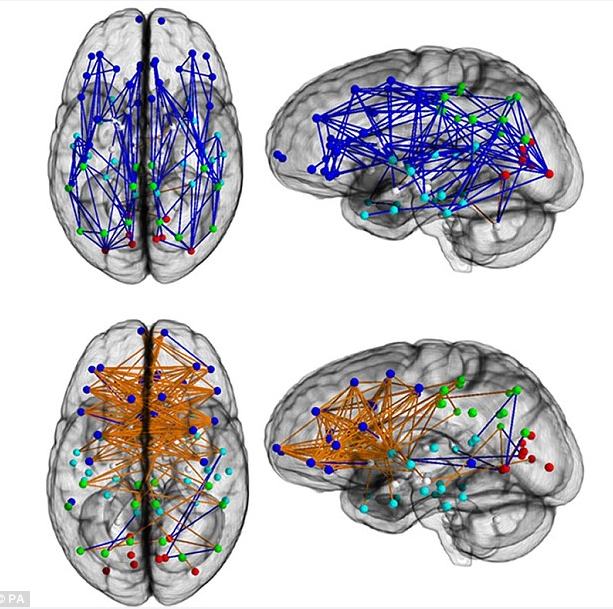
Using diffusion tensor imaging, University of Pennsylvania’s Madhura Ingalhalikar, Alex Smith, Drew Parker, Theodore D. Satterthwaite, Mark A. Elliott, Kosha Ruparel, Raquel E. Gur, Ruben C. Gur and Ragini Verma with Hakon Hakonarson of Children’s Hospital of Philadelphia, demonstrated that male and female brains differ in the network of neural connections.
Known as the “structural connectome,” these connections between neural structures were described by Indiana University’s Olaf Sporns, who reviewed imaging techniques to visualize their activity.

Ted Satterthwaite

Ted Satterthwaite

These gender-linked structural differences result in differing competencies.
Ingalhalikar’s team observed that male brains structures show more connections within the front and back of the brain hemisphere in the supratentorial region.

Olaf Sporns

Olaf Sporns

This area connects perception and coordinated action and enables males’ skill in quickly perceiving and applying information to a single complex task, spatial reasoning, and learning motor skills.

Ingalhalikar connectomeIn contrast, female brains contain more neural connections between hemispheres in supratentorial regions. 
This connection pattern enables females to recall faces and execute multiple complex tasks simultaneously more easily than males due the increased neural connections between analytical and intuitive processing modes.

Dardo Tomasi

Dardo Tomasi

Building on earlier work on these differences by Brookhaven National Lab’s Dardo Tomasi and Nora D. Volkow of National Institute on Drug Abuse, Ingalhalikar’s team found these differences were reversed in the cerebellar connections, where male brains showed greater intrahemispheric connectivity and female brains demonstrated more interhemispheric connections.

Nora Volkow

Nora Volkow

These structural differences lead to different development for girls and boys from an early age, and result in significant, less modifiable differences by adolescence and adulthood. 

Frequently-observed differences in male and female performance are rooted in different neural connection patterns by gender.

 -*What exceptions have you seen to findings of women’s skill in multitasking and social insight, and men’s competence in spatial reasoning and motor skill acquisition?

RELATED POSTS:

Follow-share-like http://www.kathrynwelds.com and @kathrynwelds

Twitter  @kathrynwelds
Blog – Kathryn Welds | Curated Research and Commentary  
Google+
LinkedIn Open Group Psychology in Human Resources (Organisational Psychology)
Facebook Notes

©Kathryn Welds

Gender Differences in Emotional Expression: Smiling

Previous blog posts have outlined dilemmas women face in being seen as competent yet  “likeable” in negotiations.

Deborah Gruenfeld

Deborah Gruenfeld

Deborah Gruenfeld of Stanford and researcher Carol Kinsey Goman note that women can increase perceived authority. if they smile when situationally-appropriate instead of consistently.

Simine Vazire

Simine Vazire

They imply that observers assign different interpretations to women’s smiles than to men’s smiles.
Washington University in St. Louis’s
Simine Vazire teamed with Laura Naumann of University of California, Berkeley, University of Cambridge’s Peter Rentfrow, and Samuel Gosling of University of Texas to investigate gender differences in the meaning of smiling behavior.   

Jacob Miguel Vigil

Jacob Miguel Vigil

They drew on University of New Mexico professor Jacob Miguel Vigil‘s theory that emotional behaviors promote attraction and aversion, based on others’ perceived:

  • Power to provide resources or harm (dominant, masculine behaviors)
  • Trustworthiness to reciprocate altruism (submissive, feminine)

Laura Naumann

Laura Naumann

Vazire’s team reported that women’s smiles signal positive affect and warmth, which are seen as “trustworthiness cues” in Vigil’s model, and typically attract fewer, but closer relationships.
Gruenfeld and Goman argue that women’s smiling also signals low power in negotiation situations and interpersonal interactions.

Peter Rentfrow

Peter Rentfrow

In contrast, smiling among men indicates confidence and lack of self-doubt, seen as “capacity cues” to the ability to either help or hurt others.
These expressions usually attract numerous, but less-intimate relationships while
conveying a key element of power, self-assurance.

Samuel Gosling

Samuel Gosling

Team Vazire’s research validated Gruenfeld’s and Goman’s hypothesis that observers interpreted women’s smiles differently than men’s, even if the underlying, subjective emotional experience is similar.

Their work supports  Gruenfeld’s and Goman’s recommendation that women balance smiling, a signal of interpersonal warmth, with powerful non-verbal behaviors to achieve best outcomes in negotiations and workplace performance.

-*How has smiling helped establish your warmth?
-*When has smiling undermined your credibility and power?

->Follow-share-like http://www.kathrynwelds.com and @kathrynwelds

RELATED POSTS:

©Kathryn Welds

Saudi Women’s Driving Campaign meets “When Everything Changed”

Saudi Women Driving CampaignSaudi Women’s Driving Campaign occurred near the time that New York Times columnist Gail Collins discussed her book When Everything Changed: The Amazing Journey of American Women from 1960 to the Present  at Harvard’s Radcliffe Institute for Advanced Studies.
Though separated by oceans and time zones, both events refer to the continuing challenge of women achieving parity in societies and workplaces.

Sheikh Saleh bin Saad al-Luhaidan

Sheikh Saleh bin Saad al-Luhaidan

Although there is no law mandating that women do not drive cars in Saudi Arabia, it is actively discouraged by religious leaders like Sheikh Saleh bin Saad al-Luhaydan, who asserted that driving injures women’s pelvis and ovaries and causes birth defects in children of women.

Saudi Woman DrivingSaudi Police detained women who drove cars on 26 October 2013, Saudi Women’s Driving Day, until their “guardians” arrived.
At that time, women were instructed to sign an affidavit stating that they would not drive a car in the future.

Jennifer Psaki

Jennifer Psaki

U.S. State Department spokesperson Jennifer Psaki said, “We support the full inclusion of women in Saudi society…. we would support their ability to drive.  We support, of course, the right of women everywhere to make their own decisions about their lives and their futures and the right to benefit equally from public services and protection from discrimination.”

Hisham Fageeh

Hisham Fageeh

Hisham Fageeh provided the memorable commentary on the controversy with his homage to Bob MarleyNo Woman, No Drive, a viral sensation.

Gail Collins

Gail Collins

According to Collins, “everything changed” for women in the U.S. in the 1960s, although many might say that many issues toward equity remain unresolved.
So far, everything has not changed for Saudi women, but they may find encouragement and even humor in Collins’ chronicle of women’s experience toward parity in the U.S.

-*What actions enable full social equity for Saudi women?

->Follow-share-like http://www.kathrynwelds.com and @kathrynwelds

©Kathryn Welds