Category Archives: Thinking

Cognition

Bilingual Competence Strengthens Brain’s “Executive Control,” “Adaptive Modulation”

Andrea Stocco

Andrea Stocco

Learning a second language in childhood or later in life provides numerous benefits, including:

  • Increased cultural awareness,
  • Enhanced creativity,
  • Possibly delaying cognitive deterioration associated with dementia.

Bilingual individuals excel on several cognitive measures, including “executive control”, measured by speed in applying new rules and switching tasks on a Rapid Instructed Task Learning (RITL) paradigm, according to University of Washington’s Andrea Stocco and Chantel S. Prat.

Chantel Prat

Chantel Prat

In addition, bilingual volunteers showed greater “adaptive modulation” of the brain’s the basal ganglia striatal activity, suggesting that competence in multiple languages changes brain activation patterns and structures.

Bilingual people’s performance advantages in executive functioning may develop as they adaptively select and apply different rules when speaking multiple languages, surmised Stocco and Prat.
They suggested that this behavioral flexibility may strengthen the brain’s fronto-striatal loops that connect to the prefrontal cortex.

The team evaluated 17 bilingual and 14 monolingual volunteers on their language proficiency and arithmetic problems defined by a set of operations and two uniquely-specified inputs.
Participants completed practice problems using just two operation sets, then tackled another set combining new items and some from the practice set.
For the final round, volunteers completed new and practice items while in an fMRI brain scanner.

Bilinguals completed the new problems significantly more quickly than monolinguals, although both groups performed similarly on familiar items, suggesting that people with multiple language competence may have an advantage in rapidly processing new information and unfamiliar challenges.

The physiological basis for this performance difference was revealed by the fMRI scan:  There was increased activity during work on novel problems in the bilingual volunteers’ basal ganglia.
This brain area is associated with learning linked to rewards and motor functions, and to prioritizing information before directing it to the prefrontal cortex for further processing. 

Ellen Bialystok

Ellen Bialystok

This research suggests that learning multiple languages trains the basal ganglia to switch more efficiently between the rules and vocabulary of different languages, a skill which can generalize to other tasks such as arithmetic.

Michelle Martin-Rhee

Michelle Martin-Rhee

The roots of this cognitive advantage is based on childhood bilingualism, which can also train inhibition of attention for perceptual information, found York University’s Ellen Bialystok and Michelle M. Martin-Rhee.

They noted that this effect was not due to differences in representational abilities because monolinguals ands bilinguals performed similarly on these tasks.
Bilingual preschoolers also showed greater creativity in non-mathematical and mathematical problem solving, reported University of Haifa’s Mark Leikin.

Mark Leikin

Mark Leikin

He compared bilingual children from a Hebrew–Russian kindergarten and a Hebrew monolingual kindergarten was well as monolingual children from a monolingual school on the Picture Multiple Solution task’s measure of general creativity and the Creating Equal Number task for mathematical creativity.
Bilingual children from the bilingual kindergarten showed significantly greater creativity on general and mathematical tasks than monolingual children.

Fergus I.M. Craik

Fergus I.M. Craik

Besides the benefit of enhanced creativity, bilingualism seems to be associated with later onset of dementia by four years, and less cognitive decline among more than 180 volunteers evaluated by York University’s Bialystok with Fergus I.M. Craik and Morris Freedman of University of Toronto.

Morris Freedman

Morris Freedman

They analyzed repeated Mini-Mental State Examination (MMSE) scores and also found that elderly bilinguals performed better on switching attention between objects, as demonstrated in Stocco and Prat’s work.

Though learning a second language in adulthood is “an order of magnitude more difficult” than learning in childhood, according to Stocco and Prat, the cognitive benefits can make it worth the challenge and effort.

-*What benefits have you experienced associated with learning a second language or life-long fluency in another language?

Follow-share-like http://www.kathrynwelds.com and @kathrynwelds

RELATED POST:

Twitter  @kathrynwelds
Blog – Kathryn Welds | Curated Research and Commentary
Google+
LinkedIn Open Group Psychology in Human Resources (Organisational Psychology)
Facebook Notes

©Kathryn Welds

Perceived Personal Power Can Modify Time Perception, Perceived Stress

Alice Moon

Alice Moon

People’s subjective experience of time differ based on individual characteristics, which can influence feelings of control over time and coping with time demands.

Serena Chen

Serena Chen

University of California Berkeley’s Alice Moon and Serena Chen evaluated more than 550 volunteers’ ratings of their perceived personal power and their perspectives on available time to accomplish goals.

Moon and Chen asked more than 100 participants to assume the role of a “manager” while sitting in a “high-power chair,” or the role of an “employee” while both groups rated their perceived personal resources of time and power.
Participants who played the more powerful role of “manager” reported that they had more time than “employee.”

Moon and Chen also primed more than 100 American adults to think of themselves in high-power or low-power positions, and asked them to rate statements about availability of time to achieve goals.

Even when participants did not actually have more available time, those who felt most powerful perceived greater control over their time, and greater time availability.
This is another example of the power of expectation exceeding the importance of an actual resource, competency, or experience.

Mario Weick

Mario Weick

These findings support other reports that managers experience less stress than subordinates in organizations, attributable to their “position power.”

Ana Guinote

Ana Guinote

People who feel powerful tend to hold a significantly optimistic bias when predicting time required to complete task, reported University of Kent’s Mario Weick and Ana Guinote of University College London.

They attributed this unrealistic optimism to
confident belief in personal self-efficacy accompanying subjective feelings of power in their evaluation of:

  • Actual power and time perception,
  • Induced feelings of power through priming,
  • Pre-existing personal self-perceptions.
Priyanka D. Joshi

Priyanka D. Joshi

This “planning fallacy” of underestimating task completion time often results from a narrow focus on the goal, coupled with the optimism bias that obscures potential obstacles and risks.

Nathanael Fast

Nathanael Fast

Likewise, people who feel powerful also tend to feel more confident about the future, more aware of their “future self,” and more willing to wait for longer-term rewards, found University of Southern California ’s Priyanka D. Joshi and Nathanael J. Fast.

Specifically, participants assigned to high-power roles and to power priming instructions were less likely to display temporal discounting, or choosing smaller short-term rewards over larger goals that require a longer waiting period.

This suggests that people who feel powerful have a sense of abundance in other domains, including time and money.
As a result, feeling powerful enables people to forego current rewards, “delay gratification,” and make present investments to achieve potentially larger longer-term pay-offs.

-*How do you increase your personal experience of power and time perspective?

Follow-share-like www.kathrynwelds.com and @kathrynwelds


RELATED POSTS:

Twitter  @kathrynwelds
Blog – Kathryn Welds | Curated Research and Commentary  
Google+
LinkedIn Open Group Psychology in Human Resources (Organisational Psychology)
Facebook Notes:

©Kathryn Welds

Increase Feelings of Power by Listening to Music with Strong Bass Beat

Dennis Hsu

Dennis Hsu

Listening to music with specific emotional qualities has been associated with productivity, performance, creative problem solving, endurance, decreased pain sensitivity, and decision biases, outlined in previous blog posts.

Loran Nordgren

Loran Nordgren

Subjective power feelings are an additional outcome of listening to music with substantial bass beat, reported Northwestern University’s Dennis Y. Hsu, Loran F. Nordgren, Derek D. Rucker, Li Huang, and Columbia’s Adam D. Galinsky.

Derek D. Rucker

Derek D. Rucker

Hsu’s team found that power-inducing music produced enhanced:

  • Abstract thinking
  • Illusions of control
  • Willingness to volunteer first for a potentially stressful task.
Li Huang

Li Huang

Subjective feelings of power are important contributors to workplace performance because they associated with confidence and self-efficacy, which influence willingness to persist in accomplishing challenging tasks.

Adam Galinsky

Adam Galinsky

More than 75 volunteers listened to an original, two-minute instrumental composition with either a prominent bass line or a subdued bass element in Team Hsu’s investigation.
Participants rated their feelings of power, dominance and determination along with their sense of happiness, excitement, and enthusiasm.

Pamela K. Smith

Pamela K. Smith

People who listened to the heavy-bass music said they experienced greater feelings of power than those who listened to the more subdued variation, but the increased bass element did not affect feelings of happiness or excitement.
Those who heard the composition with prominent bass elements also produced more power-related terms in a word-completion test.

Daniël Wigboldus

Daniël Wigboldus

Likewise, those who heard familiar “high-power music” such as Queen’s “We Will Rock You,” volunteered to be the first participants in a debate competition and scored higher on a test measuring abstract thinking, compared with people who listened to widely-known “low-power music” like “Who Let the Dogs Out?”

Ap Dijksterhuis

Ap Dijksterhuis

Feeling powerful is more important than actually possessing power in achieving superior performance, confirmed by University of California San Diego’s Pamela K. Smith with Daniël H.J. Wigboldus of Radboud University Nijmegen, and University of Amsterdam’s Ap Dijksterhuisc.
They reported this well-validated finding and expanded Smith’s previous report, with NYU’s Yaacov Trope, that people’s subjective sense of power is partly determined by individual information processing style.

Yaacov Trope

Yaacov Trope

Smith’s team found that people who demonstrated abstract thought reported greater sense of power, greater preference for high-power roles, and more feelings of control over the environment, compared with people who were primed to use concrete thinking.

Subjective feelings of power can be enhanced by listening to music with a prominent bass element, in addition to writing “power primes” and assuming expansive body postures.

-*How do you increase your personal experience of power?

Follow-share-like www.kathrynwelds.com and @kathrynwelds


RELATED POSTS:

©Kathryn Welds

“Default Mode Network”, Positive Mood Increase Creative Problem Solving

Sigmund Freud

Sigmund Freud

“Aimless engagement” in an activity can enable a non-linear, integrative “free association” of ideas leading to creative breakthroughs, confirmed Drexel University’s John Kounios.

Graham Wallas

Graham Wallas

Many people recognize this experience of creative “incubation” while performing routine, well-rehearsed tasks, though they may not be aware that nearly 90 years ago, Graham Wallas of London School of Economics proposed this phenomenon one of four stages in the creativity process.

Michael D Greicius

Michael D Greicius

The brain’s posterior cingulate cortex (PCC) and ventral anterior cingulate cortex (vACC) operate as a “default mode network” during this type of relaxed engagement, found Stanford’s Michael D. Greicius, Ben Krasnow, Allan L. Reiss, and Vinod Menon.

Rebecca Koppel

Rebecca Koppel

During free-flowing ideation, these brain regions “untether” thoughts from usual associational “mental ruts” to commingle in original ways.
Fixation forgetting” enables this innovative recombination of thoughts to develop innovative solutions, according to University of Illinois’s Rebecca Koppel and Benjamin C. Storm of University of California Santa Cruz.

Mark Beeman

Mark Beeman

Creative problem solving through insight also involves the right hemisphere’s anterior superior temporal gyrus (aSTG), an area associated with recognizing broad associative semantic relationships, reported Kounios and colleagues at Northwestern, Mark Beeman, Edward M Bowden, Jason Haberman, Stella Arambel-Liu, and Paul J Reber, collaborating with Kounios and Jennifer L Frymiare, also of Drexel, and Source Signal Imaging’s Richard Greenblatt.

John Kounios

John Kounios

They concluded that creative problem solving requires the ability to encode, retrieve, and evaluate information.
When insight is involved, integration of distantly related information is also needed.

Ruby Nadler

Ruby Nadler

In addition to these skills, University of Western Ontario’s Ruby T. Nadler, Rahel Rabi and John Paul Minda found that cognitive flexibility for problem-solving activates the prefrontal cortex and the anterior cingulate cortex, areas important in creative hypothesis-testing and rule-selection.
Additionally, they confirmed that creative solutions can be enabled by eliciting a positive mood.

Rahel Rabi

Rahel Rabi

The team induced positive, neutral, and negative moods using music clips and video clips, and asked volunteers to classify pictures with visually complex patterns.
People in the positive-mood condition showed better classification learning than those with induced neutral or negative moods, suggesting that upbeat music effectively enhanced creative thinking while boosting innovators’ mood.

John Paul Minda

John Paul Minda

Somewhat surprisingly, capturing ideas through handwriting or typing can attenuate innovation because recording requires a shift to a more linear organization of thoughts, posited Kounios.

-*How can you capture creative solutions while maintaining innovative momentum?

-*How can you prevent “fixation forgetting” from interfering with accessing information required for creative work?

Follow-share-like www.kathrynwelds.com and @kathrynwelds


RELATED POSTS:

Twitter  @kathrynwelds
Blog – Kathryn Welds | Curated Research and Commentary  
Google+
LinkedIn Open Group Psychology in Human Resources (Organisational Psychology)
Facebook Notes:

©Kathryn Welds

Brief Aerobic Exercise Increases Attention, Reading Performance

Michele Tine

Michele Tine

As little as 12 minutes of aerobic exercise increased selective attention and reading comprehension scores for low-income young adults at a highly selective, ”academically elite” (“Ivy League”) US undergraduate university, reported Dartmouth College’s Michele T. Tine and Allison G. Butler of Bryant University.

Alison Butler

Alison Butler

Even these highly-skilled participants, admitted to one of the US’s top academic institutions, had significantly different scores on Selective Visual Attention (SVA) and reading comprehension pre-test tasks, depending on their socio-economic status.

Courtney Stevens

Courtney Stevens

Selective Visual Attention (SVA) is the ability to focus on visual targets while ignoring irrelevant stimuli, and an Executive Function” (EF) required for academic and on-the-job learning, according to University of Oregon’s Courtney Stevens and Daphne Bavelier of University of Rochester.

Specifically, selective attention predicts skills in:

according to University of Oregon’s Stevens with Brittni Lauinger and Helen Neville.

Daniel Hackman

Daniel Hackman

Executive Functions, like Selective Visual Attention (SVA,) are positively correlated to socioeconomic status, found University of Pennsylvannia’s Daniel A Hackman and Martha J Farah, indicating that people with financial advantages often perform better on Executive Function tasks than people from disadvantaged backgrounds.

Eric Zillmer

Eric Zillmer

One well-validated measure of Selective Visual Attention (SVA) is the d2 Test of Attention, rapid trials of a manual letter cancellation task, developed by Rolf Brickenkamp and Eric Zillmer of Drexel University.
Participants Tine and Butler’s investigation indicated when they observed the target character among visual distractors.

John Best

John Best

One intervention to increase Executive Function skills, including Selective Visual Attention (SVA) is aerobic exercise, according to University of British Columbia’s John Best.

James Williams

James Williams

In addition to increasing Executive Functions, aerobic exercise increases levels of cortisol and brain-derived neurotrophic factor (BDNF).
These elements are associated with cognitive performance including Selective Visual Attention (SVA), reported Texas Tech’s Lee T Ferris and Chwan-Li Shen with James S Williams of Texas State University, as well as University of Dublin’s Eadaoin W. Griffin, Sinead Mulally, Carole Foley, Stuart A. Warmington, Shane M. O’Mara, and Aine M. Kelly.

Éadaoin W Griffin

Éadaoin W Griffin

Likewise, stress increases levels of cortisol, and lower-income people tend to experience more chronic stress, leading to higher levels of cortisol, according to Northwestern’s Edith Chen and Gregory E. Miller with Sheldon Cohen of Carnegie, and separately by Cornell University’s Gary Evans and Michelle Schamberg.

Edith Chen

Edith Chen

Tine and Butler investigated these diverse findings by asking volunteers to:

Gary Evans

Gary Evans

Items include:

  • My parent was fired from his/her job
  • I was a victim of a crime
  • A close friend or family member had health problems
  • My parents divorced or separated
  • I had problems being liked by classmates

Participants also completed three reading comprehension tasks from Sharon Weiner Green and Ira K. Wolf’s GRE Preparation items.

Douglas Williamson

Douglas Williamson

After 45 minutes, participants monitored heart rate to ensure that it was within 10 beats per minute of pre-test measures of resting heart rate.
Brief aerobic exercise sessions eliminated the gap between “Executive Function” performance scores for talented volunteers from lower-income and high-income backgrounds.

Lower-income participants who exercised aerobically had reading comprehension scores comparable to their higher-income counterparts, around 90%,
Likewise, people who exercised significantly improved Selective Visual Attention (SVA) scores, but the video-viewers’ scores did not change, suggesting that exercise was the “active ingredient” in these performance improvements.

In addition, volunteers who exercised and reported higher chronic stress level achieved higher SVA scores and greater SVA score improvement than those who reported less chronic stress.
Cognitive performance improvements were maintained 45 minutes after exercise.

These findings suggest aerobic exercise as an effective, low-cost intervention to reduce achievement differences between people from lower-income and more affluent backgrounds, and this could contribute to increasing the number of diverse applicants in selective higher education settings and skilled employment – as well as increasing endurance, cardiac health, and reducing stress.

-*How have you seen workplaces encourage participation in aerobic exercise for the next generation of potential employees as well as current employees?

-*Do organizations receive more benefit from reducing health care costs and health-related absences or from increasing attention, innovation, and productivity?

Follow-share-like http://www.kathrynwelds.com and @kathrynwelds

RELATED POSTS:

 ©Kathryn Welds

Musical Training Enhances “Executive Functions” of Planned Behavior, Cognitive Performance

Jennifer Zuk

Jennifer Zuk

Christopher Benjamin

Christopher Benjamin

Musical training is associated with well-developed “executive functions (EF)” – the cognitive capacities that enable intentional, controlled behavior and strong academic performance, according to Harvard University’s Jennifer Zuk, Christopher Benjamin, Arnold Kenyon, and Nadine Gaab.

“Executive functions (EF)” include:

John Best

John Best

Executive functions are required for academic readiness and long-term achievement, according to University of British Columbia’s John R Best, Patricia H Miller of San Francisco State University, and University of Virginia’s Jack A Naglieri.

Specific activities improve EF skills, even among children:

  • Kimberley Lakes

    Kimberley Lakes

    Martial arts, found University of California, Irvine’s Kimberly D. Lakes and William Hoyt

  • Lisa Flook

    Lisa Flook

    Mindfulness training, shown in research by UCLA’s Lisa Flook, Susan L. Smalley, M. Jennifer Kitil, Brian M. Galla, Susan Kaiser-Greenland, Jill Locke, Eric Ishijima, and Connie Kasari

  • Laura Chaddock-Heyman

    Laura Chaddock-Heyman

    Physical exercise, noted by University of Illinois’s Laura Chaddock, Michelle W Voss, Matt VanPatter, Matthew B. Pontifex, Charles H. Hillman, Arthur Kramer with Kirk I Erickson of University of Pennsylvania and Ohio State’s Ruchika S Prakash.

Individuals with musical training demonstrate enhanced:

  • Lisianne Hoch

    Lisianne Hoch

    Mathematical achievement, found Auckland University of Technology’s Lisianne Hoch and Barbara Tillmann University of Lyon.

Zuk and team compared adult working musicians and non-musicians, as well as children with at least two years of musical training and those with no previous musical training on cognitive ability tests of verbal fluency, mental processing speed, and working memory.

Nadine Gaab

Nadine Gaab

Adult musicians showed enhanced performance on measures of cognitive flexibility, working memory, and verbal fluency, compared to non-musicians.

Children performed a separate mental task while their brains were scanned using fMRI technology, and musically-trained children showed enhanced performance on measures of verbal fluency and cognitive processing speed.

They also showed significantly greater activation in supplementary motor area (SMA), pre-supplementary area (pre-SMA), and ventrolateral prefrontal cortex (VLPFC) during rule representation and task-switching tasks, compared to musically-untrained children.

This research suggests that current trends to eliminate arts programs in public schools could have a negative impact on development of academic achievement and job-related cognitive skills.

By implication, musical training may correlate with strong performance in pre-professional intern experiences and long term job performance, and remains to be verified by researchers and job recruiters.

-*Have you observed a relationship between musical training and on-the-job performance?

-*To what extent do physical exercise, martial arts, and mindfulness training increase cognitive task performance?

Follow-share-like http://www.kathrynwelds.com and @kathrynwelds

RELATED POSTS:

Twitter @kathrynwelds
Blog: Kathryn Welds | Curated Research and Commentary  
Google+
LinkedIn Open Group Psychology in Human Resources (Organisational Psychology)
Facebook Notes

©Kathryn Welds

Symbolic Gestures Can Prompt Behaviors, Shape Perceptions

Michal Parzuchowski

Michal Parzuchowski

Non-emotional gestures can “prime” abstract concepts, like “honesty,” and prompts people to behave consistent with these ideas, according to Michal Parzuchowski and Bogdan Wojciszke of University of Social Sciences and Humanities, Sopot, Poland.

Bodgan Wojciszke

Bodgan Wojciszke

They evaluated a symbolic gesture, putting a hand on one’s heart (“HOH”), which is associated with “honesty” in Poland, where the studies were conducted.

In the U.S., this gesture has a different meaning: Patriotism when enacted during The Pledge of Allegiance.
This distinction demonstrates cultural variation between specific gestures, and suggests opportunities for related research in other geographies.

HOHv NeutralVolunteers who performing this gesture were described as appearing more “honest” and trustworthy than when the same people enacted a neutral control gesture.

In addition, participants who performed the hand-over-heart gesture behaved more honestly when they provided more honest assessments of others’ attractiveness and refrained from cheating, compared to volunteers who performed neutral gestures.

Bodily experience associated with abstract concepts can influence both perceptions of others, and one’s own behaviors to align with the intangible idea – and the effect doesn’t depend on peoples’ emotional states.

More than 35 Polish volunteers listened to parts of a recorded job interview in which the applicant made several low-credibility statements like “I have never been late for work” and “I have never argued with members of my family.”

As they listened, participants viewed the speaker’s photograph.
Half of the participants saw a photo showing the speaker with both of hands placed behind the back, whereas the other half saw an image of the speaker with right hand over the heart (HOH).
Then, all participants rated the speaker’s credibility.

Participants rated the speaker pictured with hand over heart as more believable, suggesting that the gesture, locally associated with honesty, leading volunteers to perceive the person producing the signal of honesty “…as more credible, even if her statements are not very credible.”

Other volunteers rated the appearance of women in photographs, previously rated by independent judges as “moderate to low attractiveness”.
The women were described as the experimenter’s friends, to “prime” social desirability for a favorable evaluation from participants.

HOH-hipResearchers asked volunteers to enact gestures to “increase their cognitive load”:  Half the volunteers completed ratings while holding their right hand over their hearts whereas the other participants placed hand on their hips.

Participants who held their hand over their hearts rated less attractive faces significantly lower than volunteers who held their hand on their hips, suggesting that they the “’Hand-over-Heart’ gesture influenced people to respond more honestly,“…even if it meant being impolite.

HOJH v shoulderIn another study, more than 50 volunteers solved math problems and reported number completed .

Some wrote solutions with their dominant hands, but others held a “breathing monitor band” by either:

  • Putting right hand on left shoulder, or
  • Right hand over heart.

Participant had an incentive to exaggerate the number of completed problems because researchers told volunteers that one randomly-selected participant would be receive cash prize for each correct answer.

Those who held their hands on their shoulders claimed they solved 45 percent more problems than either of the other two groups, whereas people who held hands over hearts accurately reported completed problems, suggesting that temptation to embellish problem-solving performance was overridden by acting consistently with the gesture associated with honesty.

Bodily sensations influence the way we think, feel, and act…(and) a bodily sensation may activate the concept associated with it; this in turn may shape information processing, and behavior,” concluded Parzuchowski and Wojciszke.

These findings validate the idea of “embodied cognition” – bodily experience and states can influence thinking and likewise, thinking can affect bodily experience and states.
Other examples include judgments of height, weight, importance influenced by physical experiences.

Anita Eerland

Anita Eerland

People whose native language is read and written from left to right typically make smaller estimates of weight and height when leaning to the left (“posture-modulated estimation”) because their language leads them to represent numbers along a continuum with smaller numbers on the left and larger numbers on the right (“mental-number-line theory”), according to Anita Eerland now of Open University of the Netherlands with Max Planck Institute’s Tulio Guadalupe, and Rolf Zwaan of Erasmus University.

Tulio Guadalupe

Tulio Guadalupe

They induced people to lean slightly to the right or to the left by asking them to stand on a Wii Balance Board while answering estimation questions.
Eerland and team changed the directional lean as subjects leaned left or right, or stood upright without mentioning changes in position

When participants were leaned to the left, they produced significantly smaller estimates were than when they leaned to the right.

Eerland-Zwaan Wedding

Eerland-Zwaan Wedding

These results may vary for participants whose native language is read and written from right to left, and Eerland and team suggested replicating this study with other language groups.

Lynden Miles

Lynden Miles

Thoughts can lead to changed body position, found University of Aberdeen’s Lynden Miles, Louise Nind, and C Neil Macrae, when they asked volunteers to think about the future.

Imagining future events caused participants to shift their body position to lean forward, whereas they leaned back when asked to think about the past.

Similarly, qualitative dimension ratings can be affected by physical experience.

When volunteers judged a proposal’s importance, they rated it more momentous when holding a heavy object, according to University of Amsterdam’s Nils B. Jostmann, Daniël Lakens of Utrecht University and Institute Superior de Ciências do Trabalho e da Empresa, Lisbon’s Thomas W. Schubert.

European participants guessed the value of foreign currency in Euros while recording answers on either a heavy clipboard or a light-weight clipboard.
Those who held the lighter clipboard estimated lower average values.

In addition, volunteers estimated the importance of University students participating in making foreign study grant decisions.
Participants who held the heavier clipboard rated student participation as more important.

George Lakoff

George Lakoff

Jostmann and team experimentally demonstrated the impact of body, physical objects, and abstract metaphors on thinking, originally posited by University of California, Berkeley’s George Lakoff and Mark Johnson who linked

  • Control and Mood to direction:

“I have control over him,”
“I am on top of the situation,”
“He’s at the height of his power,”
“He ranks above me in strength,”

“I’m feeling up today”
“He is under my control,”
“His power is on the decline.

“I’m feel down in the dumps.”

  • Love, interpersonal connection to physical force

“I could feel the electricity between us”
“There were sparks
“They gravitated to each other”

  • Anger to heat, pressure

“He’s hot under the collar
“She said it in the heat of anger

John Bargh

John Bargh

Similarly, trustworthiness was associated with the physical experience of warmth when volunteer participants judged a new acquaintance as trustworthy after only a brief interaction when participants held a cup of warm coffee instead of a cold beverage, according to Yale’s John Bargh.

Embodied cognition” is one explanation for the interactive influence of symbolic thought, movement, and bodily experience on one’s behavior and peoples’ perceptions of others.

-*What metaphors and symbolic gestures affect your behavior?

Follow-share-like http://www.kathrynwelds.com and @kathrynwelds

RELATED POSTS:

Twitter  @kathrynwelds
Blog Kathryn Welds | Curated Research and CommentaryGoogle+
LinkedIn Open Group Psychology in Human Resources (Organisational Psychology)
Facebook Notes

©Kathryn Welds

Universal Body Map Pinpoints Where Emotions are Experienced

Lauri Nummenmaa

Lauri Nummenmaa

Emotions are associated with physiological changes in specific body regions, such as increased heart rate, sweaty palms, or startle response, according to Aalto University’s Lauri Nummenmaa, Enrico Glerean, and Riitta Hari, with Jari Hietanen of University of Tampere.

Enrico Glerean

Enrico Glerean

Nummenmaa and team showed emotion-laden words, videos, facial expressions and stories to more than 700 participants in Finland, Sweden and Taiwan, who then reported body regions that “felt different” after they viewed the emotion-evoking media.

Riitta Hari

Riitta Hari

Many people described the physical experience of emotions with metaphors including:

  • “Cold feet” to signal hesitation
  • “Heartbroken” to describe disappointment
  •  “Shivers down the spine” to indicate fear,
Jari Hietanen

Jari Hietanen

according to Durham University’s Zoltán Kövecses, Gary B. Palmer then of University of Nevada, Las Vegas and Rene Dirven then of University of Duisburg-Essen.

Zoltán Kövecses

Zoltán Kövecses

Nummenmaa’s team controlled for these linguistic representations by evoking emotional experiences with guided mental imagery from:

Then, volunteers reported bodily sensations they experienced during the emotion induction and rated physical sensations they expected people displaying different emotions would experience in their bodies.

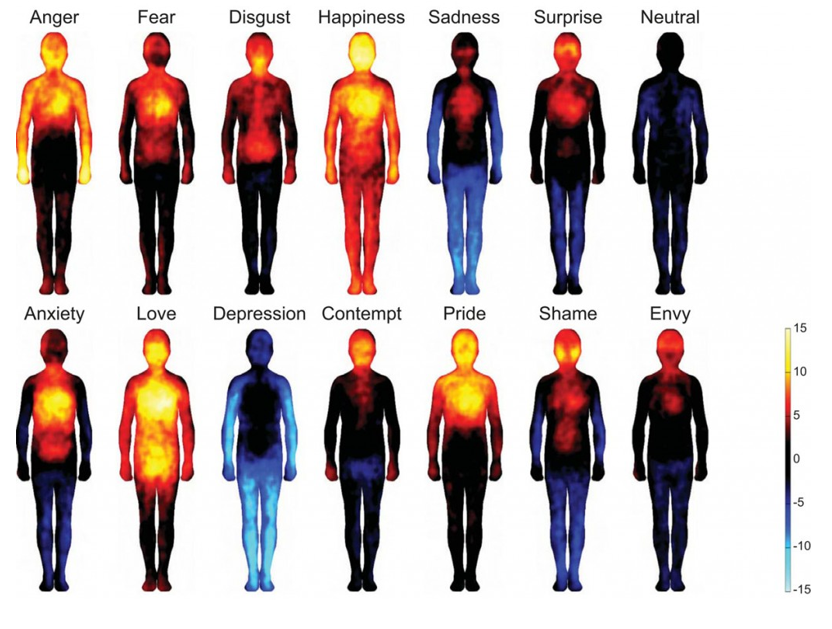
Nummenmaa and colleagues found distinctly different body areas associated with emotional experiences of happiness, contempt, love, and other feelings, with consistent results across nationalities.
They represented regions of greatest sensation associated with specific emotions with a computer-generated topographical body map.

The team proposed that emotions are represented as “culturally universal categorical somatotopic maps,” and sensing emotion-triggered bodily changes is required to perceive basic and complex emotions.Somatopic Emotion Map

Top row displays “basic” emotions:

  • Anger
  • Fear
  • Disgust
  • Happiness
  • Sadness
  • SurpriseBottom row displays “complex” emotions:
    • Anxiety
    • Love
    • Depression
    • Contempt
    • Pride
    • Shame
    • Envy

Happiness was a “full-body experience,” with increased sensation throughout the body, but some emotions were experienced in specific regions.

Christian Keysers

Christian Keysers

Likewise, most basic emotions, like anger and fear were associated with sensations of elevated activity in the upper chest area, corresponding to changes in breathing and heart rate, reported University of Groningen’s Christian Keysers and Valeria Gazzola with Jon H. Kaas of Vanderbilt.

Valeria Gazzola

Valeria Gazzola

In addition, all evoked emotions increased sensations in the head, reflecting changes in the facial area by muscle activation, skin temperature, tearing, and thoughts of emotional events.

Jon Kaas

Jon Kaas

Approach-oriented emotions,” including anger and happiness, were associated with increased upper limb sensation whereas depression was linked to decreased limb activity and sensation.
Disgust was felt in the digestive system and around the throat.

Positive emotions, including happiness, love, and pride, clustered in one group.
In contrast negative emotions diverged into four separate groups based on linguistic analysis and sensed body location:

  • Anger and fear
  • Anxiety and shame
  • Sadness and depression
  • Disgust, contempt, and envy.

Surprise was seen as neither a negative nor a positive emotion, yet it was distinctly different from neutral emotion.

Emotional metaphors appear connected to actual physiological experience of emotions, even when researchers controlled for familiar linguistic stereotypes and “conventional wisdom.”

-*What discrepancies have you observed between emotion descriptions and physical experience of emotion?

RELATED POSTS:

Twitter  @kathrynwelds
Blog – Kathryn Welds | Curated Research and Commentary  
Google+
LinkedIn Open Group Psychology in Human Resources (Organisational Psychology)
Facebook Notes:

©Kathryn Welds

Reading Changes Brain Connectivity

Reading a novel causes measurable and persistent changes in brain connectivity, building on findings that reading literary fiction can increase empathic awareness.

Gregory Berns

Gregory Berns

Stories shape our lives and in some cases help define a person,” according Emory University’s Gregory S. Berns, who with Kristina Blaine, Michael J. Prietula,and Brandon E. Pye used laboratory imaging to investigate the impact of reading fiction.

The team conducted resting-state functional magnetic resonance imaging scan (fMRI) of 21 volunteers on 19 consecutive days.

Robert Harris

Robert Harris

The first five daily scans provided a baseline, then participants read 1/9th (about 30 pages) of Robert Harriss Pompeii, a 2003 thriller, during the evening of the next 9 days.
For the next 9 mornings, they completed a quiz on the novel’s content, then resting-state (non-reading) fMRI.

Kristina Blaine

Kristina Blaine

The brain scans showed significant connectivity increases in the left angular/supramarginal gyri in the left temporal cortex and right posterior temporal gyri, areas associated with perspective taking and story comprehension.

Michael Prietula

Michael Prietula

The last 5 daily scans occurred with no reading the previous evening, and showed persistent connectivity changes for up to five days in bilateral somatosensory cortex in the central sulcus, suggesting neural mechanisms for:

Olaf Hauk

Olaf Hauk

-“Embodied semantics,” described by University of Cambridge’s Olaf Hauk and Nadja Tschentscher, as well as University of Southern California’s Lisa Aziz-Zadeh and Antonio Damasio

-“Grounded cognition,” summarized by Emory’s Lawrence Barsalou

Lawrence Barsalou

Lawrence Barsalou

Muscle memory, investigated by Amirkabir University of Technology’s Hossein Hassanpoor and Ali Fallah with Mohsin Raza of Baqiyatallah University of Medical Sciences.

Brandon Pye

Brandon Pye

This somatosensory activation suggests that reading a novel activates neural changes found with physical sensation and movement systems.
Berns noted that “…good stories can put you in someone else’s shoes in a figurative sense …(and)… may also be happening biologically.”

These fMRI findings reinforce findings that reading award-winning fiction can increase empathic awareness of others and related interpersonal insight.

-*What non-fiction reading provided memorable empathic insights about others?

RELATED POSTS:

Follow-share-like http://www.kathrynwelds.com and @kathrynwelds

Twitter  @kathrynwelds
Blog – Kathryn Welds | Curated Research and Commentary  
Google+
LinkedIn Open Group Psychology in Human Resources (Organisational Psychology)
Facebook Notes:

©Kathryn Welds

Laughter May Not Be “The Best Medicine”

Robin Ferner

Robin Ferner

Laughter has its serious side,” according to University of Birmingham’s Robin Ferner and Jeffrey Aronson of University of Oxford, despite author Norman Cousins’ anecdotal account of managing pain of his debilitating form of arthritis by watching Marx Brothers comedies, rest, and vitamin C.

Jeffrey Aronson

Jeffrey Aronson

Although laughter can feel good and has been advocated for its health benefits, Ferner and Aronson noted that “pathological” laughter can be caused by medical disorders including:

  • Amyotrophic lateral sclerosis
  • Cerebral tumors
  • Epilepsy
  • Multiple sclerosis.
Norman Cousins

Norman Cousins

Similarly, they noted many medical disorders result from laughter, including

Laughter Literature ReviewThis last “side effect” they noted was “promoting brand preference,” in a study by Radboud University Nijmegen’s Madelijn Strick, Rob Holland, Rick van Baaren, and Ad van Knippenberg, who investigated “how humor breaks resistance to influence.”

Madelijn Strick

Madelijn Strick

Strick and team concluded that “resistance” causes negative brand associations, but humor in advertisements provides cognitive distraction that prevents negative brand associations and increases positive brand impressions due to positive emotional engagement.
Together, these cognitive and emotional effects promote brand preference.

Laughter’s health benefits in addition to its commercial value, have been documented for decades, and include reduced:

Rob Holland

Rob Holland

Other documented health benefits include increased:

Rick van Baaren

Rick van Baaren

Benefit have been documented across countries and cultures: Both Indians and Canadians reported greater emotional well-being when they laughed to moderate levels, according to Hunaid Hasan and Tasneem Fatema Hasan, then of Mahatma Gandhi Mission’s Medical College.

Team Hasan compared more than 350 adults from Aurangabad, India, with the same number of adults from Mississauga, Canada on demographics, typical amount of laughter, lifestyle, subjective well-being, life satisfaction, emotional well-being, and health dimensions.

Ad van Knippenberg

Ad van Knippenberg

In India, moderate levels of laughter were linked to greatest well-being and life satisfaction, with low levels and high levels showing no effect.

Canadians also greatest benefits associated with moderate laughter, but higher levels of laughter were associated with negative effects.
The Hasan and Hasan team attributed this result to Canada’s higher prevalence of bronchial asthma, which may be precipitated or exacerbated by extreme laughter.

These research findings suggest that more laughter is “not always better” and may require “titrated doses” to extract benefits while minimizing documented “risks.”

-*How do you capitalize on laughter’s benefits while minimizing “the risks”?

RELATED POSTS:

Follow-share-like http://www.kathrynwelds.com and @kathrynwelds

Twitter  @kathrynwelds
Blog – Kathryn Welds | Curated Research and Commentary  
Google+
LinkedIn Open Group Psychology in Human Resources (Organisational Psychology)

Facebook Notes:

©Kathryn Welds