Category Archives: Career Development

Career Development

Four Leadership Behaviors Differentiate Top Performing Organizations

Ralph M. Stogdill

Ralph M. Stogdill

Effective leadership is a critical part of organizational health and growth and an important driver of shareholder returns, according to Ohio State’s Ralph M. Stogdill with McKinsey’s Aaron De Smet, Bill Schaninger, with Matthew Smith.

Bill Schaninger

Bill Schaninger

Consistent with this report, more than 90 percent of CEOs said they plan to increase investment in leadership development because they see it as their single most important human-capital issue, reported McKinsey’s Claudio Feser, Fernanda Mayol, and Ramesh Srinivasan.
However, only 43 percent of CEOs reported confidence that leadership training investments will render an acceptable ROI.
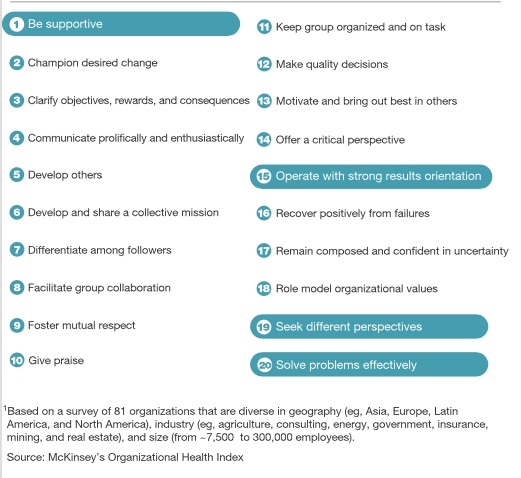
McKinsey Organizational Health Index Top Leadership Qualities

To more accurately target developable leadership behaviors associated with superior organizational performance, McKinsey identified 20 critical leadership traits then surveyed 189,000 people in 81 organizations of varying sizes across industries.

Claudio Feser

Claudio Feser

They segmented organizations by leadership effectiveness measured by McKinsey’s Organizational Health Index, and focused on companies in the top quartile and bottom quartile.

The team reported that four skills closely correlate with effective leadership and explained 89 percent of the variance in leadership effectiveness between top-performing organizations and lowest-performing organizations:

  • Effective problem solving by gathering, analyzing, and considering information before taking a decision,
  • Operating with a strong results orientation, developing and communicating a vision and setting objectives to efficiently achieve results,
  • Seeking different perspectives by monitoring trends affecting organizations and the external environment and by encouraging employees to suggest improvements,
  • Supporting others by demonstrating authenticity and sincere interest in colleagues to build trust and help others manage challenges.
Ramesh Srinivasan

Ramesh Srinivasan

A related post outlines other findings of top leadership competencies required for optimal organizational performance, including “Big Eight Competencies” described by Lominger’s Voices® 360˚ Assessment:

• Dealing with Ambiguity
• Creativity
• Innovation Management
• Strategic Agility
• Planning
• Motivating Others
• Building Effective Teams
• Managing Vision and Purpose.

-*Which leadership behaviors do you find most imperative?

Follow-share-like http://www.kathrynwelds.com and @kathrynwelds

RELATED POSTS:

Twitter  @kathrynwelds
Blog – Kathryn Welds | Curated Research and Commentary
Google+
LinkedIn Open Group Psychology in Human Resources (Organisational Psychology)
Facebook Notes

©Kathryn Welds

Individual Talent Surplus Can Reduce Team Performance 

Roderick Swaab

Roderick Swaab

More talent on a team doesn’t always increase team performance, particularly when team member must coordinate their efforts.

In fact, status conflicts based on talent differences can undermine team coordination during hand-offs for interdependent tasks, found INSEAD’s Roderick I. Swaab and Michael Schaerer, with Eric M. Anicich and Adam Galinsky of Columbia and VU University Amsterdam’s Richard Ronay.

Michael Schaerer

Michael Schaerer

Swaab and colleagues confirmed that most people believe there is a linear relationship between talent and performance:  They expect that more talent is consistently associated with improved performance.

However, the research team found an exception to this presumed rule when they analyzed National Basketball Association and Major League Baseball team and player data from 2002 through 2012.

They evaluated team performance in interdependent game tasks in basketball, a “zero sum game” because when one player shoots other players lose the opportunity to shoot at that time.
As a result, basketball players must coordinate efforts to position team members for as many shots as possible in a limited time.

Richard Ronay

Richard Ronay

In contrast, Swaab’s group studied independent sports performance in baseball.
In this game, players hit the ball in an assigned order and one player’s turn at bat does not eliminate another player’s turn to hit.
Further, each baseball player may hit a home run independent of other teammates’ batting skill, so each individual’s talent additively contributes to the team outcome.

Adam Galinsky

Adam Galinsky

Swaab’s team found that more talent is not associated with better performance when team members needed to coordinate interdependent tasks, as in basketball.
They called this the “too-much-talent effect”:  “When teams need to come together, more talent can tear them apart.”
In this case, they concluded that role differentiation is essential for optimal performance during interdependent tasks to ensure diverse capabilities in addition to willingness to collaborate.

Boris Groysberg

Boris Groysberg

This finding can be generalized to business organizations, which may experience decreased team performance if highly talented team members are unable to collaborate on interdependent tasks.
In addition, a surplus of top talent can undermine an organization’s profitability due to the high cost of attracting and hiring “stars.”

This “too-much-talent” effect was also demonstrated among Wall Street sell-side equity research analysts by Harvard Business School’s Boris Groysberg and Jeffrey T. Polzer with Hillary Anger Elfenbein of Washington University.

Hillary Anger Elfenbein

Hillary Anger Elfenbein

Increasing the number of talented analysts increased the firm’s overall performance to a point, then more stars actually decreased performance.
This effect was especially prominent when strong performers were concentrated in a small number of sectors.

As in professional sports, this “too-much-talent” effect could reflect a suboptimal integration and collaboration among analysts with similar expertise, controlling for individual performance, department size or specialization, or firm prestige.

Jennifer R. Overbeck

Jennifer R. Overbeck

Laboratory studies with volunteers confirm observations of the “too-much-talent” effect among professional athletes and Wall Street analysts, in research by University of Utah’s Jennifer R. Overbeck, Joshua Correll, and Bernadette Park.

They concluded that task groups need a few high-status members as leaders, and many more member-followers to contribute and implement work while supporting group direction.

Arthur Colman

Arthur Colman

When this “status sorting” is not explicit, Overbeck and team noted that a differentiated status hierarchy will evolve as status-seeking members vie for authority.
In rare cases, status sorting must be implemented through organizational design and responsibility definition, echoing earlier observations by University of California San Francisco’s Arthur D. Colman and W. Harold Bexton of the A.K. Rice Institute.

  • How have you managed “too-much-talent” effect in organizations?
  • To what extent do you encourage “status sorting” in your organization?

Follow-share-like http://www.kathrynwelds.com and @kathrynwelds

RELATED POSTS:

Twitter  @kathrynwelds
Blog – Kathryn Welds | Curated Research and Commentary
Google+
LinkedIn Open Group Psychology in Human Resources (Organisational Psychology)|
Facebook Notes

©Kathryn Welds

Reduce “Time Famine” By Doing for Others

Feeling “starved for time,” with “too much to do and too little time to do it”? University of Michigan’s Leslie Perlow identified the subjective experience “time famine” among software engineers, whose productivity was reduced based on frequent interruptions by others, a pervasive “crisis mentality,” rewards linked to “individual heroics.”

Cassie Moligner

Cassie Moligner

One counterintuitive remedy for “time famine” is giving time by helping other people.
This use of time increased feelings of “time affluence” in a study by Wharton’s Cassie MolignerZoë Chance of Yaleand Harvard’s Michael I. Norton.

Ernst Pöppel

Ernst Pöppel

Volunteers judged that they “did a lot with their time,” and had more available time when they helped others.
Mogilner and colleagues analyzed people’s elementary time experiences,” described by Ernst Pöppel of Ludwig-Maximilians-Universität München.

Francis Wade

Francis Wade

As Francis Wade of 2Time Labs pointed out, people cannot increase actual chronological time, but individual time experiences can vary based on physiological state, emotion, and context.

Moligner’s team compared people’s perceptions of time abundance when they:

  • Did something for someone else by writing an encouraging note to a gravely ill child or helping an at-risk student by editing his or her research essay for 15 minutes,
  • Spent 10 minutes doing something “for yourself that you weren’t already planning to do today,”
  • Spent 30 minutes doing something for someone else “that you weren’t already planning to do today,”
  • “Wasted” time on a low-meaning task by counting the letter “e” in multiple pages of Latin text,
  • Gained unexpected “free” time when they learned that “all essays had been edited,” so they could leave early.

Spending time on others seemed to “expand the future” and increase the perceived amount of available time, compared with spending time on oneself or “finding” free time.
In fact, people who unexpectedly gained fifteen minutes actually spent less time on a later required task than those who invested time helping another person.
This suggests that spending time pro-socially may increase one’s future work efforts, whereas finding free time may diminish work motivation.

Michael DeDonno

Michael DeDonno

Perceived time pressure undermined learning performance more than actual time constraints on the Iowa Gambling Task (IGT), found Florida Atlantic University’s Michael DeDonno and Heath Demaree of Case Western.

The team told more than 80 volunteers that time available for the task was “insufficient,” whereas they advised another group of more than 80 people that they had “sufficient” time to complete the task.
The time available to both groups was identical and adequate to complete the IGT, which asks participants to select from four decks of cards to win as much “money” as possible.

Heath Demaree

Heath Demaree

Two of the decks yield higher payoffs or “positive utility” whereas the remaining two decks render less favorable winnings, offering “negative utility.”
To win, participant learn which decks offer the greatest payoff in the shortest time for 100 trials.

Each group of more than 80 volunteers was separated into two sub-groups given different amounts of time between card selections to consider the task, while the total time available remained the same.

People who thought they had insufficient time for the task achieved lower payoff than volunteers who believed they had enough time.
Since both groups had the same amount of time, the performance difference was attributed to their beliefs about time constraints, suggesting the importance of focusing on the task rather than on potential time limits.

Steven J. Karau

Steven J. Karau

Actual time constraints affected both group interactions and task performance in a planning task evaluated by Southern Illinois University’s Steven J Karau and Janice R Kelly of Purdue.

They asked 36 groups of three volunteers to complete a planning task while group interactions were videotaped and coded using the Time-by-Event-by-Member Pattern Observation (TEMPO) system, developed by Texas Tech’s Gail Clark Futoran, Janice Kelly of Purdue, and University of Illinois’s Joseph McGrath.

Gail Clark Futoran

Gail Clark Futoran

Twelve of the groups had inadequate time, whereas another twelve groups had optimal time for task completion, and the final twelve groups has more than enough time.

Group performance was evaluated based on:

  • Length,
  • Originality,
  • Creativity,
  • Adequacy,
  • Issue Involvement,
  • Presentation quality,
  • Optimism,
  • Action orientation.

The groups that had greater time constraints actually focused less on the task than groups with more time, supporting Karau and Kelly’s recommendation to maintain task focus when performance time is limited to optimize performance.

Janice Kelly

Janice Kelly

Time constraints differentially affected each performance evaluation, and one way to mitigate the impact of time constraints is to shift focus from perceived time scarcity and stress to attend to the task.

-*How do you maintain task focus when perceiving time pressure?

-*To what extent does investing time in other people give you the sense of greater “time abundance”?

Follow-share-like http://www.kathrynwelds.com and @kathrynwelds

RELATED POSTS:

Twitter  @kathrynwelds
Blog – Kathryn Welds | Curated Research and Commentary
Google+
LinkedIn Open Group Psychology in Human Resources (Organisational Psychology)
Facebook Notes

©Kathryn Welds

Low-Stakes Testing Improves Learning Retention, Retrieval

Henry L. Roediger III

Henry L. Roediger III

Few people enjoy having knowledge gaps exposed by formal testing, but those who receive this corrective feedback are more likely to retain information over time, according to studies by Washington University’s Henry L. Roediger III and Jeffrey D. Karpicke.

Mary Pyc

Mary Pyc

Their work confirms considerable previous research, and the idea that testing acts as a “meditator” to retrieve stored information, suggested by Kent State University’s Mary A. Pyc and Katherine A. Rawson.

Katherine A. Rawson

Katherine A. Rawson

Participants in Roediger and Karpicke’s investigation read texts and were tested by writing as much as they recalled of selected sections, rather than completing a multiple choice test or writing a critical thinking essay on the topic.
Volunteers recalled about 70 percent of the ideas they’d read, then re-read the
remaining passages that were not tested.

Jeffrey D. Karpicke

Jeffrey D. Karpicke

Delayed testing on both sets of readings occurred after two days or seven days, and volunteers were significantly more able to remember material on which they’d been tested.

Roediger and Karpicke noted that testing requires people to retrieve knowledge from memory, rather than merely acquire information as when reading or listening to a lecture.
The testing effect, also known as the retrieval practice effect, strengthens learning by embedding information in memory.

Karl Szpunar

Karl Szpunar

Most effective testing is integrated into learning with frequent, low-stakes checkpoints in contrast to less frequent, higher-stakes testing in the traditional British education system, they suggested.

Novall Y. Khan

Novall Y. Khan

Additionally, “interpolated testing” during learning activities enables people to sustain attention, reduce mind wandering, test anxiety, and perceived “cognitive load,” found Harvard’s Karl K. Szpunar, Novall Y. Khan, and Daniel L. Schacter.

Sarah L. Eddy

Sarah L. Eddy

The testing effect can benefit people who have previously under-performed relative to their peers, and are under-represented in courses, reported University of Washington’s Sarah L Eddy and Mary Pat Wenderoth with Sara E Brownell of Arizona State University.

Mary Pat Wenderoth

Mary Pat Wenderoth

They evaluated women’s academic achievement and participation in class discussions in more than 20 large university biology courses.

Sara E. Brownell

Sara E. Brownell

Unlike in science, technology, engineering, and mathematics, 60% of the students were women.
However, they responded to only 40% of questions posed by the instructor during classes, much less than their representation in the course.
In addition, these women achieved lower exam scores than men with similar overall academic performance.

Daniel Schachter

Daniel Schachter

However, when the researchers introduced frequent, low-stakes testing – even without providing test results – women’s information retention and accessing significantly improved.

Frequent low-stakes testing integrated into learning activities leads to longer-term information comprehension, retention, and application – and this frequent exposure to a sometimes-feared or disliked activity can reduce avoidant reactions.

-*How effective do you find frequent tests to increase recall and retention of learning materials?

Related Posts:

Twitter:  @kathrynwelds
Google+
LinkedIn Groups Psychology in Human Resources (Organisational Psychology)
Facebook
Blog: – Kathryn Welds | Curated Research and Commentary

©Kathryn Welds

Perceived Personal Power Can Modify Time Perception, Perceived Stress

Alice Moon

Alice Moon

People’s subjective experience of time differ based on individual characteristics, which can influence feelings of control over time and coping with time demands.

Serena Chen

Serena Chen

University of California Berkeley’s Alice Moon and Serena Chen evaluated more than 550 volunteers’ ratings of their perceived personal power and their perspectives on available time to accomplish goals.

Moon and Chen asked more than 100 participants to assume the role of a “manager” while sitting in a “high-power chair,” or the role of an “employee” while both groups rated their perceived personal resources of time and power.
Participants who played the more powerful role of “manager” reported that they had more time than “employee.”

Moon and Chen also primed more than 100 American adults to think of themselves in high-power or low-power positions, and asked them to rate statements about availability of time to achieve goals.

Even when participants did not actually have more available time, those who felt most powerful perceived greater control over their time, and greater time availability.
This is another example of the power of expectation exceeding the importance of an actual resource, competency, or experience.

Mario Weick

Mario Weick

These findings support other reports that managers experience less stress than subordinates in organizations, attributable to their “position power.”

Ana Guinote

Ana Guinote

People who feel powerful tend to hold a significantly optimistic bias when predicting time required to complete task, reported University of Kent’s Mario Weick and Ana Guinote of University College London.

They attributed this unrealistic optimism to
confident belief in personal self-efficacy accompanying subjective feelings of power in their evaluation of:

  • Actual power and time perception,
  • Induced feelings of power through priming,
  • Pre-existing personal self-perceptions.
Priyanka D. Joshi

Priyanka D. Joshi

This “planning fallacy” of underestimating task completion time often results from a narrow focus on the goal, coupled with the optimism bias that obscures potential obstacles and risks.

Nathanael Fast

Nathanael Fast

Likewise, people who feel powerful also tend to feel more confident about the future, more aware of their “future self,” and more willing to wait for longer-term rewards, found University of Southern California ’s Priyanka D. Joshi and Nathanael J. Fast.

Specifically, participants assigned to high-power roles and to power priming instructions were less likely to display temporal discounting, or choosing smaller short-term rewards over larger goals that require a longer waiting period.

This suggests that people who feel powerful have a sense of abundance in other domains, including time and money.
As a result, feeling powerful enables people to forego current rewards, “delay gratification,” and make present investments to achieve potentially larger longer-term pay-offs.

-*How do you increase your personal experience of power and time perspective?

Follow-share-like www.kathrynwelds.com and @kathrynwelds


RELATED POSTS:

Twitter  @kathrynwelds
Blog – Kathryn Welds | Curated Research and Commentary  
Google+
LinkedIn Open Group Psychology in Human Resources (Organisational Psychology)
Facebook Notes:

©Kathryn Welds

Paradox of Potential vs Achievement in Job Search

Zachary Tormala

Zachary Tormala

When hiring or promoting, the person’s potential can trump actual accomplishments, according to Stanford’s Zakary Tormala, with Jayson Jia of University of Hong Kong and Harvard’s Michael Norton.

Jayson Shi Jia

Jayson Shi Jia

The paradox of potential occurs because possibility seems to engender greater interest and cognitive effort due to its uncertain outcome, in examples ranging across:

  • Basketball player evaluations,
  • Hiring decisions,
  • Salary offers,
  • Graduate school admissions recommendations,
  • Judgments of artistic talent,
  • Intentions to visit an untried restaurant.
Michael Norton

Michael Norton

Tormala and team demonstrated this effect by presenting identical statistics for a hypothetical NBA basketball player, then describing the data “predictions” or as “actual performance.”
Participants were more likely to judge that the player would become an All-Star player when they viewed “predicted” statistics rather than “actual” performance records.

Volunteers also evaluated a job applicant more favorably when the person performed well on an “Assessment of Leadership Potential rather than on an “Assessment of Leadership Achievement.”

Tormala’s group extended the investigation to evaluate impact of an upcoming comedian’s ”accomplishment” compared with “potential” when they posted different Facebook advertisements:

  • “Critics say he has become the next big thing”
  • “Critics say he could become the next big thing.”

The “potential” ads produced more than three times more click-throughs and five times more fan ratings.

In other studies, Tormala and team compared descriptions of an achievement and potential:

  • “This person has won an award for his work”
  • “This person could win an award for his work.”

“Potential” stimulated greater interest and cognitive information processing, resulting in more favorable reactions to the target person.

Derek Rucker

Derek Rucker

With Stanford colleague Daniella Kupor and Derek D. Rucker of Northwestern University, Tormala and Norton found that the preference for potential disappeared for people who don’t like uncertainty, and in situations that require higher degrees of certainty.

They noted that when people thoughtfully consider challenging decisions, such as in a Blackjack game, bystanders form positive impressions of others and become more willing to be influenced by them.
However, observers form negative opinions of people who “overthink” simple choices (demonstrate lack “thought calibration”), and are less willing to be influenced by them.

The appeal of potential applies to abstract enjoyable experiences, according to Southern Methodist University’s T. Andrew Poehlman and George Newman of Yale.

T Andrew Poehlman

T Andrew Poehlman

They found that the lure of “potential” makes people more likely to “consume inferior performances” in the present, but may not enjoy them.

Poehlman and Newman argued that “potential” is less influential when experienced in the past, and is less attractive when potential is associated with utilitarian dimensions.

George Newman

George Newman

These findings point to the value of:

  • Positioning one’s own “potential” as well as others’ “potential” to increase persuasiveness of support and advocacy,
  • Considering whether candidates with “potential” seem more appealing than those with greater experience – and whether potential is the appropriate selection criterion.

-*How frequently do you see people hired, promoted, and rewarded for “potential” instead of actual achievement?

Follow-share-like http://www.kathrynwelds.com and @kathrynwelds

RELATED POSTS:

Twitter @kathrynwelds
BlogKathryn Welds | Curated Research and Commentary
Google+ http:www.google.com/+KathrynWelds
LinkedIn Open Group Psychology in Human Resources (Organisational Psychology)
Facebook Notes

©Kathryn Welds

Increase Feelings of Power by Listening to Music with Strong Bass Beat

Dennis Hsu

Dennis Hsu

Listening to music with specific emotional qualities has been associated with productivity, performance, creative problem solving, endurance, decreased pain sensitivity, and decision biases, outlined in previous blog posts.

Loran Nordgren

Loran Nordgren

Subjective power feelings are an additional outcome of listening to music with substantial bass beat, reported Northwestern University’s Dennis Y. Hsu, Loran F. Nordgren, Derek D. Rucker, Li Huang, and Columbia’s Adam D. Galinsky.

Derek D. Rucker

Derek D. Rucker

Hsu’s team found that power-inducing music produced enhanced:

  • Abstract thinking
  • Illusions of control
  • Willingness to volunteer first for a potentially stressful task.
Li Huang

Li Huang

Subjective feelings of power are important contributors to workplace performance because they associated with confidence and self-efficacy, which influence willingness to persist in accomplishing challenging tasks.

Adam Galinsky

Adam Galinsky

More than 75 volunteers listened to an original, two-minute instrumental composition with either a prominent bass line or a subdued bass element in Team Hsu’s investigation.
Participants rated their feelings of power, dominance and determination along with their sense of happiness, excitement, and enthusiasm.

Pamela K. Smith

Pamela K. Smith

People who listened to the heavy-bass music said they experienced greater feelings of power than those who listened to the more subdued variation, but the increased bass element did not affect feelings of happiness or excitement.
Those who heard the composition with prominent bass elements also produced more power-related terms in a word-completion test.

Daniël Wigboldus

Daniël Wigboldus

Likewise, those who heard familiar “high-power music” such as Queen’s “We Will Rock You,” volunteered to be the first participants in a debate competition and scored higher on a test measuring abstract thinking, compared with people who listened to widely-known “low-power music” like “Who Let the Dogs Out?”

Ap Dijksterhuis

Ap Dijksterhuis

Feeling powerful is more important than actually possessing power in achieving superior performance, confirmed by University of California San Diego’s Pamela K. Smith with Daniël H.J. Wigboldus of Radboud University Nijmegen, and University of Amsterdam’s Ap Dijksterhuisc.
They reported this well-validated finding and expanded Smith’s previous report, with NYU’s Yaacov Trope, that people’s subjective sense of power is partly determined by individual information processing style.

Yaacov Trope

Yaacov Trope

Smith’s team found that people who demonstrated abstract thought reported greater sense of power, greater preference for high-power roles, and more feelings of control over the environment, compared with people who were primed to use concrete thinking.

Subjective feelings of power can be enhanced by listening to music with a prominent bass element, in addition to writing “power primes” and assuming expansive body postures.

-*How do you increase your personal experience of power?

Follow-share-like www.kathrynwelds.com and @kathrynwelds


RELATED POSTS:

©Kathryn Welds

“Default Mode Network”, Positive Mood Increase Creative Problem Solving

Sigmund Freud

Sigmund Freud

“Aimless engagement” in an activity can enable a non-linear, integrative “free association” of ideas leading to creative breakthroughs, confirmed Drexel University’s John Kounios.

Graham Wallas

Graham Wallas

Many people recognize this experience of creative “incubation” while performing routine, well-rehearsed tasks, though they may not be aware that nearly 90 years ago, Graham Wallas of London School of Economics proposed this phenomenon one of four stages in the creativity process.

Michael D Greicius

Michael D Greicius

The brain’s posterior cingulate cortex (PCC) and ventral anterior cingulate cortex (vACC) operate as a “default mode network” during this type of relaxed engagement, found Stanford’s Michael D. Greicius, Ben Krasnow, Allan L. Reiss, and Vinod Menon.

Rebecca Koppel

Rebecca Koppel

During free-flowing ideation, these brain regions “untether” thoughts from usual associational “mental ruts” to commingle in original ways.
Fixation forgetting” enables this innovative recombination of thoughts to develop innovative solutions, according to University of Illinois’s Rebecca Koppel and Benjamin C. Storm of University of California Santa Cruz.

Mark Beeman

Mark Beeman

Creative problem solving through insight also involves the right hemisphere’s anterior superior temporal gyrus (aSTG), an area associated with recognizing broad associative semantic relationships, reported Kounios and colleagues at Northwestern, Mark Beeman, Edward M Bowden, Jason Haberman, Stella Arambel-Liu, and Paul J Reber, collaborating with Kounios and Jennifer L Frymiare, also of Drexel, and Source Signal Imaging’s Richard Greenblatt.

John Kounios

John Kounios

They concluded that creative problem solving requires the ability to encode, retrieve, and evaluate information.
When insight is involved, integration of distantly related information is also needed.

Ruby Nadler

Ruby Nadler

In addition to these skills, University of Western Ontario’s Ruby T. Nadler, Rahel Rabi and John Paul Minda found that cognitive flexibility for problem-solving activates the prefrontal cortex and the anterior cingulate cortex, areas important in creative hypothesis-testing and rule-selection.
Additionally, they confirmed that creative solutions can be enabled by eliciting a positive mood.

Rahel Rabi

Rahel Rabi

The team induced positive, neutral, and negative moods using music clips and video clips, and asked volunteers to classify pictures with visually complex patterns.
People in the positive-mood condition showed better classification learning than those with induced neutral or negative moods, suggesting that upbeat music effectively enhanced creative thinking while boosting innovators’ mood.

John Paul Minda

John Paul Minda

Somewhat surprisingly, capturing ideas through handwriting or typing can attenuate innovation because recording requires a shift to a more linear organization of thoughts, posited Kounios.

-*How can you capture creative solutions while maintaining innovative momentum?

-*How can you prevent “fixation forgetting” from interfering with accessing information required for creative work?

Follow-share-like www.kathrynwelds.com and @kathrynwelds


RELATED POSTS:

Twitter  @kathrynwelds
Blog – Kathryn Welds | Curated Research and Commentary  
Google+
LinkedIn Open Group Psychology in Human Resources (Organisational Psychology)
Facebook Notes:

©Kathryn Welds

Brief Aerobic Exercise Increases Attention, Reading Performance

Michele Tine

Michele Tine

As little as 12 minutes of aerobic exercise increased selective attention and reading comprehension scores for low-income young adults at a highly selective, ”academically elite” (“Ivy League”) US undergraduate university, reported Dartmouth College’s Michele T. Tine and Allison G. Butler of Bryant University.

Alison Butler

Alison Butler

Even these highly-skilled participants, admitted to one of the US’s top academic institutions, had significantly different scores on Selective Visual Attention (SVA) and reading comprehension pre-test tasks, depending on their socio-economic status.

Courtney Stevens

Courtney Stevens

Selective Visual Attention (SVA) is the ability to focus on visual targets while ignoring irrelevant stimuli, and an Executive Function” (EF) required for academic and on-the-job learning, according to University of Oregon’s Courtney Stevens and Daphne Bavelier of University of Rochester.

Specifically, selective attention predicts skills in:

according to University of Oregon’s Stevens with Brittni Lauinger and Helen Neville.

Daniel Hackman

Daniel Hackman

Executive Functions, like Selective Visual Attention (SVA,) are positively correlated to socioeconomic status, found University of Pennsylvannia’s Daniel A Hackman and Martha J Farah, indicating that people with financial advantages often perform better on Executive Function tasks than people from disadvantaged backgrounds.

Eric Zillmer

Eric Zillmer

One well-validated measure of Selective Visual Attention (SVA) is the d2 Test of Attention, rapid trials of a manual letter cancellation task, developed by Rolf Brickenkamp and Eric Zillmer of Drexel University.
Participants Tine and Butler’s investigation indicated when they observed the target character among visual distractors.

John Best

John Best

One intervention to increase Executive Function skills, including Selective Visual Attention (SVA) is aerobic exercise, according to University of British Columbia’s John Best.

James Williams

James Williams

In addition to increasing Executive Functions, aerobic exercise increases levels of cortisol and brain-derived neurotrophic factor (BDNF).
These elements are associated with cognitive performance including Selective Visual Attention (SVA), reported Texas Tech’s Lee T Ferris and Chwan-Li Shen with James S Williams of Texas State University, as well as University of Dublin’s Eadaoin W. Griffin, Sinead Mulally, Carole Foley, Stuart A. Warmington, Shane M. O’Mara, and Aine M. Kelly.

Éadaoin W Griffin

Éadaoin W Griffin

Likewise, stress increases levels of cortisol, and lower-income people tend to experience more chronic stress, leading to higher levels of cortisol, according to Northwestern’s Edith Chen and Gregory E. Miller with Sheldon Cohen of Carnegie, and separately by Cornell University’s Gary Evans and Michelle Schamberg.

Edith Chen

Edith Chen

Tine and Butler investigated these diverse findings by asking volunteers to:

Gary Evans

Gary Evans

Items include:

  • My parent was fired from his/her job
  • I was a victim of a crime
  • A close friend or family member had health problems
  • My parents divorced or separated
  • I had problems being liked by classmates

Participants also completed three reading comprehension tasks from Sharon Weiner Green and Ira K. Wolf’s GRE Preparation items.

Douglas Williamson

Douglas Williamson

After 45 minutes, participants monitored heart rate to ensure that it was within 10 beats per minute of pre-test measures of resting heart rate.
Brief aerobic exercise sessions eliminated the gap between “Executive Function” performance scores for talented volunteers from lower-income and high-income backgrounds.

Lower-income participants who exercised aerobically had reading comprehension scores comparable to their higher-income counterparts, around 90%,
Likewise, people who exercised significantly improved Selective Visual Attention (SVA) scores, but the video-viewers’ scores did not change, suggesting that exercise was the “active ingredient” in these performance improvements.

In addition, volunteers who exercised and reported higher chronic stress level achieved higher SVA scores and greater SVA score improvement than those who reported less chronic stress.
Cognitive performance improvements were maintained 45 minutes after exercise.

These findings suggest aerobic exercise as an effective, low-cost intervention to reduce achievement differences between people from lower-income and more affluent backgrounds, and this could contribute to increasing the number of diverse applicants in selective higher education settings and skilled employment – as well as increasing endurance, cardiac health, and reducing stress.

-*How have you seen workplaces encourage participation in aerobic exercise for the next generation of potential employees as well as current employees?

-*Do organizations receive more benefit from reducing health care costs and health-related absences or from increasing attention, innovation, and productivity?

Follow-share-like http://www.kathrynwelds.com and @kathrynwelds

RELATED POSTS:

 ©Kathryn Welds

Musical Training Enhances “Executive Functions” of Planned Behavior, Cognitive Performance

Jennifer Zuk

Jennifer Zuk

Christopher Benjamin

Christopher Benjamin

Musical training is associated with well-developed “executive functions (EF)” – the cognitive capacities that enable intentional, controlled behavior and strong academic performance, according to Harvard University’s Jennifer Zuk, Christopher Benjamin, Arnold Kenyon, and Nadine Gaab.

“Executive functions (EF)” include:

John Best

John Best

Executive functions are required for academic readiness and long-term achievement, according to University of British Columbia’s John R Best, Patricia H Miller of San Francisco State University, and University of Virginia’s Jack A Naglieri.

Specific activities improve EF skills, even among children:

  • Kimberley Lakes

    Kimberley Lakes

    Martial arts, found University of California, Irvine’s Kimberly D. Lakes and William Hoyt

  • Lisa Flook

    Lisa Flook

    Mindfulness training, shown in research by UCLA’s Lisa Flook, Susan L. Smalley, M. Jennifer Kitil, Brian M. Galla, Susan Kaiser-Greenland, Jill Locke, Eric Ishijima, and Connie Kasari

  • Laura Chaddock-Heyman

    Laura Chaddock-Heyman

    Physical exercise, noted by University of Illinois’s Laura Chaddock, Michelle W Voss, Matt VanPatter, Matthew B. Pontifex, Charles H. Hillman, Arthur Kramer with Kirk I Erickson of University of Pennsylvania and Ohio State’s Ruchika S Prakash.

Individuals with musical training demonstrate enhanced:

  • Lisianne Hoch

    Lisianne Hoch

    Mathematical achievement, found Auckland University of Technology’s Lisianne Hoch and Barbara Tillmann University of Lyon.

Zuk and team compared adult working musicians and non-musicians, as well as children with at least two years of musical training and those with no previous musical training on cognitive ability tests of verbal fluency, mental processing speed, and working memory.

Nadine Gaab

Nadine Gaab

Adult musicians showed enhanced performance on measures of cognitive flexibility, working memory, and verbal fluency, compared to non-musicians.

Children performed a separate mental task while their brains were scanned using fMRI technology, and musically-trained children showed enhanced performance on measures of verbal fluency and cognitive processing speed.

They also showed significantly greater activation in supplementary motor area (SMA), pre-supplementary area (pre-SMA), and ventrolateral prefrontal cortex (VLPFC) during rule representation and task-switching tasks, compared to musically-untrained children.

This research suggests that current trends to eliminate arts programs in public schools could have a negative impact on development of academic achievement and job-related cognitive skills.

By implication, musical training may correlate with strong performance in pre-professional intern experiences and long term job performance, and remains to be verified by researchers and job recruiters.

-*Have you observed a relationship between musical training and on-the-job performance?

-*To what extent do physical exercise, martial arts, and mindfulness training increase cognitive task performance?

Follow-share-like http://www.kathrynwelds.com and @kathrynwelds

RELATED POSTS:

Twitter @kathrynwelds
Blog: Kathryn Welds | Curated Research and Commentary  

Google+
LinkedIn Open Group Psychology in Human Resources (Organisational Psychology)
Facebook Notes

©Kathryn Welds