Category Archives: Business Communication

Business Communication

Paradox of Potential vs Achievement in Job Search

Zachary Tormala

Zachary Tormala

When hiring or promoting, the person’s potential can trump actual accomplishments, according to Stanford’s Zakary Tormala, with Jayson Jia of University of Hong Kong and Harvard’s Michael Norton.

Jayson Shi Jia

Jayson Shi Jia

The paradox of potential occurs because possibility seems to engender greater interest and cognitive effort due to its uncertain outcome, in examples ranging across:

  • Basketball player evaluations,
  • Hiring decisions,
  • Salary offers,
  • Graduate school admissions recommendations,
  • Judgments of artistic talent,
  • Intentions to visit an untried restaurant.
Michael Norton

Michael Norton

Tormala and team demonstrated this effect by presenting identical statistics for a hypothetical NBA basketball player, then describing the data “predictions” or as “actual performance.”
Participants were more likely to judge that the player would become an All-Star player when they viewed “predicted” statistics rather than “actual” performance records.

Volunteers also evaluated a job applicant more favorably when the person performed well on an “Assessment of Leadership Potential rather than on an “Assessment of Leadership Achievement.”

Tormala’s group extended the investigation to evaluate impact of an upcoming comedian’s ”accomplishment” compared with “potential” when they posted different Facebook advertisements:

  • “Critics say he has become the next big thing”
  • “Critics say he could become the next big thing.”

The “potential” ads produced more than three times more click-throughs and five times more fan ratings.

In other studies, Tormala and team compared descriptions of an achievement and potential:

  • “This person has won an award for his work”
  • “This person could win an award for his work.”

“Potential” stimulated greater interest and cognitive information processing, resulting in more favorable reactions to the target person.

Derek Rucker

Derek Rucker

With Stanford colleague Daniella Kupor and Derek D. Rucker of Northwestern University, Tormala and Norton found that the preference for potential disappeared for people who don’t like uncertainty, and in situations that require higher degrees of certainty.

They noted that when people thoughtfully consider challenging decisions, such as in a Blackjack game, bystanders form positive impressions of others and become more willing to be influenced by them.
However, observers form negative opinions of people who “overthink” simple choices (demonstrate lack “thought calibration”), and are less willing to be influenced by them.

The appeal of potential applies to abstract enjoyable experiences, according to Southern Methodist University’s T. Andrew Poehlman and George Newman of Yale.

T Andrew Poehlman

T Andrew Poehlman

They found that the lure of “potential” makes people more likely to “consume inferior performances” in the present, but may not enjoy them.

Poehlman and Newman argued that “potential” is less influential when experienced in the past, and is less attractive when potential is associated with utilitarian dimensions.

George Newman

George Newman

These findings point to the value of:

  • Positioning one’s own “potential” as well as others’ “potential” to increase persuasiveness of support and advocacy,
  • Considering whether candidates with “potential” seem more appealing than those with greater experience – and whether potential is the appropriate selection criterion.

-*How frequently do you see people hired, promoted, and rewarded for “potential” instead of actual achievement?

Follow-share-like http://www.kathrynwelds.com and @kathrynwelds

RELATED POSTS:

Twitter @kathrynwelds
BlogKathryn Welds | Curated Research and Commentary
Google+ http:www.google.com/+KathrynWelds
LinkedIn Open Group Psychology in Human Resources (Organisational Psychology)
Facebook Notes

©Kathryn Welds

Does Customer Recommendation Predict Company Growth?

Fred Reichheld

Fred Reichheld

Net Promoter Scores gauge customer loyalty, expressed by willingness to recommend and advocate the company’s products and services to others.

Its creator, Fred Reichheld of Bain & Company, posited that NPS is a more meaningful measure of a company’s relationship with its customers than customer satisfaction metrics because, he argued, it is correlated with revenue growth.

Richard Owen

Richard Owen

Satmetrix Executives Richard Owen and Laura Brooks further articulated this linkage between customer loyalty and revenue growth.

NPS’s customer loyalty metric is based on 10-point ratings in response to just one question: How likely is it that you would recommend our company/product/service to a friend or colleague?

Laura Brooks

Laura Brooks

“Promoters” respond with a score of 9 or 10 whereas “Detractors” provide ratings of 0-6, and scores of 7 and 8 are ignored in this system, leading to the question of why they are included.
NPS is calculated by subtracting the percentage of customers who are Detractors from the percentage of customers who are Promoters.

Timothy L. Keiningham

Timothy L. Keiningham

Critics, including Ipsos Loyalty’s Timothy L. Keiningham, Bruce Cooil of Vanderbilt, BI Norwegian School of Management’s Tor Wallin Andreassen, and Lerzan Aksoy of Fordham, argue that American Customer Satisfaction Index (ACSI) is an equally accurate predictor of revenue growth.

They reinforced the frequently-replicated finding that actual behaviors, including positive and negative “word of mouth (WOM)are better predictors than attitudes about possible future behaviors, in their evaluation of longitudinal data from 21 firms and 15,500-plus interviews from the Norwegian Customer Satisfaction Barometer.

Claes Fornell

Claes Fornell

Likewise, University of Michigan’s Claes Fornell, Forrest V. Morgensen, and M.S. Krishan, with Sunil Mithas of University of Maryland, found that “it is possible to beat the market consistently by investing in firms that do well on the ACSI.”

Companies that invest in initiatives to increase customer satisfaction, reflected in higher scores than competitors on the American Customer Satisfaction Index (ACSI), also performed better in measures of market value.

More surprisingly, they found that these higher returns are associated with lower stock market risk, probably due to “stock market imperfections” that require time to adjust to news of strong ACSI performance.

Bob Hayes

Bob Hayes

Similarly, customer satisfaction and loyalty researcher Bob Hayes contended that “likelihood to recommend” measures the same construct and has the same predictive value of business growth as customer loyalty questions such as:

  • Overall satisfaction
  • Predicted likelihood to purchase again, evaluated through his Purchasing Loyalty Index (PLI)
  • Number of referrals through “word of mouth” and “word of mouse,” calculated in his Advocacy Loyalty Index (ALI)
  • Resistance to defection to competing offers, measured with his Retention Loyalty Index (RLI).

    Hayes Customer Loyalty Grid

    Hayes Customer Loyalty Grid

Hayes’ findings reinforced the caveat that actual behavior is a more accurate than attitudes about likely future behavior, also demonstrated by University of Connecticut’s V Kumar, J Andrew Petersen and Robert Leone in their analysis of telecoms and financial service customers willing to recommend their service provider.

V Kumar

V Kumar

Only about one-third of these potential Advocates actually recommended the provider, and only about 13% of those referrals actually led to new customers.
Kumar and team called this the “promise gap” and suggested that it can be mitigated by delivering beyond customer expectations, even when a customer complains.

Neal A Morgan

Neil Morgan

Indiana University’s Neil A. Morgan and Lopo Leotte Rego of University of Iowa added a wrinkle to critiques of Net Promoter Scores as the sole necessary indicator of customer satisfaction.

Like Keiningham’s team and Hayes, they found that recommendation intentions (“net promoters”) have “little to no predictive value.
Unlike Hayes, their results found little predictive strength for actual behavior in average number of recommendations.

Instead, Morgan and Rego argued for multiple measures of customer satisfaction as the best predictor of revenue group.
Additionally they found that Top 2 Box satisfaction scores – the sum of percentages for the top two point on surveys of purchase intent, satisfaction or awareness – provided “good” predictive value.

Daniel Schneider

Daniel Schneider

The Net Promoter Score also had the lowest predictive validity when compared to three other scales by Stanford’s Jon Krosnick and Daniel Schneider, with Intuit’s Matt Berent and Hays Interactive’s Randall Thomas.

To improve the NPS, the team recommended replacing the 11 point unipolar rating scale with a 7 point bipolar scale from positive to negative impressions.
Jon Krosnick

Jon Krosnick

Their work replicated Hayes’ finding that liking and satisfaction with a company are highly significantly predictors than the likelihood of recommending, so Krosnick’s team recommended including questions like:

  • Overall, how satisfied are you with the each of the following companies?
  • How much do you like or dislike each of the following companies?

They uncovered correlations among measures of customer experience, and showed that liking is the best predictor of the number of recommendations and satisfaction.

Leon Festinger

Leon Festinger

Customers typically form more positive evaluations after the decision to purchase, probably due to validating purchase choices and reduce cognitive dissonance of purchase dissatisfaction, described by Stanford’s Leon Festinger.

These findings suggest that Reichheld’s claim of NPS as “the only question you need to ask” may be unsubstantiated, and that multiple measures of customer experience are more accurate predictors of a company’s revenue performance.

-*How credible is “willingness to recommend” a company as a predictor of its revenue growth?

Follow-share-like www.kathrynwelds.com and @kathrynwelds

RELATED POSTS:

©Kathryn Welds

Most Effective “Calls to Action” Are Aligned to Audience “Construal Level”, Psychological Distance”

Nir Halevy

Nir Halevy

Leaders can elicit stronger commitment and willingness to follow requested actions when they deliver messages tailored to the audience’s “psychological distance” from them, according to Stanford’s Nir Halevy and Yair Berson of Bar-Ilan University.

Yaacov Trope

Yaacov Trope

Construal level theory” (CLT), developed by NYU’s Yaacov Trop and Nira Liberman of Tel Aviv University, posits that the “psychological distance” is related to differences in organizational hierarchy position as well as spatial and temporal distance.

Nira Liberman

Nira Liberman

Halevy and Berson found that greater psychological distance requires greater message abstractness, often characterized as “high level,” “visionary,” and “big picture” communications.

In contrast, communications with people who work closely with each other are more influential when messages are concrete and specific.

Yair Berson

Yair Berson

Halevy and Berson found that “construal fit” is associated with greater job satisfaction, commitment, and social bonding.

These findings add to other “fit” theories, pioneered by Paul Hersey and Ken Blanchard’s Situational Leadership concepts, and suggest leadership behaviors are most effective when tailored to specific workplace situations,

Paul Hersey

Paul Hersey

Practical implications include:

  • Providing more specific messages to people working in different locations and time zones.
  • Pairing individuals at closer organizational levels for workplace mentoring rather than “executive shadowing” experiences.
Ken Blanchard

Ken Blanchard

*How do you tailor leadership communications based on the audience’s “psychological distance” and “construal level?”

Follow-share-like http://www.kathrynwelds.com and @kathrynwelds

Situational LeadershipRELATED POSTS:

Twitter @kathrynwelds
Blog: Kathryn Welds | Curated Research and Commentary  
Google+
LinkedIn Open Group Psychology in Human Resources (Organisational Psychology)
Facebook Notes

©Kathryn Welds
Gender Bias in STEM Hiring Even When it Reduces Financial Returns  

Women are under-represented in Science, Technology, Engineering, and Mathematics (STEM) academic programs and professional roles, and some question whether this is a a result of personal preference, implicit bias, institutional barriers, or other factors,

Ernesto Reuben

Ernesto Reuben

To investigate, Columbia University’s Ernesto Reuben, Paola Sapienza of Northwestern University, and University of Chicago’s Luigi Zingales developed an experimental job market.
Both male and female candidates demonstrated equal skill in performing an arithmetic task, yet both female and male “hiring managers” were twice as like to hire comparable male candidateseven when the hiring managers earned less by hiring less qualified males.
*Even when participants had a financial incentive to choose the candidate with the greatest task-relevant skills, they chose less-qualified male candidates.

Paola Sapienza

Paola Sapienza

Reuben and team also found that when candidates were asked to report their performance on the task-related achievement test, men exaggerated their performance with “honest overconfidence.”
In contrast, women generally underreported their accomplishments, found University of Wisconsin’s Sylvia Beyer.

Luigi Zingales

Luigi Zingales

This gender-based bias in hiring decisions was reduced, but not eliminated when candidates’ previous performance was provided by a third party.

Sylvia Beyer

Sylvia Beyer

Some candidates were directed to report expected future performance based on initial math task performance, then the “employer” made the hiring decision.
Other candidates provided no estimate, but Reuben’s team reported candidates’ past performance to the “hiring managers.”

In other studies, “employers” had no information on each “candidate’s” previous performance, but met each applicant in person before making a hiring decision.
After the hiring managers’ choice, candidates reported expected future performance, or Reuben’s team provided candidates’ past performance to the “hiring manager.”

Anthony Greenwald

Anthony Greenwald

Volunteers then completed the Implicit Association Test (IAT), developed by University of Washington’s Anthony Greenwald, Debbie McGhee, and Jordan Schwartz, to elicit unconscious stereotypes of gender, competencies, and occupations.

When the candidates reported their expected performance and the “hiring manager” chose a candidate with a lower score than other contenders, 90% of the selected but underperforming candidates were male.
As a result, “hiring managers” who selected less qualified male candidates sacrificed 5-7% of their own compensation for biased selections.

Pedro Rey-Biel

Pedro Rey-Biel

Reuben and colleagues, with Pedro Rey-Biel of Universitat Autònoma de Barcelona previously demonstrated that this preference for underperforming candidates was explained by the persuasive impact of men’s significantly exaggerated statements (usually by at least 30%) about past and future performance and by scores on the Implicit Association Test.

Hyperbole is apparently effective for male candidates in job interviews when the “hiring manager” scores high on the IAT.

However, this embellishment strategy is ineffective for women, as Reuben and team demonstrated:  In another study, women were still selected 33% less than expected even when they showcased their accomplishments.
Women’s overt self-promotion may provoke “backlash” against those who behave in counter-stereotypic ways.

This research suggests the prevalence of implicit biases against hiring women to perform science, technology, engineering, and mathematics (STEM) functions, and male candidates’ tendency to embellish past performance and boast about future potential accomplishments.

As a result, women are selected less frequently for roles in STEM careers, continuing their under representation in these fields.

Even if women do not exaggerate past accomplishments and future potential, this research implies that they should ensure that they communicate and reinforce the full range of skills.

“Real life” hiring managers can overcome implicit hiring biases through awareness and “proper information processing” by focusing on validated performance data, and comparing candidates of the same gender with each other..

-*What strategies have you seen mitigate the influence of implicit bias influence in hiring decisions?

Follow-share-like http://www.kathrynwelds.com and @kathrynwelds

RELATED POSTS:

Twitter @kathrynwelds
BlogKathryn Welds | Curated Research and Commentary
Google+  http:www.google.com/+KathrynWelds
LinkedIn Open Group Psychology in Human Resources (Organisational Psychology)
Facebook Notes

©Kathryn Welds

Mitigating Pervasive “Cheap Talk” at Work, in Dating

Paul Oyer

Paul Oyer

“Cheap talk,” a game theory concept, took on personal meaning for Stanford’s Paul Oyer during his foray into the online dating “marketplace” at OkCupid.

He was candid on some parts of his profile but edited details in other areas is explained by game theory’s “cheap talk,” which suggests that the value of editing and embellishing information is based on expected utility – potential dating partners’ selection criteria – in relation to the possible cost of selective reporting – “overcoming barriers to entry” but being disqualified for lack of full disclosure.

Data from OkCupid and match.com suggest that many participants engage in cheap talk, to enhance physical attractiveness and fitness as well as income.
As a result, “profile inflators’ curatorial enhancements” (non-cooperative cheap talk) led most to discount most all claims as “cheap talk,” leading to a significant disadvantage for truthfully uninflated profiles (cooperative cheap talk), noted Oyer.

Jonathan Zinman

Jonathan Zinman

Marketing and advertising campaigns have the reputation for employing cheap talk, documented by Dartmouth’s Jonathan Zinman and Eric Zitzewitz, who found that ski resorts exaggerate snowfall, especially during periods including holidays and weekends.

Eric Zitzewitz

Eric Zitzewitz

However, external verification through real time reporting via smartphones reduced the revenue-enhancing effect of meteorological exaggeration, according to Zinman and Zitzewitz.

Like resort marketers, CEOs may engage in a cycle of optimistic forward-looking statements, based on expectations that any statement would be discounted as “cheap talk,” noted Harvard’s Jeremy Stein.

Jeremy Stein

Jeremy Stein

Similarly, before he became a member of the Federal Reserve, Stein found that official statements by the Chair of the Federal Reserve were more credible and less likely to contain “cheap talk” when a target range for inflation was announced, instead of a precise value.

Stock analysts, too, are a source of influential “cheap talk,” particularly when a company goes public, because their employer’s other services securities underwriting become more valuable, observed National Taiwan University’s Hsiou-wei Lin and Maureen McNichols of Stanford.

Hsiou-Wei Lin

Hsiou-Wei Lin

They found that analysts employed by a bank that worked with the target company provided higher forecasts than independent analysts.
As a result, the stock market was “less responsive” to assumed “cheap talk” of in-house analysts.

Maureen McNichols

Maureen McNichols

To manage “cheap talk,” Stanford’s Nobel laureate A. Michael Spence modeled signaling information to a valued target audience in the job market.
In online dating, this could be sending a virtual rose, to indicate greater-than-average interest in meeting, resulting in increased acceptance rates for participants with “average desirability” of income level and physical characteristics.

A Michael Spence

A Michael Spence

“Signaling” has become a familiar process in university application processes, when candidates indicate clear preference and intention to attend if accepted, at the “cost” of foregoing other early decision applications.

Like “signaling,” external verification of “cheap talk” claims review sites like Yelp.com, or even friend-of-a-friend accounts can increase the “cost” and reduce exaggerated claims.

-*When has “cheap talk” contributed to achieving goals?
-*How do you manage “cheap talk” by others?

Follow-share-like http://www.kathrynwelds.com and @kathrynwelds

RELATED POSTS:

·         Unrealistic Optimism Drives Profitability

·         Useful Fiction: Optimism Bias of Positive Illusions

Twitter @kathrynwelds
BlogKathryn Welds | Curated Research and Commentary
Google+
LinkedIn Open Group Psychology in Human Resources (Organisational Psychology)
Facebook Notes:

©Kathryn Welds

Universal Body Map Pinpoints Where Emotions are Experienced

Lauri Nummenmaa

Lauri Nummenmaa

Emotions are associated with physiological changes in specific body regions, such as increased heart rate, sweaty palms, or startle response, according to Aalto University’s Lauri Nummenmaa, Enrico Glerean, and Riitta Hari, with Jari Hietanen of University of Tampere.

Enrico Glerean

Enrico Glerean

Nummenmaa and team showed emotion-laden words, videos, facial expressions and stories to more than 700 participants in Finland, Sweden and Taiwan, who then reported body regions that “felt different” after they viewed the emotion-evoking media.

Riitta Hari

Riitta Hari

Many people described the physical experience of emotions with metaphors including:

  • “Cold feet” to signal hesitation
  • “Heartbroken” to describe disappointment
  •  “Shivers down the spine” to indicate fear,
Jari Hietanen

Jari Hietanen

according to Durham University’s Zoltán Kövecses, Gary B. Palmer then of University of Nevada, Las Vegas and Rene Dirven then of University of Duisburg-Essen.

Zoltán Kövecses

Zoltán Kövecses

Nummenmaa’s team controlled for these linguistic representations by evoking emotional experiences with guided mental imagery from:

Then, volunteers reported bodily sensations they experienced during the emotion induction and rated physical sensations they expected people displaying different emotions would experience in their bodies.

Nummenmaa and colleagues found distinctly different body areas associated with emotional experiences of happiness, contempt, love, and other feelings, with consistent results across nationalities.
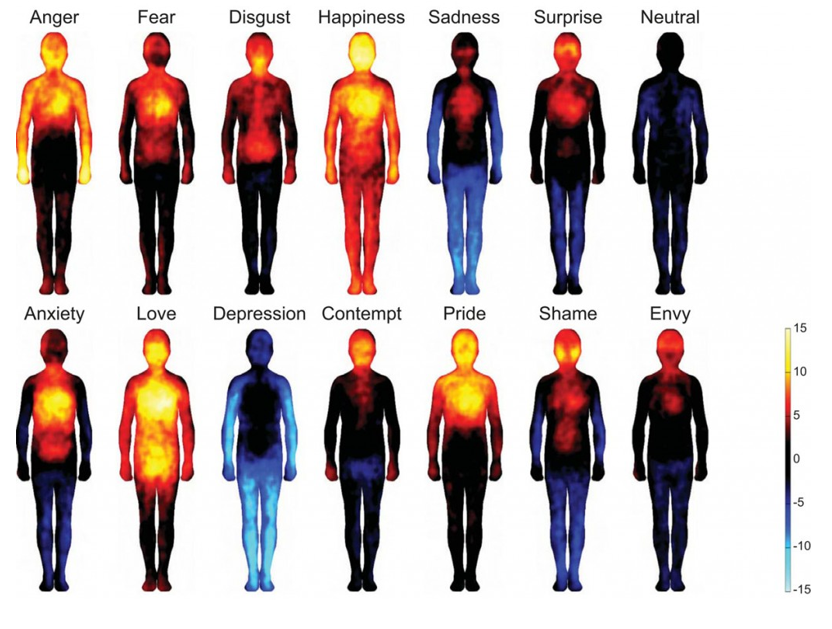
They represented regions of greatest sensation associated with specific emotions with a computer-generated topographical body map.

The team proposed that emotions are represented as “culturally universal categorical somatotopic maps,” and sensing emotion-triggered bodily changes is required to perceive basic and complex emotions.Somatopic Emotion Map

Top row displays “basic” emotions:

  • Anger
  • Fear
  • Disgust
  • Happiness
  • Sadness
  • SurpriseBottom row displays “complex” emotions:
    • Anxiety
    • Love
    • Depression
    • Contempt
    • Pride
    • Shame
    • Envy

Happiness was a “full-body experience,” with increased sensation throughout the body, but some emotions were experienced in specific regions.

Christian Keysers

Christian Keysers

Likewise, most basic emotions, like anger and fear were associated with sensations of elevated activity in the upper chest area, corresponding to changes in breathing and heart rate, reported University of Groningen’s Christian Keysers and Valeria Gazzola with Jon H. Kaas of Vanderbilt.

Valeria Gazzola

Valeria Gazzola

In addition, all evoked emotions increased sensations in the head, reflecting changes in the facial area by muscle activation, skin temperature, tearing, and thoughts of emotional events.

Jon Kaas

Jon Kaas

Approach-oriented emotions,” including anger and happiness, were associated with increased upper limb sensation whereas depression was linked to decreased limb activity and sensation.
Disgust was felt in the digestive system and around the throat.

Positive emotions, including happiness, love, and pride, clustered in one group.
In contrast negative emotions diverged into four separate groups based on linguistic analysis and sensed body location:

  • Anger and fear
  • Anxiety and shame
  • Sadness and depression
  • Disgust, contempt, and envy.

Surprise was seen as neither a negative nor a positive emotion, yet it was distinctly different from neutral emotion.

Emotional metaphors appear connected to actual physiological experience of emotions, even when researchers controlled for familiar linguistic stereotypes and “conventional wisdom.”

-*What discrepancies have you observed between emotion descriptions and physical experience of emotion?

RELATED POSTS:

Twitter  @kathrynwelds
Blog – Kathryn Welds | Curated Research and Commentary  

Google+
LinkedIn Open Group Psychology in Human Resources (Organisational Psychology)
Facebook Notes:

©Kathryn Welds

Emotional Awareness Enables Focus, Risk-taking Even When “Stressed”

Jeremy Yip

Jeremy Yip

Greater emotional understanding enables people to quell the “incidental emotion” of anxiety while they focus on decisions, according to Wharton’s Jeremy Yip and Stéphane Côté of University of Toronto.

Stéphane Côté

Stéphane Côté

Incidental emotions that influence decision-making have been called “the affect heuristic” by University of Oregon’s Paul Slovic, Melissa Finucane of the East-West Center, Ohio State’s Ellen Peters, and Donald MacGregor, then of Decision Research.

Paul Slovic

Paul Slovic

People with greater emotional intelligence can separate unpleasant thoughts and feelings from decision making and are less likely to show the affect heuristic bias in risky decisions.

Sigmund Freud

Sigmund Freud

Sigmund Freud considered this ability to separate unpleasant thoughts and feelings as a defense mechanism deployed unconsciously to reduce anxiety and preserve self-esteem.
He called this experience “isolation,” contrasted with “compartmentalization,” which he defined as separating unpleasant emotions from each other.

Roy Baumeister

Roy Baumeister

Florida State’s Roy F. Baumeister, with Karen Dale then of Case Western, and Baruch College’s Kristin L. Sommer, documented recent studies that demonstrate “isolation” as a defense mechanism or coping strategy to contain negative feelings, “emotional contagion,” and “spillover.”

John Mayer

John Mayer

Yip and Côté demonstrated the relationship among emotional intelligence, evoked anxiety and propensity to make riskier choices in their lab studies of more than 100 volunteers, who completed the Mayer-Salovey-Caruso Emotional Intelligence Test developed by Yale’s Peter Salovey and David R. Caruso with John D. Mayer of University of New Hampshire.

David R Caruso

David R Caruso

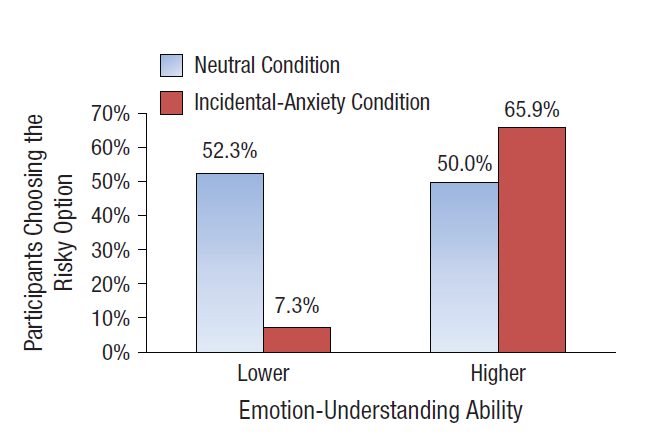
One group received an anxiety-provoking assignment:  One minute to prepare a videotaped speech shown to peers studying “academic and social standing” at the university.
The other group was given a less stressful assignment:  Prepare a grocery list.

Volunteers in both groups could choose their compensation for participating in the study: Receive $1, or take a one in 10 chance to receive $10.

Melissa Finucane

Melissa Finucane

For those given the stressful speech-writing task, people who scored higher on emotional intelligence chose the riskier option to receive $10 three times as often as those who scored lower on emotional intelligence.

In contrast, volunteers who completed the low-stress task made similar choices for compensation no matter the level of emotional intelligence.

Ellen Peters

Ellen Peters

However, people can learn emotional awareness skills to enable mental focus and contain unrelated incidental emotions, according to related studies by Yip and Côté.

They demonstrated this ability to contain anxiety when some volunteers in the speech-writing task were told they “might feel worried” because making a speech is an anxiety-producing task.
Other speech-creators received no further instructions.

Kristin Sommer

Kristin Sommer

Yip and Côté “primed” no emotion among some grocery list-creators by saying that they “may feel no emotion” or no instructions.
Participants were then primed to separate their emotions from their decision-making by being told that their emotions were irrelevant to their decisions.

 Volunteers read information about the benefits of receiving flu injections and consequences of no inoculation during flu season.
Then participants were given the option to register for nearby flu injection clinic.

The reminder that emotions were irrelevant to decisions changed previous results, by increasing the frequency that participants with lower emotional awareness chose the riskier option of not attending the flu injection clinic.

 The findings suggest that adults can reduce emotional bias in decision-making by explicitly identifying emotions and separating them from critical thinking processes

Questions that enable people to separate emotions, thoughts, and decisions include:

  • How do I feel right now?
  • What is causing me to feel that way?
  • And are my feelings relevant to the decision I need to make?

-*How do you avoid the affect heuristic when making decisions?

RELATED POSTS:

©Kathryn Welds

Detecting Trustworthiness, Opening Your Mind?

Yaacov Schul

Yaacov Schul

-*Does mistrust increases willingness to consider new information, or “open-mindedness”?

When people mistrust information, they are more likely to consider alternative information and interpretations,  according to Hebrew University’s Yaacov Schul and Ruth Mayo, with Eugene Burnstein of University of Michigan.

Ruth Mayo

Ruth Mayo

Likewise, Ann-Christin Posten and Thomas Mussweiler of Universität zu Köln noted that “distrust frees your mind” by leading people to use non-routine cognitive strategies.”

Eugene Burnstein

Eugene Burnstein

Posten and Mussweiler reported that when volunteers participated in an “untrustworthy” interaction, they later provided less stereotypic evaluations of others in an unrelated task.

Ann-Christin Posten

Ann-Christin Posten

The research team replicated this effect when they influence volunteers’ expectations of others by “priming” participants with preliminary information that elicited stereotypes.

When people distrust information and interactions, they focus on dissimilarities and discrepancies,  which enables people to more carefully attend to individual differences that disprove stereotypes, according to Posten and Mussweiler.

Thomas Mussweiler

Thomas Mussweiler

Although trust may feel better, distrust can lead to more mindful observation, and reduced stereotyping.

-*How do people determine trustworthiness?

Princeton’s Alexander Todorov and Sean G. Baron with Nikolaas Oosterhof of Dartmouth presented volunteers computer model-generated faces  representing a range of trustworthiness while participants’ brains were scanned with fMRI.

Alexander Todorov

Alexander Todorov

Specific brain areas, the right amygdala and left and right putamen, became more active when participants’ viewed less trustworthy faces.

Sean Baron

Sean Baron

Faces judged most trustworthy and most untrustworthy faces were associated with greater brain activity in the left amygdala.
In contrast, moderately trustworthy faces evoked strongest responses in the medial prefrontal cortex and precuneus areas.

Nikolaas Oosterhof

Nikolaas Oosterhof

These findings pinpoint brain areas that lead to inferences of trust and distrust, and lead to relaxed or vigilant information processing strategies.

-*How do you determine trustworthiness for information and for people?
-*What helps you minimized stereotyped judgments?

 Follow-share-like http://www.kathrynwelds.com and @kathrynwelds

RELATED POSTS:

Twitter  @kathrynwelds
Blog – Kathryn Welds | Curated Research and Commentary  
Google+
LinkedIn Open Group Psychology in Human Resources (Organisational Psychology)
Facebook Notes:

©Kathryn Welds

An End to “Death by PowerPoint”: Neuroimaging Studies Improve Visual Display Design

Stephen Kosslyn

Stephen Kosslyn

Harvard’s Stephen Kosslyn‘s fMRI studies of perceptual processes and mental imagery point to  best practices in improving visual display design, such as PowerPoint presentations, so they can be rapidly comprehended.

Alexandra Russell

Alexandra Russell

His imaging studies determined that the left half of the brain excels at encoding categories and generating mental images based on categories.
In contrast he reported that the right half of the brain skillfully encodes specific examples and generating associated images.

While at Stanford, he identified eight psychological principles often violated in PowerPoint® slideshows, in collaboration with Alexandra G. Russell, Harvard colleague Jennifer M. Shephard and Rogier A. Kievit of University of Amsterdam.

Once the viewer has seen a PowerPoint slide, the information must be converted into a storable and retrievable construct for later use.

Rogier Kievit

Rogier Kievit

They noted that perception and comprehension of visual displays require:

  • Encoding based on Discriminability, Perceptual Organization, Salience
  • Working Memory, influenced by Limited Capacity and Informative Changes
  • Accessing Long-Term Memory, enhanced by Appropriate Knowledge, Compatibility, Relevance

 Encodable content must be distinguishable from the background and context.
This requires a “Just Noticeable Difference” (JND) between size, shape, color and other attributes to enable discrimination.

Russell De Valois

Russell De Valois

PowerPoint elements achieve Discriminability with:

  • Sufficiently large typeface with differentiated text (mix of upper case, lower case, bold, italics)
  • Text and graphic color contrast with background color
  • Spatial frequency channel” ratio variance, such as points that are twice as thick as the lines that connect them
    Karen De Valois

    Karen De Valois

    Texture patterns elements, like stripes, should vary by at ratio of least 2:1 to avoid “visual beats,” according to University of California’s Russell DeValois and Karen De Valois

  • Varied line orientation (by at least 30°), to enable processing by different “orientation channels
  • Text or other fine lines in colors other than deep blues, and boundaries in colors other than red.

After encoding, figure/ground segregation processes perceptually organize adjacent (“Law of Proximity”) and similar (“Law of Similarity”) elements into groups of objects, words, and graphics.
Grouping also can be imposed by lines, such as in complex data tables, and this grouping typically increases readability and comprehension.

Additional practices to enhance visual “consumability” by Perceptual Organization include:

  • Applying labels to refer to the nearest graphic element
  • Using a common color to organize parts of a display into a group, even separated
  • Adopting consistent ordering conventions across different parts of displays, such as bar chart legends and pie chart legends
  • Explicitly grouping separated-but-related elements, such as by using inner grid lines to group the tops of bars in a bar graph with locations along the Y axis at the left of the graph
  • Eliminating inadvertently-formed groupings, such as when a banner at the top of a slide groups with nearby, similar but unrelated objects

 Attention is drawn to large perceptible differences, and these elements are processed in detail.  The brain’s superior colliculus draws visual attention to large differences among stimuli.
Salience can be enhanced with:

  • Animation because movement captures and directs attention
  • Text with a distinct format, such as color, size, or typeface
  • Visual incongruities, such as a wedge “exploding” from a pie chart
  • Summary elements like title, keywords, topic sentence, infographic
  • Warm” colors (with longer wavelengths, such as red) for emphasis or in the foreground in contrast to “cool” colors (with short wavelengths, like blue), which recede.
    Avoid using warmer colors for lines that pass beneath other lines to avoid the illusion of background oscillation

After visual patterns are encoded, they must be integrated in Working Memory for later retrieval and application, and are influenced by Limited Capacity and Informative Changes.
People have limited capacity to process and retain information, and presentations can mitigate these constraints by:

  • Limiting perceptual groups to about four units with up to four sub-units for easier processing and retrieval
  • Labeling items in a display rather than using a key or legend to reduce processing load
  • Allowing the audience time to process and assimilate information during a slide presentation
  • Avoiding slow fade-in or fade-out slides, which may lead to incorrect information processing and losing track of the organizational hierarchy.Audience members expect Informative Changes in words and graphics to convey information.
    Similarly, they also expect that each expect unit of information is associated with a perceptible change.
    Capitalize on these expectations by:
  • Avoiding random or arbitrary changes in appearance, transitions, or terminology
  • Clearly indicating section beginnings and ends to enable audience to track progress through the presentation

Retrieving information from Long-Term Memory enables viewers to compare with previously stored information to determine the new information’s relevance and applicability.

Effective presenters ensure that viewers have a common knowledge base of novel concepts, jargon, conventions, formats, terminology or symbols so they understand the presentation’s context.
Presenters ensure Appropriate Knowledge by including an explicit introduction, and explanation and review of these terms and ideas before building reasoning and conclusions.

Kosslyn-Stroop EffectA message is most intelligible and memorable when its form is Compatible with its meaning.
The Stroop effect demonstrates the difficulty people have in processing information when asked to name the color of the ink used to a color name (“red”) a different color from the ink (blue).

Similarly, people are better able to comprehend when audio and visual contents coordinate with text and the overall message.

  • Indicate quantitative difference by color saturation and intensity (or brightness)
    These “prothetic” variables are arranged quantitatively.
    In contrast, hue is ineffective as a measure of quantitative differences because it is a “metathetic” variable that is arranged qualitatively
  • Ensure that animation movements align with the object’s natural movement patterns, such as an automobile entering from the side of the slide rather than the top
  • Select sounds, typefaces, and backgrounds consistent and compatible with the content. such as sans serif typeface for high tech products
  • Use icons that depict the typical examples of represented items, such as a duck to represent “fowl” or “wild bird” but not “pet bird”
  • Include line graphs (rather than bar or mixed graphs) to illustrate trends and interactions:  The continuous variation in the height of a line in a graph directly indicates the continuous variations of a measurement
  • Apply bar graphs to illustrate specific values instead of trends because the discrete heights of the bars directly indicate specific measurements
  • Add maps to illustrate complex information about geographic territories or show alternate routes to a destination
  • Consider charts to portray organizational structure, sequential steps, or processes as in “flow charts.”

Presentations must offer most applicable, meaningful content for the topic in sufficient but not excessive detail.
Enhance Relevance by:

  • Curating content
  • Enabling viewers to organize the information into a narrative by presenting a roadmap of the topic in an outline or overview
  • Providing graphic elements including photos, drawings, graphs, diagrams, and video as well as audio to illustrate concepts clearly and label ambiguous imagery.
Don McMillan

Don McMillan

If presenters adopt Kosslyn’s recommendations, to enhance Discriminability, Perceptual Organization, Salience, Limited Capacity, Informative Changes, Appropriate Knowledge, Compatibility, and Relevance, PowerPoint comedians Don MacMillan and biologist Tim Lee may need to revert to their previous occupations. 

Tim Lee

Tim Lee

-*How do you ensure that your Business Storytelling with PowerPoint keeps your audience engaged?

Follow-share-like http://www.kathrynwelds.com and @kathrynwelds

RELATED POSTS:

Twitter  @kathrynwelds
Blog – Kathryn Welds | Curated Research and Commentary  
Google+
LinkedIn Open Group Psychology in Human Resources (Organisational Psychology)
Facebook Notes:

©Kathryn Welds

Introversion and Extraversion Starts with Your Genes and Shows in Your Brain

Susan Cain

Susan Cain

Introverts seem to be experiencing an increasingly “level playing field” in work and social environments after Susan Cain’s best-selling book celebrating “the power of introverts in a world that can’t stop talking.”

Hans Eysenck

Hans Eysenck

University of London’s Hans Eysenck provided one of the first physiological explanations of this duality after Carl Jung’s introduction to “psychological types.”

The subjective experience of introversion and extraversion is measured by the Big Five personality dimensions, developed by Robert McRae and Paul Costa, then of the National Institutes of Health, in addition to the widely-used yet psychometrically-criticized Myers-Briggs Type Indicator. 

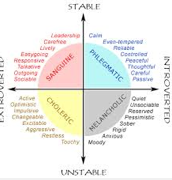
Eysenck's Three-Factor Theory of Personality

Eysenck’s Three-Factor Theory of Personality

Observable behaviors associated with extraversion include positive emotions, assertiveness, sociability and talkativeness with energetic engagement in work and social contexts.

In contrast, external manifestations of introversion are lower social engagement and energy, and less need for external social stimulation than extraverts, with a quieter, more deliberate style.

Robert McCrae

Robert McCrae

These behaviors are at least partially based on individuals’ genetic profiles, leading to differing brain activity associated with introverted and extraverted thinking and behavior.

Paul Costa

Paul Costa

Eysenck posited that extraverts and introverts differ in their levels of cortical arousal:  Introverts, he suggested, have a higher baseline level of arousal than extraverts, so need less external stimulation.

In contrast, he hypothesized that extraverts seek external stimulation because they have a lower baseline level of cortical arousal.

Yasuyuki Taki

Yasuyuki Taki

Differences in brain structure and function among introverts and extraverts was analyzed by Yasuyuki Taki’s team at Tohoku University, including collaborators  Benjamin Thyreau, Shigeo Kinomura, Kazunori Sato, Ryoi Goto, Kai Wu, Ryuta Kawashima, and Hiroshi Fukuda. 

The evaluated whether personality traits measured on a revised Big Five inventory (Revised NEO Personality Inventory – NEO-PI-R) were related cortical gray matter volume, measured by brain magnetic resonance images (MRI) for more than 270 healthy volunteers over 6 years.

Colin DeYoung

Colin DeYoung

Likewise, University of Minnesota’s Colin DeYoung, Jacob Hirsh of University of Toronto, The Mind Research Institute’s Matthew Shane, and Yale’s Xenophon Papademetris, Nallakkandi  Rajeevan, and Jeremy Gray used a similar method to conclude that behavioral and subjective extraversion was positively correlated with orbitofrontal cortex metabolism and increased cerebral volume of the medial orbitofrontal cortex in 116 adults. 

Michael X. Cohen

Michael X. Cohen

Extraversion has been correlated with sensitivity to rewards and to the brain’s dopamine system, so University of Amsterdam’s Michael X. Cohen and team investigated the brain’s dopamine-based reward system.

He collaborated with Jennifer Young, Jong-Min Baek, Christopher Kessler, and Charan Ranganath of University of California, Davis to demonstrate the connection among trait extraversion, the A1 allele on the dopamine D2 receptor gene, and “extraverted” activity in the brain’s reward system during a gambling task.

Charan Ranganath

Charan Ranganath

Participants received rewards either immediately following a behavioral response or after a 7.5 second “anticipation” interval.
The research team monitored differing fMRI brain activity in the amygdala, which processes emotional stimuli and triggers excitement, and in the nucleus accumbens, which pushes people to seek rewards, novelty and risks.

Brain activation patterns were related to individual differences in extraversion and presence of the A1 allele on the dopamine D2 receptor gene.
Neural pathways differed for extraverts and introverts, validating anecdotal observations that these personality styles are distinctly different, even deep inside the brain and genes.

Many introverts adopt extraverted behaviors in work and social situations, and a remaining question is how fMRI patterns differ for introverts displaying uncharacteristic extraverted behaviors in contrast to people with trait extraversion.

-*How easily can you adopt your non-dominant personality style when you need to display introversion or extraversion behaviors?

-*What tactics enable you to adopt your less-preferred personality style?

Please follow-share-like www.kathrynwelds.com and @kathrynwelds

RELATED POSTS:

Twitter:  @kathrynwelds
Blog: – Kathryn Welds | Curated Research and Commentary
Google+ google.com/+KathrynWelds
LinkedIn Open Group Psychology in Human Resources (Organisational Psychology)
Facebook Notes:

©Kathryn Welds