Author Archives: kathrynwelds

Unknown's avatar

About kathrynwelds

Organisational Psychologist | Leadership and Career Coach | Connecting people, information, and ideas to accomplish strategic results Professional experience spans roles as an organisational psychologist, coach, consultant, leader in technology, healthcare, professional services, public sector.

Confident Cluelessness = The Dunning-Kruger Effect

Stav Atir

Stav Atir

The Dunning-Kruger effect describes people’s overestimate of their own expertise and their unawareness of their incompetence in grammar, emotional intelligence, logical reasoning, firearm safety, debating, and financial acumen.

Emily Rosenzweig

Emily Rosenzweig

Cornell’s Stav Atir and Emily Rosenzweig of Tulane asked volunteers if they were familiar with concepts like centripetal force and photon as well as fictitious terms including plates of parallax, ultra-lipid, and cholarine.

About 90% of participants claimed some knowledge of at least one of the nine fake concepts.
People who thought they were most knowledgeable also said they recognized more of the meaningless terms.

David Dunning

David Dunning

Atir and Rosenzweig concluded that low performers lack insight about their skill deficits because they ”don’t know what they don’t know.”

Another study, by University of California San Diego’s Elanor Williams, Justin Kruger of NYU, and Cornell’s David Dunning asked volunteers to complete a logical reasoning task, an intuitive physics problem, and a financial challenge.

Elanor Williams

Elanor Williams

Participants who achieved no correct answers expressed the same degree of confidence as the most able performers.

Deborah Keleman

Deborah Keleman

Even 80 professionally-credentialed physical scientists at top universities provided a number of inaccurate purpose-based (“teleological”) explanations about “why things happen” in the natural world. 
These results are noteworthy because most physical scientists’ reject the validity of purpose-based explanations for natural phenomena.

Joshua Rottman

Joshua Rottman

When these professional scientists provided explanations under time constraints, they were twice as likely to endorse inaccurate rationales, reported Boston University’s Deborah Kelemen, Joshua Rottman, and Rebecca Seston.

Rebecca Seston

Rebecca Seston

Scientists were equally likely as humanities scholars to endorse inaccurate arguments. 

Both high and low achievers made judgments said they felt confident because they had a clear rationale for decisions, even though these were “intuitive rules” rather than empirically-based.
Williams’ team concluded, Rule-based confidence is no guarantee of self-insight into performance.”

Most people seem to hold pseudo-scientific explanations as “a default explanatory preference,” a mindset that could explain the appeal of myth and religion across cultures.

Justin Kruger

Justin Kruger

Similarly, people who filed for bankruptcy said they had high confidence in their financial acumen, although their real-life financial management skills didn’t keep them solvent.

More than 25,000 people rated their financial knowledge and completed the 2012 National Financial Capability Study, conducted by the Financial Industry Regulatory Authority with the U.S. Treasury.
Of these, 800 respondents said they filed bankruptcy within the previous two years.

Bankruptcy filers achieved financial knowledge scores in the lowest third of respondents, but they rated their knowledge more positively than financially-solvent respondents.
Nearly a quarter of the recently bankrupted respondents gave themselves the highest possible rating, whereas only 13 percent of financially-solvent respondents were equally confident.

Most people hold a positive view of their capabilities even when faced with contrary evidence.
However, women may hold an unrealistically modest view of their capabilities despite affirming feedback.
These biases in self assessment suggest the importance of realistic recalibration of confidence, aligned with consensual feedback.

-*How do you minimize the risks of “Clueless Confidence”?

-*How can systematic underestimates of competence be reduced to increase “Realistic Confidence”?

Related Posts:

Useful Fiction: Optimism Bias of Positive Illusions

Least Skillful Performers May Have Greatest Illusions of Competence

©Kathryn Welds

Defining “Executive Presence”

Sylvia Ann Hewlett

Sylvia Ann Hewlett

Communication, “Gravitas”, and Appearance were frequently-cited attributes of Executive Presence in a study by Sylvia Ann Hewlett of the Center for Talent Innovation.

Gavin Dagley

More characteristics of executive presence were identified in interviews with 34 professionals, conducted by Perspex Consulting’s Gavin Dagley and Cadeyrn J. Gaskin, formerly of Deakin University.

Caderyn Gaskin

Five “executive presence” qualities were observable during initial contact:

  • Status and reputation, similar to “gravitas” discussed by Hewitt,
  • Physical appearance, mentioned by Hewitt,
  • Confidence,
  • Communication ability, included in Hewitt’s “executive presence” triad,
  • Interpersonal engagement skills.

Five additional presence features emerged during repeated contacts:

  • Interpersonal integrity,
  • Values-in-action,
  • Intellect and expertise,
  • Outcome delivery,
  • Use of coercive power.

These qualities combine in different ways to form four presence “archetypes”:

  • Positive presence, based on favorable impressions of confidence, communication, appearance, and engagement skills plus favorable evaluations of values, intellect, and expertise,
  • Unexpected presence, linked to unfavorable impressions of confidence plus favorable evaluations of intellect, expertise, and values,
  • Unsustainable presence combines favorable impressions of confidence, status, reputation, communication, and engagement skills plus unfavorable evaluations of values and integrity,
  • “Dark presence” is associated with unfavorable perceptions of engagement skills plus unfavorable evaluations of values, integrity, and coercive use of power.

Philippe De Backer

Philippe De Backer

Another typology of executive presence characteristics was identified by Sharon V. Voros and Bain’s Philippe de Backer.
They prioritized elements in order of importance for life outcomes:

  • Focus on long term strategic drivers,
  • Intellect,
  • Charisma, comprised of confidence, intensity, commitment, care, concern and interest in others,
  • Communication skills,
  • Enthusiasm for work,
  • Cultural fit with organisation and team,
  • Poise,
  • Appearance.

Fred Luthans

Fred Luthans

University of Nebraska’s Fred Luthans and Stuart Rosenkrantz with Richard M. Hodgetts of Florida International University investigated the relationship between “executive presence” and career “success.”
These researchers observed nearly 300 managers across levels at large and small mainstream organizations when leaders:

  • Communicated,
  • Engaged in “traditional management” activities, including planning, decision making, controlling,
  • Managed human resource issues.

Richard Hodgetts

Richard Hodgetts

Communication and interpersonal skills, coupled with intentional networking and political acumen enabled some managers to rapidly advance in their organizations.

These rapidly-advancing managers were identified as “successful” leaders because they achieved a higher organizational level compared with their organizational tenure.
In contrast, “effective” managers demonstrated greater managerial skill than “successful” managers, but were not promoted as quickly.

Effective” managers spent most time managing employees’ activities including:

  • Motivating and reinforcing desired behaviours,
  • Managing conflict,
  • Hiring,
  • Training and developing team members,
  • Communicating by exchanging information,
  • Processing paperwork.

Stuart Rosenkrantz

Stuart Rosenkrantz

Subordinates of “effective” managers reported more:

  • Job satisfaction,
  • Organizational commitment,
  • Performance quality,
  • Performance quantity.

Differences in advancement and subordinate reactions to “successful” and “effective” managers were related to differing managerial behaviors.

Fred Luthans-Effective ManagersSuccessful” managers spent little time in managerial activities, but invested more effort in networking, socializing, politicking, and interacting with outsiders.
Their networking activities were most strongly related to career advancement but weakly associated with “effectiveness.”

Few managers were both “successful” and “effective”:
Only about 10% leaders were among the top third of successful managers and effective managers.
This suggests that effective managers who support employee performance may not be advance as rapidly as managers who prioritize their own career over their employees’ careers.

Gender differences in gravitas, communication, and political acumen may explain why men more often are seen as possessing “executive presence.”

Women who aspire to organizational advancement benefit from cultivating both gravitas and proactive networking to complement communication and interpersonal skills.

-*Which behaviors and characteristics are essential to “Executive Presence?”

Related Posts

©Kathryn Welds
Acknowledge Employer Appearance “Concerns” to Get Job Offer

Usually physically attractive people are positively evaluated by others. 
However, women applying for traditionally male jobs were less positively evaluated in search studies, and conclusions suggest that female gender coupled with attractive appearance seems to account for this disadvantage,

Madeline Heilman

Madeline Heilman

The “beauty is beastly effect” is a hiring bias favoring men or less attractive women for “masculine” jobs, described by Yale University’s Madeline E. Heilman and Lois R. Saruwatari.

Lois Suruwatari

Lois Suruwatari

They found that attractiveness was an advantage for men seeking managerial and non-managerial roles, but attractive women had an advantage only when seeking non-managerial roles.

Michelle Hebl

Michelle Hebl

Attractiveness can be considered a “stigma,” just as disability, gender, pregnancy, obesity, and race, suggested Rice University’s Michelle R. Hebl and Robert E. Kleck of Dartmouth College.
They reported that job seeks in these categories can reduce hiring biases by acknowledging the “stigmatising” characteristic during interviews.

Robert Kleck

Robert Kleck

Women who proactively addressed the employers conscious or unconscious concern about gender or appearance in a traditionally male role were rated higher in employment suitability in a study by University or Colorado’s Stefanie K. Johnson and Traci Sitzmann, with Anh Thuy Nguyen of Illinois Institute of Technology.

This proactive approach buffered the impact “hostile sexism” while increasing “benevolent sexism’s” link to employment suitability ratings.

Stefanie Johnson

Stefanie Johnson

Evaluators said they assumed that these candidates possessed more “masculine” traits than other female candidates, which they viewed as an advantage over possessing “feminine” traits at work.

These assessors were less likely to negatively evaluate women behaving in contrast to traditional gender role norms when these women address their appearance, avoiding frequently-observed gender norm “backlash.” 

Traci Sitzmann

Traci Sitzmann

-*How effective you found “pre-emptive objection-handling” in workplace negotiations?

RELATED POSTS:

©Kathryn Welds

Creating Productive Thought Patterns

Albert Ellis

Albert Ellis

Leaders’ actions actions are influenced by unspoken self-talk.
Sometimes, these thoughts are self-critical and provoke anxiety.

Aaron Beck

Aaron Beck

Cognitive Behavior Therapy (CBT), developed by University of Pennsylvania’s Aaron Beck, provides a systematic way to notice and restructure “irrational self-talk.
Similar approaches were developed by Albert Ellis in Rational-Emotive Therapy (RET), and David Burns in his synthesis of CBT and RET.

David Burns

David Burns

Arizona State University’s Charles Manz and Chris Neck  translated these self-management processes to managerial development.
They outlined a Thought Self-Leadership Procedure as a five-step circular process:

Charles Manz

Charles Manz

1. Observe and record thoughts,

2. Analyze thoughts for potential errors in reasoning (jumping to conclusions, exaggeration),

3. Substitute alternate positive, realistic, plausible, acceptable thoughts,

4. Monitor personal reactions to these thoughts,

5. If more negative thoughts appear, continue to substitute the more productive thoughts.

Screenshot 2023-03-04 at 10.06.57

John Crimmins

John Crimmins

Other recommendations to manage thoughts about stressful situations were distilled by John Crimmins of Behaviour Institute in coaching people at work.

He suggested asking the following questions:

  • How do I know if this thought is true?
  • What evidence do I have to support this thought or belief?
  • How can I test my assumptions/beliefs to find out if they’re accurate?
  • What would a trusted friend say about these thoughts?
  • How is this thought helpful now?
  • What other ways that I can think about this situation?
  • What would a friend say when I blame myself in this situation?
  • What would I say to a friend who was in this situation?
  • What would a friend say to me when I take this situation personally?
  • How can I consider this situation on a continuum rather than in either-or terms?

-*What practices do you use to develop and apply productive thought patterns?

©Kathryn Welds
Followers’ Role in Enabling Bad Leaders

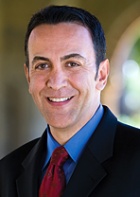
Barbara Kellerman

Barbara Kellerman

Seven types of ineffective and unethical leaders are enabled by their followers, according to Harvard’s Barbara Kellerman.

She categorized bad leaders as:

Incompetent – Failing to create positive change,

Rigid – Not adapting to new ideas, conditions,

Intemperate – Lacking self-control,

Callous – Uncaring and unkind, discounting needs and wishes of group members, especially subordinates,

Corrupt – Advancing self-interest ahead of public interest, through “lying, cheating, and stealing”,

Insular – Disregarding health and welfare of outsiders,

Evil – Committing atrocities, using pain as an instrument of power, exerting physical, psychological harm.

Kellerman’s earlier work focused on Hitler’s leadership, and asserted that his power wouldn’t have existed without complaint followership.

John Darley

John Darley

She noted that bystanders who do not speak up enable bad leaders to continue their practices.

“Bystander Apathy”  was documented more than forty years ago by NYU’s John Darley and Bibb Latané of Columbia.

Bibb Latane

Bibb Latane

Given status differentials between leaders and subordinates, followers can break out of complacent observership only if organizational structures enable them to call attention to unethical leadership practices.

Kellerman suggested mitigation practices for various organizational structures in a videotaped lecture, including developing support coalitions and considering external opportunities for employment outside the organisation.

-*What “bad leader” roles have you observed in your organization?

-*What seem to be effective ways to interact with a “bad” organizational leader?

©Kathryn Welds

Career “Planning” = Career Improvisation

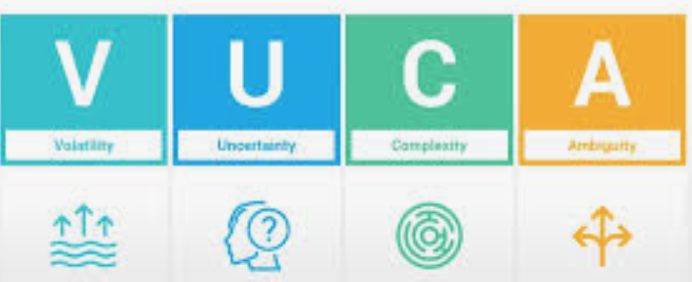
In “VUCA world,” described by the U.S. Army War College as volatile, uncertain, complex, ambiguous environments, career “planning” occurs under rapidly-shifting conditions.

As a result, it is difficult to  meaningfully respond to the interview question: “What are your career plans for the next five years?

Kathleen Eisenhardt

Planning is most suited to relatively certain circumstances when processes and decisions are linear, argued Stanford’s Kathleen Eisenhardt and Behnam Tabrizi.

In contrast, frequently-changing or uncertain conditions require improvisation, frequent testing, and revision.

Behnam Tabrizi

Iterative exploration, rapid prototyping/experimentation, and testing are used in agile software development and are applicable to rapid changes in economic, political, and technology changes that affect career paths.

Alison Maitland

University of London’s Alison Maitland and Peter Thomson offered this perspective in Future Work: How Businesses Can Adapt and Thrive In the New World of Work,

Related views on using flexible “planning” in career development come from Deloitte’s Cathy BenkoMolly Anderson, with Anne Weisberg of Paul, Weiss, Rifkind, Wharton & Garrison LLP in their model of The Corporate Lattice: Achieving High Performance in the Changing World of Work and Mass Career Customization: Aligning the Workplace with Today’s Nontraditional Workforce.

-*When have you found it more useful to “improvise” instead of “plan” your career?
-*What are the benefits of career “improvisation”?

Related Posts:

©Kathryn Welds

Performance Excellence linked to Preventing Failures, Corrective Coaching

Atul Gawande

Simple behavior changes, such as following a structured checklist, can prevent crucial workplace errors and increase quality in medical settings, found Harvard’s Atul Gawande.

He found that people effectively improved their performance when they recognized weaknesses in organizational processes, and took proactive steps to remedy these shortcomings.

Three elements of better performance can be applied across industries:

  • Diligence – Attending to details can prevent errors and overcome obstacles.
    Gawande’s The Checklist Manifesto: How to Get Things Right suggests best ways to structure these memory aids,
  • Doing Right –Ensuring that skill, will, and incentives are aligned to drive excellent performance,
  • IngenuityDeliberately monitoring potential failures, continuously seeking innovative ways to improve performance and solutions.

These elements can be improved with attentive observation and feedback to prevent errors of omission when people don’t:

  • Know enough (ignorance),
  • Make proper use of what they know (ineptitude).

Ignorance occurs less frequently than ineptitude because relevant information is widely available, Gawande noted.
He suggested that both errors can be improved by systematic analysis and consistent use of tools like checklists.

Geoffrey Smart

Checklist-based analysis was also linked to Internal Rate of Return (IRR) in Geoffrey Smart’s study of investments by Venture Capital (VC) firms,

He found a correlation between IRR and leadership effectiveness in new investment ventures.
Selecting capable leaders is critical to business outcomes, so Smart also evaluated VC firms’ typical approach to assessing potential leaders:

  • The Art Critic is the most frequent approach in which the VC assesses leadership talent at a glance, intuitively, based on extensive experience,
  • The Sponge conducts extensive due diligence, then decides based on intuition,
  • The Prosecutor interrogates the candidate, tests with challenging questions and hypothetical situations,
  • The Suitor woos the candidate instead of analyzing capabilities and fit,
  • The Terminator eliminates the evaluation because the venture firm replaces the company’s originators,
  • The Infiltrator becomes a “participant-observer” in an immersive, time-consuming experientially-based assessment,
  • The Airline Captain uses a formal checklist to prevent past mistakes.
    This last approach was linked to the highest average Internal Rate of Return (IRR) for the new ventures.
    In addition, this strategy was significantly less likely to result in later terminating senior managers.

Venture Capitalists in these studies reported that two of their most significant mistakes were:

  • Investing insufficient time in talent analysis,
  • Being influenced by “halo effect” in evaluating candidates.

Systematic reminders to execute all elements required for expert performance can prevent failure and signal potential failure points.

-*How do you improve performance?
-*What value do you find in expert coaching?

Related Post:
Developing a SMARTER Mindset for Resilience, Emotional Intelligence – Part 2

©Kathryn Welds

Four Career Trajectories: Linear, Expert, Spiral, Transitory

Kenneth Brousseau

Kenneth Brousseau

Successful careers can follow forms other than “up or out,” according to Decision Dynamics’ Kenneth Brousseau, Michael Driver of USC, with Lund University’s Kristina Eneroth, and Rikard Larsson.

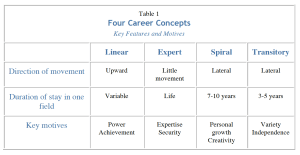
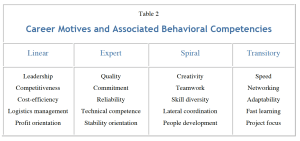
Their “pluralistic career concept framework” classified careers as:

Four Career Concepts

Four Career Concepts

LinearTraditional upward movement, with variable job role tenure, and motivated by power and achievement.

Behavioral competencies include leadership, competitiveness, cost-efficiency, logistics management, profit orientation.

This career concept is most seen in tall hierarchies with a narrow span of control.

Michael Driver

Michael Driver

Expert – Little movement and long role tenure due to deepening expertise in a narrow discipline.

Motives include mastery, expertise, and security.
Meaningful rewards are continued training, benefits, recognition.

Competencies are quality, commitment, reliability, technical competence, stability orientation.
This career concept is well-matched to flat functional organizations.

Career Motives, Competencies

Career Motives, Competencies

SpiralLateral movement to broaden functional exposure, with seven to ten year tenure in roles.

Motivated by personal growth, creativity, and suited to matrix organizations with cross-functional teams, this pattern is seen in loose, temporary team structures.

Rewards include cross-functional lateral assignments and training.
Key competencies include creativity, teamwork, skill diversity, lateral coordination, people development.

Transitory – Lateral moves with three to five year tenures are motivated by desire for variety, independence.
Most often found in temporary team structures, behavioral skills include speed, networking, adaptability, fast learning, project focus.
Meaningful rewards are job rotation, temporary assignments, immediate cash bonuses.

This team’s research was distilled into assessment tools focused on career “fit” with an organization’s structure and objectives.

Timothy Butler

Timothy Butler

A similar emphasis on cultural fit is found in CareerLeader Inventory, based on Timothy Butler and James Waldroop’s research at Harvard Business School.

James Waldroop

James Waldroop

-*Which of the four career trajectories seems most like yours?

-*Which career assessment tools have you found most useful to determine your skills, interests, and best-fit organizational context?

RELATED POSTS:

©Kathryn Welds

Ask a Narcissist

Confidence is correlated with career effectiveness and advancement.
However, people who exhibit too much of a good thing may be seen as “narcissistic.”

Jean Twenge

Jean Twenge

Narcissistic personality is characterized by:

-Inflated views of the self,
-Grandiosity,
-Self-focus,
-Vanity,
-Self-importance,

according to San Diego State University’s Jean M. Twenge, with Sara Konrath and Brad J. Bushman of University of Michigan, collaborating with University of South Alabama’s Joshua D. Foster, and Keith Campbell of University of Georgia,

Calvin S Hall

Calvin S Hall

One well-validated assessment instrument to identify narcissism is the Narcissistic Personality Inventory, developed by University of California Berkeley’s Robert Raskin and Calvin S. Hall.

Sara Konrath

Sara Konrath

Raskin and UC Berkeley colleague, Howard Terry examined responses from more than 1000 volunteers and found seven constructs related to narcissism:

  • Authority,
  • Exhibitionism,
  • Superiority,
  • Vanity,
  • Exploitativeness,
  • Entitlement,
  • Self-Sufficiency.
Timothy Leary

Timothy Leary

They related ratings of “self” and “ideal self” to participants’ responses on the Leary Interpersonal Check List, developed by Harvard’s Timothy Leary before he investigated psychedelic drugs.

Brian P Meier

Brian P Meier

An alternative to Leary’s lengthy NPI was developed by University of Michigan’s Sara Konrath, Brian P. Meier of Gettysburg College, and Ohio State’s Brad J. Bushman of Indiana University.
The Single Item Narcissism Scale (SINS) measures grandiosity, entitlement, and low empathy characteristic of “narcissistic” behavior.

The team asked more than 2,200 participants to rate their answer to a single question on a scale of one to seven: To what extent do you agree with this statement? “I am a narcissist.”

Brad J Bushman

Brad J Bushman

Konrath’s team demonstrated that the Single Item Narcissism Scale is a valid, reliable alternative to longer narcissism scales because it is significantly correlated with scores on the NPI and is uncorrelated with social desirability.

Erika Carlson

Erika Carlson

People who score high on the NPI and SINS say that they are more arrogant, condescending, argumentative, critical, and prone to brag than people who score low on the NPI, according to University of Toronto’s Erika Carlson.

Narcissism was also related in Konrath’s validation studies to:

People who scored high for narcissism also showed behaviors that can be problematic at work:

However, people who scored high for narcissism displayed positive attributes including:

Interacting with a narcissist in the workplace can be challenging, and a previous blog post identifies recommended strategies.

-*How do you identify narcissists in the workplace and in personal life?
-*What are more effective ways to work with them?

RELATED POSTS:

©Kathryn Welds
Employee Workplace Friendships: Global Comparisons

Workplace friendships positively affect task performance, and Americans report fewer friendships at work than employees in other countries.
The result could be reduced productivity and competitive disadvantage for U.S. companies in world markets.

Karen Jehn

Karen Jehn

Teams composed of friends outperformed acquaintance groups in decision making and effort tasks, reported University of Melbourne’s Karen A. Jehn and Priti Pradhan Shah of University of Minnesota.

Likewise, workplace friendships were associated with more effective performance in a meta-analytic study of more than 160 groups with nearly 78,000 employees by David A. Harrison of University of Texas and colleagues.

Even employees’ perceptions of workplace friendship opportunities affected job involvement and job satisfaction.

Christine M. Riordan

Christine M. Riordan

These perceptions indirectly affected organizational commitment and turnover intent among more than 170 employees in a small electric utility, found Adelphi University’s Christine M. Riordan and Rodger W. Griffith of Ohio University.

Olenka Kacperczyk

Olenka Kacperczyk

Fewer than one-third of Americans reported having a close friend at work, one indicator of employee engagement according to The Gallup Organization.
Workplace friendships in the U.S. have significantly declined over the past three (3) decades, but continue to be strong social connections in Polish and Indian organizations, noted MIT’s Olenka Kacperczyk with Jeffrey Sanchez-Burks, and Wayne E. Baker of University of Michigan in an unpublished working paper.

Jeffrey Sanchez-Burkes

Jeffrey Sanchez-Burkes

They conducted surveys across the U.S., Poland, and India and determined that fewer than one-third of Americans reported inviting their closest colleagues to their homes, compared with two-thirds of Polish participants and nearly three-quarters Indian employees.

The discrepancy in amount of off-work time spent with workplace friends in different national groups is significant:  Just under half of Indian survey volunteers reported going on holiday with closest co-workers, whereas one-quarter of Polish workers and only 6% of Americans said they shared a holiday with colleagues.

Richard Nisbett

Richard Nisbett

Americans were also significantly less concerned with social interactions during work tasks, compared with Mexican and Mexican-American participants, found University of Southern California’s Jeffrey Sanchez-Burks with Richard E. Nisbett and Oscar Ybarra of University of Michigan.

Oscar Ybarra

Oscar Ybarra

After volunteers from each cultural background watched a four-minute video of two people working together, Mexicans and Mexican Americans more accurately recalled social and emotional group content.

Mexicans and Mexican Americans also preferred workgroups with a strong interpersonal orientation, and said that group work performance could be improved by focusing on socio-emotional elements.

Robert D. Putnam

This focus on socio-emotional performance more greatly influenced group task success than the group’s ethnic composition.
This suggests that Americans’ trend toward social disengagement, described asbowling alone’ by Harvard’s Robert D. Putnam, could undermine their productivity.

Adam Grant

Adam Grant

One explanation for national differences is that in the U.S., long-term employment is less secure than in countries with labor protection statues.
As a result, people often don’t expect to stay in one role, so they remain detached from colleagues to prepare for voluntary or involuntary job changes.
Wharton’s Adam Grant suggested that “We view co-workers as transitory ties, greeting them with arms-length civility while reserving real camaraderie for outside work.”

Some observers attribute interpersonal disengagement to newer models of working, such as telecommuting and working remotely.

Ravi S. Gajendran

Ravi S. Gajendran

However, evidence from more than 45 studies including about 12,000 employees showed that “telecommuting had no generally detrimental effects on the quality of workplace relationships,” particularly when people came to an office at least half the time, according to University of Illinois’s Ravi S. Gajendran and David A. Harrison of University of Texas.

Even if workplace relationships don’t become friendships, brief encounters can be high-quality connections characterized by respect, trust, and mutual engagement.

Jane Dutton

Jane Dutton

These interactions energize participants, suggested University of Michigan’s Jane E. Dutton, and may mitigate potential decreases in employee engagement and collaborative productivity.

-*To what extent do you have strong workplace friendships?

-*How have you seen workplace friendships affect work quality and productivity?

Related Posts:

©Kathryn Welds