Tag Archives: negotiation

Ask for What You Want: You Have More Influence Than You Think

Most people underestimate the likelihood that requests for help will be granted, particularly after previous refusals, according to Stanford’s Daniel Newark and Francis Flynn with Vanessa Lake Bohns, then of University of Waterloo.

Francis Flynn

In fact, most people agree with a subsequent request, possibly to reduce discomfort of rejecting others’ overtures for help.

Vanessa Bohns

Vanessa Bohns

Participants estimated they would need to ask 10 people to get three people to lend their mobile phones for brief calls.
Results showed that volunteers had to ask just six people for help before they received assistance.
The team concluded that most people have a pessimistic bias about the likelihood that others will provide assistance.

In another study, volunteers requested two favours from people they did not know: 

1. Complete a brief survey
2. Take a letter to a nearby post office.

Help seekers predicted that people who refused the first request to complete the survey would be less likely to take the letter to the post office.

More people agreed to the second request than to the first request.
Requesters tended to “anchor” on the first refusal, and hesitated to make a second request.
This finding suggests that requesters have a greater chance of agreement after initial refusal, so it’s advisable to persist.

The researchers concluded that help-seekers and potential helpers analyzed requests according to different criteria. Help-seekers typically considered the magnitude of the “ask,” whereas potential helpers considered the inconvenience costs of saying “yes” compared with the interpersonal and self-image costs of saying “no.”

Requesters benefit from expanding the pool of those they ask, not just those who consistently agree.
Potential helpers to can assist by reducing help-seekers’ subjective discomfort even if they decline the request.

Mahdi Roghanizad

Mahdi Roghanizad

Bohns analysed interpersonal discomfort when people decide whether to commit an unethical act in research with University of Waterloo colleagues Mahdi Roghanizad and Amy Xu.

People who observed the unethical act but didn’t participate in it underestimated their influence over those who committed the actions.
Interpersonal discomfort caused participants to commit the asocial act to avoid conflict, they concluded.

Volunteers asked people they didn’t know to tell a small untruth or to commit a small act of vandalism after predicting the ease of enlisting others in these acts.
In related investigations, online participants responded to hypothetical vignettes about buying alcohol for children, and taking office supplies home for personal use.

These results suggest that most people underestimate their influence, particularly in situations that can evoke interpersonal discomfort, including in the workplace.

This pessimistic bias can limit employees’ willingness to:

  • Lead business transformation initiatives,
  • Recognize one’s own contributions to others’ performance issues,
  • Voice concerns about unethical workplace practices.

This underestimation bias may be reduced by:

  • Eliciting comparative judgments,
  • Objectifying an influence target,
  • Comparing actual degree of personal influence compared to perceived influence,
  • Considering the means of influence, including incentives, suggestions, reinforcements, punishments,
  • Invoking organizational culture. 

These findings suggest the benefit of asking for what you want, even after rejection and that you have more influence over others than you expect.

-*How do you assess your likelihood of getting what you want when you ask?

-*How likely are others to influence you by evoking social discomfort to increase your compliance?

RELATED POSTS:

©Kathryn Welds

Women Undermine Salary Negotiations with Excessive Gratitude

Andreas Leibbrandt

Candid self-disclosure hurt women’s salary negotiation outcomes when they revealed that a salary exceeded their expectations, in a study by Monash University’s Andreas Leibbrandt and John A. List of the University of Chicago.

John List

John List

Some women applying for administrative assistant jobs were told that the wages were “negotiable,” and these women achieved higher pay offers than women who received no information. Volunteers in the no-information group frequently revealed that they were willing to work for a lower hourly rate, and they received lower average salary offers.

Edward E. Jones

Edward E. Jones

Though this approach likely leads to lower salary, it could be considered strategic ingratiation to enhance the future working relationship>
However, this approach could lead the negotiation partner to question the applicant’s judgment and confidence.
In addition, this maneuver may delay salary increases because the candidate expresses satisfaction with the original offer.

Strategic ingratiation
is observed in several behaviours, according to Duke University’s Edward E. Jones:

-Self-presentation: Self-enhancement or “one-down” humility, providing favors or gifts,

-Flattery: “Other-enhancement” by sharing credible positive comments,

-Agreement: Opinion-conformity and matching non-verbal behaviour.

Steven H. Appelbaum

Steven H. Appelbaum

Positive outcomes from “strategic ingratiation” included promotion or pay increase, observed in a study by Concordia University’s Steven H. Appelbaum and Brent Hughes.

This contradictory finding  was explained by situational and individual factors including:

  • Machiavellianism,
  • Locus of control,
  • Work task uniqueness.
Jeffrey Flory

Jeffrey Flory

In another of Leibbrandt and List’s randomized field studies, collaborating with Concordia colleague Jeffrey Flory, men did not wait for permission to negotiate when no statement was made about salary discussions.

In fact, male participants said they prefer ambiguous salary negotiation norms or“competitive work settings”  in which salary negotiation was typically expected.

Women frequently do not negotiate unless given explicit permission.
but when they are invited to negotiate, they obtained higher salaries as frequently as men

Leibbrandt, List, and Flory concluded that women accept “competitive” workplaces when “the job task is female-oriented” and the local labor market offers few alternatives.

Women who seek higher salaries benefit from proposing their “aspirational salaries” rather than waiting for permission to negotiate.
Women negotiators can achieve better outcomes when they offer moderate expressions of gratitude and avoid revealing their “reserve” salary figure.

-*In what work situations have you benefited from applying ‘strategic ingratiation’?

-*To what extent have you seen expressions of gratitude in negotiation undermine bargaining outcomes?

RELATED POSTS:

©Kathryn Welds

How Effective are Strategic Threats, Anger, and Unpredictability in Negotiations?

Most researchers conclude that negotiators who establish a collaborative atmosphere for a “win-win” solution achieve superior results.

Marwan Sinaceur

Marwan Sinaceur

However, Marwan Sinaceur of  INSEAD and Stanford’s Larissa Tiedens investigated the potentially-risky tactic of employing strategic anger in negotiations, and found that anger expressions increase expressers’ advantage and “ability to claim value” when negotiation partners think they have few or poor alternatives.

Larissa Tiedens

Larissa Tiedens

Sinaceur and Tiedens suggested that anger expression communicates toughness, leading most non-angry counterparts to concede more to an angry negotiator.
However, other studies report that people have more negative reactions when women display anger,

-*But what about the impact of “strategic” expressions of anger that aren’t actually felt?

Stephane Cote

Stephane Cote

Ivona Hideg

Ivona Hideg

University of Toronto’s Stéphane Côté collaborated with Ivona Hideg of Wilfrid Laurier University and University of Amsterdam’s Gerben van Kleef to evaluate the impact of surface acting (showing anger that is not truly felt) on the behavior of negotiation counterparts.

They found that disingenuous anger expressions can backfire, leading to intractable, escalating demands, attributed to reduced trust.

Gerben van Kleef

Gerben van Kleef

In contrast, “deep acting” anger that is actually felt, decreased negotiation demands, as demonstrated in Sinaceur and Tiedens’ work.

-*Are threats more effective than expressing anger in eliciting concessions in negotiation?

Christophe Haag

Christophe Haag

Sinaceur and team collaborated with Margaret Neale of Stanford and Emlyon Business School’s Christophe Haag, and reported that threats delivered with “poise,” confidence and self-control trump anger to achieve great concessions.
A potential negotiation “work-around” is expressing inconsistent emotions in negotiations.

Adam Hajo

Adam Hajo

Saraceur teamed with van Kleef with Rice University’s Adam Hajo, and Adam Galinsky of Columbia, and found that negotiators who shifted among angry, happy, and disappointed expressions made recipients feel less control over the outcome, and extracted more concessions from their counterparts.

Adam Galinsky

Adam Galinsky

Emotional inconsistency proved more powerful than expressed anger in  extracting concessions, so women may achieve superior negotiation outcomes with varied, unpredictable emotional expression.

-*How do you use and manage emotional expression in negotiations?

RELATED POSTS:

©Kathryn Welds

Men Negotiate More Assertively with Women Managers

Ekaterina Netchaeva

Ekaterina Netchaeva

Men volunteers negotiated more assertively with women in supervisory roles in laboratory tasks, compared with strategies they used with male supervisors, reported Bocconi University’s Ekaterina Netchaeva, Maryam Kouchaki of Northwestern University, and Washington State University’s Leah D. Sheppard.

Maryam Kouchaki

Maryam Kouchaki

This cross-gender negotiation trend was reduced when woman in supervisory roles demonstrated directness and proactivity (“administrative agency”) rather than self-promotion and power-seeking (“ambitious agency”).

Leah D. SheppardThe team told 52 male and 24 female volunteers that they would negotiate their salary at a new job in a computer exercise with a male or female hiring manager.



After the negotiation, participants completed an implicit threat test by identifying words that appeared on a computer screen for a fraction of a second in a variation of the Implicit Association Test developed by Harvard’s Mahzarin Banaji and Anthony Greenwald of University of Washington.
Participants who chose more threat-related words like “fear” or “risk,” were inferred to feel more threatened.

Mahzarin Banaji

Mahzarin Banaji

Male participants who negotiated with a female manager selected more threat-related words on implicit association test, and they negotiated for a higher salary ($49,400 average), compared to men negotiating with a male manager ($42,870 average).

Linda Babcock

Linda Babcock

The manager’s gender didn’t affect female participants, who negotiated a lower salary ($41,346 average), reflecting a common trend where women tend not to negotiate, or to negotiate less vigorously, as noted by Carnegie Mellon’s Linda Babcock and Hannah Riley Bowles of Harvard.

Anthony Greenwald

Anthony Greenwald

In another experimental task, more than 65 male volunteers decided how to share a $10,000 bonus with a male or female team member or with supervisor.
Male participants tended to equally divided the money with male or female team members, but reacted significantly differently with a female supervisor.

Men who endorsed more threat-related words chose to keep more money for themselves when the supervisor was female, compared with when they were paired with a male supervisor.

Hannah Riley Bowles

Hannah Riley Bowles

A related online survey of 226 male and 144 female volunteers found that male participants decided to keep a larger share of the $10,000 bonus when the female manager was described as ambitious or power-seeking, but responded significantly more favorably when the female supervisor was described as proactive or ambitious.
In the latter case, male volunteers offered approximately the same bonus amount to female managers.

This suggests that women managers with male direct-reports enhance these relationships by adopting a consciously direct leadership style, characterized by consistent communication, and proactive problem-solving.

Netchaeva’s group posits that women who adopt a direct, active leadership style reduce threat in cross-gender reporting relationships, and enable greater cooperation in bargaining and negotiation situations.

-*To what extend have you observed evidence of implicit threat responses in cross-gender workplace reporting relationships?

Follow-share-like http://www.kathrynwelds.com and @kathrynwelds

Related Posts:

©Kathryn Welds

Power, Confidence Enhance Performance Under Pressure    

Sonia K. Kang

Sonia K. Kang

Role-based power can affect performance in pressure-filled situations, but has less impact on lower pressure environments, according to University of Toronto’s Sonia K. Kang, Adam D. Galinsky of Columbia University, University of California, Berkeley’s Laura J. Kray and Aiwa Shirako of Google.

Kang’s team assigned more than 130 volunteers to same-gender pairs in three negotiations experiments.
Half the participants acted as a “recruiter” (high-power role) or as a “job candidate” (low-power role) in negotiating salary, vacation time, and related benefits.

Adam Galinsky

Adam Galinsky

Volunteers were told that performance either reflected negotiation ability or was unrelated to ability.
Participants in high power roles tended to perform better under pressure when they were told their negotiation performance was an accurate reflection of ability.
Kang attributed this result to participants’ higher expectations for success based on the higher power role.

Job candidates who thought their negotiation performance indicated their skill level performed significantly worse than those who thought that the exercise was a learning experience unrelated to their negotiating capabilities.

Claude Steele

Claude Steele

Results were similar to Claude Steele of Stanford’s findings for stereotype threat and stereotype uplift, in which individuals from marginalized groups perform less effectively than members of higher-power groups, linked to negative self-attributions and expectations.
Low-power negotiators counteracted underperformance when they self-affirmed their performance.

Laura Kray

Laura Kray

Kang and team concluded that “relative power can act as either a toxic brew (stereotype/low-power threat) or a beneficial elixir (stereotype/high-power lift) for performance… (because) performance in high pressure situations is closely related to expectations of behavior and outcome… Self-affirmation is a way to neutralize … threat.

Aiwa Shirako

Aiwa Shirako

In another experiment, 60 male MBA students were paired as the “buyer” or “seller” of a biotechnology plant.
The sellers held a more powerful role in this situation, and were more assertive, reflected by negotiating a higher selling price, when they thought performance reflected ability.
In contrast, buyers performed worse when they thought negotiating performance reflected ability.

Kang’s team extended this scenario with 88 MBA students (33 male pairs and 11 female pairs), who were told the exercise would gauge their negotiating skills.
Before the negotiation, half of the participants wrote for five minutes about their most important negotiating skill, while the remaining half wrote about their least important negotiating skill.

Buyers who completed the positive self-affirmation performed significantly better in negotiating a lower sale price for the biotechnology plant, effectively reducing the power differences between the buyer and seller.

Based on these findings, Kang advocates writing self-affirmations rather than simply reflecting on positive self-statements about job skills and positive traits to enhance confidence and performance.

-*How do you mitigate differences in role-based power and confidence when performing under pressure?

Related Posts:

©Kathryn Welds

Mastering the Power Sandwich with Skillful Upward Influence

David Bradford

David Bradford

Employees’ advancement in organizations is based on preventing problems before they develop, and pre-emptively uncovering opportunities to add value, according to Stanford’s David Bradford and Allan R. Cohen of Babson College in Influencing Up.

Allan Cohen

Allan Cohen

Complementing their Influence without Authority, they distilled common-sense win-win approaches to influence those over whom one has no formal authority or control: one’s manager and others higher in the hierarchy.

Influencing UpOrganizational power discrepancies can be accentuated when the employee is female or a member of a minority group.
Cohen and Bradford’s suggest six elements to reduce power differences, and improve influence and negotiation outcomes:

  • Clarify needs and priorities
  • Consider others as potential partners rather than adversaries
  • Establish trustworthiness by sharing information and develop understanding of the other’s perspective, concerns, and “care-abouts” — empathy in a business setting
  • Determine reciprocal value exchange in “currencies” that matter to others: information, budget, removing obstacles, brokering agreements, support
  • Gain access to others by showcasing your potential value exchange
  • Negotiate a win-win outcome

Robert Cialdini

Robert Cialdini

Bradford and Cohen’s work complements influential research by Stanford colleagues Margaret Neale and Deborah Gruenberg, as well as Robert Cialdini’s classic investigation of influence.

Roger Fisher

Roger Fisher

William Ury

William Ury

Their emphasis on crafting a win-win negotiated outcome echoes earlier work by Roger Fisher and William Ury in Getting to Yes and Linda Babcock’s consideration of negotiation challenges faced by women and minority group members in the workplace.

-*How do you manage the Power Sandwich, requiring skillful 360 degree influence in your organization?

Related Posts:

Twitter:  @kathrynwelds
Google+:
Blog: – Kathryn Welds | Curated Research and Commentary
LinkedIn Open Group
Facebook Notes:

©Kathryn Welds

Women’s Career Development: Negotiation, Networking-Mentoring-Sponsorship, Skillful Self-Promotion

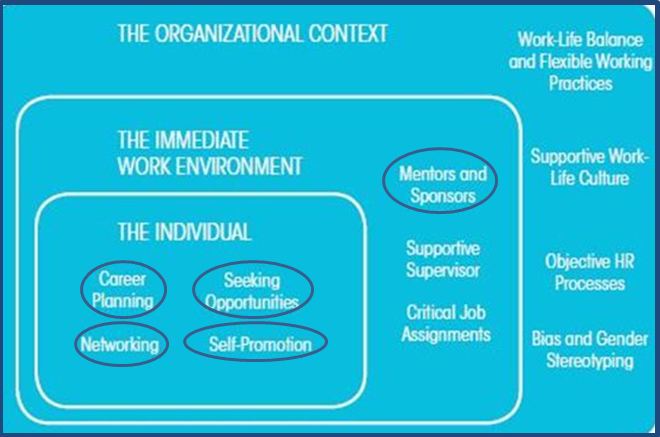
Kenexa Career Development Model-Individual Behaviors

Kenexa Career Development Model-Individual Behaviors

Part 1 of this post, Women’s Career Development: Career Planning, Career “Contest”, Sponsorship  highlighted Ines Wichart’s model of women’s career development with three levels and 11 components, based on her research as Kenexa High Performance Institute (KHPI), a subsidiary of IBM.

Ines Wichert

Ines Wichert

She outlined four behaviors that individuals can control or influence toward career advancement:

  • Career planning 
  • Opportunity-seeking, Negotiation
  • Career-building networking; Mentoring-Sponsorship    
  • Skillful self-promotion

The first segment of this two-part post considered facets of Career Planning and two independent paths to career advancement: Contest and Sponsorship routes.

Let’s consider the additional elements that respond to individual attention and efforts, including Opportunity-seeking while embracing risk.  

Susan Vinnicombe

Susan Vinnicombe

Val Singh

Val Singh

Highly effective career advancement opportunities include stretch assignments and on-the-job training.

Susan Vinnicombe and Val Singh of Cranfield University report that these development activities are most effective in building credibility, visibility, reputation as a capable, well-rounded leader.

However, their research found that women need more encouragement to take on challenging assignments than men, who are more likely to ask for these assignments.

Linda Babcock

Linda Babcock

Similarly, Linda Babcock reported that women tend to need encouragement to ask for promotions and salary increases.

Her research demonstrated that women are less likely to negotiate for their first salaries, unless they know that these are acceptable practices.

Manhattan CollegeAs a countermeasure, Babcock recommends negotiation practices demonstrated to mitigate negative perceptions by both men and women negotiation partners

Like Babcock, Mary Wade’s research at Manhattan College found that both men and women evaluated more negatively women who negotiated for salary using the same script as men.

Corinne Moss-Racusin

Corinne Moss-Racusin

Laurie Rudman

Laurie Rudman

Corinne Moss-Racusin and Laurie Rudman replicated this disconcerting finding at Rutgers University, leading to their formulation of “The Backlash Avoidance Model” (BAM)”.

According to this construct, women may demonstrate traditional gender role behaviors to mitigate “backlash” of negative reaction by men and women to “role discrepant” behaviors like asking for career advancement and commensurate compensation.

  • What approaches have been effective when you have asked for a salary increase or promotion?
         –How did you prepare?

         -How did you overcome objections?
  • When people ask you for a salary increase or promotion, what negotiation approaches have been most effective?
              -What have been least effective?

Wichart’s model of individual initiatives toward career advancement points to the importance of skillful professional networking, mentoring, and sponsorship.

National Center for Women and Information TechnologyNational Center for Women & Information Technology (NCWIT) reported that nearly half of technical women surveyed said they lack role models and mentors, and 84% said they lack sponsors.
The result is that these women are four times more likely to leave the current job role.

One reason that women’s professional networking efforts and seeking mentors may yield less effective career advancement than men:  Women tend to engage in professional networking for affiliation and emotional support with people close to their job level whereas men tend to network for career development with people significantly above the job level, according to Adelina Broadbridge of University of Stirling.University of Stirling

As a result of these differing approaches to professional networking, men may enjoy more rapid career advancement due to visibility and sponsorship.

Pamela Perrewe

Pamela Perrewe

F. Randy Blass

F. Randy Blass

In addition, women are likely to demonstrate less political understanding and insight because mentors are not sufficiently senior, according to Florida State University’s F. Randy Blass, Pamela Perrewe, and Gerald Ferris with Robyn Brouer of SUNY Buffalo.

Gerald Ferris

Gerald Ferris

Robyn Brouer

Robyn Brouer

Organizational support for formal and informal mentoring has been shown to increase employee engagement, satisfaction, and retention.

Therefore, organizations concerned with retaining talented women and minorities can increase the likelihood of keeping skilled employees by initiating structured mentoring programs and encouraging selective sponsorship.

  •  How have mentors and sponsors enabled your career moves?
  •  How do you decide who you are willing to mentor or sponsor?   

Previous posts have shared much current research and leading recommendations in building personal brand and practicing skillful self-promotion:

In light of the potential negative perceptions of women who showcase their accomplishments as they ask for salary increases and role advancement:

  •   How do you raise awareness of your accomplishments’ impact to avoid “backlash”?
  •   How do you define, develop, and communicate, “skillfully promote” your personal brand?

These research findings suggest three parting suggestions for women who want to Play Bigger:

  1. Question the thought that “I’m not ready yet.”
  2. Develop resilience and “a thick skin”:   If you are doing something innovative or important, you may draw both praise and criticism when you are noticed.
  3. Filter advice:  Implement recommendations that have “the ring of truth” and “resonate”;
    leave the rest.
  • What is the most helpful career advice you implemented?
  • What career advice have you decided not to implement?

Related Posts

©Kathryn Welds

Reduce Evaluator Bias: Showcase Best Features in Any Offer

Less can be more when designing offers, whether when offering services in job applications, crafting sales offers, or positioning for advantage in any negotiation.

Kimberlee Weaver

Kimberlee Weaver

Kimberlee Weaver of Virginia Tech and University of Michigan’s Stephen Garcia and Norbert Schwarz showed that more is not better in augmenting offers when additional elements are of lower quality.

Stephen Garcia

Stephen Garcia

Using the Presenter’s Paradox in a series of studies, they showed that positive impressions can be reduced when they are presented in the company of lower value items.

Norbert Schwartz

Norbert Schwartz

Weaver, Garcia and Schwarz offered volunteer “buyers” different iPod Touch packages: iPod and cover OR this package with a free music download.

“Buyers”, on average, offered to pay more for the lesser package, and sellers inaccurately expected that buyers would prefer the fully-featured package.
This suggests that expectations about consumer preferences may be poor predictors of people’s actual selection and purchasing behaviors.

The average price offered for the basic package, iPod and cover was $242, but the package with one free song download averaged just $177.
The additional feature reduced package’s perceived value by more than 25%.

Those designing and evaluating offers can mitigate the impact of this judgment bias by considering the value of the overall offering, then eliminating lower-value components that might reduce the comprehensive value.

This is relevant to job seekers who might be tempted to “pad” a resume with low-value activities, accomplishments and skills.
Weaver, Schwartz, and Garcia’s findings suggest that showcasing most compelling capabilities provides a more power presentations of personal and product attributes.

Santa Clara University’s Jerry Burger might argue that “more might be more” when he found that Steve Jobs’s “that’s-not-all” (TNA) technique was more effective than the much-researched “door-in-the-face” (DITF) approach in gaining agreement to sales propositions.

Jerry Burger

Jerry Burger

That’s-not-all” offers a product at a high price, then doesn’t allowing the volunteer to respond immediately.
The procedure follows up by augmenting the offer with another product or lowering the price.

Burger found “that’s-not-all” produced superior simulated sales outcomes to the much-researched “door-in-the face” (DITF) approach, which presents an unreasonably high offer, then follows with a more acceptable proposal.

Numerous replications of “door-in-the-face” have shown than people are more likely to agree to a second more modest request after an unreasonable high first proposal.
Even when the same offer is presented as a single offer, people are significantly more likely to accept it when it’s presented after an unreasonable proposal.

Burger suggested that “that’s-not-all” may have produced greater compliance because people felt obliged to respond to a new offer through an implicit norm of reciprocity,  and because the augmented offer changed the perceived anchor point that volunteers used to evaluate the offer.

-*How do you mitigate bias in evaluating offers?
-*How do you design the most attractive offer when offering something for sale?
-*Which technique for designing offers has been most persuasive to you as a purchaser?

Related Posts
:

Twitter:    @kathrynwelds
Google+:
Blog: – Kathryn Welds | Curated Research and Commentary  
LinkedIn Open Group
Facebook Notes:

©Kathryn Welds

Power Tactics for Better Negotiation

Selena Rezvani

Selena Rezvani

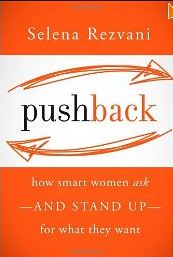
Selena Rezvani points to research documenting women’s tendency to negotiate for salaries, promotions – and even task-sharing in relationships, less often than men in Pushback: How Smart Women Ask–and Stand Up–for What They Want

Her book offers guidelines to speak up assertively while developing the resilience and “thick skins” many in sales have mastered.

These recommendations echo those suggested in research studies and popular articles, and perhaps more Machiavellian, realistic, and perhaps disconcerting come from one of her endorsers, Stanford University Graduate School of Business Professor Jeffrey Pfeffer.

Jeffrey Pfeffer

Jeffrey Pfeffer

He analyzes individual power dynamics in corporate hierarchies, and offers recommendations to acquire and use power in Power: Why Some People Have It—and Others Don’t 

Power-Jeffrey PfefferIn Rezvani’s book, Pfeffer notes that “Power is about 20% conferred and 80% taken.
Good things don’t come to those who wait; they come to those who ask, negotiate, and push.
For women—or men—to get what they deserve, they must get over the platitudes and attitudes that hold them bac
k.”

Pfeffer debunks the hopeful idea that the world is fair and just,  and counsels those seeking to have the power to “get things done” to promote themselves, avoid giving up or delegating power, but instead,  give up the wish to be well-liked.

Because the work world is not fair, Pfeffer says that intelligence, performance, and likeability alone are not the most important factors in advancing in an organization.
Instead, he argues that ambition, energy, and focus drive key power behaviors:

  • Self-promotion and seeking organizational visibility
  • Building relationships, networking, and supporting the immediate manager
    Cultivating a reputation for control and authority by managing information and first impressions (halo effect, attention decrement, cognitive discounting, self-fulfilling prophecy, biased assimilation)
  • Embodying powerful demeanor in speech, dress, posture

Useful skills in acquiring power are:

  • Self-reflection and self-knowledge
  • Confidence and self-assurance
  • Ability to “read” others by empathically understanding their perspectives
  • Capacity to tolerate and remain calm in conflict

Although power is valuable to enable execution and results, there are downsides and “prices to pay” for having and using power.
Often, the costs of power are not fully considered or anticipated by those who aspire to it, so Pfeffer usefully suggests the following drawbacks of power:

  • Loss of privacy due to public scrutiny
  • Loss of autonomy
  • Necessary investment of time and effort that might be spent in other ways, such as with family, maintaining a healthy lifestyle, pursuing non-work interests
  • Trust, confidentiality, conflict-of-interest, ethical dilemmas
  • Possible intoxication with power as an “addictive drug”

Kathleen Kelly Reardon

Kathleen Kelly Reardon

It's All PoliticsPfeffer’s Stanford University colleague, Kathleen Kelly Rearson shares specific examples of skillful, modulated application of power in her book, It’s all Politics.

-*How do you ask for what you want at work?

-*What power tactics do you employ to influence your negotiation outcomes?

RELATED POSTS

©Kathryn Welds

Women Don’t Ask for Raises or Promotions as Often as Men

Linda Babcock

Linda Babcock

Linda Babcock‘s 2011 research at Carnegie-Mellon University identified one possible reason for the oft-reported pay gap between genders: Women don’t ask for raises as often as men
They wait to be offered a salary increase, a promotion, to be assigned the task or team or job that they want.

Researchers note that this type of unsolicited offer rarely occurs.
The study found that when women do ask, it can lead to others finding them “too demanding and aggressive.”

This trend was demonstrated when researchers showed people videos of a man and a woman each asking for a raise, following the same script.
Viewers of both genders reported similar negative perceptions of women who requested promotion.

The study reviewed approaches to help women improve their negotiation skills without challenging “preconceived notions about appropriate gender behavior.”

Some critics note that this analysis doesn’t consider larger scale inclusion and diversity interventions, such as resources offered by NCWIT.org to guide design and launch of merit-based systems for hiring, promoting, and managing women and other underrepresented groups.

*How likely are you to ask for a salary increase or promotion?
-*What factors do you consider before making a request for more more or an expanded role?

©Kathryn Welds