Tag Archives: Bias

Perseverance Increases Skill Increases Luck: “The Harder I Work, The Luckier I Get”

Samuel Goldwyn

Samuel Goldwyn

Thomas Jefferson

Thomas Jefferson

Samuel Goldwyn recast Thomas Jefferson’s earlier observation: “I am a great believer in luck, and I find the harder I work, the more I have of it.”

Michael Mauboussin, of Columbia University, and previously Chief Investment Strategist at Legg Mason Capital Management Inc. investigated this relationship between effort and luck in his book, The Success Equation.The Success Equation

Michael Mauboussin

Michael Mauboussin

Mauboussin, an innovator in behavioral finance, adopted Harvard biologist Stephen Jay Gould’s “paradox of skill” to analyze the interaction of effort, skills, and luck, and best strategies to optimize outcomes in investing, sports, and career performance.

Stephen Jay Gould

Stephen Jay Gould

He posits that as skill improves in activities where outcomes are affected by skill and luck, the standard deviation of skills narrows.
In this case, luck becomes more important in determining outcomes:

Whenever you see an outlier in sports, it is always a combination of really good skill and really good luck… (Often) they are about one and a half or two standard deviations away from the average…not all skilled players have (winning) streaks, but all (winning) streaks are held by skillful players.”

For example, as investors become more sophisticated and have access to advanced computational tools, as athletes benefit from targeted training and development regimens, and as students are groomed for admission to top universities, differences among these skilled performers decreases.
Chance influences can determine outcomes.

Mauboussin says that luck has several elements:

  • Affects an individual or organization,
  • May be evaluated as “good” or “bad”
  • Another outcome could have occurred
  • The outcome is uncontrollable, but is comprised of several elements

To increase luck, he advises assessing each contender’s strength in the situation and finding “…something completely different to get you on the right side of the tail of the skill distribution,” such as employing an unusual or unexpected tactic.

The stronger player has positive asymmetric resources, so the effective strategy is to simplify the game.
In contrast the underdog should seek to complicate the game, such as through disruptive innovation, a flank strategy or a guerilla tactic.

Because most people have a bias toward optimism and overestimate personal capabilities, it may be difficult to assess oneself as an “underdog” in a performance situation.

Daniel Kahneman

Daniel Kahneman

Nobel Prize winner Daniel Kahneman and Amos Tversky explained that individuals who adopt an inside view gather substantial information, combine it with their own inputs, then project into the future without considering “distributional information” about a wide variety of previous instances.
This approach risks developing an idiosyncratic, overconfident perspective by underestimating costs, completion times, and risks of planned actions, while overestimating benefits.

Amos Tversky

Amos Tversky

In contrast, people who adopt the outside view consider the problem as an instance of a larger reference class and consider the entire distribution of outcomes when this type of situation occurred previously.
This approach can reduce overconfidence.
However, this approach could discourage entrepreneurs, who will realize that a small percentage actually succeeds.

In addition, besides the bias toward overconfidence, people tend to “under-sample” instances of failure when a previously successful approach is applied in a new situation and doesn’t succeed.

Nate Silver

Nate Silver

Sabermetricians like Nate Silver, posit that worthwhile statistics provide:

  • Persistence or correlation from one period to the next, a strong indicator of high skill
  • Predictive value or high correlation with the target objective

Nate Silver-The Signal and The NoiseThe Oakland As baseball team uncovered these principles in determining that  a superior measure of athletic performance in this sport is on-base percentage rather than the traditional measure, batting average.

In this case, on-base percentage has a higher correlation from one season to the next and a higher correlation with run production than batting average, fulfilling both criteria.

Daniel Kahneman also suggested that skill, expertise, and intuition render more uniform results in a predictable environment.

Thinking Fast and SlowHowever, many organizational environments are unstable and non-linear, rendering experts less accurate because they cannot employ an effective predictive model.

Collective judgments through “the wisdom of crowds” may mitigate the challenges of unstable contexts because they provide more data points.

Mauboussin advocated considering the continuum of stability vs instability in which the issue is situated to determine strategy and to beware of applying simple heuristics that are vulnerable to bias, and social or situational influences.

He suggested the guideline “think twice” to prepare, detect and correct for common mental traps, including:

  • The Inside-only View
  • Tunnel Vision
  • Oversimplification
  • Situational Power
  • Overvaluing Expert Knowledge

-*How do you optimize your performance when chance elements can affect your outcomes?

Related Posts

©Kathryn Welds

Mastering the Power Sandwich with Skillful Upward Influence

David Bradford

David Bradford

Employees’ advancement in organizations is based on preventing problems before they develop, and pre-emptively uncovering opportunities to add value, according to Stanford’s David Bradford and Allan R. Cohen of Babson College in Influencing Up.

Allan Cohen

Allan Cohen

Complementing their Influence without Authority, they distilled common-sense win-win approaches to influence those over whom one has no formal authority or control: one’s manager and others higher in the hierarchy.

Influencing UpOrganizational power discrepancies can be accentuated when the employee is female or a member of a minority group.
Cohen and Bradford’s suggest six elements to reduce power differences, and improve influence and negotiation outcomes:

  • Clarify needs and priorities
  • Consider others as potential partners rather than adversaries
  • Establish trustworthiness by sharing information and develop understanding of the other’s perspective, concerns, and “care-abouts” — empathy in a business setting
  • Determine reciprocal value exchange in “currencies” that matter to others: information, budget, removing obstacles, brokering agreements, support
  • Gain access to others by showcasing your potential value exchange
  • Negotiate a win-win outcome
Robert Cialdini

Robert Cialdini

Bradford and Cohen’s work complements influential research by Stanford colleagues Margaret Neale and Deborah Gruenberg, as well as Robert Cialdini’s classic investigation of influence.
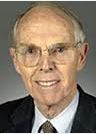
Roger Fisher

Roger Fisher

William Ury

William Ury

Their emphasis on crafting a win-win negotiated outcome echoes earlier work by Roger Fisher and William Ury in Getting to Yes and Linda Babcock’s consideration of negotiation challenges faced by women and minority group members in the workplace.

-*How do you manage the Power Sandwich, requiring skillful 360 degree influence in your organization?

Related Posts:

Twitter:  @kathrynwelds
Google+:
Blog: – Kathryn Welds | Curated Research and Commentary
LinkedIn Open Group
Facebook Notes:

©Kathryn Welds

How Sure are You of Your “Memories”? Suggestibility, Insertion, and Construction of Recall

Elizabeth Loftus

Elizabeth Loftus

Experimental psychologist, Elizabeth Loftus investigated memory and its quirks, such as mistaken eyewitness testimony and “repressed memory” of pedophilia in laboratory and naturalistic settings for nearly 40 years.

William Saletan

William Saletan

William Saletan of Slate replicated one of Loftus’s experiments in memory insertion by using digitally-altered photos by developing five images of events that did not actually occur:

  • Sen. Joe Lieberman voting to convict President Clinton at his impeachment trial
  • Vice President Cheney rebuking Sen. John Edwards in their debate for mentioning Cheney’s lesbian daughter
  • President Bush relaxing at his ranch with Roger Clemens during Hurricane Katrina
  • Hillary Clinton using Jeremiah Wright in a 2008 TV ad
  • President Obama shaking hands with Iranian President Mahmoud Ahmadinejad

These images were mixed with photos of actual events:

  • 2000 Presidential election recount in Florida
  • Colin Powell’s prewar assessment of Iraq’s weapons of mass destruction
  • 2005 congressional vote to intervene in the Terri Schiavo’s “right-to-die” case.

Each participant viewed three true incidents and one randomly selected fake incident, and was asked whether the subject remembered each one.
Next, each volunteer was informed that one of the incidents was false and was asked select the fake.

Slate’s results replicated the trend observed by Loftus:  Fewer than half of the volunteers correctly detected fake photos and many “misremembered” fake photos by giving detailed explanations of their recollections of events that did not actually occur and photos that did not exist before the experiment.

Frederic Bartlett

Frederic Bartlett

The findings validate psychologist Frederic Bartlett’s claim wrote almost a century ago at Cambridge University:

Remembering is not the re-excitation of innumerable fixed, lifeless and fragmentary traces.
It is an imaginative reconstruction, or construction, built out of the relation of our attitude towards a whole active mass of organized past reactions or experience.

Rosalind Cartwright

Rosalind Cartwright

More recently, sleep researcher Rosalind Cartwright summarized Bartlett’s point by concluding that “Memory is never a precise duplicate of the original… it is a continuing act of creation,” and artist Austin Kleon translated these concepts into current vernacular:  “you are a mash-up of what you let into your life.”

Austin Kleon

Austin Kleon

Philippa Perry

Philippa Perry

British psychotherapist Philippa Perry points to the logical conclusion from these observations in advising, “Be careful which stories you expose yourself to. … The meanings you find, and the stories you hear, will have an impact on how optimistic you are…

-*How do you monitor the accuracy of your memories?
-*How do you detect “memory mash-ups”?
-*How do you select the experiences from which you form memories?

Related Posts:

Twitter:   @kathrynwelds
Google+
Blog
: – Kathryn Welds | Curated Research and Commentary 
LinkedIn Open Group Diversity
Facebook Notes:

©Kathryn Welds
Women’s Career Development: Negotiation, Networking-Mentoring-Sponsorship, Skillful Self-Promotion

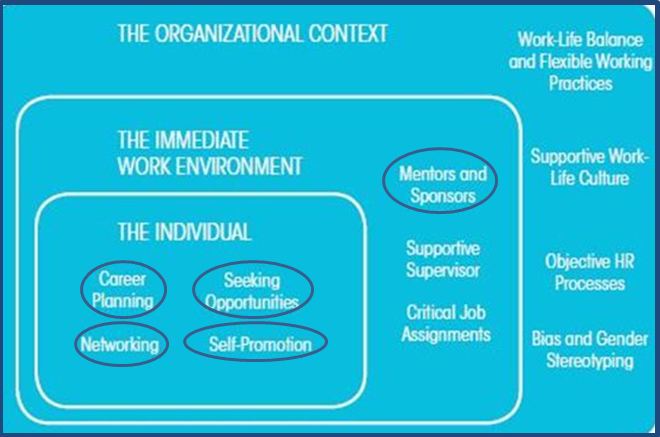
Kenexa Career Development Model-Individual Behaviors

Kenexa Career Development Model-Individual Behaviors

Part 1 of this post, Women’s Career Development: Career Planning, Career “Contest”, Sponsorship  highlighted Ines Wichart’s model of women’s career development with three levels and 11 components, based on her research as Kenexa High Performance Institute (KHPI), a subsidiary of IBM.

Ines Wichert

Ines Wichert

She outlined four behaviors that individuals can control or influence toward career advancement:

  • Career planning 
  • Opportunity-seeking, Negotiation
  • Career-building networking; Mentoring-Sponsorship    
  • Skillful self-promotion

The first segment of this two-part post considered facets of Career Planning and two independent paths to career advancement: Contest and Sponsorship routes.

Let’s consider the additional elements that respond to individual attention and efforts, including Opportunity-seeking while embracing risk.  

Susan Vinnicombe

Susan Vinnicombe

Val Singh

Val Singh

Highly effective career advancement opportunities include stretch assignments and on-the-job training.

Susan Vinnicombe and Val Singh of Cranfield University report that these development activities are most effective in building credibility, visibility, reputation as a capable, well-rounded leader.

However, their research found that women need more encouragement to take on challenging assignments than men, who are more likely to ask for these assignments.

Linda Babcock

Linda Babcock

Similarly, Linda Babcock reported that women tend to need encouragement to ask for promotions and salary increases.

Her research demonstrated that women are less likely to negotiate for their first salaries, unless they know that these are acceptable practices.

Manhattan CollegeAs a countermeasure, Babcock recommends negotiation practices demonstrated to mitigate negative perceptions by both men and women negotiation partners

Like Babcock, Mary Wade’s research at Manhattan College found that both men and women evaluated more negatively women who negotiated for salary using the same script as men.

Corinne Moss-Racusin

Corinne Moss-Racusin

Laurie Rudman

Laurie Rudman

Corinne Moss-Racusin and Laurie Rudman replicated this disconcerting finding at Rutgers University, leading to their formulation of “The Backlash Avoidance Model” (BAM)”.

According to this construct, women may demonstrate traditional gender role behaviors to mitigate “backlash” of negative reaction by men and women to “role discrepant” behaviors like asking for career advancement and commensurate compensation.

  • What approaches have been effective when you have asked for a salary increase or promotion?
         –How did you prepare?

         -How did you overcome objections?
  • When people ask you for a salary increase or promotion, what negotiation approaches have been most effective?
              -What have been least effective?

Wichart’s model of individual initiatives toward career advancement points to the importance of skillful professional networking, mentoring, and sponsorship.

National Center for Women and Information TechnologyNational Center for Women & Information Technology (NCWIT) reported that nearly half of technical women surveyed said they lack role models and mentors, and 84% said they lack sponsors.
The result is that these women are four times more likely to leave the current job role.

One reason that women’s professional networking efforts and seeking mentors may yield less effective career advancement than men:  Women tend to engage in professional networking for affiliation and emotional support with people close to their job level whereas men tend to network for career development with people significantly above the job level, according to Adelina Broadbridge of University of Stirling.University of Stirling

As a result of these differing approaches to professional networking, men may enjoy more rapid career advancement due to visibility and sponsorship.

Pamela Perrewe

Pamela Perrewe

F. Randy Blass

F. Randy Blass

In addition, women are likely to demonstrate less political understanding and insight because mentors are not sufficiently senior, according to Florida State University’s F. Randy Blass, Pamela Perrewe, and Gerald Ferris with Robyn Brouer of SUNY Buffalo.

Gerald Ferris

Gerald Ferris

Robyn Brouer

Robyn Brouer

Organizational support for formal and informal mentoring has been shown to increase employee engagement, satisfaction, and retention.

Therefore, organizations concerned with retaining talented women and minorities can increase the likelihood of keeping skilled employees by initiating structured mentoring programs and encouraging selective sponsorship.

  •  How have mentors and sponsors enabled your career moves?
  •  How do you decide who you are willing to mentor or sponsor?   

Previous posts have shared much current research and leading recommendations in building personal brand and practicing skillful self-promotion:

In light of the potential negative perceptions of women who showcase their accomplishments as they ask for salary increases and role advancement:

  •   How do you raise awareness of your accomplishments’ impact to avoid “backlash”?
  •   How do you define, develop, and communicate, “skillfully promote” your personal brand?

These research findings suggest three parting suggestions for women who want to Play Bigger:

  1. Question the thought that “I’m not ready yet.”
  2. Develop resilience and “a thick skin”:   If you are doing something innovative or important, you may draw both praise and criticism when you are noticed.
  3. Filter advice:  Implement recommendations that have “the ring of truth” and “resonate”;
    leave the rest.
  • What is the most helpful career advice you implemented?
  • What career advice have you decided not to implement?

Related Posts

©Kathryn Welds

Beware of Seeking, Acting on Advice When Anxious, Sad

Just as wise grandmothers advise, it’s best to avoid decisions when upset, anxious, or sad.

Maurice Schweitzer

Maurice Schweitzer

Maurice Schweitzer and Alison Wood Brooks of Wharton validated Grandmother Wisdom in eight experiments that demonstrated anxiety’s impact on lowering self-confidence, impairing information processing, and impeding ability to distinguish advice from neutral advisors and those with a conflict of interest.

Alison Wood Brooks

Alison Wood Brooks

They found that people experiencing anxiety tend to seek advice and act on it, but they are less able to differentiate poor advice from valid recommendations, and these results are applicable to making decisions about crucial medical treatment, financial investments, or even guidance counseling.

The team evoked anxious feeling among volunteers by presenting potentially frightening film clips and music, and asked them to judge a person’s weight based on a photograph or number of coins in a jar or solve a complex math problem.

Participants were offered money for correct judgments, and the opportunity to receive advice from others when they were uncertain.
Those who heard the scary music or saw the alarming film clip rated themselves as less confident of their decision, and were more likely to ask others for advice.
These effects were not observed when volunteers were shown a film clip that could provoke anger.

Schweitzer and Brooks concluded that people vary in their receptivity to advice based on:

  • Advisor’s characteristics, such as expertise, consistent with Cialdini’s observation

    Robert Cialdini

    Robert Cialdini

  • Perceived difficulty of the decision
  • Decision maker’s emotional state when receiving advice

The researchers advised decision-makers to:

  • Monitor their internal states for anxiety
  • Use feedback from multiple sources when making important decisions
  • Work toward developing increased self-confidence
  • Evoke calm state, often possible with systematic breathing or mindful attention and equanimity
Catherine Hartley

Catherine Hartley

Catherine Hartley, then of New York University and Elizabeth Phelps of New York University contributed to the neuroeconomic analysis of anxiety’s impact on decision- making when they reported that brain structures responsible for regulating fear and anxiety are also involved in economic decision-making under uncertain conditions.

Elizabeth Phelps

Elizabeth Phelps

Specifically, the amygdala is crucial in learning, experiencing, and regulating both fear and anxiety and it is also implicated in decision-making in situations of potential loss.
The prefrontal cortex is specialized in controlling fear and is also involved in decisions containing risk elements.

Hartley and Phelps suggest that techniques for altering fear and anxiety may also improve economic decisions-making.

Rajagopal Raganathan

Rajagopal Raganathan

Rajagopal Raghunathan, then of New York University and Michel Tuan Pham of Columbia University demonstrated the same connection between anxiety and making decisions about gambling and job selection.

Michel Tuan Pham

Michel Tuan Pham

They conducted three experiments and found that sad individuals select high risk / high-reward gambling and job options, whereas anxious individuals are biased in favor of low-risk / low-reward options.

Raghunathan and Pham posit that anxiety tends to motivate people to reduce uncertainty whereas sadness moves people to replace rewards.
They suggest suggesting two different decision biases related to mood states.

Raghunathan and Pham add to Schweitzer and Brooks’s recommendations for mitigating decision bias:

  • “Monitor feelings”
  • Consider alternate options
  • Speculate on future moods and preferences if each option were selected: “What would I feel better about . . .?

-*How do you mitigate the potential decision bias when anxious or sad?

Related posts:
Memorable Business Stories: Ideas and Numbers
Business Influence as “Enchantment”

  • ©Kathryn Welds

Useful Fiction: Optimism Bias of Positive Illusions

Tali Sharot

Tali Sharot

Tali Sharot of University College London investigated people’s tendency toward unsubstantiated optimism after she observed this bias in her neuropsychological experiments on memory processes of envisioning future events and consequences.

Shelley Taylor

Shelley Taylor

She, like Shelley Taylor of UCLA decades before, argued that this bias was an evolutionary adaptation that enabled people to survive under difficult conditions.  Sharot added to Taylor’s work by suggesting that a majority of people demonstrate the optimism bias by a margin of 5:3.3.

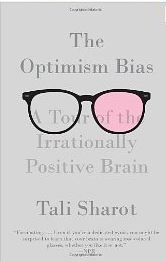
The Optimism BiasSharot’s The Optimism Bias: A Tour of the Irrationally Positive Brain
compares optimism bias to other perceptual illusions, such as sometimes-fatal spatial disorientation among airplane pilots and other frequently-cited optical illusions like “Young Lady or Old Woman”, “Vase or Two Profiles”, and Thatcher illusion.

An example of optimism bias is the well-documented “superiority illusion”, that most people rate their skills, knowledge, and tendencies as above average in a variety of dimensions.

Ellen Langer

Ellen Langer

Another example was identified in 1975 by Ellen Langer of Harvard, who suggested that a pervasive “illusion of control” causes most people to overestimate their ability to control events, even those over which they have no influence.
This cognitive bias has been suggested as prevalent among “problem gamblers” and those who believe in paranormal phenomena.

Elizabeth Phelps

Elizabeth Phelps

Sharot and Elizabeth Phelps of New York University extended Taylor’s early work with neuropsychological research, and reported that the brain’s frontal cortex communication with the posterior hippocampus enables people to envision future possibilities and events.

They observed amygdala and the rostral anterior cingulate cortex activity when people demonstrate the optimism bias and noted that malfunctions in these brain areas are associated with a bias toward pessimism and related depression.

Lauren Alloy

Lauren Alloy

These findings were foreshadowed by Lauren Alloy of Temple University and Lyn Abramson of University of Wisconsin in their 1979 study, which found that people with depression are better able to predict future events accurately, whereas people not burdened with depression have inaccurately optimistic predictions.

Lyn Abramson

Lyn Abramson

“Depressive realism,” just as optimism bias can actually influence or alter future outcomes, as demonstrated in Robert Rosenthal’s classic Pygmalion in the Classroom study and “self-fulfilling prophecy,” leading to the idea that “perception is reality.”

Robert Rosenthal

Robert Rosenthal

Though inaccurate, optimism bias has positive effects. It has been observed to:

  • Reduce perceived stress
  • Improve physical health
  • Increase life span
  • Increase likelihood of people following recommended health practices like exercising, following low-fat diets, taking vitamins.

Sharot suggested that increasing awareness of optimism bias can help people enjoy the benefits of this positive illusion while watching for pitfalls of unrealistic optimism.

-*How do you capitalize on the optimism bias and mitigate its drawbacks?

Related Post:
Oxytocin Receptor Gene’s Link to Optimism, Self-Esteem, Coping with Stress

Sharot’s TED Talk

©Kathryn Welds

Minimize “Quest for the Best” Bias

Sheena Iyengar

Sheena Iyengar

Columbia Business School professor Sheena Iyengar, Cassie Mogilner of University of Pennsylvania’s Wharton School, and Baba Shiv of Stanford’s Graduate School of Business collaborated to assess the relative satisfaction and commitment to “sequential choices,” as in “love marriages,” compared with “simultaneous choices”, like arranged marriages.

Iyengar’s earlier research revealed that more choices available at one time are associated with reduced satisfaction.
The Art of ChoosingTo evaluate satisfaction with simultaneous vs sequential choosing, Iyengar, Shiv, and Mogilner studied volunteers’ satisfaction and commitment to choices of wine, chocolate, and nail polish colors.
Results, forthcoming in the Journal of Consumer Research, found thatsimultaneous” choosers were more satisfied and committed to their decisions than “sequential” choosers.

Cassie Moligner

In the chocolate experiment, participants considered detailed descriptions of fine chocolates (“dark chocolate ganache with black tea and hints of citrus and vanilla”), and chose which they wanted to taste.
The “simultaneous” group saw the entire list, whereas the “sequential” group saw one choice at a time.

After they selected and tasted the chocolate, participants rated their satisfaction with their choice.
Verdict? “Simultaneous” choosers were more satisfied with their choices than “sequential” choosers.

Baba Shiv

When participants had an opportunity to switch to a different but randomly-selected chocolate, more “sequential” choosers took this option, though they had little information about the choice.
However, when “sequential” choosers were permitted to choose an option they’d already considered, they were less committed to their choice.

The researchers suggest that “sequential” choosers may have regretted forgoing options they didn’t select, and hoped that a future option would be better.

Shiv summarized the dilemma of the “sequential” chooser (or serial dater, serial monogamist): Hope and regret prompt people to move to the next option even though the next option could be worse.
In contrast, “simultaneous” choosers are aware of available options at a point in time, so may spend less time in regret and hope.

Retailers, daters, venture capitalists, hiring managers, house purchasers, and job candidates benefit from presenting and evaluating all choices at one time.

However, simultaneous choice may not be possible, and to avoid the “bias of the eternal quest for the best,” Shiv suggests “mentally converting sequential choices into “quasi-simultaneous” choices by recalling situations when you were happy with you choice, and when you regretted your choices.”

Though an imperfect heuristic, quasi-simultaneous choice may may provide instructive clues to the elements of a satisfying decision.

-*How do you take decisions among many options?

Related Posts on Decision-Making and Bias:

Twitter:  @kathrynwelds
Google+
LinkedIn Open Group Stanford Social Innovation Review
Facebook Notes:

Blog: – Kathryn Welds | Curated Research and Commentary

©Kathryn Welds

Hypothetical Questions May Lead to Bias

Baba Shiv

Baba Shiv, Stanford Graduate School of Business profession, showed that hypothetical questions can sway opinion and affect behavior through innuendo and implied rumor.

One example is a political “push poll” during the 2000 South Carolina Republican Primary Elections, which asked voters whether they’d vote for John McCain if they learned that he had fathered an illegitimate child.

Shiv and Duke University Fuqua School of Business professor Gavan Fitzsimons  conducted experimental inquiries of voter attitudes and behavior in 2001, and found that hypothetical questions increase information “accessibility” because the implied criticism is memorable and may align with existing stereotypes, becomes “top-of-mind,” and can direct behavioral choices.

Gavan Fitzsimons

The researchers found that participants simply focus on the hypothetical content, and don’t evaluate its credibility, even when reminded that the situation is hypothetical.

This effect was seen in one experiment where researchers gave a pretrial jury selection questionnaire to a group of actual prospective jurors.

The potential jurors were told not to use the questions to draw conclusions about the case, then some of the prospective jurors were asked how their decision would be affected by learning that the defendant was a gang member.

Participants who received the hypothetical question gave more hypothetical guilty verdicts and harsher sentences than those who received no suggestive questions.

Shiv cautions against posing hypothetical questions in situations where they are frequently used: Jury selection, political polls, marketing focus groups, job interviews.

Despite research findings (by many including Wiesner & Cronshaw’s classic 1988 article in Journal of Applied Psychology) that hypothetical questions about future behavior in work situations do not predict job performance as effectively as actual past job performance, this interview tactic is still used by some employers.

Astute job candidates can respond to hypothetical questions by citing actual past behavior as a “proof-point” of expected job performance, and may explore the interviewer’s underlying concerns in posing hypothetical questions.

-*What impact have you observed for hypothetical questions posed in the workplace?

Related Posts on Decision-Making and Bias:

Twitter:  @kathrynwelds
Google+
LinkedIn Open Group Mindful Leadership
Facebook Notes:

Blog: – Kathryn Welds | Curated Research and Commentary

©Kathryn Welds

Biases in Unconscious Automatic Mental Processing, and “Work-Arounds”

Leonard Mlodinow

Leonard Mlodinow

Leonard Mlodinow’s Subliminal: How Your Unconscious Mind Rules Your Behavior reviews evidence of automatic, out-of-awareness brain processing that handles emotional experience and routine task execution, in the same vein as  best sellers by Nobel laureate Daniel Kahneman (Thinking, Fast and Slow) and writer Malcolm Gladwell (Blink: The Power of Thinking Without Thinking).

Daniel Kahneman

Daniel Kahneman

All three authors outline the potential costs of rapid mental processing: error and bias in perception and decision-making, which are less present during mindful analytic problem-solving.

Mlodinow, a Physics Professor at CalTech, has collaborated with Stephen Hawking on two books, and like Kahneman and Gladwell, is a talented storyteller who explains implications of laboratory-based research on cognition and brain functioning.

Carol Tavris

Carol Tavris

Psychologist Carol Tavris discusses the cost of similar biases in cognitive processing in Mistakes Were Made (But Not by Me): Why We Justify Foolish Beliefs, Bad Decisions, 

Numerous studies of erroneous eyewitness testimony demonstrate that memory is constructed of fragmentary elements “stitched” together to form a cohesive narrative.
This contrasts the notion that memory is a “snapshot” replica of an event.

Opportunities for cognitive error are apparent in this Constructivist view of perception and cognition.

Most authors suggest “mindful” practices to counteract inherent biases in cognitive short-cuts, consciously focusing in present perceptions and experiences.

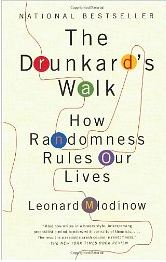
Mlodinow’s previous book, The Drunkard’s Walk: How Randomness Rules Our Lives, demystifies the use of statistics in everyday life, and prepares readers with considered questions to avoid mis-judgments based on seemingly convincing quantitative data.

He demonstrates the prevalence of chance influences in life outcomes, and the pervasive illusion that people have control over many more outcomes than they actually do.

Mlodinow reminds readers that “success” and “failure” contain random influences, and “success” is more dependent on persistence and maintaining an optimistic outlook than raw ability.

-*What practices have helped you mitigate potential cognitive bias associated with rapid mental processing and cognitive “short-cuts”?

*Related posts:

LinkedIn Open Group Women in Technology (sponsored by EMC)
Twitter: @kathrynwelds
Google+
Facebook Notes:
Blog: – Kathryn Welds | Curated Research and Commentary

©Kathryn Welds
Technorati claim token: A44X23VUV3Q6