Tag Archives: Bias

Reinventing Performance Management to Reduce Bias: Strengths, Future Focus, Frequent Feedback

Steven Scullen

Steven Scullen

Most performance management systems set goals at the beginning of the year and determine variable compensation by rating accomplishment of those objectives.

These evaluations typically are considered in lengthy “consensus meetings” in which managers discuss the performance of hundreds of people in relation to their peers – sometimes called “stack ranking,” or more cynically “rank-and-yank.”

Michael Mount

Michael Mount

These year-end ratings don’t provide “in-the-moment” and “real-time” feedback about actual performance as it happens, so may be less useful in improving performance.

Assessing skills produces inconsistent data based on raters’ own skills in that competency and the value they attach to each performance objective, leading to unconscious bias.

Maynard Goff

Maynard Goff

This risk to performance rating validity was demonstrated by Drake University’s Steven Scullen, Michael Mount of University of Iowa, and Korn Ferry’s Maynard Goff, who considered 360 degree performance evaluations by two bosses, two peers, and two subordinates for nearly 4500 managers.

They found that three times as much rating variance was explained by individual raters’ idiosyncratic evaluation choices, rather than actual performance.

Manual London

Manual London

Sources of bias include halo error, leniency error, and organizational perspective based on current role, suggested by SUNY’s Manuel London and James Smither of LaSalle University, and validated by Scullen’s team.

These findings led the researchers to conclude “Most of what is being measured by the ratings is the unique rating tendencies of the rater. Thus ratings reveal more about the rater than they do about the ratee,” replicating similar findings by University of Georgia’s Charles Lance, Julie LaPointe and Amy Stewart.

Ashley Goodall

Ashley Goodall

To mitigate these biases in Deloitte’s performance management system, Ashley Goodall of Deloitte Services LP engaged Marcus Buckingham, formerly of The Gallup Organization, to analyze existing practices and develop an empirically-validated approach.

Goodall and Buckingham calculated the total annual hours required to conduct performance ratings using the existing process and found that managers invested 2 million hours a year.
This finding confirmed that one goal in revising the process was to increase speed and efficiency.

Marcus Buckingham

Marcus Buckingham

In addition, Goodall and Buckingham sought to increase the meaningfulness of performance management by focusing on discussions about future performance and careers rather than on the appraisal process.

They concluded a performance management system should be characterized by:

  • Reliable performance data, controlling for idiosyncratic rater effects,
  • Speed to administer,
  • Ability to recognize performance,
  • Personalization: “One-size-fits-one”,
  • Considering actions to take in response to data,
  • Continuous learning and improvement.

Deloitte logoDeloitte conducted a separate controlled study of 60 high-performing teams including almost 1300 employees representing all parts of the organization compared with an equal number of employees from an equivalent sample to determine questionnaire items that differentiate high- and lower-performing teams.

They found that performance and related compensation allocations could be more accurately based on managers’ statements about their intended future actions toward each employee rather than asking about team members’ skills.

Several items accounted for the vast majority of response variation between top performing groups and others, particularly At work, I have the opportunity to do what I do best every day.”
Now Discover Your StrengthsBusiness units whose employees said they “strongly agree” with this item were substantially more likely to be more productive, earn high customer satisfaction scores, and experience low employee turnover.

Other powerful predictors of performance were:

  • I have the chance to use my strengths every day,
  • My coworkers are committed to doing quality work,
  • The mission of our company inspires me.

Deloitte’s revised performance management system asks team leaders to rate four items on a 5-point scale from “strongly agree” to “strongly disagree” or yes-no at the end of every project or once a quarter:

  • Given what I know of this person’s performance, and if it were my money, I would award this person the highest possible compensation increase and bonus [measures overall performance and unique value],
  • Given what I know of this person’s performance, I would always want him or her on my team [measures ability to work well with others],
  • This person is at risk for low performance [identifies problems that might harm the customer or the team],
  • This person is ready for promotion today [measures potential].

These responses provide a performance snapshot that informs but doesn’t completely determine compensation.
Other factors include project assignment difficulty and contributions other than formal projects, evaluated by a leader who knows each individual personally or by a group considering data across several groups.

In addition, every team leader prioritizes once-weekly “check-ins” with each employee to ensure that priorities are clear and progress toward them is consistent.

Strengthfinder 2.0

Strengthfinder 2.0

Goodall and Buckingham opined that “radically frequent check-ins are a team leader’s killer app to recognize, see, and fuel performance,” in addition to using a self-assessment tool that identifies each team members’ strengths and enables sharing with teammates, team leader, and the organization.

These three “interlocking rituals” of the weekly check-in, quarterly or project-end performance snapshot, and annual compensation decision enable a shift from retrospective view of performance to more “real-time” coaching to support performance planning and enhancement.

Deloitte’s approach seeks a “big data“ view of each person’s organizational performance and contribution rather than the “simplicity” of a small data view summarized in a single stack-rank number.

-*How do you develop a “Big Data” view of people’s performance?

-*How do you enable continuous, “in-the-moment” performance feedback instead of once-a-year retrospective view?

Follow-share-like http://www.kathrynwelds.com and @kathrynwelds

Related Posts:

Twitter:  @kathrynwelds
Google+
LinkedIn Groups Psychology in Human Resources (Organisational Psychology)
Facebook
Blog: – Kathryn Welds | Curated Research and Commentary

©Kathryn Welds

Women’s Businesses as Engine for GDP Growth

Laura Tyson

Laura Tyson

Women and girls have the most potential to produce economic growth, despite also being marginalized in many countries, according to University of California, Berkeley’s Laura Tyson, who served as chair of the US president’s Council of Economic Advisors.
She added that every year that a girl is in school increases her future income level and the country’s GDP.

Katie Drasser

Katie Drasser

Further, women’s increased workforce participation increases general economic prosperity:  Women who work invest an average of 90 percent of their income back into their families, and drive about 70 percent of global consumption, contributing to positive social and economic outcomes, noted The Aspen Institute’s Katie Drasser and Vanessa Martin of Feministing.

However, women’s economic participation and opportunity is about 15-25 percent less than men’s:  Only about half of working-age women are employed, and they earn only about 74 percent of men’s salaries when they have the same educational attainment and work in the same occupation.

Peter Roberts

Peter Roberts

Gender parity in labor-force participation rates would increase GDP by 12 percent in developed countries over the next 20 years – and even more in developing nations, estimated the Organisation for Economic Co-operation and Development (OECD) in its report, Closing the Gender Gap: Act Now .
In addition, the report advocated equal access to financing for female and male entrepreneurs as well as policy support for women-owned enterprises around the world.

However, the ambitious scope of these recommendations was illustrated by the World Economic Forum’s estimate that it will take until after the beginning of the next century – 2200 – to close the economic gender gap and achieve related economic growth, according to its Global Gender Gap Report 2014.

Required changes to realize these economic benefits include:

  • Equal legal rights for women in land ownership and inheritance,
  • Equal access to credit and lending,
  • Equal educational opportunities from early childhood education to basic literacy through postgraduate training,
  • Elimination of discriminatory practices in recruitment, retention, and pay,
  • Elimination of tax disincentives that discourage women’s labor force participation,
  • Quantified and monitored targets for recruiting and retaining women,
  • Tax credits, benefits, and employment protections for low-wage and part-time workers,
  • Widespread access to affordable childcare, parental leave, and flexible work practices integration policies.

As a result, increasing numbers of startups focus on supporting women and girls, and women’s organizations are shifting in their fundraising habits from seeking foundation funding to generating revenue.

Sean Peters

Sean Peters

Paralleling technology accelerators that “jumpstart” new venture, The Girl Effect Accelerator recently launched an effort to assist 10 organizations improve the lives of disadvantaged girls and women.

The Accelerator provided high-profile mentors, strategic financing, and network partners, supported by the Nike Foundation and the Unreasonable Group, to promising social enterprises.
Social entrepreneurs have also received fellowships, training programs, seed funding, and resources from Propeller, Echoing Green, and other organizations.

Ventures included Embrace, which makes infant warmers for premature infants that cost less than 1 percent of the average incubator, and Jayashree Industries, which distributes affordable sanitary pads via 1,500-plus women-led franchises across India.

Saurabh Lall

Saurabh Lall

Emory’s Peter W. Roberts and Sean Peters with Saurabh Lall of Aspen Network of Development Entrepreneurs analyzed companies that participated in Social Impact Accelerator programs and found they have higher revenue generation than enterprises that didn’t receive this additional support, noted in their Impact of Entrepreneurship Database 2014 mid-year report.

One example is Agora Partnerships Impact Accelerator support of Maya Mountain Cacao‘s efforts to fulfill Eleos Foundation’s investment criteria, resulting $200,000 raised from in 20 investors.

Kristin Gilliss

Kristin Gilliss

In contrast, Aspen Network of Development Entrepreneurs (ANDE) and Village Capital reported less positive results of social investment:  Only 31 percent of companies that worked with Social Impact Accelerators became profitable or received a significant investment.

Social Impact Accelerator success rate could be improved by:

  • Connecting investors with entrepreneurs,
  • Consistently adopting tech startup accelerators’ business models, to fulfill rigorous investment criteria, attract investors and raise funding,
  • Measuring and scaling actual impact, as advocated by Kristin Gilliss of the Mulago Foundation.

-*What additional policies and programs could increase the economic success and impact of social entrepreneurs?

Follow-share-like http://www.kathrynwelds.com and @kathrynwelds

RELATED POSTS:

©Kathryn Welds


Do “Hot” Emotions Lead to Better Decisions?

-*Do people in an agitated emotional state tend to make decisions they later regret?

Popular wisdom counsels against making decisions when influenced by “hot emotions” including feeling HALT – Hungry, Angry, Lonely, Tired,
This guidance is based on the assumption that these physical and emotional experiences lead to regrettable decisions, such as relapsing to substance use.

Shane Frederick

Shane Frederick

Contradictory theories and research findings compete to explain the process of emotional decision-making.
One view, suggested by Princeton’s Nobel laureate Daniel Kahneman with Shane Frederick of Yale, is that these two modes operate sequentially:  Intuitive judgments (“reflexive system”) are rapidly generated, whereas the analytical decisions (“reflective system”) are slower, and involve monitoring and modifying initial intuitive responses.

Andreas Glöckner

Andreas Glöckner

A contrasting view is that the two thinking modes work in parallel, and are applied in different decision environments, proposed by Max Planck Institute’s Andreas Glöckner and Tillman Betsch of Universität Erfurt.

J. Scott Armstrong

J. Scott Armstrong

Similarly, there are two divergent views of the quality of emotional decision-making.
One position is that the intuitive mode’s emotional approach may lead to faulty decisions, argued by Decision Research’s Donald MacGregor and J. Scott Amstrong of Wharton.

Marius Usher

Marius Usher

A counterpoint view is that the intuitive mode yields equal or better decisions compared with the analytical mode, offered by Tel Aviv University’s Marius Usher, Ran Brauner, and Dan Zakay with Zohar Rusou of Open University of Israel and University College London’s Mark Weyers.

Antonio Damasio

Antonio Damasio

Consistent with this view that intuitive thinking can enhance decisions, University of Southern California’s Antonio Damasio suggested that uncomfortable physical states like hunger, can provide access to unconscious processes that may determine decisions later rationalized with more rational explanations:  We feel, therefore we are, despite Descartes’ contrary assertion, he argued.

Dan Zakay

Dan Zakay

An integrative view is that decision quality depends on consistency (“transitivity”) between thinking modes during decision-making and characteristics of the decision, proposed Tel Aviv University’s Zohar Rusou and Marius Usher, with Dan Zakay of IDC Herzliya in their comparison of thinking during intuitive or analytical tasks.

Based on these views of thinking during decision making, the HALT theory that physiological arousal leads to poorer decisions was tested by asking hungry people to make complex choices.

Denise de Ridder

Denise de Ridder

Utrecht University’s Denise de Ridder, Floor Kroese, Marieke Adriaanse, and Catharine Evers asked volunteers to avoid eating and drinking between 11 p.m. the night before the experiment and 8:30 – 9:15 am, when they arrived at the lab.

Antoine Bechara

Antoine Bechara

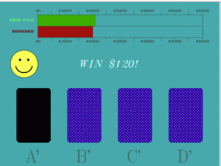
Half of the participants received breakfast before beginning the task, whereas the remaining group immediately began the Iowa Gambling Task, developed by University of Southern California’s Antoine Bechara, Antonio Damasio and Hannah Damasio, with Steven W Anderson of University of Iowa to simulate real-life decision making using uncertainty, rewards, and penalties.

Iowa Gambling Task

Iowa Gambling Task

Participants received four decks of cards and were told to earn as much money as possible and lose the least possible when they selected one card at a time.
Cards in decks A and B had a 100 Euro payoff, whereas those in decks C and D has a 50 Euro reward.

In addition, decks A and B also had cards with a larger penalty than in decks C and D.
Consequently, selecting cards from decks A and B resulted in a loss, whereas cards from C and D led to a gain.

Floor Kroese

Floor Kroese

Hungry participants selected more cards from decks C and D, leading to greater financial gains.
Similarly, hungry participants made equally astute decisions about long term payoffs when choosing between 50 Euros in 21 days instead of 27 Euros today.

People in a “hot” emotional state like hunger actually made better decisions involving uncertain outcomes because recognized the risks of loss associated with higher rewards, concluded de Ridder’s team.
This team’s findings contrasts to conventional belief that impulsivity impairs decision-making.

  • When do you make better decisions in “hot” states like “HALT”?

Follow-share-like http://www.kathrynwelds.com and @kathrynwelds

RELATED POSTS:

Twitter  @kathrynwelds
Blog – Kathryn Welds | Curated Research and Commentary
Google+
LinkedIn Open Group Psychology in Human Resources (Organisational Psychology)
Facebook Notes

©Kathryn Welds

Paradox of Potential vs Achievement in Job Search

Zachary Tormala

Zachary Tormala

When hiring or promoting, the person’s potential can trump actual accomplishments, according to Stanford’s Zakary Tormala, with Jayson Jia of University of Hong Kong and Harvard’s Michael Norton.

Jayson Shi Jia

Jayson Shi Jia

The paradox of potential occurs because possibility seems to engender greater interest and cognitive effort due to its uncertain outcome, in examples ranging across:

  • Basketball player evaluations,
  • Hiring decisions,
  • Salary offers,
  • Graduate school admissions recommendations,
  • Judgments of artistic talent,
  • Intentions to visit an untried restaurant.
Michael Norton

Michael Norton

Tormala and team demonstrated this effect by presenting identical statistics for a hypothetical NBA basketball player, then describing the data “predictions” or as “actual performance.”
Participants were more likely to judge that the player would become an All-Star player when they viewed “predicted” statistics rather than “actual” performance records.

Volunteers also evaluated a job applicant more favorably when the person performed well on an “Assessment of Leadership Potential rather than on an “Assessment of Leadership Achievement.”

Tormala’s group extended the investigation to evaluate impact of an upcoming comedian’s ”accomplishment” compared with “potential” when they posted different Facebook advertisements:

  • “Critics say he has become the next big thing”
  • “Critics say he could become the next big thing.”

The “potential” ads produced more than three times more click-throughs and five times more fan ratings.

In other studies, Tormala and team compared descriptions of an achievement and potential:

  • “This person has won an award for his work”
  • “This person could win an award for his work.”

“Potential” stimulated greater interest and cognitive information processing, resulting in more favorable reactions to the target person.

Derek Rucker

Derek Rucker

With Stanford colleague Daniella Kupor and Derek D. Rucker of Northwestern University, Tormala and Norton found that the preference for potential disappeared for people who don’t like uncertainty, and in situations that require higher degrees of certainty.

They noted that when people thoughtfully consider challenging decisions, such as in a Blackjack game, bystanders form positive impressions of others and become more willing to be influenced by them.
However, observers form negative opinions of people who “overthink” simple choices (demonstrate lack “thought calibration”), and are less willing to be influenced by them.

The appeal of potential applies to abstract enjoyable experiences, according to Southern Methodist University’s T. Andrew Poehlman and George Newman of Yale.

T Andrew Poehlman

T Andrew Poehlman

They found that the lure of “potential” makes people more likely to “consume inferior performances” in the present, but may not enjoy them.

Poehlman and Newman argued that “potential” is less influential when experienced in the past, and is less attractive when potential is associated with utilitarian dimensions.

George Newman

George Newman

These findings point to the value of:

  • Positioning one’s own “potential” as well as others’ “potential” to increase persuasiveness of support and advocacy,
  • Considering whether candidates with “potential” seem more appealing than those with greater experience – and whether potential is the appropriate selection criterion.

-*How frequently do you see people hired, promoted, and rewarded for “potential” instead of actual achievement?

Follow-share-like http://www.kathrynwelds.com and @kathrynwelds

RELATED POSTS:

Twitter @kathrynwelds
BlogKathryn Welds | Curated Research and Commentary
Google+ http:www.google.com/+KathrynWelds
LinkedIn Open Group Psychology in Human Resources (Organisational Psychology)
Facebook Notes

©Kathryn Welds

Gender Bias in STEM Hiring Even When it Reduces Financial Returns  

Women are under-represented in Science, Technology, Engineering, and Mathematics (STEM) academic programs and professional roles, and some question whether this is a a result of personal preference, implicit bias, institutional barriers, or other factors,

Ernesto Reuben

Ernesto Reuben

To investigate, Columbia University’s Ernesto Reuben, Paola Sapienza of Northwestern University, and University of Chicago’s Luigi Zingales developed an experimental job market.
Both male and female candidates demonstrated equal skill in performing an arithmetic task, yet both female and male “hiring managers” were twice as like to hire comparable male candidateseven when the hiring managers earned less by hiring less qualified males.
*Even when participants had a financial incentive to choose the candidate with the greatest task-relevant skills, they chose less-qualified male candidates.

Paola Sapienza

Paola Sapienza

Reuben and team also found that when candidates were asked to report their performance on the task-related achievement test, men exaggerated their performance with “honest overconfidence.”
In contrast, women generally underreported their accomplishments, found University of Wisconsin’s Sylvia Beyer.

Luigi Zingales

Luigi Zingales

This gender-based bias in hiring decisions was reduced, but not eliminated when candidates’ previous performance was provided by a third party.

Sylvia Beyer

Sylvia Beyer

Some candidates were directed to report expected future performance based on initial math task performance, then the “employer” made the hiring decision.
Other candidates provided no estimate, but Reuben’s team reported candidates’ past performance to the “hiring managers.”

In other studies, “employers” had no information on each “candidate’s” previous performance, but met each applicant in person before making a hiring decision.
After the hiring managers’ choice, candidates reported expected future performance, or Reuben’s team provided candidates’ past performance to the “hiring manager.”

Anthony Greenwald

Anthony Greenwald

Volunteers then completed the Implicit Association Test (IAT), developed by University of Washington’s Anthony Greenwald, Debbie McGhee, and Jordan Schwartz, to elicit unconscious stereotypes of gender, competencies, and occupations.

When the candidates reported their expected performance and the “hiring manager” chose a candidate with a lower score than other contenders, 90% of the selected but underperforming candidates were male.
As a result, “hiring managers” who selected less qualified male candidates sacrificed 5-7% of their own compensation for biased selections.

Pedro Rey-Biel

Pedro Rey-Biel

Reuben and colleagues, with Pedro Rey-Biel of Universitat Autònoma de Barcelona previously demonstrated that this preference for underperforming candidates was explained by the persuasive impact of men’s significantly exaggerated statements (usually by at least 30%) about past and future performance and by scores on the Implicit Association Test.

Hyperbole is apparently effective for male candidates in job interviews when the “hiring manager” scores high on the IAT.

However, this embellishment strategy is ineffective for women, as Reuben and team demonstrated:  In another study, women were still selected 33% less than expected even when they showcased their accomplishments.
Women’s overt self-promotion may provoke “backlash” against those who behave in counter-stereotypic ways.

This research suggests the prevalence of implicit biases against hiring women to perform science, technology, engineering, and mathematics (STEM) functions, and male candidates’ tendency to embellish past performance and boast about future potential accomplishments.

As a result, women are selected less frequently for roles in STEM careers, continuing their under representation in these fields.

Even if women do not exaggerate past accomplishments and future potential, this research implies that they should ensure that they communicate and reinforce the full range of skills.

“Real life” hiring managers can overcome implicit hiring biases through awareness and “proper information processing” by focusing on validated performance data, and comparing candidates of the same gender with each other..

-*What strategies have you seen mitigate the influence of implicit bias influence in hiring decisions?

Follow-share-like http://www.kathrynwelds.com and @kathrynwelds

RELATED POSTS:

Twitter @kathrynwelds
BlogKathryn Welds | Curated Research and Commentary

Google+  http:www.google.com/+KathrynWelds
LinkedIn Open Group Psychology in Human Resources (Organisational Psychology)
Facebook Notes

©Kathryn Welds
Gratitude Increases Financial Patience, Investment Earnings

Jennifer Lerner

Jennifer Lerner

Emotions affect personal financial decision-making, and negative emotions like anger and fear can lead people to make either risky or conservative financial choices, according to Harvard’s Jennifer Lerner.

David DeSteno

David DeSteno

With Northeastern University’s David DeSteno, Leah Dickens, University of California Riverside’s Ye Li, Lerner and Columbia University colleague Elke Weber noted that sadness increases impatience and leads to “myopic misery” – focus on immediate gain instead of more profitable longer-term options.

Leah Dickens

Leah Dickens

Lerner and team analyzed participants’ payoff choices when they were in an induced sad state or a neutral emotional condition compared with disgust as a control state.

Ye Li

Ye Li

On average, sad-state participants accepted between 13% and 34% less money to receive a payoff immediately (“present bias”) instead of waiting 90 days for a larger payment, confirming that induced sad feeling led to preference for immediate reward and less patience for a better but more distant payoff.

Elke Weber

Elke Weber

However, these sad volunteers were not more impatient in other generalized areas, suggesting that this effect focuses on impatience for rewards.
In contrast, the negative emotion of disgust did not result in greater impatience, pointing to the specific impact of sad feelings on payoff choices.

Cynthia Cryder

Cynthia Cryder

In a related study, Lerner and team evaluated the impact of induced positive emotions: Happiness and gratitude.
Again, participants could select a smaller, immediate payoff or larger payout later.

Induced gratitude enabled most volunteers to negotiate larger immediate rewards in exchange for giving up a larger, but more distant payment: “…the mean grateful participant required $63 immediately to forgo receiving $85 in three months, whereas the mean neutral or happy participant required only $55 immediately.

James Gross

James Gross

This trend was replicated in other studies by Lerner, Li, and Weber, who reported that average sad-mood participant was willing to accept $4 today instead of $100 in a year, whereas the average neutral-mood volunteer required more than four times as much$19 today to forego $100 in a year.
Another study estimated that sad volunteers accepted between 35% and 79% less money immediately instead of waiting for a future payoff.

Ronald Dahl

Ronald Dahl

This ”misery is not miserly” effect is influenced by the degree of “self-focus” or attention to personal impact in  an observed situation.
When volunteers were primed to focus on their personal reactions while experiencing induced sadness, they gave up more money to acquire a commodity compared with people who had neutral emotions or neutral self-focus, according to Lerner with Washington University’s Cynthia E. Cryder, James J. Gross of Stanford, and University of Pittsburgh’s Ronald E. Dahl.

Gratitude moderates “economic impatience” and suggests that affect-based interventions can help investors enhance financial decision making.

-*How do you manager the impact of transient emotional states on financial decision-making and risk-taking?

Follow-share-like http://www.kathrynwelds.com and @kathrynwelds

RELATED POSTS:

Twitter @kathrynwelds
BlogKathryn Welds | Curated Research and Commentary
Google+
LinkedIn Open Group Psychology in Human Resources (Organisational Psychology)
Facebook Notes

©Kathryn Welds

Racial Categorizations Change Based on Social Status Markers

Aliya Saperstein

Aliya Saperstein

Race is a changeable status marker of rather than a fixed individual attribute, according to Stanford’s Aliya Saperstein and Andrew Penner of University of California, Irvine.

Andrew Penner

Andrew Penner

Racial fluidity” – or changeable racial categorization – influences and is influenced by racial inequality in the United States, noted Saperstein and Penner.

They analyzed longitudinal U.S. national survey data collected over two decades and found that individuals’ racial classification, both rated by themselves and by others, changed over time in response to changes in social position.

In these data, unemployed, incarcerated, or impoverished Americans were more likely to be seen and self-identify as Black, even if the same individuals were originally classified in a different racial category.

Jonathan Freeman

Jonathan Freeman

Racial self-perception and racial perceptions by others depend on social position, even though most people believe that race is perceived in facial features, such as skin color.
However, social status cues around a face systematically change the perception of race, found Dartmouth’s Jonathan B. Freeman, Matthias Scheutz of Tufts, with Penner, Saperstein and her Stanford colleague, Nalini Ambady.

Matthias Scheutz

Matthias Scheutz

Participants categorized 16 computer-generated face identities (8 male) that were morphed along a 13-point race continuum, from White (morph −6) to Black (morph +6).
Developed by Max Planck Institute’s Volker Blanz and Thomas Vetter, this program generated 3D models based on laser scans of human faces.

Volunteers saw faces in a randomized order and evaluated them as White or Black using the keyboard, which recorded and analyzed mouse movement with MouseTracker software.

Participants rated the race of faces along “White–Black morph continua” when they saw faces with “high-status” attire (suit) or “low-status” attire (maintenance uniform).

“Low-status” attire increased the likelihood of categorization as Black, whereas “high-status” attire increased the likelihood of categorization as White, and this effect increased as physical characteristics associated with each race became more ambiguous.

The team  also monitored hand movements to determine hesitation in making a racial category decision.

They noted hesitation and shifting between choices when participants categorized faces with high-status attire as “Black” or faces with low-status attire as “White.”
Stereotypes interact with contextual and physical cues to shape “neutrally- plausible” person categorization, concluded Freeman and team.

When stereotypes associated with race and occupation categories overlap, contextual cues to occupation can activate social status stereotypes, then exert “top-down pressure” on the race categorization process.

For example, business attire can activate high-status stereotypes that influence visual processing of race-categorization.
Race categorization, therefore, could be driven by both “bottom-up” processing of facial features, and “top-down” stereotypes activated by contextual cues.

Racial fluidity reinforces stereotypic status differences by classifying “successful” or high-status people as “White” or “not Black” and “unsuccessful” or low-status people as “Black” or “not White.”

“Social cognition” can influence visual perception because “person perception…makes compromises between how other people “actually” appear and the stereotyped expectations dictating how they ‘should’ appear,” noted Freeman and team.

Aaron Gullickson

Aaron Gullickson

The U.S. briefly fluidity and ambiguity in racial classification when it adopted a “mulatto” category for the U.S. Census between 1870 and1920.

Saperstein and University of Oregon’s Aaron Gullickson noted that people categorized as “mulatto” in one census were re-categorized as Black in the next census, particularly when Southern men’s occupational status changed “downward” between censuses.

Like clothing, another non-racial factor – cause of death – influences racial classification, and can bias official U.S. statistics, according to Penner and UC Irvine colleague
Andrew Noymer with Saperstein in their analysis of a representative sample of U.S. death certificates.

Andrew Noymer

Andrew Noymer

They controlled for existing statistical reports by interviewing decedents’ next-of-kin regarding cause of death and racial classification.

Noymer’s team reported significant discrepancies between the two racial classifications by cause of death, with cirrhosis decedents more likely to be recorded as Native American and homicide victims more likely to be recorded as Black.

These findings are another example of interaction between changeable indicators of social status and seemingly fixed characteristics like physical appearance of race – both in forming perceptions of others and in defining oneself.

-*How have you adjusted your self-categorization based on occupational role and status over time?

Related Posts:

Follow-share-like http://www.kathrynwelds.com and @kathrynwelds

©Kathryn Welds


Paradoxical Bias against Innovative Ideas in the Workplace

Jennifer Mueller

Jennifer Mueller

Managers’ implicit attitudes and cognitive “mindset” during proposal presentations can bias organizational decision-makers against innovative solutions without their awareness, according to University of San Diego’s Jennifer Mueller with Shimul Melwani of University of North Carolina and Cornell University’s Jack Goncalo.

Shimul Melwani

Shimul Melwani

Mueller and team pointed out a paradox:  Most managers say they want innovative solutions to workplace issues from team members, yet often reject these creative ideas to reduce risk and uncertainty.

The team asked volunteers to rate a running shoe equipped with nanotechnology that improved fit and reduced potential to develop blisters.

Jack Goncalo

Jack Goncalo

They “primed” some participants toward increased uncertainty in this task by telling them that there were many potential answers to a problem.
In contrast, they cued another group with reduced uncertainty by instructing them that a problem required a single solution.

When volunteers who said they favored creative ideas experienced uncertainty, they preferred concepts of practicality on an implicit word association test, and associated “creativity” with negative concepts including “vomit,” “poison” and “agony.”

Uncertain participants also rated the shoe as significantly less creative than those in the more structured condition, suggesting that were less able to recognize a creative idea and held an unconscious “negative bias against creativity.”

Cheryl Wakslak

Cheryl Wakslak

In more recent work, Mueller collaborated with University of Southern California’s Cheryl Wakslak and Viswanathan Krishnan with University of California, San Diego to expand the idea assessment scenario with two ideas that were independently rated as “creative,” and two ideas judged “not creative.”

Vish Krishnan

Vish Krishnan

Mueller, Wakslak and Krishnan cued some participants to consider “why” in evaluating creative ideas, to evoke broad, abstract thinking, and “high-level construal.
They instructed other volunteers to think about “how” creative idea works, to stimulate narrow focus on practical details and logistics, and “low-level construal.”

Although participants in both groups rated two non-creative ideas similarly, those who adopted a “high-level construal” or a “why” mindset recognized creative ideas more often than those using the “how” mindset.

As an idea’s degree of creativity increases, uncertainty also increases about its feasibility, acceptability, and practicality.
This increased risk may reduce evaluators’ willingness to accept and advocate for an innovative idea, even when objective evidence is presented to validate a creative idea.

To mitigate the paradoxical rejection of creative ideas, organizational leaders can ask team members to consider “why” when creative evaluating proposals to enable “big picture” thinking and a broader construal level.

-*How do you encourage innovative solutions to work challenges?

Follow-share-like http://www.kathrynwelds.com and @kathrynwelds

RELATED POSTS:

Twitter  @kathrynwelds
Blog – Kathryn Welds | Curated Research and Commentary  

Google+
LinkedIn Open Group Psychology in Human Resources (Organisational Psychology)
Facebook Notes:

©Kathryn Welds

Emotional Music Can Lead to Biased Judgments

Joydeep Bhattacharya

Joydeep Bhattacharya

Emotions elicited by music influence can influence and even bias visual judgments, according to University of London’s Nidhya Logeswaran and Joydeep Bhattacharya.

They presented volunteers with short excerpts of “happy” music or “sad” music, then showed neutral, “happy,” and “sad” faces.
When people listened to a “happy” music, they were more likely to perceive faces as “happy” even when the face was neutral.
Similarly, the “priming” with “sad” music was associated with more ratings of faces as “sad,” even if they were neutral.

The team also observed the effects of musical “priming” in electrophysiological measures of brain potential components within 100 milliseconds after the faces were presented, suggesting rapid neuronal information processing.

Even if listeners’ perceptions and judgments can be biased by emotional music, listeners do not experience the precise emotions they hear in music.

Kiyoshi Furukawa

Kiyoshi Furukawa

Listeners can identify strong emotions conveyed by music, but do not experience the same degree or type of emotion, according to Tokyo University of the Arts’s Ai Kawakami and Kiyoshi Furukawa, who collaborated with University of Tokyo’s Kentaro Katahira and Kazuo Okanoya.

Kazuo Okanoya

Kazuo Okanoya

Kawakami and team distinguished “perceived emotion” from “felt emotion” in response to music, and presented two pieces of “sad” music (Mikhail Glinka’s “La Séparation” in F minor) and one piece of “happy” music to 44 volunteers, both musicians and non-musicians.

Mikhail Glinka

Mikhail Glinka

Participants rated their perceived emotions and felt emotions in response to each musical selection using 62 descriptions on a scale from 0 (not at all) to 4 (very much).
Although participants recognized the “sad” music’s negative emotions, most reported feeling “romantic,” and “blithe,” rather than negative or unpleasant.

Muzak

Muzak

“Muzak” (now Mood Media) audio in workplaces can evoke emotional responses that may lead to biased business decisions.

As long ago as the 1950s, concerned American citizens claimed that Muzak practiced “brainwashing” with its planned musical sequences in quarter-hour segments.

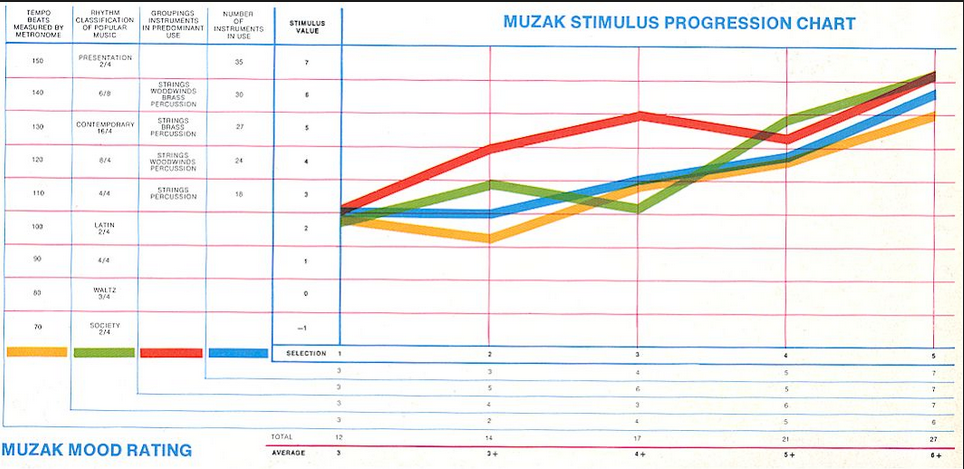
Muzak Stimulus ProgressionMuzak’s playlist is synchronized to time of day to “increase energy” at predicted low-energy times based on its patented “Stimulus Progression.
These 15-minute sequences feature about six songs with varying “stimuli values,” based on tempo, rhythm, instrumentation and orchestra size.
The next 15-minute period features silence.
Mood Media
Over a 24-hour period, tunes with higher “stimulus value” are played when people are typically “lethargic” – 11 a.m. and 3 p.m., and slower songs are played “after lunch” and at the end of the work day.
Muzak claimed that this programming “increases morale and productivity at workplaces, increase sales at supermarkets, and even dissuade potential shoplifting at department stores.”

The emotional tone of music may bias other cross-sensory judgments.
Adrian C. North, working at University of Leicester and Herriott Watt University, tested the effect of music in a supermarket on wine selections and olfactory/gustatory judgments wine’s properties.

North ensured that French accordian music or German Bierkeller brass band music were played on alternating days for two weeks at the supermarket.
French wines and German wines had similar prices and their order on the shelf was changed each day.

After 82 shoppers selected wines, an interviewer asked customers to complete a questionnaire about the purchase, including:

  • Preference for French or German wines
  • Extent to which the music brought to mind France or Germany
  • Degree to which the music influenced specific wine selection.

The results from 44 shoppers suggest that music influenced shoppers’ wine selections:  More French wine was sold when French music played (40 bottles of French wine vs 8 bottles of German wine), and more German wine was sold when German music played (22 bottles of German wine vs 12 bottles of French wine).

North concluded that barely audible music can implicitly, unconsciously affect thoughts, perceptions, decisions, and even buying action.

Charles Areni

Charles Areni

Music can trigger thoughts similar to the music’s mood, context, or speed, according to the Preference-for-prototypes model proposed by Macquarie University’s Charles Areni and David Kim of Texas Tech.

-*When have your judgments and performance been altered by ambient music?

Follow-share-like http://www.kathrynwelds.com and @kathrynwelds

RELATED POSTS:

©Kathryn Welds

Detecting Trustworthiness, Opening Your Mind?

Yaacov Schul

Yaacov Schul

-*Does mistrust increases willingness to consider new information, or “open-mindedness”?

When people mistrust information, they are more likely to consider alternative information and interpretations,  according to Hebrew University’s Yaacov Schul and Ruth Mayo, with Eugene Burnstein of University of Michigan.

Ruth Mayo

Ruth Mayo

Likewise, Ann-Christin Posten and Thomas Mussweiler of Universität zu Köln noted that “distrust frees your mind” by leading people to use non-routine cognitive strategies.”

Eugene Burnstein

Eugene Burnstein

Posten and Mussweiler reported that when volunteers participated in an “untrustworthy” interaction, they later provided less stereotypic evaluations of others in an unrelated task.

Ann-Christin Posten

Ann-Christin Posten

The research team replicated this effect when they influence volunteers’ expectations of others by “priming” participants with preliminary information that elicited stereotypes.

When people distrust information and interactions, they focus on dissimilarities and discrepancies,  which enables people to more carefully attend to individual differences that disprove stereotypes, according to Posten and Mussweiler.

Thomas Mussweiler

Thomas Mussweiler

Although trust may feel better, distrust can lead to more mindful observation, and reduced stereotyping.

-*How do people determine trustworthiness?

Princeton’s Alexander Todorov and Sean G. Baron with Nikolaas Oosterhof of Dartmouth presented volunteers computer model-generated faces  representing a range of trustworthiness while participants’ brains were scanned with fMRI.

Alexander Todorov

Alexander Todorov

Specific brain areas, the right amygdala and left and right putamen, became more active when participants’ viewed less trustworthy faces.

Sean Baron

Sean Baron

Faces judged most trustworthy and most untrustworthy faces were associated with greater brain activity in the left amygdala.
In contrast, moderately trustworthy faces evoked strongest responses in the medial prefrontal cortex and precuneus areas.

Nikolaas Oosterhof

Nikolaas Oosterhof

These findings pinpoint brain areas that lead to inferences of trust and distrust, and lead to relaxed or vigilant information processing strategies.

-*How do you determine trustworthiness for information and for people?
-*What helps you minimized stereotyped judgments?

 Follow-share-like http://www.kathrynwelds.com and @kathrynwelds
RELATED POSTS:

Twitter  @kathrynwelds
Blog – Kathryn Welds | Curated Research and Commentary  
Google+
LinkedIn Open Group Psychology in Human Resources (Organisational Psychology)
Facebook Notes:

©Kathryn Welds