Tag Archives: Bias

Knowing without Knowing – Implicit Learning in Action

Lyn Abramson

Lyn Abramson

Implicit learning – knowing without conscious awareness – has positive effects like accelerating foreign language learning and developing more secure computer authentication systems.
It also has negative consequences like prejudiced, biased decision-making.
All of these effects require sufficient sleep to enable memory consolidation of implicit learning.

Patricia Devine

Patricia Devine

When implicit learning leads to inaccurate beliefs about others, the result is often prejudiced behavior.
In contrast,  when biased perceptions are about one self, they can lead to feelings of depression, anxiety, or grandiosity, according to University of Wisconsin’s William T. L. Cox, Lyn Abramson and Patricia Devine with Steven Hollon of Vanderbilt.

Brian Nosek

Brian Nosek

A validated way to identify hidden beliefs about race, age, gender, weight, and more is the Implicit Association Test, developed by University of Virginia’s Brian Nosek, Mahzarin Banaji of Harvard and University of Washington’s Anthony Greenwald.
Mahzarin Banaji

Mahzarin Banaji

Banaji and Greenwald’s popular book provides numerous examples of frequently used thinking short cuts that lead to biased beliefs, decisions, judgments, and behaviors.

Anthony Greenwald

Anthony Greenwald

Similarly, most people make quick assessments of others based on appearance using habitual strategies that don’t account for perceptual limitations, noted journalist Joseph Hallinan, who summarized research on bias, misperceptions, and judgment errors.

Joseph Hallinan

Joseph Hallinan

He cited the impact of situational framing on decision making:  When a decision option is posed as a potential gain, most people are less inclined to take risky decisions.
However, they are more willing to take risks if the option is positioned as a possible loss.

Kara Morgan-Short

Kara Morgan-Short

Implicit language learning was demonstrated by “immersion” listening to multiple native speakers.
University of Illinois at Chicago’s Kara Morgan-Short teamed with Karsten Steinhauer of McGill University and Georgetown’s Cristina Sanz and Michael T. Ullman to conduct brain scans on these language learners, and found they showed “native-like language processing.”
By contrast, explicit grammar training did not improve language learning.

Karsten Steinhauer

Karsten Steinhauer

Likewise, implicit learning principles can increase computer security authentication, useful in high-security nuclear plants or military facilities that usually require the code-holder to be physically present.

Cristina Sanz

Cristina Sanz

Security can be compromised when attackers:

  • Steal the user’s hardware token,
  • Fake the user’s identify through biometrics,
  • Coerce the victim into revealing the secret key or password (“rubber hose cryptanalysis”).
Hristo Bojinov

Hristo Bojinov

Unconscious knowledge” is a highly secure approach to biometrics authentication, demonstrated by Stanford University’s Hristo Bojinov and Dan Boneh, collaborating with Daniel Sanchez and Paul Reber of Northwestern and SRI’s Patrick Lincoln.

They included implicit learning principles in a computer game to subliminally deliver a security password without the user’s conscious awareness of the password.

Paul Reber

Paul Reber

Players “intercepted” falling objects in one of six non-random positions on a computer game screen by pressing a key corresponding to the screen position.
The game repeated a hidden sequence of 30 successive positions more than 100 times during game play.

Players made fewer errors when they encountered this sequence on successive rounds, suggesting they implicitly learned the sequence.
Skill re-tests after two weeks demonstrated that players retained this learned skill, but they were unable to consciously reconstruct or recognize fragments of the planted code sequence.

Patrick Lincoln

Patrick Lincoln

Team Bojinov’s implicit learning game demonstrated a new method of highly secure authentication that resists “rubber hose cryptanalysis” by implicitly training the user to enact the password without conscious knowledge of the code.
Their new project analyzes the rate of forgetting implicitly learned passwords and optimal frequency of security authentication refresher sessions.

However, this innovation in security authentication is dependent on the authenticator having sufficient sleep to consolidate implicit learning in memory, found Innsbruck Medical University’s Stefan Fischer, I. Wilhelm, and J. Born, who examined sleep’s impact on implicit memory formation in children ages 7- 11 and 12 young adults between ages 20 and 30.

Fischer’s team measured serial reaction time task before and after eight implicit learning sessions concentrated on rules underlying grammatical and non-grammatical language structures.
Most volunteer responded quickly, demonstrating implicit rule understanding, even though they couldn’t explain why their performance improved.

When adult participants had an interval of sleep between training sessions, their response times were quicker.
In contrast, well-rested children did not show a similar performance improvement, suggesting that sleep actually interferes with implicit performance gains among children.

Implicit learning can boost performance, seemingly “effortlessly,” but requires sufficient sleep to consolidate longer term performance improvements.
These findings are another argument against sleep deprivation in “Crunch Time” all-night work marathons.

-*How do you capitalize on implicit learning to improve performance?

->*Follow-share-like www.kathrynwelds.com and @kathrynwelds

RELATED POSTS:

Twitter:  @kathrynwelds
Blog: – Kathryn Welds | Curated Research and Commentary
Google+
LinkedIn Open Group Psychology in Human Resources (Organisational Psychology)
Facebook Notes:

©Kathryn Welds

Clearly-Imagined Future Self Enables More Effective Goal Planning

Most people choose near-term payoffs over distant benefits, often leading to poor outcomes when the future arrives.

Hal Hersfield

Hal Hersfield

Many individuals have difficulty envisioning a personal future because a distant time horizon is more abstract than the tangible reality of an extended present.
This bias toward short-term rewards generally leads to inadequate planning for future eventualities, like health care and financial requirements.

However, making the intangible future more concrete alters this near-term preference.

Laura Carstensen

Laura Carstensen

Volunteers received a visual aid to clearly imagining a future self by viewing a current photo of themselves or a digitally-aged photo from the same present-day view in a study by NYU’s Hal Hershfield collaborating with Daniel Goldstein of London Business School, Stanford’s  William F. SharpeLaura CarstensenJeremy Bailenson, and Leo Yeykelis plus Jesse Fox of Ohio State University.

Jeremy Bailenson

Jeremy Bailenson

The team asked participants in each group to estimate the amount of their income they would save for retirement.
People who saw their aged photos said they would save substantially more money than those who saw the present-day image.

Leo Yeykelis

Leo Yeykelis

When participants interacted with realistic, immersive age-progressed renderings of themselves, they tended to defer present rewards for future monetary rewards.

Hershfield and collaborators argued that the aged photos are vivid, less-deniable glimpses of a personal future.
These images enabled people to more realistically imagine their distant future lives by enhancing their experience of “self-continuity” over time.

Jesse Fox

Jesse Fox

Financial planners, health care advisors, and life insurers have applied these findings by developing a commercial version of this future self-image, to enable people to develop more realistic savings and retirement strategies for a tangible future self.

Emily Pronin

Emily Pronin

Another team’s findings supported Hershfield’s suggestion that people view their future selves as “other” and alien rather than personally relevant and meaningful.

Christopher Olivola

Christopher Olivola

Princeton’s Emily Pronin, Christopher Olivola, now of University of Warwick and Kathleen Kennedy, now of Columbia, asked participants to estimate the amount of an unsavory liquid mixture they would be willing to drink immediately and in several months to advance scientific knowledge.
In addition, volunteers estimated the amount of this liquid that another participant should drink.

Kathleen Kennedy

Kathleen Kennedy

Most volunteers judged that they would drink more in the future and that others should drink about the same amount.
However, participants estimated that they would drink only about half as much if consumed immediately.

This suggests that judgments about the future self and unknown other people are similarly distant from the present self.

These time perception biases include:

  • Quasi-hyperbolic time discounting, which leads most people to make an inter-temporal choice for a smaller payoff in the present instead of a larger payoff in the future.
    They attributed this trend to discounting a less-imaginable future payoff for a more tangible, nearer-term benefit.
  • Affective forecasting errors, described in a previous blog post, leading to inaccurate predictions of future choices, preferences, emotional reactions, and behaviors due to:
    • Projection biasAssuming that a present state will occur at a future time in a different circumstance,
    • Impact bias Overestimating future emotional responses to adverse events, and underestimating adaptability and coping,
    • Narrow bracketing — Considering individual decisions and outcomes without reference to context or long-term additive effects with other decisions and circumstances.

-*How do you overcome biases to plan for future goals and needs?

RELATED POSTS:

Twitter:  @kathrynwelds
Blog: – Kathryn Welds | Curated Research and Commentary
Google+
LinkedIn Open Group Psychology in Human Resources (Organisational Psychology)
Facebook Notes:

©Kathryn Welds

Stigma Contagion When Women Predominate in Groups

Women in Engineering or Information Technology organizations may find themselves the only person using the women’s restroom, one advantage in light of well-documented workplace challenges associated with minority status.
Men face similar challenges when they work in Human Resources, Marketing, or Communications, where more women are employed.

Rosabeth Moss Kanter

Rosabeth Moss Kanter

Vicki Belt

Vicki Belt

Despite potential isolation of experiencing gender minority status, Harvard’s Rosabeth Moss Kanter advised women who wish to advance: ”avoid the Ps: Personnel, Public Relations, Purchasing, to avoid being “pigeonholed in a female ghetto.
This recommendation was validated by Vicki Belt, then of University of Newcastle, and noted that technical women often intentionally avoided female-dominated groups.

Tessa West

Tessa West

In fact, both women and men held implicit biases against women-dominated groups, found Research by NYU’s Tessa West, Madeline Heilman, Lindy Gullett, and Joe Magee with Corinne Moss-Racusin of Yale University.

Madeline Heilman

Madeline Heilman

The team organized five-person groups to perform “a male-typed cooperative task” as quickly as possible.
Groups differed in proportion of women to men:

  • 2 women and 3 men
  • 3 women and 2 men
  • 4 women and 1 man.
Lindy Gullett

Lindy Gullett

Groups with more women performed equally well as the group with more men.

Joe Magee

Joe Magee

However, when the number of women increased in the work groups, participants’ evaluations of  the group’s effectiveness decreased. Similarly, both women and men offered lower ratings participants’ contributions when more women were in the work group.
Both men and women in the same group judged their own team mates more harshly when their groups have a greater proportion of women.

Corinne Moss-Racusin

Corinne Moss-Racusin

Group gender composition also negatively affected team cohesiveness:  After 10 weeks, those who worked in groups with more women said they were less interested in working together again.

West and team suggested that women in work groups may be subject to “stigma-by-association,” when negative evaluations of a stigmatized individual spread to an associated individual.
As a result, men who work with women may be subject to a “contagion effect” and may be perceived as having similar stereotypic strengths and weaknesses.

Carol Kulik

Carol Kulik

Hugh Bainbridge

Hugh Bainbridge

The prevalence of stigma-by-association in the workplace was conceptualized by University of South Australia’s Carol Kulik with Hugh Bainbridge of University of New South Wales and University of Melbourne’s Christina Cregan in a “masculine” performance task.
Women were evaluated as less competent at “masculine” tasks, and this negative evaluation was also assigned all group members through stigma contagion.

Michelle Haynes

Michelle Haynes

NYU’s Heilman extended her work on women’s perceptions of their capabilities in an ingeniously-designed study with Michelle Haynes of the University of Massachusetts, Lowell.

They asked participants to work remotely with another person on tasks traditionally associated with a male role:  Acting as a managing supervisor at an investment company.
Volunteers were paired with male or female “partners,” but each volunteer actually acted alone without a teammate.

When female participants received positive group feedback, they “gave away” credit to men “teammates” unless their contribution was specific and indisputable.
However, women showcased their accomplishments when they worked with female “partners.”
Women systematically undervalued their contributions to group problem-solving when they collaborated on teams with men, but not when they work with other women.

This study demonstrated that women’s expectations and beliefs about their work contexts, themselves, their peers, and organizational superior influence how they construe group feedback on performance.
Women may continue to limit their advancement when they implicitly accept micro-inequities and limiting performance stereotypes.

Anita Wooley Williams

Anita Wooley Williams

An unexpected positive finding about women’s role in work groups emerged from work by Carnegie Mellon University‘s Anita Williams Woolley, with Christopher F. Chabris of Union College, and MIT’s Alexander Pentland, Nada Hashmi, and Thomas W. Malone, who demonstrated that the “collective intelligence” of collaborative group members exceeds the cognitive abilities of individual members.

Christopher Chabris

Christopher Chabris

In fact, the average and maximum intelligence of individual group members did not significantly predict the performance of their groups overall.

Alexander Pentland

Alexander Pentland

This means that a group’s performance is more dependent on interaction behaviors and norms than on individual cognitive capabilities.
These findings support Emotional Intelligence theory’s assertion that self-management and interpersonal behaviors are more important to individual achievement than measured intelligence.

Nada Hashmi

Nada Hashmi

Wooley’s team assigned nearly 700 volunteers to groups ranging between two and five members to work on visual puzzles, negotiations, brainstorming, games and complex rule-based design assignments.
Collective intelligence of each group accounted for only about 40 percent of the variation in performance on this wide range of tasks.

Thomas W. Malone

Thomas W. Malone

The remaining 60% contribution to collective intelligence depends on members’ “social sensitivity“:  Accurately perceiving each other’s emotions, and ability to more equally share conversational turns.
Groups with more women excelled in both capabilities, and the team noted that accurate social perception and conversational turn-taking skills that may be further developed with attention and effort.

-*How can workplace Inclusion and Diversity programs mitigate the impact of stigma-by-association?

RELATED POSTS:

Twitter:    @kathrynwelds
Blog – Kathryn Welds | Curated Research and Commentary 
Google+:
LinkedIn Open Group Psychology in Human Resources (Organisational Psychology)
Facebook Notes:

©Kathryn Welds

When Appearance Matters for Career Development

Linda Jackson

Linda Jackson

Numerous social science studies link perceived attractiveness with perceived competence and likeability, including a meta-analysis by Michigan State University’s Linda JacksonJohn E. Hunter and Carole N. Hodge.
They found that physically attractive people are perceived as more intellectually competent, based on their research on “status generalization” theory and “implicit personality” theory.

Women who wore cosmetics were rated more highly for attractiveness, competence, likability and trustworthiness when viewed for as little as 250 milliseconds.
However, when raters looked at the faces for a longer period of time, ratings for likability and trustworthiness changed based on specific makeup looks even though volunteers accurately distinguished between judgments of facial trustworthiness and attractiveness.

Nancy Etcoff

Cosmetics differentially affected automatic and deliberative judgments, found Massachusetts General Hospital’s Nancy Etcoff and Lauren E. Haley collaborating with Shannon Stock of Dana Farber Cancer Institute and Boston University’s David M. House as well as Sarah A. Vickery of Procter & Gamble.

Sarah Vickery

Sarah Vickery

Attractiveness was significantly related to positive judgments of competence, but had a less systematic effect on perceived social warmth.
Integrating these findings, the team concluded that attractiveness “rivets attention, and impels actions that help ensure the survival of our genes.”

Although most people recognize the bias inherent in assumptions that attractive people are competent and that unattractive people are not, this correlation is important in impression management in the workplace, as well as in the political arena.

-*Where have you seen appearance exert an influence in workplace credibility, decision-making and role advancement?

RELATED POSTS:


©Kathryn Welds

Implicit Discrimination Associated with Meritocratic Beliefs, Low Empathy

Michael Young

Michael Young

Americans more than other nationalities, embrace the idea of meritocracy – that rewards are distributed based on merit, a combination of ability + effort with success, described by University of London’s Michael Young with Sheri Kunovich of Southern Methodist University, and Ohio State’s Kazimierz M. Slomczynski.

Satya Nadella

Satya Nadella

Microsoft’s CEO, Satya Nadella, made headlines when asked his advice for women who are uncomfortable asking for a raise at the 2014 Grace Hopper Celebration of Women in Computing.
He told more than 12,000 women: “It’s not really about asking for a raise, but knowing and having faith that the system will give you the right raise … It’s good karma. It will come back.”

Although his response resulted in widespread criticism, he may have been referring to the social penalty women experience when negotiating for salary increases and promotions.

Hannah Riley Bowles

Hannah Riley Bowles

Harvard’s Hannah Riley Bowles with Linda Babcock and Lei Lai of Carnegie Mellon demonstrated this social penalty when they showed volunteers videos of men and women asking for a raise using identical scripts.
Participants agreed to give both genders a pay increase, but evaluated women as “too aggressive” and not someone they would want to work with.
However, men in these salary negotiation situations were seen as “likable.”

Emilio Castilla

Emilio Castilla

The unequal impact of merit-based compensation on minorities was demonstrated in MIT’s Emilio J. Castilla’s analysis of almost 9,000 employees in support roles at a large service-sector company.
The organization espoused commitment to diversity and had implemented a merit-based compensation system intended to reward high-level performance and equitably reward employees.

Lei Lai

Lei Lai

Despite these egalitarian goals, women, ethnic minorities, and non-U.S.-born employees received smaller increases in compensation compared with white men, despite holding the same jobs, having the same performance score, working in the same units for the same supervisors.

These results illustrated what he called the performance-reward bias – the need for minority groups “to work harder and obtain higher performance scores in order to receive similar salary increases to white men.”

Stephen Benard

Stephen Benard

With his Indiana University colleague, Stephen Benard, Castilla uncovered the paradox of meritocracy” – organizations that espouse meritocratic values awarded a larger monetary reward to male employees compared with equally performing female employees.

Despite their positive intentions and policies, these organizations perpetuated unequal evaluations and rewards across equally performing employee groups.

Eric Luis Uhlmann

Eric Luis Uhlmann

In fact, people who think they are the most objective exhibited greatest evaluation bias, found Northwestern’s Eric Luis Uhlmann and Geoffrey L. Cohen of University of Colorado.
They attributed this finding to overconfidence in objectivity, leading to lack of self-scrutiny and self-assessment of potential and implicit bias.

Corinne Moss-Racusin

Corinne Moss-Racusin

This bias was also demonstrated when volunteers provided significantly more positive evaluations of resumes were attributed to whites and men than identical resumes linked to minority-group members and women, reported by Yale’s Corinne A. Moss-Racusin, John F. Dovidio, Victoria L. Brescoll, Mark J. Graham, and Jo Handelsman.

John Dovidio

John Dovidio

Since egalitarian aspirations and performance management systems do not result in equitable reward distribution, MIT’s Castilla advocated increased transparency and accountability by creating a performance-reward committee to monitor compensation increases and to share information about pay segmented by gender, race, and nationality.
Five years after these changes were introduced in companies Castilla studied, he found that the demographic pay gap had disappeared.

Grit Hein

Grit Hein

Another way to reduce bias is to increase empathy, found Universität Bern’s Grit Hein, Jan B. Engelmann of Tinbergen Institute, and University of Zurich’s Philippe N. Tobler, with Marius C. Vollberg of University College London, in their study of 40 young men of Swiss or Balkan descent.

Participants and two research confederates received an electric charge on the back of the hand.
Next, one of the two confederates was attributed a typical Balkan name or a Swiss name, and was designated a “decision maker.”

Jan B. Engelmann

Jan B. Engelmann

Volunteers were then told they would receive “painful shocks,” but the “decision maker” could prevent this “by giving up money he would otherwise earn.”
Participants received help from the other person 15 times out of 20 trials, and received a shock five times.

Two new confederates, one with a Swiss name and one with a Balkan name, replaced the first two and the participant watched as one of them received the painful electrical pulses.
A brain scan measured the volunteers’s level of empathy for the person receiving the shock.

Philippe Tobler

Philippe Tobler

When the confederate with the Balkan minority name “helped” the participant avoid a shock by “sacrificing” a payoff, the volunteer’s brain scans demonstrated increased empathy for both the specific helper, and for other Balkan people.

The team interpreted this finding to suggest, “…empathy with an out-group member can be learned, and generalizes to other out-group individuals.”

If this trend can be replicated in the workplace by increasing organizational and managerial empathy for members of minority groups during the appraisal process, organizational rewards may be more equitably distributed.

-*How do you reduce bias in appraisal and reward processes?

Follow-share-like http://www.kathrynwelds.com and @kathrynwelds

Related Posts:

Twitter:  @kathrynwelds
Google+
LinkedIn Groups Psychology in Human Resources (Organisational Psychology)
Facebook
Blog: – Kathryn Welds | Curated Research and Commentary

©Kathryn Welds

 

Men Negotiate More Assertively with Women Managers

Ekaterina Netchaeva

Ekaterina Netchaeva

Men volunteers negotiated more assertively with women in supervisory roles in laboratory tasks, compared with strategies they used with male supervisors, reported Bocconi University’s Ekaterina Netchaeva, Maryam Kouchaki of Northwestern University, and Washington State University’s Leah D. Sheppard.

Maryam Kouchaki

Maryam Kouchaki

This cross-gender negotiation trend was reduced when woman in supervisory roles demonstrated directness and proactivity (“administrative agency”) rather than self-promotion and power-seeking (“ambitious agency”).

Leah D. SheppardThe team told 52 male and 24 female volunteers that they would negotiate their salary at a new job in a computer exercise with a male or female hiring manager.

After the negotiation, participants completed an implicit threat test by identifying words that appeared on a computer screen for a fraction of a second in a variation of the Implicit Association Test developed by Harvard’s Mahzarin Banaji and Anthony Greenwald of University of Washington.
Participants who chose more threat-related words like “fear” or “risk,” were inferred to feel more threatened.

Mahzarin Banaji

Mahzarin Banaji

Male participants who negotiated with a female manager selected more threat-related words on implicit association test, and they negotiated for a higher salary ($49,400 average), compared to men negotiating with a male manager ($42,870 average).

Linda Babcock

Linda Babcock

The manager’s gender didn’t affect female participants, who negotiated a lower salary ($41,346 average), reflecting a common trend where women tend not to negotiate, or to negotiate less vigorously, as noted by Carnegie Mellon’s Linda Babcock and Hannah Riley Bowles of Harvard.

Anthony Greenwald

Anthony Greenwald

In another experimental task, more than 65 male volunteers decided how to share a $10,000 bonus with a male or female team member or with supervisor.
Male participants tended to equally divided the money with male or female team members, but reacted significantly differently with a female supervisor.

Men who endorsed more threat-related words chose to keep more money for themselves when the supervisor was female, compared with when they were paired with a male supervisor.

Hannah Riley Bowles

Hannah Riley Bowles

A related online survey of 226 male and 144 female volunteers found that male participants decided to keep a larger share of the $10,000 bonus when the female manager was described as ambitious or power-seeking, but responded significantly more favorably when the female supervisor was described as proactive or ambitious.
In the latter case, male volunteers offered approximately the same bonus amount to female managers.

This suggests that women managers with male direct-reports enhance these relationships by adopting a consciously direct leadership style, characterized by consistent communication, and proactive problem-solving.

Netchaeva’s group posits that women who adopt a direct, active leadership style reduce threat in cross-gender reporting relationships, and enable greater cooperation in bargaining and negotiation situations.

-*To what extend have you observed evidence of implicit threat responses in cross-gender workplace reporting relationships?

Follow-share-like http://www.kathrynwelds.com and @kathrynwelds

Related Posts:

©Kathryn Welds

Recalling Supportive Relationships Can Reduce Dislike of Outsiders

Animosity toward perceived outsiders remains a powerful driver of political attitudes and aggressive behavior toward out-groups, even in diverse societies.

Muniba Saleem

Muniba Saleem

However, intergroup discord can be reduced by recalling times of connection to supportive others, found University of Michigan’s Muniba Saleem collaborating with Sara Prot, Ben C. P. Lam and Craig A. Anderson of Iowa State, plus Harvard’s Mina Cikara and Margareta Jelic University of Zagreb.

John Bowlby

John Bowlby

Their study is based on observations by John Bowlby of London’s Child Guidance clinic and his protégée, University of Virginia’s Mary Ainsworth, that healthy social and emotional functioning depends on healthy attachment to at least one reliably supportive person in childhood.

Mary Ainsworth

Mary Ainsworth

Saleem’s team confirmed that evoking early positive memories of attachment can modify aggressive thoughts and behaviors based on fear and insecurity, particularly among those strongly identified with their in-group.

Muzafer Sherif

Muzafer Sherif

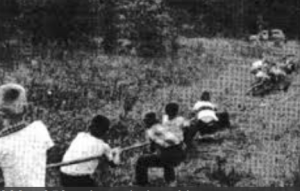
This approach proved more effective than earlier prejudice-reduction techniques requiring different groups to work together on shared goals such as in Muzafer Sherif’s Robber’s Cave experiment with University of Oklahoma colleagues O. J. Harvey, B. Jack White, William R. Hood, and Carolyn W. Sherif.
Saleem’s intervention produced more robust attitude change because it  reduced fear that can lead to aggression.

Muzafer Sherif - Robber's Cave

Team Tasks at Robber’s Cave

In Team Saleem’s experiments, more than 275 people from University of Michigan had the opportunity to undermine counterparts from a rival school, Ohio State, with no negative personal consequences.

Sara Prot

Sara Prot

Participants completed surveys of their propensity for attachment anxiety and avoidance of close relationships.
Then, half described someone “who loves and accepts you in times of need” while the remaining volunteers described a person “who lives in your neighborhood, but you do not know well.”

Craig Anderson

Craig Anderson

Next, University of Michigan participants assigned 11 puzzles of varying difficulty to an Ohio State student, who could win a $25 gift card by completing all the puzzles within 10 minutes.
University of Michigan volunteers could reduce the likelihood of the OSU student winning the gift card by assigning more challenging puzzles.

Mina Cikara

Mina Cikara

Those who strongly identified with University of Michigan and who were primed to think about the close, loving personal relationship were significantly less likely to assign difficult puzzles.
This result suggests that the positive emotional memory reduced the impulse to undermine a rival’s positive outcome even with a strong in-group preference.

In a related study, more than 260 Americans recalled one of several situations:

  • Someone close was available, supportive, and loving,
  • Typical, uneventful workday,”
  • When you accomplished a meaningful goal.”

Islamic State of Iraq and Syria

Islamic State of Iraq and Syria

Saleem’s team tested related scenarios closer to current geo-political concerns:  Volunteers in the US reported their reactions to the terrorist group Islamic State of Iraq and Syria (ISIS).
Their descriptions included “angry,” “disgusted,” and “fearful.”

Finally, participants indicated their degree of support for “militaristic and aggressive policies intended to counter terrorism,” such as “I think it is OK to bomb an entire country if it is known to harbor ISIS terrorists.”

Gordon Moskowitz

Gordon Moskowitz

Volunteers prompted to recall a secure attachment were less likely to support military and aggressive measures against ISIS members and demonstrated significantly reduced negative stereotypes and negative emotions.

This effect was not due to increase positive mood because participants who recalled the positive experience of accomplishing an important goal responded significantly more aggressively.

Irmak Olcaysoy Okten

Irmak Olcaysoy Okten

Though promising, the impact of this work may be limited to those who have the advantage of experiencing close, secure relationships.
People who have missed these experiences are more likely to express prejudice, lack of remorse for aggression toward others.
In addition, cross-school rivalry and fears of terrorists are at least partially condoned, whereas racial and cultural prejudices are socially unacceptable to many.

As a result of social disapproval, some prejudices becomes implicit or unconscious.
They can be detected only through indirect measures such as the Implicit Association Test, and more recently, by evidence of biased time perception accompanying racial prejudice.

Cynthia Gooch

Cynthia Gooch

For example, White people who were concerned about appearing racially prejudiced were asked to judge the length of time they viewed faces of White men and Black men.
These White volunteers thought that time passed 10% more slowly than measured by clock time: They reported viewing faces of Black men for longer than they actually had, found Lehigh University’s Gordon B. Moskowitz and Irmak Olcaysoy Okten with Cynthia M. Gooch of Temple University.

Perceptual bias about time is also relevant to high stakes situations including perceived duration of job interviews for candidates of a different race than the interviewer, and physicians’ perception of the length of medical encounters.

This intergroup perceptual bias also can have significant consequences when white police officers’ estimate the duration of an encounter with a suspect of another race, and when they determine lethal force should be initiated.

First Person Shooter Task

First Person Shooter Task

This research reinforces the importance of early and later supportive relationships in reducing bias, subtle undermining, and over aggression toward other groups

-*How do you reduce prejudice and aggression across work teams?

Follow-share-like http://www.kathrynwelds.com and @kathrynwelds

Related Posts:

Twitter:  @kathrynwelds
Google+LinkedIn Groups Psychology in Human Resources (Organisational Psychology)
Facebook
Blog: – Kathryn Welds | Curated Research and Commentary

©Kathryn Welds

Thinking in a Second Languages Reduces Decision Bias 

Boaz Keysar

Boaz Keysar

People who can think in a foreign language are more able to rationally analyze risk compared with evaluating risk in their native language, found University of Chicago’s Boaz Keysar, Sayuri L. Hayakawa, and Sun Gyu An.

Sayuri Hayakawa

Sayuri Hayakawa

When volunteers analyzed risks presented in their native language, they were risk-averse when considering potential gains and more risk- tolerant when considering possible losses.
However, they were did not show this risk assessment bias when they considered the same risks vs rewards in a foreign language.
Using a foreign language reduced loss aversion and increased acceptance of hypothetical and real bets with positive expected values.

Micheline Favreau

Micheline Favreau

This effect could occur because foreign languages are typically processed more slowly than in a native tongue, leading to more deliberate cognitive processing, argued Concordia University’s Micheline Favreau and Norman Segalowitz.

Norman Segalowitz

Norman Segalowitz

Foreign language processing generally requires greater cognition-intensive systematic, analytical effort, leading to increased emotional and cognitive distance than in a native tongue, suggested Princeton’s Daniel Kahneman in his distinction between Thinking Fast and Slow.

Stefano Puntoni

Stefano Puntoni

Even when people fully understand language nuances including colloquialisms, impolite words, terms of endearment and reproach, they react less emotionally in a foreign language, according to self-report and electrodermal measurements, found Erasmus University’s Stefano Puntoni, Bart de Langhe of University of Colorado, and Cornell’s Stijn M.J. van Osselaer.
As a result, more than half the participants preferred the riskier option presented in a foreign language instead of the native tongue.

Richard Thaler

Richard Thaler

This finding confirmed participants’ tendency toward myopic risk aversion, or greater sensitivity to losses when thinking and acting in their native languagedescribed by University of Chicago’s Richard Thaler, Amos Tversky of Stanford, Princeton’s Kahneman, and Alan Schwartz of University of Illinois.

Amos Tversky

Amos Tversky

Among more than 140 native Korean speakers and more than 100 English speakers in Paris, Keysar’s team confirmed the same pattern of enhanced deliberation and reduced framing effects in a foreign language in hypothetical low-loss, high-gain bets.
Just 57 percent of Korean-speaking participants accepted bets offered in Korean, contrasted with 67 percent when offered in English, suggesting heightened deliberation in a second language.

Daniel Kahneman

Daniel Kahneman

Likewise, more than 50 English-speaking volunteers who spoke Spanish as a second language received $15 in $1 bills, which could be kept or bet on a coin toss.
For every lost toss, participants lost $1.
However, if they won, they kept the $1 and earned another $1.50, a significant return on the chance bet.
When conducted in participants’ native English language, 54% accepted bets, whereas when presented in Spanish, 71% agreed to bet.

Alan Schwartz

Alan Schwartz

“They take more bets in a foreign language because they…are less affected by the typically exaggerated aversion to losses … People who routinely make decisions in a foreign language rather than their native tongue might be less biased in their savings, investment, and retirement decisions, as a result of reduced myopic loss aversion” wrote Keysar and colleagues.

-*How do you reduce “myopic risk aversion” in your native language?

Follow-share-like http://www.kathrynwelds.com and @kathrynwelds

Related Posts:

Twitter: @kathrynwelds
Google+
LinkedIn Groups Psychology in Human Resources (Organisational Psychology)
Facebook

Blog: – Kathryn Welds | Curated Research and Commentary

©Kathryn Welds

Managing Collective Emotions Affects Leader Reputation, Impact

Gustave Le Bon

Gustave Le Bon

People in groups and crowds demonstrate collective affect, according to Gustave Le Bon, who asserted that individuals in these contexts collectively act with “impulsiveness, irritability, incapacity to reason, the absence of judgment of the critical spirit, the exaggeration of sentiments…” even if these are not their usual individual behaviors.

Adolph Hitler

Adolph Hitler

Well before the rise of charismatic leader Adolph Hitler, Le Bon claimed that “…an individual immersed for some length of time in a crowd soon finds himself…. in a special state, which much resembles the state of fascination in which the hypnotized individual finds himself in the hands of the hypnotizer.

One way to evaluate individual and collective affect is through facial expressions because they provide information about how others understand people and events.
As a result, these non-verbal cues enable people to tailor responses to individuals and groups they encounter.

Peter Salovey

Peter Salovey

Tailoring interaction style based on observing others is a key element of Emotional Intelligence, described by Yale’s Peter Salovey and Daisy Grewal as accurately perceiving others’ emotional states and effectively responding with emotionally-charged interpersonal situations.

Daisy Grewal

Daisy Grewal

This is also an essential leadership skill because it enables awareness of sentiments that may be out of others’ awareness or that they may consciously try to suppress to align with prevailing organizational cultures — particularly those that do not encourage emotional awareness and expression.

Hillary Anger Elfenbein

Hillary Anger Elfenbein

Consequently, accurate perception of others’ emotions is related to effectively managing interpersonal relationships according to University of California, Berkeley’s Hillary Elfenbein and to subordinates’ ratings of managers as transformational leaders in research by Depaul University’s Robert S. Rubin, David C. Munz of Saint Louis University and Cleveland State University’s William H. Bommer.

However, accurate perception of group sentiment is difficult because many people narrow attention to a few individuals and to focus in detail on them, leading to perceptual bias of collective “tunnel vision.”

Takahiko Masuda

Takahiko Masuda

As a result, much information in social context, including the group’s prevailing emotional tone, may be filtered out, noted University of Alberta’s Takahiko Masuda, Phoebe C. Ellsworth of University of Michigan, Wake Forest University’s Batja Mesquita, Janxin Leu of University of Washington, Hokkaido University’s Shigehito Tanida, and Ellen Van de Veerdonk of University of Amsterdam.

Executives and leaders must decode and attend to collective emotions because they often cannot develop individual relationships with each of their many stakeholders and when addressing group emotions including:

Phoebe Ellsworth

Phoebe Ellsworth

  • Employees’ collective anxiety about corporate restructuring, mergers, divestitures, and reductions in force,
  • Consumers’ collective anger,
  • Board of Directors members’ lack of support.
Jennifer George

Jennifer George

Positive collective emotions tend to be over-estimated, and linked to greater customer service and lower absenteeism, reported Texas A & M’s Jennifer George.
In contrast, negative collective emotions like envy are easily under-estimated, and associated with lower group performance and satisfaction by reducing group potency and cohesion in research by University of Kentucky’s Michelle Duffy and Jason Shaw.

Michelle Duffy

Michelle Duffy

A leader’s ability to respond effectively to patterns of shared emotions during strategic organizational change and other emotionally turbulent organizational processes depends on the leader’s ability to widen the “emotional aperture.”

Emotional Aperture 1Like a camera’s aperture adjustment for increased depth of field, emotional aperture refers to ability to recognize the mix of positive and negative emotional experiences in a team, workgroup or business unit.

This “setting change” can bring into focus both nearby individuals and more distantly scattered groups of people.
Likewise, adjusting the emotional aperture involves moving an information-processing focus from individual emotional experiences to a group’s collective emotional composition.

David Matsumoto

David Matsumoto

Although ability to recognize individual emotional expression has been measured by instruments like the Brief Affect Recognition Testthis tool doesn’t evaluate perception and recognition of collective affect.

Jeffrey Sanchez-Burkes

Jeffrey Sanchez-Burkes

To address this limitationUniversity of Michigan’s Jeffrey Sanchez-Burks and Caroline A. Bartel of University of Texas collaborating with Vanderbilt University’s Laura Rees and Quy Huy of INSEAD developed an Emotional Aperture Measure (EAM).

EAM analyzes a person’s ability to accurately perceive a group’s collective emotions in short video clips of employee groups before and after an organizational event.
Next, participants estimate the proportion of rapid individual positive and negative reactions among group members.
Feedback from this instrument can increase perceiver accuracy through heightened awareness.

Caroline Bartel

Caroline Bartel

Sanchez-Burks contacted direct reports of a global sample of high-ranking managers and requested online evaluations of the manager’s leadership performance.
Three studies demonstrated that collective affect recognition requires a distinct information processing style, differing from perceiving individual emotion.

Laura Rees

Laura Rees

Managers’ EAM performance was significantly correlated with direct reports’ perception of managers’ “transformational leadership” behaviors, suggesting that this ability to accurately perceive group emotion can significantly influence stakeholder impressions and opinions.

People can open their emotional aperture through attention to collective emotions, and may influence prevailing negative group affect by asking the positive minority to share optimistic sentiments with the skeptical majority.
This dialog can increase trust and shared perspectives that may move negative sentiment to become more positive.

Quy Huy

Quy Huy

Leaders who increase the range of their “emotional aperture” can increase followers’ alignment with strategic direction to increase the likelihood to effective execution and change impact.

Try the Emotional Aperture Measure to see your results.Emotional Aperture Measure

-*How do you read the “emotional tone” of a group?

Related Posts:

©Kathryn Welds

Debiasing Decisions: Combat Confirmation Bias, Overconfidence Bias

Philip Meißner

Philip Meißner

Cognitive and behavioral biases can contribute to “blind spots” in decision-making, leading to less effective outcomes.
To improve decision outcomes, University of Marburg ’s Philip Meißner, Torsten Wulf of HHL Leipzig Graduate School of Management and HEC’s Olivier Sibony proposed a systematic checklist to identify potential decision derailment based on bias, along with rapid remedies.

Torsten Wulf

Torsten Wulf

They argues that two types of bias contribute to most decisions that lead to undesirable results:

  • Confirmation bias, the unconscious tendency to believe new information that is consistent with existing beliefs and recent experiences, and to discount contradictory data,
  • Overconfidence bias, the out-of-awareness likelihood to overestimate one’s skills, insights, and judgment.
    This leads to increased risk-taking based on illusory sureness of the decision and ability to mitigate adverse outcomes.

Olivier Sibony

Olivier Sibony

Previously, Lovallo and Sibony articulated four related decision biases:

  • Pattern-recognition biases, countered by changing the “angle of vision,”
  • Action-oriented biases, mitigated by recognizing uncertainty,
  • Interest biases, minimized by explicitly highlighting these interests,
  • Social biases, reduced by depersonalizing debate.

Debiasing techniques such as checklists, can limit the negative effects of biases in decision-making by offering a disciplined, comprehensive analysis of downside risks and by systematically considering multiple viewpoints.

Atul Gawande

Atul Gawande

However, effectively implementing checklists requires consistent discipline, noted Harvard’s Atul Gawande, who cited examples of partial adherence leading to costly oversights and failures.

One approach, suggested by Princeton’s Daniel Kahneman and Gary Klein of McKinsey, is a “premortem.”
Decision makers imagine that the decision has failed and analyze sources and reasons for adverse outcomes, to more thoroughly assess points of failure and possible mitigation strategies.
Formal scenario-planning is another way to expose assumptions underlying a plan, as well as a competitor’s priorities and potential strategy.

Massimo Garbuio

Massimo Garbuio

Using a variety of debiasing techniques significantly increased the Return on Investment (ROI) in a study by University of Sydney’s Massimo Garbuio and Dan Lovallo and Olivier Sibony of HEC.
As a result, Michael Birshan, Ishaan Nangia, and Felix Wenger of McKinsey, argued that debiasing techniques should be embedded in formal organizational decision-making processes, particularly for high-impact, repetitive decisions.

Michael Birshan

Michael Birshan

Decision biases may be out of awareness, or unconscious, so it’s more effective to evaluate the process of developing a proposal, rather than focusing only on the content and merits of a proposal.

Decision-making safeguards can be built into standard analysis processes by including questions to expose:

  • Multiple data sources,
  • Diverse opinions and perspectives,
  • Downside risk,
  • Potential negative outcomes for company, industry, and broader ecosystem.

Daniel Kahneman

Daniel Kahneman

Proposals are considered ready for a decision only when multiple perspectives are available to mitigate confirmation bias and risk analysis is available to reduce overconfidence bias.
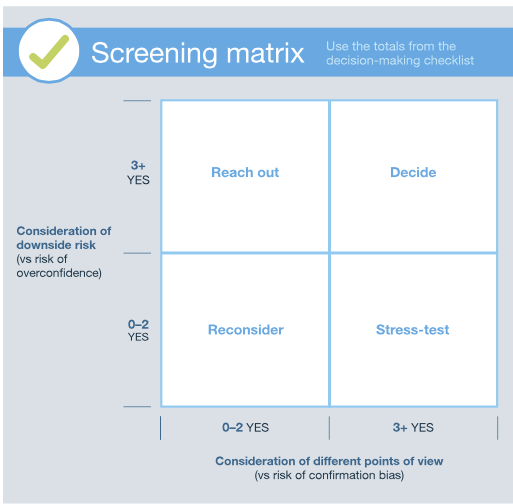
Responses to decision checklist questions can be quantified to indicate one of four action steps, according to Daniel Kahneman:

  • Decide, based on inclusion of robust safeguards against both confirmation bias and overconfidence bias,
  • Screening MatrixReach out, suggesting the need for gathering additional perspectives, opinions, and perspectives to prevent narrow assumptions to reduce confirmation bias.
    The Vanishing-Options Test, proposed by Stanford’s Chip Heath and Dan Heath of Duke University, can generate new ideas by imagining that none of the current proposals are available.
  • Stress-test, by conducting a pre-mortem or analysis by external devil’s advocate or provocateur to reduce overconfidence risk by.
  • Reconsider when both more perspectives and risk analysis are required to reduce both overconfidence bias and confirmation bias.
    This screening matrix helps reduce related decision-making biases:
  1. Self-interest Bias
    -To what extent is the proposal motivated by self-interest?

Ishaan Nangia

Ishaan Nangia

Recommendation
-Assess for over-optimism

  1. Affect Heuristic
    -How strong is the team’s emotional attachment to a specific proposal?
    -To what extent were risks and costs fully considered for both preferred and non-preferred options?

Recommendations
-Assess for strongly-preferred outcomes
-Reintroduce analysis of all options

  1. Groupthink
    -How many dissenting opinions were analyzed?
    -How adequately were all options explored?
    -Was dissent discouraged? 

Felix Wenger

Felix Wenger

Recommendations
-Encourage substantive disagreements as a valuable part of the decision process
-Solicit dissenting views from members of the recommending team, through private meetings

4. Saliency Bias
     -To what extent are decisions made based on a potentially incomparable, but memorable success?
     -What about the proposed analogy is comparable to the current situation?
     -What are relevant examples from less successful companies? What happened in those cases?

Decision Making QuestionsRecommendation
-Carefully scrutinize analogies’ similarity to the current decision situation
Solicit additional analogies using reference class forecasting:

.Select reference class,
.Assess distribution of outcomes,
.Intuitively estimate project’s position in distribution,
.Assess estimate’s reliability,
.Correct intuitive estimate.

  1. Confirmation Bias
    -What viable alternatives were included with the preferred recommendation?
    -At what stage in the decision analysis were alternatives discarded?
    -What efforts were undertaken to seek information to disconfirm the main assumptions and hypotheses?

Recommendation
-Request two additional alternatives to the main recommendation, including analysis of benefits and drawbacks
-Acknowledge unknowns, risks

  1. Availability Bias

    Max Bazerman

    Max Bazerman

    If you had more time to gather date, what information would you seek?, asked Harvard’s Max Bazerman
    -How can you access similar data now?

Recommendation
-Use checklists to ensure comprehensive analysis of data required for each decision type

  1. Anchoring Bias
    -What data sources are used to analyze decision?
    -Which data are estimates? By whom? If so, from which data were estimates extrapolated?
    -To what extent could there be:
  • Unsubstantiated numbers?
  • Extrapolation from non-equivalent previous situations?
  • Attraction to specific anchors?

Recommendations
-Present data from other sources, benchmarks, or models
-Request new analysis

8. Halo Effect
     -To what extent does the analysis team expect that a person, organization, or approach previously successful in one context will be equally effective in different situation?

Phil Rosenzweig

Phil Rosenzweig

Recommendations
-Question potentially inaccurate inferences
-Solicit additional comparable examples
-Question attributions of success and failure to leaders’ personalities instead of chance factors, advised IMD’s Phil Rosenzweig.

9. Sunk-Cost Fallacy, Endowment Effect
     -To what extent are recommenders attached to past decisions?

Recommendation
Disregard past expenditures when considering future costs and revenues

  1. Overconfidence, Planning Fallacy, Optimistic Biases, Competitor Neglect
    -To what extent is the comparison case unwarrantedly optimistic?

Recommendation
-Adopt an outside view by using relevant simulations or war games

  1. Disaster Neglect
    -To what extent is the worst case scenario realistically and sufficiently negative?
    -How was the worst case generated?
    -To what extent does the worst case consider competitors’ likely responses?
    -What other scenarios could occur?

Recommendation
-Conduct a premortem, suggested by Gary Klein of Applied Research Associates:  Imagine the worst case scenario occurred, then propose likely causes, mitigations   

  1. Loss Aversion
    -To what extent is the evaluation and decision team risk averse?

Recommendation
-Realign incentives to share responsibility for the risk or to reduce risk

  1. Planning Fallacy focuses only on the current case while ignoring similar projects’ history and statistical generalization from related cases.
    -To what extent does the analysis rely on “top-down, outside-view” comparisons to similar projects?
    -Did the evaluators use a “bottom-up, inside-view” to estimate time required for each step?

Recommendation
-Statistically analyze a broad range of similar cases to avoid over-estimates from “top-down, outside-view” approaches and underestimates from “bottom-up, inside-view”
-Differentiate accurate forecasts from ambitious targets

  1. Loss aversion
    -To what extent are evaluators more concerned with avoiding loss than achieving gains?
    – How concerned are evaluators with being held responsible for a failed project?
    -To what extent has the organization specified acceptable risk levels?

Recommendation
-Seek risk tolerance guidelines from organizational leaders.

Decision-making tools like checklists can significantly reduce unconscious biases, provided that they are consistently and systematically applied.

-*What strategies have you found most helpful in reducing biases in decision-making?

Follow-share-like http://www.kathrynwelds.com and @kathrynwelds

Related Posts:

Twitter:  @kathrynwelds
Google+LinkedIn Groups Psychology in Human Resources (Organisational Psychology)
Facebook
Blog:  Kathryn Welds | Curated Research and Commentary

©Kathryn Welds