Category Archives: Thinking

Thinking

Does Music Increase Risk-Taking, Ethical Lapses?

John DrydenJohn Dryden

John Dryden

What passion cannot Music raise and quell?” asked English poet, playwright, and critic John Dryden in A Song for St. Cecilia’s Day, 1687.

More recently, researchers have identified that music can increase risk-taking and ethically questionable behaviors in experimental settings.

Marja-Liisa Halko

Marja-Liisa Halko

Listening to preferred music was associated with increased risk-taking in a study of 23 adolescents ages 12 to 17 conducted by University of Helsinki’s Marja-Liisa Halko and Markku Kaustia of Aalto University.
Participants identified favorite and most disliked songs, and these tracks provided alternating background music during 16 opportunities to gamble for real money in trials with varying risk.

Volunteers could choose whether to participate or pass on gambles that offered a 50-50 chance to win or lose money.
If they accepted a gamble marked “plus 1.50, minus 1.20,” they had a 50 percent chance of winning 1.5 Euros, and a 50 percent chance of losing 1.2 Euros.
Preferred music was played during 64 gambles, whereas disliked music provided the auditory background during 64 other trials, and another 128 gambles were conducted in silence.

Markku Kaustia

Markku Kaustia

Participants accepted more risky gambles when their favorite music played, and they accepted fewest high risk gambles when accompanied by disliked tunes. These findings suggest that preferred music increases money’s “marginal utility” or additional satisfaction a consumer gains from “consuming one more unit of a good or service.”

Favorite music seemed to encourage people to “do what it takes” to earn more money, even if it involves greater risk and potential loss.

Naomi Ziv

Naomi Ziv

Many people prefer up-tempo music due to its mood-enhancing effects, yet upbeat music may have a darker side:  It can move people to harm others, found NYU’s Naomi Ziv.

More than 100 volunteers spent 90 seconds trying to underline all vowels in an unclear photocopied page of text.
One-quarter of the participants completed the task in silence, while the others heard one of four upbeat musical numbers, including James Brown’s I Feel Good while they finished the job.

Erica Nadera

Erica Nadera

Ziv’s team asked volunteers to inconvenience and disappoint their peers by telling saying that other volunteers couldn’t participate in a study required for academic credit because the researcher didn’t feel like staying during the experiment.

In another study, Ziv’s team asked voluntary participants to tell another volunteer who had been seriously ill that the researcher would not provide previously-promised course material, again because the researcher didn’t feel like doing so.

Steven Brown

Steven Brown

People who heard upbeat music played in the background were significantly more willing to provide the ethically dubious excuse to another volunteer compared with people who completed the task in silence.

Ulrik Volgsten

Ulrik Volgsten

Effective manipulation through music, including its use in advertising and in torture were summarized by Erica Nadera of Rutgers, while MacMaster University’s Steven Brown and Ulrik Volgsten of Örebro University assembled academic articles on music’s social uses and social control processes.

Daniel Västfjäll

Daniel Västfjäll

The specific mechanism to trigger changes in individuals’ experienced affective processes has been called including “musical mood induction procedure” (MMIP) by Linköping University’s Daniel Västfjäll in his review of research demonstrating music’ effect on peoples’ moods and emotions.

Emmett Velten

Emmett Velten

The most frequently-used mood induction procedure was developed by University of Southern California’s Emmett Velten and typically asks participants to read 60 self-referent statements including “This is great, I really do feel good” (elated condition), “I have too many bad things in my life” (depressed condition), and  “This book or any part thereof must not be reproduced in any form” (neutral condition).

However, this approach’s validity and reliability are limited by demand characteristics biasing results because the experimenters’ expectations suggest an implicit demand for specific performance requirements.

David M Clark

David M Clark

As a result, University of Oxford’s David M. Clark developed the Musical MIP eliciting depressed, neutral, and elated mood conditions based on music, and University of Oxford colleague Maryanne Martin noted that the MMIP induced the desired mood more than 75% of experimental trials.

She also concluded that the MMIP was especially efficient in inducing depressed and anxious moods, but inferior to other MIPs (such as Welten’s mood-induction procedure, social feedback, and social recollection) in inducing elated moods

Music’s varied impact on mood, performance, decision-making, pain perception, endurance and other dimensions is discussed in related blog posts, as is its use for beneficial and these less altruistic ends.

-*How do you use music to manage your own and others’ mood and productivity?

Follow-share-like http://www.kathrynwelds.com and @kathrynwelds

Related Posts:

Twitter:  @kathrynwelds
Google+LinkedIn Groups Psychology in Human Resources (Organisational Psychology)
Facebook
Blog: – Kathryn Welds | Curated Research and Commentary

©Kathryn Welds

Thinking in a Second Languages Reduces Decision Bias 

Boaz Keysar

Boaz Keysar

People who can think in a foreign language are more able to rationally analyze risk compared with evaluating risk in their native language, found University of Chicago’s Boaz Keysar, Sayuri L. Hayakawa, and Sun Gyu An.

Sayuri Hayakawa

Sayuri Hayakawa

When volunteers analyzed risks presented in their native language, they were risk-averse when considering potential gains and more risk- tolerant when considering possible losses.
However, they were did not show this risk assessment bias when they considered the same risks vs rewards in a foreign language.
Using a foreign language reduced loss aversion and increased acceptance of hypothetical and real bets with positive expected values.

Micheline Favreau

Micheline Favreau

This effect could occur because foreign languages are typically processed more slowly than in a native tongue, leading to more deliberate cognitive processing, argued Concordia University’s Micheline Favreau and Norman Segalowitz.

Norman Segalowitz

Norman Segalowitz

Foreign language processing generally requires greater cognition-intensive systematic, analytical effort, leading to increased emotional and cognitive distance than in a native tongue, suggested Princeton’s Daniel Kahneman in his distinction between Thinking Fast and Slow.

Stefano Puntoni

Stefano Puntoni

Even when people fully understand language nuances including colloquialisms, impolite words, terms of endearment and reproach, they react less emotionally in a foreign language, according to self-report and electrodermal measurements, found Erasmus University’s Stefano Puntoni, Bart de Langhe of University of Colorado, and Cornell’s Stijn M.J. van Osselaer.
As a result, more than half the participants preferred the riskier option presented in a foreign language instead of the native tongue.

Richard Thaler

Richard Thaler

This finding confirmed participants’ tendency toward myopic risk aversion, or greater sensitivity to losses when thinking and acting in their native languagedescribed by University of Chicago’s Richard Thaler, Amos Tversky of Stanford, Princeton’s Kahneman, and Alan Schwartz of University of Illinois.

Amos Tversky

Amos Tversky

Among more than 140 native Korean speakers and more than 100 English speakers in Paris, Keysar’s team confirmed the same pattern of enhanced deliberation and reduced framing effects in a foreign language in hypothetical low-loss, high-gain bets.
Just 57 percent of Korean-speaking participants accepted bets offered in Korean, contrasted with 67 percent when offered in English, suggesting heightened deliberation in a second language.

Daniel Kahneman

Daniel Kahneman

Likewise, more than 50 English-speaking volunteers who spoke Spanish as a second language received $15 in $1 bills, which could be kept or bet on a coin toss.
For every lost toss, participants lost $1.
However, if they won, they kept the $1 and earned another $1.50, a significant return on the chance bet.
When conducted in participants’ native English language, 54% accepted bets, whereas when presented in Spanish, 71% agreed to bet.

Alan Schwartz

Alan Schwartz

“They take more bets in a foreign language because they…are less affected by the typically exaggerated aversion to losses … People who routinely make decisions in a foreign language rather than their native tongue might be less biased in their savings, investment, and retirement decisions, as a result of reduced myopic loss aversion” wrote Keysar and colleagues.

-*How do you reduce “myopic risk aversion” in your native language?

Follow-share-like http://www.kathrynwelds.com and @kathrynwelds

Related Posts:

Twitter: @kathrynwelds
Google+
LinkedIn Groups Psychology in Human Resources (Organisational Psychology)
Facebook

Blog: – Kathryn Welds | Curated Research and Commentary

©Kathryn Welds

Change Future Time Perspective to Reduce Procrastination

Neil Lewis

Neil Lewis

Future events seemed more “proximal” or occurring sooner when volunteers considered in days rather than months or years.

This shift in perspective made the Future Self and the future event seem more tangible and connected to the Present Self, enabling participants to begin progress toward distant goals, according to University of Michigan’s Neil Lewis and Daphna Oyserman of the University of Southern California.

Daphna Oyserman

Daphna Oyserman

Many people know the dilemma between purchasing expensive clothes now instead of putting the money into retirement savings or between enjoying dessert now when “swimsuit season” is just weeks away.
This pull between current rewards and costs vs future events and required efforts was labeled temporal discounting by Stanford’s Kacey Ballard and Brian Knutson.

Kacey Ballard

Kacey Ballard

People may not act when considering future events like retirement because they focus more on whether to take action in the present.
In contrast, people tend to concentrate how to act when faced with imminent situations requiring attention, according to temporal construal theory, described by NYU’s Yaacov Trope and Nira Liberman.

Yaacov Trope

Yaacov Trope

Further, people may not act when an anticipated Future Self seems incongruous or disconnected with the Present Self, found Williams College’s Kris Kirby with Nancy Petry of University of Vermont and Virginia Tech’s Warren Bickel.

Nancy Petry

Nancy Petry

When volunteers have begun preparing for the future, such as a work presentation, saving for a home, retirement, or children’s education, they saw metrics implying when a future event will occur.

More than 160 volunteers considered six scenarios — three with time metrics and three without.
For the time-metric situations, participants imagined that they were shopping, studying, or carrying out other tasks in preparation for future events — a birthday party, presentation, wedding, exam — and were asked to report how long it would be until those events occurred.

Warren Bickel

Warren Bickel

When participants considered time in the smaller of two possible units, the event seemed closer – an average of 29.7 days sooner when considered in days instead of months and an average of 8.7 months sooner when considered in months instead of years.

In other Lewis and Oyserman studies, more than 1100 participants in the U.S. indicated when they should start saving for a future scenario such as a child’s college education, measured either as 18 years or 6,570 days.

Nira Liberman

Nira Liberman

People who realized that this event would arrive within days planned to start saving four times sooner than those who thought that educational expenditures were years away, even when controlling for income, age, and self-control.

In contrast, when participants hadn’t begun preparing for an expected future event, they considered metrics as implying when they should start preparing.

This difference in time perspective can affect whether people achieve future goals that require consistent, long-term investments of time, effort, and money.
In fact, Oyserman argues that changing time perspective is  “… a new way to think about reaching goals that does not require willpower and is not about having character or caring.

Brian Knutson

Brian Knutson

Since the majority of people do not save save sufficient financial resources for required future expenditures, changing time metrics to more granular measures can make both future goals and one’s Future Self more aligned with the Present Self.

-*How do you align Future Self with Present Self when working toward future goals?

Follow-share-like http://www.kathrynwelds.com and @kathrynwelds

Related Posts:

Twitter: @kathrynwelds
Google+
LinkedIn Groups Psychology in Human Resources (Organisational Psychology)
Facebook
Blog: – Kathryn Welds | Curated Research and Commentary

©Kathryn Welds


Cynical Beliefs Linked to Lower Earnings, Poorer Health

Olga Stavrova

Olga Stavrova

People who hold cynical beliefs about human nature and the world have lower incomes than those with a more optimistic view, found University of Cologne’s Olga Stavrova and Daniel Ehlebracht.

Cynical beliefs are measured by statements including:

  • “I think most people would lie to get ahead,”
  • “It’s safer to trust nobody,”
  • “Most people will use somewhat unfair reasons to gain profit or an advantage rather than lose it.”
Daniel Ehlebracht

Daniel Ehlebracht

People who agree with these ideas may avoid cooperation, trust and collaboration with others and while focusing on monitoring, control, and preventing potential exploitation.

Volunteers who endorsed these self-protective behaviors and cynical beliefs reported lower personal income than people who demonstrate greater trust and interpersonal collaboration in studies using a representative sample of Americans between 1986 and 2012, and replicated with a representative German group between 2003 and 2012.

Robert McCrae

Robert McCrae

A related study showed that income-suppressing cynical beliefs are not associated with enduring personality characteristic measured by Robert McCrae of NIH and Paul Costa’s Big Five personality dimensions.

In addition, lower earnings were not explained by cynical individuals’ poorer health, lower education, and greater agreement with items that measure neuroticism and introversion.

Paul Costa

Paul Costa

However, some cynical beliefs are justified by the local environment, such as in counties with low levels of charitable giving, high homicide rates and high overall societal cynicism levels.
Survey data from 41 countries showed that people in these contexts who held cynical beliefs did not have lower personal income than those with more optimistic views.

Anna-Maija Tolppanen

Anna-Maija Tolppanen

Holding cynical beliefs about people was also associated with greater risk of dementia and death among the elderly in a study over 8 to 10 years, according to University of Eastern Finland’s Elisa NeuvonenMinna Rusanen, Anna-Maija Tolppanen, collaborating with Alina Solomon of University of Kuopio, Flinders University’s Tiina Laatikainen, with Tiia Ngandu of Finland’s National Institute for Health and Welfare, Hilkka Soininen of Hospital District of North Karelia, and Kuopio University Hospital’s Miia Kivipelto.

Alina Solomon

Alina Solomon

The team measured cynical distrust with the Cook-Medley Hostility Scale (CMHS) by University of Minnesota’s Walter Cook and Donald Medley, and cognitive status using screening, clinical phase, and differential diagnosis using the Diagnostic and Statistical Manual of Mental Disorders, 4th Edition (DSM-IV) criteria for more than 1450 people.

People with highest level of cynical distrust had higher risk of dementia after the researchers controlled for confounding factors including:

  • Age,
  • Gender,
  • Systolic blood pressure,
  • Total cholesterol,
  • Fasting glucose,
  • Body mass index,
  • Socioeconomic background,
  • Smoking,
  • Alcohol use,
  • Self-reported health,
  • Apolipoprotein E (APOE).
Tiina Laatikainen

Tiina Laatikainen

People with highest levels of cynical distrust were three times more likely to develop dementia than people with low levels of cynicism, even when Neuvonen’s team controlled for effects of dementia risk, including high blood pressure, high cholesterol and smoking.

Tiia Ngandu

Tiia Ngandu

This finding supports suggestions that people who are more open and optimistic have a lower risk for dementia.

Hilary Tindle

Hilary Tindle

In related findings, positive expectations about the future, and trait optimism were associated with reduced rates of coronary heart disease (CHD) and mortality in postmenopausal women, reported University of Pittsburgh’s Hilary A. Tindle, Yue-Fang Chang, Lewis H. Kuller, Greg J. Siegle, Karen A. Matthews, collaborating with Harvard’s JoAnn E. Manson, Jennifer G. Robinson of University of Iowa, and University of Massachusetts’ Milagros C. Rosal.

Michael Scheier

Michael Scheier

More than 97,250 white and black women with no signs of cancer and cardiovascular disease completed the Life Orientation Test–Revised (LOT-R) by Carnegie Mellon’s Michael Scheier and Charles Carver of University of Miami, plus the Cook Medley Questionnaire’s cynicism subscale.

Charles Carver

Charles Carver

Women who scored in the top quartile for optimism had lower age-adjusted rates of Coronary Heart Disease (CHD) and total mortality.
Black women with this optimistic perspective also had significantly less cancer-related mortality.

In contrast, those who scored in the top quartile for cynical hostility had significantly higher rates of CHD and total mortality, reinforcing the value of cultivating a positive viewpoint.

Hilkka Soininen

Hilkka Soininen

Likewise, individuals with the highest cynical distrust measured by Cook-Medley Hostility Scale had higher risk of dementia after adjusting for confounding factors including socioeconomic position, lifestyle, alcohol use, and health status, found Neuvonen’s team.

Financial, physical, and cognitive well-being can be enhanced by cultivating optimism and trust and reducing cynicism.

-*How do you increase and sustain optimism, trust, and collaboration?

Follow-share-like http://www.kathrynwelds.com and @kathrynwelds

Related Posts:

Twitter:  @kathrynwelds
Google+LinkedIn Groups Psychology in Human Resources (Organisational Psychology)
Facebook
Blog: – Kathryn Welds | Curated Research and Commentary

©Kathryn Welds

Power, Confidence Enhance Performance Under Pressure    

Sonia K. Kang

Sonia K. Kang

Role-based power can affect performance in pressure-filled situations, but has less impact on lower pressure environments, according to University of Toronto’s Sonia K. Kang, Adam D. Galinsky of Columbia University, University of California, Berkeley’s Laura J. Kray and Aiwa Shirako of Google.

Kang’s team assigned more than 130 volunteers to same-gender pairs in three negotiations experiments.
Half the participants acted as a “recruiter” (high-power role) or as a “job candidate” (low-power role) in negotiating salary, vacation time, and related benefits.

Adam Galinsky

Adam Galinsky

Volunteers were told that performance either reflected negotiation ability or was unrelated to ability.
Participants in high power roles tended to perform better under pressure when they were told their negotiation performance was an accurate reflection of ability.
Kang attributed this result to participants’ higher expectations for success based on the higher power role.

Job candidates who thought their negotiation performance indicated their skill level performed significantly worse than those who thought that the exercise was a learning experience unrelated to their negotiating capabilities.

Claude Steele

Claude Steele

Results were similar to Claude Steele of Stanford’s findings for stereotype threat and stereotype uplift, in which individuals from marginalized groups perform less effectively than members of higher-power groups, linked to negative self-attributions and expectations.
Low-power negotiators counteracted underperformance when they self-affirmed their performance.

Laura Kray

Laura Kray

Kang and team concluded that “relative power can act as either a toxic brew (stereotype/low-power threat) or a beneficial elixir (stereotype/high-power lift) for performance… (because) performance in high pressure situations is closely related to expectations of behavior and outcome… Self-affirmation is a way to neutralize … threat.

Aiwa Shirako

Aiwa Shirako

In another experiment, 60 male MBA students were paired as the “buyer” or “seller” of a biotechnology plant.
The sellers held a more powerful role in this situation, and were more assertive, reflected by negotiating a higher selling price, when they thought performance reflected ability.
In contrast, buyers performed worse when they thought negotiating performance reflected ability.

Kang’s team extended this scenario with 88 MBA students (33 male pairs and 11 female pairs), who were told the exercise would gauge their negotiating skills.
Before the negotiation, half of the participants wrote for five minutes about their most important negotiating skill, while the remaining half wrote about their least important negotiating skill.

Buyers who completed the positive self-affirmation performed significantly better in negotiating a lower sale price for the biotechnology plant, effectively reducing the power differences between the buyer and seller.

Based on these findings, Kang advocates writing self-affirmations rather than simply reflecting on positive self-statements about job skills and positive traits to enhance confidence and performance.

-*How do you mitigate differences in role-based power and confidence when performing under pressure?

Related Posts:

©Kathryn Welds

Reduce “Time Famine” By Doing for Others

Feeling “starved for time,” with “too much to do and too little time to do it”? University of Michigan’s Leslie Perlow identified the subjective experience “time famine” among software engineers, whose productivity was reduced based on frequent interruptions by others, a pervasive “crisis mentality,” rewards linked to “individual heroics.”

Cassie Moligner

Cassie Moligner

One counterintuitive remedy for “time famine” is giving time by helping other people.
This use of time increased feelings of “time affluence” in a study by Wharton’s Cassie MolignerZoë Chance of Yaleand Harvard’s Michael I. Norton.

Ernst Pöppel

Ernst Pöppel

Volunteers judged that they “did a lot with their time,” and had more available time when they helped others.
Mogilner and colleagues analyzed people’s elementary time experiences,” described by Ernst Pöppel of Ludwig-Maximilians-Universität München.

Francis Wade

Francis Wade

As Francis Wade of 2Time Labs pointed out, people cannot increase actual chronological time, but individual time experiences can vary based on physiological state, emotion, and context.

Moligner’s team compared people’s perceptions of time abundance when they:

  • Did something for someone else by writing an encouraging note to a gravely ill child or helping an at-risk student by editing his or her research essay for 15 minutes,
  • Spent 10 minutes doing something “for yourself that you weren’t already planning to do today,”
  • Spent 30 minutes doing something for someone else “that you weren’t already planning to do today,”
  • “Wasted” time on a low-meaning task by counting the letter “e” in multiple pages of Latin text,
  • Gained unexpected “free” time when they learned that “all essays had been edited,” so they could leave early.

Spending time on others seemed to “expand the future” and increase the perceived amount of available time, compared with spending time on oneself or “finding” free time.
In fact, people who unexpectedly gained fifteen minutes actually spent less time on a later required task than those who invested time helping another person.
This suggests that spending time pro-socially may increase one’s future work efforts, whereas finding free time may diminish work motivation.

Michael DeDonno

Michael DeDonno

Perceived time pressure undermined learning performance more than actual time constraints on the Iowa Gambling Task (IGT), found Florida Atlantic University’s Michael DeDonno and Heath Demaree of Case Western.

The team told more than 80 volunteers that time available for the task was “insufficient,” whereas they advised another group of more than 80 people that they had “sufficient” time to complete the task.
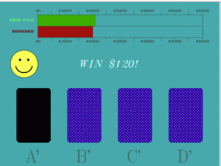
The time available to both groups was identical and adequate to complete the IGT, which asks participants to select from four decks of cards to win as much “money” as possible.

Heath Demaree

Heath Demaree

Two of the decks yield higher payoffs or “positive utility” whereas the remaining two decks render less favorable winnings, offering “negative utility.”
To win, participant learn which decks offer the greatest payoff in the shortest time for 100 trials.

Each group of more than 80 volunteers was separated into two sub-groups given different amounts of time between card selections to consider the task, while the total time available remained the same.

People who thought they had insufficient time for the task achieved lower payoff than volunteers who believed they had enough time.
Since both groups had the same amount of time, the performance difference was attributed to their beliefs about time constraints, suggesting the importance of focusing on the task rather than on potential time limits.

Steven J. Karau

Steven J. Karau

Actual time constraints affected both group interactions and task performance in a planning task evaluated by Southern Illinois University’s Steven J Karau and Janice R Kelly of Purdue.

They asked 36 groups of three volunteers to complete a planning task while group interactions were videotaped and coded using the Time-by-Event-by-Member Pattern Observation (TEMPO) system, developed by Texas Tech’s Gail Clark Futoran, Janice Kelly of Purdue, and University of Illinois’s Joseph McGrath.

Gail Clark Futoran

Gail Clark Futoran

Twelve of the groups had inadequate time, whereas another twelve groups had optimal time for task completion, and the final twelve groups has more than enough time.

Group performance was evaluated based on:

  • Length,
  • Originality,
  • Creativity,
  • Adequacy,
  • Issue Involvement,
  • Presentation quality,
  • Optimism,
  • Action orientation.

The groups that had greater time constraints actually focused less on the task than groups with more time, supporting Karau and Kelly’s recommendation to maintain task focus when performance time is limited to optimize performance.

Janice Kelly

Janice Kelly

Time constraints differentially affected each performance evaluation, and one way to mitigate the impact of time constraints is to shift focus from perceived time scarcity and stress to attend to the task.

-*How do you maintain task focus when perceiving time pressure?

-*To what extent does investing time in other people give you the sense of greater “time abundance”?

Follow-share-like http://www.kathrynwelds.com and @kathrynwelds

RELATED POSTS:

Twitter  @kathrynwelds
Blog – Kathryn Welds | Curated Research and Commentary
Google+
LinkedIn Open Group Psychology in Human Resources (Organisational Psychology)
Facebook Notes

©Kathryn Welds

Do “Hot” Emotions Lead to Better Decisions?

-*Do people in an agitated emotional state tend to make decisions they later regret?

Popular wisdom counsels against making decisions when influenced by “hot emotions” including feeling HALT – Hungry, Angry, Lonely, Tired,
This guidance is based on the assumption that these physical and emotional experiences lead to regrettable decisions, such as relapsing to substance use.

Shane Frederick

Shane Frederick

Contradictory theories and research findings compete to explain the process of emotional decision-making.
One view, suggested by Princeton’s Nobel laureate Daniel Kahneman with Shane Frederick of Yale, is that these two modes operate sequentially:  Intuitive judgments (“reflexive system”) are rapidly generated, whereas the analytical decisions (“reflective system”) are slower, and involve monitoring and modifying initial intuitive responses.

Andreas Glöckner

Andreas Glöckner

A contrasting view is that the two thinking modes work in parallel, and are applied in different decision environments, proposed by Max Planck Institute’s Andreas Glöckner and Tillman Betsch of Universität Erfurt.

J. Scott Armstrong

J. Scott Armstrong

Similarly, there are two divergent views of the quality of emotional decision-making.
One position is that the intuitive mode’s emotional approach may lead to faulty decisions, argued by Decision Research’s Donald MacGregor and J. Scott Amstrong of Wharton.

Marius Usher

Marius Usher

A counterpoint view is that the intuitive mode yields equal or better decisions compared with the analytical mode, offered by Tel Aviv University’s Marius Usher, Ran Brauner, and Dan Zakay with Zohar Rusou of Open University of Israel and University College London’s Mark Weyers.

Antonio Damasio

Antonio Damasio

Consistent with this view that intuitive thinking can enhance decisions, University of Southern California’s Antonio Damasio suggested that uncomfortable physical states like hunger, can provide access to unconscious processes that may determine decisions later rationalized with more rational explanations:  We feel, therefore we are, despite Descartes’ contrary assertion, he argued.

Dan Zakay

Dan Zakay

An integrative view is that decision quality depends on consistency (“transitivity”) between thinking modes during decision-making and characteristics of the decision, proposed Tel Aviv University’s Zohar Rusou and Marius Usher, with Dan Zakay of IDC Herzliya in their comparison of thinking during intuitive or analytical tasks.

Based on these views of thinking during decision making, the HALT theory that physiological arousal leads to poorer decisions was tested by asking hungry people to make complex choices.

Denise de Ridder

Denise de Ridder

Utrecht University’s Denise de Ridder, Floor Kroese, Marieke Adriaanse, and Catharine Evers asked volunteers to avoid eating and drinking between 11 p.m. the night before the experiment and 8:30 – 9:15 am, when they arrived at the lab.

Antoine Bechara

Antoine Bechara

Half of the participants received breakfast before beginning the task, whereas the remaining group immediately began the Iowa Gambling Task, developed by University of Southern California’s Antoine Bechara, Antonio Damasio and Hannah Damasio, with Steven W Anderson of University of Iowa to simulate real-life decision making using uncertainty, rewards, and penalties.

Iowa Gambling Task

Iowa Gambling Task

Participants received four decks of cards and were told to earn as much money as possible and lose the least possible when they selected one card at a time.
Cards in decks A and B had a 100 Euro payoff, whereas those in decks C and D has a 50 Euro reward.

In addition, decks A and B also had cards with a larger penalty than in decks C and D.
Consequently, selecting cards from decks A and B resulted in a loss, whereas cards from C and D led to a gain.

Floor Kroese

Floor Kroese

Hungry participants selected more cards from decks C and D, leading to greater financial gains.
Similarly, hungry participants made equally astute decisions about long term payoffs when choosing between 50 Euros in 21 days instead of 27 Euros today.

People in a “hot” emotional state like hunger actually made better decisions involving uncertain outcomes because recognized the risks of loss associated with higher rewards, concluded de Ridder’s team.
This team’s findings contrasts to conventional belief that impulsivity impairs decision-making.

  • When do you make better decisions in “hot” states like “HALT”?

Follow-share-like http://www.kathrynwelds.com and @kathrynwelds

RELATED POSTS:

Twitter  @kathrynwelds
Blog – Kathryn Welds | Curated Research and Commentary
Google+
LinkedIn Open Group Psychology in Human Resources (Organisational Psychology)
Facebook Notes

©Kathryn Welds

Task Switching Skills Improved With Musical Training

Ira Hyman

Ira Hyman

“Multitasking” is more accurately described as “task switching” because people typically can’t effectively sustain split attention.
However, it is possible to alternate between two mental tasks, but there is a “cognitive switching cost” in decreased speed and performance accuracy.

S. Matthew Boss

S. Matthew Boss

One vivid example of performance decrements when performing simple “multitasking” is illustrated in a study of walking while using a mobile phone, conducted by Western Washington University’s Ira E. Hyman Jr., S. Matthew Boss, Breanne M. Wise-Swanson, Kira E. McKenzie, and Jenna M. Caggiano.

Ira Hyman-Unicycling Clown Attentional BlindnessThey found that walking and talking caused most volunteers to experience “inattentional blindness” to unicycling clown.

Breanne M Wise-Swanson

Breanne M Wise-Swanson

In addition, the “multitasking” participants walked more slowly, changed directions more frequently, and were less likely to acknowledge other people than individuals.

Hyman and team concluded, “Doing more than one task at a time, especially more than one complex task, takes a toll on productivity,” and went on to note the dangers of driving while talking on a phone.
In fact, a previous blog reviewed the evidence for reduced driving performance when listening to music, a less-demanding activity than texting or talking on a telephone.

Ranate Meuter

Ranate Meuter

Even switching between two well-practiced languages can reduce cognitive processing speed, found Queensland University of Techology’s Renata Meuter and University of Oxford’s Alan Allport.

They asked bilingual participants to name numerals in their first language or second language in an unpredictable sequence.
Participants responded more slowly when they switched to the other language, indicating a “cognitive switching cost.”

Volunteers named digits associated with a background color in their first language or second language.
They named digits in their second language more slowly, but were slower in their first language after the language changed from the previous cue.

Jeffrey Evans

Jeffrey Evans

Involuntary persistence of the second-acquired language interfered with participants actively suppressing their original language, leading to delays when responding in their more well practiced “birth tongue,” they argued.

As tasks become more complex, the performance-hampering effects of task switching increase, according to United Stated Federal Aviation Authority’s Joshua Rubinstein with Jeffrey Evans, and David Meyer of University of Michigan, who evaluated switching between different task like solving math problems or classifying geometric objects.

David Meyer

David Meyer

Like Meuter and Allport, they noted that people switching tasks navigate two stages of “executive control:”

  • Goal shifting: “I want to do this now instead of that,”
  • Rule activation: “I’m turning off the rules for that and turning on the rules for this”.Rubinstein’s team estimated that traversing these phases can reduce productivity by much as 40 percent, and noted that the problem is compounded for individuals with damage to the dorsolateral prefrontal cortex.
Linda Moradzadeh

Linda Moradzadeh

However, musical training seems to reduce the costs of task switching, found York University’s Linda Moradzadeh, Galit Blumenthal, and Melody Wiseheart.
This team matched more than 150 similar age and socioeconomic status participants who were also:

  • Monolingual musicians (averaging 12 years of musical training) or
  • Bilingual musicians (averaging 12 years of musical training) or
  • Bilingual non-musicians or
  • Monolingual non-musicians.
Galit Blumenthal

Galit Blumenthal

Volunteers performed task switching and dual-task challenges, along with intelligence and vocabulary measures.
Musicians demonstrated fewer global and local switch costs compared with non-musicians and bilingual volunteers.
This finding contrasts other results regarding bilingualism’s advantage for task switching performance in a previous blog post.

Melody Wiseheart

Melody Wiseheart

In addition, Moradzadeh’s team found no benefit of combining bilingual expertise with musical training to reduce task-switching costs,

These results suggest that musical training can contribute to increased ability to shift between mental sets in both task switching and dual-task efforts, thanks to “superior ability to maintain and manipulate competing information in memory, allowing for efficient “global” or holistic processing.”

-*To what extent do you find “multitasking” an effective practice to accomplish cognitive tasks?

Follow-share-like http://www.kathrynwelds.com and @kathrynwelds

Related Posts:

Twitter:  @kathrynwelds
Google+
LinkedIn Groups Psychology in Human Resources (Organisational Psychology)
Facebook
Blog: – Kathryn Welds | Curated Research and Commentary

©Kathryn Welds

Low-Stakes Testing Improves Learning Retention, Retrieval

Henry L. Roediger III

Henry L. Roediger III

Few people enjoy having knowledge gaps exposed by formal testing, but those who receive this corrective feedback are more likely to retain information over time, according to studies by Washington University’s Henry L. Roediger III and Jeffrey D. Karpicke.

Mary Pyc

Mary Pyc

Their work confirms considerable previous research, and the idea that testing acts as a “meditator” to retrieve stored information, suggested by Kent State University’s Mary A. Pyc and Katherine A. Rawson.

Katherine A. Rawson

Katherine A. Rawson

Participants in Roediger and Karpicke’s investigation read texts and were tested by writing as much as they recalled of selected sections, rather than completing a multiple choice test or writing a critical thinking essay on the topic.
Volunteers recalled about 70 percent of the ideas they’d read, then re-read the
remaining passages that were not tested.

Jeffrey D. Karpicke

Jeffrey D. Karpicke

Delayed testing on both sets of readings occurred after two days or seven days, and volunteers were significantly more able to remember material on which they’d been tested.

Roediger and Karpicke noted that testing requires people to retrieve knowledge from memory, rather than merely acquire information as when reading or listening to a lecture.
The testing effect, also known as the retrieval practice effect, strengthens learning by embedding information in memory.

Karl Szpunar

Karl Szpunar

Most effective testing is integrated into learning with frequent, low-stakes checkpoints in contrast to less frequent, higher-stakes testing in the traditional British education system, they suggested.

Novall Y. Khan

Novall Y. Khan

Additionally, “interpolated testing” during learning activities enables people to sustain attention, reduce mind wandering, test anxiety, and perceived “cognitive load,” found Harvard’s Karl K. Szpunar, Novall Y. Khan, and Daniel L. Schacter.

Sarah L. Eddy

Sarah L. Eddy

The testing effect can benefit people who have previously under-performed relative to their peers, and are under-represented in courses, reported University of Washington’s Sarah L Eddy and Mary Pat Wenderoth with Sara E Brownell of Arizona State University.

Mary Pat Wenderoth

Mary Pat Wenderoth

They evaluated women’s academic achievement and participation in class discussions in more than 20 large university biology courses.

Sara E. Brownell

Sara E. Brownell

Unlike in science, technology, engineering, and mathematics, 60% of the students were women.
However, they responded to only 40% of questions posed by the instructor during classes, much less than their representation in the course.
In addition, these women achieved lower exam scores than men with similar overall academic performance.

Daniel Schachter

Daniel Schachter

However, when the researchers introduced frequent, low-stakes testing – even without providing test results – women’s information retention and accessing significantly improved.

Frequent low-stakes testing integrated into learning activities leads to longer-term information comprehension, retention, and application – and this frequent exposure to a sometimes-feared or disliked activity can reduce avoidant reactions.

-*How effective do you find frequent tests to increase recall and retention of learning materials?

Related Posts:

Twitter:  @kathrynwelds
Google+
LinkedIn Groups Psychology in Human Resources (Organisational Psychology)
Facebook
Blog: – Kathryn Welds | Curated Research and Commentary

©Kathryn Welds