Oxytocin Increases Empathic Work Relationships, Workplace Trust, Generosity

Paul Zak

Paul Zak

Paul Zak, director of the Center for Neuroeconomic Studies at Claremont Graduate Center, and author of The Moral Molecule: The Source of Love and Prosperity, suggests that the hormone oxytocin empathic understanding, generosity (donating to charities, giving money to others in experimental situations), happiness, and trust/trustworthiness.The Moral Molecule

He verified these laboratory-based findings in real-world situations, like a wedding he attended in southern England, prior to which he drew blood samples from the wedding party.

Zak says that oxytocin can be increased by massage, dance, story-telling, prayer, engaging in social media with a loved one, and hugs.
As a result, he “prescribes 8 hugs a day” for better mood and improved “relationships of all types.”

He says that oxytocin can be inhibited by improper nurturing in childhood, stress, abuse, and by oxytocin’s antagonist, testosterone.
Known as the “selfish hormone,” testosterone is also correlated with expressions of power and leadership in the workplace.

One reason women may have challenges expressing these traits in work situations is that their average testosterone levels are ten times lower than men’s.
Zak’s TED Talk

Amy Cuddy

Amy Cuddy

Related Post:

Thoughts change bodies, bodies change minds, roles shapes hormones: Amy Cuddy on “Faking Until It’s Real”

-*To what extent have you seen “eight hugs a day improve mood and relationships”?

LinkedIn Open Group
Twitter @kathrynwelds
Google+
Facebook Notes:
Blog: – Kathryn Welds | Curated Research and Commentary

©Kathryn Welds
Working From Home: Calculating Cost, Time, Environmental Savings

Companies and individuals save money when employees work from home offices, and there’s an environmental impact of reducing traffic congestion and emissions.

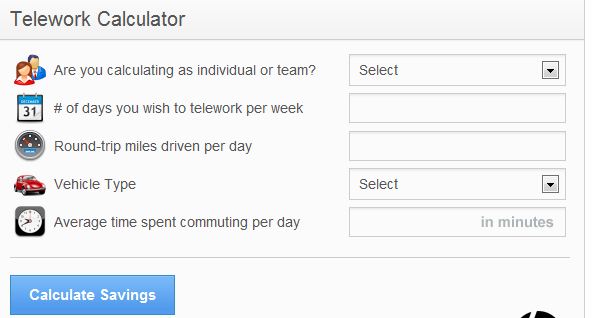
Govloop and HP produced a calculator based on federal databases and studies that considers time and distance traveled each day, vehicle type, and number of telecommuting days to calculate cost savings and productivity gains.

Govloop estimates that the average employer spends about $10,000 in energy, real estate, and production costs per employee annually, while advocacy group American Telecommuting Association claims teleworkers show 10% to 15% improved productivity in nearly every related study over the past two decades.

One Stanford University study  in China found working from home increased performance by 13% and cut attrition by 50%.

Govloop Telework Calculator

Calculators from other organizations consider other costs like work clothes, shoes, and accessories, plus attending office social events.

NIHNational Institute of Health

Seattle’s commuter challenge

More information here and here

-*To what extent does your workplace enable employees to work remotely?

LinkedIn Open Group Stanford Social Innovation Review
Twitter: @kathrynwelds
Google+
Facebook Notes:
Blog: – Kathryn Welds | Curated Research and Commentary

©Kathryn Welds

Startup Success Correlates with Women Executive Involvement

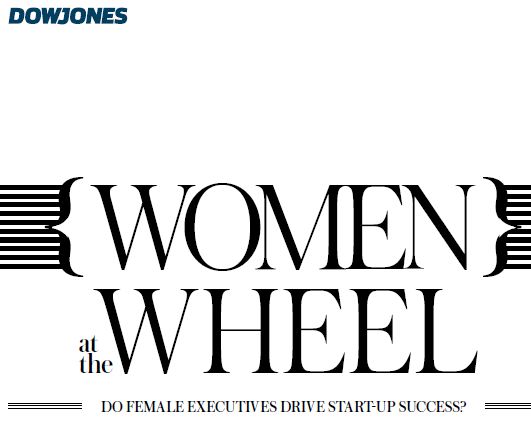
A Dow Jones Venture Source study of 167,500 executives and 2,200 venture-backed companies funded between 1997 and 2011 showed that women helped lead more start-ups to success.

Women are less involved as founders and leaders of start-ups than men.

Just 1.3 percent of start-ups have a female founder, 6.5 percent have a female CEO, and 20 percent have one or more C-level female executives.

Women at the WheelAbout 27 percent were in sales and marketing roles, and many as vice presidents.
Companies that have been acquired, went public or gained profitability have 7.1 percent of executive staff members are women.

In contrast, only about 3.1 percent  executives are women at companies that failed, exited at a low valuation, or haven’t reached other milestones.

-*To what extent have you observed a correlation between gender balance in executive leadership and successful financial performance among new enterprises?

LinkedIn Open Group Catalyst:
Twitter: @kathrynwelds
Google+
Facebook Notes:
Blog: – Kathryn Welds | Curated Research and Commentary

©Kathryn Welds

Questions to Discover, Communicate Personal Mission, Brand

Tina Su

Tina Su, former software engineer at Amazon.com and author of Think Simple Now: A Moment of Clarity blog, shared self- assessment questions that have helped her and others focus on life purpose and mission.

From these, she developed a personal vision “to ‘never work again’, by living a life following one’s inner calling, exploring one’s potential, generating massive value, and living fully in every moment.”

• What activities, people, events, hobbies, projects make you smile?
• What have been your favorite activities in the past?
• What have been your favorite activities now?
• What makes you feel great about yourself?
• Who inspires you: family, friends, authors, artists, leaders, historical figures?
• Which qualities inspire you?
• What are your natural skills, abilities, gifts?
• For what do people ask your advice, help?
• What would you teach?
• What would you regret not fully doing in your life?
• What would you regret not being in your life?
• When you are 90 years old, what achievements will matter most?
• What achievements relationships will matter most?
• What are your 3-6 deepest values?
• What were some challenges, difficulties and hardships you’ve overcome or are in the process of overcoming?
• How did you do it?
• What causes do you strongly believe in or have personal meaning for you?
• What message would you like to effectively convey to a large group of people?
• How can you use your talents, resources, passions and values to serve, to help, to contribute to people, beings, causes, organization, environment?

The answers to these questions can answer the questions addressed in a personal mission statement, as Tina demonstrated in her bold direction.
• What do I want to do?
• Who do I want to help?
• What is the result? What value will I create?

Randall Hansen

Randall Hansen

Randall Hansen offers a different, but compatible The Five-Step Plan for Creative Personal Mission Statements.
• Identify Past Successes
• Identify Core Values
• Identify Contributions
• Identify Goals
• Write Mission Statement

Like any self-assessment process, developing a personal mission statement is an investment of time and attention spanning several days or weeks.

-*What questions have been more revealing in developing your personal brand?

LinkedIn Open Group Brazen Careerist
Twitter: @kathrynwelds
Google+
Facebook Notes:
Blog: – Kathryn Welds | Curated Research and Commentary

©Kathryn Welds

French Scott Adams, voiced by faux-Robin Williams Drives Organizational Change

Serge Grudzinski

Serge Grudzinski

Serge Grudzinski draws on his elite engineering education at Paris’ École Polytechnique and at Stanford University, combined with his managerial and consulting experience at  Saint-Gobain Glass, Mars & Co, Booz Allen Hamilton, and AT Kearney to incite organizational change through humor.

He created the character “Max de Bley”, aka “Manager Max” to deliver his cross-cultural zingers on strategy, Powerpoint, IT, proposals, email “and much more” for more than 200 global organizations.

For a quick mental diversion, check his micro-bits

-*How have you seen humor used to inspire organizational change?

LinkedIn Open Group Mindful Leadership
Twitter: @kathrynwelds
Google+
Facebook Notes:
Blog: – Kathryn Welds | Curated Research and Commentary

©Kathryn Welds

Hacking Human Behavior with “Tiny Habits”

BJ Fogg directs the Behavior Design Lab at Stanford University, leads Persuasion Boot Camps and wrote Persuasive Technology: Using Computers to Change What We Think and Do

He defines behavior change targets according to :

Type of change:
• Initiate new behavior
• Maintain existing behavior
• Increase  behavior
• Decrease behavior
• Stop behavior

Frequency of change:
• Dot – One time behavior
• Span – Time-limited behavior
• Path – Continuing behavior

From this matrix, he identifies 15 ways to change behavior, and recommends designing behavior change as a “span” for time-limited behavior, like the Alcoholic Anonymous “One Day at a Time” credo.

He evaluates behavior for ease vs. difficulty and motivation as high vs. low, and designs behaviors for ease and to capture moments of high motivation, to align with his assertion that “Behavior occurs in response to trigger at the same time as motivation + ability.”

Fogg notes that motivation is experienced in “waves”, and recommends seizing moments of high motivation to do “difficult” behaviors, and to capitalize on low motivation to do routine activities.

To enable the co-occurrence of motivation and ability, Fogg links behavior change to a reminder (also known as a “prompt”, “cue”, “call-to-action” or “trigger”) to “exceed the activation threshold.”

He suggests designing behavior change to existing behaviors according to the formula: “After xxx, I will yyyy”, such as “After I walk in the door, I will hang my keys on the hook.”

Fogg recommends reinforcing behavior change by celebrating successful behavior execution, and cited examples of people who tell themselves “I’m awesome”  or actually pat themselves on the back.

©Kathryn Welds

Thoughts Change Bodies, Bodies Change Minds, Roles Shape Hormones

Deborah Gruenfeld, formerly of Stanford Graduate School of Business, studied the impact of non-verbal behavior on perceptions of power.

Deborah Gruenfeld

Deborah Gruenfeld

She reported that people who “occupy space” are viewed as more dominant and powerful by others.

See Related Posts:

She demonstrated that non-verbal behavior like erect, “space-occupying” postures and selective smiling affect the way the person executing these behavior feels about his or her personal power, competence, and mood.

“Power postures” affect secretion of hormones associated with dominance (testosterone) and stress (cortisol).

Effective leaders and recently promoted leaders show a hormone profile of high testosterone and low cortisol, indicating high dominance and low stress.

Individuals in low power role have low testosterone and high cortisol, and this trend is more common among women.

Posture can make a large difference in how people view themselves, how others see them, and their opportunities and outcomes.

Before a job interview or stressful interaction, a “big power posture”  can increase confidence and performance.

-*What is your emotional response to people who assume a “big power posture” at work?
-*How do you feel when you occupy more space in professional settings?

©Kathryn Welds

Authoritative Non-Verbal Communication for Women in the Workplace

Carol Kinsey Goman

Carol Kinsey Goman

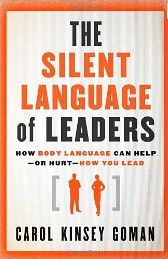
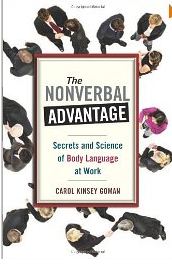
Carol Kinsey Goman has integrated research on the impact of non-verbal behavior on workplace outcomes for women in two books:

The Silent Language of Leaders: How Body Language Can Help–or Hurt–How You Lead

The Nonverbal Advantage: Secrets and Science of Body Language at Work

She notes that all business leaders need to establish interpersonal warmth and likability balanced with authority, power, and credibility.

Women have been viewed as likeable, but lacking authority, so Goman suggests the following behavior changes:

• Focusing eye contact in business situations on the conversation partner’s forehead and eyes instead of eyes and mouth, which is more appropriate for social situations

• Limit the number of head tilts and head nods, which may signal empathy and encouragement, but may be interpreted as submissive and lacking authority

 Occupy space: Stand tall with erect posture and head, and a wider stance hold your head high.  Claim territory with belongings.

• Keep your hands on your lap or on the conference table where they can be seen to limit nervous hand gestures such as rubbing hands, grabbing arms, touching neck, tossing hair, leaning forward.

  • Use authoritative hand gestures:

o Show palms when indicating openness and inclusiveness

o “Steeple” fingers by touching fingertips with palms separated to indicate precision

o Turn hands palms-down to signal confidence and certainty

o Keep gestures at waist height or above. Drop the pitch at the end of each sentence to make an authoritative statement. Avoid raising tone at the end of a sentence when not asking a question, as this may be interpreted as uncertain or submissive.

• Smile selectively and appropriately to maintain both likeability and authority

• “Learn to interrupt,” advised former U.S. Secretary of State Madeleine Albright. ”
Like occupying physical space, occupy “air-space.”

• Moderate emotional expressiveness, movement, and animation to signal authority and composure

• Cultivate a firm handshake, with palm-to-palm contact and that the web of your hand (the skin between your thumb and first finger) touching the web of the other person’s. Face the person squarely, look in the eyes, smile, and greet the person.

Goman stated that women generally excel at accurately read the body language of others, and this can be an advantage in intuitively grasping underlying issues in a meeting or during a negotiation.

-*How do you cultivate both credibility and likeability in work relationships?

See related posting on Olivia Fox Cabane’s discussion of non-verbal contributors to “charisma

RELATED POST:

Deborah Gruenfeld‘s discussion of power non-verbal behaviors

©Kathryn Welds

Two Approaches to Following-Through on Plans, Adapting to Changes

Kelly McGonigal

Kelly McGonigal

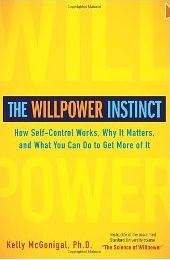
Stanford University lecturer Kelly McGonigal integrates cognitive psychology and neuroscience in her book, The Willpower Instinct: How Self-Control Works, Why It Matters, and What You Can Do To Get More of It

She argues that willpower can be developed by:

• Paying attention to situations that undermine willpower

• Managing stress and mood,

  • Maintaining exercise, sleep, and healthy eating habits

• Practice small willpower challenges to build the willpower “muscle”

• Expect willpower “slips” and plan for alternate responses

• Associating with others who have strong willpower habits

Begin now:   Willpower is not easier in the future,

• Disputing thoughts of shame and guilt, and re-interpreting them more optimistically, hopefully, and forgivingly.

M.J. Ryan

M.J. Ryan

Several years before McGonigal, M.J. Ryan wrote about life’s challenges, including responding to unplanned changes and following through on commitments and plans.
Her books include self-assessments, encouragement, de-stigmatization, suggestions, and resources.

This Year I Will…: How to Finally Change a Habit, Keep a Resolution, or Make a Dream Come True

Another of her books deals with managing unplanned changes:
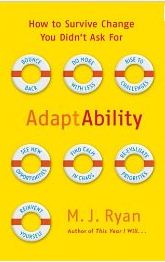
AdaptAbility: How to Survive Change You Didn’t Ask For

See related post on McGonigal’s twin sister, gamer Jane McGonigal, whose TED talk discusses the value to games to improve the quality, duration, and experience of life.

-*What practices have helped you develop and exercise “willpower” to change behaviors and thoughts?

©Kathryn Welds

Silicon Valley Venture Capitalist’s Leadership Credo for Growing Businesses, Careers

Ann Winblad

Ann Winblad

Ann Winblad is one of the most prominent, yet low-profile venture capitalists and among a minority of women venture capitalists – about 11 percent of today’s VCs.

She co-founded Open Systems, an accounting software company in 1976, then co-founded Venture Capital firm Hummer Winblad Venture Partners, which invests more than $1 billion in software companies.

Hummer Winblad She offers recommendations for women and men investing in businesses, careers, and themselves:

• Seek risk and fail fast to enable rapid course-correction
• Strive to be more resilient than strong
• Adapt as quickly as possible
• Place greater value on learning from all sources over formal education
• Exercise intellectual curiosity and stamina
• Tolerate ambiguity and lack of experts during high-growth periods
• Look for possibility in the “half-full glass”
• State assumptions and build on those of others
• Cultivate honesty and transparency

-*Which of Winblad’s recommendations have you seen practiced by the most effective organizational leaders and entrepreneurs you know?

LinkedIn Open Group: Women in Technology (Sponsored by EMC)
Twitter: @kathrynwelds
Google+
Facebook Notes:
Blog: – Kathryn Welds | Curated Research and Commentary   

©Kathryn Welds