Category Archives: Resilience

Resilience

Gratitude Increases Financial Patience, Investment Earnings

Jennifer Lerner

Jennifer Lerner

Emotions affect personal financial decision-making, and negative emotions like anger and fear can lead people to make either risky or conservative financial choices, according to Harvard’s Jennifer Lerner.

David DeSteno

David DeSteno

With Northeastern University’s David DeSteno, Leah Dickens, University of California Riverside’s Ye Li, Lerner and Columbia University colleague Elke Weber noted that sadness increases impatience and leads to “myopic misery” – focus on immediate gain instead of more profitable longer-term options.

Leah Dickens

Leah Dickens

Lerner and team analyzed participants’ payoff choices when they were in an induced sad state or a neutral emotional condition compared with disgust as a control state.

Ye Li

Ye Li

On average, sad-state participants accepted between 13% and 34% less money to receive a payoff immediately (“present bias”) instead of waiting 90 days for a larger payment, confirming that induced sad feeling led to preference for immediate reward and less patience for a better but more distant payoff.

Elke Weber

Elke Weber

However, these sad volunteers were not more impatient in other generalized areas, suggesting that this effect focuses on impatience for rewards.
In contrast, the negative emotion of disgust did not result in greater impatience, pointing to the specific impact of sad feelings on payoff choices.

Cynthia Cryder

Cynthia Cryder

In a related study, Lerner and team evaluated the impact of induced positive emotions: Happiness and gratitude.
Again, participants could select a smaller, immediate payoff or larger payout later.

Induced gratitude enabled most volunteers to negotiate larger immediate rewards in exchange for giving up a larger, but more distant payment: “…the mean grateful participant required $63 immediately to forgo receiving $85 in three months, whereas the mean neutral or happy participant required only $55 immediately.

James Gross

James Gross

This trend was replicated in other studies by Lerner, Li, and Weber, who reported that average sad-mood participant was willing to accept $4 today instead of $100 in a year, whereas the average neutral-mood volunteer required more than four times as much$19 today to forego $100 in a year.
Another study estimated that sad volunteers accepted between 35% and 79% less money immediately instead of waiting for a future payoff.

Ronald Dahl

Ronald Dahl

This ”misery is not miserly” effect is influenced by the degree of “self-focus” or attention to personal impact in  an observed situation.
When volunteers were primed to focus on their personal reactions while experiencing induced sadness, they gave up more money to acquire a commodity compared with people who had neutral emotions or neutral self-focus, according to Lerner with Washington University’s Cynthia E. Cryder, James J. Gross of Stanford, and University of Pittsburgh’s Ronald E. Dahl.

Gratitude moderates “economic impatience” and suggests that affect-based interventions can help investors enhance financial decision making.

-*How do you manager the impact of transient emotional states on financial decision-making and risk-taking?

Follow-share-like http://www.kathrynwelds.com and @kathrynwelds

RELATED POSTS:

Twitter @kathrynwelds
BlogKathryn Welds | Curated Research and Commentary
Google+
LinkedIn Open Group Psychology in Human Resources (Organisational Psychology)
Facebook Notes

©Kathryn Welds

Symbolic Gestures Can Prompt Behaviors, Shape Perceptions

Michal Parzuchowski

Michal Parzuchowski

Non-emotional gestures can “prime” abstract concepts, like “honesty,” and prompts people to behave consistent with these ideas, according to Michal Parzuchowski and Bogdan Wojciszke of University of Social Sciences and Humanities, Sopot, Poland.

Bodgan Wojciszke

Bodgan Wojciszke

They evaluated a symbolic gesture, putting a hand on one’s heart (“HOH”), which is associated with “honesty” in Poland, where the studies were conducted.

In the U.S., this gesture has a different meaning: Patriotism when enacted during The Pledge of Allegiance.
This distinction demonstrates cultural variation between specific gestures, and suggests opportunities for related research in other geographies.
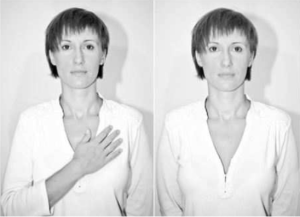
HOHv NeutralVolunteers who performing this gesture were described as appearing more “honest” and trustworthy than when the same people enacted a neutral control gesture.

In addition, participants who performed the hand-over-heart gesture behaved more honestly when they provided more honest assessments of others’ attractiveness and refrained from cheating, compared to volunteers who performed neutral gestures.

Bodily experience associated with abstract concepts can influence both perceptions of others, and one’s own behaviors to align with the intangible idea – and the effect doesn’t depend on peoples’ emotional states.

More than 35 Polish volunteers listened to parts of a recorded job interview in which the applicant made several low-credibility statements like “I have never been late for work” and “I have never argued with members of my family.”

As they listened, participants viewed the speaker’s photograph.
Half of the participants saw a photo showing the speaker with both of hands placed behind the back, whereas the other half saw an image of the speaker with right hand over the heart (HOH).
Then, all participants rated the speaker’s credibility.

Participants rated the speaker pictured with hand over heart as more believable, suggesting that the gesture, locally associated with honesty, leading volunteers to perceive the person producing the signal of honesty “…as more credible, even if her statements are not very credible.”

Other volunteers rated the appearance of women in photographs, previously rated by independent judges as “moderate to low attractiveness”.
The women were described as the experimenter’s friends, to “prime” social desirability for a favorable evaluation from participants.

HOH-hipResearchers asked volunteers to enact gestures to “increase their cognitive load”:  Half the volunteers completed ratings while holding their right hand over their hearts whereas the other participants placed hand on their hips.

Participants who held their hand over their hearts rated less attractive faces significantly lower than volunteers who held their hand on their hips, suggesting that they the “’Hand-over-Heart’ gesture influenced people to respond more honestly,“…even if it meant being impolite.

HOJH v shoulderIn another study, more than 50 volunteers solved math problems and reported number completed .

Some wrote solutions with their dominant hands, but others held a “breathing monitor band” by either:

  • Putting right hand on left shoulder, or
  • Right hand over heart.

Participant had an incentive to exaggerate the number of completed problems because researchers told volunteers that one randomly-selected participant would be receive cash prize for each correct answer.

Those who held their hands on their shoulders claimed they solved 45 percent more problems than either of the other two groups, whereas people who held hands over hearts accurately reported completed problems, suggesting that temptation to embellish problem-solving performance was overridden by acting consistently with the gesture associated with honesty.

Bodily sensations influence the way we think, feel, and act…(and) a bodily sensation may activate the concept associated with it; this in turn may shape information processing, and behavior,” concluded Parzuchowski and Wojciszke.

These findings validate the idea of “embodied cognition” – bodily experience and states can influence thinking and likewise, thinking can affect bodily experience and states.
Other examples include judgments of height, weight, importance influenced by physical experiences.

Anita Eerland

Anita Eerland

People whose native language is read and written from left to right typically make smaller estimates of weight and height when leaning to the left (“posture-modulated estimation”) because their language leads them to represent numbers along a continuum with smaller numbers on the left and larger numbers on the right (“mental-number-line theory”), according to Anita Eerland now of Open University of the Netherlands with Max Planck Institute’s Tulio Guadalupe, and Rolf Zwaan of Erasmus University.

Tulio Guadalupe

Tulio Guadalupe

They induced people to lean slightly to the right or to the left by asking them to stand on a Wii Balance Board while answering estimation questions.
Eerland and team changed the directional lean as subjects leaned left or right, or stood upright without mentioning changes in position

When participants were leaned to the left, they produced significantly smaller estimates were than when they leaned to the right.

Eerland-Zwaan Wedding

Eerland-Zwaan Wedding

These results may vary for participants whose native language is read and written from right to left, and Eerland and team suggested replicating this study with other language groups.

Lynden Miles

Lynden Miles

Thoughts can lead to changed body position, found University of Aberdeen’s Lynden Miles, Louise Nind, and C Neil Macrae, when they asked volunteers to think about the future.

Imagining future events caused participants to shift their body position to lean forward, whereas they leaned back when asked to think about the past.

Similarly, qualitative dimension ratings can be affected by physical experience.

When volunteers judged a proposal’s importance, they rated it more momentous when holding a heavy object, according to University of Amsterdam’s Nils B. Jostmann, Daniël Lakens of Utrecht University and Institute Superior de Ciências do Trabalho e da Empresa, Lisbon’s Thomas W. Schubert.

European participants guessed the value of foreign currency in Euros while recording answers on either a heavy clipboard or a light-weight clipboard.
Those who held the lighter clipboard estimated lower average values.

In addition, volunteers estimated the importance of University students participating in making foreign study grant decisions.
Participants who held the heavier clipboard rated student participation as more important.

George Lakoff

George Lakoff

Jostmann and team experimentally demonstrated the impact of body, physical objects, and abstract metaphors on thinking, originally posited by University of California, Berkeley’s George Lakoff and Mark Johnson who linked

  • Control and Mood to direction:

“I have control over him,”
“I am on top of the situation,”
“He’s at the height of his power,”
“He ranks above me in strength,”

“I’m feeling up today”
“He is under my control,”
“His power is on the decline.

“I’m feel down in the dumps.”

  • Love, interpersonal connection to physical force

“I could feel the electricity between us”
“There were sparks
“They gravitated to each other”

  • Anger to heat, pressure

“He’s hot under the collar
“She said it in the heat of anger

John Bargh

John Bargh

Similarly, trustworthiness was associated with the physical experience of warmth when volunteer participants judged a new acquaintance as trustworthy after only a brief interaction when participants held a cup of warm coffee instead of a cold beverage, according to Yale’s John Bargh.

Embodied cognition” is one explanation for the interactive influence of symbolic thought, movement, and bodily experience on one’s behavior and peoples’ perceptions of others.

-*What metaphors and symbolic gestures affect your behavior?

Follow-share-like http://www.kathrynwelds.com and @kathrynwelds

RELATED POSTS:

Twitter  @kathrynwelds
Blog Kathryn Welds | Curated Research and CommentaryGoogle+
LinkedIn Open Group Psychology in Human Resources (Organisational Psychology)
Facebook Notes

©Kathryn Welds

Racial Categorizations Change Based on Social Status Markers

Aliya Saperstein

Aliya Saperstein

Race is a changeable status marker of rather than a fixed individual attribute, according to Stanford’s Aliya Saperstein and Andrew Penner of University of California, Irvine.

Andrew Penner

Andrew Penner

Racial fluidity” – or changeable racial categorization – influences and is influenced by racial inequality in the United States, noted Saperstein and Penner.

They analyzed longitudinal U.S. national survey data collected over two decades and found that individuals’ racial classification, both rated by themselves and by others, changed over time in response to changes in social position.

In these data, unemployed, incarcerated, or impoverished Americans were more likely to be seen and self-identify as Black, even if the same individuals were originally classified in a different racial category.

Jonathan Freeman

Jonathan Freeman

Racial self-perception and racial perceptions by others depend on social position, even though most people believe that race is perceived in facial features, such as skin color.
However, social status cues around a face systematically change the perception of race, found Dartmouth’s Jonathan B. Freeman, Matthias Scheutz of Tufts, with Penner, Saperstein and her Stanford colleague, Nalini Ambady.

Matthias Scheutz

Matthias Scheutz

Participants categorized 16 computer-generated face identities (8 male) that were morphed along a 13-point race continuum, from White (morph −6) to Black (morph +6).
Developed by Max Planck Institute’s Volker Blanz and Thomas Vetter, this program generated 3D models based on laser scans of human faces.

Volunteers saw faces in a randomized order and evaluated them as White or Black using the keyboard, which recorded and analyzed mouse movement with MouseTracker software.

Participants rated the race of faces along “White–Black morph continua” when they saw faces with “high-status” attire (suit) or “low-status” attire (maintenance uniform).

“Low-status” attire increased the likelihood of categorization as Black, whereas “high-status” attire increased the likelihood of categorization as White, and this effect increased as physical characteristics associated with each race became more ambiguous.

The team  also monitored hand movements to determine hesitation in making a racial category decision.

They noted hesitation and shifting between choices when participants categorized faces with high-status attire as “Black” or faces with low-status attire as “White.”
Stereotypes interact with contextual and physical cues to shape “neutrally- plausible” person categorization, concluded Freeman and team.

When stereotypes associated with race and occupation categories overlap, contextual cues to occupation can activate social status stereotypes, then exert “top-down pressure” on the race categorization process.

For example, business attire can activate high-status stereotypes that influence visual processing of race-categorization.
Race categorization, therefore, could be driven by both “bottom-up” processing of facial features, and “top-down” stereotypes activated by contextual cues.

Racial fluidity reinforces stereotypic status differences by classifying “successful” or high-status people as “White” or “not Black” and “unsuccessful” or low-status people as “Black” or “not White.”

“Social cognition” can influence visual perception because “person perception…makes compromises between how other people “actually” appear and the stereotyped expectations dictating how they ‘should’ appear,” noted Freeman and team.

Aaron Gullickson

Aaron Gullickson

The U.S. briefly fluidity and ambiguity in racial classification when it adopted a “mulatto” category for the U.S. Census between 1870 and1920.

Saperstein and University of Oregon’s Aaron Gullickson noted that people categorized as “mulatto” in one census were re-categorized as Black in the next census, particularly when Southern men’s occupational status changed “downward” between censuses.

Like clothing, another non-racial factor – cause of death – influences racial classification, and can bias official U.S. statistics, according to Penner and UC Irvine colleague
Andrew Noymer with Saperstein in their analysis of a representative sample of U.S. death certificates.

Andrew Noymer

Andrew Noymer

They controlled for existing statistical reports by interviewing decedents’ next-of-kin regarding cause of death and racial classification.

Noymer’s team reported significant discrepancies between the two racial classifications by cause of death, with cirrhosis decedents more likely to be recorded as Native American and homicide victims more likely to be recorded as Black.

These findings are another example of interaction between changeable indicators of social status and seemingly fixed characteristics like physical appearance of race – both in forming perceptions of others and in defining oneself.

-*How have you adjusted your self-categorization based on occupational role and status over time?

Related Posts:

Follow-share-like http://www.kathrynwelds.com and @kathrynwelds

©Kathryn Welds


Universal Body Map Pinpoints Where Emotions are Experienced

Lauri Nummenmaa

Lauri Nummenmaa

Emotions are associated with physiological changes in specific body regions, such as increased heart rate, sweaty palms, or startle response, according to Aalto University’s Lauri Nummenmaa, Enrico Glerean, and Riitta Hari, with Jari Hietanen of University of Tampere.

Enrico Glerean

Enrico Glerean

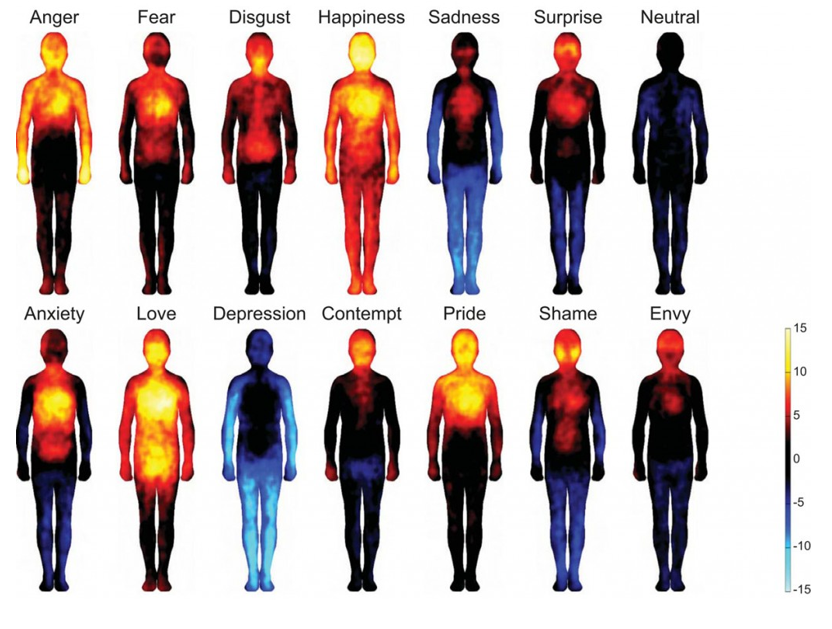
Nummenmaa and team showed emotion-laden words, videos, facial expressions and stories to more than 700 participants in Finland, Sweden and Taiwan, who then reported body regions that “felt different” after they viewed the emotion-evoking media.

Riitta Hari

Riitta Hari

Many people described the physical experience of emotions with metaphors including:

  • “Cold feet” to signal hesitation
  • “Heartbroken” to describe disappointment
  •  “Shivers down the spine” to indicate fear,
Jari Hietanen

Jari Hietanen

according to Durham University’s Zoltán Kövecses, Gary B. Palmer then of University of Nevada, Las Vegas and Rene Dirven then of University of Duisburg-Essen.

Zoltán Kövecses

Zoltán Kövecses

Nummenmaa’s team controlled for these linguistic representations by evoking emotional experiences with guided mental imagery from:

Then, volunteers reported bodily sensations they experienced during the emotion induction and rated physical sensations they expected people displaying different emotions would experience in their bodies.

Nummenmaa and colleagues found distinctly different body areas associated with emotional experiences of happiness, contempt, love, and other feelings, with consistent results across nationalities.
They represented regions of greatest sensation associated with specific emotions with a computer-generated topographical body map.

The team proposed that emotions are represented as “culturally universal categorical somatotopic maps,” and sensing emotion-triggered bodily changes is required to perceive basic and complex emotions.Somatopic Emotion Map

Top row displays “basic” emotions:

  • Anger
  • Fear
  • Disgust
  • Happiness
  • Sadness
  • SurpriseBottom row displays “complex” emotions:
    • Anxiety
    • Love
    • Depression
    • Contempt
    • Pride
    • Shame
    • Envy

Happiness was a “full-body experience,” with increased sensation throughout the body, but some emotions were experienced in specific regions.

Christian Keysers

Christian Keysers

Likewise, most basic emotions, like anger and fear were associated with sensations of elevated activity in the upper chest area, corresponding to changes in breathing and heart rate, reported University of Groningen’s Christian Keysers and Valeria Gazzola with Jon H. Kaas of Vanderbilt.

Valeria Gazzola

Valeria Gazzola

In addition, all evoked emotions increased sensations in the head, reflecting changes in the facial area by muscle activation, skin temperature, tearing, and thoughts of emotional events.

Jon Kaas

Jon Kaas

Approach-oriented emotions,” including anger and happiness, were associated with increased upper limb sensation whereas depression was linked to decreased limb activity and sensation.
Disgust was felt in the digestive system and around the throat.

Positive emotions, including happiness, love, and pride, clustered in one group.
In contrast negative emotions diverged into four separate groups based on linguistic analysis and sensed body location:

  • Anger and fear
  • Anxiety and shame
  • Sadness and depression
  • Disgust, contempt, and envy.

Surprise was seen as neither a negative nor a positive emotion, yet it was distinctly different from neutral emotion.

Emotional metaphors appear connected to actual physiological experience of emotions, even when researchers controlled for familiar linguistic stereotypes and “conventional wisdom.”

-*What discrepancies have you observed between emotion descriptions and physical experience of emotion?

RELATED POSTS:

Twitter  @kathrynwelds
Blog – Kathryn Welds | Curated Research and Commentary  
Google+
LinkedIn Open Group Psychology in Human Resources (Organisational Psychology)
Facebook Notes:

©Kathryn Welds

Reading Changes Brain Connectivity

Reading a novel causes measurable and persistent changes in brain connectivity, building on findings that reading literary fiction can increase empathic awareness.

Gregory Berns

Gregory Berns

Stories shape our lives and in some cases help define a person,” according Emory University’s Gregory S. Berns, who with Kristina Blaine, Michael J. Prietula,and Brandon E. Pye used laboratory imaging to investigate the impact of reading fiction.

The team conducted resting-state functional magnetic resonance imaging scan (fMRI) of 21 volunteers on 19 consecutive days.

Robert Harris

Robert Harris

The first five daily scans provided a baseline, then participants read 1/9th (about 30 pages) of Robert Harriss Pompeii, a 2003 thriller, during the evening of the next 9 days.
For the next 9 mornings, they completed a quiz on the novel’s content, then resting-state (non-reading) fMRI.

Kristina Blaine

Kristina Blaine

The brain scans showed significant connectivity increases in the left angular/supramarginal gyri in the left temporal cortex and right posterior temporal gyri, areas associated with perspective taking and story comprehension.

Michael Prietula

Michael Prietula

The last 5 daily scans occurred with no reading the previous evening, and showed persistent connectivity changes for up to five days in bilateral somatosensory cortex in the central sulcus, suggesting neural mechanisms for:

Olaf Hauk

Olaf Hauk

-“Embodied semantics,” described by University of Cambridge’s Olaf Hauk and Nadja Tschentscher, as well as University of Southern California’s Lisa Aziz-Zadeh and Antonio Damasio

-“Grounded cognition,” summarized by Emory’s Lawrence Barsalou

Lawrence Barsalou

Lawrence Barsalou

Muscle memory, investigated by Amirkabir University of Technology’s Hossein Hassanpoor and Ali Fallah with Mohsin Raza of Baqiyatallah University of Medical Sciences.

Brandon Pye

Brandon Pye

This somatosensory activation suggests that reading a novel activates neural changes found with physical sensation and movement systems.
Berns noted that “…good stories can put you in someone else’s shoes in a figurative sense …(and)… may also be happening biologically.”

These fMRI findings reinforce findings that reading award-winning fiction can increase empathic awareness of others and related interpersonal insight.

-*What non-fiction reading provided memorable empathic insights about others?

RELATED POSTS:

Follow-share-like http://www.kathrynwelds.com and @kathrynwelds

Twitter  @kathrynwelds
Blog – Kathryn Welds | Curated Research and Commentary  
Google+
LinkedIn Open Group Psychology in Human Resources (Organisational Psychology)
Facebook Notes:

©Kathryn Welds

Laughter May Not Be “The Best Medicine”

Robin Ferner

Robin Ferner

Laughter has its serious side,” according to University of Birmingham’s Robin Ferner and Jeffrey Aronson of University of Oxford, despite author Norman Cousins’ anecdotal account of managing pain of his debilitating form of arthritis by watching Marx Brothers comedies, rest, and vitamin C.

Jeffrey Aronson

Jeffrey Aronson

Although laughter can feel good and has been advocated for its health benefits, Ferner and Aronson noted that “pathological” laughter can be caused by medical disorders including:

  • Amyotrophic lateral sclerosis
  • Cerebral tumors
  • Epilepsy
  • Multiple sclerosis.
Norman Cousins

Norman Cousins

Similarly, they noted many medical disorders result from laughter, including

Laughter Literature ReviewThis last “side effect” they noted was “promoting brand preference,” in a study by Radboud University Nijmegen’s Madelijn Strick, Rob Holland, Rick van Baaren, and Ad van Knippenberg, who investigated “how humor breaks resistance to influence.”

Madelijn Strick

Madelijn Strick

Strick and team concluded that “resistance” causes negative brand associations, but humor in advertisements provides cognitive distraction that prevents negative brand associations and increases positive brand impressions due to positive emotional engagement.
Together, these cognitive and emotional effects promote brand preference.

Laughter’s health benefits in addition to its commercial value, have been documented for decades, and include reduced:

Rob Holland

Rob Holland

Other documented health benefits include increased:

Rick van Baaren

Rick van Baaren

Benefit have been documented across countries and cultures: Both Indians and Canadians reported greater emotional well-being when they laughed to moderate levels, according to Hunaid Hasan and Tasneem Fatema Hasan, then of Mahatma Gandhi Mission’s Medical College.

Team Hasan compared more than 350 adults from Aurangabad, India, with the same number of adults from Mississauga, Canada on demographics, typical amount of laughter, lifestyle, subjective well-being, life satisfaction, emotional well-being, and health dimensions.

Ad van Knippenberg

Ad van Knippenberg

In India, moderate levels of laughter were linked to greatest well-being and life satisfaction, with low levels and high levels showing no effect.

Canadians also greatest benefits associated with moderate laughter, but higher levels of laughter were associated with negative effects.
The Hasan and Hasan team attributed this result to Canada’s higher prevalence of bronchial asthma, which may be precipitated or exacerbated by extreme laughter.

These research findings suggest that more laughter is “not always better” and may require “titrated doses” to extract benefits while minimizing documented “risks.”

-*How do you capitalize on laughter’s benefits while minimizing “the risks”?

RELATED POSTS:

Follow-share-like http://www.kathrynwelds.com and @kathrynwelds

Twitter  @kathrynwelds
Blog – Kathryn Welds | Curated Research and Commentary  
Google+
LinkedIn Open Group Psychology in Human Resources (Organisational Psychology)
Facebook Notes:

©Kathryn Welds

Emotional Awareness Enables Focus, Risk-taking Even When “Stressed”

Jeremy Yip

Jeremy Yip

Greater emotional understanding enables people to quell the “incidental emotion” of anxiety while they focus on decisions, according to Wharton’s Jeremy Yip and Stéphane Côté of University of Toronto.

Stéphane Côté

Stéphane Côté

Incidental emotions that influence decision-making have been called “the affect heuristic” by University of Oregon’s Paul Slovic, Melissa Finucane of the East-West Center, Ohio State’s Ellen Peters, and Donald MacGregor, then of Decision Research.

Paul Slovic

Paul Slovic

People with greater emotional intelligence can separate unpleasant thoughts and feelings from decision making and are less likely to show the affect heuristic bias in risky decisions.

Sigmund Freud

Sigmund Freud

Sigmund Freud considered this ability to separate unpleasant thoughts and feelings as a defense mechanism deployed unconsciously to reduce anxiety and preserve self-esteem.
He called this experience “isolation,” contrasted with “compartmentalization,” which he defined as separating unpleasant emotions from each other.

Roy Baumeister

Roy Baumeister

Florida State’s Roy F. Baumeister, with Karen Dale then of Case Western, and Baruch College’s Kristin L. Sommer, documented recent studies that demonstrate “isolation” as a defense mechanism or coping strategy to contain negative feelings, “emotional contagion,” and “spillover.”

John Mayer

John Mayer

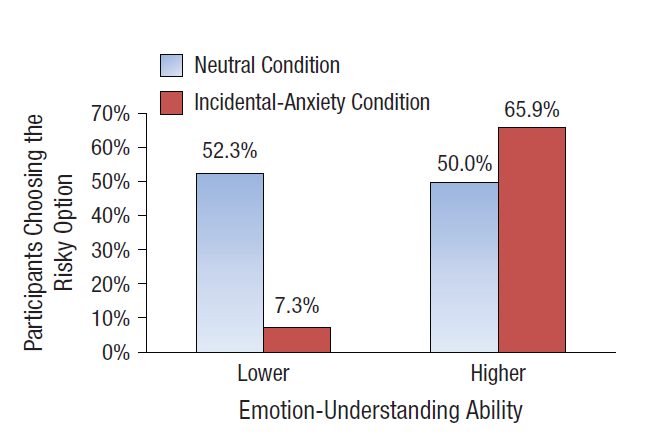
Yip and Côté demonstrated the relationship among emotional intelligence, evoked anxiety and propensity to make riskier choices in their lab studies of more than 100 volunteers, who completed the Mayer-Salovey-Caruso Emotional Intelligence Test developed by Yale’s Peter Salovey and David R. Caruso with John D. Mayer of University of New Hampshire.

David R Caruso

David R Caruso

One group received an anxiety-provoking assignment:  One minute to prepare a videotaped speech shown to peers studying “academic and social standing” at the university.
The other group was given a less stressful assignment:  Prepare a grocery list.

Volunteers in both groups could choose their compensation for participating in the study: Receive $1, or take a one in 10 chance to receive $10.

Melissa Finucane

Melissa Finucane

For those given the stressful speech-writing task, people who scored higher on emotional intelligence chose the riskier option to receive $10 three times as often as those who scored lower on emotional intelligence.

In contrast, volunteers who completed the low-stress task made similar choices for compensation no matter the level of emotional intelligence.

Ellen Peters

Ellen Peters

However, people can learn emotional awareness skills to enable mental focus and contain unrelated incidental emotions, according to related studies by Yip and Côté.

They demonstrated this ability to contain anxiety when some volunteers in the speech-writing task were told they “might feel worried” because making a speech is an anxiety-producing task.
Other speech-creators received no further instructions.

Kristin Sommer

Kristin Sommer

Yip and Côté “primed” no emotion among some grocery list-creators by saying that they “may feel no emotion” or no instructions.
Participants were then primed to separate their emotions from their decision-making by being told that their emotions were irrelevant to their decisions.

 Volunteers read information about the benefits of receiving flu injections and consequences of no inoculation during flu season.
Then participants were given the option to register for nearby flu injection clinic.

The reminder that emotions were irrelevant to decisions changed previous results, by increasing the frequency that participants with lower emotional awareness chose the riskier option of not attending the flu injection clinic.

 The findings suggest that adults can reduce emotional bias in decision-making by explicitly identifying emotions and separating them from critical thinking processes

Questions that enable people to separate emotions, thoughts, and decisions include:

  • How do I feel right now?
  • What is causing me to feel that way?
  • And are my feelings relevant to the decision I need to make?

-*How do you avoid the affect heuristic when making decisions?

RELATED POSTS:

©Kathryn Welds

Time of Day Affects Problem Solving Abilities

People differ in their circadian rhythms, which determine times of greatest mental alertness, reflected in body temperature differences.

James A Horne

James A Horne

Morningness” describes people who awaken easily and are most alert early in the morning, whereas “eveningness” refers to “night owls” who awaken later and feel most alert late in the day, according to Loughborough University’s James A. Horne and colleague O. Östberg, who developed a self-report questionnaire to distinguish these these temporal preferences.

Mareike Wieth

Mareike Wieth

Creative problem solving is more effective at “non-optimal” times of day for both “morning people” and “night people,” according to Albion College’s Mareike B. Wieth and Rose T. Zacks of Michigan State University.

Rose Zacks

Rose Zacks

They studied volunteers who solved insight problems and analytic problems at their optimal or non-optimal time of day and found consistently better performance on insight problem-solving during non-optimal times, but no consistent effect for analytic problem solving.

During non-optimal times, people may be more distractible, less focused and more able to consider diverse information, alternatives, and interpretations.
These conditions can enable innovative thinking and creativity.

William Hrushesky

William Hrushesky

William Hrushesky, formerly of University of South Carolina, argued that “timing is everything” in medical treatment, and Wieth and Zacks’ findings suggest suggests that working at “off-peak” times is effective for tasks that require creative thinking rather than analytic rigor.

-*How do you sequence your work tasks to enhance performance during “non-optimal” and “peak” times of day?

Follow-share-like http://www.kathrynwelds.com and @kathrynwelds

RELATED POSTS:


Twitter  @kathrynwelds
Blog – Kathryn Welds | Curated Research and Commentary  
Google+
LinkedIn Open Group Psychology in Human Resources (Organisational Psychology)
Facebook Notes:

©Kathryn Welds

Music Preferences Indicate Personality Traits

Besides individual aesthetic preferences, people may prefer musical genres to “regulate” mood or express self-image.

-*Does personality style shape musical preferences?
-*Does preferred music affect personality?

Peter Jason Rentfrow

Peter Jason Rentfrow

University of Cambridge’s Peter Jason Rentfrow and Samuel Gosling uncovered four music-preference dimensions when they analyzed music preferences of more than 3,500 individuals in six studies:

  • Reflective and Complex
  • Intense and Rebellious
  • Upbeat and Conventional
  • Energetic and Rhythmic

These music-preference categories were related to cognitive abilities like verbal IQ and attitudes like political orientation in addition to Big Five personality dimensions.

In other studies, Rentfrow and Gosling found that musical preference accurately predicted Big Five personality traits including “Openness to Experience”, Extraversion, and Emotional Stability among strangers when they asked same-sex and opposite-sex volunteers with an average age of 18  to “get to know each other” over 6 weeks.

Rentfrow and Gosling found significant correlations between musical genre preferences and Big Five personality characteristics:

  • Blues: High self-esteem, creative, outgoing, gentle, at ease
  • Jazz: High self-esteem, creative, outgoing, at ease, intellectual
  • Classical: High self-esteem, creative, introvert, at ease
  • Rap: High self-esteem, outgoing
  • Opera: High, gentle self-esteem, creative
  • Country and Western: Hardworking, outgoing, emotionally stable
  • Reggae: High self-esteem, creative, not hardworking, outgoing, gentle, at ease
  • Dance: Creative, outgoing, not gentle
  • Indie: Low self-esteem, creative, not hard working, not gentle
  • Bollywood: Creative, outgoing
  • Rock/heavy metal: Low self-esteem, creative, not hard-working, gentle, at ease, not outgoing,
  • Chart Pop: High self-esteem, hardworking, outgoing, gentle, not creative, not at ease
  • Soul: High self-esteem, creative, outgoing, gentle, at ease
  • Vocals: Extraverted
Marvin Zuckerman

Marvin Zuckerman

Additional support for the relationship between music preference and personality characteristics came from University of Melbourne’s David Rawlings and Vera Ciancarelli in their study correlating responses on University of Delaware’s Patrick Little and Marvin Zuckerman‘s Music Preference Scale and the NEO Personality Inventory (Revised).

Individuals who scored high on extraversion and women tended to prefer
“Popular Music
” and those who scored high on “Openness to Experience” showed strong “Breadth of Musical Preference.”

This study related “sensation seeking” to musical preferences and confirmed speculation that people who seek greater levels of environmental stimulation through auditory, visual, gustatory, and other experiences tend to like complex, intense music.

High scorers on Sensation Seeking Scale form V preferred Rock music and but not Soundtrack music and those who scored high on Thrill and Adventure Seeking subscale and Experience Seeking subscale liked Folk and Classical music in addition to Rock music.
As might be expected, participants who scored high on the Disinhibition subscale liked Rock but not Religious or Soundtrack music.

Hans Eysenck

Hans Eysenck

“Extraversion” has been related to “sensation seeking” in Hans Eysenck’s seminal research.
Southern Illinois University’s Stephen J. Dollinger demonstrated that people who report behaviors and traits associated with extraversion tend to prefer Jazz, which has “high arousal properties” and those who endorse “excitement seeking” behaviors said they prefer Hard Rock music.

Stephen Dollinger

Stephen Dollinger

These generalizations may change as people age, so Nazarene University College’s Kelley Schwartz and Gregory Fouts of University of Calgary examined 164 adolescents’ music preferences in relation to personality dimensions and developmental issues.

Gregory Fouts

Gregory Fouts

Those who preferred music with “heavy” or “light” qualities reported personality and developmental difficulties, but those who preferred “eclectic” music reported no personality or developmental concerns.

Schwartz and Fouts concluded that adolescents prefer music that reflects personality characteristics and developmental challenges, supporting Renfrow and Gosling’s caveat that results for adult musical preferences may not reflect the same personality characteristics among people in other age groups.

Taken together, these findings on personality trends related to musical preferences among adolescents and adults suggest that when people master specific developmental issues, music relevant to those challenges may no longer be appealing, and preferences may change.

-*To what extent do you prefer music that “regulates” your mood and productivity?

-*How accurately can you infer people’s personality traits from their musical preferences?

Please follow-share-like www.kathrynwelds.com and @kathrynwelds

RELATED POSTS:

Twitter  @kathrynwelds
Blog – Kathryn Welds | Curated Research and Commentary  
Google+
LinkedIn Open Group Psychology in Human Resources (Organisational Psychology)
Facebook Notes

©Kathryn Welds

Emotional Music Can Lead to Biased Judgments

Joydeep Bhattacharya

Joydeep Bhattacharya

Emotions elicited by music influence can influence and even bias visual judgments, according to University of London’s Nidhya Logeswaran and Joydeep Bhattacharya.

They presented volunteers with short excerpts of “happy” music or “sad” music, then showed neutral, “happy,” and “sad” faces.
When people listened to a “happy” music, they were more likely to perceive faces as “happy” even when the face was neutral.
Similarly, the “priming” with “sad” music was associated with more ratings of faces as “sad,” even if they were neutral.

The team also observed the effects of musical “priming” in electrophysiological measures of brain potential components within 100 milliseconds after the faces were presented, suggesting rapid neuronal information processing.

Even if listeners’ perceptions and judgments can be biased by emotional music, listeners do not experience the precise emotions they hear in music.

Kiyoshi Furukawa

Kiyoshi Furukawa

Listeners can identify strong emotions conveyed by music, but do not experience the same degree or type of emotion, according to Tokyo University of the Arts’s Ai Kawakami and Kiyoshi Furukawa, who collaborated with University of Tokyo’s Kentaro Katahira and Kazuo Okanoya.

Kazuo Okanoya

Kazuo Okanoya

Kawakami and team distinguished “perceived emotion” from “felt emotion” in response to music, and presented two pieces of “sad” music (Mikhail Glinka’s “La Séparation” in F minor) and one piece of “happy” music to 44 volunteers, both musicians and non-musicians.

Mikhail Glinka

Mikhail Glinka

Participants rated their perceived emotions and felt emotions in response to each musical selection using 62 descriptions on a scale from 0 (not at all) to 4 (very much).
Although participants recognized the “sad” music’s negative emotions, most reported feeling “romantic,” and “blithe,” rather than negative or unpleasant.

Muzak

Muzak

“Muzak” (now Mood Media) audio in workplaces can evoke emotional responses that may lead to biased business decisions.

As long ago as the 1950s, concerned American citizens claimed that Muzak practiced “brainwashing” with its planned musical sequences in quarter-hour segments.

Muzak Stimulus ProgressionMuzak’s playlist is synchronized to time of day to “increase energy” at predicted low-energy times based on its patented “Stimulus Progression.
These 15-minute sequences feature about six songs with varying “stimuli values,” based on tempo, rhythm, instrumentation and orchestra size.
The next 15-minute period features silence.
Mood Media
Over a 24-hour period, tunes with higher “stimulus value” are played when people are typically “lethargic” – 11 a.m. and 3 p.m., and slower songs are played “after lunch” and at the end of the work day.
Muzak claimed that this programming “increases morale and productivity at workplaces, increase sales at supermarkets, and even dissuade potential shoplifting at department stores.”

The emotional tone of music may bias other cross-sensory judgments.
Adrian C. North, working at University of Leicester and Herriott Watt University, tested the effect of music in a supermarket on wine selections and olfactory/gustatory judgments wine’s properties.

North ensured that French accordian music or German Bierkeller brass band music were played on alternating days for two weeks at the supermarket.
French wines and German wines had similar prices and their order on the shelf was changed each day.

After 82 shoppers selected wines, an interviewer asked customers to complete a questionnaire about the purchase, including:

  • Preference for French or German wines
  • Extent to which the music brought to mind France or Germany
  • Degree to which the music influenced specific wine selection.

The results from 44 shoppers suggest that music influenced shoppers’ wine selections:  More French wine was sold when French music played (40 bottles of French wine vs 8 bottles of German wine), and more German wine was sold when German music played (22 bottles of German wine vs 12 bottles of French wine).

North concluded that barely audible music can implicitly, unconsciously affect thoughts, perceptions, decisions, and even buying action.

Charles Areni

Charles Areni

Music can trigger thoughts similar to the music’s mood, context, or speed, according to the Preference-for-prototypes model proposed by Macquarie University’s Charles Areni and David Kim of Texas Tech.

-*When have your judgments and performance been altered by ambient music?

Follow-share-like http://www.kathrynwelds.com and @kathrynwelds

RELATED POSTS:

©Kathryn Welds