Tag Archives: stress

Companion Animals in the Workplace

Technology companies like Autodesk, Google, and Amazon made news when they permitted employees to bring companion dogs to work.Dog at work

This policy was viewed as an employee benefit or “perk”, but a recent study published in International Journal of Workplace Health Management indicates that bringing a companion dog to work can lower stress levels, increase productivity and make work more satisfying.

Centers for Disease Control and Prevention

In fact, the U.S. Centers for Disease Control and National Institutes of Health conclude that companion animals can lower individuals’ cholesterol, trigylcerides, blood pressure, heart rates,  weight, stress, risk of heart attack, social isolation, inactivity, and overall healthcare costs, all of which benefit organization’s operational costs.

National Institute of Health

Randolph Barker and collaborators from Virginia Commonwealth University examined a service-manufacturing-retail company in North Carolina with 550 employees and between 20 – 30 companion dogs.

Randolph Barker

Randolph Barker

Researchers measured 76 employees’ stress levels via surveys of attitudes toward animals in general and in the workplace.
Equal numbers of employees perceived dogs’ presence as increasing or decreasing work productivity.

Employees’ perceived stress levels, measured by cortisol in saliva samples, were significantly lower and job satisfaction was higher on days when dogs were present at work.

Companion dogs at work appeared to boost interpersonal communication, organizational engagement, and morale when employees who did not own dogs asking dog owners to interact with dogs or take them for a walk.

Considerable research around the globe suggests that the stress-reducing effect of companion dogs is tied to an increase in oxytocin when humans and dogs interact.

Kerstin Uvnas-Moberg

Kerstin Uvnas-Moberg

Kerstin Uvnas-Moberg of Uppsala University and author of The Oxytocin Factor: Tapping the Hormone of Calm, Love, And Healing, reported that women and their dogs experienced similar increases in oxytocin levels after ten minutes of friendly contact, and women’s oxytocin response was significantly correlated to the quality of the bond they reported in a survey taken prior to the interacting with their dogs.

The Oxytocin Factor

Likewise, JS Odendaal and RS Meintjes, then of Pretoria Technikon, showed that friendly contact between dogs and humans release oxytocin in both and Miho Nagasawa‘s team  at Azabu University found that amount of oxytocin among dog owners increased with the amount of time they shared eye contact with their dogs.

Suzanne C. Miller’s research group showed that oxytocin increased among women but not men after greeting their companion dog when returning home from work.

Christopher Honts

Christopher Honts

Christopher Honts and Matthew Christensen of Central Michigan University extended findings on stress reduction to evaluate trust, team cohesion and intimacy among teams collaborating on tasks when a well-trained, hypoallergenic dog was present.
During a collaborative creative thinking exercise, participants rated teammates higher on trust and teamwork than those without a dog.

Teams with a dog during the prisoner’s dilemma measure of trust and collaboration were 30% less likely to betray teammates accused of being co-conspirators in a hypothetical crime scenario.

Hiroshi Nittono

Hiroshi Nittono

Hiroshi Nittono and team at Hiroshima University demonstrated improved performance on problem-solving, attention, perceptual discrimination, and motor performance tasks after volunteers viewing images of baby animals compare with adult animals or food, reported in Public Library of Science .

Despite evidence that companion animals in the workplace reduce stress, increase perceptual and problem-solving capabilities and health indicators, barriers include:

  • Cultural objections to dogs and other animals
  • Allergies to companion animals
  • Animals without proper obedience and social skills training for the workplace

-*What do you think about potential financial and morale benefits of companions animals in the workplace?

Gromit

Gromit

<-Will this

Miss Sarah's Guide

Miss Fido Manners

be replaced with this? <—————>

Related Posts

Twitter: @kathrynwelds
Google+
LinkedIn Open Group Psychology in Human Resources (Organisational Psychology)
Facebook Notes
Blog: – Kathryn Welds | Curated Research and Commentary

©Kathryn Welds

Oxytocin Receptor Gene’s Link to Optimism, Self-Esteem, Coping with Stress

Shelley Taylor

Shelley Taylor

Shelley E. Taylor, distinguished professor at UCLA identified the oxytocin receptor gene (OXTR) link to optimism, self-esteem and “mastery” — the belief that one has control over one’s own life.
These three elements are required to manage stress and depression.

Reported in the Proceedings of the National Academy of Sciences (PNAS), she notes that oxytocin, a hormone that increases in response to stress, is associated with good social skills such as empathy and social behavior, especially under stress.

In one location on the oxytocin receptor gene, two variants occur:

•    “A” (adenine) variant, associated with increased sensitivity to stress, poorer social skills, depressive symptoms and worse mental health outcomes

•    “G” (guanine) variant, associated with optimism, self-esteem and mastery.

This effect was demonstrated in 326 volunteers, who completed measured by self-assessments and saliva samples for DNA analysis.
Those with two “A” nucleotides or one “A” and one “G” at this oxytocin receptor gene location, showed lower levels of optimism, self-esteem and mastery and higher levels of depressive symptoms than people with two “G” nucleotides,

Taylor notes that genes may predict behavior, but do not determine it because many environmental factors and other genes interact with oxytocin receptor gene variants in stress, coping, and emotional behaviors.

These findings suggest people who train themselves to appraise situations more optimistically, to see themselves more worthy, capable and competent, are able to improve ability to cope with stressful events.

Taylor’s book, The Tending Instinct: Women, Men, and the Biology of Relationships, outlines the importance of cultivating socially nurturing environments to mitigate genetic vulnerabilities.

She notes that “a mother’s tending can completely eliminate the potential effects of a gene; a risk for a disease can fail to materialize with nurturing, and a genetic propensity may lead to one outcome for one person and the opposite for another, based on the tending they received.”

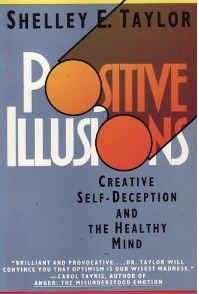
Her most influential work demonstrated a “self-enhancement bias” in her book, Positive Illusions: Creative Self-Deception and the Healthy Mind ,
she explained that “most people regard themselves, their circumstances, and the future as considerably more positive than is objectively likely…. These illusions are not merely characteristic of human thought; they appear actually to be adaptive, promoting rather than undermining good mental health.”

In contrast, Rick Hanson argues that a negative bias is more adaptive to survival than a positive bias.
He notes that negative stimuli produce more neural activity than do equally intense positive ones, and are perceived more easily and quickly: “The brain is like Velcro for negative experiences but Teflon for positive ones.”

His book, Just One Thing: Developing a Buddha Brain One Simple Practice at a Time, recommends meditation to tame automatic negative thoughts.

-*Where have you seen examples of “the tending instinct,” positive illusions and negative bias in the workplace?

See related posts on Hormones and Emotional Expression:
•    Oxytocin, Testoterone: Oxytocin Increases Empathic Work Relationships, Workplace Trust, Generosity
•    Cortisol, Testosterone: Thoughts Change Bodies, Bodies Change Minds, Roles Shape Hormones: “Faking Until It’s Real”

Twitter:  @kathrynwelds
Google+
LinkedIn Open Group Mindful Leadership
Facebook Notes 

Blog: – Kathryn Welds | Curated Research and Commentary

©Kathryn Welds

10 Ways to Build Resilience

A key factor in “psychological resilience”, or the process of adapting to unexpected adversity, trauma, tragedy, threats, or stress, is having caring and supportive relationships within and outside the family, according to research by the American Psychological Association (APA).

Other factors include:

• Making realistic plans and executing them
• Positive view of self
• Confidence in your strengths and abilities
• Skills in communication and problem solving
• Managing strong feelings and impulses

APA outlines actions that increase personal resilience

• Make connections with family members, friends, or others to request and accept support. Civic groups, faith-based organizations, or volunteering to help others can make meaningful connections

• Consider crises as solvable problems. You can change how you interpret and respond to these events.

• Recognize that change occurs with increasing frequency. You can balance thoughtful acceptance of a situation with acting to change it.

• Move toward your goals, with regular small accomplishments

• Take decisive actions

• Look for opportunities for self-discovery and learning “life lessons” that may benefit others

• Develop confidence that you can address the issues. Others in the social support network may assist.

• Keep things in perspective, in relation to the great challenges faced by others

• Visualize your goals and aspirations

  • Cultivate an optimistic outlook, and consider hope as essential as oxygen

• Take care of yourself with exercise, relaxation, balanced diet and lifestyle, medical attention

Additional strategies may assist: the process of adapting well in the face of adversity, trauma, tragedy, threats, or even significant sources of stress

-*What are your most effective strategies for building personal resilience in the face of challenges?

LinkedIn Open Group – Mindful Leadership
Twitter: @kathrynwelds
Google+
Facebook Notes:

©Kathryn Welds

Thoughts Change Bodies, Bodies Change Minds, Roles Shape Hormones

Deborah Gruenfeld, formerly of Stanford Graduate School of Business, studied the impact of non-verbal behavior on perceptions of power.

Deborah Gruenfeld

Deborah Gruenfeld

She reported that people who “occupy space” are viewed as more dominant and powerful by others.

See Related Posts:

She demonstrated that non-verbal behavior like erect, “space-occupying” postures and selective smiling affect the way the person executing these behavior feels about his or her personal power, competence, and mood.

“Power postures” affect secretion of hormones associated with dominance (testosterone) and stress (cortisol).

Effective leaders and recently promoted leaders show a hormone profile of high testosterone and low cortisol, indicating high dominance and low stress.

Individuals in low power role have low testosterone and high cortisol, and this trend is more common among women.

Posture can make a large difference in how people view themselves, how others see them, and their opportunities and outcomes.

Before a job interview or stressful interaction, a “big power posture”  can increase confidence and performance.

-*What is your emotional response to people who assume a “big power posture” at work?
-*How do you feel when you occupy more space in professional settings?

©Kathryn Welds