Organizational pressures and anxiety can trigger expressions of anger.
Victoria Brescoll
When women and men expressed anger at work, evaluators considered women less competent, with lower leadership effectiveness than men who also expressed anger.
Negative evaluations of women who express anger were consistent across job roles, from female CEOs to female trainees. In contrast, men who expressed anger at work were conferred higher status than men who expressed sadness.
Men were also negatively evaluated for leadership effectiveness when they expressed sadness. Sadness seems to be negatively evaluated in both men and women, and anger is especially negatively evaluated in women.
Observers attribute different motivations and causes to anger expressions by women and men. Women’s angry emotional reactions were attributed to stableinternal characteristics such as “she is an angry person,” in Brescoll’s and Uhlmann’s research. In contrast, men’s angry reactions were attributed to changeableexternal circumstances, such as having external pressure and demands.
Donald Gibson
These differing evaluations are related to societal norms for women to regulate anger expressions, suggested Fairfield University’ s Donald Gibson and Ronda Callister of Utah State University.
Women may buffer the status-lowering, competence-eroding, and dislike-provoking consequences of anger at work by:
They asked more than 230 volunteers to remember recent emotional episodes and report their duration.
Klaus R. Scherer
Participants also described their strategies to evaluate and deal with emotions categorized by Swiss Center for Affective Sciences’ s Klaus R. Scherer, including admiration,anger, anxiety, being touched, boredom, compassion,contentment, desperation, disappointment, disgust, enthusiasm, fear, gratitude, guilt, hatred, hope, humiliation, irritation, jealousy, joy, pride, relaxation, relief, sadness, shame, stress, and surprise.
James Gross
Volunteers rated coping strategies according to a model of emotional regulation developed by Stanford’s James Gross and Ross A. Thompson of University of California Davis:
Situation selection – Entering the situation that elicited emotion
Situation modification – Trying to change the event that elicited the emotion
Distraction – Attempting to distract attention from the emotional situation
Rumination – Continued thinking about feelings and consequences of the event
Reflecting – Considering the emotion-eliciting event, but not repetitively ruminating
Reappraisal – Trying to differently view the emotion-eliciting event
Emotional suppression – Attempting to stop experiencing the emotion
Expressive suppression – Trying not expressing the emotion.
Iven Van Mechelen
Participants also rated their appraisal of the situation that triggered emotion based on Scherer’s Geneva Appraisal Questionnaire:
Event importance – Extent the event that elicited the emotion was important to them
Event impact – Advantages and disadvantages of the event that elicited the emotion
Other responsibility – Degree that someone else was responsible for the emotion-eliciting event
Self responsibility – Degree that they were responsible for the emotion-eliciting event
Problem-focused coping – Extent that they could change something about the emotion- eliciting event
Emotion-focused coping – Extent that they could change something about the emotion elicited by the event
Expectedness – Degree to which they anticipated the emotion-eliciting event
Negative impact on self-image – Extent to which they judged the emotion-evoking event as reducing self-esteem
Injustice – Degree to which they judged the emotion-eliciting event as unjust
Immorality – Extent to which they judged the emotion-eliciting event as immoral.
Verduyn and Lavrijsen differentiated emotions from moods by telling volunteers that an emotion is always elicited by an external or internal event with a specific onset point.
Karen Brans
The team also provided two differing definitions of an emotion’s end point:
Half the participants were told than an emotion ends as soon as the emotion is no longer felt for the first time (except for sleep) whereas the remaining volunteers were told than an emotion ends as soon as one has fully recovered from the event.
Emotion duration differed for similar emotions, such as persistent guilt compared with transient shame, and longer-lasting anxiety contrasted with intense but fleeting fear.
Susan Nolen-Hoeksema
Two regulation strategies – rumination and reflection – and one appraisal dimension – event importance – were associated with increased emotion duration, supporting theories by KU Leuven’s Iven Van Mechelen, Verduyn, and Karen Brans, and empirical research by Yale’s Susan Nolen-Hoeksema.
Though boredom, shame, and fear seem to endure endlessly, this research indicates that they are more transient than most people expect.
These unpleasant experiences pass, as do significant incidents that require time to “process.”
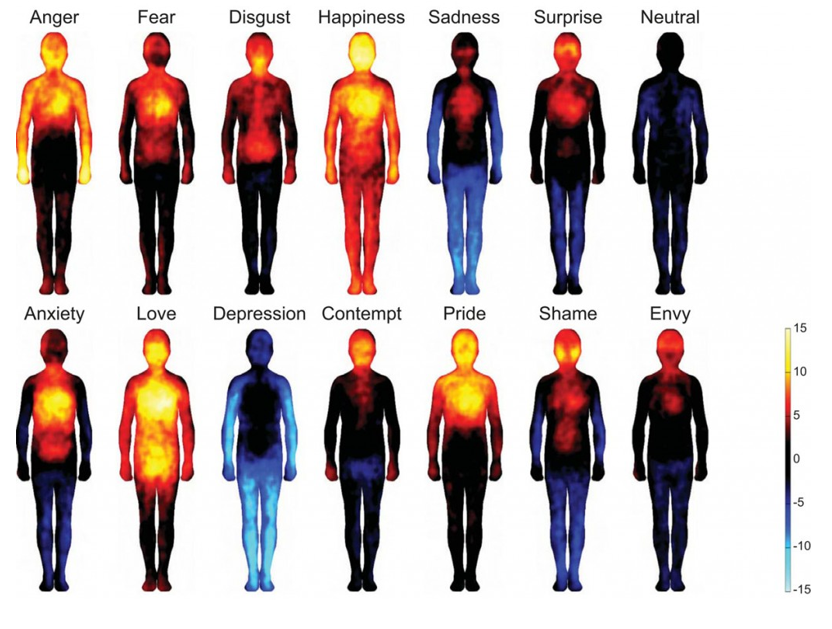
Emotions are associated with physiological changes in specific body regions, such as increased heart rate, sweaty palms, or startle response, according to Aalto University’s Lauri Nummenmaa, Enrico Glerean, and Riitta Hari, with Jari Hietanen ofUniversity of Tampere.
Enrico Glerean
Nummenmaa and team showed emotion-laden words, videos, facial expressions and stories to more than 700 participants in Finland, Sweden and Taiwan, who then reported body regions that “felt different” after they viewed the emotion-evoking media.
according to Durham University’s Zoltán Kövecses, Gary B. Palmer then of University of Nevada, Las Vegas and Rene Dirven then of University of Duisburg-Essen.
Zoltán Kövecses
Nummenmaa’s team controlled for these linguistic representations by evoking emotional experiences with guided mental imagery from:
Nummenmaa and colleagues found distinctly different body areas associated with emotional experiences of happiness, contempt, love, and other feelings, with consistent resultsacross nationalities.
They represented regions of greatest sensation associated with specific emotions with a computer-generated topographical body map.
The team proposed that emotions are represented as “culturally universal categorical somatotopic maps,” and sensing emotion-triggered bodily changes is required to perceive basic and complex emotions.
Top row displays “basic” emotions:
Anger
Fear
Disgust
Happiness
Sadness
SurpriseBottom row displays “complex” emotions:
Anxiety
Love
Depression
Contempt
Pride
Shame
Envy
Happiness was a “full-body experience,” with increased sensation throughout the body, but some emotions were experienced in specific regions.
In addition, all evoked emotions increased sensations in the head, reflecting changes in the facial area by muscle activation, skin temperature, tearing, and thoughts of emotional events.
Jon Kaas
“Approach-oriented emotions,” including anger and happiness, were associated with increased upper limb sensation whereas depression was linked to decreased limb activity and sensation.
Disgust was felt in the digestive system and around the throat.
Positive emotions, including happiness, love, and pride, clustered in one group.
In contrast negative emotions diverged into four separate groups based on linguistic analysis and sensed body location:
Anger and fear
Anxiety and shame
Sadness and depression
Disgust, contempt, and envy.
Surprise was seen as neither a negative nor a positive emotion, yet it was distinctly different from neutral emotion.
Emotional metaphors appear connected to actual physiological experience of emotions, even when researchers controlled for familiar linguistic stereotypes and “conventional wisdom.”
-*What discrepancies have you observed between emotion descriptions and physical experience of emotion?
Emotions elicited by music influence can influence and even bias visual judgments, according to University of London’s Nidhya Logeswaran and Joydeep Bhattacharya.
They presented volunteers with short excerpts of “happy” music or “sad” music, then showed neutral, “happy,” and “sad” faces. When people listened to a “happy” music, they were more likely to perceive faces as “happy” even when the face was neutral.
Similarly, the “priming” with “sad” music was associated with more ratings of faces as “sad,” even if they were neutral.
The team also observed the effects of musical “priming” in electrophysiological measures of brain potential components within 100 milliseconds after the faces were presented, suggesting rapid neuronal information processing.
Even if listeners’ perceptions and judgments can be biased by emotional music, listeners do not experience the precise emotions they hear in music.
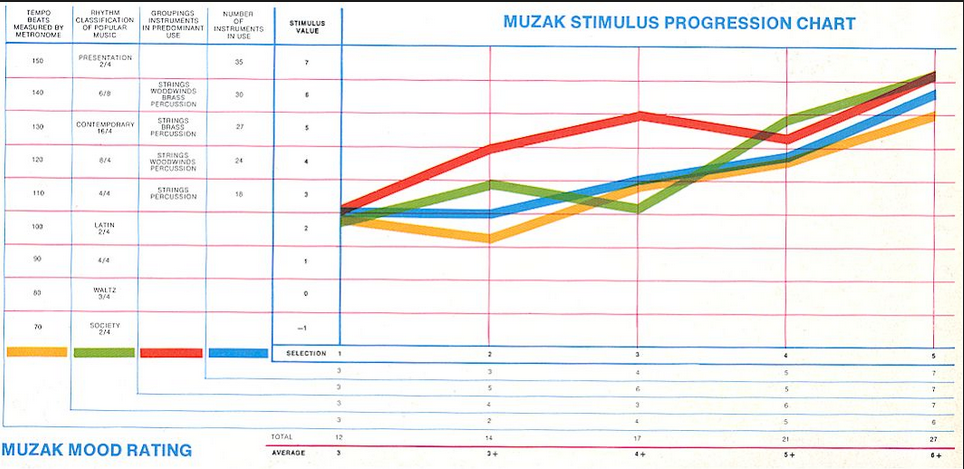
“Muzak” (now Mood Media) audio in workplaces can evoke emotional responses that may lead to biased business decisions.
As long ago as the 1950s, concerned American citizens claimed that Muzak practiced “brainwashing” with its planned musical sequences in quarter-hour segments.
Muzak’s playlist is synchronized to time of day to “increase energy” at predicted low-energy times based on its patented “Stimulus Progression.”
These 15-minute sequences feature about six songs with varying “stimuli values,” based on tempo, rhythm, instrumentation and orchestra size.
The next 15-minute period features silence.
Over a 24-hour period, tunes with higher “stimulus value” are played when people are typically “lethargic” – 11 a.m. and 3 p.m., and slower songs are played “after lunch” and at the end of the work day.
Muzak claimed that this programming “increases morale and productivity at workplaces, increase sales at supermarkets, and even dissuade potential shoplifting at department stores.”
The emotional tone of music may bias other cross-sensory judgments. Adrian C. North, working atUniversity of Leicester and Herriott Watt University, tested the effect of music in a supermarket on wine selections and olfactory/gustatory judgments wine’s properties.
North ensured that French accordian music or German Bierkeller brass band music were played on alternating days for two weeks at the supermarket.
French wines and German wines had similar prices and their order on the shelf was changed each day.
After 82 shoppers selected wines, an interviewer asked customers to complete a questionnaire about the purchase, including:
Preference for French or German wines
Extent to which the music brought to mind France or Germany
Degree to which the music influenced specific wine selection.
The results from 44 shoppers suggest that music influenced shoppers’ wine selections:More French wine was sold when French music played (40 bottles of French wine vs 8 bottles of German wine), and more German wine was sold when German music played (22 bottles of German wine vs 12 bottles of French wine).
North concluded that barely audible music can implicitly, unconsciously affect thoughts, perceptions, decisions, and even buying action.
Numerous studies, pioneered by Paul Ekman of University of California, San Francisco, argue that facial expressions provide an accurate, consistent, universal “tell” to underlying emotions.
However, body language more accurately conveys intense emotions than facial expressions, according to Hebrew University’s Hillel Aviezer,Yaacov Trope of NYU, and Princeton University’s Alexander Todorov.
Three groups of 15 people judged intense emotions, including pain, pleasure, victory, defeat, grief and joy, portrayed in stock photographs of:
facial expressions alone or
body language alone or
both facial and body expressions.
Hillel Aviezer
Volunteers assigned more accurate inferences of pictured emotion based on body language, alone or combined with facial expressions, than judgments based on facial context alone.
These results challenge presumption that the face best communicates feeling, yet most participants believe that they rely on facial expression was their most important cue in making inferences.
Yaacov Trope
More than half the volunteers reported that they use facial expression to judge underlying emotions, a bias labeled “illusory facial affect” by Aviezer and team.
Some participants did not view the photos, but heard a description of the content.
The vast majority – 80 percent – said they “would” rely solely on the face when determining the emotion.
The remainder said they would consider the face and body together, yet not one participant indicated that body language alone would be the most important guide to emotion.
Alexander Todorov
Another experiment presented volunteers with altered photos that combined one intense emotional expressed in the face with an opposing “peak” emotion portrayed by the body language.
Volunteers more often judged the emotion associated with the body, although they thought that facial expression was more indicative of underlying emotional experience.
A different condition demonstrated that most participants provided inaccurate judgments of six emotional states portrayed by faces alone: They judged positive facial expressions as negative more frequently than the actual negative expressions.
Aviezer, Trope, and Todorov argue that facial expressions can be ambiguous and subjective when viewed without the context of body, particularly during intense emotional expressions.
Jamin Halberstadt
Jamin Halberstadt of University of Otago explained Team Aviezer’s findings by noting “…bodily context is the expression of emotion…the face reveals a general intensity of feeling but doesn’t communicate what the person is feeling exactly. The body is where the valid information comes from during intense feelings.”
Piotr Winkielman
His expertise is based on earlier research with University of California at San Diego’s Piotr Winkielman, Paula Niedenthal of University of Wisconsin and University of Clermont-Ferrand’s Nathalie Dalle. They demonstrated the important role of expectancy in reading, experiencing, and recalling emotions expressed by ambiguous facial photographs.
Paula Niedenthal
Halberstadt’s team usedelectromyography (EMG) to evaluate volunteers’ muscle mimicry responses and memory of photos portraying ambiguous faces when associated with emotion labels like “angry” or “happy”, and when the same photos were presented without labels.
Nathalie Dalle
Participants displayed more EMG activity associated with smiling when they viewed faces labeled “happy” than “angry,” and remembered faces labeled “happy” as happier than faced coded “angry” even though the photographed expressions were ambiguous.
When participants spontaneously mimicked emotions labeled with a specific affect label, they were more likely to remember this emotion.
Since the photos were ambiguous, this recall represents memory bias, based on expecting, then mirroring an expected emotion.
Body language’s greater accuracy than facial expression as a measure of emotion, has important implications for mission critical interrogation and security-screening techniques.
One example is the U.S. Transportation Security Administration’s Screening of Passengers by Observation Techniques (SPOT) program, which was based on Ekman’s facial expression research, but did not account for bodily expression as an indicator of underlying emotion.
Team Aviezer’s findings argue that emotion-screening procedures, as well as everyday workplace interactions, should evaluate both cues from both the body and the face to form most accurate judgments of others’ likely emotional states.
-*Which cues do you find most helpful in judging other people’s emotional states when interacting with them?
People often make “affective predictions” about choice of life partner, occupation, residence, yet most everyone makes small, but systematic errors in forecasting personal emotional responses.
These misjudgments can negatively affect personal health, happiness, financial well-being, and interpersonal relationships.
In addition, Kushlev and Dunn reported that people tend to overestimate the duration of future emotional reactions, labeled durability bias.
Seymour Epstein
Durability bias (focalism) can occur when people rely on the “rational system” for information processing, according to Seymour Epstein of University of Massachusetts.
His Cognitive-Experiential Self Theory proposes that the “rational system” is used to make affective forecasts using slow, analytic and abstract processing.
In contrast, the “experiential system” of information processing is rapid, associative, holistic, and concrete.
Shifts between rational (“cold”) and experiential (“hot”) decision systems can cause another bias, “Empathy gap.”
Epstein posits that rational system processing can lead to imagining the event isolated from its broader context, which can underestimate its emotional impact. This can lead to focus on and overvalue distinctive, observable characteristics.
Immune neglect is a related error, when people underestimate their likelihood of later reinterpreting future events to reduce regret.
Underestimating the power of future physical states is another predictive error recognised in Alcoholics Anonymous guidance to analyse whether cravings occur when people experience “HALT” (“Hungry, Angry, Lonely, Tired”.) “Personality neglect,” is another error that occurs when people underestimate the influence of personal dispositions and characteristics.
Roger Buehler
Expectations affect future emotions, according to Wilfrid Laurier University’sRoger Buehler, Vassili Spyropoulos and Kent C. H. Lam with Cathy McFarland of Simon Fraser University. They found that those with positive expectations experience more positive present and future emotions. This optimism bias may provide protection and benefit to each individual’s “psychological immune system.”
Kristin Weger
People can reduce errors in predicting future emotions by evaluating expectations in comparison to actual experience during a “post-mortem” session to review “lessons learned,” found University of Alabama at Huntsville’s Kristin Weger and Sandra Carpenter.
-*How accurate are you in predicting your feelings about a specific choice or situation in the future?
-*How do you detect and mitigate bias in predicting your future emotional reactions?
-*What positive and negative impacts have you observed in affective forecasting errors?
Compassion training has positive effects on mood and health, and University of Zurich’s Susanne Leiberg, Olga Klimecki, Tania Singer demonstrated that it can actually change the brain’s functioning, and related emotions and behaviors.
Olga Klimecki
Klimecki, Leiberg, Singer, now at Max Planck Institute collaborated with Claus Lamm of University of Vienna to examine the impact of compassion training on brain activity in response to observing another person’s distress.
In contrast, compassion is concern with others’ suffering coupled with the desire to alleviate the other person’s pain, and can exist without actually experiencing the other persons’ distress through empathy.
The researchers evaluated whether personal distress be transformed into compassion, a useful coping strategy for those in health care professions, and in caretaking roles.
They developed the Socio-affective Video Task to measure neural and subjective responses to witnessing the distress of others.
In contrast, control group volunteers who received memory training did not have more positive emotions, and participants in empathy training actually experienced more negative feelings.
The studies suggest that compassion training can be an effective coping strategy when observing or supporting others in distress, and the mental discipline of compassion training can increase positive emotion more effectively than memory training or empathy training.
Besides changing the brain and related feelings, compassion training triggered more “prosocial” behavior, including helping and cooperating.
The team considered whether these participants, who had suffered maltreatment, experienced improved psychosocial functioning after twice-weekly Cognitive-Based Compassion Training (CBCT) for six weeks compared with young people assigned to the “wait-list-no treatment” group.
Barbara Frederickson of University of North Carolina posits that negative emotions aid human survival by narrowing and limiting people’s perceived range of possible actions, whereas positive emotions enhance survival by “broadening and building” options for action.
Her lab’s findings suggest that positive thinking expands awareness and perception of the surrounding world, so can lead to innovative solutions to problems.
She suggests intentionally implementing a “broaden-and-build” approach to emulate this expanded view: Choose a degree of focus and perspective depending on requirements.
For example, to garner more clout in a discussion, she suggests involving more people who will provide support.
Similarly, to mitigate negative thinking or “tunnel vision,” think more broadly by viewing “the big picture.”
Rosabeth Moss Kanter of Harvard Business School referred this perceptual shift as “zooming in” and “zooming out”, depending on the perspective requires.
Rosabeth Moss Kanter
Frederickson found that people who experience positive thinking are:
* Healthier
* More generous
* More productive
* Bounce back from adversity more quickly
* Are better managers of people
* Live longer
than those with a bleaker outlook.
Fredrickson’s research implies that positive emotions can mitigate the cardiovascular effects of negative emotions and stress.
In these activated conditions, people generally have increased heart rate, higher blood sugar, greater immunosuppression.
These conditions tax physical systems and can lead to life-threatening illnesses like coronary disease.
To mitigate these negative health consequences, Fredrickson recommends observing positive emotional experiences of joy, gratitude, serenity, interest, hope, pride, amusement, inspiration, awe, and love.
Besides noticing these experiences, she advocates writing and meditating about these to increase grateful awareness.
In addition, Frederickson echoes common wisdom:
Spend time in nature to appreciate the natural world
Develop interests
Invest time in relationships
Reduce exposure to negative news
Practice kindness
Dispute negative thoughts and replace them with more positive, realistic thoughts.
She broadens the concept of love to suggest that love – or an intense connection – occurs when people share positive emotion.
This lead to alignment between people’s biochemistries, particularly the release of oxytocin and vagal nerve functioning.
Related emotions and behaviors synchronize and mirror each other, resulting in shared interest in mutual well-being in a three-phase “positivity resonance.”
She argues that love “literally changes your mind.
It expands your awareness of your surroundings, even your sense of self.
The boundaries between you and not-you – what lies beyond your skin – relax and become more permeable.
While infused with love, you see fewer distinctions between you and others.”
Fredrickson argues that this intense connection requires physical presence, and cannot be replaced by existing digital media — reinforcing her recommendation to invest in relationships with others.
-*What practices enable you to cultivate and sustain positive emotions?
They analyzed more than 450,000 responses to the Gallup-Healthways Well-Being Index, a daily survey of 1,000 US residents conducted by the Gallup Organization, and distinguished two elements of “subjective well-being” or happiness:
Emotional well-being – Frequency and intensity of joy, stress, sadness, anger, and affection,leading to pleasant or unpleasant quality of life, measured by Cantril’s Self-Anchoring Scale of yesterday’s emotional experiences
Life evaluation – Subjective assessment of one’s life.
They found that as emotional well-being rises with income up to about $75,000 in 2010 US dollars, then does not continue increasing with higher income levels.
In addition, daily emotions were predicted by health status, care giving, loneliness, and smoking.
Life evaluation increased as income and education increased, and the study confirmed that low income exacerbates the emotional pain associated with divorce, ill health, and being alone.
Michael Norton
In fact, Michael Norton of Harvard Business School found that volunteers’ happiness increased with more money only when they spent money on others.
Replicated in Canada, Uganda, Rwanda, and other countries, his research found that happiness increases when people:
Select experiences over things
Spend money on others, regardless of the amount of money spent
He concluded that money can buy happiness when it’s spent on other people and experiences in Happy Money: The Science of Smarter Spending … a worthwhile reminder in this season of gift-giving.
Norton’s TED talk
British researchers investigated longitudinal connections between happiness and money, and found that people who express more positive emotions as teenagers have more positive life outcomes as adults, including higher education and income.
Jan-Emmanuel De Neve of University College London and Andrew Oswald of
Jan-Emmanuel De Neve
University of Warwick analyzed Carolina Population Center’s National Longitudinal Study of Adolescent Health (“Add Health”) profiles of more than 10,000 Americans at ages 16, 18 and 22 and their annual incomes at age 29.
De Neve and Oswald controlled for education level, IQ, height and self-esteem, all known to contribute to financial success.
Reported in Proceedings of the National Academy of Sciences, they found that those who express more positive emotions in their teen years, reported greater life satisfaction and optimism as young adults, were more likely to earn a university degree, secure employment, advance to higher-level roles, and have higher incomes by age 29.
The survey assessed life satisfaction on a 5-point scale, and found that an increase of 1-point at age 22 made translated to a $2,000 difference in later income measured in in 2012 US dollars, and the later income difference between the happiest and unhappiest participants was $8,000 by the same measure.
Andrew Oswald
DeNeve and Oswald validated the finding by comparing about 3,000 sibling pairs who shared the same parents and socioeconomic status.
They found that the happier siblings also had more positive emotions and life evaluation than less-happy participants.
One explanation of these findings is that observers generalize positive impressions of people who display more positive emotions in a “halo effect”, so these happier individuals are seen as more likeable, competent and attractive, and are offered more opportunities for education, employment, and social relationships.
These findings suggest the importance of increasing the “Emotional Intelligence” competencies of emotional self-regulation.
See The Happiness-Money Connection: Halo Effect of Happy Mood?Part 2 for research-based recommendations on developing happiness and well-being.
-*How do you view the connection between happiness and money?
Peter Salovey, newly appointed President-Elect of Yale University, introduced the term “Emotional Intelligence” in 1989 as “the ability to monitor one’s own and others’ feelings and emotions, to discriminate among them, and to use this information to guide one’s thinking and actions”.
Yale’s new President, is considered a pioneer and originator of research into four elements of EQ used to think and behave adaptively:
Accurately perceiving, identifying, pinpointing emotions in self, others
Expressing, using emotions as information to decide, plan, achieve, communicate, create, think
Understanding, predicting own and others’ emotions, temporary moods
Self-regulating, transforming emotions.
Peter Salovey
Salovey is widely regarded as one who embodies these characteristics and creates community through his bluegrass band performances with Professors of Bluegrass, active participation in student life (as a Super Mario Brother at Halloween 2009, accompanied by the Yale Symphony orchestra during his tenure as Provost), and award-winning teaching and research.
Emotional Intelligence can be intentionally increased in work and personal settings by increasing awareness of one’s own and others’ emotions. One way to achieve this goal is through “Mindfulness,” or non-evaluatively, non-judgmentally attending to physical, cognitive, and emotional experiences arising in the present moment.
He discussed the possible impact of these practices on business leadership and government, building on research findings that mindfulness practice can lower aggressive feelings and increase peaceful sentiments.
He added that Obama “… is really present, he has a lot of different qualities that seem to indicate he is emotionally balanced, not driven by ego concerns, that he knows how to balance family life and the impossible job that he has. There is something about him that’s measured, very peaceful, he listens very, very deeply.”
Many observers will evaluate whether Salovey can put into practice Emotionally Intelligent leadership at Yale, and whether Barack Obama can demonstrate Mindfulness in peaceful international relations and domestic issue-resolution during his final term in office.
-*Where do you observe emotional intelligence and mindfulness among top leaders?













































 He concluded that money can buy happiness when it’s spent on other people and experiences in






 Kathryn Welds, PhD | Curated Research + Commentary