Premium Pay to Attract Diverse Women Candidates?

Companies must pay more to attract and hire women from diverse backgrounds because there are few qualified female and nonwhite candidates – and because these candidates are highly sought by employers.

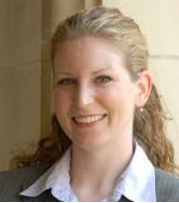
Deborah Ashton

Deborah Ashton

Myth or reality?, asks Deborah Ashton of Novant Health.

Myth: American women earned significantly less than men, so it is unlikely that diverse women enjoy a salary advantage over men.

In fact, women in the U.S. earned $0.82 for every $1.00 earned by American men in 2013, up from $0.79 the year before, according to the 2012 Bureau of Labor Statistics earnings survey.

Daryl G. Smith

Daryl G. Smith

Nana Osei-Kofi

Nana Osei-Kofi

More education may not result in higher or even equitable salaries for African-American, white, and Hispanic women: The gender pay gap actually increases as when these women complete higher education levels.
In fact, workers with the least education actually experienced the least pay gap, but they are rewarded with “equal opportunity poverty.”

Sandra Richard Mayo

Sandra Richard Mayo

Men, regardless of race or ethnicity, earn more than women of any race when education level is held constant, except for Asian women with at least a Bachelor’s degree, who earned more than African-American men – the lowest-earning group of men.

Caroline Turner

Caroline Turner

These data and related studies reviewed by Claremont Graduate University’s Daryl G. Smith, Nana Osei-Kofi of Oregon State University, Azusa Pacific University’s Sandra Richards Mayo,  and Caroline S. Turner of Arizona State University, do not support claims that most diverse female candidates are paid more than men.

Patricia White

Patricia White

Likewise, Patricia E. White of the U.S. National Science Foundation, found no evidence for “bidding wars” to attract, hire and retain diverse women job candidates.

The gap in pay equity continues, and affects women across all ethnic and racial categories, with particularly adverse impact on Hispanic and African-American women. Deborah Ashton Table 1

-*How frequently have you encountered the myth of salary premiums to attract qualified diverse women and men job candidates?

Follow-share-like

http://www.kathrynwelds.com and @kathrynwelds

RELATED POSTS:

Twitter @kathrynwelds
Blog: Kathryn Welds | Curated Research and Commentary
Google+
LinkedIn Open Group Psychology in Human Resources (Organisational Psychology)
Facebook Notes

©Kathryn Welds

Gender Bias in STEM Hiring Even When it Reduces Financial Returns  

Women are under-represented in Science, Technology, Engineering, and Mathematics (STEM) academic programs and professional roles, and some question whether this is a a result of personal preference, implicit bias, institutional barriers, or other factors,

Ernesto Reuben

Ernesto Reuben

To investigate, Columbia University’s Ernesto Reuben, Paola Sapienza of Northwestern University, and University of Chicago’s Luigi Zingales developed an experimental job market.
Both male and female candidates demonstrated equal skill in performing an arithmetic task, yet both female and male “hiring managers” were twice as like to hire comparable male candidateseven when the hiring managers earned less by hiring less qualified males.
*Even when participants had a financial incentive to choose the candidate with the greatest task-relevant skills, they chose less-qualified male candidates.

Paola Sapienza

Paola Sapienza

Reuben and team also found that when candidates were asked to report their performance on the task-related achievement test, men exaggerated their performance with “honest overconfidence.”
In contrast, women generally underreported their accomplishments, found University of Wisconsin’s Sylvia Beyer.

Luigi Zingales

Luigi Zingales

This gender-based bias in hiring decisions was reduced, but not eliminated when candidates’ previous performance was provided by a third party.

Sylvia Beyer

Sylvia Beyer

Some candidates were directed to report expected future performance based on initial math task performance, then the “employer” made the hiring decision.
Other candidates provided no estimate, but Reuben’s team reported candidates’ past performance to the “hiring managers.”

In other studies, “employers” had no information on each “candidate’s” previous performance, but met each applicant in person before making a hiring decision.
After the hiring managers’ choice, candidates reported expected future performance, or Reuben’s team provided candidates’ past performance to the “hiring manager.”

Anthony Greenwald

Anthony Greenwald

Volunteers then completed the Implicit Association Test (IAT), developed by University of Washington’s Anthony Greenwald, Debbie McGhee, and Jordan Schwartz, to elicit unconscious stereotypes of gender, competencies, and occupations.

When the candidates reported their expected performance and the “hiring manager” chose a candidate with a lower score than other contenders, 90% of the selected but underperforming candidates were male.
As a result, “hiring managers” who selected less qualified male candidates sacrificed 5-7% of their own compensation for biased selections.

Pedro Rey-Biel

Pedro Rey-Biel

Reuben and colleagues, with Pedro Rey-Biel of Universitat Autònoma de Barcelona previously demonstrated that this preference for underperforming candidates was explained by the persuasive impact of men’s significantly exaggerated statements (usually by at least 30%) about past and future performance and by scores on the Implicit Association Test.

Hyperbole is apparently effective for male candidates in job interviews when the “hiring manager” scores high on the IAT.

However, this embellishment strategy is ineffective for women, as Reuben and team demonstrated:  In another study, women were still selected 33% less than expected even when they showcased their accomplishments.
Women’s overt self-promotion may provoke “backlash” against those who behave in counter-stereotypic ways.

This research suggests the prevalence of implicit biases against hiring women to perform science, technology, engineering, and mathematics (STEM) functions, and male candidates’ tendency to embellish past performance and boast about future potential accomplishments.

As a result, women are selected less frequently for roles in STEM careers, continuing their under representation in these fields.

Even if women do not exaggerate past accomplishments and future potential, this research implies that they should ensure that they communicate and reinforce the full range of skills.

“Real life” hiring managers can overcome implicit hiring biases through awareness and “proper information processing” by focusing on validated performance data, and comparing candidates of the same gender with each other..

-*What strategies have you seen mitigate the influence of implicit bias influence in hiring decisions?

Follow-share-like http://www.kathrynwelds.com and @kathrynwelds

RELATED POSTS:

Twitter @kathrynwelds
BlogKathryn Welds | Curated Research and Commentary
Google+  http:www.google.com/+KathrynWelds
LinkedIn Open Group Psychology in Human Resources (Organisational Psychology)
Facebook Notes

©Kathryn Welds

Executives’ Financial Risk Tolerance Related to Marital Status

Nickolai Roussanov

Nickolai Roussanov

Unmarried executives tend to advocate more aggressive investments in corporate capital expenditures, innovation activity, research and development, and acquisitions, resulting in significantly higher stock return volatility, according to Wharton’s Nikolai Roussanov and Pavel G. Savor of Temple University.

Pavel G. Savor

Pavel G. Savor

Marital status is a changeable characteristic rather than a personal inherent trait, previously considered as unrelated to risk-taking decisions.

However, Roussanov and Savor found that marital status can both reflect and affect individual risk preferences based on their analysis of financial risk-taking decisions of CEOs of the U.S.’s 1,500 largest public companies and variations in divorce laws across U.S. states.

Although unmarried CEOs tend lead smaller, early-stage, high-growth firms that benefit from greater investing, Roussanov and Savor controlled for various differences between firms and found that unmarried CEOs make about 10% more risky investments than married CEOs.
Managers are “rational maximizers,” and the target of maximization can change based on personal circumstances, they concluded.

Terence Burnham

Terence Burnham

Unmarried men are more aggressive and willing to take risks, due to higher testosterone levels, according to Chapman University’s Terence Burnham, with colleagues Judith Flynn Chapman and Peter Ellison of Harvard, University of Nevada’s Peter Gray, Matthew McIntyre of 23and Me, and University of Rochester’s Susan Lipson.

Judith Flynn Chapman

Judith Flynn Chapman

In addition, they note that married men may become more cautious as responsibilities for family members increase and testosterone levels decrease.

CEOs, they found, are more likely to be unmarried in U.S. community property states because it is much costlier for a wealthy individual to be divorced.
As a result, it  may be potentially costlier to marry, given the significant chance of divorce.

Peter Ellison

Peter Ellison

A person’s individual characteristics and … individual life cycle matter for the decisions that they make…on behalf of the firms that they lead… Managerial decisions are affected by what is happening in those individual’s personal lives.,” said Roussanov.

Peter Gray

Peter Gray

Boards of Directors may consider a leader’s or candidate’s personal situation, although in the U.S., this is not a legitimate selection criterion.
However, Boards may design CEO incentive compensation tailored to the executive’s risk tolerance, informed by marital status.

For example, a married male or a female CEO leading a fast-growing firm may need financial incentives to increase risk tolerance, since both groups tend to have lower average testosterone levels and lower risk appetite than unmarried men, according to researchers including Northwestern’ s Paola Sapienza, with Luigi Zingales and Dario Maestripieri of University of Chicago

Likewise, a younger unmarried male or CEO of a less dynamic business may need compensation that rewards slower but consistent long term growth.

-*To what extent have you seen organizational leader’s changeable characteristics affect business performance?

RELATED POSTS:

©Kathryn Welds

Work with Experts – But Don’t Compete – to Improve Performance

Francis Flynn

Francis Flynn

People can improve performance on tasks ranging across:

Emily Amanatullah

Emily Amanatullah

when performing individually but alongside an outstanding performer, according to Stanford’s Francis Flynn and University of Texas, Austin’s Emily Amanatullah.

They attributed performance enhancement to increased mental focus and physical effort, motivated by:

Robert Zajonc

Robert Zajonc

  • Social facilitation due to the expert role model’s mere presence, described more than 50 years ago by Robert Zajonc, then of University of Michigan
  • Social comparison” with “skillful coactors,” demonstrated by University of North Carolina’s John Seta.

    John Seta

    John Seta

However, performance declined when people competed directly with a strong performer, Flynn and Amanatullah reported.
They concluded that “high status coactors” enable people to “psych up” performance when not competing, but become “psyched out” when challenging the expert, based on their analysis of Masters golf tournament statistics over five years.

Ray Reagans

Ray Reagans

High status co-actors can achieve their influential position through demonstrated skill or their greater awareness of status dynamics due to better ability to “self-monitor,” found Flynn and Amanatullah with Ray E. Reagans of Carnegie Mellon and Daniel R. Ames of Columbia University.

Daniel R Ames

Daniel R Ames

People with greater self-monitoring ability tend to more effective in managing their “exchange relationships,” and generally establish a reputation as a generous “exchange partner.”

As a result, they are typically more likely than low self-monitors to be sought out for help and to refrain from asking others for help.

Co-action,” organizational status differences and interpersonal “exchange” all occur in organizations when employees work independently but in near proximity with others, and when people collaborate toward shared goals.

These finding suggest that working near expert colleagues can enable improve performance among co-workers, but competition for salary increases, promotions, access to special training, and other perks can undermine individual achievement by provoking anxiety.

Flynn and Amanatullah recommended that organizations and employees can showcase desired skillful performance by role models, while enabling employees to earn rewards and incentives through individual efforts rather than competition.
This recommendation may be impossible to implement in hierarchical organizations that identify “high potential” employees and differentiate performance through “stack ranking.”

-*How do you avoid the “psych out” effect of competing with highly skilled performers?

Follow-share-like http://www.kathrynwelds.com and @kathrynwelds

RELATED POSTS:

Twitter @kathrynwelds
BlogKathryn Welds | Curated Research and Commentary
Google+
LinkedIn Open Group Psychology in Human Resources (Organisational Psychology)
Facebook Notes

©Kathryn Welds

Gratitude Increases Financial Patience, Investment Earnings

Jennifer Lerner

Jennifer Lerner

Emotions affect personal financial decision-making, and negative emotions like anger and fear can lead people to make either risky or conservative financial choices, according to Harvard’s Jennifer Lerner.

David DeSteno

David DeSteno

With Northeastern University’s David DeSteno, Leah Dickens, University of California Riverside’s Ye Li, Lerner and Columbia University colleague Elke Weber noted that sadness increases impatience and leads to “myopic misery” – focus on immediate gain instead of more profitable longer-term options.

Leah Dickens

Leah Dickens

Lerner and team analyzed participants’ payoff choices when they were in an induced sad state or a neutral emotional condition compared with disgust as a control state.

Ye Li

Ye Li

On average, sad-state participants accepted between 13% and 34% less money to receive a payoff immediately (“present bias”) instead of waiting 90 days for a larger payment, confirming that induced sad feeling led to preference for immediate reward and less patience for a better but more distant payoff.

Elke Weber

Elke Weber

However, these sad volunteers were not more impatient in other generalized areas, suggesting that this effect focuses on impatience for rewards.
In contrast, the negative emotion of disgust did not result in greater impatience, pointing to the specific impact of sad feelings on payoff choices.

Cynthia Cryder

Cynthia Cryder

In a related study, Lerner and team evaluated the impact of induced positive emotions: Happiness and gratitude.
Again, participants could select a smaller, immediate payoff or larger payout later.

Induced gratitude enabled most volunteers to negotiate larger immediate rewards in exchange for giving up a larger, but more distant payment: “…the mean grateful participant required $63 immediately to forgo receiving $85 in three months, whereas the mean neutral or happy participant required only $55 immediately.

James Gross

James Gross

This trend was replicated in other studies by Lerner, Li, and Weber, who reported that average sad-mood participant was willing to accept $4 today instead of $100 in a year, whereas the average neutral-mood volunteer required more than four times as much$19 today to forego $100 in a year.
Another study estimated that sad volunteers accepted between 35% and 79% less money immediately instead of waiting for a future payoff.

Ronald Dahl

Ronald Dahl

This ”misery is not miserly” effect is influenced by the degree of “self-focus” or attention to personal impact in  an observed situation.
When volunteers were primed to focus on their personal reactions while experiencing induced sadness, they gave up more money to acquire a commodity compared with people who had neutral emotions or neutral self-focus, according to Lerner with Washington University’s Cynthia E. Cryder, James J. Gross of Stanford, and University of Pittsburgh’s Ronald E. Dahl.

Gratitude moderates “economic impatience” and suggests that affect-based interventions can help investors enhance financial decision making.

-*How do you manager the impact of transient emotional states on financial decision-making and risk-taking?

Follow-share-like http://www.kathrynwelds.com and @kathrynwelds

RELATED POSTS:

Twitter @kathrynwelds
BlogKathryn Welds | Curated Research and Commentary
Google+
LinkedIn Open Group Psychology in Human Resources (Organisational Psychology)
Facebook Notes

©Kathryn Welds

Mitigating Pervasive “Cheap Talk” at Work, in Dating

Paul Oyer

Paul Oyer

“Cheap talk,” a game theory concept, took on personal meaning for Stanford’s Paul Oyer during his foray into the online dating “marketplace” at OkCupid.

He was candid on some parts of his profile but edited details in other areas is explained by game theory’s “cheap talk,” which suggests that the value of editing and embellishing information is based on expected utility – potential dating partners’ selection criteria – in relation to the possible cost of selective reporting – “overcoming barriers to entry” but being disqualified for lack of full disclosure.

Data from OkCupid and match.com suggest that many participants engage in cheap talk, to enhance physical attractiveness and fitness as well as income.
As a result, “profile inflators’ curatorial enhancements” (non-cooperative cheap talk) led most to discount most all claims as “cheap talk,” leading to a significant disadvantage for truthfully uninflated profiles (cooperative cheap talk), noted Oyer.

Jonathan Zinman

Jonathan Zinman

Marketing and advertising campaigns have the reputation for employing cheap talk, documented by Dartmouth’s Jonathan Zinman and Eric Zitzewitz, who found that ski resorts exaggerate snowfall, especially during periods including holidays and weekends.

Eric Zitzewitz

Eric Zitzewitz

However, external verification through real time reporting via smartphones reduced the revenue-enhancing effect of meteorological exaggeration, according to Zinman and Zitzewitz.

Like resort marketers, CEOs may engage in a cycle of optimistic forward-looking statements, based on expectations that any statement would be discounted as “cheap talk,” noted Harvard’s Jeremy Stein.

Jeremy Stein

Jeremy Stein

Similarly, before he became a member of the Federal Reserve, Stein found that official statements by the Chair of the Federal Reserve were more credible and less likely to contain “cheap talk” when a target range for inflation was announced, instead of a precise value.

Stock analysts, too, are a source of influential “cheap talk,” particularly when a company goes public, because their employer’s other services securities underwriting become more valuable, observed National Taiwan University’s Hsiou-wei Lin and Maureen McNichols of Stanford.

Hsiou-Wei Lin

Hsiou-Wei Lin

They found that analysts employed by a bank that worked with the target company provided higher forecasts than independent analysts.
As a result, the stock market was “less responsive” to assumed “cheap talk” of in-house analysts.

Maureen McNichols

Maureen McNichols

To manage “cheap talk,” Stanford’s Nobel laureate A. Michael Spence modeled signaling information to a valued target audience in the job market.
In online dating, this could be sending a virtual rose, to indicate greater-than-average interest in meeting, resulting in increased acceptance rates for participants with “average desirability” of income level and physical characteristics.

A Michael Spence

A Michael Spence

“Signaling” has become a familiar process in university application processes, when candidates indicate clear preference and intention to attend if accepted, at the “cost” of foregoing other early decision applications.

Like “signaling,” external verification of “cheap talk” claims review sites like Yelp.com, or even friend-of-a-friend accounts can increase the “cost” and reduce exaggerated claims.

-*When has “cheap talk” contributed to achieving goals?
-*How do you manage “cheap talk” by others?

Follow-share-like http://www.kathrynwelds.com and @kathrynwelds

RELATED POSTS:

·         Unrealistic Optimism Drives Profitability

·         Useful Fiction: Optimism Bias of Positive Illusions

Twitter @kathrynwelds
BlogKathryn Welds | Curated Research and Commentary
Google+
LinkedIn Open Group Psychology in Human Resources (Organisational Psychology)
Facebook Notes:

©Kathryn Welds

Symbolic Gestures Can Prompt Behaviors, Shape Perceptions

Michal Parzuchowski

Michal Parzuchowski

Non-emotional gestures can “prime” abstract concepts, like “honesty,” and prompts people to behave consistent with these ideas, according to Michal Parzuchowski and Bogdan Wojciszke of University of Social Sciences and Humanities, Sopot, Poland.

Bodgan Wojciszke

Bodgan Wojciszke

They evaluated a symbolic gesture, putting a hand on one’s heart (“HOH”), which is associated with “honesty” in Poland, where the studies were conducted.

In the U.S., this gesture has a different meaning: Patriotism when enacted during The Pledge of Allegiance.
This distinction demonstrates cultural variation between specific gestures, and suggests opportunities for related research in other geographies.
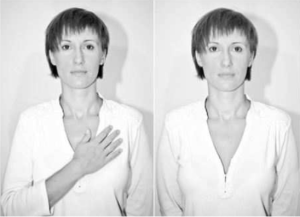
HOHv NeutralVolunteers who performing this gesture were described as appearing more “honest” and trustworthy than when the same people enacted a neutral control gesture.

In addition, participants who performed the hand-over-heart gesture behaved more honestly when they provided more honest assessments of others’ attractiveness and refrained from cheating, compared to volunteers who performed neutral gestures.

Bodily experience associated with abstract concepts can influence both perceptions of others, and one’s own behaviors to align with the intangible idea – and the effect doesn’t depend on peoples’ emotional states.

More than 35 Polish volunteers listened to parts of a recorded job interview in which the applicant made several low-credibility statements like “I have never been late for work” and “I have never argued with members of my family.”

As they listened, participants viewed the speaker’s photograph.
Half of the participants saw a photo showing the speaker with both of hands placed behind the back, whereas the other half saw an image of the speaker with right hand over the heart (HOH).
Then, all participants rated the speaker’s credibility.

Participants rated the speaker pictured with hand over heart as more believable, suggesting that the gesture, locally associated with honesty, leading volunteers to perceive the person producing the signal of honesty “…as more credible, even if her statements are not very credible.”

Other volunteers rated the appearance of women in photographs, previously rated by independent judges as “moderate to low attractiveness”.
The women were described as the experimenter’s friends, to “prime” social desirability for a favorable evaluation from participants.

HOH-hipResearchers asked volunteers to enact gestures to “increase their cognitive load”:  Half the volunteers completed ratings while holding their right hand over their hearts whereas the other participants placed hand on their hips.

Participants who held their hand over their hearts rated less attractive faces significantly lower than volunteers who held their hand on their hips, suggesting that they the “’Hand-over-Heart’ gesture influenced people to respond more honestly,“…even if it meant being impolite.

HOJH v shoulderIn another study, more than 50 volunteers solved math problems and reported number completed .

Some wrote solutions with their dominant hands, but others held a “breathing monitor band” by either:

  • Putting right hand on left shoulder, or
  • Right hand over heart.

Participant had an incentive to exaggerate the number of completed problems because researchers told volunteers that one randomly-selected participant would be receive cash prize for each correct answer.

Those who held their hands on their shoulders claimed they solved 45 percent more problems than either of the other two groups, whereas people who held hands over hearts accurately reported completed problems, suggesting that temptation to embellish problem-solving performance was overridden by acting consistently with the gesture associated with honesty.

Bodily sensations influence the way we think, feel, and act…(and) a bodily sensation may activate the concept associated with it; this in turn may shape information processing, and behavior,” concluded Parzuchowski and Wojciszke.

These findings validate the idea of “embodied cognition” – bodily experience and states can influence thinking and likewise, thinking can affect bodily experience and states.
Other examples include judgments of height, weight, importance influenced by physical experiences.

Anita Eerland

Anita Eerland

People whose native language is read and written from left to right typically make smaller estimates of weight and height when leaning to the left (“posture-modulated estimation”) because their language leads them to represent numbers along a continuum with smaller numbers on the left and larger numbers on the right (“mental-number-line theory”), according to Anita Eerland now of Open University of the Netherlands with Max Planck Institute’s Tulio Guadalupe, and Rolf Zwaan of Erasmus University.

Tulio Guadalupe

Tulio Guadalupe

They induced people to lean slightly to the right or to the left by asking them to stand on a Wii Balance Board while answering estimation questions.
Eerland and team changed the directional lean as subjects leaned left or right, or stood upright without mentioning changes in position

When participants were leaned to the left, they produced significantly smaller estimates were than when they leaned to the right.

Eerland-Zwaan Wedding

Eerland-Zwaan Wedding

These results may vary for participants whose native language is read and written from right to left, and Eerland and team suggested replicating this study with other language groups.

Lynden Miles

Lynden Miles

Thoughts can lead to changed body position, found University of Aberdeen’s Lynden Miles, Louise Nind, and C Neil Macrae, when they asked volunteers to think about the future.

Imagining future events caused participants to shift their body position to lean forward, whereas they leaned back when asked to think about the past.

Similarly, qualitative dimension ratings can be affected by physical experience.

When volunteers judged a proposal’s importance, they rated it more momentous when holding a heavy object, according to University of Amsterdam’s Nils B. Jostmann, Daniël Lakens of Utrecht University and Institute Superior de Ciências do Trabalho e da Empresa, Lisbon’s Thomas W. Schubert.

European participants guessed the value of foreign currency in Euros while recording answers on either a heavy clipboard or a light-weight clipboard.
Those who held the lighter clipboard estimated lower average values.

In addition, volunteers estimated the importance of University students participating in making foreign study grant decisions.
Participants who held the heavier clipboard rated student participation as more important.

George Lakoff

George Lakoff

Jostmann and team experimentally demonstrated the impact of body, physical objects, and abstract metaphors on thinking, originally posited by University of California, Berkeley’s George Lakoff and Mark Johnson who linked

  • Control and Mood to direction:

“I have control over him,”
“I am on top of the situation,”
“He’s at the height of his power,”
“He ranks above me in strength,”

“I’m feeling up today”
“He is under my control,”
“His power is on the decline.

“I’m feel down in the dumps.”

  • Love, interpersonal connection to physical force

“I could feel the electricity between us”
“There were sparks
“They gravitated to each other”

  • Anger to heat, pressure

“He’s hot under the collar
“She said it in the heat of anger

John Bargh

John Bargh

Similarly, trustworthiness was associated with the physical experience of warmth when volunteer participants judged a new acquaintance as trustworthy after only a brief interaction when participants held a cup of warm coffee instead of a cold beverage, according to Yale’s John Bargh.

Embodied cognition” is one explanation for the interactive influence of symbolic thought, movement, and bodily experience on one’s behavior and peoples’ perceptions of others.

-*What metaphors and symbolic gestures affect your behavior?

Follow-share-like http://www.kathrynwelds.com and @kathrynwelds

RELATED POSTS:

Twitter  @kathrynwelds
Blog Kathryn Welds | Curated Research and CommentaryGoogle+
LinkedIn Open Group Psychology in Human Resources (Organisational Psychology)
Facebook Notes

©Kathryn Welds

Racial Categorizations Change Based on Social Status Markers

Aliya Saperstein

Aliya Saperstein

Race is a changeable status marker of rather than a fixed individual attribute, according to Stanford’s Aliya Saperstein and Andrew Penner of University of California, Irvine.

Andrew Penner

Andrew Penner

Racial fluidity” – or changeable racial categorization – influences and is influenced by racial inequality in the United States, noted Saperstein and Penner.

They analyzed longitudinal U.S. national survey data collected over two decades and found that individuals’ racial classification, both rated by themselves and by others, changed over time in response to changes in social position.

In these data, unemployed, incarcerated, or impoverished Americans were more likely to be seen and self-identify as Black, even if the same individuals were originally classified in a different racial category.

Jonathan Freeman

Jonathan Freeman

Racial self-perception and racial perceptions by others depend on social position, even though most people believe that race is perceived in facial features, such as skin color.
However, social status cues around a face systematically change the perception of race, found Dartmouth’s Jonathan B. Freeman, Matthias Scheutz of Tufts, with Penner, Saperstein and her Stanford colleague, Nalini Ambady.

Matthias Scheutz

Matthias Scheutz

Participants categorized 16 computer-generated face identities (8 male) that were morphed along a 13-point race continuum, from White (morph −6) to Black (morph +6).
Developed by Max Planck Institute’s Volker Blanz and Thomas Vetter, this program generated 3D models based on laser scans of human faces.

Volunteers saw faces in a randomized order and evaluated them as White or Black using the keyboard, which recorded and analyzed mouse movement with MouseTracker software.

Participants rated the race of faces along “White–Black morph continua” when they saw faces with “high-status” attire (suit) or “low-status” attire (maintenance uniform).

“Low-status” attire increased the likelihood of categorization as Black, whereas “high-status” attire increased the likelihood of categorization as White, and this effect increased as physical characteristics associated with each race became more ambiguous.

The team  also monitored hand movements to determine hesitation in making a racial category decision.

They noted hesitation and shifting between choices when participants categorized faces with high-status attire as “Black” or faces with low-status attire as “White.”
Stereotypes interact with contextual and physical cues to shape “neutrally- plausible” person categorization, concluded Freeman and team.

When stereotypes associated with race and occupation categories overlap, contextual cues to occupation can activate social status stereotypes, then exert “top-down pressure” on the race categorization process.

For example, business attire can activate high-status stereotypes that influence visual processing of race-categorization.
Race categorization, therefore, could be driven by both “bottom-up” processing of facial features, and “top-down” stereotypes activated by contextual cues.

Racial fluidity reinforces stereotypic status differences by classifying “successful” or high-status people as “White” or “not Black” and “unsuccessful” or low-status people as “Black” or “not White.”

“Social cognition” can influence visual perception because “person perception…makes compromises between how other people “actually” appear and the stereotyped expectations dictating how they ‘should’ appear,” noted Freeman and team.

Aaron Gullickson

Aaron Gullickson

The U.S. briefly fluidity and ambiguity in racial classification when it adopted a “mulatto” category for the U.S. Census between 1870 and1920.

Saperstein and University of Oregon’s Aaron Gullickson noted that people categorized as “mulatto” in one census were re-categorized as Black in the next census, particularly when Southern men’s occupational status changed “downward” between censuses.

Like clothing, another non-racial factor – cause of death – influences racial classification, and can bias official U.S. statistics, according to Penner and UC Irvine colleague
Andrew Noymer with Saperstein in their analysis of a representative sample of U.S. death certificates.

Andrew Noymer

Andrew Noymer

They controlled for existing statistical reports by interviewing decedents’ next-of-kin regarding cause of death and racial classification.

Noymer’s team reported significant discrepancies between the two racial classifications by cause of death, with cirrhosis decedents more likely to be recorded as Native American and homicide victims more likely to be recorded as Black.

These findings are another example of interaction between changeable indicators of social status and seemingly fixed characteristics like physical appearance of race – both in forming perceptions of others and in defining oneself.

-*How have you adjusted your self-categorization based on occupational role and status over time?

Related Posts:

Follow-share-like http://www.kathrynwelds.com and @kathrynwelds

©Kathryn Welds



Universal Body Map Pinpoints Where Emotions are Experienced

Lauri Nummenmaa

Lauri Nummenmaa

Emotions are associated with physiological changes in specific body regions, such as increased heart rate, sweaty palms, or startle response, according to Aalto University’s Lauri Nummenmaa, Enrico Glerean, and Riitta Hari, with Jari Hietanen of University of Tampere.

Enrico Glerean

Enrico Glerean

Nummenmaa and team showed emotion-laden words, videos, facial expressions and stories to more than 700 participants in Finland, Sweden and Taiwan, who then reported body regions that “felt different” after they viewed the emotion-evoking media.

Riitta Hari

Riitta Hari

Many people described the physical experience of emotions with metaphors including:

  • “Cold feet” to signal hesitation
  • “Heartbroken” to describe disappointment
  •  “Shivers down the spine” to indicate fear,
Jari Hietanen

Jari Hietanen

according to Durham University’s Zoltán Kövecses, Gary B. Palmer then of University of Nevada, Las Vegas and Rene Dirven then of University of Duisburg-Essen.

Zoltán Kövecses

Zoltán Kövecses

Nummenmaa’s team controlled for these linguistic representations by evoking emotional experiences with guided mental imagery from:

Then, volunteers reported bodily sensations they experienced during the emotion induction and rated physical sensations they expected people displaying different emotions would experience in their bodies.

Nummenmaa and colleagues found distinctly different body areas associated with emotional experiences of happiness, contempt, love, and other feelings, with consistent results across nationalities.
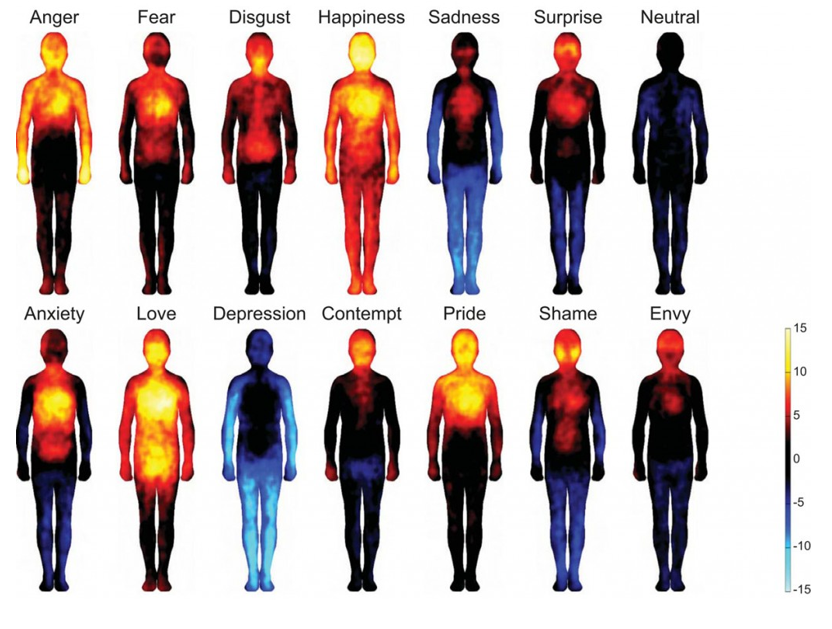
They represented regions of greatest sensation associated with specific emotions with a computer-generated topographical body map.

The team proposed that emotions are represented as “culturally universal categorical somatotopic maps,” and sensing emotion-triggered bodily changes is required to perceive basic and complex emotions.Somatopic Emotion Map

Top row displays “basic” emotions:

  • Anger
  • Fear
  • Disgust
  • Happiness
  • Sadness
  • SurpriseBottom row displays “complex” emotions:
    • Anxiety
    • Love
    • Depression
    • Contempt
    • Pride
    • Shame
    • Envy

Happiness was a “full-body experience,” with increased sensation throughout the body, but some emotions were experienced in specific regions.

Christian Keysers

Christian Keysers

Likewise, most basic emotions, like anger and fear were associated with sensations of elevated activity in the upper chest area, corresponding to changes in breathing and heart rate, reported University of Groningen’s Christian Keysers and Valeria Gazzola with Jon H. Kaas of Vanderbilt.

Valeria Gazzola

Valeria Gazzola

In addition, all evoked emotions increased sensations in the head, reflecting changes in the facial area by muscle activation, skin temperature, tearing, and thoughts of emotional events.

Jon Kaas

Jon Kaas

Approach-oriented emotions,” including anger and happiness, were associated with increased upper limb sensation whereas depression was linked to decreased limb activity and sensation.
Disgust was felt in the digestive system and around the throat.

Positive emotions, including happiness, love, and pride, clustered in one group.
In contrast negative emotions diverged into four separate groups based on linguistic analysis and sensed body location:

  • Anger and fear
  • Anxiety and shame
  • Sadness and depression
  • Disgust, contempt, and envy.

Surprise was seen as neither a negative nor a positive emotion, yet it was distinctly different from neutral emotion.

Emotional metaphors appear connected to actual physiological experience of emotions, even when researchers controlled for familiar linguistic stereotypes and “conventional wisdom.”

-*What discrepancies have you observed between emotion descriptions and physical experience of emotion?

RELATED POSTS:

Twitter  @kathrynwelds
Blog – Kathryn Welds | Curated Research and Commentary  
Google+
LinkedIn Open Group Psychology in Human Resources (Organisational Psychology)
Facebook Notes:

©Kathryn Welds

Reading Changes Brain Connectivity

Reading a novel causes measurable and persistent changes in brain connectivity, building on findings that reading literary fiction can increase empathic awareness.

Gregory Berns

Gregory Berns

Stories shape our lives and in some cases help define a person,” according Emory University’s Gregory S. Berns, who with Kristina Blaine, Michael J. Prietula,and Brandon E. Pye used laboratory imaging to investigate the impact of reading fiction.

The team conducted resting-state functional magnetic resonance imaging scan (fMRI) of 21 volunteers on 19 consecutive days.

Robert Harris

Robert Harris

The first five daily scans provided a baseline, then participants read 1/9th (about 30 pages) of Robert Harriss Pompeii, a 2003 thriller, during the evening of the next 9 days.
For the next 9 mornings, they completed a quiz on the novel’s content, then resting-state (non-reading) fMRI.

Kristina Blaine

Kristina Blaine

The brain scans showed significant connectivity increases in the left angular/supramarginal gyri in the left temporal cortex and right posterior temporal gyri, areas associated with perspective taking and story comprehension.

Michael Prietula

Michael Prietula

The last 5 daily scans occurred with no reading the previous evening, and showed persistent connectivity changes for up to five days in bilateral somatosensory cortex in the central sulcus, suggesting neural mechanisms for:

Olaf Hauk

Olaf Hauk

-“Embodied semantics,” described by University of Cambridge’s Olaf Hauk and Nadja Tschentscher, as well as University of Southern California’s Lisa Aziz-Zadeh and Antonio Damasio

-“Grounded cognition,” summarized by Emory’s Lawrence Barsalou

Lawrence Barsalou

Lawrence Barsalou

Muscle memory, investigated by Amirkabir University of Technology’s Hossein Hassanpoor and Ali Fallah with Mohsin Raza of Baqiyatallah University of Medical Sciences.

Brandon Pye

Brandon Pye

This somatosensory activation suggests that reading a novel activates neural changes found with physical sensation and movement systems.
Berns noted that “…good stories can put you in someone else’s shoes in a figurative sense …(and)… may also be happening biologically.”

These fMRI findings reinforce findings that reading award-winning fiction can increase empathic awareness of others and related interpersonal insight.

-*What non-fiction reading provided memorable empathic insights about others?

RELATED POSTS:

Follow-share-like http://www.kathrynwelds.com and @kathrynwelds

Twitter  @kathrynwelds
Blog – Kathryn Welds | Curated Research and Commentary  

Google+
LinkedIn Open Group Psychology in Human Resources (Organisational Psychology)

Facebook Notes:

©Kathryn Welds