Higher “Purpose in Life” Reduces Adverse Health Outcomes

Lei Yu

Lei Yu

Purpose in Life – the sense that life has meaning and goal direction – is associated with reduced risks of adverse health outcomes including stroke, according to Rush University Medical Center’s Lei Yu, Patricia A. Boyle, Robert S. Wilson, Julie A. Schneider, and David A. Bennett collaborating with Steven R. Levine of SUNY Downstate Medical Center.

Patricia A. Boyle

Patricia A. Boyle

Older people with a greater sense of purpose are less likely to develop other undesirable health conditions including:

Robert S. Wilson

Robert S. Wilson

Yu’s team analyzed autopsy results on 453 older adults enrolled in the Rush Memory and Aging Project.

All participants underwent annual physical and psychological evaluations, including a standard assessment of Purpose in Life, and were followed until they died, at an average age of 90.
None of the participants had dementia when they entered the study, but 114 people had suffered a stroke.

Eric S. Kim

Eric S. Kim

Yu’s team extended earlier work by University of Michigan’s Eric S. Kim, Jennifer K. Sun, Nansook Park, and Christopher Peterson, demonstrating that Purpose in Life is associated with a reduced risk of clinical strokes in a group of participants aged 53 to 105 years.

This difference suggests that purpose in life is protective for silent infarcts, as well as clinical stroke.

Jennifer Sun

Jennifer Sun

At autopsy, Yu’s group observed macroscopic infarctions, areas of stroke damage visible to the naked eye, among 154 participants and microinfarcts, areas of damage visible with a microscope, among another 128.

Purpose in Life was judged annually using a modified 10-item measure derived from University of Wisconsin’s Carol D. Ryff and Corey Lee Keyes’ scales of Psychological Well-being.

Carol D. Ryff

Carol D. Ryff

Higher scores indicating a greater purpose, and every one-point increase, the likelihood of having one or more macroscopic infarctions decreased by about 50 percent.
In contrast, there was no link between purpose and microinfarcts.

These results persisted after adjusting for potentially confounding factors including vascular risk factors:

  • Body mass index,
  • History of smoking,
  • Diabetes mellitus,
  • Blood pressures.
    Corey Lee Keyes

    Corey Lee Keyes

    Other controlled factors include:

  • Optimism,
  • Childhood adverse experiences,
  • Loneliness,
  • Negative affect,
  • Physical activity,
  • Clinical stroke.Purpose in Life can predict later health status and outcomes, and is amenable to improvement by social participation with friends, community services, physical activity and health behavior modification.
    These positive lifestyle changes contribute to improved physical and mental health and enhanced quality of life throughout the lifespan.

-*How do you define you Purpose in Life?
-*What factors contribute to Purpose in your Life?
-*How do you intentionally increase your sense of Purpose in Life?

Follow-share-like http://www.kathrynwelds.com and @kathrynwelds

Related Posts:

Twitter:  @kathrynwelds
Google+LinkedIn Groups Psychology in Human Resources (Organisational Psychology)
Facebook
Blog: – Kathryn Welds | Curated Research and Commentary

©Kathryn Welds

 

Reinventing Performance Management to Reduce Bias: Strengths, Future Focus, Frequent Feedback

Steven Scullen

Steven Scullen

Most performance management systems set goals at the beginning of the year and determine variable compensation by rating accomplishment of those objectives.

These evaluations typically are considered in lengthy “consensus meetings” in which managers discuss the performance of hundreds of people in relation to their peers – sometimes called “stack ranking,” or more cynically “rank-and-yank.”

Michael Mount

Michael Mount

These year-end ratings don’t provide “in-the-moment” and “real-time” feedback about actual performance as it happens, so may be less useful in improving performance.

Assessing skills produces inconsistent data based on raters’ own skills in that competency and the value they attach to each performance objective, leading to unconscious bias.

Maynard Goff

Maynard Goff

This risk to performance rating validity was demonstrated by Drake University’s Steven Scullen, Michael Mount of University of Iowa, and Korn Ferry’s Maynard Goff, who considered 360 degree performance evaluations by two bosses, two peers, and two subordinates for nearly 4500 managers.

They found that three times as much rating variance was explained by individual raters’ idiosyncratic evaluation choices, rather than actual performance.

Manual London

Manual London

Sources of bias include halo error, leniency error, and organizational perspective based on current role, suggested by SUNY’s Manuel London and James Smither of LaSalle University, and validated by Scullen’s team.

These findings led the researchers to conclude “Most of what is being measured by the ratings is the unique rating tendencies of the rater. Thus ratings reveal more about the rater than they do about the ratee,” replicating similar findings by University of Georgia’s Charles Lance, Julie LaPointe and Amy Stewart.

Ashley Goodall

Ashley Goodall

To mitigate these biases in Deloitte’s performance management system, Ashley Goodall of Deloitte Services LP engaged Marcus Buckingham, formerly of The Gallup Organization, to analyze existing practices and develop an empirically-validated approach.

Goodall and Buckingham calculated the total annual hours required to conduct performance ratings using the existing process and found that managers invested 2 million hours a year.
This finding confirmed that one goal in revising the process was to increase speed and efficiency.

Marcus Buckingham

Marcus Buckingham

In addition, Goodall and Buckingham sought to increase the meaningfulness of performance management by focusing on discussions about future performance and careers rather than on the appraisal process.

They concluded a performance management system should be characterized by:

  • Reliable performance data, controlling for idiosyncratic rater effects,
  • Speed to administer,
  • Ability to recognize performance,
  • Personalization: “One-size-fits-one”,
  • Considering actions to take in response to data,
  • Continuous learning and improvement.

Deloitte logoDeloitte conducted a separate controlled study of 60 high-performing teams including almost 1300 employees representing all parts of the organization compared with an equal number of employees from an equivalent sample to determine questionnaire items that differentiate high- and lower-performing teams.

They found that performance and related compensation allocations could be more accurately based on managers’ statements about their intended future actions toward each employee rather than asking about team members’ skills.

Several items accounted for the vast majority of response variation between top performing groups and others, particularly At work, I have the opportunity to do what I do best every day.”

Now Discover Your StrengthsBusiness units whose employees said they “strongly agree” with this item were substantially more likely to be more productive, earn high customer satisfaction scores, and experience low employee turnover.

Other powerful predictors of performance were:

  • I have the chance to use my strengths every day,
  • My coworkers are committed to doing quality work,
  • The mission of our company inspires me.

Deloitte’s revised performance management system asks team leaders to rate four items on a 5-point scale from “strongly agree” to “strongly disagree” or yes-no at the end of every project or once a quarter:

  • Given what I know of this person’s performance, and if it were my money, I would award this person the highest possible compensation increase and bonus [measures overall performance and unique value],
  • Given what I know of this person’s performance, I would always want him or her on my team [measures ability to work well with others],
  • This person is at risk for low performance [identifies problems that might harm the customer or the team],
  • This person is ready for promotion today [measures potential].

These responses provide a performance snapshot that informs but doesn’t completely determine compensation.
Other factors include project assignment difficulty and contributions other than formal projects, evaluated by a leader who knows each individual personally or by a group considering data across several groups.

In addition, every team leader prioritizes once-weekly “check-ins” with each employee to ensure that priorities are clear and progress toward them is consistent.

Strengthfinder 2.0

Strengthfinder 2.0

Goodall and Buckingham opined that “radically frequent check-ins are a team leader’s killer app to recognize, see, and fuel performance,” in addition to using a self-assessment tool that identifies each team members’ strengths and enables sharing with teammates, team leader, and the organization.

These three “interlocking rituals” of the weekly check-in, quarterly or project-end performance snapshot, and annual compensation decision enable a shift from retrospective view of performance to more “real-time” coaching to support performance planning and enhancement.

Deloitte’s approach seeks a “big data“ view of each person’s organizational performance and contribution rather than the “simplicity” of a small data view summarized in a single stack-rank number.

-*How do you develop a “Big Data” view of people’s performance?

-*How do you enable continuous, “in-the-moment” performance feedback instead of once-a-year retrospective view?

Follow-share-like http://www.kathrynwelds.com and @kathrynwelds

Related Posts:

Twitter:  @kathrynwelds
Google+
LinkedIn Groups Psychology in Human Resources (Organisational Psychology)
Facebook
Blog: – Kathryn Welds | Curated Research and Commentary

©Kathryn Welds

Women, Men, and Time: Differences in “Managing” a Limited Resource

Francis Wade

Francis Wade

Special thanks to Francis Wade of 2TimeLabs for his sharing his expertise.

Though women and men have the same amount of time, women seem to manage more time demands and have developed more skillful time practices to grapple with perceived “time scarcity,” according to detailed time-use studies by New South Wales’s Lyn Craig and Janeen Baxter of University of Queensland.

Lyn Craig

Lyn Craig

They found that working mothers invest more hours taking care of children and doing housework than their working husbands.

Arlie Hochschild

Arlie Hochschild

This finding validates the idea that women do a “Second Shift” of work – at home and at the office, described by University of California Berkeley’s Arlie Hochschild.

Brigid Schulte

Brigid Schulte

Personal anecdotes from of women stretched between “two shifts” validate these research findings, distilled in journalist Brigid Schulte’s popular Overwhelmed: Work, Love, and Play When No One Has the Time.

Therese Macan

Therese Macan

To grapple with time demands that may seem to outweigh available time resources, women typically engage in significantly more mechanical time management behaviors like planning, listing, and scheduling, found University of Missouri’s Therese Macan, Comila Shahani of Hofstra University and Robert Dipboye of University of South Florida, who developed the Time Management Behaviors (TMB) inventory

Abdülkadir Pehlivan

Abdülkadir Pehlivan

Many, but not all, gender differences appear to hold across countries and cultures:  Like Macan’s team, Karadeniz Technical University’s Abdülkadir Pehlivan noted that women use more listing, planning and programming than men.

In contrast, male volunteers said they feel more in charge of their time management behaviors, even when they don’t employ the same systematic time procedures as women.

Ranjita Misra

Ranjita Misra

However in a U.S. investigation, females reported better perceived “control” of time, based on using “mechanical” techniques like setting and prioritizing goals as well as planning, reported West Virginia University’s Ranjita Misra and Michelle McKean.
In addition, women said they organize tasks and workspaces more frequently than men.

Despite this efficiency, women paid a price with higher anxiety and lower leisure satisfaction, which may explain the need to develop improved practices.
Males, in contrast, reported more leisure activities and less anxiety.

Tanya Meade

Tanya Meade

In addition, Australian Time Organisation and Management Scale (ATOMS), developed by University of Western Sydney’s Tanya Covic Meade, B.J. Adamson, M. Lincoln and P.L. Kench revealed that 71% of women volunteers recognize this gender difference in time practices:  Women respondents and Meade’s team concluded that “females may be better at carrying out behavioral activities associated with time management, such as making lists and keeping a diary.”

Mark Trueman

Mark Trueman

Another study found that female student volunteers reported considerably greater use of time “management” skills than male students in a five-year investigation by Keele University’s Mark Trueman and James Hartley and in similar research by Al Ain University of Science and Technology Ahmad Saleh Al Khatib.

Nurten Kaya

Nurten Kaya

These gender differences also persisted in specific working environments such as nursing in University of Istanbul’s study by Hatice Kaya with Nurten Kaya, Aylin Öztürk Palloş, Leyla Küçük, which found that female students were able to manage their time better than male students.

Jale Eldeleklioglu

Jale Eldeleklioglu

Because time is a limited and valuable resource, Uludag University’s Jale Eldeleklioglu suggested the life skill of time “management” should begin at a young age in school: ” male students’ time management skills are not as developed as female students’ (so we need) more programs to reduce anxiety and improve students’ time management skills.

-*What differences have you observed in the ways that women and men interact with available time?

-*What practices have you found beneficial in managing time demands?

Follow-share-like http://www.kathrynwelds.com | @kathrynwelds

Follow-share-like www.2time-sys.com | http://perfect.mytimedesign.com |@fwade

Related Posts:

Twitter:  @kathrynwelds
Google+LinkedIn Groups Psychology in Human Resources (Organisational Psychology)
Facebook
Blog: – Kathryn Welds | Curated Research and Commentary

©Kathryn Welds



Rx to Reduce Cardiovascular Risk: Listen to Music

Charalambos Vlachopoulos

Charalambos Vlachopoulos

Listening to music, both classical and rock, decreases aortic stiffness and wave reflection to reduce cardiovascular risk of death and disability, according to Athens Medical School’s Charalambos Vlachopoulos with Angelos Aggelakas, Nikolaos Ioakeimidis, Panagiotis Xaplanteris, Dimitrios Terentes-Printzios, Mahmoud Abdelrasoul, George Lazaros, and Dimitris Tousoulis.

Panagiotis Xaplanteris

Panagiotis Xaplanteris

Even “a brief period of mental stress can have an enduring effect on arterial stiffness,” Vlachopoulos and colleagues noted, suggesting the value of music listening as a health intervention to decrease stress and cardiovascular risk.

Dimitris Tousoulis

Dimitris Tousoulis

The team compared aortic stiffness and carotid-femoral pulse wave velocity (PWV) reflections for 20 healthy volunteers after a half-hour rest period.
Then, participants were divided into three groups that listened to a half-hour of:

  • Classical music including excerpts from J.S. Bach’s Orchestral Suites OR
  • Rock featuring selections by Led Zeppelin, Black Sabbath, and Green Day OR
  • Silence.

Cardiovascular measurements were recorded immediately after the different auditory conditions, and then again after 30 minutes.

Liisa Ukkola-Vuoti

Liisa Ukkola-Vuoti

Participants who listened to either musical genre had lower aortic stiffness immediately after the music, and wave reflection was reduced for at least 30 minutes after the music.
This effect was even greater for those who preferred classical music, whether they listened to rock or classical selections.

Chakravarthi Kanduri

Chakravarthi Kanduri

Music’s “whole body experience” begins with genes:  Musical receptivity, perception, and creativity were linked to gene clusters and duplicate DNA associated with the brain’s serotonin systems in research by University of Helsinki’s Liisa Ukkola-Vuoti, Chakravarthi Kanduri, Jaana Oikkonen, Gemma Buck, Pirre Raijas, Kai Karma, and Irma Järvelä, collaborating with Christine Blancher of Oxford Genomics Centre and Aalto University’s Harri Lähdesmäki.

Jaana Oikkonen

Jaana Oikkonen

They found that neurotransmitter systems enable brain plasticity and connectivity in the brain’s posterior cingulate cortex.

Yi Ting Tan

Yi Ting Tan

Several chromosomes contain specific areas associated with musical perception, found University of Melbourne’s Yi Ting Tan, Gary McPherson, Samuel Berkovic, and Sarah Wilson, collaborating with Isabelle Peretz from University of Montreal.

Isabelle Peretz

Isabelle Peretz

They detected several locations on chromosome 4 tied to music perception and singing, and a specific area on chromosome 8q is implicated in music perception and absolute pitch.
In addition chromosome 12q’s gene AVPR1A was linked to music perception, music memory, and music listening, whereas SLC6A4 on chromosome 17q was associated with music memory.

These findings suggest music listening can be an easy, enjoyable way to enhance arterial function and cardiovascular health.

-*What physical effects do you notice when listening to your preferred musical genre?

Follow-share-like http://www.kathrynwelds.com and @kathrynwelds

Related Posts:

Twitter:  @kathrynwelds
Google+LinkedIn Groups Psychology in Human Resources (Organisational Psychology)
Facebook
Blog: – Kathryn Welds | Curated Research and Commentary

©Kathryn Welds

Greater Hemispheric Specialization, not Integration = Increased Creativity

Rafeeque Bhadelia

Rafeeque Bhadelia

Increased connection between brain hemispheres has been considered essential for creative problem-solving and creative expression:  Previous research reported a relationship between the size of the corpus callosum connecting brain hemispheres.

However, a more nuanced understanding of brain structure is needed, based on contradictory findings from Cornell’s Dana W. Moore, collaborating with Rafeeque A. Bhadelia and Carl Fulwiler of Tufts and Suffolk University’s Rebecca L. Billings and David A. Gansler, teamed with University of Florida’s Kenneth M. Heilman, and Kenneth M.J. Rood of Boston University.

Carl Fulwiler

Carl Fulwiler

The team measured creativity in divergent thinking using the Torrance Tests of Creative Thinking (TTCT) for 21 right-handed male volunteers.
Divergent-thinking tasks provide scores for fluency, flexibility, originality, abstractness, resistance to premature closure, and elaboration, and additional scores for emotional expressiveness, story-telling articulateness, movement, synthesis of figures, humor, richness of imagery, and fantasy.

Paul Torrance

Paul Torrance

Results from the Torrance Tests of Creative Thinking (TTCT) explained almost half of the variance in creative achievement, measured by quantity of publicly-recognized innovative accomplishments and ratings by judges of each participant’s three most significant creative work products in research by Indiana University of Connecticut’s Jonathan Plucker.

Jonathan Plucker

Jonathan Plucker

Moore’s team also performed volumetric MRIs participants’ distributed inter- and intra-hemispheric network activity, and confirmed the relationship between visual–spatial divergent .

However, they found no significant relationship between the right hemisphere’s white matter volume (WMV) and creative production in divergent thinking tasks.

In fact, people with smaller corpus callosum in relation to total white matter volume scored higher on divergent-thinking tasks than those with larger corpus callosum.

Torrance Test of Creativity

Torrance Test of Creativity

Smaller white matter volume indicates more successful neuronal pruning during brain development, leading to increased neural connection and modular brain organization efficiency, they suggested.

Lateralized knowledge processing and momentary suspension of hemispheric modularity may account for creative illumination, incubation and generating divergent ideas, noted University of Southern California’s Joseph E. Bogen and Glenda M. Bogen.
Both processes were aided by decreased callosal connectivity and increased enhances hemispheric specialization in their observations.

Joseph E. Bogen

Joseph E. Bogen

Creativity and brain structures seem to have a reciprocal relationship:  The brain’s structure is reflected in creative performance, and can be changed by training in visual art.

As drawing skills improved, cortical and cerebellar activity patterns changed and prefrontal white matter reorganized, shown in monthly fMRI scans by Dartmouth’s Alexander Schlegel, Prescott Alexander, Sergey V. Fogelson, Xueting Li, Zhengang Lu, Peter J. Kohler, Enrico Riley, Peter U. Tse, and Ming Men.

Alex Schlegel, Prescott Alexander

Alex Schlegel, Prescott Alexander

In addition, participants showed increased divergent thinking and use of model systems, processes, and imagery, but not perceptual abilities.

These findings indicate that neural pathways are adaptable or “plastic” to enable creative cognition and perceptual-motor integration.

-*What do you do to change your brain function?

Follow-share-like http://www.kathrynwelds.com and @kathrynwelds

RELATED POSTS:

©Kathryn Welds

Women’s Businesses as Engine for GDP Growth

Laura Tyson

Laura Tyson

Women and girls have the most potential to produce economic growth, despite also being marginalized in many countries, according to University of California, Berkeley’s Laura Tyson, who served as chair of the US president’s Council of Economic Advisors.
She added that every year that a girl is in school increases her future income level and the country’s GDP.

Katie Drasser

Katie Drasser

Further, women’s increased workforce participation increases general economic prosperity:  Women who work invest an average of 90 percent of their income back into their families, and drive about 70 percent of global consumption, contributing to positive social and economic outcomes, noted The Aspen Institute’s Katie Drasser and Vanessa Martin of Feministing.

However, women’s economic participation and opportunity is about 15-25 percent less than men’s:  Only about half of working-age women are employed, and they earn only about 74 percent of men’s salaries when they have the same educational attainment and work in the same occupation.

Peter Roberts

Peter Roberts

Gender parity in labor-force participation rates would increase GDP by 12 percent in developed countries over the next 20 years – and even more in developing nations, estimated the Organisation for Economic Co-operation and Development (OECD) in its report, Closing the Gender Gap: Act Now .
In addition, the report advocated equal access to financing for female and male entrepreneurs as well as policy support for women-owned enterprises around the world.

However, the ambitious scope of these recommendations was illustrated by the World Economic Forum’s estimate that it will take until after the beginning of the next century – 2200 – to close the economic gender gap and achieve related economic growth, according to its Global Gender Gap Report 2014.

Required changes to realize these economic benefits include:

  • Equal legal rights for women in land ownership and inheritance,
  • Equal access to credit and lending,
  • Equal educational opportunities from early childhood education to basic literacy through postgraduate training,
  • Elimination of discriminatory practices in recruitment, retention, and pay,
  • Elimination of tax disincentives that discourage women’s labor force participation,
  • Quantified and monitored targets for recruiting and retaining women,
  • Tax credits, benefits, and employment protections for low-wage and part-time workers,
  • Widespread access to affordable childcare, parental leave, and flexible work practices integration policies.

As a result, increasing numbers of startups focus on supporting women and girls, and women’s organizations are shifting in their fundraising habits from seeking foundation funding to generating revenue.

Sean Peters

Sean Peters

Paralleling technology accelerators that “jumpstart” new venture, The Girl Effect Accelerator recently launched an effort to assist 10 organizations improve the lives of disadvantaged girls and women.

The Accelerator provided high-profile mentors, strategic financing, and network partners, supported by the Nike Foundation and the Unreasonable Group, to promising social enterprises.
Social entrepreneurs have also received fellowships, training programs, seed funding, and resources from Propeller, Echoing Green, and other organizations.

Ventures included Embrace, which makes infant warmers for premature infants that cost less than 1 percent of the average incubator, and Jayashree Industries, which distributes affordable sanitary pads via 1,500-plus women-led franchises across India.

Saurabh Lall

Saurabh Lall

Emory’s Peter W. Roberts and Sean Peters with Saurabh Lall of Aspen Network of Development Entrepreneurs analyzed companies that participated in Social Impact Accelerator programs and found they have higher revenue generation than enterprises that didn’t receive this additional support, noted in their Impact of Entrepreneurship Database 2014 mid-year report.

One example is Agora Partnerships Impact Accelerator support of Maya Mountain Cacao‘s efforts to fulfill Eleos Foundation’s investment criteria, resulting $200,000 raised from in 20 investors.

Kristin Gilliss

Kristin Gilliss

In contrast, Aspen Network of Development Entrepreneurs (ANDE) and Village Capital reported less positive results of social investment:  Only 31 percent of companies that worked with Social Impact Accelerators became profitable or received a significant investment.

Social Impact Accelerator success rate could be improved by:

  • Connecting investors with entrepreneurs,
  • Consistently adopting tech startup accelerators’ business models, to fulfill rigorous investment criteria, attract investors and raise funding,
  • Measuring and scaling actual impact, as advocated by Kristin Gilliss of the Mulago Foundation.

-*What additional policies and programs could increase the economic success and impact of social entrepreneurs?

Follow-share-like http://www.kathrynwelds.com and @kathrynwelds

RELATED POSTS:

©Kathryn Welds


Four Leadership Behaviors Differentiate Top Performing Organizations

Ralph M. Stogdill

Ralph M. Stogdill

Effective leadership is a critical part of organizational health and growth and an important driver of shareholder returns, according to Ohio State’s Ralph M. Stogdill with McKinsey’s Aaron De Smet, Bill Schaninger, with Matthew Smith.

Bill Schaninger

Bill Schaninger

Consistent with this report, more than 90 percent of CEOs said they plan to increase investment in leadership development because they see it as their single most important human-capital issue, reported McKinsey’s Claudio Feser, Fernanda Mayol, and Ramesh Srinivasan.
However, only 43 percent of CEOs reported confidence that leadership training investments will render an acceptable ROI.

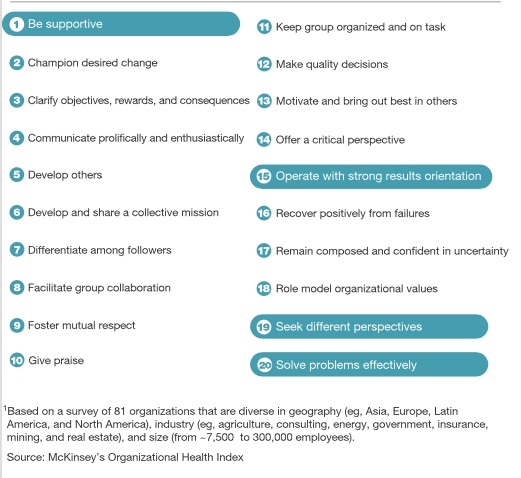
McKinsey Organizational Health Index Top Leadership Qualities

To more accurately target developable leadership behaviors associated with superior organizational performance, McKinsey identified 20 critical leadership traits then surveyed 189,000 people in 81 organizations of varying sizes across industries.

Claudio Feser

Claudio Feser

They segmented organizations by leadership effectiveness measured by McKinsey’s Organizational Health Index, and focused on companies in the top quartile and bottom quartile.

The team reported that four skills closely correlate with effective leadership and explained 89 percent of the variance in leadership effectiveness between top-performing organizations and lowest-performing organizations:

  • Effective problem solving by gathering, analyzing, and considering information before taking a decision,
  • Operating with a strong results orientation, developing and communicating a vision and setting objectives to efficiently achieve results,
  • Seeking different perspectives by monitoring trends affecting organizations and the external environment and by encouraging employees to suggest improvements,
  • Supporting others by demonstrating authenticity and sincere interest in colleagues to build trust and help others manage challenges.
Ramesh Srinivasan

Ramesh Srinivasan

A related post outlines other findings of top leadership competencies required for optimal organizational performance, including “Big Eight Competencies” described by Lominger’s Voices® 360˚ Assessment:

• Dealing with Ambiguity
• Creativity
• Innovation Management
• Strategic Agility
• Planning
• Motivating Others
• Building Effective Teams
• Managing Vision and Purpose.

-*Which leadership behaviors do you find most imperative?

Follow-share-like http://www.kathrynwelds.com and @kathrynwelds

RELATED POSTS:

Twitter  @kathrynwelds
Blog – Kathryn Welds | Curated Research and Commentary
Google+
LinkedIn Open Group Psychology in Human Resources (Organisational Psychology)
Facebook Notes

©Kathryn Welds

Individual Talent Surplus Can Reduce Team Performance 

Roderick Swaab

Roderick Swaab

More talent on a team doesn’t always increase team performance, particularly when team member must coordinate their efforts.

In fact, status conflicts based on talent differences can undermine team coordination during hand-offs for interdependent tasks, found INSEAD’s Roderick I. Swaab and Michael Schaerer, with Eric M. Anicich and Adam Galinsky of Columbia and VU University Amsterdam’s Richard Ronay.

Michael Schaerer

Michael Schaerer

Swaab and colleagues confirmed that most people believe there is a linear relationship between talent and performance:  They expect that more talent is consistently associated with improved performance.

However, the research team found an exception to this presumed rule when they analyzed National Basketball Association and Major League Baseball team and player data from 2002 through 2012.

They evaluated team performance in interdependent game tasks in basketball, a “zero sum game” because when one player shoots other players lose the opportunity to shoot at that time.
As a result, basketball players must coordinate efforts to position team members for as many shots as possible in a limited time.

Richard Ronay

Richard Ronay

In contrast, Swaab’s group studied independent sports performance in baseball.
In this game, players hit the ball in an assigned order and one player’s turn at bat does not eliminate another player’s turn to hit.
Further, each baseball player may hit a home run independent of other teammates’ batting skill, so each individual’s talent additively contributes to the team outcome.

Adam Galinsky

Adam Galinsky

Swaab’s team found that more talent is not associated with better performance when team members needed to coordinate interdependent tasks, as in basketball.
They called this the “too-much-talent effect”:  “When teams need to come together, more talent can tear them apart.”
In this case, they concluded that role differentiation is essential for optimal performance during interdependent tasks to ensure diverse capabilities in addition to willingness to collaborate.

Boris Groysberg

Boris Groysberg

This finding can be generalized to business organizations, which may experience decreased team performance if highly talented team members are unable to collaborate on interdependent tasks.
In addition, a surplus of top talent can undermine an organization’s profitability due to the high cost of attracting and hiring “stars.”

This “too-much-talent” effect was also demonstrated among Wall Street sell-side equity research analysts by Harvard Business School’s Boris Groysberg and Jeffrey T. Polzer with Hillary Anger Elfenbein of Washington University.

Hillary Anger Elfenbein

Hillary Anger Elfenbein

Increasing the number of talented analysts increased the firm’s overall performance to a point, then more stars actually decreased performance.
This effect was especially prominent when strong performers were concentrated in a small number of sectors.

As in professional sports, this “too-much-talent” effect could reflect a suboptimal integration and collaboration among analysts with similar expertise, controlling for individual performance, department size or specialization, or firm prestige.

Jennifer R. Overbeck

Jennifer R. Overbeck

Laboratory studies with volunteers confirm observations of the “too-much-talent” effect among professional athletes and Wall Street analysts, in research by University of Utah’s Jennifer R. Overbeck, Joshua Correll, and Bernadette Park.

They concluded that task groups need a few high-status members as leaders, and many more member-followers to contribute and implement work while supporting group direction.

Arthur Colman

Arthur Colman

When this “status sorting” is not explicit, Overbeck and team noted that a differentiated status hierarchy will evolve as status-seeking members vie for authority.
In rare cases, status sorting must be implemented through organizational design and responsibility definition, echoing earlier observations by University of California San Francisco’s Arthur D. Colman and W. Harold Bexton of the A.K. Rice Institute.

  • How have you managed “too-much-talent” effect in organizations?
  • To what extent do you encourage “status sorting” in your organization?

Follow-share-like http://www.kathrynwelds.com and @kathrynwelds

RELATED POSTS:

Twitter  @kathrynwelds
Blog – Kathryn Welds | Curated Research and Commentary
Google+
LinkedIn Open Group Psychology in Human Resources (Organisational Psychology)|
Facebook Notes

©Kathryn Welds

Choice of Confidants Evolves Rapidly in New Contexts

Peter V Marsden

Peter V Marsden

Prevailing career advice reinforces maintaining a robust professional network, and well-being research emphasizes cultivating supportive social contacts.

Claude S. Fischer

Claude S. Fischer

Core discussion networks,” described by Harvard’s Peter V. Marsden, include people consulted about important matters across professional and personal realms.
Most people expect that these confidants are enduring close contacts, according to University of California, Berkeley’s Lynne McCallister and Claude Fischer.

Mario Luis Small

Mario Luis Small

However, Harvard’s Mario Luis Small, with Vontrese Deeds Pamphile of Northwestern, and University of Chicago’s Peter McMahan demonstrated that core discussion networks can change quickly with new social contexts and obligations.
In fact, Small and team found much quicker network evolutions than previously observed by Utrecht University’s Gerald Mollenhorst, Beate Volker, and Henk Flap.

Gerald Mollenhorst

Gerald Mollenhorst

Change in core discussion network often results from lack of opportunity to meet, asserted Mollenhorst and colleagues.
In addition, life transition events, such as completing education, beginning a job, entering a marriage, and birth of a child were associated with changes in personal networks in research by University of Amsterdam’s Matthijs Kalmijn.

Matthijs Kalmijn

Matthijs Kalmijn

Small and colleagues evaluated a core discussion network during transition to graduate school for 37 first-year students from three academic departments during their first 12 months, using a qualitative-quantitative complementary approach described by Sam Houston State University’s Anthony J. Onwuegbuzie and Kathleen Collins of University of Arkansas.

Network Outcomes” observed by Small’s team were characterized as:

  • Stasis,
  • Expansion,
  • Shedding,
  • Substitution.
Anthony J Onwuegbuzie

Anthony J Onwuegbuzie

Related “Network Mechanisms” of core discussion group changes included new routine activities and obligations and variance in strength of existing social relationships and were associated with rapid adaptation to new social contexts.

Previously, Small demonstrated than almost half the members of a typical core discussion network were composed of people not seen as “close,” suggesting that sources of social support are adaptable to changing contexts of life transitions, and need not be close or long-term contacts.

  • What percentage of your core discussion group confidents are “close” social contacts?
  • What processes enable developing new social support relationships? 

    Follow-share-like http://www.kathrynwelds.com and @kathrynwelds

RELATED POSTS:

Twitter  @kathrynwelds
Blog – Kathryn Welds | Curated Research and Commentary
Google+
LinkedIn Open Group Psychology in Human Resources (Organisational Psychology)

Facebook Notes


©Kathryn Welds