
Carol Kinsey Goman
Carol Kinsey Goman has integrated research on the impact of non-verbal behavior on workplace outcomes for women in two books:
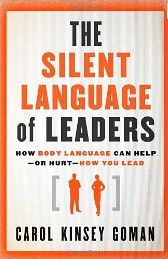
 The Silent Language of Leaders: How Body Language Can Help–or Hurt–How You Lead
The Nonverbal Advantage: Secrets and Science of Body Language at Work
She notes that all business leaders need to establish interpersonal warmth and likability balanced with authority, power, and credibility.
 Women have been viewed as likeable, but lacking authority, so Goman suggests the following behavior changes:
• Focusing eye contact in business situations on the conversation partner’s forehead and eyes instead of eyes and mouth, which is more appropriate for social situations
• Limit the number of head tilts and head nods, which may signal empathy and encouragement, but may be interpreted as submissive and lacking authority
• Occupy space: Stand tall with erect posture and head, and a wider stance hold your head high. Claim territory with belongings.
• Keep your hands on your lap or on the conference table where they can be seen to limit nervous hand gestures such as rubbing hands, grabbing arms, touching neck, tossing hair, leaning forward.
- Use authoritative hand gestures:
o Show palms when indicating openness and inclusiveness
o “Steeple” fingers by touching fingertips with palms separated to indicate precision
o Turn hands palms-down to signal confidence and certainty
o Keep gestures at waist height or above. Drop the pitch at the end of each sentence to make an authoritative statement. Avoid raising tone at the end of a sentence when not asking a question, as this may be interpreted as uncertain or submissive.
• Smile selectively and appropriately to maintain both likeability and authority
• “Learn to interrupt,” advised former U.S. Secretary of State Madeleine Albright. ”
Like occupying physical space, occupy “air-space.”
• Moderate emotional expressiveness, movement, and animation to signal authority and composure
• Cultivate a firm handshake, with palm-to-palm contact and that the web of your hand (the skin between your thumb and first finger) touching the web of the other person’s. Face the person squarely, look in the eyes, smile, and greet the person.
Goman stated that women generally excel at accurately read the body language of others, and this can be an advantage in intuitively grasping underlying issues in a meeting or during a negotiation.
-*How do you cultivate both credibility and likeability in work relationships?
 See related posting on Olivia Fox Cabane’s discussion of non-verbal contributors to “charisma”
RELATED POST:
Deborah Gruenfeld‘s discussion of power non-verbal behaviors
©Kathryn Welds


















 She offers recommendations for women and men investing in businesses, careers, and themselves:


 Kathryn Welds, PhD | Curated Research + Commentary