Category Archives: Business Communication

Business Communication

Touch Can Increase Compliance, Persistence, Performance

Edward T. Hall

Edward T. Hall

Fifty years ago, Edward T. Hall, then of Illinois Institute of Technology, identified differences in interpersonal space ranging from intimate to personal to social to public, and inspired examination of acceptable interpersonal distance across cultures, genders, and organizations.

Circles of Interpersonal Space

Circles of Interpersonal Space

A decade later, Chris Kleinke, then of Wheaton College, expanded Hall’s work on “proxemics” as he explored the impact of close contact in public spaces, particularly non-intimate touching.

He found that in a relatively low-touch culture like the U.S., directing gaze and touch toward others increased their compliance with ambiguous requests in laboratory experiments.

Chris Kleinke

Chris Kleinke

Since then, this finding has been incorporated in sales, learning, healthcare, and other service settings based on evidence that touch increased performance when applied after a person initially agreed to a request, in research by Oakland University Jane C. Nannberg and Christine H. Hansen.

David Vaidis

David Vaidis

“Dosage” of touch had an additive effect when University of Paris’ David Vaidis and Severine Halimi-Falkowicz of University of Provence found that people who were touched two times persisted in lengthy tasks more than people who were touched once.

Likewise, University of Missouri’s Frank N. Willis and Helen K. Hamm found that touch contributed to compliance with challenging requests, especially in gaining agreement from people of the same gender as the requestor.

Séverine Halimi-Falkowicz

Séverine Halimi-Falkowicz

Another demonstration of influential touch was when female restaurant servers briefly touched customers on the hand or the shoulder while returning change from the bill payment.

These customers’ reactions were compared with other patrons who were not touched by the servers, in research by University of Mississippi‘s  April H. Crusco and Christopher G. Wetzel of Rhodes College.

Chris Wetzel

Chris Wetzel

They evaluated customers’ reactions to service, food, setting, and other elements of the dining experience with a restaurant survey as well as the gratuity amount, expressed as a percentage of the bill.

Customers who were touched on the hand or shoulder gave the server significantly larger gratuities than those who were not touched, and there was no significant difference between tips from customers who had been touched on the hand or the shoulder.

These findings confirm the influence of interpersonal touch in public commercial settings, and offer a reminder that non-intimate touching can increase cooperation and commitment to complete lengthy or challenging tasks.

-*How have you used interpersonal touch in public work situations to enable cooperation and performance?

Follow-share-like http://www.kathrynwelds.com and @kathrynwelds

Related Posts:

Twitter:  @kathrynwelds
Google+
LinkedIn Groups Psychology in Human Resources (Organisational Psychology)
Facebook
Blog: – Kathryn Welds | Curated Research and Commentary

©Kathryn Welds

Collaboration Can Encourage Corruption, Lying

Damon Jones

Damon Jones

Many corporations encourage collaboration and make it part of culture statements and annual performance reviews.
Cisco Systems, for example, defined collaboration as “working across boundaries, building teams, managing conflict, earning trust, and recognizing good performance,” part of the CLEAD performance management and development system.

Mark Greenberg

Mark Greenberg

Ability to collaborate develops in childhood and is associated with positive life outcomes, demonstrated in a two decade longitudinal study of more than 750 Americans from kindergarten into adulthood by Penn State’s Damon Jones, Mark Greenberg and Daniel Max Crowley.

Daniel Max Crowley

Daniel Max Crowley

They found that kindergartners whose teachers rated them highly on social competence dimensions including:

Ori Weisel

Ori Weisel

Although collaborative settings may boost honesty due to increased observability, accountability, University of Nottingham’s Ori Weisel and Shaul Shalvi of Ben-Gurion University of the Negev showed that collaboration among equals can trigger corruption by lying, misreporting, and exaggerating performance.

Shaul Shalvi

Shaul Shalvi

They experimentally evaluated performance between 280 partners on a die rolling task for which they earned cash.
Player A privately rolled a die and reported the result to player B, who then privately rolled and reported the result.
Both players were paid only if they both reported the same results — for example, if both reported rolling “6”, each earned €6.

Robert S Feldman

Robert S Feldman

Players tended to inflate potential profit by misreporting actual outcomes, demonstrated by the proportion of reported matches.
The probability of rolling the same number in each round was one in six, or an average of 3.33 times in 20 rounds.
However, teams reported an average of 16.3 matches—nearly five times the expected number, demonstrating likely misrepresentation to achieve financial payoff.

Participants also lied even when they did not benefit, provided their partner benefitted.
Wiesel and Shalvi explained that “people are willing to pay the moral cost of lying even if they don’t stand to get any material benefit—the only benefit is the joy of collaboration.

Paul Ekman

Paul Ekman

When partners’ payoffs were not aligned, they were less likely to inaccurately report performance.
This finding suggests that participants were more likely to engage in “corrupt collaboration” when lying was financially advantageous to themselves and their partners.

Lying, one component of “corrupt collaboration,” occurs many times each day, according to University of Massachusetts’ Robert Feldman.
In fact, he found that two people getting acquainted lied an average of three times in ten minutes.

James Tyler

James Tyler

However, lying may not be detected in collaborative situations.
Feldman asserts that “no single or even combination of verbal or nonverbal behaviors accurately indicate when a person is lying… Most people have no better than a coin-flip chance of telling a lie from the truth….And many of the cues we think are associated with lying are unrelated to deception.”
This view is more pessimistic than  Paul Ekman’s contention that lying can be detected.

Andreas Reichert

Andreas Reichert

Besides being potentially difficult to detect in collaborative situations, lying can be contagious.
For example, volunteers were more likely to engage in their own deceptive behavior toward others as a result of being duped, in research by Purdue’s James M. Tyler, Robert S. Feldman of University of Massachusetts with Andreas Reichert of University of Konstanz.

Greg Willard

Greg Willard

Corrupt collaboration practices like lying may persist due to financial and other benefits.
In fact, people who lie also demonstrated more confidence, higher  achievement goals, positive affect, and composure during a stressful mock job interview scenario by Harvard’s Greg Willard and Richard Gramzow of Syracuse University.

However, when liars knew that their embellishments would be verified, their performance – and their prevarications – were reduced over time.
This finding suggests that visible monitoring seem to curb the potential downsides of collaboration in the workplace.

Richard Gramzow

Richard Gramzow

Despite collaboration’s purported positive effects on innovation, this teamwork approach can be accompanied by a side effect of enabling willful and reckless “corruption”, lying, and exaggeration.
However, this darker side of collaboration can be reduced by verifying the trust instilled in others.

-*How have you maximized the benefit of collaboration and team work while reducing the likelihood of developing “corrupt collaboration”?

Follow-share-like http://www.kathrynwelds.com and @kathrynwelds

Related Posts:

 Twitter: @kathrynwelds
Google+
LinkedIn Groups Psychology in Human Resources (Organisational Psychology)
Facebook

Blog: – Kathryn Welds | Curated Research and Commentary

©Kathryn Welds

Enabling Neurodiversity in the Workplace with Early Detection, Intervention

Eugene Edgar

Eugene Edgar

Reading and related language and information processing skills are crucial for effective academic and occupational performance.
For example, people with reading difficulties face challenges in completing education, securing post-college employment and advancing in careers, found University of Washington’s Phyllis Levine and Eugene Edgar.

However, early detection and intervention can equip people for effective performance in school and work situations by practicing required skills and learn problem solving skills to manage these information processing differences.

Kineret Sharfi

Kineret Sharfi

People with learning disabilities including reading difficulties face significant challenges: They are significantly less likely to attend 4-year college programs or graduate, noted Haifa University’s Kineret Sharfi and Sara Rosenbaum.

David Goldstein

David Goldstein

Similar results were reported separately in a study of U.S. high school graduates from classes of 1985-1990, interviewed in the next 5 year, by De Paul University’s Christopher Murray, with Donald E. Goldstein, Steven Nourse and Eugene Edgar of University of Washington.

Tomer Einat

Tomer Einat

Of even greater concern is that learning disabilities (LD) including low reading skills, were significantly associated with ADHD, school dropout age, and onset of criminal activity among Israeli-born prisoners, according to Bar-Ilan University Tomer Einat and Amela Einat of Tel-Hai Academic College.

Michelle Patterson

Michelle Patterson

Further, these information processing challenges were also prevalent among homeless adults in Canada, reported Simon Fraser University’s Michelle Patterson, Akm Moniruzzaman, and Julian M. Somers with Charles James Frankish of University of British Columbia.

Travis White-Schwoch

Travis White-Schwoch

For those with years of practice in reading, Northwestern’s Travis White-Schwoch noted that learning to read is a chief developmental milestone with lifelong consequences.”
His research colleagues Kali Woodruff Carr, Elaine C. Thompson, Samira Anderson, Trent Nicol, Steven G. Zecker, Ann R. Bradlow and Nina Kraus added “… an ongoing challenge has been to identify candidates for intervention at a young-enough age.

Kali Woodruff Carr

Kali Woodruff Carr

However, it’s possible to identify potential reading difficulty is possible as early as age three.
This early awareness can enable early remediation efforts including skill-building in phonics, sound blending, phonograms, and close listening for comprehension and memorization, suggested among multi-media interventions and practice processes by Johns Hopkins’ Crystal Kelly and Linda Campbell.

Travis White-Schwoch 2White Schwoch’s team asked 112 children ages 3 – 14 years to detect consonants while in a noisy environment.
These children selected and watched a movie in separate booths while wearing electroencephalograms (EEG) and headphones, which provided “babbling” (semantically anomalous English sentences) in the right ear and “da” sounds in the left ear as the movie’s audio played .

Samira Anderson

Samira Anderson

The group accurately predicted that children with higher scores on a test understanding sounds that make up words and sentences (“phonological awareness”) were were more able to quickly and accurately detect the “da” sound.
Similarly, higher performance on phonological awareness predicted higher scores on a literacy test a year later among 37 four year old pre-reading children.

Trent Nicol

Trent Nicol

Neurodiversity” at work is a more frequent topic in popular business publications, public policy and diversity efforts, so it’s essential to understand the complexity of acquiring information processing skills, and the adverse consequences for those who don’t master these capabilities.

Steven Zecker

Steven Zecker

As a result, progressive workplaces enable greater inclusion of these different abilities by offering skill enhancement opportunities for those whose reading difficulties affect their ability to perform their work responsibilities.

-*How do you enable people with neurodiversity to optimally perform in the workplace?

Follow-share-like http://www.kathrynwelds.com and @kathrynwelds

Related Posts:

Twitter: @kathrynwelds
Google+

LinkedIn Groups Psychology in Human Resources (Organisational Psychology)
Facebook

Blog: – Kathryn Welds | Curated Research and Commentary

©Kathryn Welds

Managing Collective Emotions Affects Leader Reputation, Impact

Gustave Le Bon

Gustave Le Bon

People in groups and crowds demonstrate collective affect, according to Gustave Le Bon, who asserted that individuals in these contexts collectively act with “impulsiveness, irritability, incapacity to reason, the absence of judgment of the critical spirit, the exaggeration of sentiments…” even if these are not their usual individual behaviors.

Adolph Hitler

Adolph Hitler

Well before the rise of charismatic leader Adolph Hitler, Le Bon claimed that “…an individual immersed for some length of time in a crowd soon finds himself…. in a special state, which much resembles the state of fascination in which the hypnotized individual finds himself in the hands of the hypnotizer.

One way to evaluate individual and collective affect is through facial expressions because they provide information about how others understand people and events.
As a result, these non-verbal cues enable people to tailor responses to individuals and groups they encounter.

Peter Salovey

Peter Salovey

Tailoring interaction style based on observing others is a key element of Emotional Intelligence, described by Yale’s Peter Salovey and Daisy Grewal as accurately perceiving others’ emotional states and effectively responding with emotionally-charged interpersonal situations.

Daisy Grewal

Daisy Grewal

This is also an essential leadership skill because it enables awareness of sentiments that may be out of others’ awareness or that they may consciously try to suppress to align with prevailing organizational cultures — particularly those that do not encourage emotional awareness and expression.

Hillary Anger Elfenbein

Hillary Anger Elfenbein

Consequently, accurate perception of others’ emotions is related to effectively managing interpersonal relationships according to University of California, Berkeley’s Hillary Elfenbein and to subordinates’ ratings of managers as transformational leaders in research by Depaul University’s Robert S. Rubin, David C. Munz of Saint Louis University and Cleveland State University’s William H. Bommer.

However, accurate perception of group sentiment is difficult because many people narrow attention to a few individuals and to focus in detail on them, leading to perceptual bias of collective “tunnel vision.”

Takahiko Masuda

Takahiko Masuda

As a result, much information in social context, including the group’s prevailing emotional tone, may be filtered out, noted University of Alberta’s Takahiko Masuda, Phoebe C. Ellsworth of University of Michigan, Wake Forest University’s Batja Mesquita, Janxin Leu of University of Washington, Hokkaido University’s Shigehito Tanida, and Ellen Van de Veerdonk of University of Amsterdam.

Executives and leaders must decode and attend to collective emotions because they often cannot develop individual relationships with each of their many stakeholders and when addressing group emotions including:

Phoebe Ellsworth

Phoebe Ellsworth

  • Employees’ collective anxiety about corporate restructuring, mergers, divestitures, and reductions in force,
  • Consumers’ collective anger,
  • Board of Directors members’ lack of support.
Jennifer George

Jennifer George

Positive collective emotions tend to be over-estimated, and linked to greater customer service and lower absenteeism, reported Texas A & M’s Jennifer George.
In contrast, negative collective emotions like envy are easily under-estimated, and associated with lower group performance and satisfaction by reducing group potency and cohesion in research by University of Kentucky’s Michelle Duffy and Jason Shaw.

Michelle Duffy

Michelle Duffy

A leader’s ability to respond effectively to patterns of shared emotions during strategic organizational change and other emotionally turbulent organizational processes depends on the leader’s ability to widen the “emotional aperture.”

Emotional Aperture 1Like a camera’s aperture adjustment for increased depth of field, emotional aperture refers to ability to recognize the mix of positive and negative emotional experiences in a team, workgroup or business unit.

This “setting change” can bring into focus both nearby individuals and more distantly scattered groups of people.
Likewise, adjusting the emotional aperture involves moving an information-processing focus from individual emotional experiences to a group’s collective emotional composition.

David Matsumoto

David Matsumoto

Although ability to recognize individual emotional expression has been measured by instruments like the Brief Affect Recognition Testthis tool doesn’t evaluate perception and recognition of collective affect.

Jeffrey Sanchez-Burkes

Jeffrey Sanchez-Burkes

To address this limitationUniversity of Michigan’s Jeffrey Sanchez-Burks and Caroline A. Bartel of University of Texas collaborating with Vanderbilt University’s Laura Rees and Quy Huy of INSEAD developed an Emotional Aperture Measure (EAM).

EAM analyzes a person’s ability to accurately perceive a group’s collective emotions in short video clips of employee groups before and after an organizational event.
Next, participants estimate the proportion of rapid individual positive and negative reactions among group members.
Feedback from this instrument can increase perceiver accuracy through heightened awareness.

Caroline Bartel

Caroline Bartel

Sanchez-Burks contacted direct reports of a global sample of high-ranking managers and requested online evaluations of the manager’s leadership performance.
Three studies demonstrated that collective affect recognition requires a distinct information processing style, differing from perceiving individual emotion.

Laura Rees

Laura Rees

Managers’ EAM performance was significantly correlated with direct reports’ perception of managers’ “transformational leadership” behaviors, suggesting that this ability to accurately perceive group emotion can significantly influence stakeholder impressions and opinions.

People can open their emotional aperture through attention to collective emotions, and may influence prevailing negative group affect by asking the positive minority to share optimistic sentiments with the skeptical majority.
This dialog can increase trust and shared perspectives that may move negative sentiment to become more positive.

Quy Huy

Quy Huy

Leaders who increase the range of their “emotional aperture” can increase followers’ alignment with strategic direction to increase the likelihood to effective execution and change impact.

Try the Emotional Aperture Measure to see your results.Emotional Aperture Measure

-*How do you read the “emotional tone” of a group?

Related Posts:

©Kathryn Welds

Debiasing Decisions: Combat Confirmation Bias, Overconfidence Bias

Philip Meißner

Philip Meißner

Cognitive and behavioral biases can contribute to “blind spots” in decision-making, leading to less effective outcomes.
To improve decision outcomes, University of Marburg ’s Philip Meißner, Torsten Wulf of HHL Leipzig Graduate School of Management and HEC’s Olivier Sibony proposed a systematic checklist to identify potential decision derailment based on bias, along with rapid remedies.

Torsten Wulf

Torsten Wulf

They argues that two types of bias contribute to most decisions that lead to undesirable results:

  • Confirmation bias, the unconscious tendency to believe new information that is consistent with existing beliefs and recent experiences, and to discount contradictory data,
  • Overconfidence bias, the out-of-awareness likelihood to overestimate one’s skills, insights, and judgment.
    This leads to increased risk-taking based on illusory sureness of the decision and ability to mitigate adverse outcomes.

Olivier Sibony

Olivier Sibony

Previously, Lovallo and Sibony articulated four related decision biases:

  • Pattern-recognition biases, countered by changing the “angle of vision,”
  • Action-oriented biases, mitigated by recognizing uncertainty,
  • Interest biases, minimized by explicitly highlighting these interests,
  • Social biases, reduced by depersonalizing debate.

Debiasing techniques such as checklists, can limit the negative effects of biases in decision-making by offering a disciplined, comprehensive analysis of downside risks and by systematically considering multiple viewpoints.

Atul Gawande

Atul Gawande

However, effectively implementing checklists requires consistent discipline, noted Harvard’s Atul Gawande, who cited examples of partial adherence leading to costly oversights and failures.

One approach, suggested by Princeton’s Daniel Kahneman and Gary Klein of McKinsey, is a “premortem.”
Decision makers imagine that the decision has failed and analyze sources and reasons for adverse outcomes, to more thoroughly assess points of failure and possible mitigation strategies.
Formal scenario-planning is another way to expose assumptions underlying a plan, as well as a competitor’s priorities and potential strategy.

Massimo Garbuio

Massimo Garbuio

Using a variety of debiasing techniques significantly increased the Return on Investment (ROI) in a study by University of Sydney’s Massimo Garbuio and Dan Lovallo and Olivier Sibony of HEC.
As a result, Michael Birshan, Ishaan Nangia, and Felix Wenger of McKinsey, argued that debiasing techniques should be embedded in formal organizational decision-making processes, particularly for high-impact, repetitive decisions.

Michael Birshan

Michael Birshan

Decision biases may be out of awareness, or unconscious, so it’s more effective to evaluate the process of developing a proposal, rather than focusing only on the content and merits of a proposal.

Decision-making safeguards can be built into standard analysis processes by including questions to expose:

  • Multiple data sources,
  • Diverse opinions and perspectives,
  • Downside risk,
  • Potential negative outcomes for company, industry, and broader ecosystem.

Daniel Kahneman

Daniel Kahneman

Proposals are considered ready for a decision only when multiple perspectives are available to mitigate confirmation bias and risk analysis is available to reduce overconfidence bias.
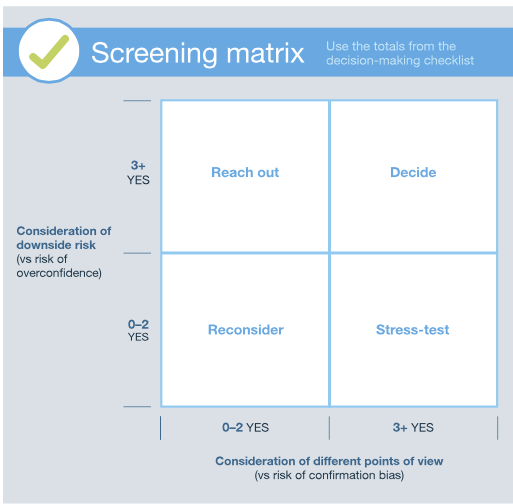
Responses to decision checklist questions can be quantified to indicate one of four action steps, according to Daniel Kahneman:

  • Decide, based on inclusion of robust safeguards against both confirmation bias and overconfidence bias,
  • Screening MatrixReach out, suggesting the need for gathering additional perspectives, opinions, and perspectives to prevent narrow assumptions to reduce confirmation bias.
    The Vanishing-Options Test, proposed by Stanford’s Chip Heath and Dan Heath of Duke University, can generate new ideas by imagining that none of the current proposals are available.
  • Stress-test, by conducting a pre-mortem or analysis by external devil’s advocate or provocateur to reduce overconfidence risk by.
  • Reconsider when both more perspectives and risk analysis are required to reduce both overconfidence bias and confirmation bias.
    This screening matrix helps reduce related decision-making biases:
  1. Self-interest Bias
    -To what extent is the proposal motivated by self-interest?

Ishaan Nangia

Ishaan Nangia

Recommendation
-Assess for over-optimism

  1. Affect Heuristic
    -How strong is the team’s emotional attachment to a specific proposal?
    -To what extent were risks and costs fully considered for both preferred and non-preferred options?

Recommendations
-Assess for strongly-preferred outcomes
-Reintroduce analysis of all options

  1. Groupthink
    -How many dissenting opinions were analyzed?
    -How adequately were all options explored?
    -Was dissent discouraged? 

Felix Wenger

Felix Wenger

Recommendations
-Encourage substantive disagreements as a valuable part of the decision process
-Solicit dissenting views from members of the recommending team, through private meetings

4. Saliency Bias
     -To what extent are decisions made based on a potentially incomparable, but memorable success?
     -What about the proposed analogy is comparable to the current situation?
     -What are relevant examples from less successful companies? What happened in those cases?

Decision Making QuestionsRecommendation
-Carefully scrutinize analogies’ similarity to the current decision situation
Solicit additional analogies using reference class forecasting:

.Select reference class,
.Assess distribution of outcomes,
.Intuitively estimate project’s position in distribution,
.Assess estimate’s reliability,
.Correct intuitive estimate.

  1. Confirmation Bias
    -What viable alternatives were included with the preferred recommendation?
    -At what stage in the decision analysis were alternatives discarded?
    -What efforts were undertaken to seek information to disconfirm the main assumptions and hypotheses?

Recommendation
-Request two additional alternatives to the main recommendation, including analysis of benefits and drawbacks
-Acknowledge unknowns, risks

  1. Availability Bias

    Max Bazerman

    Max Bazerman

    If you had more time to gather date, what information would you seek?, asked Harvard’s Max Bazerman
    -How can you access similar data now?

Recommendation
-Use checklists to ensure comprehensive analysis of data required for each decision type

  1. Anchoring Bias
    -What data sources are used to analyze decision?
    -Which data are estimates? By whom? If so, from which data were estimates extrapolated?
    -To what extent could there be:
  • Unsubstantiated numbers?
  • Extrapolation from non-equivalent previous situations?
  • Attraction to specific anchors?

Recommendations
-Present data from other sources, benchmarks, or models
-Request new analysis

8. Halo Effect
     -To what extent does the analysis team expect that a person, organization, or approach previously successful in one context will be equally effective in different situation?

Phil Rosenzweig

Phil Rosenzweig

Recommendations
-Question potentially inaccurate inferences
-Solicit additional comparable examples
-Question attributions of success and failure to leaders’ personalities instead of chance factors, advised IMD’s Phil Rosenzweig.

9. Sunk-Cost Fallacy, Endowment Effect
     -To what extent are recommenders attached to past decisions?

Recommendation
Disregard past expenditures when considering future costs and revenues

  1. Overconfidence, Planning Fallacy, Optimistic Biases, Competitor Neglect
    -To what extent is the comparison case unwarrantedly optimistic?

Recommendation
-Adopt an outside view by using relevant simulations or war games

  1. Disaster Neglect
    -To what extent is the worst case scenario realistically and sufficiently negative?
    -How was the worst case generated?
    -To what extent does the worst case consider competitors’ likely responses?
    -What other scenarios could occur?

Recommendation
-Conduct a premortem, suggested by Gary Klein of Applied Research Associates:  Imagine the worst case scenario occurred, then propose likely causes, mitigations   

  1. Loss Aversion
    -To what extent is the evaluation and decision team risk averse?

Recommendation
-Realign incentives to share responsibility for the risk or to reduce risk

  1. Planning Fallacy focuses only on the current case while ignoring similar projects’ history and statistical generalization from related cases.
    -To what extent does the analysis rely on “top-down, outside-view” comparisons to similar projects?
    -Did the evaluators use a “bottom-up, inside-view” to estimate time required for each step?

Recommendation
-Statistically analyze a broad range of similar cases to avoid over-estimates from “top-down, outside-view” approaches and underestimates from “bottom-up, inside-view”
-Differentiate accurate forecasts from ambitious targets

  1. Loss aversion
    -To what extent are evaluators more concerned with avoiding loss than achieving gains?
    – How concerned are evaluators with being held responsible for a failed project?
    -To what extent has the organization specified acceptable risk levels?

Recommendation
-Seek risk tolerance guidelines from organizational leaders.

Decision-making tools like checklists can significantly reduce unconscious biases, provided that they are consistently and systematically applied.

-*What strategies have you found most helpful in reducing biases in decision-making?

Follow-share-like http://www.kathrynwelds.com and @kathrynwelds

Related Posts:

Twitter:  @kathrynwelds
Google+LinkedIn Groups Psychology in Human Resources (Organisational Psychology)
Facebook
Blog:  Kathryn Welds | Curated Research and Commentary

©Kathryn Welds


Power, Confidence Enhance Performance Under Pressure    

Sonia K. Kang

Sonia K. Kang

Role-based power can affect performance in pressure-filled situations, but has less impact on lower pressure environments, according to University of Toronto’s Sonia K. Kang, Adam D. Galinsky of Columbia University, University of California, Berkeley’s Laura J. Kray and Aiwa Shirako of Google.

Kang’s team assigned more than 130 volunteers to same-gender pairs in three negotiations experiments.
Half the participants acted as a “recruiter” (high-power role) or as a “job candidate” (low-power role) in negotiating salary, vacation time, and related benefits.

Adam Galinsky

Adam Galinsky

Volunteers were told that performance either reflected negotiation ability or was unrelated to ability.
Participants in high power roles tended to perform better under pressure when they were told their negotiation performance was an accurate reflection of ability.
Kang attributed this result to participants’ higher expectations for success based on the higher power role.

Job candidates who thought their negotiation performance indicated their skill level performed significantly worse than those who thought that the exercise was a learning experience unrelated to their negotiating capabilities.

Claude Steele

Claude Steele

Results were similar to Claude Steele of Stanford’s findings for stereotype threat and stereotype uplift, in which individuals from marginalized groups perform less effectively than members of higher-power groups, linked to negative self-attributions and expectations.
Low-power negotiators counteracted underperformance when they self-affirmed their performance.

Laura Kray

Laura Kray

Kang and team concluded that “relative power can act as either a toxic brew (stereotype/low-power threat) or a beneficial elixir (stereotype/high-power lift) for performance… (because) performance in high pressure situations is closely related to expectations of behavior and outcome… Self-affirmation is a way to neutralize … threat.

Aiwa Shirako

Aiwa Shirako

In another experiment, 60 male MBA students were paired as the “buyer” or “seller” of a biotechnology plant.
The sellers held a more powerful role in this situation, and were more assertive, reflected by negotiating a higher selling price, when they thought performance reflected ability.
In contrast, buyers performed worse when they thought negotiating performance reflected ability.

Kang’s team extended this scenario with 88 MBA students (33 male pairs and 11 female pairs), who were told the exercise would gauge their negotiating skills.
Before the negotiation, half of the participants wrote for five minutes about their most important negotiating skill, while the remaining half wrote about their least important negotiating skill.

Buyers who completed the positive self-affirmation performed significantly better in negotiating a lower sale price for the biotechnology plant, effectively reducing the power differences between the buyer and seller.

Based on these findings, Kang advocates writing self-affirmations rather than simply reflecting on positive self-statements about job skills and positive traits to enhance confidence and performance.

-*How do you mitigate differences in role-based power and confidence when performing under pressure?

Related Posts:

©Kathryn Welds

Choice of Confidants Evolves Rapidly in New Contexts

Peter V Marsden

Peter V Marsden

Prevailing career advice reinforces maintaining a robust professional network, and well-being research emphasizes cultivating supportive social contacts.

Claude S. Fischer

Claude S. Fischer

Core discussion networks,” described by Harvard’s Peter V. Marsden, include people consulted about important matters across professional and personal realms.
Most people expect that these confidants are enduring close contacts, according to University of California, Berkeley’s Lynne McCallister and Claude Fischer.

Mario Luis Small

Mario Luis Small

However, Harvard’s Mario Luis Small, with Vontrese Deeds Pamphile of Northwestern, and University of Chicago’s Peter McMahan demonstrated that core discussion networks can change quickly with new social contexts and obligations.
In fact, Small and team found much quicker network evolutions than previously observed by Utrecht University’s Gerald Mollenhorst, Beate Volker, and Henk Flap.

Gerald Mollenhorst

Gerald Mollenhorst

Change in core discussion network often results from lack of opportunity to meet, asserted Mollenhorst and colleagues.
In addition, life transition events, such as completing education, beginning a job, entering a marriage, and birth of a child were associated with changes in personal networks in research by University of Amsterdam’s Matthijs Kalmijn.

Matthijs Kalmijn

Matthijs Kalmijn

Small and colleagues evaluated a core discussion network during transition to graduate school for 37 first-year students from three academic departments during their first 12 months, using a qualitative-quantitative complementary approach described by Sam Houston State University’s Anthony J. Onwuegbuzie and Kathleen Collins of University of Arkansas.

Network Outcomes” observed by Small’s team were characterized as:

  • Stasis,
  • Expansion,
  • Shedding,
  • Substitution.

Anthony J Onwuegbuzie

Anthony J Onwuegbuzie

Related “Network Mechanisms” of core discussion group changes included new routine activities and obligations and variance in strength of existing social relationships and were associated with rapid adaptation to new social contexts.

Previously, Small demonstrated than almost half the members of a typical core discussion network were composed of people not seen as “close,” suggesting that sources of social support are adaptable to changing contexts of life transitions, and need not be close or long-term contacts.

  • What percentage of your core discussion group confidents are “close” social contacts?
  • What processes enable developing new social support relationships? 

    Follow-share-like http://www.kathrynwelds.com and @kathrynwelds

RELATED POSTS:

Twitter  @kathrynwelds
Blog – Kathryn Welds | Curated Research and Commentary
Google+
LinkedIn Open Group Psychology in Human Resources (Organisational Psychology)
Facebook Notes


©Kathryn Welds

Perceived Power Affects Vocal Characteristics, Life Outcomes

Margaret Thatcher

Margaret Thatcher

British Prime Minister Margaret Thatcher participated in vocal training to project greater authority in her political role, with highly effective results.

Even without specific vocal training, research volunteers adopted powerful vocal elements when believed they had power and informational advantages in lab experiments by San Diego State University’s Sei Jin Ko and Melody S. Sadler with Adam D. Galinsky of Columbia.

Sei Jin Ko

Sei Jin Ko

Ko’s team asked more than 160 volunteers to read a text designed to evaluate speaking skills as a baseline for later comparison.
Then, they randomly assigned volunteers to a “high” ranking role with the prime “you have a strong alternative offer, valuable inside information, or high status in the workplace, or by asking participants to recall an experience in which they had power.

The remaining participants were told they had “a weak offer, no inside information, or low workplace status,” or were asked to recall an experience in which they lacked power.

Melody Sadler

Melody Sadler

To compare the impact of these power primes with the baseline reading performance, participants in both groups read a text about negotiating.
People in the high power group spoke in a higher pitch, with greater volume, and less tone variability than the low-power group.
In fact, team Ko found that people in the high power prime group had a similar vocal profile to Thatcher following her vocal training.

Mariëlle Stel

Mariëlle Stel

This contrasts previous research that demonstrated lower vocal pitch is associated with greater perceived power in work by Tilburg University’s Mariëlle Stel and Farah M. Djalal with Eric van Dijk and Wilco W. van Dijk of Leiden University, collaborating with University of California, San Diego’s Pamela K. Smith.

Eric van Dijk

Eric van Dijk

In additional investigations by Ko’s team, additional participants listened to recordings of people who read in the previous condition, and accurately determined which volunteers conveyed higher status and were more likely to engage in high-power behaviors, based only on vocal elements.

Joris Lammers

Joris Lammers

Power primes” or asking people to recall a time they had power and felt powerful, can significantly influence important life opportunities determined by hiring and university admission decisions, reported Tilburg University’s Joris Lammers with David Dubois of INSEAD and Northwestern’s Derek D. Rucker collaborating with Adam D. Galinsky of Columbia.

Thomas Mussweiler

Thomas Mussweiler

Self-generated primes are especially influential because they lead to “assimilation of the power suggestion, whereas primes provided by other people, as in Ko’s investigation, yield “contrast,” suggested Universität Würzburg’s Thomas Mussweiler and Roland Neumann.

Egon Brunswik

Egon Brunswik

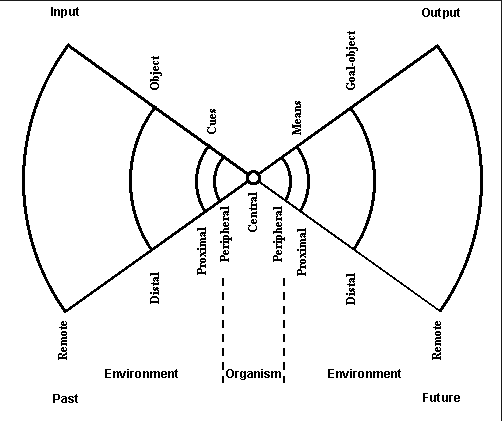
The strong impact of beliefs about power has been explained by Egon Brunswik of Berkeley’s “lens model” of perception, self-fulfilling prophecy theory by University of California’s Robert Rosenthal, and self-efficacy theory described Stanford’s Albert Bandura.

These findings suggest that beliefs about personal power shape behaviors like vocal profile, which can lead to differing outcomes in occupational and life opportunities.

Egon Brunswik's Lens Model

Egon Brunswik’s Lens Model

  • How do you modify your voice to convey power and authority?
  • How do you develop confidence in your power?

RELATED POSTS:

©Kathryn Welds

Paradox of Potential vs Achievement in Job Search

Zachary Tormala

Zachary Tormala

When hiring or promoting, the person’s potential can trump actual accomplishments, according to Stanford’s Zakary Tormala, with Jayson Jia of University of Hong Kong and Harvard’s Michael Norton.

Jayson Shi Jia

Jayson Shi Jia

The paradox of potential occurs because possibility seems to engender greater interest and cognitive effort due to its uncertain outcome, in examples ranging across:

  • Basketball player evaluations,
  • Hiring decisions,
  • Salary offers,
  • Graduate school admissions recommendations,
  • Judgments of artistic talent,
  • Intentions to visit an untried restaurant.

Michael Norton

Michael Norton

Tormala and team demonstrated this effect by presenting identical statistics for a hypothetical NBA basketball player, then describing the data “predictions” or as “actual performance.”
Participants were more likely to judge that the player would become an All-Star player when they viewed “predicted” statistics rather than “actual” performance records.

Volunteers also evaluated a job applicant more favorably when the person performed well on an “Assessment of Leadership Potential rather than on an “Assessment of Leadership Achievement.”

Tormala’s group extended the investigation to evaluate impact of an upcoming comedian’s ”accomplishment” compared with “potential” when they posted different Facebook advertisements:

  • “Critics say he has become the next big thing”
  • “Critics say he could become the next big thing.”

The “potential” ads produced more than three times more click-throughs and five times more fan ratings.

In other studies, Tormala and team compared descriptions of an achievement and potential:

  • “This person has won an award for his work”
  • “This person could win an award for his work.”

“Potential” stimulated greater interest and cognitive information processing, resulting in more favorable reactions to the target person.

Derek Rucker

Derek Rucker

With Stanford colleague Daniella Kupor and Derek D. Rucker of Northwestern University, Tormala and Norton found that the preference for potential disappeared for people who don’t like uncertainty, and in situations that require higher degrees of certainty.

They noted that when people thoughtfully consider challenging decisions, such as in a Blackjack game, bystanders form positive impressions of others and become more willing to be influenced by them.
However, observers form negative opinions of people who “overthink” simple choices (demonstrate lack “thought calibration”), and are less willing to be influenced by them.

The appeal of potential applies to abstract enjoyable experiences, according to Southern Methodist University’s T. Andrew Poehlman and George Newman of Yale.

T Andrew Poehlman

T Andrew Poehlman

They found that the lure of “potential” makes people more likely to “consume inferior performances” in the present, but may not enjoy them.

Poehlman and Newman argued that “potential” is less influential when experienced in the past, and is less attractive when potential is associated with utilitarian dimensions.

George Newman

George Newman

These findings point to the value of:

  • Positioning one’s own “potential” as well as others’ “potential” to increase persuasiveness of support and advocacy,
  • Considering whether candidates with “potential” seem more appealing than those with greater experience – and whether potential is the appropriate selection criterion.

-*How frequently do you see people hired, promoted, and rewarded for “potential” instead of actual achievement?

Follow-share-like http://www.kathrynwelds.com and @kathrynwelds

RELATED POSTS:

Twitter @kathrynwelds
BlogKathryn Welds | Curated Research and Commentary
Google+ http:www.google.com/+KathrynWelds
LinkedIn Open Group Psychology in Human Resources (Organisational Psychology)
Facebook Notes

©Kathryn Welds

Does Customer Recommendation Predict Company Growth?

Fred Reichheld

Fred Reichheld

Net Promoter Scores gauge customer loyalty, expressed by willingness to recommend and advocate the company’s products and services to others.

Its creator, Fred Reichheld of Bain & Company, posited that NPS is a more meaningful measure of a company’s relationship with its customers than customer satisfaction metrics because, he argued, it is correlated with revenue growth.

Richard Owen

Richard Owen

Satmetrix Executives Richard Owen and Laura Brooks further articulated this linkage between customer loyalty and revenue growth.

NPS’s customer loyalty metric is based on 10-point ratings in response to just one question: How likely is it that you would recommend our company/product/service to a friend or colleague?

Laura Brooks

Laura Brooks

“Promoters” respond with a score of 9 or 10 whereas “Detractors” provide ratings of 0-6, and scores of 7 and 8 are ignored in this system, leading to the question of why they are included.
NPS is calculated by subtracting the percentage of customers who are Detractors from the percentage of customers who are Promoters.

Timothy L. Keiningham

Timothy L. Keiningham

Critics, including Ipsos Loyalty’s Timothy L. Keiningham, Bruce Cooil of Vanderbilt, BI Norwegian School of Management’s Tor Wallin Andreassen, and Lerzan Aksoy of Fordham, argue that American Customer Satisfaction Index (ACSI) is an equally accurate predictor of revenue growth.

They reinforced the frequently-replicated finding that actual behaviors, including positive and negative “word of mouth (WOM)are better predictors than attitudes about possible future behaviors, in their evaluation of longitudinal data from 21 firms and 15,500-plus interviews from the Norwegian Customer Satisfaction Barometer.

Claes Fornell

Claes Fornell

Likewise, University of Michigan’s Claes Fornell, Forrest V. Morgensen, and M.S. Krishan, with Sunil Mithas of University of Maryland, found that “it is possible to beat the market consistently by investing in firms that do well on the ACSI.”

Companies that invest in initiatives to increase customer satisfaction, reflected in higher scores than competitors on the American Customer Satisfaction Index (ACSI), also performed better in measures of market value.

More surprisingly, they found that these higher returns are associated with lower stock market risk, probably due to “stock market imperfections” that require time to adjust to news of strong ACSI performance.

Bob Hayes

Bob Hayes

Similarly, customer satisfaction and loyalty researcher Bob Hayes contended that “likelihood to recommend” measures the same construct and has the same predictive value of business growth as customer loyalty questions such as:

  • Overall satisfaction
  • Predicted likelihood to purchase again, evaluated through his Purchasing Loyalty Index (PLI)
  • Number of referrals through “word of mouth” and “word of mouse,” calculated in his Advocacy Loyalty Index (ALI)
  • Resistance to defection to competing offers, measured with his Retention Loyalty Index (RLI).

    Hayes Customer Loyalty Grid

    Hayes Customer Loyalty Grid

Hayes’ findings reinforced the caveat that actual behavior is a more accurate than attitudes about likely future behavior, also demonstrated by University of Connecticut’s V Kumar, J Andrew Petersen and Robert Leone in their analysis of telecoms and financial service customers willing to recommend their service provider.

V Kumar

V Kumar

Only about one-third of these potential Advocates actually recommended the provider, and only about 13% of those referrals actually led to new customers.
Kumar and team called this the “promise gap” and suggested that it can be mitigated by delivering beyond customer expectations, even when a customer complains.

Neal A Morgan

Neil Morgan

Indiana University’s Neil A. Morgan and Lopo Leotte Rego of University of Iowa added a wrinkle to critiques of Net Promoter Scores as the sole necessary indicator of customer satisfaction.

Like Keiningham’s team and Hayes, they found that recommendation intentions (“net promoters”) have “little to no predictive value.
Unlike Hayes, their results found little predictive strength for actual behavior in average number of recommendations.

Instead, Morgan and Rego argued for multiple measures of customer satisfaction as the best predictor of revenue group.
Additionally they found that Top 2 Box satisfaction scores – the sum of percentages for the top two point on surveys of purchase intent, satisfaction or awareness – provided “good” predictive value.

Daniel Schneider

Daniel Schneider

The Net Promoter Score also had the lowest predictive validity when compared to three other scales by Stanford’s Jon Krosnick and Daniel Schneider, with Intuit’s Matt Berent and Hays Interactive’s Randall Thomas.

To improve the NPS, the team recommended replacing the 11 point unipolar rating scale with a 7 point bipolar scale from positive to negative impressions.

Jon Krosnick

Jon Krosnick

Their work replicated Hayes’ finding that liking and satisfaction with a company are highly significantly predictors than the likelihood of recommending, so Krosnick’s team recommended including questions like:

  • Overall, how satisfied are you with the each of the following companies?
  • How much do you like or dislike each of the following companies?

They uncovered correlations among measures of customer experience, and showed that liking is the best predictor of the number of recommendations and satisfaction.

Leon Festinger

Leon Festinger

Customers typically form more positive evaluations after the decision to purchase, probably due to validating purchase choices and reduce cognitive dissonance of purchase dissatisfaction, described by Stanford’s Leon Festinger.

These findings suggest that Reichheld’s claim of NPS as “the only question you need to ask” may be unsubstantiated, and that multiple measures of customer experience are more accurate predictors of a company’s revenue performance.

-*How credible is “willingness to recommend” a company as a predictor of its revenue growth?

Follow-share-like www.kathrynwelds.com and @kathrynwelds

RELATED POSTS:

©Kathryn Welds