Author Archives: kathrynwelds

Unknown's avatar

About kathrynwelds

Organizational Psychologist | Change Consultant | Leadership and Career Coach | Thought Partner | Accountability Ally | Creating value by connecting people, information, and ideas, to accomplish strategic results Professional experience spans roles as an organizational psychologist, coach, consultant, leader in technology, healthcare, professional services, public sector.

Non-Verbal Behaviors that Signal “Charisma”

Olivia Fox Cabane

Olivia Fox Cabane

Olivia Fox Cabane defines charismatic behaviors as managing internal states and beliefs through self-awareness, emotional self-management to focus on others and “make them feel good,” in her book, The Charisma Myth: How Anyone Can Master the Art and Science of Personal Magnetism.

She identified four types of “charisma:”

o Focus: Presence, listening intently, confidence
o Visionary: Belief, confidence, inspires others
o Kindness: Warmth, confidence, eye contact, compassion/self-compassion, gratitude, goodwill, enable others to feel important and heard through asking open-ended questions, redirecting focus to other with question about opinion
o Authority: Power, status, confidence, appearance/clothing, “take up space” posture, reduce number of non-verbal reassurances (nodding)

Her book considers three key contributors to “charisma”:

o Presence – mindful attention, patient listening, avoiding interruption

o Power – appearance, clothing, occupy space, positive wording (avoid “don’t”), placebo effect

o Warmth – chin down, eye contact, Duchenne smile (mouth corners, eye corners), gratitude, compassion, appreciation to counteract “hedonic adaptation”

In an interview, Fox Cabane offered three “quick fixes” to amplify perceived “charisma”:

• Lower the intonation of your voice at the end of your sentences (no Valley Girl talk…)
• Reduce the speed and rapidity of nodding
• Pause for two seconds before you speak

She offered a number of self-management and communication tips, including a review of Cognitive Behavior Modification practices:

o Destigmatize Discomfort-Dedramatize
o Neutralize Negativity by disputing thoughts
o Rewrite Reality with cognitive reappraisal-reframing

Other reminders include:

• Increasing resilience by expanding the personal “comfort zone”
• Employing mental rehearsal through visualization
• Adopting equanimity, “radical acceptance”, calm
• Increasing impressions of similarity by increasing subtle mirroring of phrases, posture, gestures (such as handshake)
.Investigating appropriate attire, match level of formality/informality
o Delivering value: entertainment, information, good feeling
o Inhaling through nose to avoid anxious, breathless sound
o Using as few words as possible; be succinct; illustrate with imagery, metaphor, analogy, story, compelling statistics relevant to the listener
o Expressing appreciation for specific help, influence; identify positive impact, and context in which it came to mind
o Avoiding verbal “distractors”: “um”, “ah”, “you know”
o Breathing to avoid self-generated anxiety: ”Pause-Breathe-Slow Down”

-*Which elements of Power, Presence, and Warmth have you observed among the most “charismatic” people you know?

©Kathryn Welds

Lessons from Business Storytelling in Constructive Personal Narrative

Business Storytelling books and resources have proliferated, drawing many lessons from Hollywood’s storytelling business and from advertising, public relations, and marketing.

David Epston

David Epston

Michael White

Michael White

Yet business readers may be less aware that more than two decades ago, Australia-based family therapists Michael White and David Epston asserted that people experience personal problems when the stories they tell about their lives do not represent their actual experiences.

They offered ways for people to “re-story” of “re-author” their personal narratives in their now-classic Narrative Means to Therapeutic Ends

Michel Foucault

Years after White and Epston built on French philosopher, Michel Foucault’s Post-Structuralist/Modernist analysis of narrative, Paul John Eakin integrated literature, cognitive science, ethics and social criticism in his intriguingly-titled books, Living Autobiographically: How We Create Identity in Narrative and How Our Lives Become Stories: Making Selves 

Eakin echoes Foucault’s view that cultural and social “discourses” influence the narratives people develop about themselves and others, and he, like White and Epston, suggests that personal narratives can be modified to reduce subjective discomfort. How Our Lives Become Stories

Though White and Epston led their clients’ introspective analysis of personal narrative, philosophers like Foucault, and perhaps even Eakin, would argue for the viability of self-guided introspection.

-*When have you used stories to help others solve problems?
-*When have you heard stories that helped you resolve issues?

Related Resources:
Lead with a Story: A Guide to Crafting Business Narratives That Captivate, Convince, and Inspire

Whoever Tells the Best Story WinsWhoever Tells the Best Story Wins: How to Use Your Own Stories to Communicate with Power and Impact

The Elements of Persuasion: Use Storytelling to Pitch Better, Sell Faster & Win More Business 
Tell to Win

Tell to Win: Connect, Persuade, and Triumph with the Hidden Power of Story

The Leader's Guide to StorytellingThe Leader’s Guide to Storytelling: Mastering the Art and Discipline of Business Narrative
Winning the Story WarsWinning the Story Wars: Why Those Who Tell (and Live) the Best Stories Will Rule the Future

LinkedIn Open Group Psychology in HR (Organisational Psychology)
Twitter: @kathrynwelds
Facebook Notes:
Blog: – Kathryn Welds | Curated Research and Commentary
Google+

©Kathryn Welds


Online Brain Training For Attention, Memory, Processing Speed, Interpersonal Skills

Michael Merzenich

Michael Merzenich

Michael Merzenich is Chief Scientific Officer of Posit Science and his work has been featured on four PBS specials: The Brain Fitness Program, Brain Fitness 2: Sight and Sound, The New Science of Learning, and Brain Fitness Frontiers.

He asserts that “you can change your brain at any age…You lose your memory because what you hear is not represented clearly in your brain.”
Posit’s online BrainHQ training is designed to help users develop and maintain accurate listening to better remember and speak

This 30-40 hour training uses tasks validated by scientific research to improve the accuracy of receiving information and using it.
Peer-reviewed research studies support the use of systematic brain training to combat the effects of age-related performance decrements, and to assist children with conditions that slow their progress in learning to read.

Posit’s online brain training helps users:
• Focus attention
• Increase brain speed
• Improve memory
• Enhance people skills

Like a gym membership, this series of exercises focuses on increasing strength, stamina, speed, resilience, and capacity.
Exercises include auditory processing, a foundation of accurate memory processing, and useful field of view, imperative in tasks like driving a car safely.

Merzenich discusses the development of brain plasticity from birth
and his TED Talk expands his remarks.

MyBrainSolution offers a different solution based on similar findings in brain plasticity and training studies.
Free trial .

-*What brain development practices have you seen render more benefits?

LinkedIn Open Group Women in Technology (Sponsored by EMC)
Twitter: @kathrynwelds
Google+
Facebook Notes:
Blog: – Kathryn Welds | Curated Research and Commentary

©Kathryn Welds

claim token A44X23VUV3Q6

Business Stories as Narratives

Paul Smith

Paul Smith

Paul Smith’s book, Lead with a Story: A Guide to Crafting Business Narratives That Captivate, Convince, and Inspire, builds on thought leadership (references below), with tools to develop effective business narratives in response to 21 business challenges and “five 5 E” leadership scenarios:

Envision Success
Environment for Winning
Energize the Team
Educate People
Empower Others

Smith explains that business effective stories are:Lead With a Story
• Simple
• Timeless
• Inspiring
• Respectful
• Easy to understand
• Segue easily into appropriate learning modes for various ways of taking in information
• Compatible with business discourse

Peter Guber

• “contagious” (amenable to retelling and viral broadcast such as the “purposeful narrative” discussed by Peter Guber – see previous posting below)

• proof-points

He explains “four levels of discourse” to understand story as a rhetorical device, and suggests using more than one of these in memorable business stories:

Exposition explains with information
Description makes vivid with compelling details
Narration tells a story or explains a sequence
Argumentation convinces with logic or evidence.

In addition to these elements, Smith recommends weaving in:
• Metaphors
• Emotion
• Realism

Surprise “to sear the entire story in your audience’s long-term memory” because memories consolidate shortly after an event (or its story) happens

Specific, familiar examples of outcomes that have occurred to individuals like themselves, and vivid individual characterizations

Style: Use the CAR mnemonic to “drive” a story:

o Context: Sufficiently-detailed time and location of the story to “set the stage” for dramatic action and “lesson”
o Action: Catalyst, turning point, climax and final action towards resolution
o Result: The outcome, and its importance or “lesson learned.

Smith’s book joins an expanding list of valuable references to increase business narrative impact:

Winning the Story Wars: Why Those Who Tell (and Live) the Best Stories Will Rule the Future

Whoever Tells the Best Story Wins Whoever Tells the Best Story Wins
The Elements of Persuasion: Use Storytelling to Pitch Better, Sell Faster & Win More Business

The Leader’s Guide to Storytelling: Mastering the Art and Discipline of Business Narrative

Tell to Win: Connect, Persuade, and Triumph with the Hidden Power of Story

Related Posts:

-*What elements do you consider when crafting a business story for greatest impact?

LinkedIn Open Group Mindful Leadership
Twitter: @kathrynwelds
Google+:
Facebook Notes:
Blog: – Kathryn Welds | Curated Research and Commentary

©Kathryn Welds

Two Models of Business Innovation, Courtesy of Two Kaplans

Two Kaplans present differing but possibly compatible innovation guidelines in recent books.
Both offer vivid and familiar business examples, and argue that transformational change rather than incremental change is required to drive innovation.

Saul Kaplan

Saul Kaplan

Saul Kaplan founded Business Innovation Factory (BIF), after serving as the Executive Counselor to the Governor of Rhode Island on Economic Growth and Community Development, Executive Director of the Rhode Island Economic Development Corporation, and Senior Partner at Accenture’s Health & Life Science practice.

He boldly states in his book, The Business Model Innovation Factory: How to Stay Relevant When the World Is Changing,  that business transformations that underlie innovation start by “transforming ourselves” 

This Kaplan says the top three action steps for innovators are:
• Do more stuff
• Use a different lens
• Enable random collisions of unusual suspects

He advises innovators to:
• Embrace a culture of “fail early, fail often” to enable risk-taking
• Think and act with the system in mind

Soren Kaplan

Soren Kaplan

Soren Kaplan offers LEAPS as an acronym of innovation practices in his well-received book Leapfrogging: Harness the Power of Surprise for Business Breakthroughs 

• Listen: Start with yourself, not the market
• Explore: Go outside to stretch the inside
• Act: Take small steps again, again, and again
• Persist: Take the surprise out of failure
• Seize: Making the journey part of the final destination

He advocates “optimistic persistence” in the face of repeated trials that depart from intended outcomes, and reframing these efforts as progressive learning that inspires continued forward efforts.
Though he attributes effective business to achieving “surprise”, this effect has also been characterized as “differentiation” and “customer delight.”
This Kaplan acknowledges that many business executives openly state that they do not like surprises, and that they hire people to prevent surprises.

Both Kaplans recommend breaking conceptual limitations and perceptual tunnel vision, and offer compatible tips for systems thinking and courageous experimentation to drive business innovation.

-*What models of business innovation have been most effective in igniting creative problem solving in your work environment?

LinkedIn Open Group Stanford Social Innovation Review
Twitter@kathrynwelds
Google+
Facebook Notes:
Blog: – Kathryn Welds | Curated Research and Commentary

©Kathryn Welds

Remaining Workplace Challenges after 1970 Newsweek Sex-Discrimination Lawsuit

As recently as 2006, a young female journalist at Newsweek observed that men received higher-profile assignments and better opportunities, at higher salaries.
She learned that decades earlier, women Newsweek staffers brought the first sex discrimination lawsuit in the media industry concerning the same issues.

Lynn Povich

Lynn Povich

Lynn Povich, one of the original Newsweek staffers, recounts the incident in its larger social context, in The Good Girls Revolt: How the Women of Newsweek Sued their Bosses and Changed the Workplace 

Their complaint to the Equal Employment Opportunity Commission was filed on the same day that Newsweek ran a cover story on “Women in Revolt,” March 16, 1970.

Women staffers charged that they had been “systematically discriminated against in both hiring and promotion and forced to assume subsidiary role” due entirely to their gender.

As viewers enjoy the quaint period elements of the Mad Men-era workplace, Povich’s book illustrates that significant remnants of this discriminatory culture persists today.

-*What continuing workplace inequities have you observed in the past year?
-*What are effective ways to respond to differential workplace opportunities and treatment?

LinkedIn Open Group Catalyst
Twitter: @kathrynwelds
Google+
Facebook Notes:
Blog: – Kathryn Welds | Curated Research and Commentary

©Kathryn Welds

Cooperative Instinct, Reflective Self-Interest

David Rand

Harvard scientists, led by postdoctoral researcher David Rand found that volunteers who were asked to contribute to the greater good at their own expense at first tended toward generous and cooperative behavior, but upon reflection, they chose self-interest.
Evolutionary biologist Martin Nowak and psychology professor Joshua Greene collaborated with Rand in the study published in Nature .

Martin Nowak

Rand, Nowak, and Greene gave money to volunteers for use in games where they could earn more, depending on choices about cooperating with others.

The team found that people acted most generously when they made immediate decisions about how much to contribute, or were asked to report a time when their intuitions and emotions guided them to a good decision.

When volunteers took more time to consider decisions, or were asked to remember a time they benefitted because rational thinking or when an emotional response led them to an adverse decision, they contributed less to the common pool of money.

Joshua Greene

In one situation, four participants were given 40 cents each and told that they could contribute as much money as desired to the common pool, which would be doubled and then divided equally among the four people.

People decided most quickly on their contribution strategy were more willing to contribute than those who considered the choice for more than 10 seconds.

When researchers forced some volunteers to decide a strategy rapidly and others to wait at least 10 seconds before deciding, they again observed that those who decided most quickly contributed most.

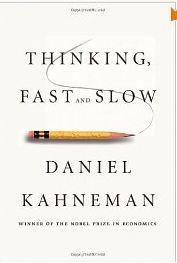
Daniel Kahneman, a Nobel laureate and author of the book, Thinking, Fast and Slow, which examines the two cognitive systems and the role they play in decision-making.

The researchers suggest that people’s intuitive responses are associated with what they have learned to benefit them, through experiences in various situations.

They asked participants if their everyday interactions with others were typically cooperative or uncooperative.
Those who reported having mainly cooperative interactions made quick decisions to contribute more and gave less when they had more time to ponder the scenario.
In contrast, those who reported uncooperative interactions in daily life gave the same amount when they made fast vs more deliberate decisions.

These studies could suggest policies or incentives to encourage desired behavior.
One complication that researchers consider is that a monetary reward or a fine is introduced, people may begin to ignore their first response and weigh the costs and benefits.
This delay can lead to people acting more in self-interest, and less for the common good.

An example of this paradox is seen in a study of Israeli day care programs.
Monetary fines were levied when parents picked up their children late, and the number of parents who arrived late increased rather than decreased.

This finding is consistent with punishment’s lower efficacy in motivating behavior.

-*In which work situations do you favor cooperation with colleagues?
-*When do you find that “enlightened self-interest” is the more prudent approach at work?

LinkedIn Open Group Stanford Social Innovation Review
Twitter: @kathrynwelds
Google+
Facebook Notes:
Blog: – Kathryn Welds | Curated Research and Commentary

©Kathryn Welds

Toys, Books, and Kits Attract Girls to Engineering

The small number of women role models in Science, Technology, Engineering, and Mathematics (STEM) careers is widely recognized.

Debbie Sterling

Debbie Sterling

Debbie Sterling, a Stanford-educated engineer, is among a group of educators and entrepreneurs developing toys, books, games, and kits to attract girls to technical careers.

She introduced books and construction toys for girls centered on a fictional role model, Goldie, in response to her experience of collaborating mostly with men during her studies of product design in Stanford’s mechanical engineering department.

The first book, intended for girls, ages 5 to 9, is called GoldieBlox and the Spinning Machine. Goldie lives in “her engineering house with gears and moving parts everywhere,” five character figurines (including Nacho the dog and Benjamin Cranklin the cranky cat), and a construction toy, featuring a pegboard, wheels, axles, blocks, a crank, a ribbon, and washers.

Goldie creates a “spinning machine” for her dog, who enjoys chasing his tail and yelling out random words in Spanish, by deconstructing a ballerina music box and reverse engineering it. Girls can create their own spinning toys with as they read through the story.

Her next products include books with a pulley system elevator, a parade float, circuits and gears, and an eBook where Goldie learns to code.

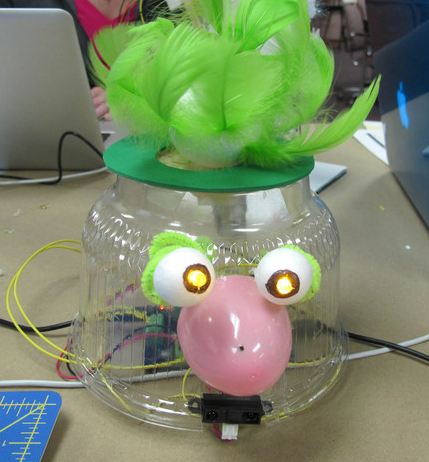
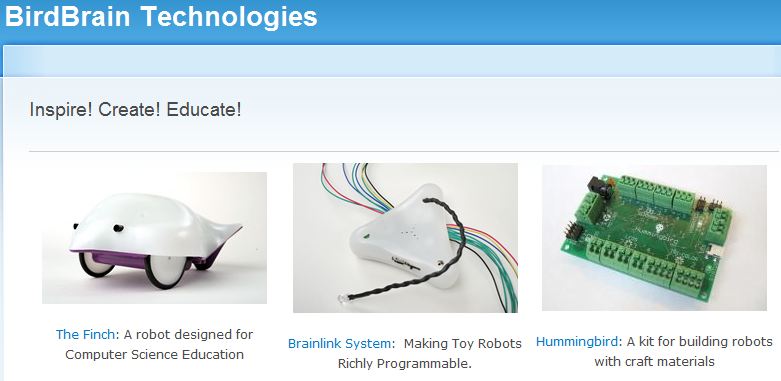
Another product intended to increase girls’ skill and confidence in working with technology is Hummingbird, an educational robotics kit.
Developed at Carnegie Mellon University’s Robotics Institute’s Arts and Bots program, spin-off startup BirdBrain Technologies, showcases robotics with craft materials and text to communicate thoughts, feelings, or ideas.

The kit includes a control board, lights, sensors, and motors.
Students (usually ages 11 and up) program their creations on a computer by dragging and dropping icons, so they don’t have to learn computer languages.

Students have experimented with making a robot from cardboard wrapped in tin foil that can twirl, flash lights, and even impersonate the Star Wars robot, R2D2.
Another project was a dragon made of paper and popsicle sticks that flaps its wings and hisses.
Others crafted a robotic arm with muscles made of cast-off pantyhose.

Pennsylvania students analyzed poetry, then created animated scenes for poems using the kit.
Elsewhere high school students created kinetic sculptures with sensors that detect environmental changes and respond with movement.
Others built a “coin monster” for the school’s ancient coin exhibit.

Emily Hamner

Emily Hamner

Research Associate Emily Hamner and Tom Lauwers, the founder of BirdBrain Technologies conducted workshops to learn girls’ goals and interests in making robots.
They learned that girls are most interested in creating robots that can tell stories, dance, communicate, and interact with people.

Hamner and Lauwers’ goal is to enable young people “to create whatever they can imagine,” to inspire students’ interest in STEM careers, and to increase their “understanding and confidence in using the technology.”

-*What toys and games have you seen increase young people’s interest in Science, Technology, Engineering, and Mathematics activities?

LinkedIn Open Group Women in Technology (sponsored by EMC)
Twitter: @kathrynwelds
Google+
Facebook Notes:
Blog: – Kathryn Welds | Curated Research and Commentary

©Kathryn Welds

Video Games as Cognitive Enhancers

Adam Gazzaley

Neuroscientist Adam Gazzaley of UCSF presents convincing data to suggest that video games can improve cognitive functioning in people of all ages, due to increasing performance based on training and generalization of learning in three limiting areas of:

• Processing speed
• Attention
• Working memory

Training in one skill has been shown in previous research not to generalize to other skills, so Gazzaley’s lab investigated whether training with video games can generalize to improve the brain’s three limitations (above).

His recent work has confirmed this trend, and next studies are intended to monitor generalizability to Activities of Daily Living such as shopping and finding directions.

Training may be strategic, to instruct in “tips” to manage challenging situations, as in occupational therapy or physical therapy or plasticity-based, using repetition, feedback, adaptive adjustment of difficulty based on performance.

Medal of Honor, a first person shooter game, proved more effective than Tetris or crossword puzzles in counteracting the brain’s three limitations (above).

Most effective games are:
• Fast-paced
• Unpredictable
• Engaging, immersive
• Provide feedback
• Adjust difficulty based on performance
• Provide changes to the brain’s three limitations: working memory, attention, processing speed via interference

Cliff Nass

Mastering interference is important because research in Gazzaley’s lab as well as work by Cliff Nass of Stanford, and Daphne Bavelier, University of Rochester, confirm that attention can be impaired by internal intrusions (mind-wandering), intentional multi-tasking (for fun, diversion) or external interference through distraction or interruption (semi-intentional multi-tasking).

Distraction and interruption reduce cognitive performance when people try to multi-task.
These researchers conclude that “multi-tasking is a myth” because “task-switching” occurs instead of simultaneous processing.
They note that task-switching (also important in driving skills) becomes slower with age, but can be improved through training on video games like Neuroracer.

Daphne Bavelier

Bavelier demonstrated that video gamers show improved skills in visual perception (contrast sensitivity, resolve small detail in context of clutter, resolve different levels of threat), attention (retain focus, less distractable).
In addition, these skills can generalize to improvements in other “real-world skills” like spatial cognition.

Skilled gamers’ have efficient neural firings and in different areas of the brain than in less adept individuals, similar to a trend seen among musicians vs non-musicians.
fMRI studies have demonstrated that gamers’ brain structures actually change in brain networks that control attention:

• Parietal cortex – orienting attention
• Frontal lobe – maintaining attention
• Anterior cingulate –allocate, regulate attention, resolve conflicts
Your brains on action games

Games may be recommended for people of all ages to enhance cognition as further research findings add to these trends in the next decade.

Videogames as cognitive neurotherapeutics
Brain – Memory and Multitasking
Exercising Your Brain
Memory and the Aging Brain
The Distracted Mind

-*How have you used game-based training to strengthen your brain functioning?
-*How effective is multi-tasking in your work organization?


©Kathryn Welds

Developing a SMARTER Mindset for Resilience, Emotional Intelligence – Part 2

Carol Dweck

Stanford professor Carol Dweck distilled Salvador Maddi’s three mindsets into two mindsets in her book, Mindset: The New Psychology of Success.

She differentiated:
• Fixed Mindset – Belief that personal capabilities are given, fixed, limited to present capacities.
This “nature” mindset can lead to fear, anxiety, protectiveness and guardedness.
• Growth Mindset– Belief that personal capabilities can expand based on commitment, effort, practice, instruction, confronting and correcting mistakes. This “nurture” mindset enables teamwork and collaboration.
K. Anders Ericcson

K. Anders Ericcson

Research by K. Anders Ericsson demonstrated that highly skilled experts in nearly every field are distinguished from their talented peers by practice.
Similarly, Malcolm Gladwell asserted that expert performance comes after 10,000 hours of practice.

The Road to Excellence: The Acquisition of Expert Performance in the Arts and Sciences, Sports, and Games

Expert Performance in Sports: Advances in Research on Sport Expertise

Although mindsets consist of relatively stable beliefs, they can be modified by reinforcing, praising, and rewarding performance strategy and process, not the resulting outcome.

Cynthia Kivland

Cynthia Kivland

Cynthia Kivland introduced a practice of “vetting emotions” using a three step process to investigate and manage emotions

• Validate – Name the emotion
• Explore – What is the broader context?
What are the familiar reaction patterns?
• Tolerate – Transform limiting emotions into information and intelligence to move forward

“Cognitive appraisal” refers to evaluative elements of thoughts, and can provoke emotions.
This type of appraisal is based on three factors, outlined by eminent researcher

Martin Seligman

Martin Seligman

Martin Seligman in his book, Learned Optimism: How to Change Your Mind and Your Life

• Personalization of cause, responsibility: Internal control vs External control
• Pervasiveness of event and impact: Specific vs Global
• Permanence of event and impact: Temporary vs. Continuing

Kivland suggested that mindsets and related attitudes can direct individuals to either of two paths:

• Surviving Path, based on reactive, fearful protecting from anticipated danger

• Hope Path, proactive, thriving, growing, able to let go of fears, observe emotions as information for decision-making rather than as unpleasant experiences to be tolerated

Kivland, Dweck, Maddi, Ericcson, Seligman, and other advocates of Emotional Intelligence practices suggest benefits of the Hope Path.

Dweck model and the mindset of positive psychology

Dweck’s Brainology software for students

Related Post:
Developing a SMARTER Mindset to increase Resilience, Emotional Intelligence – Part 1

-*What “mindsets” help you achieve optimal performance in work and life activities?

©Kathryn Welds