Monthly Archives: December 2015

Confidence Enables Persistence Enables Performance

Brian J. Lucas

Brian J. Lucas

People consistently underestimated the number of creative ideas they could generate if they continued working on a task, particularly on subjectively difficult innovation challenges, found Northwestern’s Brian J. Lucas and Loran F. Nordgren.

Loran Nordgren

Loran Nordgren

People who were undaunted by difficult tasks were more able to persist in developing novel ideas, and their work produced both more ideas and higher quality of innovations than they predicted.
This research suggests the benefits of “grit”, described by University of Pennsylvania’s Angela Duckworth as perseverance and passion for goals, particularly long-term objectives.

Angela Duckworth

Angela Duckworth

In Lucas and Nordgren’s research, more than 20 volunteers had 10 minutes to generate as many original ideas as possible for things to eat or drink at a U.S. Thanksgiving dinner.
Then, external judges evaluated responses for originality and suggestions rated “above average” were eligible to win a $50 lottery.

Volunteers took a break from idea generating, and estimated the number of ideas they expected to generate with another 10 minutes’ effort before they continued the idea development task.
External raters judged ideas developed in the second work phase as significantly more original than those in the initial session.

Screen Shot 2015-10-05 at 5.14.56 PMThese results were replicated with professional comedy performers from SketchFest, the largest sketch comedy festival in the U.S.
Performers received a comedic scene set-up such as “Four people are laughing hysterically onstage. Two them high five, and everyone stops laughing immediately and someone says….”

Their task was to create as many endings as they could during four minutes and to
predict the number of endings they would develop with during an additional four minutes work time.

These professional comedians also significantly underestimated the number of ideas they would develop with on their second attempt, suggesting persistent undervaluation even among experts.
When a task seems challenging, “people decrease their expectations about how well they will perform,” argued Lucas and Norgren, even though “creative thought is a trial-and-error process that generally produces a series of failed associations before a creative solution emerges.”
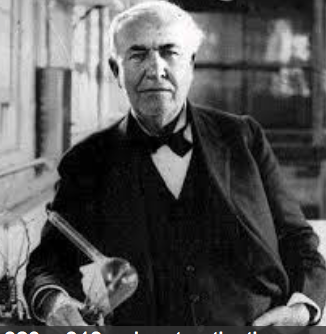
Thomas Edison

Thomas Edison

These findings indicate that negative expectations can reduce persistence, leading to performance below potential.
They confirm Thomas Edison’s assertion that “Our greatest weakness lies in giving up. The most certain way to success is always to try just one more time.”

This effect was also demonstrated in comparisons of people’s numeric competency including:

  • Objective numeracy, or ability to work with numbers: “If the chance of getting a disease is 10 percent, how many people would be expected to get the disease out of 1000?
  • Subjective numeracy, a self-evaluation of math abilities: “How good are you at working with percentages?”;
    How often do you find numerical information to be useful?
  • Symbolic-number mapping abilities, or predicting and understanding numeric relationships such as a carpenter estimating the amount of wood needed for a project.
Ellen J. Peters

Ellen J. Peters

More than 110 volunteers completed tasks including remembering numbers paired to different objects, then evaluating bets based on risk.
People lower in subjective numeracy and confidence had more negative emotional reactions to numbers and were less motivated and confident in numeric tasks, reported Ohio State’s Ellen Peters with Pär Bjälkebring of University of Gothenburg.

Pär Bjälkebring

Pär Bjälkebring

This negative reaction to quantitative tasks presents significant challenges for those who still need to complete tasks like preparing annual personal income tax forms and expense reimbursement reports.

These studies replicated findings that people are not the best judges of their own skills: In fact, one in five people who said they were not good at math actually scored in the top half of an objective math test.

David Dunning

David Dunning

Conversely, one-third of people who said they were good at math actually scored in the bottom half, validating the Dunning-Kruger effect when incompetent individuals overestimating performance despite feedback.

Justin Kruger

Justin Kruger

Persistence in creative as well as tactical tasks can lead to more plentiful and higher quality results than abandoning difficult efforts.

-*How do you maintain persistence during challenging tasks?
-*How do you verify that your self-perceptions align with actual performance and other’s perceptions?

Follow-share-like http://www.kathrynwelds.com and @kathrynwelds

Related Posts:

Twitter:  @kathrynwelds
Google+
LinkedIn Groups Psychology in Human Resources (Organisational Psychology)
Facebook
Blog: – Kathryn Welds | Curated Research and Commentary

©Kathryn Welds

Does Music Increase Risk-Taking, Ethical Lapses?

John DrydenJohn Dryden

John Dryden

What passion cannot Music raise and quell?” asked English poet, playwright, and critic John Dryden in A Song for St. Cecilia’s Day, 1687.

More recently, researchers have identified that music can increase risk-taking and ethically questionable behaviors in experimental settings.

Marja-Liisa Halko

Marja-Liisa Halko

Listening to preferred music was associated with increased risk-taking in a study of 23 adolescents ages 12 to 17 conducted by University of Helsinki’s Marja-Liisa Halko and Markku Kaustia of Aalto University.
Participants identified favorite and most disliked songs, and these tracks provided alternating background music during 16 opportunities to gamble for real money in trials with varying risk.

Volunteers could choose whether to participate or pass on gambles that offered a 50-50 chance to win or lose money.
If they accepted a gamble marked “plus 1.50, minus 1.20,” they had a 50 percent chance of winning 1.5 Euros, and a 50 percent chance of losing 1.2 Euros.
Preferred music was played during 64 gambles, whereas disliked music provided the auditory background during 64 other trials, and another 128 gambles were conducted in silence.

Markku Kaustia

Markku Kaustia

Participants accepted more risky gambles when their favorite music played, and they accepted fewest high risk gambles when accompanied by disliked tunes. These findings suggest that preferred music increases money’s “marginal utility” or additional satisfaction a consumer gains from “consuming one more unit of a good or service.”

Favorite music seemed to encourage people to “do what it takes” to earn more money, even if it involves greater risk and potential loss.

Naomi Ziv

Naomi Ziv

Many people prefer up-tempo music due to its mood-enhancing effects, yet upbeat music may have a darker side:  It can move people to harm others, found NYU’s Naomi Ziv.

More than 100 volunteers spent 90 seconds trying to underline all vowels in an unclear photocopied page of text.
One-quarter of the participants completed the task in silence, while the others heard one of four upbeat musical numbers, including James Brown’s I Feel Good while they finished the job.

Erica Nadera

Erica Nadera

Ziv’s team asked volunteers to inconvenience and disappoint their peers by telling saying that other volunteers couldn’t participate in a study required for academic credit because the researcher didn’t feel like staying during the experiment.

In another study, Ziv’s team asked voluntary participants to tell another volunteer who had been seriously ill that the researcher would not provide previously-promised course material, again because the researcher didn’t feel like doing so.

Steven Brown

Steven Brown

People who heard upbeat music played in the background were significantly more willing to provide the ethically dubious excuse to another volunteer compared with people who completed the task in silence.

Ulrik Volgsten

Ulrik Volgsten

Effective manipulation through music, including its use in advertising and in torture were summarized by Erica Nadera of Rutgers, while MacMaster University’s Steven Brown and Ulrik Volgsten of Örebro University assembled academic articles on music’s social uses and social control processes.

Daniel Västfjäll

Daniel Västfjäll

The specific mechanism to trigger changes in individuals’ experienced affective processes has been called including “musical mood induction procedure” (MMIP) by Linköping University’s Daniel Västfjäll in his review of research demonstrating music’ effect on peoples’ moods and emotions.

Emmett Velten

Emmett Velten

The most frequently-used mood induction procedure was developed by University of Southern California’s Emmett Velten and typically asks participants to read 60 self-referent statements including “This is great, I really do feel good” (elated condition), “I have too many bad things in my life” (depressed condition), and  “This book or any part thereof must not be reproduced in any form” (neutral condition).

However, this approach’s validity and reliability are limited by demand characteristics biasing results because the experimenters’ expectations suggest an implicit demand for specific performance requirements.

David M Clark

David M Clark

As a result, University of Oxford’s David M. Clark developed the Musical MIP eliciting depressed, neutral, and elated mood conditions based on music, and University of Oxford colleague Maryanne Martin noted that the MMIP induced the desired mood more than 75% of experimental trials.

She also concluded that the MMIP was especially efficient in inducing depressed and anxious moods, but inferior to other MIPs (such as Welten’s mood-induction procedure, social feedback, and social recollection) in inducing elated moods

Music’s varied impact on mood, performance, decision-making, pain perception, endurance and other dimensions is discussed in related blog posts, as is its use for beneficial and these less altruistic ends.

-*How do you use music to manage your own and others’ mood and productivity?

Follow-share-like http://www.kathrynwelds.com and @kathrynwelds

Related Posts:

Twitter:  @kathrynwelds
Google+LinkedIn Groups Psychology in Human Resources (Organisational Psychology)
Facebook
Blog: – Kathryn Welds | Curated Research and Commentary

©Kathryn Welds

Collaboration Can Encourage Corruption, Lying

Damon Jones

Damon Jones

Many corporations encourage collaboration and make it part of culture statements and annual performance reviews.
Cisco Systems, for example, defined collaboration as “working across boundaries, building teams, managing conflict, earning trust, and recognizing good performance,” part of the CLEAD performance management and development system.

Mark Greenberg

Mark Greenberg

Ability to collaborate develops in childhood and is associated with positive life outcomes, demonstrated in a two decade longitudinal study of more than 750 Americans from kindergarten into adulthood by Penn State’s Damon Jones, Mark Greenberg and Daniel Max Crowley.

Daniel Max Crowley

Daniel Max Crowley

They found that kindergartners whose teachers rated them highly on social competence dimensions including:

Ori Weisel

Ori Weisel

Although collaborative settings may boost honesty due to increased observability, accountability, University of Nottingham’s Ori Weisel and Shaul Shalvi of Ben-Gurion University of the Negev showed that collaboration among equals can trigger corruption by lying, misreporting, and exaggerating performance.

Shaul Shalvi

Shaul Shalvi

They experimentally evaluated performance between 280 partners on a die rolling task for which they earned cash.
Player A privately rolled a die and reported the result to player B, who then privately rolled and reported the result.
Both players were paid only if they both reported the same results — for example, if both reported rolling “6”, each earned €6.

Robert S Feldman

Robert S Feldman

Players tended to inflate potential profit by misreporting actual outcomes, demonstrated by the proportion of reported matches.
The probability of rolling the same number in each round was one in six, or an average of 3.33 times in 20 rounds.
However, teams reported an average of 16.3 matches—nearly five times the expected number, demonstrating likely misrepresentation to achieve financial payoff.

Participants also lied even when they did not benefit, provided their partner benefitted.
Wiesel and Shalvi explained that “people are willing to pay the moral cost of lying even if they don’t stand to get any material benefit—the only benefit is the joy of collaboration.

Paul Ekman

Paul Ekman

When partners’ payoffs were not aligned, they were less likely to inaccurately report performance.
This finding suggests that participants were more likely to engage in “corrupt collaboration” when lying was financially advantageous to themselves and their partners.

Lying, one component of “corrupt collaboration,” occurs many times each day, according to University of Massachusetts’ Robert Feldman.
In fact, he found that two people getting acquainted lied an average of three times in ten minutes.

James Tyler

James Tyler

However, lying may not be detected in collaborative situations.
Feldman asserts that “no single or even combination of verbal or nonverbal behaviors accurately indicate when a person is lying… Most people have no better than a coin-flip chance of telling a lie from the truth….And many of the cues we think are associated with lying are unrelated to deception.”
This view is more pessimistic than  Paul Ekman’s contention that lying can be detected.

Andreas Reichert

Andreas Reichert

Besides being potentially difficult to detect in collaborative situations, lying can be contagious.
For example, volunteers were more likely to engage in their own deceptive behavior toward others as a result of being duped, in research by Purdue’s James M. Tyler, Robert S. Feldman of University of Massachusetts with Andreas Reichert of University of Konstanz.

Greg Willard

Greg Willard

Corrupt collaboration practices like lying may persist due to financial and other benefits.
In fact, people who lie also demonstrated more confidence, higher  achievement goals, positive affect, and composure during a stressful mock job interview scenario by Harvard’s Greg Willard and Richard Gramzow of Syracuse University.

However, when liars knew that their embellishments would be verified, their performance – and their prevarications – were reduced over time.
This finding suggests that visible monitoring seem to curb the potential downsides of collaboration in the workplace.

Richard Gramzow

Richard Gramzow

Despite collaboration’s purported positive effects on innovation, this teamwork approach can be accompanied by a side effect of enabling willful and reckless “corruption”, lying, and exaggeration.
However, this darker side of collaboration can be reduced by verifying the trust instilled in others.

-*How have you maximized the benefit of collaboration and team work while reducing the likelihood of developing “corrupt collaboration”?

Follow-share-like http://www.kathrynwelds.com and @kathrynwelds

Related Posts:

 Twitter: @kathrynwelds
Google+
LinkedIn Groups Psychology in Human Resources (Organisational Psychology)
Facebook

Blog: – Kathryn Welds | Curated Research and Commentary

©Kathryn Welds