
Professional advancement requires demonstrated knowledge, skill, and competence, coupled with perceived “cultural fit,” “collaboration,” and “executive presence.”

Sylvia Ann Hewlett
These requirements appear prone to subjective definition and biased judgments.
What is “executive presence”? How is it measured?
Sylvia Ann Hewlett, CEO of Center for Talent Innovation, conducted 18 focus groups and 60 interviews to investigate behavioral and attitudinal aspects of Executive Presence (EP).
Perceived Executive Presence includes three components: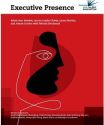
“Gravitas” – Authoritative Behavior
-
- Confidence, composure,
- Decisiveness,
- Integrity,
- Emotional Intelligence: Self-awareness, self-regulation, interpersonal skills,
- Personal reputation,
- Vision for leadership,
Communication
-
- Speaking skills: Voice tone, articulation, grammatical speech conveying competence,
- “Presence,” “bearing,” “charisma” including assertiveness, humour, humility,
- Ability to sense audience engagement, emotion, interests,
Appearance
-
- Grooming, posture,
- Physical attractiveness, average body weight,
- Professional attire.
According to Hewlett’s interviewees, “Executive Presence” accounts for more than a quarter of factors that determine a next promotion.

Harrison Monarth
How can Executive Presence be developed?
Harrison Monarth suggested that Executive Presence behaviours can be cultivated with Image Management tactics including:
-Maintaining a positive personal reputation to influence others’ favourable perceptions and willingness to collaborate,
-Effectively managing online “brand”,
-Gaining followers online and in the “real world,”
-Influencing and persuading others,
-Demonstrating “Emotional Intelligence” through self-awareness, awareness of others (empathic insight), and regulating one’s own emotions.
He focused less on appearance than Hewlett and Stanford Law School’s Deborah Rhode, who summarized extensive research on Halo Effect and “The Beauty Bias”.

Deborah Rhode
Rhode estimated that annual world-wide investment in appearance was close to $USD 200 billion in 2010.
She contended that bias based on appearance influences career and life outcomes and is:
- Is prevalent,
- Infringes on individuals’ fundamental rights,
- Compromises merit principles,
- Reinforces negative stereotypes,
- Compounds disadvantages facing members of non-dominant races, classes, and gender.
Executive Presence is widely recognized as a prerequisite for leadership roles, yet its components remained loosely-defined until Hewlett’s investigation and Rhode’s human rights analysis.
-*Which elements seem most essential to Executive Presence?
See related posts
- Powerful Non-Verbal Behavior May Have More Impact Than a Good Argument
- Authoritative Non-Verbal Communication for Women in the Workplace
- When Appearance Matters for Career Development
- Developing “Charisma” and “Presence”
- Non-Verbal Behaviors that Signal “Charisma”
©Kathryn Welds


 Kathryn Welds, PhD | Curated Research + Commentary