Category Archives: Career Development

Career Development

Harvard B-School Women “Lean Out” of the Workforce?

First HBS Women

First HBS Women

Women were first admitted to Harvard Business School in 1963, and 50 years later, women are not 50% of the students at HBS.
They trail at 42% for the currently-admitted class, up from the 40% at the time of this survey.

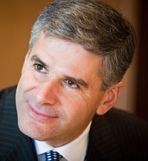
Robin Ely

Robin Ely

Robin Ely of Harvard conducted a survey of of 3,786 women and 2,655 men HBS graduates and found that more than 70% of alumnae are in the paid workforce, and 56% work full time.

Of the 10% of alumnae ages 31 to 47 who “lean out” to care for children full time, only 3% said they planned not to return to return.

HBS 50Ely argues that rather than leaning out, women are actually pushed out or pulled out of the workforce:

“…a whole set of experiences … look less like women opting out, and more like women being pushed out, by organizations that demand a 24/7 work schedule…Women are being pulled out by a culture that promulgates a compelling—some might say guilt-inducing—image of mothering that is hard to live up to while you are trying to hold a job.”

Among women working part-time, three-fourths are engaged in pro bono and volunteer efforts, suggesting that these women continue to have demanding schedules.
More than 63% of the women report regular or significant volunteer commitments, with 67% of those caring for children full-time reporting substantial volunteer activity.

HBS WomenYounger women with two or more children are less likely to be in the workforce than those with no children: 37% for parents vs 9% for the non-parents.

And among the younger cohort of Gen X’ers, 13% of women are working part-time, contrasted with 2% of Gen X men.

At the other end of the age-experience spectrum, another type of “age-approriate opting out” was reported by 43% of female graduates ages 48-66 no longer working full-time.
In contrast, only 28% of men in the same age range were not longer employed, reinforcing previous findings that men work both more hours per year and more years over their careers, leading to higher overall career earnings.

More than 84% of female respondents acknowledged “taking leaves or reducing work hours” hold back women from career advancement.

HBS RestroomThe second most-cited impediment to career advancement for women was “prioritizing family over work,” according to 82% of the female respondents.

Most alumnae reported organizational factors limit women’s advancement:

  • Lack of senior female role models
  • Inhospitable corporate cultures
  • Lack of supportive environments

Fewer than half of the women under the age of 67 report being satisfied with their professional accomplishments or opportunities for career growth.
In contrast, the majority of men agree that their work is meaningful and satisfying.

Drew Gilpin Faust

Drew Gilpin Faust

Harvard’s President Drew Gilpin Faust noted that, women are not equally represented in top leadership roles, echoing statistics showcased by HBS grad Sheryl Sandberg.
She share that women:

  • Comprise 4 percent of Fortune 500 Company CEOs
  • Lead fewer than 10 percent of America’s venture capital firms
  • Hold 26 percent of US full professorships
  • Serve in 20 percent of top US government jobs
Sheryl Sandberg

Sheryl Sandberg

Ely believes that organizations, women, and families will benefit from recruiting and hiring women who have opted out of full-time work but now want to resume their careers, because today’s graduates can expect to live nearly a century.

This change in hiring practices can increase use of top talent while reducing the substantial regret and dissatisfaction many HBS women experienced in their career trajectories.

As one highly-educated, highly-skilled women reflected on her sense of under-utilization and under-employment in a large global organization: “I don’t want to have to go home and vacuum to feel like I’ve accomplished something.”

Organizational policy can increase firms’ profitability, competitiveness, and innovation by deploying top talent across generations and genders, and this HBS study points to one source of potential talent.

-*What actions should individual women and organizations implement to increase the utilization of skilled women’s talents in the workplace?

Related Post

Women’s Post-Business School Work-Life Issues

Twitter:  @kathrynwelds
Blog: Kathryn Welds |Curated Research and Commentary
Google+:
LinkedIn Open Group Psychology in Human Resources (Organisational Psychology)
Facebook Notes: 

©Kathryn Welds

Productivity and Work Motivation Affected by Meaning, Challenge, Mastery, Ownership

Small gestures and verbalizations by managers and organizations can have a large impact on employee productivity, motivation, engagement, and retention – for better or worse.

Dan Ariely

Dan Ariely

Dan Ariely’s research at Duke University showed the small changes in task design dramatically increase or diminish persistence, satisfaction, and commitment to tasks.

The good news is that by simply looking at something that somebody has done, scanning it and saying ‘uh huh,’ [you] dramatically improve people’s motivations…. The bad news is that ignoring the performance of people is almost as bad as shredding their effort in front of their eyes. …,” according to Ariely.

Ariely’s lab experiments found that volunteers valued and liked their work product more when they worked hard and managed obstacles to produce it.
In addition, most people believed, often inaccurately, that other observers shared their positive view of their work product,

His research concluded that people seek meaning, challenge, and ownership in their work, and that these elements can increase work motivation and persistence.

Viktor Frankl

Viktor Frankl

Holocaust survivor and psychiatrist Viktor Frankel articulated this existential perspective in his examination of the critical role that meaning played in the enabling survivors of concentration camp prisoners in Man’s Search for Meaning.

In the less extreme circumstances of the workplace, finding and assigning meaning to work efforts enables people to persist in complex tasks to achieve satisfaction in mastering challenges.

Rosabeth Moss Kanter

Rosabeth Moss Kanter

Harvard’s Rosabeth Moss Kanter concurred that both meaning and mastery are productivity drivers, and to these she added a social dimension, membership, and a distant runner-up, money.

Frederick Herzberg

Frederick Herzberg

In contrast, one of the early though leaders in business management, psychologist Frederick Herzberg, developed a classic formulation of motivational factors contrasted with “hygiene factors.”

Frederick Herzberg - Motivation-Hygiene factorsHis two-factor theory of motivation did not include meaning or money as driving job satisfaction or productivity.

Shawn Achor, formerly of Harvard, argues that happiness is the most important work productivity lever.

Shawn Achor

Shawn Achor

To support his contention, he cited research findings that happy workforces increase an organization’s sales by 37 percent, productivity by 31 percent and accuracy on tasks by 19 percent.

Whether you work for mainly for meaning, money, or other motivations, you may agree that an ideal workplace and manager would foster all of these contributors to employee engagement and productivity.

-*What is the most important work motivator for you?
-*How have you seen managers increase employee engagement and performance through words and actions?

Related Posts

Twitter:  @kathrynwelds
Blog |Kathryn Welds| Curated Research and Commentary
Google+:
LinkedIn Open Group Psychology in Human Resources (Organisational Psychology)
Facebook Notes:

©Kathryn Welds

Interpersonal Envy in Competitive Organizations

Workplace envy is rarely discussed, although it is a logical outcome of competition for scarce resources:  Recognition, advancement, power, reputation, compensation in explicit or implicit organizational “tournaments.”

Jayanth Narayanan

Jayanth Narayanan

National University of Singapore’s Jayanth Narayanan, Kenneth Tai, and Daniel McAllister broached the near-taboo of workplace envy as an inevitable outgrowth of social comparison and related “cognitive dissonance” in attempting to self-regulate or return to emotional and equity “homeostasis.”

Daniel McAllister

Daniel McAllister

They differentiated malicious envy from benign envy and argue that the latter can drive performance through emulating admired outcomes.

This process, called firgun in Hebrew, is characterized by happiness, envy, and support of others, and is positively related to organizational success.
Mudita in Buddhist texts, refers to similar feelings of vicarious joy at another’s success and good fortune.

Hidehiko Takahashi

Hidehiko Takahashi

Narayan and team posit that envy is pain at another’s good fortune, and Hidehiko Takahashi’s team at Japan’s National Institute of Radiological Sciences demonstrated that the social-emotional pain of envy is a variation of the physical pain experience.

Their fMRI study found that the emotional pain of workplace envy is physically manifested in activation of the brain’s anterior cingulate cortex.

Nathan DeWall

Nathan DeWall

As such, Nathan DeWall of University of Kentucky and colleagues reported that Tylenol™ reduces behavioral and neural responses associated with social pain in two fMRI studies.

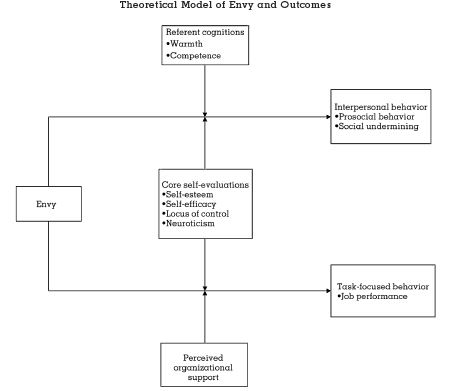
Narayanan argues that envy exerts its differential effect on workplace behavior through each individual’s specific:

  • Core self-evaluations (self-esteem, self-efficacy, locus of control, and neuroticism),
  • Referent cognitions” regarding warmth, likeability, and competence of the envied  person
  • Perceived organizational support

Workplace envy, they argue, can affect:

  • Social undermining
  • Prosocial behavior
  • Job performance

Narayanan and team proposed that those with higher self-esteem are less prone to negative workplace behaviors when experiencing on-the-job envy.

They propose that people are less likely to socially undermine the envied individual when the envied person is viewed as both warm-likeable and competent.

Similarly, they suggest that people who think their organization values them and their work, and supports their work and career development efforts are less likely to decrease job performance when envious at work.

Chade-Meng Tan

Chade-Meng Tan

Search Inside YourselfGoogle’s Jolly Good Fellow ChadeMeng Tan proposes the mindfulness-based program “Search Inside Yourself” (SIY) as a way to self-manage workplace envy and other painful social experiences, by developing skills in:

  • Trained attention
  • Self-knowledge and self-mastery
  • Creating useful mental habits.

-*How do you manage workplace envy when you notice it in yourself or others?

RELATED POSTS:

©Kathryn Welds

Gender Differences and Diversity in Corporate Interaction Styles, Financial Outcomes

Gender makes a difference in interaction styles on corporate boards, and the ratio of women to men on these boards is linked to corporate financial performance.

Interaction Styles

Gregory McQueen

Gregory McQueen

Chris Bart

Chris Bart

McMaster University’s Chris Bart and Gregory McQueen of Western University of Health Sciences surveyed 600 board directors (75% male) and found that men tended to base corporate decisions on tradition, rules, and regulations, whereas women tended to ask questions to develop more solution options, cooperate, and consider the interests of all stakeholders.

Nanette Fondas

Nanette Fondas

Nanette Fondas, then of Duke University, and Susan Sassalos, now of Edison International found that women on corporate boards influence other board members to act more “civilized” and “sensitive to other perspectives.”

Val Singh

Val Singh

In the same vein, Cranfield University’s Val Singh reported that women on corporate boards also reduce ‘game playing’ among board members.

Siri Terjesen

Siri Terjesen

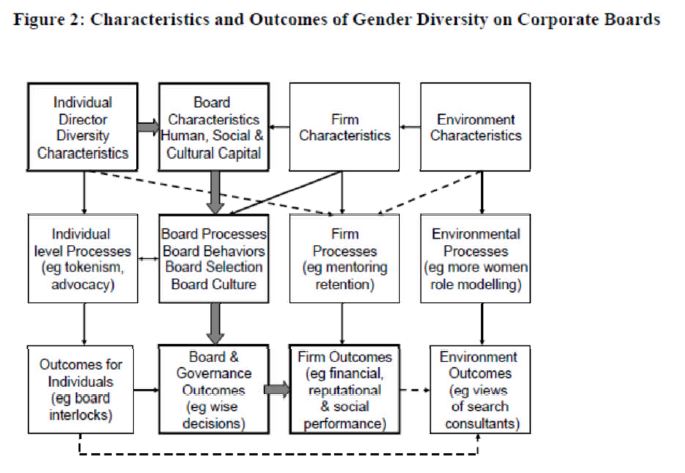
With Siri Terjesen of Indiana University and Cranfield University’s Ruth Sealy, Singh evaluated existing research on corporate board gender diversity to develop a model of analysis by:Val Singh - Gender Diversity on Corporate Boards Model

  • Individual
  • Board
  • Firm
  • Industry and Environment

Financial Performance:

Nancy Carter

Nancy Carter

Catalyst’s Nancy Carter and Lois Joy with Harvey Wagner of University of North Carolina and Michigan State University’s Sriram Narayanan found that Fortune 500 boards with 3 or more women report:

Harvey Wagner

Harvey Wagner

compared to boards with more men.

Nick Wilson

Nick Wilson

Nick Wilson and Ali Altanlar of Leeds University added another financial indicator affected by gender ratios on boards.

Ali Altanlar

Ali Altanlar

In their analysis of 17,000 UK companies that went insolvent in 2008, Wilson and Altanlar reported even one female board director reduces bankruptcy risk by 20%.

Pepperdine University’s Roy D. Adler studied 200 companies among the Fortune 500 to mine data from 1980 through 2001 and reported results consistent with the Catalyst investigation.

Roy Adler

Roy Adler

Adler and team identified the firms that had a record of promoting women to high levels and compared their profit performance to the median performance of Fortune 500 firms in the same industries.

The researchers separately compared profits as a percentage of sales, of revenues and of assets and found that for 2001, the 25 firms with the strongest record of promoting women to high organizational levels outperformed the industry medians with:

  • 34 percent higher revenue
  • 18 percent higher assets
  • 69 percent higher equity.

The 10 firms with the very best records of promoting women showed greater profits than competitors, and results were confirmed in subsequent studies in 2004 through 2008.
Adler and team noted that the odds of all 18 financial measures favoring women are 262,114 to 1, suggesting that these findings were not random errors.

Cristian Dezso

Cristian Dezso

Likewise, University of Maryland’s Cristian Dezső and David Ross of Columbia University found that companies with one or more women in top management  close to CXO level perform better than other companies, based on their assessment of the largest 1,500 public US companies from 1992 to 2006.

Sheryl Sandberg

Sheryl Sandberg

Sheryl Sandberg isn’t the only one to ask “Why so few?” in corporate and government leadership roles, particularly when these results consistently point to the financial benefits of more women in top decision-making roles.

AAUW

AAUW

American Association of University Women asked the same question about women in Science, Technology, Engineering, and Mathematics roles, and concluded that there remains a large gap in equal gender representation in leadership roles and in technical careers – and this discrepancy comes at the price of financial performance and organizational climate.

  • Where have you observed work group interaction differences depending on the ratio of women?
  • What financial impacts have you observed for organizations with women in top leadership roles?
    Level of Analysis Model

RELATED POSTS:

Twitter: @kathrynwelds
Google+
Blog
: – Kathryn Welds | Curated Research and Commentary 
LinkedIn Open Group Psychology in Human Resources (Organisational Psychology)
Facebook Notes:

©Kathryn Welds

What is Your Signature Story in Behavioral Interviews?

Behavioral interviews require advance preparation for both the interviewer and the job applicant, in contrast to the frequently unplanned volley of unstructured Q&A intended to assess candidate fit and potential effectiveness in a work role.

Tom Janz

Tom Janz

Behavioral Interviews, developed by Tom Janz, now Chief Scientist at peopleassessments.com, ask job candidates to provide examples of past behaviors in specific situations deemed relevant to the target role.

The questions are typically framed as an invitation to tell a story about a situation, a challenge, the candidate’s action or solution, and the outcome:

  • Give an example of an occasion when you used logic to solve a problem
  • Think of a goal you reached and tell me how you achieved it
  • Describe a decision you made that was unpopular and how you implemented it
  • Tell me about a time you went “above and beyond the call of duty
  • When was the last time you handled interruptions to your schedule?  How did you do it?
  • When and how did you convince a team to work on a project they didn’t like?
  • Provide an example of handling a difficult situation with a co-worker
  • Tell me about how you worked effectively under pressure

Sometimes the questions are structured to explicitly request that the candidate reply in the “STAR” format:

  • Situation
  • Task
  • Action
  • Results

Candidates increase odds of memorably and skillfully conveying relevant qualifications by preparing “Signature Stories” – theirs alone – to demonstrate how they resourcefully and innovatively:

  • Solved challenging problems
  • Improved strained work relationships
  • Met deadlines and budget
  • Applied “Lessons Learned”
  • Initiated transformational change
  • Demonstrated courage and integrity
Gary Oliphant

Gary Oliphant

Besides being noticed and remembered, signature stories told in behavioral interviews can help both the candidate and interviewer evaluate whether the fit between the role requirements and the candidate’s skills would likely lead to strong future performance.

Becky Oliphant

Becky Oliphant

Evidence for the predictive validity of signature stories told in behavioral interviews was provided by Gary Oliphant and Becky Oliphant of Stetson University with Katharine Hansen of quintcareers.com in their evaluation of 10 Gallup Organization “Life Themes” relevant to loan sales.
From these signature stories, the researchers accurately predicted post-hire performance and retention at a large financial sales organization.

Katharine Hansen

Katharine Hansen

Stories are 22 times more memorable than facts or figures alone,” contends Jennifer Aaker of Stanford, and she offers four elements that increase the impact of signature stories:

  • Goal: Defines a clear purpose and Call to Action, conveying what the listener should think, feel, do
  • Interest: Attracts focused attention by using a “hook” of surprising truth, visual effect, unusual problem-solving approach
  • Caring: Establishes empathic emotional connection with the storyteller’s challenge and journey to reach a meaningful goal
  • Memorable: Makes the story compelling, unforgettable, “re-tellable” and worth “going viral.”
Jennifer Aaker

Jennifer Aaker

Aaker suggests testing stories by asking others to what extent the story:

  • Changed the listener’s perspective
  • Resonated with the listener’s experiences, values, interests
  • Delivered “Moments of insight”
  • Had incomprehensible, inconsistent, or disjointed parts

She says that the mark of an effective “signature story” is that “others look at you differently” and the story moves you closer to a goal.

-*How do you craft dramatic, memorable Signature Stories to illustrate your values and capabilities?

RELATED POSTS:

Twitter:  @kathrynwelds
Google+:
Blog: – Kathryn Welds | Curated Research and Commentary 
LinkedIn Open Group Psychology in Human Resources (Organisational Psychology)
Facebook Notes:

©Kathryn Welds

Is Optimistic View of the Future Associated with Disabilities, Shorter Life Expectancy?

Frieder Lang

Frieder Lang

Frieder Lang of the University of Erlangen-Nuremberg and German Institute for Economic Research and his colleagues challenged the robust, replicated finding that optimism is associated with positive health outcomes.

David Weiss

David Weiss

Lang with University of Zurich’s David Weiss and Denis Gerstorf of Humboldt-University of Berlin and German Institute for Economic Research examined data from 1993 to 2003  German Socio-Economic Panel household surveys.

Denis Gerstorf

Denis Gerstorf

The team collaborated with Gert Wagner of German Institute for Economic Research and Max Planck Institute for Human Development evaluated approximately ratings from 40,000 people 18 to 96 years old, concerning their current and predicted life satisfaction in five years.

Gert Wagner

Gert Wagner

Their disruptive finding is that participants who expected highest life satisfaction in five years were more likely to experience disability and death within the following decade.

Five years after the first interviews:

  • 43 percent of participants were more satisfied with their lives than predicted,
  • 25 percent predicted accurately
  • 32 percent overestimated their life satisfaction with an optimistic bias.

Lang, Weiss, Gerstorf, and Wagner calculated that overestimating future life satisfaction was related to a 9.5 percent increase in reporting disabilities and a 10 percent increased incidence of death.

The youngest participants had the most optimistic outlook, whereas middle-aged adults made the most accurate predictions, but became more pessimistic over time.

Lauren Alloy

Lauren Alloy

Older adults’ predictions of future life satisfaction may be more accurate, albeit less optimistic, consistent with Shelley Taylor, Ellen Langer, Lauren Alloy, Lyn Abramson and others demonstration of an “optimism bias” and “depressive realism.”

Lyn Abramson

Lyn Abramson

In contrast to findings that higher income is associated with better health outcomes, Lang’s team found that stable, good health and income were associated with expecting a greater decline compared with those in poor health or with low incomes.
In contrast to other findings, higher income was related to a greater risk of disability.

Shelley Taylor

Shelley Taylor

Lang and team concluded that the outcomes of optimistic, accurate or pessimistic forecasts may depend on age, available resources, and motivation to adopt health-improving behaviors.
They acknowledged that unrealistic optimism about the future may help people feel better when they are facing inevitable negative outcomes, such as terminal disease.

Neil Weinstein

Neil Weinstein

Similarly, Neil Weinstein of Rutgers found that people may underestimate susceptibility to harm from a variety of hazards.
Close to 300 volunteers across age, gender, educational levels and occupational groups, demonstrated an optimism bias that they were less at risk than peers.

Weinstein hypothesized that optimism bias may be introduced when people extrapolate from their past experience to estimate their future vulnerability.
Therefore, volunteers future expectations may be biased  because they tended not to expect problems they had not already experienced.

He demonstrated that these personal risk judgments were not correlated with volunteers’ actual objective risk factors, suggesting that volunteers did not modify their optimistic biases based on laboratory findings, physical examination, and reported health habits.
Positive illusions persist even in the face of contradictory evidence.

Eric Kim

Eric Kim

These findings that optimistic bias may not be associated with positive health outcomes contrasts with findings from including University of Michigan’s Eric S Kim, Nansook Park, and Christopher Peterson, who found that “Dispositional Optimism” protects older adults from stroke.

George Patton

George Patton

Similarly, George Patton and colleagues at Royal Children’s Hospital in Parkville, Victoria, Australia reported that optimism has a somewhat protective effect on adolescent health risks in a prospective study.

Eric Giltay

Eric Giltay

Yet another counterpoint to Lang and team’s work was offered by Eric Giltay and colleagues at Leiden University Medical Center Johanna Geleijnse, Frans Zitman, Brian Buijsse, and Daan Kromhout, who demonstrated that optimists typically report healthier habits, like less smoking and drinking alcohol, more physical activity and consumption of fruit, vegetables and whole-grain bread.

-*What do you make of these conflicting findings about optimism’s role in health outcomes?

-*How have you seen optimism relate to health outcomes: Does it seem to drive healthy behaviors and outcomes or poorer health?

RELATED POSTS

Twitter:  @kathrynwelds
Google+:
Blog: – Kathryn Welds | Curated Research and Commentary
LinkedIn Open Group Psychology in Human Resources (Organisational Psychology)
Facebook Notes:

©Kathryn Welds


What Do (Executive) Women (and Men) Want? Accenture Uncovers Priorities

Martha Bernays Freud-Sigmund Freud

Martha Bernays Freud-Sigmund Freud

Accenture’s online survey of 4,100 business executive women and men born between 1946 and 1994 from medium to large organizations across 33 countries sought to answer the updated version of Sigmund Freud’s question: “What do women want?”

Conducted in November 2012, the survey’s margin of error is +/-2 percent, with at least 100 respondents from each country, except Denmark, Finland, Norway and Sweden where the combined number totaled 200.

It provides some answers:  Women’s – and men’s top priorities in defining career success are:

  • Work-life balance
  • Money
  • Recognition
  • Autonomy
Frederick Herzberg

Frederick Herzberg

This finding contradicts Frederick Herzberg’s theory that people are less motivated by “hygiene factors” like work-life balance and money than “motivation factors” like recognition and autonomy.

In contrast to Yahoo’s much-publicized ban on working remotely, 80 percent of male and female respondents reported that having flexibility in their work schedule is extremely or very important to work-life balance and more than three-quarters (78 percent) agree technology enables them to be more flexible with their schedules.

This is an important value statement in light of landmark findings that lack of flexibility and control in work environments has been associated with poorer health indicators and status than roles with greater flexibility

Hannah Kuper

Hannah Kuper

Hannah Kuper and Michael Marmot of University College London analyzed health outcomes of British civil service workers in the Whitehall I and II studies and found employees with least control over their work lives, typically associated with lower employment grade and lower social class, consistently had the poorest well-being and the highest mortality rates.

Michael Marmot

Michael Marmot

Marmot with other researchers who analyzed Whitehall study data, including Geoffrey Rose, surmise that not having discretion over how a task is accomplished, underutilizing skills, lack of clarity and predictability in job role can lead to job stress and physical indicators like abnormal heart rate and blood pressure, increased blood cortisol.

Erin Kelly

Erin Kelly

Phyllis Moen

Phyllis Moen

More than half of all respondents said they declined a job due to concerns about its impact on work-life balance, also reported by Erin Kelly and Phyllis Moen of University of Minnesota, suggesting that Yahoo’s policy could lead to significant attrition over time.

To realize monetary goals, the majority of respondents – 49 percent of women and 57 percent of men – had asked for or negotiated a pay raise, and four out of five respondents who negotiated a pay raise received one.

These rates represent a substantial increase over the year before in which 44 percent of women and 48 percent of men reported asking for a pay increase.
Notably, the percentage of men requesting more money increased considerably more than the percentage of women in that year period.

Linda Babcock

Linda Babcock

This result is more encouraging than Linda Babcock’s finding that women tend not to ask for raises, and tend not to receive them when they do ask.

Sheryl Sandberg

Sheryl Sandberg

Even Sheryl Sandberg wasn’t inclined to negotiate for her salary when offered the role as COO of Facebook until she forcefully urged by her husband and brother-in-law, she revealed on 60 Minutes while promoting Lean In.

The Accenture study may demonstrate a changing trend for the better:  Almost half of all respondents reported that they had asked for a promotion, suggesting greater willingness to advocate for themselves to achieve the second priority, monetary reward.

-*How well do Accenture’s findings reflect your career priorities?

Related Posts

Twitter:    @kathrynwelds
Google+:
Blog: – Kathryn Welds | Curated Research and Commentary 
LinkedIn Open Group Psychology in Human Resources (Organisational Psychology)
Facebook Notes:

©Kathryn Welds

ROI of Effective Managers

Dilbert and Pointy-Haired Boss

Dilbert and Pointy-Haired Boss

Inept managers cause stress, cynical posting of Dilbert cartoons, and foment incredulous recounting of unparalleled cluelessness.
However, the all-too-rare effective manager delivers a creditable Return on Investment.

Edward Lazear

Edward Lazear

Stanford’s Edward Lazear and Kathryn Shaw collaborated with Christopher Stanton, now of of University of Utah to study the impact of nearly 2000 supervisors on more than 23,000 employees’ output productivity in a large  services firm.

Kathryn Shaw

Kathryn Shaw

They found that although there is substantial variation in managerial quality, as measured by their effect on worker productivity, the skillful managers in this workplace improved productivity by 10 percent.

Christopher Stanton

Christopher Stanton

Lazear, Shaw and Stanton demonstrated that replacing managers rated in the lower 10% of boss quality by employee output with managers in the upper 10%, the resulting increase in team total output is about the same amount as adding one worker to a nine member team.

In addition, effective managers are associated with increased productivity among both top-rated workers and the lowest-performing workers, with greater performance increases among the firm‘s top performers.

The researchers noted that employees’ peers had negligible impact on productivity measures, so they concluded that productivity increases are significantly influenced by managerial behaviors.

These findings point to the importance of hiring skilled managers and improving or removing unskilled managers to drive productivity and associated profit.

As a result, pre-employment assessment and managerial training industries are required to demonstrate efficacy in selecting already-skilled managers, and transforming less-skilled managers into top performing supervisors.

Some argue that developing managerial skill is a long-term behavior change because many of the interpersonal behaviors of effective managers have long-standing characterological roots.

For example, Lazear reported that the best managers in this large sample demonstrated humility and a sense of humor in their efforts to teach and motivate employees.
These attitudes develop over years, and may not be amenable to short-term training interventions.

Randy Hodson

Randy Hodson

Randy Hodson of Ohio State University conducted an ethnographic study of “worker citizenship behavior”, including level of work effort, absenteeism, and employee engagement.

He found “manager citizenship behavior” has the greatest impact on employee engagement, work effort, and employee’s related productivity.
These management behaviors include:

  • Leadership practices
  • Communication style
  • Commitment to worker job security
  • Providing appropriate work supplies and tools to achieve workers’ output requirements
  • Absence of “management abuse.”

Managers who respected worker rights and maintained an effective, productive environment for workers  had workers who invested more efforts in work and achieved greater productivity, besides having a better relationship with each other and with bosses.

Watson Wyatt TowersWatson Wyatt’s WorkUSA 2009 survey of 13,000 full-time U.S. workers across all job levels and in all major industries that organizations with highly engaged employees had:

The report found waning employee engagement over job tenure:  Employee engagement is highest in the first six months on the job, and is more than 11 percent higher during that “honeymoon period” than for longer-tenure employees.
Employee engagement drops nine percent after the first six months on the job, and continues to decline.

Watson Wyatt’s regression analysis of these data found that this 11% decline in employee engagement has the same expected impact on employee productivity as a decline of assets per employee of nearly 0.6 percent.

To offset the impact on productivity, a typical firm would need to invest more than $2,700 per employee.

A similar regression analysis controlled for industry, firm size and capital intensity and estimated that 11% decline in engagement is associated with a 1.7 percent reduction in market value.
For the typical S&P 500 firm, this decreased expected market value could be $216 million, suggesting that managerial behavior is a critical determinant of productivity and ultimate market value.

The challenge for top management is to evaluate sustained improvement in managerial behavior attributable to managerial learning and development interventions, to ensure Return on Investment for managerial development.

-*What managerial attitudes and behaviors have you seen increase employee productivity?

Related Post

Twitter:  @kathrynwelds
Google+:
Blog: – Kathryn Welds | Curated Research and Commentary
LinkedIn Open Group Psychology in Human Resources (Organisational Psychology)
Facebook Notes:

©Kathryn Welds
Results-Only Work Environments, Productivity, and Employee Engagement

Cali Ressler-Jody Thompson

Cali Ressler-Jody Thompson

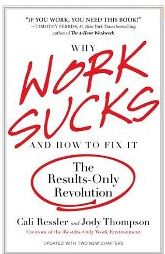
Why Work SucksJody Thompson and Cali Ressler proposed compensating employees based on outputs, rather than elapsed time, in a “Results-Only Work Environments (ROWE)” policy.

This management strategy evaluated “performance, not presence” practices at Best Buy and has been implemented at another large retailer, Gap.
Is this is a return to a “piece-work” approach of decades ago?
Or is it a performance management practice that emphasizes achieving targeted results?

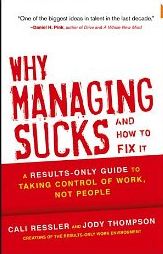
Why Managing SucksROWE  is being considered at such tech giants as Cisco Systems, in direct contrast to Yahoo’s recent call for employees to be present in offices.
The underlying goal of Yahoo’s “presentism” policy may be to increase innovative performance outputs, although the explanation provided to employees emphasized presence as a prerequisite for effective collaboration.

Widespread negative reaction to Yahoo’s on-site work policy, based on complaints that the policy:

  • Conveys lack of trust in employees
  • Undermines opportunities to manage complex work-life responsibilities
  • Places emphasis on “face time” rather than results
  • Leads to employee resentment and disengagement.
Erin Kelly

Erin Kelly

In contrast, University of Minnesota sociologists Erin Kelly and Phyllis Moen with University of Delaware’s Eric Tranby documented the positive impact of ROWE practices in their survey of more than 600 Best Buy employees before and after the program was implemented.

Phyllis Moen

Phyllis Moen

The researchers found turnover was reduced by 45 percent after they controlled for gender, job level, organizational tenure, job satisfaction, income adequacy, job security and turnover intentions.

Participants reported reduced stress and improved work-home interfaces by increasing employees’ schedule control, and reduced the “opting out” of the workforce due to personal commitments for both men and women.

Eric Tranby

Eric Tranby

Kelly, Moen, and Tranby opine that ROWE “moves us away from the “time cages” developed around the work day…ROWE challenges these taken-for-granted clockworks…our mantra is ‘change the workplace, not the worker’.

Rachelle Hill, also of University of Minnesota collaborated with Moen and Kelly in a related study that documented ROWE moderated turnover effects of negative home-to-work spillover, personal troubles, and physical symptoms.

-*What impacts – positive and negative – have you seen in “Performance, not Presence” workplace policies like ROWE?

RELATED POST

©Kathryn Welds

Perseverance Increases Skill Increases Luck: “The Harder I Work, The Luckier I Get”

Samuel Goldwyn

Samuel Goldwyn

Thomas Jefferson

Thomas Jefferson

Samuel Goldwyn recast Thomas Jefferson’s earlier observation: “I am a great believer in luck, and I find the harder I work, the more I have of it.”

Michael Mauboussin, of Columbia University, and previously Chief Investment Strategist at Legg Mason Capital Management Inc. investigated this relationship between effort and luck in his book, The Success Equation.The Success Equation

Michael Mauboussin

Michael Mauboussin

Mauboussin, an innovator in behavioral finance, adopted Harvard biologist Stephen Jay Gould’s “paradox of skill” to analyze the interaction of effort, skills, and luck, and best strategies to optimize outcomes in investing, sports, and career performance.

Stephen Jay Gould

Stephen Jay Gould

He posits that as skill improves in activities where outcomes are affected by skill and luck, the standard deviation of skills narrows.
In this case, luck becomes more important in determining outcomes:

Whenever you see an outlier in sports, it is always a combination of really good skill and really good luck… (Often) they are about one and a half or two standard deviations away from the average…not all skilled players have (winning) streaks, but all (winning) streaks are held by skillful players.”

For example, as investors become more sophisticated and have access to advanced computational tools, as athletes benefit from targeted training and development regimens, and as students are groomed for admission to top universities, differences among these skilled performers decreases.
Chance influences can determine outcomes.

Mauboussin says that luck has several elements:

  • Affects an individual or organization,
  • May be evaluated as “good” or “bad”
  • Another outcome could have occurred
  • The outcome is uncontrollable, but is comprised of several elements

To increase luck, he advises assessing each contender’s strength in the situation and finding “…something completely different to get you on the right side of the tail of the skill distribution,” such as employing an unusual or unexpected tactic.

The stronger player has positive asymmetric resources, so the effective strategy is to simplify the game.
In contrast the underdog should seek to complicate the game, such as through disruptive innovation, a flank strategy or a guerilla tactic.

Because most people have a bias toward optimism and overestimate personal capabilities, it may be difficult to assess oneself as an “underdog” in a performance situation.

Daniel Kahneman

Daniel Kahneman

Nobel Prize winner Daniel Kahneman and Amos Tversky explained that individuals who adopt an inside view gather substantial information, combine it with their own inputs, then project into the future without considering “distributional information” about a wide variety of previous instances.
This approach risks developing an idiosyncratic, overconfident perspective by underestimating costs, completion times, and risks of planned actions, while overestimating benefits.

Amos Tversky

Amos Tversky

In contrast, people who adopt the outside view consider the problem as an instance of a larger reference class and consider the entire distribution of outcomes when this type of situation occurred previously.
This approach can reduce overconfidence.
However, this approach could discourage entrepreneurs, who will realize that a small percentage actually succeeds.

In addition, besides the bias toward overconfidence, people tend to “under-sample” instances of failure when a previously successful approach is applied in a new situation and doesn’t succeed.

Nate Silver

Nate Silver

Sabermetricians like Nate Silver, posit that worthwhile statistics provide:

  • Persistence or correlation from one period to the next, a strong indicator of high skill
  • Predictive value or high correlation with the target objective

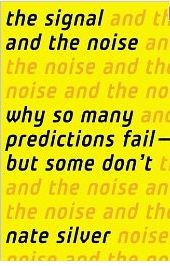
Nate Silver-The Signal and The NoiseThe Oakland As baseball team uncovered these principles in determining that  a superior measure of athletic performance in this sport is on-base percentage rather than the traditional measure, batting average.

In this case, on-base percentage has a higher correlation from one season to the next and a higher correlation with run production than batting average, fulfilling both criteria.

Daniel Kahneman also suggested that skill, expertise, and intuition render more uniform results in a predictable environment.

Thinking Fast and SlowHowever, many organizational environments are unstable and non-linear, rendering experts less accurate because they cannot employ an effective predictive model.

Collective judgments through “the wisdom of crowds” may mitigate the challenges of unstable contexts because they provide more data points.

Mauboussin advocated considering the continuum of stability vs instability in which the issue is situated to determine strategy and to beware of applying simple heuristics that are vulnerable to bias, and social or situational influences.

He suggested the guideline “think twice” to prepare, detect and correct for common mental traps, including:

  • The Inside-only View
  • Tunnel Vision
  • Oversimplification
  • Situational Power
  • Overvaluing Expert Knowledge

-*How do you optimize your performance when chance elements can affect your outcomes?

Related Posts

©Kathryn Welds