Category Archives: Business Communication

Business Communication

Mastering the Power Sandwich with Skillful Upward Influence

David Bradford

David Bradford

Employees’ advancement in organizations is based on preventing problems before they develop, and pre-emptively uncovering opportunities to add value, according to Stanford’s David Bradford and Allan R. Cohen of Babson College in Influencing Up.

Allan Cohen

Allan Cohen

Complementing their Influence without Authority, they distilled common-sense win-win approaches to influence those over whom one has no formal authority or control: one’s manager and others higher in the hierarchy.

Influencing UpOrganizational power discrepancies can be accentuated when the employee is female or a member of a minority group.
Cohen and Bradford’s suggest six elements to reduce power differences, and improve influence and negotiation outcomes:

  • Clarify needs and priorities
  • Consider others as potential partners rather than adversaries
  • Establish trustworthiness by sharing information and develop understanding of the other’s perspective, concerns, and “care-abouts” — empathy in a business setting
  • Determine reciprocal value exchange in “currencies” that matter to others: information, budget, removing obstacles, brokering agreements, support
  • Gain access to others by showcasing your potential value exchange
  • Negotiate a win-win outcome
Robert Cialdini

Robert Cialdini

Bradford and Cohen’s work complements influential research by Stanford colleagues Margaret Neale and Deborah Gruenberg, as well as Robert Cialdini’s classic investigation of influence.

Roger Fisher

Roger Fisher

William Ury

William Ury

Their emphasis on crafting a win-win negotiated outcome echoes earlier work by Roger Fisher and William Ury in Getting to Yes and Linda Babcock’s consideration of negotiation challenges faced by women and minority group members in the workplace.

-*How do you manage the Power Sandwich, requiring skillful 360 degree influence in your organization?

Related Posts:

Twitter:  @kathrynwelds
Google+:
Blog: – Kathryn Welds | Curated Research and Commentary
LinkedIn Open Group
Facebook Notes:

©Kathryn Welds

Women’s Career Development: Negotiation, Networking-Mentoring-Sponsorship, Skillful Self-Promotion

Kenexa Career Development Model-Individual Behaviors

Kenexa Career Development Model-Individual Behaviors

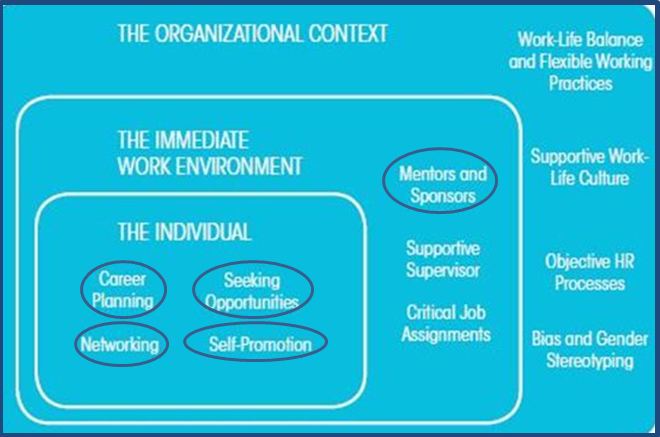
Part 1 of this post, Women’s Career Development: Career Planning, Career “Contest”, Sponsorship  highlighted Ines Wichart’s model of women’s career development with three levels and 11 components, based on her research as Kenexa High Performance Institute (KHPI), a subsidiary of IBM.

Ines Wichert

Ines Wichert

She outlined four behaviors that individuals can control or influence toward career advancement:

  • Career planning 
  • Opportunity-seeking, Negotiation
  • Career-building networking; Mentoring-Sponsorship    
  • Skillful self-promotion

The first segment of this two-part post considered facets of Career Planning and two independent paths to career advancement: Contest and Sponsorship routes.

Let’s consider the additional elements that respond to individual attention and efforts, including Opportunity-seeking while embracing risk.  

Susan Vinnicombe

Susan Vinnicombe

Val Singh

Val Singh

Highly effective career advancement opportunities include stretch assignments and on-the-job training.

Susan Vinnicombe and Val Singh of Cranfield University report that these development activities are most effective in building credibility, visibility, reputation as a capable, well-rounded leader.

However, their research found that women need more encouragement to take on challenging assignments than men, who are more likely to ask for these assignments.

Linda Babcock

Linda Babcock

Similarly, Linda Babcock reported that women tend to need encouragement to ask for promotions and salary increases.

Her research demonstrated that women are less likely to negotiate for their first salaries, unless they know that these are acceptable practices.

Manhattan CollegeAs a countermeasure, Babcock recommends negotiation practices demonstrated to mitigate negative perceptions by both men and women negotiation partners

Like Babcock, Mary Wade’s research at Manhattan College found that both men and women evaluated more negatively women who negotiated for salary using the same script as men.

Corinne Moss-Racusin

Corinne Moss-Racusin

Laurie Rudman

Laurie Rudman

Corinne Moss-Racusin and Laurie Rudman replicated this disconcerting finding at Rutgers University, leading to their formulation of “The Backlash Avoidance Model” (BAM)”.

According to this construct, women may demonstrate traditional gender role behaviors to mitigate “backlash” of negative reaction by men and women to “role discrepant” behaviors like asking for career advancement and commensurate compensation.

  • What approaches have been effective when you have asked for a salary increase or promotion?
         –How did you prepare?

         -How did you overcome objections?
  • When people ask you for a salary increase or promotion, what negotiation approaches have been most effective?
              -What have been least effective?

Wichart’s model of individual initiatives toward career advancement points to the importance of skillful professional networking, mentoring, and sponsorship.

National Center for Women and Information TechnologyNational Center for Women & Information Technology (NCWIT) reported that nearly half of technical women surveyed said they lack role models and mentors, and 84% said they lack sponsors.
The result is that these women are four times more likely to leave the current job role.

One reason that women’s professional networking efforts and seeking mentors may yield less effective career advancement than men:  Women tend to engage in professional networking for affiliation and emotional support with people close to their job level whereas men tend to network for career development with people significantly above the job level, according to Adelina Broadbridge of University of Stirling.University of Stirling

As a result of these differing approaches to professional networking, men may enjoy more rapid career advancement due to visibility and sponsorship.

Pamela Perrewe

Pamela Perrewe

F. Randy Blass

F. Randy Blass

In addition, women are likely to demonstrate less political understanding and insight because mentors are not sufficiently senior, according to Florida State University’s F. Randy Blass, Pamela Perrewe, and Gerald Ferris with Robyn Brouer of SUNY Buffalo.

Gerald Ferris

Gerald Ferris

Robyn Brouer

Robyn Brouer

Organizational support for formal and informal mentoring has been shown to increase employee engagement, satisfaction, and retention.

Therefore, organizations concerned with retaining talented women and minorities can increase the likelihood of keeping skilled employees by initiating structured mentoring programs and encouraging selective sponsorship.

  •  How have mentors and sponsors enabled your career moves?
  •  How do you decide who you are willing to mentor or sponsor?   

Previous posts have shared much current research and leading recommendations in building personal brand and practicing skillful self-promotion:

In light of the potential negative perceptions of women who showcase their accomplishments as they ask for salary increases and role advancement:

  •   How do you raise awareness of your accomplishments’ impact to avoid “backlash”?
  •   How do you define, develop, and communicate, “skillfully promote” your personal brand?

These research findings suggest three parting suggestions for women who want to Play Bigger:

  1. Question the thought that “I’m not ready yet.”
  2. Develop resilience and “a thick skin”:   If you are doing something innovative or important, you may draw both praise and criticism when you are noticed.
  3. Filter advice:  Implement recommendations that have “the ring of truth” and “resonate”;
    leave the rest.
  • What is the most helpful career advice you implemented?
  • What career advice have you decided not to implement?

Related Posts

©Kathryn Welds

Extract More Value from Meetings with Effective Questions

Shane Snow

Shane Snow

Shane Snow, co-founder of Contently.com  advocates asking incisive questions to extract more value from meetings, mentors’ guidance, and chance encounters with thought leaders and influencers.

He notes that expert journalists, researchers, innovators, and therapists are trained to ask effective questions, and their common “best practices” include:

  • Listening more than talking
  • Asking open-ended questions to avoid suggesting responses: “Who?”, “What?”, “When?”, “Where?”, “How?”, “Why?”
    They use closed-ended questions sparingly: “Is?”, “Would?” and “Do?”
  • Posing one concise question at a time.
    They avoid multiple choice questions
  • Waiting for an answer without interjecting more questions or comments.
    They rarely interrupt themselves or others
  • Tolerating the other person’s silence for several seconds before talking
  • Directly, repeatedly probing for insightful, revealing replies
  • Nodding only when the response is intelligible, logical, and understandable
  • Interjecting questions or rephrasing the original question to redirect tangential responses
  • Cross-checking information and following up possible inconsistencies with more probing questions
Sakichi Toyoda

Sakichi Toyoda

Nearly a century earlier, Sakichi Toyoda, founder of Toyota Industries introduced an iterative problem-solving approach based on posing “Five Whys” to uncover the root cause of an issue.

The Lean StartupThis technique is now-widely applied in Lean Manufacturing, and is advocated by Eric Reis in The Lean Startup: How Today’s Entrepreneurs Use Continuous Innovation to Create Radically Successful Businesses .

‘”Five Whys” were reduced to “Three Whys” to uncover customer objections in sales situations, and was modified Judith Beck in cognitive therapy to identify underlying Core Beliefs that lead to negative automatic thoughts.

Judith Beck

Judith Beck

Beck softens the “Five Whys” by repeatedly asking “If that were true, what would it mean?”
Her model that suggest connections among:

Early experience->Core beliefs (schemas) ->Underlying assumptions (if/then – conditional) ->Automatic thoughts-> Physical Experiences->Self-Limiting Behaviors

Five Whys to Uncover Core Beliefs

Lois Frankel

Lois Frankel

Therapist and writer Lois Frankel illustrated the similarity of effective questions in psychotherapy sessions with those used to spur inquiry and innovative breakthroughs.
She advises interviewers and consultants to:

  • Use questions to define your purpose:
    What do you want to gain from this conversation?

    • Help
    • Advice
    • Information
    • Commitment
    • New ideas
    • Clarification of opinions or attitudes
    • Decision
      Overcoming your strengths
    • What is the “real” problem? Engineers and business people answer this question using a “Root Cause Analysis”
      • What are the options?
      • What are the likely consequences?
      • What results will justify the invested time, effort or money?
      • Ask specific questions:
        • What could we do differently?
        • Why is this important?
        • How can we best meet our objective?
        • What do you want to happen?
          • What don’t you want to happen?
          • What is the best thing that could happen?
          • What is the worst thing that could happen?
          • How will you react if you don’t follow this course of action?

Frankel advises to

  • Maintain eye contact:
  • Focus full attention on the interviewee
  • Repeat and summarize important points to verify accurate understanding
  • Listen for:
  • Content (facts)
  • Intent (feelings)
  • The way these are expressed (process).
    Warren Berger

    Warren Berger

    Journalist Warren Berger applied refined questioning in Design Thinking processes to produce innovative solutions in Glimmer: How Design Can Transform Your World .

    He advocates continued exploration of meaningful “big” questions in his blog, A More Beautiful Question.

-*What effective questioning practices have you found most helpful in achieving business results?

Related Posts:

Twitter:   @kathrynwelds
Blog: – Kathryn Welds | Curated Research and Commentary
Google+
LinkedIn Open Group Psychology in Human Resources (Organisational Psychology)
Facebook Notes:

©Kathryn Welds

Reduce Evaluator Bias: Showcase Best Features in Any Offer

Less can be more when designing offers, whether when offering services in job applications, crafting sales offers, or positioning for advantage in any negotiation.

Kimberlee Weaver

Kimberlee Weaver

Kimberlee Weaver of Virginia Tech and University of Michigan’s Stephen Garcia and Norbert Schwarz showed that more is not better in augmenting offers when additional elements are of lower quality.

Stephen Garcia

Stephen Garcia

Using the Presenter’s Paradox in a series of studies, they showed that positive impressions can be reduced when they are presented in the company of lower value items.

Norbert Schwartz

Norbert Schwartz

Weaver, Garcia and Schwarz offered volunteer “buyers” different iPod Touch packages: iPod and cover OR this package with a free music download.

“Buyers”, on average, offered to pay more for the lesser package, and sellers inaccurately expected that buyers would prefer the fully-featured package.
This suggests that expectations about consumer preferences may be poor predictors of people’s actual selection and purchasing behaviors.

The average price offered for the basic package, iPod and cover was $242, but the package with one free song download averaged just $177.
The additional feature reduced package’s perceived value by more than 25%.

Those designing and evaluating offers can mitigate the impact of this judgment bias by considering the value of the overall offering, then eliminating lower-value components that might reduce the comprehensive value.

This is relevant to job seekers who might be tempted to “pad” a resume with low-value activities, accomplishments and skills.
Weaver, Schwartz, and Garcia’s findings suggest that showcasing most compelling capabilities provides a more power presentations of personal and product attributes.

Santa Clara University’s Jerry Burger might argue that “more might be more” when he found that Steve Jobs’s “that’s-not-all” (TNA) technique was more effective than the much-researched “door-in-the-face” (DITF) approach in gaining agreement to sales propositions.

Jerry Burger

Jerry Burger

That’s-not-all” offers a product at a high price, then doesn’t allowing the volunteer to respond immediately.
The procedure follows up by augmenting the offer with another product or lowering the price.

Burger found “that’s-not-all” produced superior simulated sales outcomes to the much-researched “door-in-the face” (DITF) approach, which presents an unreasonably high offer, then follows with a more acceptable proposal.

Numerous replications of “door-in-the-face” have shown than people are more likely to agree to a second more modest request after an unreasonable high first proposal.
Even when the same offer is presented as a single offer, people are significantly more likely to accept it when it’s presented after an unreasonable proposal.

Burger suggested that “that’s-not-all” may have produced greater compliance because people felt obliged to respond to a new offer through an implicit norm of reciprocity,  and because the augmented offer changed the perceived anchor point that volunteers used to evaluate the offer.

-*How do you mitigate bias in evaluating offers?
-*How do you design the most attractive offer when offering something for sale?
-*Which technique for designing offers has been most persuasive to you as a purchaser?

Related Posts
:

Twitter:    @kathrynwelds
Google+:
Blog: – Kathryn Welds | Curated Research and Commentary  
LinkedIn Open Group
Facebook Notes:

©Kathryn Welds

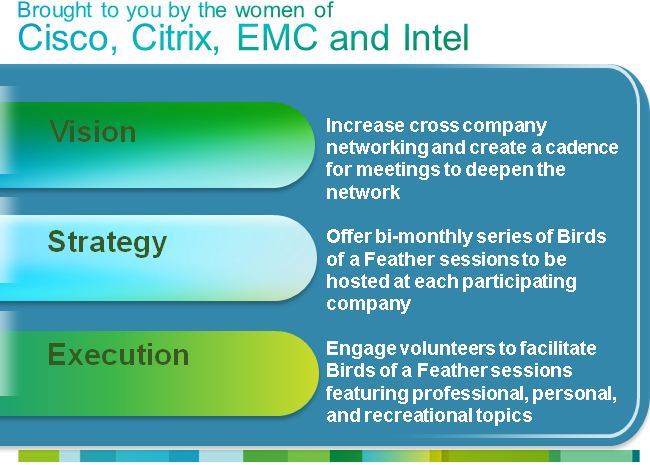
“Birds of a Feather” brings together Silicon Valley women for Network Development

CiscoWomen of Cisco, Citrix, EMC, Intel come together on Thursday  17 January 2013 at Cisco Systems in San Jose, California, for the first of three “unconferences” to build professional relationships across technology companies. Citrix

EMCEach firm has an Employee Resource Group (ERG) focusing on career development and advancement for women in technical and non-technical roles, and each recognizes the value of building cross-organizational business networks and relationships.IntelWomen of Cisco-Citrix-EMC-Intel

Women of Intel (WIN) has been a leader by hosting annual events that bring together women from other local technology firms, and occasional efforts have brought together women from Google, Applied Materials, EMC, Intel, Yahoo, Cisco, IBM, Hewlett-Packard, Citrix, Symantec, Adobe, and other Silicon Valley technology companies.

Marylene Delbourg-Delphis

Marylene Delbourg-Delphis

In 2012, EMC and Cisco collaborated on an event designed to encourage longer-term relationships through small-group discussions of a talk by the versatile Marylene Delbourg-Delphis, serial tech entrepreneur, philosophy professor and fashion journalist.

Anna Van Rijswijk

Anna Van Rijswijk

Anna Van Rijswijk of Cisco, member of the EMC-Cisco planning team, expanded this concept to a multi-session series  and incorporated  a “Birds of a Feather” format, developed by the Internet Engineering Task Force (IETF) to denote initial meetings of members interested in a particular issue.

Olivia Shen Green

Olivia Shen Green

This  “Birds of a Feather” structure was  successfully launched in Cisco’s 2012 one-day event, Women in Technology Forum, attended by more than 1200 Cisco employees worldwide, and led by Cisco’s Olivia Shen Green, who shared principles for conducting an “unconference.”  Women In Techology Forum

The goal of the multi-company, multi-session “Birds of a Feather” networking event is to increase insight and resource-sharing on topics crucial to professional women’s career advancement in technology firms, while establishing and developing stronger cross-company resource networks.

Unconference GuidelinesDiscussion topics, facilitated by members of multiple sponsor companies, include:

  • Developing “personal brand”
  • Practicing superior communication skills,  “Executive Presence”
  • Striving toward Work – Life Balance
  • Establishing Peer Mentoring and “Greenlight Groups”
  • Developing technical skills
  • Best practices in design, innovation, and creative processes

Upcoming sessions in the spring of 2013 will hosted onsite at Citrix, EMC, and Intel, and will continue these themes.

-*How do you expand your professional network across companies in your industry and across professional roles?

Twitter:   @kathrynwelds
Google+:
Blog: – Kathryn Welds | Curated Research and Commentary 
LinkedIn Open Group Women in Technology (sponsored by EMC)
Facebook Notes

©Kathryn Welds

Guy Kawasaki Disrupts Again: Innovative “Artisinal Publishing,” Entrepreneurship to build Brand, Visibility

APEGuy Kawasaki’s new book and most recent book have departed from his focus on business strategy, marketing, and storytelling to focus on tactical “how-to” guides.
APE: Author, Publisher, Entrepreneur-How to Publish a Book echoes his earlier imperatives to “add value, make meaning”, whether writing or developing an entrepreneurial idea.

This reference manual enumerates the benefits of self-publishing (aka “artisinal publishing”) compared with traditional publishing models:

  • Content and design control
  • Longevity
  • Revisions   
  • Money
  • Direct connection
  • Price control
  • Time to market
  • Global distribution
  • Control of foreign rights
  • Analytics
  • Deal flexibility.
Guy Kawasaki

Guy Kawasaki

He acknowledges drawbacks, but argues that “artisinal publishing” trumps traditional publishing models despite:

  • No advance
  • No editing team
  • No corporate marketing team
  • Possibly lower prestige
  • Self-service distribution
  • Self-service foreign rights and translations
Guy Kawasaki

Guy Kawasaki

Kawasaki crowd-sourced the origami butterfly concept for his last book cover, Enchantment: The Art of Changing Hearts, Minds, and Actions, and applied the same social approach to “beta-testing,” proof reading, critiquing, and editing this volume.

He candidly acknowledged the value of a professional copy editor to ensure that “artisinally-published” books look professional: even with massive iterations of crowd-sourced review, the copy editor found 1500 issues for correction.Enchantment

He provides clear cost delineations in 2012 US dollars and suggestions to fund the development process, such as engaging in affiliate fee arrangements for products and services mentioned in a book and taking advantage of discounts through the Independent Booksellers Association.

Kawasaki candidly reveals that publishing a book may not be a revenue generator, citing his experience of making more from speaking engagements than royalties on his more than a dozen traditionally-published books

Despite his track record of evangelizing Apple products, he advocated using Microsoft Word for manuscript layout because many who collaborate on an “artisinally-published” book may require this format.

A seasoned marketer, he demystified distribution channels and suggested:

  • Amazon (Kindle Direct Publishing),
  • Apple (iBookstore),
  • Barnes & Noble (Nook),
  • Google (Google Play),
  • Kobo

He clarified the implications of producing digital media in contrast to physical media in discussing distribution through Gumroad for direct sales or printed books.
The latter requires the self-published author to collect, record, and report sales tax for sales within the same state or locale.

As a founder of Alltop and a Twitter evangelist, Kawasaki provided recommendations for promoting awareness of “artisinally-published” books via social media, Net Galley reviewers and bloggers, as well as virtual book tours.

He offers recommendations for independent author and publisher resources including:The Chicago Manual of Style

The Chicago Manual of Style: The Essential Guide for Writers, Editors, and Publishers (14th Edition)

If You Want to WriteIf You Want to Write by Brenda Ueland, which he said “changed my life by empowering me to write even though I didn’t consider myself a writer.”

Kawasaki provided an unexpected “pearl of wisdom,” applicable to many life situations beyond building personal brand reach through “artisinal publishing,” from book enthusiast Marilyn Monroe who said,

Marilyn Monroe

Marilyn Monroe

“Sometimes good things fall apart so better things can fall together.”

-*What has been your experience in traditional or “artisinal” publishing?

Related post:
Business Influence as “Enchantment”

Effective Questions as Change and Innovation Catalyst

James Thurber

James Thurber

American humorist and cartoonist James Thurber reassured his readers that “It is better to know some of the questions than all of the answers,” a dictum supported by philosophers, mindfulness meditation practitioners, psychotherapists, scientists, artists, and creative others.

Given the importance of questioning, many resources are available to refine skill in inquiry:  Understanding others’ questions, framing high-impact queries, responding to others, and using questions to catalyze individual and organizational change.

QBQJohn Miller’s sales-oriented QBQ! The Question Behind the Question: Practicing Personal Accountability at Work and in Life advocates understanding the intent of statements phased as questions by crafting “What?” and “How?” questions instead of defense-provoking “Why?”

His approach is applicable in organizational management and change situations, and argues for increasing personal accountability while decreasing blame by focusing on the underlying work concerns like achieving revenue targets, deliverable timelines, customer satisfaction goals, cost savings.

The Art of Powerful QuestionsLike Miller, Eric Vogt, Juanita Brown, David Isaacs advocate “What?” questions in The Art of Powerful Questions: Catalyzing Insight, Innovation, and Action.

This team asserts that high-impact questions in business situations are valuable because they

• Evoke the listener’s curiosity, imagination, creative problem-solving, new possibilities
• Stimulate reflective conversation
• Provoke thoughtful consideration of diverse perspectives, contributions
• Clarify underlying assumptions
• Generates energy, progress, improvement
• Focus attention on issues and alternatives
• Memorably resonate with meaning
• Articulate progress toward shared understanding
• Suggest more questions

Dennis Matthies

Dennis Matthies, Chief Questioning Officer of Training organization Vervago supplies the “how” of questioning by helping business participants refine skill in formulating seven types of “precision” analytic questions, drawing on formal logic and critical thinking disciplines:

  • Assumption Questions, including existence, uniqueness, measurement, possibility, value, audience, time constancy, category, similarity
  • Basic Critical Questions (BCQ), including data, source
  • Questions of Clarification, including ambiguity/vagueness, “pivot table” segmentation for granular analysis
  • Go/No Go Questions, including “meeting basics and participation”, participant motivation analysis, inquiry focus

Vervago advocates “precision” responses to questions by:

  • Referring to the question
  • Answering briefly
  • Anticipating and addressing underlying concerns embedded in the question.
David Cooperrider

David Cooperrider

David Cooperrider of Case Western Reserve University broadened the vision of effective questioning’s potential impact when he developed Appreciative Inquiry (AI) as an affirmative approach collaborative organizational change.

This approach reduces resistance by focusing on desired change instead of the perceived problem, outlined in his book, with Diana Whitney, Appreciative Inquiry: A Positive Revolution in Change.

Appreciative InquiryAI’s “4Ds” of organizational change share some similarities with Design Thinking Processes:

  • Discovery Phase – Appreciating strengths and best practices of the current situation
  • Dream Phase – Envisioning the value and benefits of a proposed change
  • Design Phase – Defining processes and organizational structures that can deploy demonstrated strengths while moving toward a defined change state
  • Destiny Phase – Strengthen the organizational system’s capacity to sustain ongoing positive change

-*How do you use questions to clarify direction and initiate change?

Related Posts:

Twitter  @kathrynwelds
Google+
LinkedIn Open Group Mindful Leadership
Facebook Notes

Blog: – Kathryn Welds | Curated Research and Commentary

©Kathryn Welds

First Emotionally Intelligent, Mindful Presidents: Barack Obama, Peter Salovey?

Peter Salovey

Peter Salovey, newly appointed President-Elect of Yale University, introduced the term “Emotional Intelligence” in 1989 as “the ability to monitor one’s own and others’ feelings and emotions, to discriminate among them, and to use this information to guide one’s thinking and actions”.

Yale’s new President, is considered a pioneer and originator of research into four elements of EQ used to think and behave adaptively:

  • Accurately perceiving, identifying, pinpointing emotions in self, others
  • Expressing, using emotions as information to decide,  plan, achieve, communicate, create, think
  • Understanding, predicting own and others’ emotions, temporary moods
  • Self-regulating, transforming emotions.
  • Peter Salovey

    Salovey is widely regarded as one who embodies these characteristics and creates community  through his bluegrass band performances with Professors of Bluegrass, active participation in student life (as a Super Mario Brother at Halloween 2009, accompanied by the Yale Symphony orchestra during his tenure as Provost), and award-winning teaching and research.

He applied EQ concepts to business with David Caruso in The Emotionally Intelligent Manager: How to Develop and Use the Four Key Emotional Skills of Leadership

Emotional Intelligence can be intentionally increased in work and personal settings by increasing awareness of one’s own and others’ emotions.
One way to achieve this goal is through “Mindfulness,” or non-evaluatively, non-judgmentally attending to physical, cognitive, and emotional experiences arising in the present moment.

Jon Kabat-Zinn

Jon Kabat-Zinn introduced this practice in 1979 and founded Stress Reduction Clinic and the Center for Mindfulness in Medicine, Health Care, and Society at the University of Massachusetts Medical School.
His programs and books, including Mindfulness for Beginners: Reclaiming the Present Moment–and Your Life  help develop skill in being “present” through:

  • Observing – expanded awareness with detachment
  • Describing
  • Participating fully
  • Focused, narrowed attention

He discussed the possible impact of these practices on business leadership and government, building on research findings that mindfulness practice can lower aggressive feelings and increase peaceful sentiments.

Kabat-Zinn provided an example in recently-re-elected U.S. President Barack Obama is the first mindful President, “…since Lincoln, or maybe ever.”

The Dalai Lama, Barack Obama

He added that Obama “… is really present, he has a lot of different qualities that seem to indicate he is emotionally balanced, not driven by ego concerns, that he knows how to balance family life and the impossible job that he has.
There is something about him that’s measured, very peaceful, he listens very, very deeply.”

Many observers will evaluate whether Salovey can put into practice Emotionally Intelligent leadership at Yale, and whether Barack Obama can demonstrate Mindfulness in peaceful international relations and domestic issue-resolution during his final term in office.

-*Where do you observe emotional intelligence and mindfulness among top leaders?

Twitter:  @kathrynwelds
Google+
LinkedIn Open Group Mindful Leadership
Facebook Notes:

Blog: – Kathryn Welds | Curated Research and Commentary

©Kathryn Welds

Minimize “Quest for the Best” Bias

Sheena Iyengar
Sheena Iyengar

Columbia Business School professor Sheena Iyengar, Cassie Mogilner of University of Pennsylvania’s Wharton School, and Baba Shiv of Stanford’s Graduate School of Business collaborated to assess the relative satisfaction and commitment to “sequential choices,” as in “love marriages,” compared with “simultaneous choices”, like arranged marriages.

The Art of Choosing

Iyengar’s earlier research revealed that more choices available at one time are associated with reduced satisfaction.
To evaluate satisfaction with simultaneous vs sequential choosing, Iyengar, Shiv, and Mogilner studied volunteers’ satisfaction and commitment to choices of wine, chocolate, and nail polish colors.
Results, forthcoming in the Journal of Consumer Research, found thatsimultaneous” choosers were more satisfied and committed to their decisions than “sequential” choosers.

Cassie Moligner

In the chocolate experiment, participants considered detailed descriptions of fine chocolates (“dark chocolate ganache with black tea and hints of citrus and vanilla”), and chose which they wanted to taste.
The “simultaneous” group saw the entire list, whereas the “sequential” group saw one choice at a time.

After they selected and tasted the chocolate, participants rated their satisfaction with their choice.
Verdict? “Simultaneous” choosers were more satisfied with their choices than “sequential” choosers.

Baba Shiv

When participants had an opportunity to switch to a different but randomly-selected chocolate, more “sequential” choosers took this option, though they had little information about the choice.
However, when “sequential” choosers were permitted to choose an option they’d already considered, they were less committed to their choice.

The researchers suggest that “sequential” choosers may have regretted forgoing options they didn’t select, and hoped that a future option would be better.

Shiv summarized the dilemma of the “sequential” chooser (or serial dater, serial monogamist): Hope and regret prompt people to move to the next option even though the next option could be worse.
In contrast, “simultaneous” choosers are aware of available options at a point in time, so may spend less time in regret and hope.

Retailers, daters, venture capitalists, hiring managers, house purchasers, and job candidates benefit from presenting and evaluating all choices at one time.

However, simultaneous choice may not be possible, and to avoid the “bias of the eternal quest for the best,” Shiv suggests “mentally converting sequential choices into “quasi-simultaneous” choices by recalling situations when you were happy with you choice, and when you regretted your choices.”

Though an imperfect heuristic, quasi-simultaneous choice may may provide instructive clues to the elements of a satisfying decision.

-*How do you take decisions among many options?

Related Posts on Decision-Making and Bias:

©Kathryn Welds

Use Your Own Stories to Communicate with Power and Impact

Annette Simmons

Annette Simmons

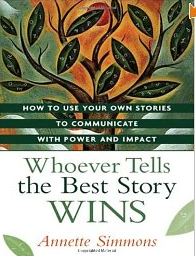
Annette Simmons asserts that the power of stories derives from stimulating feelings and focusing these sentiments on a goal or action in her book, Whoever Tells the Best Story Wins: How to Use Your Own Stories to Communicate with Power and Impact

Nancy Duarte

Nancy Duarte

Nancy Duarte, who designed Al Gore’s original Inconvenient Truth slides, concurs in her most recent book, Resonate: Present Visual Stories that Transform Audiences 

George Lakoff

George Lakoff

UC Berkeley professor George Lakoff, in his classic, Metaphors We Live By, contends that stories create a framework that directs and filters attention, and enables the speaker to “control the conclusions.”

Simmons suggests the following sources of stories:

1.Personal stories of your successes
2.Personal stories of failures, to demonstrate learning, and to build trust and credibility
3.Stories of mentors and other people who influenced you
4.Memorable stories from books, movies, and current events that influenced you.

Aristotle

Aristotle

She referred to Aristotle‘s premise that the best stories contain knowledge (logos), feeling (pathos), and credibility (ethos) when she offered guidelines for effective story-telling:

1. Describe events in a way that evokes a concrete, sensory experience, as it is the way to stimulating emotion
2. Be brief
3. Offer measurable outcomes
4. Enable the listener to similar situations, organizations
5.Solidarity, or enabling the listener to experience another person’s point-of-view

-*What practices enable you to craft influential, memorable “stories”?

LinkedIn Open Group – Psychology in HR (Organisational Psychology)
Twitter: @kathrynwelds
Google+
Facebook Notes:

Blog: – Kathryn Welds | Curated Research and Commentary

©Kathryn Welds