Category Archives: Business Communication

Business Communication

Self-Distancing Pronouns Use Can Increase Self-Management

Ethan Kross

Ethan Kross

Despite years of popular guidance to use self-statements for difficult conversations with partners, spouses, and bosses, research argues for using self-distancing alternatives to manage stress and increase self-control.

Emma Bruehlman-Senecal

Emma Bruehlman-Senecal

University of Michigan’s Ethan Kross, Jiyoung Park, Aleah Burson, Adrienne Dougherty, Holly Shablack, and Ryan Bremner with Emma Bruehlman-Senecal and Ozlem Ayduk of University of California, Berkeley, plus Michigan State’s Jason Moser studied more than 580 people’s ability to self-regulate reactions to social stress by using different ways of referring to the self during introspection.

LeBron James

LeBron James

One example of variations in self-reference is LeBron James’ statement, One thing I didn’t want to do was make an emotional decision. I wanted to do what’s best for LeBron James and to do what makes LeBron James happy.”

The team demonstrated that using non-first-person pronouns (such as “he” or “she”)  and one’s own name (rather than “I”) during introspection enhanced self-distancing, or focusing on the self from a distant perspective.

Stephen Hayes

Stephen Hayes

Distancing, also called “decentering” or “self as context,” allows people to observe and accept their feelings, according to University of Nevada’s Steven Hayes, Jason Luoma, Akihiko Masuda and Jason Lillis collaborating with Frank Bond of University of London.

Ozlem Ayduk

Ozlem Ayduk

Self-distancing verbalizations were associated with less distress and less maladaptive “post-event processing  (reviewing performance) when delivering a speech without sufficient time to prepare, and when seeking to make a good first impression on others.
Post-event processing can lead to increased social anxiety, noted Temple University’s Faith Brozovich and Richard Heimberg.

Faith Brozovich

Faith Brozovich

They found that participantsexperienced less global negative affect and shame after delivering a speech without sufficient preparation time, and engaged in less post-event processing.

Adrienne Dougherty

People who talked about themselves with non-first person pronouns also performed better in speaking and impression-formation social tasks, according to ratings by observers.

Participants who used self-distancing language appraised future stressors as less threatening, and they more effectively reconstrued experiences for greater coping, insight, and closure, in another study by Kross and Ayduk.

Ryan Bremner

Ryan Bremner

People with elevated scores on measures of depression or bipolar disorder experienced less distress when applying a self-distanced visual perspective as they contemplated emotional experiences, noted Kross and Ayduk, collaborating with San Francisco State University’s David Gard, Patricia Deldin of University of Michigan, and Jessica Clifton of University of Vermont.

David Gard

Using second-person pronouns (“you”) seems to be a self-distancing strategy when people reflect on situations that involve self-control, noted University of North Carolina’s Ethan Zell, Amy Beth Warriner of McMaster University and University of Illinois’s Dolores Albarracín.

Ethan Zell

These findings demonstrate that small changes in self-referencing words during introspection significantly increase self-regulation of thoughts, feelings, and behavior during social stress experiences.

Self-distancing references may help people manage depression and anger about past and anticipated social anxiety.

Dolores Albarracín

-*What impact do you experience when you use “self-distancing language”?

-*How do you react when you hear others using “self-distancing language,” like referring to “you” when speaking about their own experience?

Related Posts:

Twitter:  @kathrynwelds
Google+
Facebook

©Kathryn Welds

Gender-Neutral Language Associated with Greater Gender Wage Parity

Lucas van der Velde

Lucas van der Velde

Nations that use gender-neutral languages have a smaller Gender Wage Gap (GWG) than countries with clear gender differentions in their languages, reported University of Warsaw’s Lucas van der Velde, Joanna Tyrowicz, and Joanna Siwinska.

Gender-Neutral Language

Gender-Neutral Language

The team evaluated Yale linguists Benjamin Whorf and Edward Sapir’s hypothesis that linguistic categories influence perception, thinking, and behavior by examining data from the World Atlas of Linguistic Structures to determine whether the primary language spoken in a given country had a “sex-based gender system” of grammar rules like gender-specific noun and pronouns.

Benjamin Whorf

Benjamin Whorf

For example, French language links specific nouns to genders, whereas English generally uses different pronouns for men and women (“his” and “hers”) — despite the increasing use of “they” to indicate an individual of either gender, not a group of people.
In contrast, Mandarin and Finnish languages “have no system of gender identification.”

The researchers analyzed whether the primary language contained expressions that celebrate one gender while disparaging another, and compared these findings with estimates for Gender Wage Disparities (GWD) in more than 50 countries from 117 studies published between 2005 and 2014.

Benjamin Whorf

The gender wage gap may be driven by some deep societal features stemming from such basic social codes as language,” they concluded, supporting the Sapir-Whorf Hypothesis.

Katarzyna Bojarska

Katarzyna Bojarska

Gender cues are implicitly and unconsciously used to decode a message’s full meaning in addition to its semantic content, suggested University of Gdańsk’s Katarzyna Bojarska.

She argued that when gender is not clearly specified, unconscious cognitive processing attempts to plausibly reconstruct missing gender information with non-semantic cues.

Gender Neutral Occupational Titles

Gender Neutral Occupational Titles

These findings suggest that countries that favor policies to reduce disparate earnings by gender can enable this goal by providing early training to set children’s expectations of gender equality, particularly in countries using a gendered language,

-*To what extent has your workplace adopted gender-inclusive language?

-*How does your organization’s use of gendered language relate to its wage parity practices?

Related Posts:

Twitter:  @kathrynwelds
Google+
Facebook

©Kathryn Welds

“Social Accounts” as Pay Substitutes for Women

Managers’ “social accounts” of beyond their social media log-ins.
Experts in procedural justice broaden definition of “social accounts” to include explanations for decisions and outcomes.

Maura Belliveau

Maura Belliveau

Experienced managers who were permitted to give a rationale for salary decisions – a “social account” – awarded smaller salary increases to women employees but not men, in a study by Long Island University’s Maura A. Belliveau.

Less experienced managers did not use social accounts as substitutes for pay, suggesting that managers’ adherence to procedural justice was affected by age and years of experience.
More experienced managers in this study did not enhance women’ earning power.

Julie Cloutier

Julie Cloutier

In addition to “social accounts,” Julie Cloutier of École des Sciences de la Gestion in Montréal  and Cornell’s Lars Vilhuber found the perceptions of fairness and justice in salary decisions are affected by:

Expansive Body Language Decreases Power for Some

Lora E Park Bunting

Lora E Park Bunting

Expansive body postures and feelings of power are related for some cultures, but not all, according to SUNY’s Lora E. Park Bunting and Lindsey Streamer with Li Huang of INSEAD and Columbia’s Adam D. Galinsky.

Lindsey Streamer

Lindsey Streamer

They built on much-cited work by Columbia’s Dana R. Carney and Andy J. Yap, demonstrating the posture-power connection, by evaluating three expansive postures among Americans and East Asians:

  • Hands spread on a desk
  • Upright sitting
  • Feet on a desk
Li Huang

Li Huang

Park and team demonstrated that “embodied emotion” depends on the posture and its symbolic meaning within the prevailing cultural context.

Adam Galinsky

Adam Galinsky

Both Americans and East Asians rated the feet-on-desk pose as least consistent with East Asian cultural norms of modesty, humility, and restraint.
In contrast, when Americans assumed this posture, they experienced greater power activation and action orientation.

This effect was reversed for East Asians when they demonstrated the feet-on-desk pose:  They showed less power activation and action orientation than Americans in this position.

However, when Americans and East Asians assumed hands-spread-on-desk and upright-sitting postures, they reported a greater sense of power than when they held a constricted posture (sitting with hands tucked underneath their thighs).

Albert Mehrabian

Albert Mehrabian

Changes in a person’s mood, emotion, and feelings expressed by changes in body posture was first demonstrated by Albert Mehrabian and John T. Friar of UCLA.

They asked nearly 50 volunteers to sit as they would in addressing another person in a variety of imagined scenarios.

Mehrabian and Friar considered relationships between Communicator attitude and gender as well as Addressee status and gender in relation to eye contact, interpersonal distance, head orientation, shoulder orientation, leg orientation, arm openness, leg openness, and hand, foot, and trunk relaxation.

Positive attitude was demonstrated by a slight backward lean of the torso, close distance, and greater eye contact.
When communicating with “high status” individuals, Communicators provided more eye contact and less sideways leaning.
Female Communicators used a more constrained posture with less arm openness when communicating with “higher status” individuals.

Dana Carney

Dana Carney

Carney and team demonstrated that these postural changes elicit measurable neuroendocrine changes.
When people in the U.S. assumed in high-power nonverbal displays, their  testosterone increased, their cortisol decreased and they reported increased feelings of power and tolerance for risk.

Andy Yap

Andy Yap

University of Florida’s Andrea Kleinsmith, P. Ravindra De Silva at Toyohashi University of Technology and University College London’s Nadia Bianchi-Berthouze demonstrated these cross-cultural differences in perceiving emotion and subjective experience from body posture.

Andrea Kleinsmith

Andrea Kleinsmith

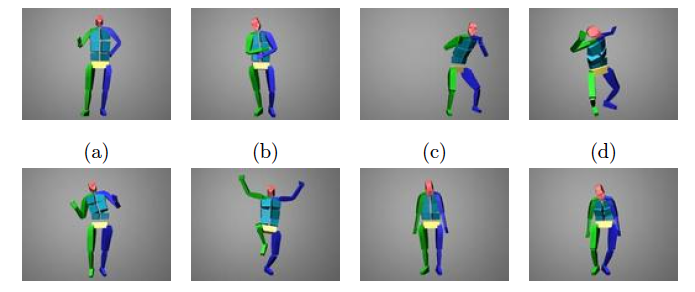
Kleinsmith and team used static posture images of affectively expressive avatars or “embodied agents” to test emotion recognition by volunteers from three cultures. From these findings, they developed cultural models for affective posture recognition.

Andrea Kleinsmith-avatarsThese results suggest both the impact of changing body postures to elicit different feeling states, and caveats when adopting expansive postures to activate power while interacting across cultural groups.

Ravindra De Silva

Ravindra De Silva

Encouragement to “Think Big, Play Big” may require specific recommendations for culturally appropriate action.

-*How do you demonstrate power when interacting with colleagues from different cultural backgrounds?

Nadia Bianchi-Berthouze

Nadia Bianchi-Berthouze

 RELATED POSTS:

Twitter  @kathrynwelds
Blog – Kathryn Welds | Curated Research and Commentary
Google+
LinkedIn Open Group Psychology in Human Resources (Organisational Psychology)
Facebook Notes

©Kathryn Welds

Clothing Influences Thinking and Behavior, not Just Others’ Perceptions

A previous post highlighted the influence of the body on thinking, through “embodied cognition.”

Hajo Adam

Hajo Adam

An extension of this idea is “unclothed cognition,” the impact of clothing on thinking and behavior, according to Rice University’s Hajo Adam and Adam Galinsky of Northwestern University.

Adam and Galinsky considered the symbolic meaning of clothing and wearer’s physical experience by evaluating the impact of wearing a lab coat on participants’ task performance.

Adam Galinsky

Adam Galinsky

Before the experiments, volunteers said in a survey that they associated “attentiveness” and “carefulness” with “a lab coat.”
Next, participants completed a Stroop Test, a task that requires selective attention to differentiate words in incongruent colors (“red” presented in green letters), while wear a lab coat or their street clothes.

Volunteers performed better when they wore a lab coat than when they completed the same tasks while wearing street clothes.

In other experiments, Adam and Galinsky described the lab coat to some participants as a “doctor’s coat” and to others as a  “painter’s coat.”
Volunteers who wore a “doctor’s coatperformed better on sustained attention tasks and were better able to discriminate features in nearly-similar images, than those who wore a  “painter’s coat.” 

Joshua Davis

Joshua Davis

Clothing’s symbolic meaning as visual communication can influence the viewer’s attributions and the wearer’s behavioral alignment with the role suggested by clothing, argued Joshua I. Davis of Barnard College, who studied the effect of BOTOX injections on emotional experience.

Sandra Forsythe

Sandra Forsythe

Clothing’s impact on others’ evaluation of the wearer was further detailed by Sandra Forsythe, now of Auburn University collaborated with University of Tennessee’s Mary F. Drake, and Charles E. Cox.
They videotaped simulated job interviews of women wearing various styles of dress, and found that more than 75 human resources professionals recommended hiring female job applicants who wore more “masculine” attire than those wearing other styles of dress.

Norah Dunbar

Norah Dunbar

Clothing’s influence on the viewers’ impression of others’ credibility was investigated by University of Oklahoma’s Norah E. Dunbar and Chris Segrin of University of Arizona guided by their colleague Judee Burgoon‘s expectancy violation theory.

Chris Segrin

Chris Segrin

Two instructors gave lectures in undergraduate college classes, wearing either expected “appropriate” attire for this role, or wearing unconventionally casual clothing.
The instructors also provided either high interpersonal support or less rewarding interactions.

Judee Burgoon

Judee Burgoon

Dunbar and Segrin found that students were less influenced by unexpected attire when the instructor provided more social rewards.
They suggested that interpersonal demeanor can be even more influential than clothing in determining impressions of credibility and likability.

Similarly, the impact of clothing on judgments of competence and achievement for both students and teachers in Ohio high schools was demonstrated in research by Bowling Green State’s Dorothy Behling with Elizabeth Williams.

Anat Rafaeli

Anat Rafaeli

Clothing’s influence on impression formation and related organizational dynamics is based on attributes, homogeneity and conspicuousness, posited Anat Rafaeli of Technion, and Boston College’s Michael Pratt.

Michael Pratt

Michael Pratt

Clothing has been considered an important influence on others’ perception of the wearer, and Adam and Galinsky’s studies offer evidence that clothing can affect the wearer’s actual task performance.

-*How has clothing changed your workplace behavior and performance?
-*How do others treat you different depending on your attire?

Follow-share-like http://www.kathrynwelds.com and @kathrynwelds

RELATED POSTS:

Twitter  @kathrynwelds
Blog – Kathryn Welds | Curated Research and Commentary  
Google+
LinkedIn Open Group Psychology in Human Resources (Organisational Psychology)
Facebook Notes:

©Kathryn Welds

Managerial Gender Bias in Granting Flex Time, Backlash Against Men Flex-Time Seekers

Managers hold gender biases in granting flex time requests, and most employees inaccurately anticipate managers’ likelihood of approving these proposals, found Yale’s Victoria Brescoll with Jennifer Glass of University of Texas-Austin and Harvard’s Alexandra Sedlovskaya.

Victoria Brescoll

Victoria Brescoll

Men across job levels were more likely than women to receive flex time to pursue career advancement or to address family issues, found their survey of 76 managers.

Jennifer Glass

Jennifer Glass

Men in high-status jobs were more likely receive approval for career development, and men in low-level jobs tended to get flex time for family issues.
Both groups were more likely than women to receive requested work schedule accommodations.

Women in low-status jobs with childcare requirements were among the least likely to receive accommodations from their managers.
In addition, all employees tended to overestimate the likelihood of receiving a flexible work schedule and underestimate “backlash” after the request.

Women in high-status jobs requesting flextime for career advancement were most likely to expect their requests would be granted, yet they had a lower approval rate than men in high-status jobs.
Conversely, these schedule-accommodated men were least likely to believe they would receive flextime for career development reasons, yet they often received approval.

Brescoll suggested that men in high-status positions who are granted flex time to pursue career development achieve more rapid career advancement.
In contrast, women in high-status roles who request flex time for the same purpose may “…be suspected of hiding the true reason for their request, or they may be viewed as less deserving of further training because it’s assumed that they’ll leave their jobs in the future.”

Women in the workplace encounter a “gendered wall of resistance” (schedule accommodation denials due to gender), whereas men face “status-specific resistance” (objections based on reason for flex time request), according to Brescoll.

Employees’ lack of awareness of managerial bias in granting flextime coupled with realistic concern about negative consequences of workplace accommodation requests can lead to lower productivity, unnecessary turnover and persistent social problems like child poverty and lack of upward mobility for low-wage workers.

Laurie Rudman

Laurie Rudman

In fact, volunteers attributed more “feminine” traits (weakness, uncertainty) and fewer “masculine” traits (competitiveness, ambition) to male leave requestors, found Laurie Rudman and Kris Mescher of Rutgers University.

Kris Mescher

Kris Mescher

Rudman and Mescher asked volunteers of both genders and diverse ethnic backgrounds to evaluate fictional vignettes concerning men who requested a 12-week family leave to care for a sick child or an ailing mother.

Participants attributed poor organizational citizenship (“bad worker stigma”) to men who requested family leave and recommended organizational penalties (e.g., demotion, layoff, ineligibility for bonus) for them.

When men were viewed with the “feminine stigma” of “weakness” and other traditionally-feminine characteristics, they were more likely to incur organizational penalties.

Joseph Vandello

Joseph Vandello

Jennifer Bosson

Jennifer Bosson

The impact of these stigmas on men seeking flexible work arrangements was confirmed in related research by University of South Florida’s Joseph Vandello, Vanessa Hettinger, Jennifer  Bosson, and Jasmine Siddiqi.

Their experimental study found that volunteers assigned lower job evaluations, less masculine and more feminine traits to employees who requested flex time than those with traditional work arrangements.

Jasmine Siddiqi

Jasmine Siddiqi

However, evaluators judged requestors as “warmer” and more “moral,” suggesting that flexibility-seeking employees may be more well-liked and judged as a desirable work colleague.

-*How do you counteract implicit biases in approving workplace flexibility arrangements?

RELATED POSTS:

Twitter@kathrynwelds
Blog: – Kathryn Welds | Curated Research and Commentary
Google+
LinkedIn Open Group Psychology in Human Resources (Organisational Psychology)
Facebook Notes:

©Kathryn Welds

Women’s Branding – Impact of Rebranding at Marriage, Divorce

Oscar Wilde

Oscar Wilde

Playwright, esthete, and bon vivant Oscar Wilde anticipated current attention to personal branding in his comment, “Names are everything.”

It is well-known that women who change their names at marriage are more difficult to find and connect to their pre-marriage professional accomplishments.
This is a “Brand Equity Risk,” and may result in reduced “personal brand value.

However, “rebranding” at marriage was prevalent among about 19,000 women who married in 2012, surveyed by TheKnot.com and www.WeddingChannel.com.
A significant majority – 86 percent – changed their birth names to their husband’s surname, with just 14% choosing another option such as:

  • Retaining their original name (<8%),
  • Hyphenating both partners’ last names (6%),
  • Creating a new surname, often from parts of each partner’s name.
Brian Powell

Brian Powell

Just three years before, Indiana University’s  Brian Powell and Laura Hamilton of University of California – Merced, found that that significantly fewer respondents – 71 percent of 815 survey participants – believed a woman should change her name at marriage, and half of those said it should be legally required.

Laura Hamilton

Laura Hamilton

This suggests that there is an increasing sentiment toward rebranding at marriage.

Richard Kopelman

Richard Kopelman

However, Baruch College’s Richard Kopelman, with  Rita Shea-Van Fossen of Ramapo College, Eletherios Paraskevas, Sacred Heart University’s Leanna Lawter, and David Prottas of Adelphi University, reported significantly decreasing incidence of women changing birth names at marriage from the 1990s to the 2000s. 

Claudia Goldin

Claudia Goldin

Likewise, Harvard’s  Claudia Goldin and Maria Shim, found a similar trend in their evaluation of  New York Times‘ marriage announcements, Massachusetts birth records, and Harvard alumni records: Fewer college-educated women kept their birth names in 2004 than in the 1970s and 1980s.

Maria Shim

Maria Shim

They noted that older brides and those who graduated from elite educational institutions were more likely to retain their original names, as were  those with occupations in arts, writing, and media.

Rita Shea-Van Fossen

Rita Shea-Van Fossen

Wayne State University’s Ernest Abel and Michael Kruger echoed Goldin and Shim’s finding that older brides are more likely to retain their original “brand.”

Ernest Abel

Ernest Abel

Women who married between ages 35 and 39 were six times more likely to keep their original names than women who married when they were 20 to 24 years old, reported Abel and Kruger in their analysis of 2575 wedding announcements in the New York Times.
They found that women who married in 2007–2008 were three times more likely to retain their birth names than those married in 1990–1991.

Stephanie Coontz

Stephanie Coontz

Diana Boxer

Diana Boxer

Stephanie Coontz of Evergreen College said that many of the women who changed their names in the 1970s did so as a counterpoint to marital inequality in obtaining credit, renting an apartment, and owning real property.
Other cross-cultural gender-specific identity practices were outlined by University of Florida’s Diana Boxer and Elena Gritsenko’s Women and surnames across cultures: reconstituting identity in marriage.

Education, age, religious affiliation, cultural traditions, and sentiment seem to over-ride typical advice for building a brand:  Repeated exposure to a consistent message over time.
Brand strategists who consider threats to corporate brand value could contribute to post-marriage rebranding decision-making by quantifying the potential long-term financial impact of women’s  nominal changes after marriage and marital dissolution.

-*What are the benefits to personal brand value of keeping or changing original names?

RELATED POSTS:

Twitter:    @kathrynwelds
Blog: – Kathryn Welds | Curated Research and Commentary
Google+:
LinkedIn Open Group Psychology in Human Resources (Organisational Psychology)
Facebook Notes:

©Kathryn Welds

How Effective are Strategic Threats, Anger, and Unpredictability in Negotiations?

Most researchers conclude that negotiators who establish a collaborative atmosphere for a “win-win” solution achieve superior results.

Marwan Sinaceur

Marwan Sinaceur

However, Marwan Sinaceur of  INSEAD and Stanford’s Larissa Tiedens investigated the potentially-risky tactic of employing strategic anger in negotiations, and found that anger expressions increase expressers’ advantage and “ability to claim value” when negotiation partners think they have few or poor alternatives.

Larissa Tiedens

Larissa Tiedens

Sinaceur and Tiedens suggested that anger expression communicates toughness, leading most non-angry counterparts to concede more to an angry negotiator.
However, other studies report that people have more negative reactions when women display anger,

-*But what about the impact of “strategic” expressions of anger that aren’t actually felt?

Stephane Cote

Stephane Cote

Ivona Hideg

Ivona Hideg

University of Toronto’s Stéphane Côté collaborated with Ivona Hideg of Wilfrid Laurier University and University of Amsterdam’s Gerben van Kleef to evaluate the impact of surface acting (showing anger that is not truly felt) on the behavior of negotiation counterparts.

They found that disingenuous anger expressions can backfire, leading to intractable, escalating demands, attributed to reduced trust.

Gerben van Kleef

Gerben van Kleef

In contrast, “deep acting” anger that is actually felt, decreased negotiation demands, as demonstrated in Sinaceur and Tiedens’ work.

-*Are threats more effective than expressing anger in eliciting concessions in negotiation?

Christophe Haag

Christophe Haag

Sinaceur and team collaborated with Margaret Neale of Stanford and Emlyon Business School’s Christophe Haag, and reported that threats delivered with “poise,” confidence and self-control trump anger to achieve great concessions.
A potential negotiation “work-around” is expressing inconsistent emotions in negotiations.

Adam Hajo

Adam Hajo

Saraceur teamed with van Kleef with Rice University’s Adam Hajo, and Adam Galinsky of Columbia, and found that negotiators who shifted among angry, happy, and disappointed expressions made recipients feel less control over the outcome, and extracted more concessions from their counterparts.

Adam Galinsky

Adam Galinsky

Emotional inconsistency proved more powerful than expressed anger in  extracting concessions, so women may achieve superior negotiation outcomes with varied, unpredictable emotional expression.

-*How do you use and manage emotional expression in negotiations?

RELATED POSTS:

©Kathryn Welds

Air Time Matters: Speak Up in the First Five Minutes of a Meeting

More than thirty years ago, University of Florida’s Marvin Shaw observed that participation in small group approximates the 80/20 Principle:

Marvin Shaw

Marvin Shaw

In a 5 member team, 2 members make 70% of comments
In a  6 member team, 3 members make 70% of comments
In a  8 member team, 3 members make 67% of comments

Most of the comment contributors were men, and those who speak most are typically viewed as most influential, according to Melissa Thomas-Hunt of University of Virginia.
This suggests that women can be at a disadvantage in groups if they don’t speak up.

Melissa Thomas-Hunt

Melissa Thomas-Hunt

Thomas-Hunt found that women were less influential in small groups even when they possessed specific expertise in survival skills, a stereotypically male endeavor.
Further, women with elite knowledge were judged as less expert by others.

Conversely, men who possessed expertise were more influential than expert women.
Overall group task performance was affected by these dynamics:  Groups with a female expert made less accurate assessments than groups with a male expert, perhaps because females’ expertise was discounted or ignored due to gender-related expectations for specific competencies.

Christopher Karpowitz

Christopher Karpowitz

Women spoke less when there are fewer women in a group, but not when women predominated and decisions were made by majority rule, according to Christopher Karpowitz of Brigham Young University, Princeton University’s Tali Mendelberg and Lee Shaker of Portland State University.

Tali Mendelberg

Tali Mendelberg

They also found that women spoke equally in small groups when there were few women but the decision required unanimous vote.
One implication is that women benefit from building consensus when they are in the minority.

Powerful women who talk more than male counterparts incur backlash from both male and female observers, according to Victoria Brescoll of Yale.

Victoria Brescoll

Victoria Brescoll

In an experimental study, both female and male volunteers read about a female CEO who talked longer than others.  They judged her as significantly less competent and less suitable for leadership than a male CEO who was reported to speak for the same amount of time.

A high-power woman who talked much less than others was judged as equally competent and capable of leading as a high-power man who talked much more than others.
Raters were less generous in their ratings of a high-power male who talked much less than others:  He was judged as equally incompetent and unsuitable for leadership as a high-power female who talked much more than expected.

This suggests that both men and women are punished for behaviors different from gender-role expectations.

Lee Shaker

Lee Shaker

Women’s tendency not to speak up in groups begins well before they enter the workplace, found Harvard’s Catherine Krupnick.
She and her team investigated differences between male and female students’ participation in classroom discussion and the impact of the instructor’s gender on students’ participation.

They reviewed videotapes of 12 women and 12 men instructors, and concluded that male students talked two and a half times longer than female students when the instructor was male and the majority of the students were male — a frequent situation in many educational and work organizations.
On the other hand, female students spoke almost three times longer when instructors were female.

Women students were interrupted more frequently than their male counterparts, most often by other women, and leading them to withdraw from the discussion for the remainder of the class.

Krupnick posited that women’s lower participation in classrooms – and perhaps in other small groups – may be explained by their:

  • Unwillingness to compete against men,
  • Vulnerability to interruption,
  • Unwillingness to interject into men’s and other women’s long uninterrupted statements, known as “discourse runs,”
  • Individual differences in assertiveness, confidence, and speed of formulating responses.
Elizabeth Aries

Elizabeth Aries

Amherst’s Elizabeth Aries noticed that groups composed entirely of women students tended to have a participatory style in which women took turns and spoke for about equal amounts of time throughout the class hour.

In contrast, male groups appeared more contest-like, with extremely uneven amounts of talk per man.
They competed by telling personal anecdotes or raising their voices to establish hierarchies of participation, and this competitive style persisted in mixed-gender groups.

Kathleen Welch-Torres, then of Yale, compared women’s and men’s assertiveness in class discussions at Yale and Brown (mixed-gender institution) with women’s class participation at Wellesley and Smith (single-gender).
She reported that women at both of the mixed-sex institutions were verbally less assertive than men, by using “hedges,” qualifiers and questioning intonations.
However, women at the single-gender institutions Smith and Wellesley were more assertive than women at Yale and Brown and more assertive than men at the coeducational institutions.

Larraine Zappert

Larraine Zappert

Kendyll Stansbury

Kendyll Stansbury

Welch-Torres linked these behaviors to measures of self-esteem and her findings are similar to those of Stanford’s Laraine Zappert and Kendyll Stansbury  who reported that female graduate students held lower self-esteem, less trust in their judgments, and greater fear of making mistakes than male graduate students.

Recommendations to help women move toward fuller participation in small groups from Melissa Thomas-Hunt and Margaret Neale of Stanford include:

Margaret Neale

Margaret Neale

  • Before a meeting:
    • Ask trusted attendees to:
      • Support your ideas during the meeting,
      • Solicit your input in the meeting,
    • Refer to your specific expertise during the meeting,
    • Set a goal for number of contributions in the first five minutes of a meeting.
    • In a meeting:
      • If interrupted: Restate, rephrase and provide specific evidence based on expertise,
      • Showcase  others’ expertise by soliciting their input,
      • Create environment in which  other participants have equal opportunity to participate,
      • Urge members to consider each alternative, rather than disregarding suggestions presented by “lower status” individual.

-*How do you ensure that your expertise is recognized and influential in small group settings?

*What “best practices” do you apply to ensure active participation by women and minority-group members?

RELATED POSTS:

Twitter:    @kathrynwelds
Google+:
Blog: – Kathryn Welds | Curated Research and Commentary
LinkedIn Open Group Psychology in Human Resources (Organisational Psychology)
Facebook Notes:

©Kathryn Welds

Are You Enabling a Bad Leader?

Responsibility for ineffective and unethical leadership is held by many parties, not just leaders themselves.

Barbara Kellerman

Barbara Kellerman

Harvard’s Barbara Kellerman argued that followers – and certainly Executive Board members –  can precipitate, enable and collaborate in bad leadership.

She studied followership of incompetent, corrupt, and evil leadership in public and business settings.
Kellerman concluded that both followers and uninvolved bystanders who do not object enable bad leaders to continue their practices.

John Darley

John Darley

Supporting her contention is experimental demonstration of  the powerful impact of “Bystander Apathy” by New York University’s John Darley and Bibb Latané of Columbia.

Bibb Latane

Bibb Latane

Because followers have less power and status than leaders, complacent observership can be the norm when organizations don’t establish processes to report ineffective and unethical leadership practices with protections against negative repercussions.

Given the challenges of challenging bad leadership practices, followers can increase chances of understanding organizational culture and leadership practices by conducting pre-employment “due diligence”  before accepting a role,

Questions to evaluate “fit” with a leader include:

  • How do you prefer to communicate with your direct reports?
  • How do you mentor, coach, and develop your direct reports?
  • How would you describe your work style?
  • How do you manage conflict within the team?
  • How will you measure success in this role after a year?
  • What are your three most important values?
  • How do your direct reports describe your management style?
  • How are you and your team perceived in the organizations?
  • To what extent do you involve your team members in decisions?
  • How do you support work-life balance for team members?

These queries can’t guard against unexpected circumstances like managers rapidly moving to a new group or restructurings that result in an unevaluated new manager, role, or group.
However, they may provide additional guidance to potential “warning signs” of “misemployment,” and reduce responsibility for complicity in enabling poor management styles.

-*What questions have you found most effective in assessing work style “fit” and compatibility with a potential manager?
-*What “bad leader” roles have you observed in your organzation?

Related Reading:

LinkedIn Open Group Psychology in HR (Organisational Psychology)
Twitter: @kathrynwelds
Google+
Facebook Notes:
Blog: – Kathryn Welds | Curated Research and Commentary

©Kathryn Welds