Tag Archives: Decision making

Do “Hot” Emotions Lead to Better Decisions?

-*Do people in an agitated emotional state tend to make decisions they later regret?

Popular wisdom counsels against making decisions when influenced by “hot emotions” including feeling HALT – Hungry, Angry, Lonely, Tired,
This guidance is based on the assumption that these physical and emotional experiences lead to regrettable decisions, such as relapsing to substance use.

Shane Frederick

Shane Frederick

Contradictory theories and research findings compete to explain the process of emotional decision-making.
One view, suggested by Princeton’s Nobel laureate Daniel Kahneman with Shane Frederick of Yale, is that these two modes operate sequentially:  Intuitive judgments (“reflexive system”) are rapidly generated, whereas the analytical decisions (“reflective system”) are slower, and involve monitoring and modifying initial intuitive responses.

Andreas Glöckner

Andreas Glöckner

A contrasting view is that the two thinking modes work in parallel, and are applied in different decision environments, proposed by Max Planck Institute’s Andreas Glöckner and Tillman Betsch of Universität Erfurt.

J. Scott Armstrong

J. Scott Armstrong

Similarly, there are two divergent views of the quality of emotional decision-making.
One position is that the intuitive mode’s emotional approach may lead to faulty decisions, argued by Decision Research’s Donald MacGregor and J. Scott Amstrong of Wharton.

Marius Usher

Marius Usher

A counterpoint view is that the intuitive mode yields equal or better decisions compared with the analytical mode, offered by Tel Aviv University’s Marius Usher, Ran Brauner, and Dan Zakay with Zohar Rusou of Open University of Israel and University College London’s Mark Weyers.

Antonio Damasio

Antonio Damasio

Consistent with this view that intuitive thinking can enhance decisions, University of Southern California’s Antonio Damasio suggested that uncomfortable physical states like hunger, can provide access to unconscious processes that may determine decisions later rationalized with more rational explanations:  We feel, therefore we are, despite Descartes’ contrary assertion, he argued.

Dan Zakay

Dan Zakay

An integrative view is that decision quality depends on consistency (“transitivity”) between thinking modes during decision-making and characteristics of the decision, proposed Tel Aviv University’s Zohar Rusou and Marius Usher, with Dan Zakay of IDC Herzliya in their comparison of thinking during intuitive or analytical tasks.

Based on these views of thinking during decision making, the HALT theory that physiological arousal leads to poorer decisions was tested by asking hungry people to make complex choices.

Denise de Ridder

Denise de Ridder

Utrecht University’s Denise de Ridder, Floor Kroese, Marieke Adriaanse, and Catharine Evers asked volunteers to avoid eating and drinking between 11 p.m. the night before the experiment and 8:30 – 9:15 am, when they arrived at the lab.

Antoine Bechara

Antoine Bechara

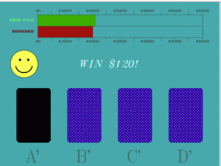
Half of the participants received breakfast before beginning the task, whereas the remaining group immediately began the Iowa Gambling Task, developed by University of Southern California’s Antoine Bechara, Antonio Damasio and Hannah Damasio, with Steven W Anderson of University of Iowa to simulate real-life decision making using uncertainty, rewards, and penalties.
Iowa Gambling Task

Iowa Gambling Task

Participants received four decks of cards and were told to earn as much money as possible and lose the least possible when they selected one card at a time.
Cards in decks A and B had a 100 Euro payoff, whereas those in decks C and D has a 50 Euro reward.

In addition, decks A and B also had cards with a larger penalty than in decks C and D.
Consequently, selecting cards from decks A and B resulted in a loss, whereas cards from C and D led to a gain.

Floor Kroese

Floor Kroese

Hungry participants selected more cards from decks C and D, leading to greater financial gains.
Similarly, hungry participants made equally astute decisions about long term payoffs when choosing between 50 Euros in 21 days instead of 27 Euros today.

People in a “hot” emotional state like hunger actually made better decisions involving uncertain outcomes because recognized the risks of loss associated with higher rewards, concluded de Ridder’s team.
This team’s findings contrasts to conventional belief that impulsivity impairs decision-making.

  • When do you make better decisions in “hot” states like “HALT”?

Follow-share-like http://www.kathrynwelds.com and @kathrynwelds

RELATED POSTS:

Twitter  @kathrynwelds
Blog – Kathryn Welds | Curated Research and Commentary
Google+
LinkedIn Open Group Psychology in Human Resources (Organisational Psychology)
Facebook Notes

©Kathryn Welds

Executives’ Financial Risk Tolerance Related to Marital Status

Nickolai Roussanov

Nickolai Roussanov

Unmarried executives tend to advocate more aggressive investments in corporate capital expenditures, innovation activity, research and development, and acquisitions, resulting in significantly higher stock return volatility, according to Wharton’s Nikolai Roussanov and Pavel G. Savor of Temple University.

Pavel G. Savor

Pavel G. Savor

Marital status is a changeable characteristic rather than a personal inherent trait, previously considered as unrelated to risk-taking decisions.

However, Roussanov and Savor found that marital status can both reflect and affect individual risk preferences based on their analysis of financial risk-taking decisions of CEOs of the U.S.’s 1,500 largest public companies and variations in divorce laws across U.S. states.

Although unmarried CEOs tend lead smaller, early-stage, high-growth firms that benefit from greater investing, Roussanov and Savor controlled for various differences between firms and found that unmarried CEOs make about 10% more risky investments than married CEOs.
Managers are “rational maximizers,” and the target of maximization can change based on personal circumstances, they concluded.

Terence Burnham

Terence Burnham

Unmarried men are more aggressive and willing to take risks, due to higher testosterone levels, according to Chapman University’s Terence Burnham, with colleagues Judith Flynn Chapman and Peter Ellison of Harvard, University of Nevada’s Peter Gray, Matthew McIntyre of 23and Me, and University of Rochester’s Susan Lipson.

Judith Flynn Chapman

Judith Flynn Chapman

In addition, they note that married men may become more cautious as responsibilities for family members increase and testosterone levels decrease.

CEOs, they found, are more likely to be unmarried in U.S. community property states because it is much costlier for a wealthy individual to be divorced.
As a result, it  may be potentially costlier to marry, given the significant chance of divorce.

Peter Ellison

Peter Ellison

A person’s individual characteristics and … individual life cycle matter for the decisions that they make…on behalf of the firms that they lead… Managerial decisions are affected by what is happening in those individual’s personal lives.,” said Roussanov.

Peter Gray

Peter Gray

Boards of Directors may consider a leader’s or candidate’s personal situation, although in the U.S., this is not a legitimate selection criterion.
However, Boards may design CEO incentive compensation tailored to the executive’s risk tolerance, informed by marital status.

For example, a married male or a female CEO leading a fast-growing firm may need financial incentives to increase risk tolerance, since both groups tend to have lower average testosterone levels and lower risk appetite than unmarried men, according to researchers including Northwestern’ s Paola Sapienza, with Luigi Zingales and Dario Maestripieri of University of Chicago

Likewise, a younger unmarried male or CEO of a less dynamic business may need compensation that rewards slower but consistent long term growth.

-*To what extent have you seen organizational leader’s changeable characteristics affect business performance?

RELATED POSTS:

©Kathryn Welds

Emotional Music Can Lead to Biased Judgments

Joydeep Bhattacharya

Joydeep Bhattacharya

Emotions elicited by music influence can influence and even bias visual judgments, according to University of London’s Nidhya Logeswaran and Joydeep Bhattacharya.

They presented volunteers with short excerpts of “happy” music or “sad” music, then showed neutral, “happy,” and “sad” faces.
When people listened to a “happy” music, they were more likely to perceive faces as “happy” even when the face was neutral.
Similarly, the “priming” with “sad” music was associated with more ratings of faces as “sad,” even if they were neutral.

The team also observed the effects of musical “priming” in electrophysiological measures of brain potential components within 100 milliseconds after the faces were presented, suggesting rapid neuronal information processing.

Even if listeners’ perceptions and judgments can be biased by emotional music, listeners do not experience the precise emotions they hear in music.

Kiyoshi Furukawa

Kiyoshi Furukawa

Listeners can identify strong emotions conveyed by music, but do not experience the same degree or type of emotion, according to Tokyo University of the Arts’s Ai Kawakami and Kiyoshi Furukawa, who collaborated with University of Tokyo’s Kentaro Katahira and Kazuo Okanoya.

Kazuo Okanoya

Kazuo Okanoya

Kawakami and team distinguished “perceived emotion” from “felt emotion” in response to music, and presented two pieces of “sad” music (Mikhail Glinka’s “La Séparation” in F minor) and one piece of “happy” music to 44 volunteers, both musicians and non-musicians.

Mikhail Glinka

Mikhail Glinka

Participants rated their perceived emotions and felt emotions in response to each musical selection using 62 descriptions on a scale from 0 (not at all) to 4 (very much).
Although participants recognized the “sad” music’s negative emotions, most reported feeling “romantic,” and “blithe,” rather than negative or unpleasant.

Muzak

Muzak

“Muzak” (now Mood Media) audio in workplaces can evoke emotional responses that may lead to biased business decisions.

As long ago as the 1950s, concerned American citizens claimed that Muzak practiced “brainwashing” with its planned musical sequences in quarter-hour segments.

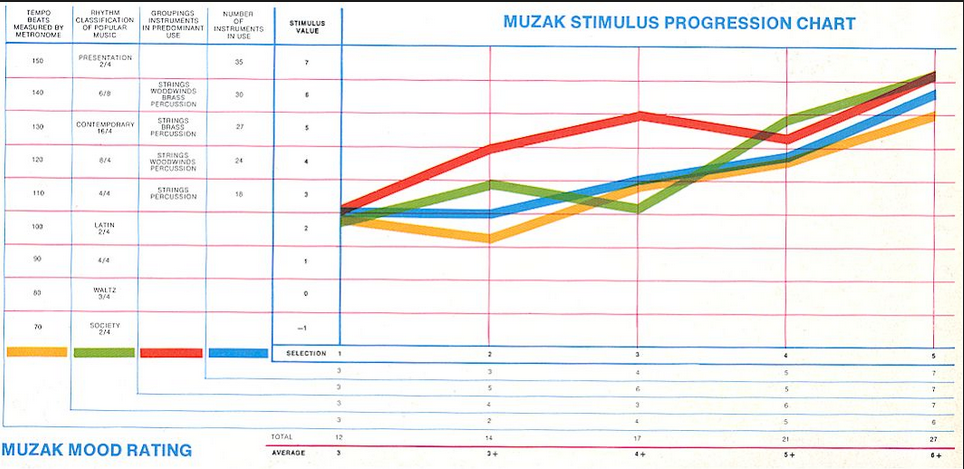
Muzak Stimulus ProgressionMuzak’s playlist is synchronized to time of day to “increase energy” at predicted low-energy times based on its patented “Stimulus Progression.
These 15-minute sequences feature about six songs with varying “stimuli values,” based on tempo, rhythm, instrumentation and orchestra size.
The next 15-minute period features silence.
Mood Media
Over a 24-hour period, tunes with higher “stimulus value” are played when people are typically “lethargic” – 11 a.m. and 3 p.m., and slower songs are played “after lunch” and at the end of the work day.
Muzak claimed that this programming “increases morale and productivity at workplaces, increase sales at supermarkets, and even dissuade potential shoplifting at department stores.”

The emotional tone of music may bias other cross-sensory judgments.
Adrian C. North, working at University of Leicester and Herriott Watt University, tested the effect of music in a supermarket on wine selections and olfactory/gustatory judgments wine’s properties.

North ensured that French accordian music or German Bierkeller brass band music were played on alternating days for two weeks at the supermarket.
French wines and German wines had similar prices and their order on the shelf was changed each day.

After 82 shoppers selected wines, an interviewer asked customers to complete a questionnaire about the purchase, including:

  • Preference for French or German wines
  • Extent to which the music brought to mind France or Germany
  • Degree to which the music influenced specific wine selection.

The results from 44 shoppers suggest that music influenced shoppers’ wine selections:  More French wine was sold when French music played (40 bottles of French wine vs 8 bottles of German wine), and more German wine was sold when German music played (22 bottles of German wine vs 12 bottles of French wine).

North concluded that barely audible music can implicitly, unconsciously affect thoughts, perceptions, decisions, and even buying action.

Charles Areni

Charles Areni

Music can trigger thoughts similar to the music’s mood, context, or speed, according to the Preference-for-prototypes model proposed by Macquarie University’s Charles Areni and David Kim of Texas Tech.

-*When have your judgments and performance been altered by ambient music?

Follow-share-like http://www.kathrynwelds.com and @kathrynwelds

RELATED POSTS:

©Kathryn Welds

Buying Happiness: Satisfaction and Material Purchases vs. Experiential “Investments”

-*Does acquiring possessions lead to happiness and satisfaction?

Leaf Van Boven

Leaf Van Boven

“Not so much,” according to University of Colorado’s Leaf Van Boven and Thomas Gilovich of Cornell, who reported that material purchases are less satisfying than experiential purchases.

Thomas Gilovich

Thomas Gilovich

They suggest that experiences make people happier because experiences are:

  • Subject to positive reinterpretation
  • Central to one’s identity
  • More positively valued by others as having “social value.”
Travis Carter

Travis Carter

Gilovich collaborated with Travis Carter of University of Chicago to survey diverse respondents from various demographic groups.
These two cross-sections of the public reported that purchases to acquire a life experience made them happier than “hedonic” or “utilitarian” material purchases.

In Gilovich and Carter’s related lab experiment, volunteers said they had more positive feelings after recalling an experiential purchase than after thinking about a material purchase.

Eunice Kim

Eunice Kim

Participants also expected that experiences would make them happier than material possessions when they adopted a future, “big picture” perspective in contrast to a present-oriented view.
This finding echoes Eunice Kim Cho and team’s decision-making conclusions highlighted in the last blog postReframing Non-Comparable Choices to Make Them Simpler, More Satisfying

Volunteers reported that material purchases are less satisfying because they can lead to focusing on unchosen options, and comparing to other people’s choices, which contributes to doubt and rumination about alternate choices.

Russell Belk

Russell Belk

In addition, most people “maximize” when they make material purchases in an exhaustive, time-consuming process of considering all possible options, then selecting the optimal-seeming alternative.

Marsha Richins

Marsha Richins

In contrast, most people “satisfice” when selecting experiences by setting a minimum standard for decision quality, then selecting the first option.
This more rapid approach typically leads to less regret.

Scott Dawson

Scott Dawson

People who strongly agree with statements like “Some of the most important achievements in life include acquiring material possessions” and “Buying things gives me a lot of pleasure” report lower levels of life satisfaction according to York University’s Russell Belk as well as to University of Missouri’s Marsha Richins and Scott Dawson of Portland State University, in separate studies.

Many people intuitively sense that possessions don’t buy happiness, and these studies confirm that life experiences tend to be more satisfying than material objects.

-*How do you choose among “utilitarian” items, experiences, and “hedonic” possessions when making purchases?

Please follow-share-like www.kathrynwelds.com and @kathrynwelds

RELATED POSTS:

Twitter:  @kathrynwelds
Blog: – Kathryn Welds | Curated Research and Commentary
Google+ google.com/+KathrynWelds
LinkedIn Open Group Psychology in Human Resources (Organisational Psychology)
Facebook Notes:

©Kathryn Welds

Genes Influence Investment Risk-Taking: Implications for Taking Career Risks?

Camelia Kuhnen

Camelia Kuhnen

Brian Knutson

Brian Knutson

Camelia Kuhnen, then of Stanford with her Stanford colleague Brian Knutson and Vanderbilt’s Gregory Samanez-Larkin posit a small but meaningful genetic basis to risk-averse financial investing, providing a biological basis for findings that women hedge fund managers outperformed male counterparts.

Volunteers with two short serotonin transporter genes (5-HTTLPR) reported that they tend to worry, and this pattern was associated with chosing less risky investment choices.

Gregory Samanez-Larkin

Gregory Samanez-Larkin

“Short allele carriers” also showed higher levels of the personality trait “neuroticism,” but no significant difference in cognitive skills, education, or financial status.
Kuhnen estimates that less than 30 percent of variance in risk-taking is attributable to short 5-HTTLPR, and the remaining difference is derived from experience, culture, education, and social environment.

Kuhnen and Knutson reported the neural basis of financial risk taking using event-related fMRI.
They observed that the nucleus accumbens was activated before volunteers made risky choices and made risk-seeking mistakes.
In contrast, they found that the anterior insula was activated before risk-free choices and risk-aversion mistakes.

They proposed that different neural circuits are associated with differing emotions as volunteers anticipate gain or loss associated with financial choices.
This emotional activation “signature” can lead to specific investment choices, favoring or avoiding risk, and may lead to investing mistakes.

In unpublished research, Kuhnen found that short-allele carriers showed increased anxiety before making a decision in a trial-and-error risk discovery task, but reacted no differently than long-allele carriers when they observed a negative outcome.

She noted that volunteers differ in how they anticipate and react to a potential decision before they make it rather that in their reactions to actual outcomes of investment decisions.

Joan Chiao

Joan Chiao

Kuhnen, now at Northwestern collaborated with Northwestern colleague Joan Chiao to investigate the impact of both the 5-HTTLPR gene and the DRD4, gene, which regulates dopamine transmission.
These genes and their related neurotransmitters have been linked to emotional behavior, anxiety and addiction.

Their research replicated Kuhnen’s earlier finding that individuals with two short 5-HTTLPR alleles take 28% less risk than people with other combinations, and they demonstrated that the double DRD4 7 allele carriers took 25% more risk than people with other combinations.
They conclude that serotonin is associated with risk-averse investment choices, whereas dopamine is associated with riskier choices.

Kuhnen and Chiao argue that risky investment behavior shares commonalities with other risky behaviors like drug use, gambling, unsafe sex, dangerous physical and social pursuits, and more.

-*How do you determine the right amount of risk to undertake in career development and financial investing?

Related Posts

©Kathryn Welds

Why Organizations Care about Employee “Happiness”

“Command-and-control” managers of the past might have scoffed at current business research on happiness.
Under their spans-of-control, employees ought to have been happy to have a job from which they derived an income.
This view has been supplanted by widespread recognition that desirable outcomes like innovative problem solving, flexible decision making, and workplace productivity are associated with employees’ positive mood.

GallupResearch by the Gallup Organization offers further justification in its finding that disgruntled employees disengage and cost the American economy up to $350 billion a year in lost productivity.

Therefore, organizations can increase financial performance by improving operational efficiency in the many processes involving people.

Sigal Barsade

Sigal Barsade

Sigal Barsade of the Wharton School of Business contributed to the investigation of happiness’s impact on organizational productivity.
She found that positive moods prompt “more flexible decision-making, wider search behavior and greater analytic precision,” which enable the organization to take considered risks.

Jennifer Aaker

Jennifer Aaker

On the other coast, Jennifer Aaker, award-winning professor at Stanford Graduate School of Business, links workplace happiness and a sense of meaning.

She asserts that having a meaningful impact on the world is a strong predictor of happiness and that it’s possible to cultivate mindfulness and awareness of meaning in work and personal activities.
This cultivated awareness, she said, influences people’s subjective well-being and may positively affect that of others in a contagion effect.

Jonathan Haidt

Jonathan Haidt

New York University’s Jonathan Haidt, a psychologist in the Stern School of Business, takes a more philosophical view of happiness.
He redefines “wisdom” – other might say “leadership” or “self-management” – as the ability to adapt, shape the environment, and know when to move to new environments.

His moral and ethical framework includes high-level philosophical “virtues” associated with a sense of well-being and shared across cultures:

  • Courage
  • Humanity
  • Justice
  • Temperance
  • Transcendence

The Happiness HypothesisHaidt’s book, The Happiness Hypothesis: Finding Modern Truth in Ancient Wisdom , specified contributors to well-being:

  • Strong marriages
  • Physical touch
  • Meaningful relationships
  • Religious affiliation
  • Autonomy
  • Meaningful engagement in work
  • Contributing to a community through voluntary effort

Engineering organizations analyze issues according to “Is-Is Not.
Using this approach, Jonathan Haidt’s research offered some surprising happiness detractors or “is-nots”:

  • Persistent noise
  • Long commutes
  • Lack of situational and person control
  • Shame
  • Dysfunctional relationships

Matthias Mehl

Matthias Mehl

Matthias Mehl of the University of Arizona offered an additional contributor to happiness: Interpersonal dialog.
He found that volunteers who engaged in a meaningful conversation create shared meaning, strengthened their connections, and reported feeling happy.

Jennifer Michael Hecht

Jennifer Michael Hecht

Jennifer Michael Hecht’s The Happiness Myth, offers a framework for types and levels of happiness:

  • Good day, awareness, savoring, and gratitude for the fortunate conditions of one’s life
  • Good life, engaging in meaningful and challenging tasks that help provide a material quality of life and doing one’s best in any endeavor
  • Peak, choosing experiences that inspire awe and a sense of the eternal, connect to families and communities.

The Happiness MythShe cites familiar recommendations to:

  • Cultivate self-knowledge
  • Develop a clear view of one’s worth
  • Moderate desires
  • Appreciate mortality and time limits
  • Try new things
  • Increase involvement with others and the community.

Organizational policies can contribute to employees’ sense of well-being through establishing:

  • Opportunities for career movement and development
  • Regular acknowledgement and praise for a job well done
  • Focus on well-being as individuals through health and work/life integration programs

The payoffs to organizations include increased productivity, innovation and engagement.

-*How have you seen efforts to increase organizational “happiness” result in improved employee engagement, productivity, or decision-making?

Related Posts:

©Kathryn Welds

“Productive Pause”, Intuition for Better Decisions

Everyday wisdom offers familiar advice to curtail impulsivity through slowing down and reflecting:

  • “Go slow to go fast”
  • “Sleep on it”
  • “Wait before sending an emotional email”
  • “Count to 10, think again”

Frank Partnoy

Frank Partnoy

Former investment banker and lawyer Frank Partnoy’s Wait: The Art and Science of Delay provides empirical evidence on the value of delay to increase the quality of decisions and performance across investment, sports, comedy, and other disciplines.Wait

Creativity experts have demonstrated the importance of an “incubation period” in developing innovative solutions, and Partnoy suggests that similar principles provide and advantage: gathering maximum information in uncertain situations, by executing decisions and performance close to the last opportunity.

University of San Diego’s Partnoy recommends a three step approach to decision-making:

1) Determine the maximum time available to gather information and take the decision
2) Consider, reflect, “incubate” on the information as long as possible
3) Act quickly at the last possible moment

Malcolm Gladwell

Malcolm Gladwell

His approach could be summarized by referring to Malcolm Gladwell’s best-seller, Blink: The Power of Thinking Without Thinking : “Don’t just blink but think.”

Nalini Ambady

Nalini Ambady

Gladwell argues that people with expert experience and insight are often skilled at using ‘adaptive unconscious’ intuition to “thin-slice” subtle cues to filter relevant information from “noise,” a concept based on Nalini Ambady and Robert Rosenthal’s research at Harvard.

Justin Albrechtsen

Justin Albrechtsen

Christian Meissner

Christian Meissner

Research by Justin Albrechtsen, Christian Meissner, and Kyle Susa  of University of Texas at El Paso demonstrated “thin-slicing” when they found that intuitive processing can lead to more accurate judgments of deception when compared with deliberative processing.

Kyle Susa

Kyle Susa

Gladwell and these researchers acknowledge that non-experts, and even experts, can be make erroneous decisions due to bias and prejudice that comes from automatic thinking and habitual cognitive heuristics like the halo effect.

Gerard Hodgkinson

Gerard Hodgkinson

Gerard Hodgkinson of Leeds University found that biased intuitive judgment may be mitigated by “devil’s advocacy” and applying analytical tools like multi-attribute decision analysis and root cause analysis.

He suggests that informed intuition or ‘intelligent-unconscious’ results from subconscious information storage, processing and retrieval, and has conducted several empirical studies to evaluate its mechanisms applied to developing business strategies.

Intuitive judgment was positively correlated with quality and speed of decisions, organizational financial and non-financial performance in at least five studies.

Hodgkinson’s team summarized recent advances in neuroscience, including functional magnetic resonance imaging (fMRI) studies to explain complementary intuitive and analytical approaches to decision making  instead of the overly-simplified notion of left brain vs right brain processing  strengths.

He synthesized intuition attributes:

  • Instantaneous insight after incubation period
  • Subjective judgments
  • Based on experience, tacit knowledge, “knowing without knowing
  • Arise through rapid, non-conscious holistic associations
  • Affectively-charged: “feels right”, experienced as ‘‘inklings’’ or ‘‘glimmerings’’
  • Lacking verbalization or conscious awareness of problem solving.

Cognitive neuroscientists have differentiated intuition from instinct and insight using functional magnetic resonance imaging (fMRI) techniques.

Instinct refers to hardwired, autonomous reflex actions, whereas insight involves recognizing and articulating a problem’s structure, and may follow from intuition.

Hodgkinson’s research suggests that intuition can be enhanced by increasing:

  • Expertise (“prepared mind” or ‘‘deep smarts’’)
  • Self-awareness (feeling and cognitive style)
  • Reflection

Akio Morita

Akio Morita

His team’s research supports an assertion by Akio Morita, co-founder of Sony and driving force behind its successful Sony Walkman, that ‘‘creativity requires something more than the processing of information. It requires human thought, spontaneous intuition and a lot of courage.’’

-*How have you used pauses or intuition to strengthen decision-making and advance business innovation?

Related Posts

©Kathryn Welds

Minimize “Quest for the Best” Bias

Sheena Iyengar

Sheena Iyengar

Columbia Business School professor Sheena Iyengar, Cassie Mogilner of University of Pennsylvania’s Wharton School, and Baba Shiv of Stanford’s Graduate School of Business collaborated to assess the relative satisfaction and commitment to “sequential choices,” as in “love marriages,” compared with “simultaneous choices”, like arranged marriages.

Iyengar’s earlier research revealed that more choices available at one time are associated with reduced satisfaction.
The Art of ChoosingTo evaluate satisfaction with simultaneous vs sequential choosing, Iyengar, Shiv, and Mogilner studied volunteers’ satisfaction and commitment to choices of wine, chocolate, and nail polish colors.
Results, forthcoming in the Journal of Consumer Research, found thatsimultaneous” choosers were more satisfied and committed to their decisions than “sequential” choosers.

Cassie Moligner

In the chocolate experiment, participants considered detailed descriptions of fine chocolates (“dark chocolate ganache with black tea and hints of citrus and vanilla”), and chose which they wanted to taste.
The “simultaneous” group saw the entire list, whereas the “sequential” group saw one choice at a time.

After they selected and tasted the chocolate, participants rated their satisfaction with their choice.
Verdict? “Simultaneous” choosers were more satisfied with their choices than “sequential” choosers.

Baba Shiv

When participants had an opportunity to switch to a different but randomly-selected chocolate, more “sequential” choosers took this option, though they had little information about the choice.
However, when “sequential” choosers were permitted to choose an option they’d already considered, they were less committed to their choice.

The researchers suggest that “sequential” choosers may have regretted forgoing options they didn’t select, and hoped that a future option would be better.

Shiv summarized the dilemma of the “sequential” chooser (or serial dater, serial monogamist): Hope and regret prompt people to move to the next option even though the next option could be worse.
In contrast, “simultaneous” choosers are aware of available options at a point in time, so may spend less time in regret and hope.

Retailers, daters, venture capitalists, hiring managers, house purchasers, and job candidates benefit from presenting and evaluating all choices at one time.

However, simultaneous choice may not be possible, and to avoid the “bias of the eternal quest for the best,” Shiv suggests “mentally converting sequential choices into “quasi-simultaneous” choices by recalling situations when you were happy with you choice, and when you regretted your choices.”

Though an imperfect heuristic, quasi-simultaneous choice may may provide instructive clues to the elements of a satisfying decision.

-*How do you take decisions among many options?

Related Posts on Decision-Making and Bias:

Twitter:  @kathrynwelds
Google+
LinkedIn Open Group Stanford Social Innovation Review
Facebook Notes:

Blog: – Kathryn Welds | Curated Research and Commentary

©Kathryn Welds

Overcoming Decision Bias: Allure of “Availability Heuristic”, “Primacy Effect”

Dana Carney

Dana Carney of Berkeley’s Haas School of Business and Mahzarin Banaji of Harvard University investigated whether people prefer the first option they receive in their paper, “First is Best”.

Olympics gymnastic competitors are aware of this phenomenon, and typically prefer to perform first, to “set the standard” against which other competitors must excel.
Volunteers in one experience were shown pictures of two violent criminals and then asked which one deserved parole.

Mahzarin Banaji

Mahzarin Banaji

Most favored the first mug shot they viewed, no matter the order of viewing.
Similarly, 68% of respondents at a railway station in Boston preferred the first stick of gum they were offered, and volunteers preferred to buy a car from the first salesperson they met.
This is one reason that the first advertisement break on television costs 10-15% more than the second, according to Jonathan Allan, sales director at British broadcaster Channel 4.

Carney and Banaji concluded that people “consistently” the first choice if they have time limits or are distracted, and that this primacy effect is even more important online, because few people scroll through dozens of pages of search results.
Google page rankings, and dating sites such as Badoo, are aware of this trend, and offer enhancements to position results in a more eye-catching location.

Awareness of the human cognitive short-cuts that bias decision making can mitigate their effects.

-*What decision short-cuts do you use?
-*When have you seen these heuristics lead to decision bias?

Blindspot: Hidden Biases of Good People, Mahzarin R. Banaji, Anthony G. Greenwald

LinkedIn Open Group: Mindful Leadership
Twitter: @kathrynwelds
Google+:
Facebook Notes:
Blog: – Kathryn Welds | Curated Research and Commentary

©Kathryn Welds