Tag Archives: Behavior Change

Behavior Change

Five Questions to “Work Any Room”

Allison Graham

Allison Graham

Allison Graham asserts in her book, From Business Cards to Business Relationships: Personal Branding and Profitable Networking Made Easy,  that the goal of conversation at business and social events is to determine whether there is enough common ground to connect again.

She offers five questions to start conversations with people you’ve never met before:

• “What’s your connection to the event?
This question can uncover mutual contacts

• “What’s keeping you busy when you’re not at events like this or at work?

• “Are you getting away this summer?
This question can lead to conversations about family, reveal special interests and travel

• “Are you working on any charity initiatives?
This question makes it easy to launch into a deeper connection, revealing values and priorities

• “How did you come to be in your line of work?
For many, the path to where they are today can be an inspiring or challenging journey, full of surprise, suspense, and drama

Graham concludes that:

• Each person decides during the initial contact whether there is enough connection to warrant future interaction

• During these small conversations, people form their opinions about whether they like you, trust you, and believe you’re competent

• Match the depth of dialogue to the environment

• Your words may be forgotten, but how you make people feel will be remembered

• Relaxation, full engagement, genuine interest, enable the conversation to “flow”

-*How do you prepare for professional “networking” with people you’ve never met before?

LinkedIn Open Group – The Executive Coach
Twitter: @kathrynwelds
Google+
Facebook Notes:
Blog: – Kathryn Welds | Curated Research and Commentary

©Kathryn Welds

Reduce Stress by Resetting Expectations about Life’s Five “Givens”

David Richo

David Richo

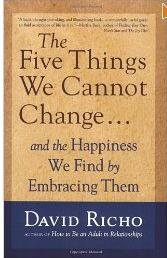
David Richo integrates Eastern and Western philosophies in his book, The Five Things We Cannot Change: And the Happiness We Find by Embracing Them,  to conclude that human life operates in the context of five unavoidable “givens”:

• Everything changes and ends
• Things do not always go as planned
• Life is not always fair
• Pain is a part of life
• People are not always loving and loyal

He asserts that people can experience misery, frustration, anxiety and a host of other uncomfortable emotions if they expect life to contradict these five “givens.”

An approach to reducing stress generated by fighting these “givens” is to reset expectations and to practice a “radical acceptance” of these realities.

Abundant social science research demonstrates that dissatisfaction is generated by the gap between expectations and experience.

Individuals have more control over their expectations than their actual experiences, so a stress-reduction tactic is to modify expectations related to life’s five “givens.”

-*How do you deal with life’s “givens” that may not be as you would like?

LinkedIn Open Group – Brazen Careerist:
Twitter @kathrynwelds
Google+
Facebook Notes:
Blog: – Kathryn Welds | Curated Research and Commentary

©Kathryn Welds
Tired of Motivational Cheerleading? Larry Smith on Why You’ll Fail to Have a Great Career

Larry Smith

Larry Smith

Economist Larry Smith, confesses that he “does dismal” as a motivational curmudgeon in his entertaining TED Talk

He reveals reasons that his audience, and perhaps you, will fail to have a great career:

1. Good jobs are disappearing; what remains are high work load and soul destroying jobs OR great jobs and great careers

2. You will not follow your passion

3. You will hope for luck

4. You think that only geniuses can “succeed” and have a great career

5. You think you’re not weird enough to follow your passion

6. You will not identify your passion; you will fall back on interests

7. You fail to find the highest expression of your talent

8. You will fail to execute on your passion because you value human relationships over great accomplishment

9. You say your parents won’t encourage you to follow your passion, and you won’t encourage your children to pursue their passions

10. You are afraid to fail

11. You are afraid to look ridiculous

“Unless….”

-*What actions do you take to prove Larry Smith wrong?

LinkedIn Open Group, Brazen Careerist:
Twitter: @kathrynwelds
Google+
Facebook Notes:
Blog: – Kathryn Welds | Curated Research and Commentary

©Kathryn Welds

Women Don’t Ask for Raises or Promotions as Often as Men

Linda Babcock

Linda Babcock

Linda Babcock‘s 2011 research at Carnegie-Mellon University identified one possible reason for the oft-reported pay gap between genders: Women don’t ask for raises as often as men
They wait to be offered a salary increase, a promotion, to be assigned the task or team or job that they want.

Researchers note that this type of unsolicited offer rarely occurs.
The study found that when women do ask, it can lead to others finding them “too demanding and aggressive.”

This trend was demonstrated when researchers showed people videos of a man and a woman each asking for a raise, following the same script.
Viewers of both genders reported similar negative perceptions of women who requested promotion.

The study reviewed approaches to help women improve their negotiation skills without challenging “preconceived notions about appropriate gender behavior.”

Some critics note that this analysis doesn’t consider larger scale inclusion and diversity interventions, such as resources offered by NCWIT.org to guide design and launch of merit-based systems for hiring, promoting, and managing women and other underrepresented groups.

*How likely are you to ask for a salary increase or promotion?
-*What factors do you consider before making a request for more more or an expanded role?

©Kathryn Welds

Detect and Mitigate Decision Biases

Sydney Finkelstein

Sydney Finkelstein

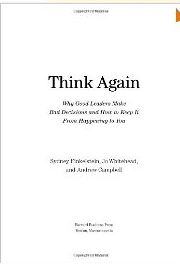
Sydney Finkelstein, Jo Whitehead and Andrew Campbell of Dartmouth’s Tuck Business School, posit that leaders make decisions largely through unconscious neural processes in their book and Harvard Business Review article, Think Again: Why Good Leaders Make Bad Decisions and How to Keep it from Happening to You

• Pattern recognition
• Emotional tagging.

Although these processes are usually effective “heuristics” that enable quick and often prudent decisions, pattern recognition and emotional tagging can be distorted by biases including:

• Self-interest
• Emotional attachments to a position
• Misleading memories derived from inaccurate generalizations from dissimilar previous situations

The authors articulate common-sense recommendations to detect and mitigate “red flags” to decisional bias, echoing conclusions from much-earlier research on “GroupThink” more than four decades ago:

• Enlist the perspective of an independent person to identify which decision makers are likely to be affected by self-interest, emotional attachments, or misleading memories

• Develop safeguards and oversight mechanisms in organizational governance processes

• Alert decision-makers to possible sources of bias

• Build in opportunities to analyze, “spar”, challenge, decisions

-*What approaches do you use to detect and neutralize your potential biases in decision-making?

LinkedIn Open Group – Mindful Leadership:
Twitter: @kathrynwelds
Google+
Facebook Notes:

©Kathryn Welds

Developing “Charisma” and “Presence”

Olivia Fox Cabane

Olivia Fox Cabane

Olivia Fox Cabane integrated research findings from social psychology and neuropsychology with principles of Emotional Intelligence and “Practical Buddhist Philosophy” in her book, The Charisma Myth: How Anyone Can Master the Art and Science of Personal Magnetism

She concluded that charismatic behaviors are based on managing internal state and beliefs through self-awareness to focus on others and “make them feel good.”

She found that “charisma” or “presence” is composed of:

•Presence – mindful attention, patient listening, avoiding interruption

•Power – appearance, clothing, occupy space, positive wording (avoid “don’t”), placebo effect

•Warmth – chin down, eye contact, Duchenne smile (mouth corners, eye corners), gratitude, compassion, appreciation – counteract “hedonic adaptation”

•Goodwill – wishing the other person well

•Empathy – understanding the other’s experience

•Altruism

•Compassion – a combination of empathy+goodwill

•Forgiveness of self and others

•Self-compassion – self-acceptance. Positively correlated with emotional resilience, sense of personal responsibility, accountability, sense of connectedness, life satisfaction, positive relationships with others, self-confidence, willingness to admit errors, low self-pity, low depression, low anxiety, improved immune system functioning

•”Metta” – loving kindness to self, others

Fox Cabane offered three “quick fixes” to increase your “charisma”:

•Lower the intonation of your voice at the end of your sentences (no “Valley Girl talk”…)
•Reduce the speed and rapidity of nodding
•Pause for two seconds before you speak

-*When you see a charismatic person in action, what behaviors and attitudes add to the interpersonal impact and appeal?

©Kathryn Welds