Category Archives: Leadership

Leadership

“Social Accounts” as Pay Substitutes for Women

Managers’ “social accounts” of beyond their social media log-ins.
Experts in procedural justice broaden definition of “social accounts” to include explanations for decisions and outcomes.

Maura Belliveau

Maura Belliveau

Experienced managers who were permitted to give a rationale for salary decisions – a “social account” – awarded smaller salary increases to women employees but not men, in a study by Long Island University’s Maura A. Belliveau.

Less experienced managers did not use social accounts as substitutes for pay, suggesting that managers’ adherence to procedural justice was affected by age and years of experience.
More experienced managers in this study did not enhance women’ earning power.

Julie Cloutier

Julie Cloutier

In addition to “social accounts,” Julie Cloutier of École des Sciences de la Gestion in Montréal  and Cornell’s Lars Vilhuber found the perceptions of fairness and justice in salary decisions are affected by:

Diverse Teams Analyze Problems More Effectively

When people anticipate working with people similar to themselves, they process information less effectively than when they anticipate collaborating with diverse co-workers.

Denise Lewin Loyd

Denise Lewin Loyd

Volunteers completed a survey about their political attitudes, read a murder mystery, determined the perpetrator, and rated their confidence in their conclusion in a study designed by MIT’s Denise Lewin Loyd, Cynthia S. Wang of Oklahoma State University, Columbia’s Katherine Phillips  and Robert Lount Jr. of Ohio State University.

Participants then wrote a statement about their conclusions before meeting another volunteer who had a different conclusion about the perpetrator to solve the case.

Cynthia Wang

Cynthia Wang

They learned the other person’s political affiliation and opinion about the murder and wrote their statements but were told the experiment was over, without meeting the other person.

Loyd’s team analyzed these preparation statements to determine “elaboration,” a measure of analysis complexity and depth, when people anticipated working with others who have different attitudes.

Katherine Phillips

Katherine Phillips

People who said they were members of any political party wrote less-detailed statements when they anticipated meeting with someone affiliated with the same political party.
In contrast, participants wrote more detailed statements when they anticipated meeting someone of a different political orientation.

Volunteers prepared less carefully when they anticipated working with someone who shared their views.
In contrast, when they expected to work with someone holding different views, they applied greater critical thinking to their problem analyses.

Robert B Lount Jr

Robert B Lount Jr

Some volunteers were instructed before preparing their written case analysis that developing a positive interpersonal relationship with the other person would increase solution accuracy.

Other participants learned that “concentrating on the task rather than the interpersonal relationship was most important way to have a productive meeting.”

People primed to focus on their interpersonal relations wrote less detailed preparation statements, suggesting that analytic rigor was sacrificed for interpersonal harmony.
In addition, when people were primed to focus on the task, they produced more thoroughly considered solutions.

When volunteers actually met to solve the case after writing their statements,
partners with the most accurate solutions came to the meeting with most detailed case analyses.

People in homogeneous groups may prepare less completely if they focus on cultivating interpersonal harmony and avoiding conflict.
In contrast, diverse groups may not attempt to form close social relationships, so are more able to focus on task analysis and solutions.
Diverse teams, then, provide multiple perspectives and greater focus on shared work tasks.

Ron Elsdon

Ron Elsdon

However, other researchers advocate workplace affiliation as a way to engage and retain employees.
Ron Elsdon, formerly of Cambridge University and Air Liquide America, suggested that workplace affiliation leads to organizational value creation, and Gallup’s Marcus Buckingham and Curt Coffman argued that “having a best friend at work” is both important for employee engagement and “one of the most controversial of the 12 traits of highly productive workgroups.”

Marcus Buckingham

Marcus Buckingham

Social relationships among similar people at work may feel good, but may not lead to the most effective or innovative problem analysis.

-*To what extent have you observed homogeneous work groups focusing on maintaining harmony at the expense of rigorous task analysis?

Curt Coffman

Curt Coffman

RELATED POSTS:


Follow-share-like http://www.kathrynwelds.com and @kathrynwelds  

Twitter  @kathrynwelds
Blog – Kathryn Welds | Curated Research and Commentary  
Google+
LinkedIn Open Group Psychology in Human Resources (Organisational Psychology)
Facebook Notes:

©Kathryn Welds

“Derailing” Executive Personality Measures Predict Leadership Mishaps

Ellen Van Velsor

Ellen Van Velsor

Executive Derailment” occurs when a person with an executive-level position is seen by others to “fail” in achieving the most important goals for the role, including business outcomes and interpersonal relationships.
Ellen Van Velsor and Jean Brittain Leslie of The Center for Creative Leadership’s reassessed and confirmed their earlier findings on derailment dynamics.

Jean Brittain Leslie

Jean Brittain Leslie

Executive derailment can occur when:

  • An executive overuses or underuses a strength, resulting in a performance liability,
  • Superiors overlook an executive’s performance-impairing deficiencies in personality or character,
  • An executive encounters extreme market challenges or personal difficulties,
  • Career advancement leads the executive to behave arrogantly.

Derailed executives typically:

  • Do not achieve business objectives,
  • Are unable or unwilling to adapt to frequent changes,
  • Have interpersonal problems,
  • Lack broad functional experience,
  • Do not hire the right people and build a cohesive, readable team.

Derailment can also occur when an executive’s interpersonal skill deficits interact with adverse organizational conditions:

  • Unclear organizational direction, with misalignment between corporate strategy and objectives,
  • Lack of role mandate or clarity, in which the executive is not endowed with necessary power and authority to achieve the organization’s goals,
  • Lack of rapport with key stakeholders including the board, the management team, employees,
  • Inability to perceive, understand and respond to strategic market trends, customer priorities,
  • Inaccurate prioritization and abdicating accountability for delivery, execution, performance,
  • Unresponsiveness to rapidly changing market conditions and innovation opportunities.
Joyce Hogan-Robert Hogan

Joyce Hogan-Robert Hogan

“Derailing” personality measures were empirically differentiated from “everyday” personality tendencies by Robert Hogan and Joyce Hogan, then at University of Tulsa, with Gordon Curphy, then at Personnel Decisions, Inc.

They asked observers to rate individuals when they are “at their best” on the “Big Five” personality dimensions, also known as the Five-Factor Model (FFM) – Emotional Stability, Extraversion/Ambition, Agreeableness, Conscientiousness, and Intellect/Openness to Experience.

Gordon Curphy

Gordon Curphy

This approach differs from self-report inventories because it is based on “socioanalytic theory” to understand individual differences in work performance, and avoids biases inherent in self report.

Hogan and Hogan observed a high base rate for managerial incompetence in any organizations based on validated assessment inventories.
These tools, they argue, can promote professional development by providing candid performance feedback to help managers modify dysfunctional behaviors associated with derailment.
However, this quantified feedback is valuable only if inept managers are willing to receive feedback and coaching, and develop a plan to observe and modify unproductive behaviors.

Brent Holland

Brent Holland

These “everyday” personality assessment scales also predicted occupational performance in addition to behavior patterns, in Joyce Hogan with Brent Holland‘s review of more than 450 validation studies predicting occupational performance across job roles and industries.

Timothy Judge

Timothy Judge

Similarly, the Five Factor model’s measures correlated with leadership behaviors, reported University of Notre Dame’s Timothy Judge, and Remus Ilies of National University of Singapore, with Joyce Bono of University of Florida and Miami University’s Megan Gerhardt.

They noted that extraversion consistently correlates with leadership dimensions, including leader emergence and leadership effectiveness.
Recent emphasis on the “power of introverts” suggests further investigation of how introverts assume and exercise leadership.

Joyce Bono

Joyce Bono

Derailment may be mitigated by developing:

  • Diverse career experiences,
  • Hardiness and composure under stress,
  • Responsibility by acknowledging mistakes and failures with honesty, candor, and poise,
  • Focus on solutions and learning from errors,
  • Ability to collaborate with diverse groups and individuals
Megan Gerhardt

Megan Gerhardt

-*How do you evaluate potential for leadership success and derailment?

-*How do you prevent derailment in your work activities?


RELATED POSTS:

©Kathryn Welds

Expansive Body Language Decreases Power for Some

Lora E Park Bunting

Lora E Park Bunting

Expansive body postures and feelings of power are related for some cultures, but not all, according to SUNY’s Lora E. Park Bunting and Lindsey Streamer with Li Huang of INSEAD and Columbia’s Adam D. Galinsky.

Lindsey Streamer

Lindsey Streamer

They built on much-cited work by Columbia’s Dana R. Carney and Andy J. Yap, demonstrating the posture-power connection, by evaluating three expansive postures among Americans and East Asians:

  • Hands spread on a desk
  • Upright sitting
  • Feet on a desk

Li Huang

Li Huang

Park and team demonstrated that “embodied emotion” depends on the posture and its symbolic meaning within the prevailing cultural context.

Adam Galinsky

Adam Galinsky

Both Americans and East Asians rated the feet-on-desk pose as least consistent with East Asian cultural norms of modesty, humility, and restraint.
In contrast, when Americans assumed this posture, they experienced greater power activation and action orientation.

This effect was reversed for East Asians when they demonstrated the feet-on-desk pose:  They showed less power activation and action orientation than Americans in this position.

However, when Americans and East Asians assumed hands-spread-on-desk and upright-sitting postures, they reported a greater sense of power than when they held a constricted posture (sitting with hands tucked underneath their thighs).

Albert Mehrabian

Albert Mehrabian

Changes in a person’s mood, emotion, and feelings expressed by changes in body posture was first demonstrated by Albert Mehrabian and John T. Friar of UCLA.

They asked nearly 50 volunteers to sit as they would in addressing another person in a variety of imagined scenarios.

Mehrabian and Friar considered relationships between Communicator attitude and gender as well as Addressee status and gender in relation to eye contact, interpersonal distance, head orientation, shoulder orientation, leg orientation, arm openness, leg openness, and hand, foot, and trunk relaxation.

Positive attitude was demonstrated by a slight backward lean of the torso, close distance, and greater eye contact.
When communicating with “high status” individuals, Communicators provided more eye contact and less sideways leaning.
Female Communicators used a more constrained posture with less arm openness when communicating with “higher status” individuals.

Dana Carney

Dana Carney

Carney and team demonstrated that these postural changes elicit measurable neuroendocrine changes.
When people in the U.S. assumed in high-power nonverbal displays, their  testosterone increased, their cortisol decreased and they reported increased feelings of power and tolerance for risk.

Andy Yap

Andy Yap

University of Florida’s Andrea Kleinsmith, P. Ravindra De Silva at Toyohashi University of Technology and University College London’s Nadia Bianchi-Berthouze demonstrated these cross-cultural differences in perceiving emotion and subjective experience from body posture.

Andrea Kleinsmith

Andrea Kleinsmith

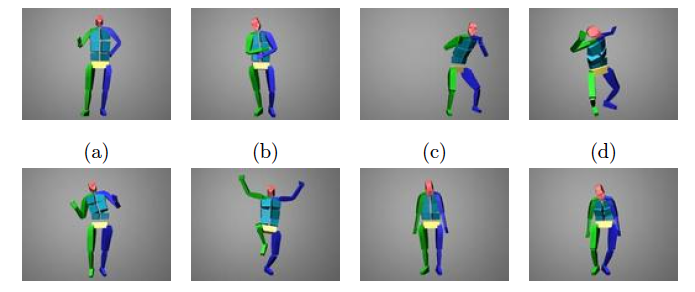
Kleinsmith and team used static posture images of affectively expressive avatars or “embodied agents” to test emotion recognition by volunteers from three cultures. From these findings, they developed cultural models for affective posture recognition.

Andrea Kleinsmith-avatarsThese results suggest both the impact of changing body postures to elicit different feeling states, and caveats when adopting expansive postures to activate power while interacting across cultural groups.

Ravindra De Silva

Ravindra De Silva

Encouragement to “Think Big, Play Big” may require specific recommendations for culturally appropriate action.

-*How do you demonstrate power when interacting with colleagues from different cultural backgrounds?

Nadia Bianchi-Berthouze

Nadia Bianchi-Berthouze

 RELATED POSTS:

Twitter  @kathrynwelds
Blog – Kathryn Welds | Curated Research and Commentary
Google+
LinkedIn Open Group Psychology in Human Resources (Organisational Psychology)
Facebook Notes

©Kathryn Welds

Unrealistic Optimism Drives Profitability

Overconfident decision-making in financial markets led to myriad negative consequences in the past decade, when companies underestimated business risks. 

Gilles Hilary

Gilles Hilary

In contrast to overconfidence, unrealistically optimistic judgments can result in increased profitability and market value, according to INSEAD’s Gilles Hilary and Benjamin Segal with Charles Hsu of Hong Kong University of Science & Technology.

Benjamin Segal

Benjamin Segal

Hilary, Hsu, and Segal demonstrated that over-optimism differs from overconfidence, and may result in larger growth projections.

Charles Hsu

Charles Hsu

The team drew on earlier work by University of Illinois’s Dirk Hackbarth that showed both overconfident, and overoptimistic managers chose higher debt levels and issued more new debt.
Hackbarth did not differentiate over-confident and over-optimistic investment behaviors, and reported that both tendencies reduce manager-shareholder conflict, which can increase firm value.

Dirk Hackbarth

Dirk Hackbarth

Static over-optimism” refers to an unrealistically positive view of the impact of one’s own actions on future outcomes.
In contrast, “dynamic overconfidence” refers to overvaluation of one’s skills and the accuracy of private information.
In addition, “dynamic overconfidence”  is associated with  underestimates of random events after several positive outcomes, according to Hackbarth.

Together, static over-optimism and dynamic overconfidence lead to “dynamic over-optimism” after successes.

Neil Weinstein

Neil Weinstein

The pervasiveness of this “rose-tinted glasses” view leading to over-optimistic assessments was demonstrated by Neil Weinstein of University of Arizona.
He investigated people’s beliefs about future positive and negative health events, discussed in a previous blog post.
Weinstein reported that people tend to believe negative events are less likely to happen to them than to others, whereas they expect they are more likely than other people to experience positive events.

Hilary’s team built on Hackbarth’s concepts by comparing North American companies’ quarterly earnings forecasts with analysts’ predictions and actual performance.
Then, they calculated the number of company-issued press releases containing optimistic language.

Optimistic performance forecasts were correlated with better-than-expected performance, suggesting that successes led to additional effort and positive expectations.

Hilary noted the potentiating effect of past successful performance, though it may lead to “burnout” after about four quarters due to the challenge of continually exceeding performance expectations.

The team noted that this cycle of over-optimism and burnout might be mitigated by instituting policies to moderate overestimates or underestimates future performance by rewarding executives who provide accurate forecasts.

Sheryl Winston Smith

Sheryl Winston Smith

Similarly, Temple’s Sheryl Winston Smith noted that optimistic entrepreneurs chose higher levels of debt financing relative to equity, facilitating patent-based and product-based innovation among nearly 5,000 US firms tracked by the Kauffman Firm Survey (KFS).

Young-Hoon Kim

Young-Hoon Kim

In contrast to these financial studies, Yonsei University’s Young-Hoon Kim, Nanyang Technical University’s Chi-yue Chiu and Zhimin Zou of University of Illinois reported mixed results for self-enhancing (overconfident) and self-effacing (pessimistic) biases on performance

Chiu Chi-Yue

Chiu Chi-Yue

Kim’s team posited that either over-optimistic or pessimistic biases lead to “self-handicapping” behavior, in which people perform under disadvantageous conditions that provide an explanation for any poor performance outcomes.

Although over-optimism may drive innovation and financial results, longer-term consequences may include performance “burnout,” reduced motivation, and lower performance.

-*How to you manage the impact of optimism bias and pessimism bias on judgments and performance?

Please follow-share-like www.kathrynwelds.com and @kathrynwelds

RELATED POSTS:

Twitter:  @kathrynwelds
Blog: – Kathryn Welds | Curated Research and Commentary
Google+ google.com/+KathrynWelds
LinkedIn Open Group Psychology in Human Resources (Organisational Psychology)
Facebook Notes:

©Kathryn Welds

Clothing Influences Thinking and Behavior, not Just Others’ Perceptions

A previous post highlighted the influence of the body on thinking, through “embodied cognition.”

Hajo Adam

Hajo Adam

An extension of this idea is “unclothed cognition,” the impact of clothing on thinking and behavior, according to Rice University’s Hajo Adam and Adam Galinsky of Northwestern University.

Adam and Galinsky considered the symbolic meaning of clothing and wearer’s physical experience by evaluating the impact of wearing a lab coat on participants’ task performance.

Adam Galinsky

Adam Galinsky

Before the experiments, volunteers said in a survey that they associated “attentiveness” and “carefulness” with “a lab coat.”
Next, participants completed a Stroop Test, a task that requires selective attention to differentiate words in incongruent colors (“red” presented in green letters), while wear a lab coat or their street clothes.

Volunteers performed better when they wore a lab coat than when they completed the same tasks while wearing street clothes.

In other experiments, Adam and Galinsky described the lab coat to some participants as a “doctor’s coat” and to others as a  “painter’s coat.”
Volunteers who wore a “doctor’s coatperformed better on sustained attention tasks and were better able to discriminate features in nearly-similar images, than those who wore a  “painter’s coat.” 

Joshua Davis

Joshua Davis

Clothing’s symbolic meaning as visual communication can influence the viewer’s attributions and the wearer’s behavioral alignment with the role suggested by clothing, argued Joshua I. Davis of Barnard College, who studied the effect of BOTOX injections on emotional experience.

Sandra Forsythe

Sandra Forsythe

Clothing’s impact on others’ evaluation of the wearer was further detailed by Sandra Forsythe, now of Auburn University collaborated with University of Tennessee’s Mary F. Drake, and Charles E. Cox.
They videotaped simulated job interviews of women wearing various styles of dress, and found that more than 75 human resources professionals recommended hiring female job applicants who wore more “masculine” attire than those wearing other styles of dress.

Norah Dunbar

Norah Dunbar

Clothing’s influence on the viewers’ impression of others’ credibility was investigated by University of Oklahoma’s Norah E. Dunbar and Chris Segrin of University of Arizona guided by their colleague Judee Burgoon‘s expectancy violation theory.

Chris Segrin

Chris Segrin

Two instructors gave lectures in undergraduate college classes, wearing either expected “appropriate” attire for this role, or wearing unconventionally casual clothing.
The instructors also provided either high interpersonal support or less rewarding interactions.

Judee Burgoon

Judee Burgoon

Dunbar and Segrin found that students were less influenced by unexpected attire when the instructor provided more social rewards.
They suggested that interpersonal demeanor can be even more influential than clothing in determining impressions of credibility and likability.

Similarly, the impact of clothing on judgments of competence and achievement for both students and teachers in Ohio high schools was demonstrated in research by Bowling Green State’s Dorothy Behling with Elizabeth Williams.

Anat Rafaeli

Anat Rafaeli

Clothing’s influence on impression formation and related organizational dynamics is based on attributes, homogeneity and conspicuousness, posited Anat Rafaeli of Technion, and Boston College’s Michael Pratt.

Michael Pratt

Michael Pratt

Clothing has been considered an important influence on others’ perception of the wearer, and Adam and Galinsky’s studies offer evidence that clothing can affect the wearer’s actual task performance.

-*How has clothing changed your workplace behavior and performance?
-*How do others treat you different depending on your attire?

Follow-share-like http://www.kathrynwelds.com and @kathrynwelds

RELATED POSTS:

Twitter  @kathrynwelds
Blog – Kathryn Welds | Curated Research and Commentary  
Google+
LinkedIn Open Group Psychology in Human Resources (Organisational Psychology)
Facebook Notes:

©Kathryn Welds

How Effective are Strategic Threats, Anger, and Unpredictability in Negotiations?

Most researchers conclude that negotiators who establish a collaborative atmosphere for a “win-win” solution achieve superior results.

Marwan Sinaceur

Marwan Sinaceur

However, Marwan Sinaceur of  INSEAD and Stanford’s Larissa Tiedens investigated the potentially-risky tactic of employing strategic anger in negotiations, and found that anger expressions increase expressers’ advantage and “ability to claim value” when negotiation partners think they have few or poor alternatives.

Larissa Tiedens

Larissa Tiedens

Sinaceur and Tiedens suggested that anger expression communicates toughness, leading most non-angry counterparts to concede more to an angry negotiator.
However, other studies report that people have more negative reactions when women display anger,

-*But what about the impact of “strategic” expressions of anger that aren’t actually felt?

Stephane Cote

Stephane Cote

Ivona Hideg

Ivona Hideg

University of Toronto’s Stéphane Côté collaborated with Ivona Hideg of Wilfrid Laurier University and University of Amsterdam’s Gerben van Kleef to evaluate the impact of surface acting (showing anger that is not truly felt) on the behavior of negotiation counterparts.

They found that disingenuous anger expressions can backfire, leading to intractable, escalating demands, attributed to reduced trust.

Gerben van Kleef

Gerben van Kleef

In contrast, “deep acting” anger that is actually felt, decreased negotiation demands, as demonstrated in Sinaceur and Tiedens’ work.

-*Are threats more effective than expressing anger in eliciting concessions in negotiation?

Christophe Haag

Christophe Haag

Sinaceur and team collaborated with Margaret Neale of Stanford and Emlyon Business School’s Christophe Haag, and reported that threats delivered with “poise,” confidence and self-control trump anger to achieve great concessions.
A potential negotiation “work-around” is expressing inconsistent emotions in negotiations.

Adam Hajo

Adam Hajo

Saraceur teamed with van Kleef with Rice University’s Adam Hajo, and Adam Galinsky of Columbia, and found that negotiators who shifted among angry, happy, and disappointed expressions made recipients feel less control over the outcome, and extracted more concessions from their counterparts.

Adam Galinsky

Adam Galinsky

Emotional inconsistency proved more powerful than expressed anger in  extracting concessions, so women may achieve superior negotiation outcomes with varied, unpredictable emotional expression.

-*How do you use and manage emotional expression in negotiations?

RELATED POSTS:

©Kathryn Welds

Air Time Matters: Speak Up in the First Five Minutes of a Meeting

More than thirty years ago, University of Florida’s Marvin Shaw observed that participation in small group approximates the 80/20 Principle:

Marvin Shaw

Marvin Shaw

In a 5 member team, 2 members make 70% of comments
In a  6 member team, 3 members make 70% of comments
In a  8 member team, 3 members make 67% of comments

Most of the comment contributors were men, and those who speak most are typically viewed as most influential, according to Melissa Thomas-Hunt of University of Virginia.
This suggests that women can be at a disadvantage in groups if they don’t speak up.

Melissa Thomas-Hunt

Melissa Thomas-Hunt

Thomas-Hunt found that women were less influential in small groups even when they possessed specific expertise in survival skills, a stereotypically male endeavor.
Further, women with elite knowledge were judged as less expert by others.

Conversely, men who possessed expertise were more influential than expert women.
Overall group task performance was affected by these dynamics:  Groups with a female expert made less accurate assessments than groups with a male expert, perhaps because females’ expertise was discounted or ignored due to gender-related expectations for specific competencies.

Christopher Karpowitz

Christopher Karpowitz

Women spoke less when there are fewer women in a group, but not when women predominated and decisions were made by majority rule, according to Christopher Karpowitz of Brigham Young University, Princeton University’s Tali Mendelberg and Lee Shaker of Portland State University.

Tali Mendelberg

Tali Mendelberg

They also found that women spoke equally in small groups when there were few women but the decision required unanimous vote.
One implication is that women benefit from building consensus when they are in the minority.

Powerful women who talk more than male counterparts incur backlash from both male and female observers, according to Victoria Brescoll of Yale.

Victoria Brescoll

Victoria Brescoll

In an experimental study, both female and male volunteers read about a female CEO who talked longer than others.  They judged her as significantly less competent and less suitable for leadership than a male CEO who was reported to speak for the same amount of time.

A high-power woman who talked much less than others was judged as equally competent and capable of leading as a high-power man who talked much more than others.
Raters were less generous in their ratings of a high-power male who talked much less than others:  He was judged as equally incompetent and unsuitable for leadership as a high-power female who talked much more than expected.

This suggests that both men and women are punished for behaviors different from gender-role expectations.

Lee Shaker

Lee Shaker

Women’s tendency not to speak up in groups begins well before they enter the workplace, found Harvard’s Catherine Krupnick.
She and her team investigated differences between male and female students’ participation in classroom discussion and the impact of the instructor’s gender on students’ participation.

They reviewed videotapes of 12 women and 12 men instructors, and concluded that male students talked two and a half times longer than female students when the instructor was male and the majority of the students were male — a frequent situation in many educational and work organizations.
On the other hand, female students spoke almost three times longer when instructors were female.

Women students were interrupted more frequently than their male counterparts, most often by other women, and leading them to withdraw from the discussion for the remainder of the class.

Krupnick posited that women’s lower participation in classrooms – and perhaps in other small groups – may be explained by their:

  • Unwillingness to compete against men,
  • Vulnerability to interruption,
  • Unwillingness to interject into men’s and other women’s long uninterrupted statements, known as “discourse runs,”
  • Individual differences in assertiveness, confidence, and speed of formulating responses.

Elizabeth Aries

Elizabeth Aries

Amherst’s Elizabeth Aries noticed that groups composed entirely of women students tended to have a participatory style in which women took turns and spoke for about equal amounts of time throughout the class hour.

In contrast, male groups appeared more contest-like, with extremely uneven amounts of talk per man.
They competed by telling personal anecdotes or raising their voices to establish hierarchies of participation, and this competitive style persisted in mixed-gender groups.

Kathleen Welch-Torres, then of Yale, compared women’s and men’s assertiveness in class discussions at Yale and Brown (mixed-gender institution) with women’s class participation at Wellesley and Smith (single-gender).
She reported that women at both of the mixed-sex institutions were verbally less assertive than men, by using “hedges,” qualifiers and questioning intonations.
However, women at the single-gender institutions Smith and Wellesley were more assertive than women at Yale and Brown and more assertive than men at the coeducational institutions.

Larraine Zappert

Larraine Zappert

Kendyll Stansbury

Kendyll Stansbury

Welch-Torres linked these behaviors to measures of self-esteem and her findings are similar to those of Stanford’s Laraine Zappert and Kendyll Stansbury  who reported that female graduate students held lower self-esteem, less trust in their judgments, and greater fear of making mistakes than male graduate students.

Recommendations to help women move toward fuller participation in small groups from Melissa Thomas-Hunt and Margaret Neale of Stanford include:
Margaret Neale

Margaret Neale

  • Before a meeting:
    • Ask trusted attendees to:
      • Support your ideas during the meeting,
      • Solicit your input in the meeting,
    • Refer to your specific expertise during the meeting,
    • Set a goal for number of contributions in the first five minutes of a meeting.
    • In a meeting:
      • If interrupted: Restate, rephrase and provide specific evidence based on expertise,
      • Showcase  others’ expertise by soliciting their input,
      • Create environment in which  other participants have equal opportunity to participate,
      • Urge members to consider each alternative, rather than disregarding suggestions presented by “lower status” individual.

-*How do you ensure that your expertise is recognized and influential in small group settings?

*What “best practices” do you apply to ensure active participation by women and minority-group members?

RELATED POSTS:

Twitter:    @kathrynwelds
Google+:
Blog: – Kathryn Welds | Curated Research and Commentary
LinkedIn Open Group Psychology in Human Resources (Organisational Psychology)
Facebook Notes:

©Kathryn Welds

Learning Mindsets Enable Employee Development at Work

David Perkins

David Perkins

People adopt differing mindsets when trying to achieve quality results and increase learning at work, according to Harvard’s David Perkins, Michele Rigolizzo, and Marga Biller.

They expanded the distinction between fixed mindset and growth mindset described by Stanford’s Carol Dweck, and assessed with a brief questionnaire.

  • Michele Rigolizzo

    Michele Rigolizzo

    Completion mindset focuses on finishing a routine task with little mental investment.
    Accidental learning occurs with this stance, and employees who experience fear of failure, impersonal work environments, and monotonous tasks usually operate with this mindset.

  • Performance mindset aims to complete a task  without reflecting on how to can re-apply the process in the future.

    Marga Biller

    Marga Biller

    An example is temporarily using a technology but not investing attention to become an expert user.
    Incidental learning is a by-product of this mindset, described by Columbia’s Victoria Marsick and Karen Watkins of University of Georgia.

  • Development mindset seeks to complete a task and to learn applicable approaches when completing similar future tasks.
    An example is leading an effective kickoff meeting to set the tone for productive work sessions.

    Victoria Marsick

    Victoria Marsick

    Intentional learning occurs with active involvement in observing, analyzing, and reflecting on the process.

To move beyond a Completion stance, Perkins and team suggested that organizational leaders  encourage quality work and active reflection on that work to set the expectation of a Development mindset.
In addition, leaders can also implement collaboration and feedback systems with time for reflection on completed tasks.

-*How do you enable team members to adopt a Development Mindset?

Follow-share-like http://www.kathrynwelds.com and @kathrynwelds

Related Posts:

©Kathryn Welds

Implicit Discrimination Associated with Meritocratic Beliefs, Low Empathy

Michael Young

Michael Young

Americans more than other nationalities, embrace the idea of meritocracy – that rewards are distributed based on merit, a combination of ability + effort with success, described by University of London’s Michael Young with Sheri Kunovich of Southern Methodist University, and Ohio State’s Kazimierz M. Slomczynski.

Satya Nadella

Satya Nadella

Microsoft’s CEO, Satya Nadella, made headlines when asked his advice for women who are uncomfortable asking for a raise at the 2014 Grace Hopper Celebration of Women in Computing.
He told more than 12,000 women: “It’s not really about asking for a raise, but knowing and having faith that the system will give you the right raise … It’s good karma. It will come back.”

Although his response resulted in widespread criticism, he may have been referring to the social penalty women experience when negotiating for salary increases and promotions.

Hannah Riley Bowles

Hannah Riley Bowles

Harvard’s Hannah Riley Bowles with Linda Babcock and Lei Lai of Carnegie Mellon demonstrated this social penalty when they showed volunteers videos of men and women asking for a raise using identical scripts.
Participants agreed to give both genders a pay increase, but evaluated women as “too aggressive” and not someone they would want to work with.
However, men in these salary negotiation situations were seen as “likable.”

Emilio Castilla

Emilio Castilla

The unequal impact of merit-based compensation on minorities was demonstrated in MIT’s Emilio J. Castilla’s analysis of almost 9,000 employees in support roles at a large service-sector company.
The organization espoused commitment to diversity and had implemented a merit-based compensation system intended to reward high-level performance and equitably reward employees.

Lei Lai

Lei Lai

Despite these egalitarian goals, women, ethnic minorities, and non-U.S.-born employees received smaller increases in compensation compared with white men, despite holding the same jobs, having the same performance score, working in the same units for the same supervisors.

These results illustrated what he called the performance-reward bias – the need for minority groups “to work harder and obtain higher performance scores in order to receive similar salary increases to white men.”

Stephen Benard

Stephen Benard

With his Indiana University colleague, Stephen Benard, Castilla uncovered the paradox of meritocracy” – organizations that espouse meritocratic values awarded a larger monetary reward to male employees compared with equally performing female employees.

Despite their positive intentions and policies, these organizations perpetuated unequal evaluations and rewards across equally performing employee groups.

Eric Luis Uhlmann

Eric Luis Uhlmann

In fact, people who think they are the most objective exhibited greatest evaluation bias, found Northwestern’s Eric Luis Uhlmann and Geoffrey L. Cohen of University of Colorado.
They attributed this finding to overconfidence in objectivity, leading to lack of self-scrutiny and self-assessment of potential and implicit bias.

Corinne Moss-Racusin

Corinne Moss-Racusin

This bias was also demonstrated when volunteers provided significantly more positive evaluations of resumes were attributed to whites and men than identical resumes linked to minority-group members and women, reported by Yale’s Corinne A. Moss-Racusin, John F. Dovidio, Victoria L. Brescoll, Mark J. Graham, and Jo Handelsman.

John Dovidio

John Dovidio

Since egalitarian aspirations and performance management systems do not result in equitable reward distribution, MIT’s Castilla advocated increased transparency and accountability by creating a performance-reward committee to monitor compensation increases and to share information about pay segmented by gender, race, and nationality.
Five years after these changes were introduced in companies Castilla studied, he found that the demographic pay gap had disappeared.

Grit Hein

Grit Hein

Another way to reduce bias is to increase empathy, found Universität Bern’s Grit Hein, Jan B. Engelmann of Tinbergen Institute, and University of Zurich’s Philippe N. Tobler, with Marius C. Vollberg of University College London, in their study of 40 young men of Swiss or Balkan descent.

Participants and two research confederates received an electric charge on the back of the hand.
Next, one of the two confederates was attributed a typical Balkan name or a Swiss name, and was designated a “decision maker.”

Jan B. Engelmann

Jan B. Engelmann

Volunteers were then told they would receive “painful shocks,” but the “decision maker” could prevent this “by giving up money he would otherwise earn.”
Participants received help from the other person 15 times out of 20 trials, and received a shock five times.

Two new confederates, one with a Swiss name and one with a Balkan name, replaced the first two and the participant watched as one of them received the painful electrical pulses.
A brain scan measured the volunteers’s level of empathy for the person receiving the shock.

Philippe Tobler

Philippe Tobler

When the confederate with the Balkan minority name “helped” the participant avoid a shock by “sacrificing” a payoff, the volunteer’s brain scans demonstrated increased empathy for both the specific helper, and for other Balkan people.

The team interpreted this finding to suggest, “…empathy with an out-group member can be learned, and generalizes to other out-group individuals.”

If this trend can be replicated in the workplace by increasing organizational and managerial empathy for members of minority groups during the appraisal process, organizational rewards may be more equitably distributed.

-*How do you reduce bias in appraisal and reward processes?

Follow-share-like http://www.kathrynwelds.com and @kathrynwelds

Related Posts:

Twitter:  @kathrynwelds
Google+
LinkedIn Groups Psychology in Human Resources (Organisational Psychology)
Facebook
Blog: – Kathryn Welds | Curated Research and Commentary

©Kathryn Welds