Category Archives: Innovation

Innovation

Integrating Natural Sciences and Business to Consider Strategy as “Structured Chaos”

Shona Brown

Shona Brown

Former Google Senior Vice President of Business Operations Shona Brown and Stanford Engineering Professor Kathleen Eisenhardt assert in their best-selling book, Competing on the Edge: Strategy as Structured Chaos, that “the key driver of superior performance is the ability to change. Success is measured by the ability to survive, to change, and ultimately to reinvent the firm constantly over time.”
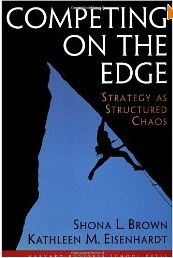
The book investigates matched pairs of anonymized companies in the computer industry as an example of strategy in fast-moving, unpredictable, competitive markets.

It draws upon concepts from the natural sciences, such as evolutionary theory and natural selection, as an analogy to change in businesses.

The authors state that decisions on what to structure or not, draw on:

-Improvisation
-Co-adaptation
-Regeneration
-Experimentation
-Time-pacing

These considerations set the pace of change by “balancing on the edge of time” from the past to the future.
They assert that these five phenomena enable a “semi-coherent” strategy, that is “unpredictable, uncontrolled, inefficient, proactive, continuous, diverse.”

Kathleen Eisenhardt

Kathleen Eisenhardt

Brown and Eisenhardt define natural science concepts in business terms:

• Complexity Theory
• Evolutionary Theory
• Dissipative Equilibrium
• Coadaptation
• Natural Selection
• Mutations
• Complexity Catastrophe
• Error Catastrophe
• Repeated Layering
• Genetic Algorithm
• Recombination
• Rearchitecture
• Modularity
• Entrainment

The authors advise to move to “the edge of time” and “the edge of chaos”, and offer guidelines including:

• Prune to reveal the core of the business
• Build the business through growth, not assembly, of modular parts
• Recognize that the business’s starting point and the order of implementing change strategies, are among outcome determinants
• Devote 15% of the product portfolio to experimental probes
• Apply successes from experimental probes in new ways
• Institute regular planning meetings focused on the future
• Exploit current capabilities in new ways
• Develop time-pacing through regular benchmark reviews
• Watch for missing linkage between key processes and innovation elements
• Use “patching” to match the best people resources with required tasks

This book offers an original examples and metaphors for change strategies in business, including jazz improvisation, The Tour de France, American Baseball.

-*What models do you use to understand and execute business strategy?

LinkedIn Open Group – Business Strategy & Competitive Strategy Forum
Twitter: @kathrynwelds
Facebook Notes:
Google+
Blog
: – Kathryn Welds | Curated Research and Commentary

©Kathryn Welds

 

“Smart Failure” to Manage in a Fast-Changing World

Eddie Obeng

Eddie Obeng

Eddie Obeng’s dizzyingly rapid-fire TED talk asserts that we live in a “New World” in which “the local environment of individuals, organizations and governments changes faster than we can learn.”

As a result, he contends that most commonly-used concepts, best practices and assumptions to plan, manage and lead, organizations are obsolete.

He refers to this “New World” as the “World After Midnight” and shares discussion and observations.

To offer a forum to discuss and advance this approach with a “continuous link between learning and implementation”, he established Pentacle (The Virtual Business School), which offers tools and courses, with an emphasis on executing strategy through project management best practices.

Obeng draws on his experience as an engineer at Royal Dutch Shell, then Professor at the School of Entrepreneurship and Innovation, Henley Business School, and a Council Member at the UK Design Council in his books:

Like the Silicon Valley mantra “Fail Fast” to capture relevant learning experiences, Obeng urges “Smart Failure” through multiple experiments or trials, and rapid prototyping.

-*Where have you seen “Fast Failure” aid workplace innovation?

Twitter
: @kathrynwelds
Google+:
LinkedIn Open Group – Stanford Social Innovation Review:
Facebook Notes:

Blog: – Kathryn Welds | Curated Research and Commentary

©Kathryn Welds

Business Stories as Narratives

Paul Smith

Paul Smith

Paul Smith’s book, Lead with a Story: A Guide to Crafting Business Narratives That Captivate, Convince, and Inspire, builds on thought leadership (references below), with tools to develop effective business narratives in response to 21 business challenges and “five 5 E” leadership scenarios:

Envision Success
Environment for Winning
Energize the Team
Educate People
Empower Others

Smith explains that business effective stories are:Lead With a Story
• Simple
• Timeless
• Inspiring
• Respectful
• Easy to understand
• Segue easily into appropriate learning modes for various ways of taking in information
• Compatible with business discourse

Peter Guber

• “contagious” (amenable to retelling and viral broadcast such as the “purposeful narrative” discussed by Peter Guber – see previous posting below)

• proof-points

He explains “four levels of discourse” to understand story as a rhetorical device, and suggests using more than one of these in memorable business stories:

Exposition explains with information
Description makes vivid with compelling details
Narration tells a story or explains a sequence
Argumentation convinces with logic or evidence.

In addition to these elements, Smith recommends weaving in:
• Metaphors
• Emotion
• Realism

Surprise “to sear the entire story in your audience’s long-term memory” because memories consolidate shortly after an event (or its story) happens

Specific, familiar examples of outcomes that have occurred to individuals like themselves, and vivid individual characterizations

Style: Use the CAR mnemonic to “drive” a story:

o Context: Sufficiently-detailed time and location of the story to “set the stage” for dramatic action and “lesson”
o Action: Catalyst, turning point, climax and final action towards resolution
o Result: The outcome, and its importance or “lesson learned.

Smith’s book joins an expanding list of valuable references to increase business narrative impact:

Winning the Story Wars: Why Those Who Tell (and Live) the Best Stories Will Rule the Future

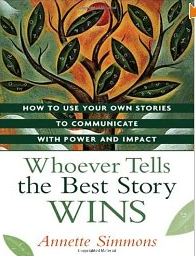
Whoever Tells the Best Story Wins Whoever Tells the Best Story Wins
The Elements of Persuasion: Use Storytelling to Pitch Better, Sell Faster & Win More Business

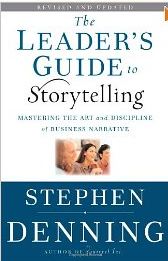
The Leader’s Guide to Storytelling: Mastering the Art and Discipline of Business Narrative

Tell to Win: Connect, Persuade, and Triumph with the Hidden Power of Story

Related Posts:

-*What elements do you consider when crafting a business story for greatest impact?

LinkedIn Open Group Mindful Leadership
Twitter: @kathrynwelds
Google+:
Facebook Notes:
Blog: – Kathryn Welds | Curated Research and Commentary

©Kathryn Welds

Two Models of Business Innovation, Courtesy of Two Kaplans

Two Kaplans present differing but possibly compatible innovation guidelines in recent books.
Both offer vivid and familiar business examples, and argue that transformational change rather than incremental change is required to drive innovation.

Saul Kaplan

Saul Kaplan

Saul Kaplan founded Business Innovation Factory (BIF), after serving as the Executive Counselor to the Governor of Rhode Island on Economic Growth and Community Development, Executive Director of the Rhode Island Economic Development Corporation, and Senior Partner at Accenture’s Health & Life Science practice.

He boldly states in his book, The Business Model Innovation Factory: How to Stay Relevant When the World Is Changing,  that business transformations that underlie innovation start by “transforming ourselves” 

This Kaplan says the top three action steps for innovators are:
• Do more stuff
• Use a different lens
• Enable random collisions of unusual suspects

He advises innovators to:
• Embrace a culture of “fail early, fail often” to enable risk-taking
• Think and act with the system in mind

Soren Kaplan

Soren Kaplan

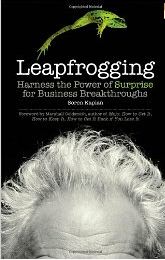
Soren Kaplan offers LEAPS as an acronym of innovation practices in his well-received book Leapfrogging: Harness the Power of Surprise for Business Breakthroughs 

• Listen: Start with yourself, not the market
• Explore: Go outside to stretch the inside
• Act: Take small steps again, again, and again
• Persist: Take the surprise out of failure
• Seize: Making the journey part of the final destination

He advocates “optimistic persistence” in the face of repeated trials that depart from intended outcomes, and reframing these efforts as progressive learning that inspires continued forward efforts.
Though he attributes effective business to achieving “surprise”, this effect has also been characterized as “differentiation” and “customer delight.”
This Kaplan acknowledges that many business executives openly state that they do not like surprises, and that they hire people to prevent surprises.

Both Kaplans recommend breaking conceptual limitations and perceptual tunnel vision, and offer compatible tips for systems thinking and courageous experimentation to drive business innovation.

-*What models of business innovation have been most effective in igniting creative problem solving in your work environment?

LinkedIn Open Group Stanford Social Innovation Review
Twitter@kathrynwelds
Google+
Facebook Notes:
Blog: – Kathryn Welds | Curated Research and Commentary

©Kathryn Welds

Crash Course on Innovation, Creativity

Tina Seelig

Tina Seelig

Tina Seelig, Executive Director for the Stanford Technology Ventures Program (STVP), the entrepreneurship center at Stanford University’s School of Engineering, and the Director of the National Center for Engineering Pathways to Innovation (Epicenter), offers a “crash course” in creativity.

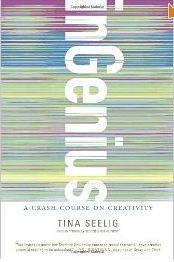
She summarized her recommendations in her book, inGenius: A Crash Course on Creativity, and explored factors that stimulate and inhibit creativity in individuals, teams, and organizations, including framing problems, challenging assumptions, and creative teams.

She introduces six interdependent elements of the “Innovation Engine”:

• Internal
o Information that becomes knowledge (fuel),
o Imagination (a catalytic converter that transforms knowledge into new ideas),
o Attitude (a spark that ignites the Engine, setting it in motion).

• External
o Resources (a community’s assets),
o Habitats (physical locations within which the Engine functions at peak performance),
o Culture (shared beliefs, values, and behaviors of the given community).

inGenius: A Crash Course on Creativity also discusses models and tools that can be applied to class projects:

o The “Theory of Inventive Problem Solving” or TRIZ (the Russian acronym) methodology (Pages 50-51)
o A two-by-two creativity/pressure matrix (106-108)
o Habitats that simulate or inhibit creativity (128-131)
o Edward de Bono’s “Six Thinking Hats” model/exercise (128-131)
o Creating a habitat that encourages and supports risk taking and experimentation (160-163)
o Tapping into and activating strong emotional engagement (179-180)
o Précis: Knowledge, Imagination, and Attitude (185-189)

Seelig was awarded the 2009 Gordon Prize from the National Academy of Engineering, recognizing her as a national leader in engineering education, and the 2008 National Olympus Innovation Award, and the 2005 Stanford Tau Beta Pi Award for Excellence in Undergraduate Teaching.
She earned her Ph.D. in Neuroscience from Stanford University Medical School and has written 16 popular science books and educational games.

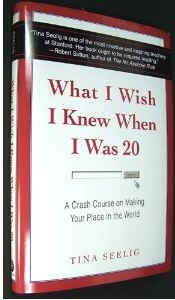
Another of Seelig’s books is What I Wish I Knew When I Was 20: A Crash Course on Making Your Place in the World

-*What “Innovation Engine” components have been most effective in generating creative solutions in your organization?

LinkedIn Open Group Stanford Social Innovation Review
Twitter:  @kathrynwelds
Google+
Facebook Notes:
Blog: – Kathryn Welds | Curated Research and Commentary

©Kathryn Welds

“Zooming” to Shift Strategic Thinking Perspective

Rosabeth Moss Kanter

Rosabeth Moss Kanter

Rosabeth Moss Kanter of Harvard Business School suggests the electronic metaphor of “zooming in” and “zooming out”, to characterize a critical practice of changing points of view in strategic thinking.

She says that “zooming” represents the flexible shift from detail to context to better consider other routes to the ultimate goals.

Kanter observed the traditional association of women with the “zoom in” perspective to focus on detail and transactions (such as CFO roles), whereas men are often found in “big-picture” roles that define vision and direction (such as CEOs).

She argues for systematically incorporating both “zooming in” and “zooming out” in strategic problem analysis, and for recognizing potential biases that may exclude men from roles that focus on “zooming in” and women from roles that emphasize “zooming out.”

-*What practices do you use to intentionally shift your perspective from “big picture” to implementation details?

LinkedIn Open Group Women in Technology (EMC)
Twitter
Google+
Facebook Notes:
Blog: – Kathryn Welds | Curated Research and Commentary

©Kathryn Welds