Tag Archives: Business Communication

Business Communication

Business Storytelling = Trance Induction?

Jonathan Brill

Jonathan Brill

Jonathan Brill of Prolific.com asserts that storytelling in sales situations can be memorable, evocative, and often persuasive because stories engender:

• Trust-credibility
• Engagement-interest-attention
• Comprehension
• Transformation
• Vision
• Sharing

Brian Sturm

Brian Sturm

Brill referred to a model of storytelling developed by Brian Sturm, a professor at University of North Carolina’s School of Information and Library Science, who Sturm asserts that storytelling induces a “qualitatively different state of consciousness”, like “a light trance.”

Sturm surmises that trance can be induced ”when stories begin with paradoxical or nonsensical premises that engage both the more logical functions associated with the ‘left brain’ and non-verbal, emotive, creative elements associated with the ‘right brain’.”

He observes that stories “create an immersive, powerful world” that the listener may “struggle to gain access.”
In addition, stories “organize information” to “connect data points.”

Sturm notes that stories convey emotions and opportunities to learn from the example of winners and losers, so stories can build a sense of community and the capacity for empathy through shared experience.

He presents a seven-stage model of the Storylistening Experience in this video.

Mike Bonifer

Mike Bonifer

Brill also drew on Mike Bonifer’s discussion of the difference between “Newtonian narrative” vs “Quantum narrative,” which aligns to the distinction between a linear, logical, rational story in contrast to an organically emerging story suffused with emotion, imagery, and metaphor.

Like Sturm, Bonifer sees story as a way to organize information, and he adapts theatrical improvisation methods to business environments.
Bonifer sees improvisation as a “narrative engine” in the context of his ‘Five Act’ methodology for business consulting:

-Listen
-Connect
-Collaborate
-Adapt
-Perform

-*Where have you seen business stories induce “trance”?

LinkedIn Open Group – Mindful Leadership
Twitter: @kathrynwelds
Google+:
Facebook Notes:

©Kathryn Welds

Self-Marketing: Improve your PVI: Sharpen Perception, Increase Visibility, Exert Influence

Joel Garfinkle

Joel Garfinkle

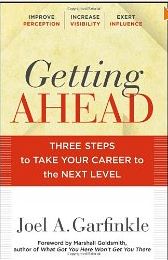
Joel Garfinkle emphasizes the importance of making your accomplishments and contributions visible to peers and executive: Self-marketing as a career development strategy in his book, Getting Ahead: Three Steps to Take Your Career to the Next Level

His extroverted persona encourages even the most introverted professional to speak up and showcase work contributions to guide career development instead of waiting to be noticed among a field of many able contributors.

-*What practices are effective and acceptable to increase professional visibility?

LinkedInOpen Group – Women in Technology (sponsored by EMC)
Twitter: @kathrynwelds
Google+
Facebook Notes:

©Kathryn Welds

Developing “Charisma” and “Presence”

Olivia Fox Cabane

Olivia Fox Cabane

Olivia Fox Cabane integrated research findings from social psychology and neuropsychology with principles of Emotional Intelligence and “Practical Buddhist Philosophy” in her book, The Charisma Myth: How Anyone Can Master the Art and Science of Personal Magnetism

She concluded that charismatic behaviors are based on managing internal state and beliefs through self-awareness to focus on others and “make them feel good.”

She found that “charisma” or “presence” is composed of:

•Presence – mindful attention, patient listening, avoiding interruption

•Power – appearance, clothing, occupy space, positive wording (avoid “don’t”), placebo effect

•Warmth – chin down, eye contact, Duchenne smile (mouth corners, eye corners), gratitude, compassion, appreciation – counteract “hedonic adaptation”

•Goodwill – wishing the other person well

•Empathy – understanding the other’s experience

•Altruism

•Compassion – a combination of empathy+goodwill

•Forgiveness of self and others

•Self-compassion – self-acceptance. Positively correlated with emotional resilience, sense of personal responsibility, accountability, sense of connectedness, life satisfaction, positive relationships with others, self-confidence, willingness to admit errors, low self-pity, low depression, low anxiety, improved immune system functioning

•”Metta” – loving kindness to self, others

Fox Cabane offered three “quick fixes” to increase your “charisma”:

•Lower the intonation of your voice at the end of your sentences (no “Valley Girl talk”…)
•Reduce the speed and rapidity of nodding
•Pause for two seconds before you speak

-*When you see a charismatic person in action, what behaviors and attitudes add to the interpersonal impact and appeal?

©Kathryn Welds

3P Marketing to Define, Communicate Personal Brand

Rita Allen

Rita Allen

Rita B. Allen defines 3 Ps Marketing to create personal brand and effectively market yourself in an increasingly competitive, global employment landscape.

.Preparation:
-Conduct self-assessment and “due diligence”
-Define brand differentiators and subject matter expertise
-Articulate positioning statement (“elevator pitch”)
-Curate your professional network

.Packaging:
-Create your portfolio (resume, CV, performance reviews, awards, presentations, articles, references, testimonials, community and professional service, continuing education)
-Expand alliances with relevant thought leaders

.Presentation:
-Practice and refine delivery of your brand message
-Develop strong active listening, presentation, and interpersonal skills
-Continuously enhance your brand

This approach helps answer:
• What are your “value-adds”, your unique differentiators?
• What is your personal brand?
• How comfortable are you articulating your brand?
• How do you continuously enhance your brand?

-*What elements do you consider when communicating your personal brand?

LinkedIn Open Group – Social Media Marketing
Twitter: @kathrynwelds
Google+
Facebook Notes:

©Kathryn Welds

Five Elements to Construct a Good Story

Robert Dickman

Robert Dickman

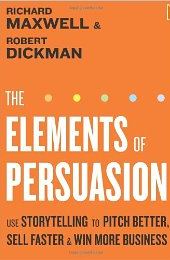
Robert Dickman and Richard Maxwell weigh in on storytelling as a business persuasion tool in their book, The Elements of Persuasion: Use Storytelling to Pitch Better, Sell Faster & Win More Business

Richard Maxwell

Richard Maxwell

They discuss storytelling as a persuasion method in this four minute video

They assert that a high-impact story contains the following elements:

1) Passion conveys authenticity, and makes the story memorable

2) Protagonist or hero (which might be an individual, group, or community) can be respected, liked, and engages and inspires interest, caring

3) Antagonist presents a challenge to the Protagonist, and this conflict engages interest and caring about the characters and outcome

4) Awareness, in which the protagonists, antagonists, and observers learn something, the kernel of the story’s dramatic impact

5) Transformation, or meaningful change during the story

Nancy Duarte

Nancy Duarte

These elements have also been identified by well-known story experts including Nancy Duarte, whose books, Resonate and slide:ology, have been best-sellers.

Annette Simmons

Annette Simmons

Annette Simmons  is another expert whose book, Whoever Tells the Best Story Wins: How to Use Your Own Stories to Communicate with Power and Impact, has garnered attention.

Jonah Sachs

Jonah Sachs

Jonah Sachs’ 2012, Winning the Story Wars: Why Those Who Tell (and Live) the Best Stories Will Rule the Future, weaves together examples from various disciplines including marketing, advertising, classic mythology, as well as psychology and biology.

He characterized it as “a call to arms”, but its more practical contribution is highlighting the transformative power of social media in contemporary story-telling aimed at influencing and persuading.

-*What elements have you seen in stories that have most persuaded and motivated you?

LinkedIn Open Group – Stanford Social Innovation Review
Twitter: @kathrynwelds
Google+
Facebook Notes:

©Kathryn Welds