Category Archives: Storytelling

Storytelling

Making Magic Meaningful as a Life Metaphor

Kim Silverman

Kim Silverman

Kim Silverman is Principal Research Scientist at Apple, and holds a Ph.D. in Experimental Psychology from Cambridge University.
Before his academic credentials, he sharpened his skills as a magician and cultivated an appearance similar to that of Hogwarts’ Professor Albus Percival Wulfric Brian Dumbledore.
He is a president of the Society of American Magicians (Palo Alto), and a Magician Member of the Academy of Magical Arts.

He describes his “hobby” as “performing magic in a meaningful way that gives people something they can take away with them, to make them feel better about themselves and their lives, and thereby thrive more effectively.”

Silverman believes that magic can change the way we think about our lives:

-Things that seem impossible may be possible
-Things that are separated and broken may be rejoined
-There is always a way
-We can get free from something that holds us back
-When we feel trapped by a problem, it is just an illusion.

He asserts that magic provides a change of perspective from negative thoughts, and provides a broader perspective.
He acknowledges that suffering is an intrinsic part of human life and that it brings us together, and through it all, we can experience magic through our relationships.

Silverman concludes that things might not be as they appear, so there is hope, and this is an idea worth sharing.

-*How can the metaphors of perceptual illusion accelerate problem-solving in complex situations?

©Kathryn Welds

Business Influence as “Enchantment”

Guy Kawasaki

Guy Kawasaki

Guy Kawasaki, former Chief Evangelist at Apple, co-founder of Alltop.com, and author of Enchantment: The Art of Changing Hearts, Minds, and Actions, shared with Stanford University entrepreneurship students his conviction that business influence or “enchantment” is the foundation of successful entrepreneurship.

He maintains that business influence, or “charisma”, or persuasiveness, is based on the following characteristics and behaviors.

Likeability
• Smile, engaging the corner of eyes (“crow’s feet”!) of Duchene smile
• Handshake, drawing on University of Manchester research, for the optimal handshake to engage social connection
• Dress equal to audience, not more formally or more casually

Trustworthiness
• Must trust others in order to have others trust you
• “Believe that the world is a non-zero sum game”
• “Default to Yes: How can I help this person?”
• Create something (product, services) DICEE for the listener
o D-eep
o I-ntelligent
o C-ompleteness
o E-mpowering
o E-legant

In promoting products and services, he advises:

• Branding must be “short, sweet, swallowable”: “Mantra, not Mission Statement.”
[Kawasaki’s mantra is “Empower People”]

• Conduct pre-mortem to course-correct: Pretend that the company failed; use diagnosis to course-correct

• Launch product or service by telling a compelling story

• “Plant many seeds: The world has been inverted: LonelyBoy15 needs to embrace your product and he encourages his contacts to embrace your product.”

• “Put your prototype out there because you never know who your LonelyBoy15 will be.”

• Make salient points, things that matter to listeners

• Overcome resistance via:
o Social proof (“others are doing it, so it must be ok”)
o “Find a bright spot – don’t fix something for the nay-sayers; use what is working”
o Enchant all the influencers. “The higher you go, the thinner the air, and the more difficult to support intelligent life. If you deal with CXOs, you will deal with the dumbest people. Look for the influencer, in the middle or bottom.”

• Make something endure
o Don’t default to using money; cultivate genuine “belief” and “commitment”
o Invoke reciprocity –“pay it forward”.
When the person expresses gratitude, say, “I know you would do the same for me.”
Enable the reciprocity to “alleviate the guilt” the other person experiences
o Build an ecosystem beyond your product including all interested stakeholders, users

• Learn to speak
o Customize the introduction: verbally, photos
o Sell your idea
o 10-20-30 rule: 10 slides, 20 minutes, 30 point font

• Provide value via social media
o Information
o Insight, meaning

o Assistance
o Remove the speed bumps, and obstacles to adoption
o Engage within 24 hours – “fast, many, often: it is core to your existence”

• Enchant up
o “Drop everything and whatever the boss asks: Just do it”
o Prototype fast – exceed expectations, deliver early
o Deliver bad news early, with ways to correct

• Enchant down
o Master
o Autonomy: Empower action, convey trust of others’ judgment
o Purpose
o Never ask others to do what you wouldn’t: “Suck it up”

-*How do you use “enchantment” to influence others?

LinkedIn Open Group – The Executive Coach
Twitter: http://www.twitter.com/kathrynwelds
Google+
Facebook Notes:
Blog: – Kathryn Welds | Curated Research and Commentary

©Kathryn Welds

Five Questions to “Work Any Room”

Allison Graham

Allison Graham

Allison Graham asserts in her book, From Business Cards to Business Relationships: Personal Branding and Profitable Networking Made Easy,  that the goal of conversation at business and social events is to determine whether there is enough common ground to connect again.

She offers five questions to start conversations with people you’ve never met before:

• “What’s your connection to the event?
This question can uncover mutual contacts

• “What’s keeping you busy when you’re not at events like this or at work?

• “Are you getting away this summer?
This question can lead to conversations about family, reveal special interests and travel

• “Are you working on any charity initiatives?
This question makes it easy to launch into a deeper connection, revealing values and priorities

• “How did you come to be in your line of work?
For many, the path to where they are today can be an inspiring or challenging journey, full of surprise, suspense, and drama

Graham concludes that:

• Each person decides during the initial contact whether there is enough connection to warrant future interaction

• During these small conversations, people form their opinions about whether they like you, trust you, and believe you’re competent

• Match the depth of dialogue to the environment

• Your words may be forgotten, but how you make people feel will be remembered

• Relaxation, full engagement, genuine interest, enable the conversation to “flow”

-*How do you prepare for professional “networking” with people you’ve never met before?

LinkedIn Open Group – The Executive Coach
Twitter: @kathrynwelds
Google+
Facebook Notes:
Blog: – Kathryn Welds | Curated Research and Commentary

©Kathryn Welds

Business Storytelling = Trance Induction?

Jonathan Brill

Jonathan Brill

Jonathan Brill of Prolific.com asserts that storytelling in sales situations can be memorable, evocative, and often persuasive because stories engender:

• Trust-credibility
• Engagement-interest-attention
• Comprehension
• Transformation
• Vision
• Sharing

Brian Sturm

Brian Sturm

Brill referred to a model of storytelling developed by Brian Sturm, a professor at University of North Carolina’s School of Information and Library Science, who Sturm asserts that storytelling induces a “qualitatively different state of consciousness”, like “a light trance.”

Sturm surmises that trance can be induced ”when stories begin with paradoxical or nonsensical premises that engage both the more logical functions associated with the ‘left brain’ and non-verbal, emotive, creative elements associated with the ‘right brain’.”

He observes that stories “create an immersive, powerful world” that the listener may “struggle to gain access.”
In addition, stories “organize information” to “connect data points.”

Sturm notes that stories convey emotions and opportunities to learn from the example of winners and losers, so stories can build a sense of community and the capacity for empathy through shared experience.

He presents a seven-stage model of the Storylistening Experience in this video.

Mike Bonifer

Mike Bonifer

Brill also drew on Mike Bonifer’s discussion of the difference between “Newtonian narrative” vs “Quantum narrative,” which aligns to the distinction between a linear, logical, rational story in contrast to an organically emerging story suffused with emotion, imagery, and metaphor.

Like Sturm, Bonifer sees story as a way to organize information, and he adapts theatrical improvisation methods to business environments.
Bonifer sees improvisation as a “narrative engine” in the context of his ‘Five Act’ methodology for business consulting:

-Listen
-Connect
-Collaborate
-Adapt
-Perform

-*Where have you seen business stories induce “trance”?

LinkedIn Open Group – Mindful Leadership
Twitter: @kathrynwelds
Google+:
Facebook Notes:

©Kathryn Welds

Self-Marketing: Improve your PVI: Sharpen Perception, Increase Visibility, Exert Influence

Joel Garfinkle

Joel Garfinkle

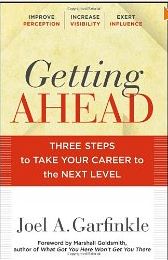
Joel Garfinkle emphasizes the importance of making your accomplishments and contributions visible to peers and executive: Self-marketing as a career development strategy in his book, Getting Ahead: Three Steps to Take Your Career to the Next Level

His extroverted persona encourages even the most introverted professional to speak up and showcase work contributions to guide career development instead of waiting to be noticed among a field of many able contributors.

-*What practices are effective and acceptable to increase professional visibility?

LinkedInOpen Group – Women in Technology (sponsored by EMC)
Twitter: @kathrynwelds
Google+
Facebook Notes:

©Kathryn Welds

Five Elements to Construct a Good Story

Robert Dickman

Robert Dickman

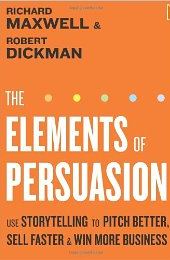
Robert Dickman and Richard Maxwell weigh in on storytelling as a business persuasion tool in their book, The Elements of Persuasion: Use Storytelling to Pitch Better, Sell Faster & Win More Business

Richard Maxwell

Richard Maxwell

They discuss storytelling as a persuasion method in this four minute video

They assert that a high-impact story contains the following elements:

1) Passion conveys authenticity, and makes the story memorable

2) Protagonist or hero (which might be an individual, group, or community) can be respected, liked, and engages and inspires interest, caring

3) Antagonist presents a challenge to the Protagonist, and this conflict engages interest and caring about the characters and outcome

4) Awareness, in which the protagonists, antagonists, and observers learn something, the kernel of the story’s dramatic impact

5) Transformation, or meaningful change during the story

Nancy Duarte

Nancy Duarte

These elements have also been identified by well-known story experts including Nancy Duarte, whose books, Resonate and slide:ology, have been best-sellers.

Annette Simmons

Annette Simmons

Annette Simmons  is another expert whose book, Whoever Tells the Best Story Wins: How to Use Your Own Stories to Communicate with Power and Impact, has garnered attention.

Jonah Sachs

Jonah Sachs

Jonah Sachs’ 2012, Winning the Story Wars: Why Those Who Tell (and Live) the Best Stories Will Rule the Future, weaves together examples from various disciplines including marketing, advertising, classic mythology, as well as psychology and biology.

He characterized it as “a call to arms”, but its more practical contribution is highlighting the transformative power of social media in contemporary story-telling aimed at influencing and persuading.

-*What elements have you seen in stories that have most persuaded and motivated you?

LinkedIn Open Group – Stanford Social Innovation Review
Twitter: @kathrynwelds
Google+
Facebook Notes:

©Kathryn Welds