
Confidence mobilizes people’s performance and increases others’ perceptions of competence, likeability, and persuasiveness – but may lead to careless errors that undermine performance.

David Dunning
Women and men show significantly different levels of confidence, with cascading effects on performance and participation in specific occupations.
For example women tend to underestimate their performance in scientific reasoning, but actually perform about equally to men, found Cornell’s David Dunning and Washington State University psychologist Joyce Ehrlinger in their investigation of women’s low representation in Science, Technology, Engineering, and Mathematics (STEM) academic programs and work roles.
They concluded that women underestimate their performance, based on lower levels of confidence.

Joyce Ehrlinger
In a related tasks, Dunning and Ehrlinger invited these volunteers to participate in a science competition for prizes.
Women were less likely to accept the invitation than men, also attributed to lower confidence in their capabilities in scientific tasks.
The researchers pointed to low confidence as a source of women’s proportionally lower participation in Science, Technology, Engineering, and Mathematics (STEM) job roles.

Jessica Kennedy
Confidence – even unjustified confidence – seems to lead observers to perceive assured individuals as competent, high status leaders, found Wharton’s Jessica A. Kennedy, Cameron Anderson of University of California at Berkeley, and Don A. Moore.

Cameron Anderson
They asked more than 240 students to estimate their confidence in identifying “historical” names and events, which included real and bogus entries.
Some participants said they could identify items that were actually fake, indicating that they believed – or wanted to convey – they knew more than they actually did.

T Don A Moore
Then, Kennedy and team asked participants to rate each other based on status in the group.
Volunteers who said they could identify the most fraudulent items were rated as most prominent in the group, suggesting that confidence, even false confidence, contributes to perceived status.
The team suggested that overconfident volunteers genuinely believed their self-assessments, their confidence persuaded their peers of their task skill and commitment to the group’s success.

Ernesto Reuben
“Honest overconfidence,” was also observed by Ernesto Reuben of Columbia, Paola Sapienza of Northwestern University, and University of Chicago’s Luigi Zingales, in their finding that men rated their performance on a set of math problems to be about 30 percent better than it was, whereas women underestimated their performance.

Carol Dweck
The power of honest and unjustified confidence may be rooted in childhood socialization patterns, observed Stanford’s Carol Dweck: “Boys’ mistakes are attributed to a lack of effort (whereas)…girls … see mistakes as a reflection of their deeper qualities.”
These different types of feedback lead men to attribute negative outcomes to external factors like unfairly difficult task, but women attribute undesirable results to their personal qualities like low ability.
Confidence is reflected in employees’ willingness to speak in work settings, and those who speak more than others are considered dominant.
However, women who exert authority by speaking more than others, even when they are in senior organizational levels, may alienate others and be seen as less capable.

Victoria Brescoll
Yale’s Victoria Brescoll found that even senior-level women hesitate to speak as much senior-level men due to anticipated negative reaction from others.
These concerns were validated by Brescoll’s investigation of men’s and women’s rating of a fictitious female CEO who talked more than other people.
Both women and men evaluated the female CEO as significantly less competent and less suited to leadership than a male CEO who talked for the same amount of time.
However, when the female CEO was described as talking less than others, participants rated her as significantly more competent.
Roger Shepard
Similarly, a high-power male who talked much less was evaluated as incompetent and undeserving of leadership, just like the high-power female who spoke more than average.
Brescoll suggested that these reactions are associated with stereotypic gender expectations.
 As a result, women are unlikely to increase confidence, perceived status and power by speaking and behaving like men because this approach would violate gender stereotype expectations, leading to a “backlash” effect.

Zachary Estes
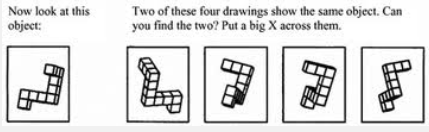
However, when women are “primed” to experience confidence, they performed better on 3D rotation spatial tasks in Roger Shepard and Jacqueline Metzler’s Mental Rotations Test, reported University of Warwick’s Zachary Estes and Sydney Felker, then of University of Georgia Health Center.
In one set of tests, women and men performed similarly when women and men again completed each item and reported their:
–Confidence level in their answers,
-Whether they would change their responses if given the opportunity.
Women’s performance dropped below previous scores whereas men’s increased significantly when they elected to change answers.
“Second-guessing” and “over-thinking” eroded women’s confidence which affected their scores.
Albert Bandura
“People who have a strong sense of efficacy focus their attention on analyzing and figuring out solutions to problems, whereas those beset with self-doubts of their efficacy tend to turn their attention inwardly and become self-preoccupied with evaluative concerns when their efforts prove unsuccessful,” explained Stanford’s Albert Bandura and Forest Jourdan.

Robert K Merton
However, both men and women significantly improved their scores after they were told that they achieved high scores on the previous test irrespective of actual score.
This finding demonstrates the performance-enhancing effect of positive expectancy, and replicated “The Rosenthal Effect,” or “self-fulfilling prophecy,” described by Robert K. Merton of Columbia.

Jeffrey Vancouver
Confidence may have performance-eroding effects despite much previous research documenting performance-enhancing effects, according to Ohio University’s Jeffrey Vancouver and Charles Thompson, with University of Cincinnati’s E. Casey Tischner, and Dan Putka of Human Resources Research Organization.

Dan Putka
They primed confidence or “self-efficacy” among half the participants in an analytic game, and found that those who received positive feedback about their performance didn’t perform as well in the next game, and were more likely to make logical errors.
Vancouver and team suggested that participants whose confidence was artificially-inflated tended to apply less mental effort to challenging tasks before attempting the next item.
Fortunately, actual skill trumps inflated confidence.
Women considering technical training and careers may be reassured by Kennedy and team’s observation that, “…Acting capable was beneficial, but actually being capable was better.”
However, these findings suggest that women aspiring to STEM careers are likely to be more effective when they create a “hybrid” style of communication and professional presence, drawing on behaviors that demonstrate confidence, competence, and proactivity without violating gender-linked expectations.
-*How do you capitalize on the performance-enhancing effects of confidence without alienating others or reducing future performance efforts?
RELATED POSTS:
- Least Skillful Performers May Have Greatest Self-Delusions of Skill: Pointy-Haired Boss Effect
- Self-Stereotypes Still Limit Women’s Performance
- Price of Job “Flexibility” for Women: Lower Salaries
- Unrealistic Optimism Drives Profitability
- Useful Fiction: Optimism Bias of Positive Illusions
- Oxytocin Receptor Gene’s Link to Optimism, Self-Esteem, Coping with Stress
- Gender Bias in STEM Hiring Even When it Reduces Financial Returns
- “Grit” Rivals IQ and EQ to Achieve Goals
- Developing a SMARTER Mindset for Resilience, Emotional Intelligence – Part 2
- Women’s Likeability – Competence Dilemma: Overcoming the Backlash Effect
©Kathryn Welds









 Kathryn Welds, PhD | Curated Research + Commentary