Monthly Archives: May 2025

Career “Planning” = Career Improvisation

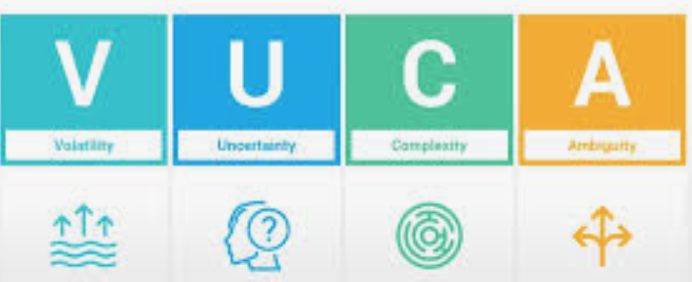
In “VUCA world,” described by the U.S. Army War College as volatile, uncertain, complex, ambiguous environments, career “planning” occurs under rapidly-shifting conditions.

As a result, it is difficult to  meaningfully respond to the interview question: “What are your career plans for the next five years?

Kathleen Eisenhardt

Planning is most suited to relatively certain circumstances when processes and decisions are linear, argued Stanford’s Kathleen Eisenhardt and Behnam Tabrizi.

In contrast, frequently-changing or uncertain conditions require improvisation, frequent testing, and revision.

Behnam Tabrizi

Iterative exploration, rapid prototyping/experimentation, and testing are used in agile software development and are applicable to rapid changes in economic, political, and technology changes that affect career paths.

Alison Maitland

University of London’s Alison Maitland and Peter Thomson offered this perspective in Future Work: How Businesses Can Adapt and Thrive In the New World of Work,

Related views on using flexible “planning” in career development come from Deloitte’s Cathy BenkoMolly Anderson, with Anne Weisberg of Paul, Weiss, Rifkind, Wharton & Garrison LLP in their model of The Corporate Lattice: Achieving High Performance in the Changing World of Work and Mass Career Customization: Aligning the Workplace with Today’s Nontraditional Workforce.

-*When have you found it more useful to “improvise” instead of “plan” your career?
-*What are the benefits of career “improvisation”?

Related Posts:

©Kathryn Welds

Performance Excellence linked to Preventing Failures, Corrective Coaching

Atul Gawande

Simple behavior changes, such as following a structured checklist, can prevent crucial workplace errors and increase quality in medical settings, found Harvard’s Atul Gawande.

He found that people effectively improved their performance when they recognized weaknesses in organizational processes, and took proactive steps to remedy these shortcomings.

Three elements of better performance can be applied across industries:

  • Diligence – Attending to details can prevent errors and overcome obstacles.
    Gawande’s The Checklist Manifesto: How to Get Things Right suggests best ways to structure these memory aids,
  • Doing Right –Ensuring that skill, will, and incentives are aligned to drive excellent performance,
  • IngenuityDeliberately monitoring potential failures, continuously seeking innovative ways to improve performance and solutions.

These elements can be improved with attentive observation and feedback to prevent errors of omission when people don’t:

  • Know enough (ignorance),
  • Make proper use of what they know (ineptitude).

Ignorance occurs less frequently than ineptitude because relevant information is widely available, Gawande noted.
He suggested that both errors can be improved by systematic analysis and consistent use of tools like checklists.

Geoffrey Smart

Checklist-based analysis was also linked to Internal Rate of Return (IRR) in Geoffrey Smart’s study of investments by Venture Capital (VC) firms,

He found a correlation between IRR and leadership effectiveness in new investment ventures.
Selecting capable leaders is critical to business outcomes, so Smart also evaluated VC firms’ typical approach to assessing potential leaders:

  • The Art Critic is the most frequent approach in which the VC assesses leadership talent at a glance, intuitively, based on extensive experience,
  • The Sponge conducts extensive due diligence, then decides based on intuition,
  • The Prosecutor interrogates the candidate, tests with challenging questions and hypothetical situations,
  • The Suitor woos the candidate instead of analyzing capabilities and fit,
  • The Terminator eliminates the evaluation because the venture firm replaces the company’s originators,
  • The Infiltrator becomes a “participant-observer” in an immersive, time-consuming experientially-based assessment,
  • The Airline Captain uses a formal checklist to prevent past mistakes.
    This last approach was linked to the highest average Internal Rate of Return (IRR) for the new ventures.
    In addition, this strategy was significantly less likely to result in later terminating senior managers.

Venture Capitalists in these studies reported that two of their most significant mistakes were:

  • Investing insufficient time in talent analysis,
  • Being influenced by “halo effect” in evaluating candidates.

Systematic reminders to execute all elements required for expert performance can prevent failure and signal potential failure points.

-*How do you improve performance?
-*What value do you find in expert coaching?

Related Post:
Developing a SMARTER Mindset for Resilience, Emotional Intelligence – Part 2

©Kathryn Welds

Four Career Trajectories: Linear, Expert, Spiral, Transitory

Kenneth Brousseau

Kenneth Brousseau

Successful careers can follow forms other than “up or out,” according to Decision Dynamics’ Kenneth Brousseau, Michael Driver of USC, with Lund University’s Kristina Eneroth, and Rikard Larsson.

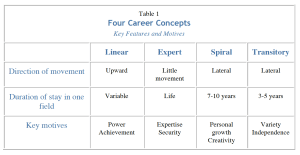
Their “pluralistic career concept framework” classified careers as:

Four Career Concepts

Four Career Concepts

LinearTraditional upward movement, with variable job role tenure, and motivated by power and achievement.

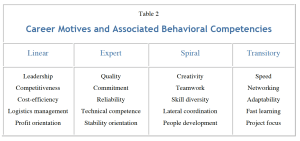
Behavioral competencies include leadership, competitiveness, cost-efficiency, logistics management, profit orientation.

This career concept is most seen in tall hierarchies with a narrow span of control.

Michael Driver

Michael Driver

Expert – Little movement and long role tenure due to deepening expertise in a narrow discipline.

Motives include mastery, expertise, and security.
Meaningful rewards are continued training, benefits, recognition.

Competencies are quality, commitment, reliability, technical competence, stability orientation.
This career concept is well-matched to flat functional organizations.

Career Motives, Competencies

Career Motives, Competencies

SpiralLateral movement to broaden functional exposure, with seven to ten year tenure in roles.

Motivated by personal growth, creativity, and suited to matrix organizations with cross-functional teams, this pattern is seen in loose, temporary team structures.

Rewards include cross-functional lateral assignments and training.
Key competencies include creativity, teamwork, skill diversity, lateral coordination, people development.

Transitory – Lateral moves with three to five year tenures are motivated by desire for variety, independence.
Most often found in temporary team structures, behavioral skills include speed, networking, adaptability, fast learning, project focus.
Meaningful rewards are job rotation, temporary assignments, immediate cash bonuses.

This team’s research was distilled into assessment tools focused on career “fit” with an organization’s structure and objectives.

Timothy Butler

Timothy Butler

A similar emphasis on cultural fit is found in CareerLeader Inventory, based on Timothy Butler and James Waldroop’s research at Harvard Business School.

James Waldroop

James Waldroop

-*Which of the four career trajectories seems most like yours?

-*Which career assessment tools have you found most useful to determine your skills, interests, and best-fit organizational context?

RELATED POSTS:

©Kathryn Welds

Ask a Narcissist

Confidence is correlated with career effectiveness and advancement.
However, people who exhibit too much of a good thing may be seen as “narcissistic.”

Jean Twenge

Jean Twenge

Narcissistic personality is characterized by:

-Inflated views of the self,
-Grandiosity,
-Self-focus,
-Vanity,
-Self-importance,

according to San Diego State University’s Jean M. Twenge, with Sara Konrath and Brad J. Bushman of University of Michigan, collaborating with University of South Alabama’s Joshua D. Foster, and Keith Campbell of University of Georgia,

Calvin S Hall

Calvin S Hall

One well-validated assessment instrument to identify narcissism is the Narcissistic Personality Inventory, developed by University of California Berkeley’s Robert Raskin and Calvin S. Hall.

Sara Konrath

Sara Konrath

Raskin and UC Berkeley colleague, Howard Terry examined responses from more than 1000 volunteers and found seven constructs related to narcissism:

  • Authority,
  • Exhibitionism,
  • Superiority,
  • Vanity,
  • Exploitativeness,
  • Entitlement,
  • Self-Sufficiency.
Timothy Leary

Timothy Leary

They related ratings of “self” and “ideal self” to participants’ responses on the Leary Interpersonal Check List, developed by Harvard’s Timothy Leary before he investigated psychedelic drugs.

Brian P Meier

Brian P Meier

An alternative to Leary’s lengthy NPI was developed by University of Michigan’s Sara Konrath, Brian P. Meier of Gettysburg College, and Ohio State’s Brad J. Bushman of Indiana University.
The Single Item Narcissism Scale (SINS) measures grandiosity, entitlement, and low empathy characteristic of “narcissistic” behavior.

The team asked more than 2,200 participants to rate their answer to a single question on a scale of one to seven: To what extent do you agree with this statement? “I am a narcissist.”

Brad J Bushman

Brad J Bushman

Konrath’s team demonstrated that the Single Item Narcissism Scale is a valid, reliable alternative to longer narcissism scales because it is significantly correlated with scores on the NPI and is uncorrelated with social desirability.

Erika Carlson

Erika Carlson

People who score high on the NPI and SINS say that they are more arrogant, condescending, argumentative, critical, and prone to brag than people who score low on the NPI, according to University of Toronto’s Erika Carlson.

Narcissism was also related in Konrath’s validation studies to:

People who scored high for narcissism also showed behaviors that can be problematic at work:

However, people who scored high for narcissism displayed positive attributes including:

Interacting with a narcissist in the workplace can be challenging, and a previous blog post identifies recommended strategies.

-*How do you identify narcissists in the workplace and in personal life?
-*What are more effective ways to work with them?

RELATED POSTS:

©Kathryn Welds