Monthly Archives: August 2016

Expansive Body Language Decreases Power for Some

Lora E Park Bunting
Lora E Park Bunting

Expansive body postures and feelings of power are related for some cultures, but not all, according to SUNY’s Lora E. Park Bunting and Lindsey Streamer with Li Huang of INSEAD and Columbia’s Adam D. Galinsky.

Lindsey Streamer
Lindsey Streamer

They built on much-cited work by Columbia’s Dana R. Carney and Andy J. Yap, demonstrating the posture-power connection, by evaluating three expansive postures among Americans and East Asians:

  • Hands spread on a desk
  • Upright sitting
  • Feet on a desk
Li Huang
Li Huang

Park and team demonstrated that “embodied emotion” depends on the posture and its symbolic meaning within the prevailing cultural context.

Adam Galinsky
Adam Galinsky

Both Americans and East Asians rated the feet-on-desk pose as least consistent with East Asian cultural norms of modesty, humility, and restraint.
In contrast, when Americans assumed this posture, they experienced greater power activation and action orientation.

This effect was reversed for East Asians when they demonstrated the feet-on-desk pose:  They showed less power activation and action orientation than Americans in this position.

However, when Americans and East Asians assumed hands-spread-on-desk and upright-sitting postures, they reported a greater sense of power than when they held a constricted posture (sitting with hands tucked underneath their thighs).

Albert Mehrabian
Albert Mehrabian

Changes in a person’s mood, emotion, and feelings expressed by changes in body posture was first demonstrated by Albert Mehrabian and John T. Friar of UCLA.

They asked nearly 50 volunteers to sit as they would in addressing another person in a variety of imagined scenarios.

Mehrabian and Friar considered relationships between Communicator attitude and gender as well as Addressee status and gender in relation to eye contact, interpersonal distance, head orientation, shoulder orientation, leg orientation, arm openness, leg openness, and hand, foot, and trunk relaxation.

Positive attitude was demonstrated by a slight backward lean of the torso, close distance, and greater eye contact.
When communicating with “high status” individuals, Communicators provided more eye contact and less sideways leaning.
Female Communicators used a more constrained posture with less arm openness when communicating with “higher status” individuals.

Dana Carney
Dana Carney

Carney and team demonstrated that these postural changes elicit measurable neuroendocrine changes.
When people in the U.S. assumed in high-power nonverbal displays, their  testosterone increased, their cortisol decreased and they reported increased feelings of power and tolerance for risk.

Andy Yap
Andy Yap

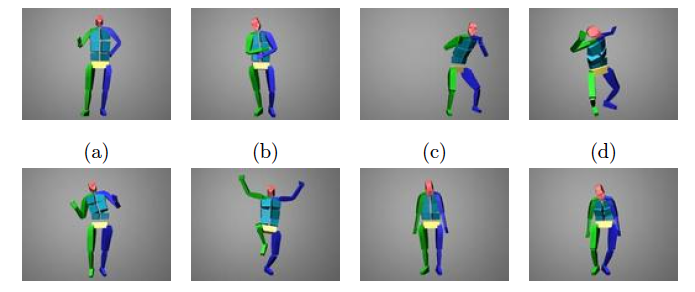
University of Florida’s Andrea Kleinsmith, P. Ravindra De Silva at Toyohashi University of Technology and University College London’s Nadia Bianchi-Berthouze demonstrated these cross-cultural differences in perceiving emotion and subjective experience from body posture.

Andrea Kleinsmith
Andrea Kleinsmith

Kleinsmith and team used static posture images of affectively expressive avatars or “embodied agents” to test emotion recognition by volunteers from three cultures. From these findings, they developed cultural models for affective posture recognition.
Andrea Kleinsmith-avatars

These results suggest both the impact of changing body postures to elicit different feeling states, and caveats when adopting expansive postures to activate power while interacting across cultural groups.

Ravindra De Silva
Ravindra De Silva

Encouragement to “Think Big, Play Big” may require specific recommendations for culturally appropriate action.

-*How do you demonstrate power when interacting with colleagues from different cultural backgrounds?

Nadia Bianchi-Berthouze

 RELATED POSTS:

©Kathryn Welds

Brand You: Pronounceable Names are More Likeable, Maybe More Hireable

Simon Laham

Simon Laham

Personal names, like brands, evoke inferences about likability and specific characteristics, like gender, ethnicity, social class, intellectual competence, masculinity-femininity, and even personality characteristics, according to University of Melbourne’s Simon M. Laham, Peter Koval of University of Leuven, and NYU’s Adam L. Alter.

Peter Koval

Peter Koval

They argue that these assumptions affect impression formation and may lead to bias.

More than 20 years ago, UCLA’s Albert Mehrabian began investigating the impact of personal names and developed the Name Connotation Profile to assess attributions to specific names.

Albert Mehrabian

Albert Mehrabian

He concluded that “people with desirable or attractive names are treated more favorably by others than are those with undesirable or unattractive names,” base on findings from more than ten studies.

Personal names are also associated income and educational attainment, reported Saku Aura of University of Missouri, collaborating with Claremont McKenna College’s Gregory D. Hess.

Saku Aura

Saku Aura

They evaluated the relationship among “first name features” (FNF) including:

  • “Popularity” (frequency),
  • Number of syllables,
  • Phonetic features,
  • Scrabble score (?),
  • “Blackness” (fraction of people with that name who are African-American),
  • “Exogenous” background factors (sex, race, parents’ education).

Gregory Hess

Gregory Hes

In addition, Aura and Hess scrutinized associations between first names and “lifetime outcomes” including:

  • Financial status,
  • Occupational prestige,
  • Perceived social class,
  • Education,
  • Happiness,
  • Becoming a parent before age 25. 


First name features predicted education, happiness and early fertility, which were also related to labor market productivity.
However, workforce productivity can be reduced when discriminatory decisions about names reduce labor market participation, such as for names rated for “blackness.”

Marianne Bertrand

Marianne Bertrand

University of Chicago’s Marianne Bertrand and Sendhil Mullainathan of Harvard documented this effect when they found that name discrimination affects hiring decisions. 
 Job applicants with “African American-sounding” names were less likely to be invited for a job interview than a person with a “White-sounding” name.

Sendhil Mullainathan

Sendhil Mullainathan

Bertrand and Mullainathan responded to help-wanted ads in Boston and Chicago newspapers by sending fictitious resumes containing “African-American” or “White” names.

They found that “White name” candidate received 50% more interview invitations across occupation, industry, and employer size.
This bias was centered more on inferred race than social class, suggesting that discrimination in hiring practices persists but has become more subtle, and perhaps even unconscious.

Claire Etaugh

Claire Etaugh

Another form of name discrimination is women who take their husband’s surname.
They are typically seen as less “agentic” and more “communal” than those who retain their own names, noted Bradley University’s Claire E. Etaugh, Myra Cummings-Hill, and Joseph Cohen with Judith S. Bridges of University of Hartford.
These attributions are usually associated with stereotypic “feminine” attitudes and behaviors, which can slow career advancement.

David Figlio

David Figlio

Gender-based name discrimination can affect males as well:  Gender-incongruous names seem to invoke social penalties for boys, according to Northwestern’s David Figlio.

He reported that boys who had names usually associated with girls were more likely to be expelled from school after disruptive behavior beginning in middle school.

Daniel Y Lee

Daniel Y Lee

In related findings, Shippensburg University’s David E. Kalist and Daniel Y. Lee found that people with unusual names (less “popular”) were more likely to have juvenile delinquency experiences.

These finding suggest that unusual names may provoke negative and stigmatizing attributions, which can lead to confirmatory behaviors that lead to asocial acts.

Besides racial and ethnic associations with names, some are easier for English speaking people to pronounce.

Adam Alter

Adam Alter

Easy-to-say names are judged more favorably than difficult-to-pronounce names, in related findings by LahamKoval, and Alter.

In fact, they found that people with easier-to-pronounce surnames occupy higher status positions in law firms, demonstrating the importance of “processing fluency”- the subjective ease or difficulty of a cognitive task – when forming an impression.

Laham and team pointed to the “hedonic marking hypothesis,” that posits “processing fluency” automatically activates a positive emotional reaction, which is then attributed to the evaluated “stimulus object” – a person’s name.

They noted that pronouncability strongly influences likeability and other evaluations, and can lead to decision bias, as in hiring choices.

Names matter, whether for products or people, because they carry emotional and cognitive associations that may bias impressions and decisions.

-*How have you modified your name?

-*What have been the effects on how others perceive you?
Your occupational opportunities?

Follow-share-like www.kathrynwelds.com and @kathrynwelds

RELATED POSTS:

Twitter  @kathrynwelds
Blog – Kathryn Welds | Curated Research and Commentary  
Google+
LinkedIn Open Group Psychology in Human Resources (Organisational Psychology)
Facebook Notes

©Kathryn Welds

Least Skillful Performers May Have Greatest Illusions of Competence

William Shakespeare

William Shakespeare

The Foole doth thinke he is wise, but the wiseman knowes himselfe to be a Foole,” wrote  William Shakespeare in As You Like It.
Charles Darwin decoded this observation with his update: “Ignorance more frequently begets confidence than does knowledge.”

Charles Darwin

Charles Darwin

Both view are applicable to the workplace and notoriously “clueless” players like Dilbert’s Pointy Haired Boss.

Pointy Haired Boss

Pointy Haired Boss

Incompetent performance often results from ignorance of performance standards in both cognitive skills and physical skills, found Columbia’s David Dunning and Justin Kruger of NYU in a series of experiments.

David Dunning

David Dunning

Volunteers performed humor, grammar, and logic tasks, then viewed their performance scores and again estimated their performance rank.
Competent individuals accurately estimated their rank, whereas incompetent individuals overestimated their ranks despite actual feedback.

Dunning and Kruger posited that incompetent people:

  •          Overestimate their skill levels,
  •          Overlook other people’s skills,
  •          Underestimate their lack of skill in relation to performance standards.

Justin Kruger

Justin Kruger

However, training may reverse this “insight blindness.”
Low-skill individuals in some cases can benefit from corrective feedback and recognize their original lack of skill after they participate in skill training.

The Dunning–Kruger effect describes unskilled individuals’ sense of “illusory superiority,” when they rate their ability as much higher than average although it is actually much lower than average.
In contrast, highly competent individuals miscalibrate other’s performance.

Joyce Ehrlinger

Joyce Ehrlinger

Kerri Johnson

Kerri Johnson

These observations were validated by Washington State University’s Joyce Ehrlinger, Kerri Johnson of UCLA, and Cornell’s Matthew Banner.

People also demonstrate “illusory superiority” when they estimate their ability to identify deception and to infer intentions and emotions (interpersonal sensitivity),  found Columbia’s Daniel R. Ames and Lara K. Kammrath of Wilfrid Laurier University.

Daniel Ames

Daniel Ames

Their results replicated previous findings that most people overestimate their social judgment and mind-reading skills, and showed that people who demonstrate least accurate social judgment and “mind-reading” significantly overestimate their relative competence.

Lara Kamrath

Lara Kamrath

Ames and Kammrath suggested that these inaccurate self-assessments are based “in general narcissistic tendencies toward self-aggrandizement.”

Different tasks elicit differing degrees of the illusory superiority bias, according to University of Michigan’s Katherine A. Burson, Richard P. Larrick of Duke University, University of Chicago’s Joshua Klayman.

Katherine Burson

Katherine Burson

When performing moderately difficult tasks, best and worst performers provided similarly accurate estimates of their skills.
However, when they performed more difficult tasks, best performers provided less accurate skill estimates than worst performers.

Richard Larrick

Richard Larrick

Burson and team proposed that “noise-plus-bias” explains erroneous judgments of personal skill across competence levels.

Dunning and Ehrlinger showed that people’s views of themselves and their skill change when influenced by external cues.
They note that this effect can limit women’s participation in STEM careers (Science, Technology, Engineering, Mathematics).

Joshua Klayman

Joshua Klayman

The team found that women performed equally to men on a science quiz, yet participants underestimated their performance because they assigned low judgments to their general scientific reasoning ability.
This inaccurate underestimate of abilities can dissuade many women from entering STEM careers.

The Dunning–Kruger effect may be culturally limited because one study found that East Asians tend to underestimate their abilities due to norms of humility, and see underachievement as a chance to improve themselves and cooperate with others.

-*How do you mitigate overestimate and underestimates of your skill performance?
-*Where have you seen inaccurate performance estimate affect long-range career achievement?

RELATED POSTS:

©Kathryn Welds

Unrealistic Optimism Drives Profitability

Overconfident decision-making in financial markets led to myriad negative consequences in the past decade, when companies underestimated business risks. 

Gilles Hilary
Gilles Hilary

In contrast to overconfidence, unrealistically optimistic judgments can result in increased profitability and market value, according to INSEAD’s Gilles Hilary and Benjamin Segal with Charles Hsu of Hong Kong University of Science & Technology.

Benjamin Segal
Benjamin Segal

Hilary, Hsu, and Segal demonstrated that over-optimism differs from overconfidence, and may result in larger growth projections.

Charles Hsu
Charles Hsu

The team drew on earlier work by University of Illinois’s Dirk Hackbarth that showed both overconfident, and overoptimistic managers chose higher debt levels and issued more new debt.
Hackbarth did not differentiate over-confident and over-optimistic investment behaviors, and reported that both tendencies reduce manager-shareholder conflict, which can increase firm value.

Dirk Hackbarth
Dirk Hackbarth

Static over-optimism” refers to an unrealistically positive view of the impact of one’s own actions on future outcomes.
In contrast, “dynamic overconfidence” refers to overvaluation of one’s skills and the accuracy of private information.
In addition, “dynamic overconfidence”  is associated with  underestimates of random events after several positive outcomes, according to Hackbarth.

Together, static over-optimism and dynamic overconfidence lead to “dynamic over-optimism” after successes.

Neil Weinstein
Neil Weinstein

The pervasiveness of this “rose-tinted glasses” view leading to over-optimistic assessments was demonstrated by Neil Weinstein of University of Arizona.
He investigated people’s beliefs about future positive and negative health events, discussed in a previous blog post.
Weinstein reported that people tend to believe negative events are less likely to happen to them than to others, whereas they expect they are more likely than other people to experience positive events.

Hilary’s team built on Hackbarth’s concepts by comparing North American companies’ quarterly earnings forecasts with analysts’ predictions and actual performance.
Then, they calculated the number of company-issued press releases containing optimistic language.

Optimistic performance forecasts were correlated with better-than-expected performance, suggesting that successes led to additional effort and positive expectations.

Hilary noted the potentiating effect of past successful performance, though it may lead to “burnout” after about four quarters due to the challenge of continually exceeding performance expectations.

The team noted that this cycle of over-optimism and burnout might be mitigated by instituting policies to moderate overestimates or underestimates future performance by rewarding executives who provide accurate forecasts.

Sheryl Winston Smith

Similarly, Temple’s Sheryl Winston Smith noted that optimistic entrepreneurs chose higher levels of debt financing relative to equity, facilitating patent-based and product-based innovation among nearly 5,000 US firms tracked by the Kauffman Firm Survey (KFS).

Young-Hoon Kim
Young-Hoon Kim

In contrast to these financial studies, Yonsei University’s Young-Hoon Kim, Nanyang Technical University’s Chi-yue Chiu and Zhimin Zou of University of Illinois reported mixed results for self-enhancing (overconfident) and self-effacing (pessimistic) biases on performance

Chiu Chi-Yue
Chiu Chi-Yue

Kim’s team posited that either over-optimistic or pessimistic biases lead to “self-handicapping” behavior, in which people perform under disadvantageous conditions that provide an explanation for any poor performance outcomes.

Although over-optimism may drive innovation and financial results, longer-term consequences may include performance “burnout,” reduced motivation, and lower performance.

-*How to you manage the impact of optimism bias and pessimism bias on judgments and performance?

RELATED POSTS:

©Kathryn Welds

Clothing Influences Thinking and Behavior, not Just Others’ Perceptions

A previous post highlighted the influence of the body on thinking, through “embodied cognition.”

Hajo Adam

Hajo Adam

An extension of this idea is “unclothed cognition,” the impact of clothing on thinking and behavior, according to Rice University’s Hajo Adam and Adam Galinsky of Northwestern University.

Adam and Galinsky considered the symbolic meaning of clothing and wearer’s physical experience by evaluating the impact of wearing a lab coat on participants’ task performance.

Adam Galinsky

Adam Galinsky

Before the experiments, volunteers said in a survey that they associated “attentiveness” and “carefulness” with “a lab coat.”
Next, participants completed a Stroop Test, a task that requires selective attention to differentiate words in incongruent colors (“red” presented in green letters), while wear a lab coat or their street clothes.

Volunteers performed better when they wore a lab coat than when they completed the same tasks while wearing street clothes.

In other experiments, Adam and Galinsky described the lab coat to some participants as a “doctor’s coat” and to others as a  “painter’s coat.”
Volunteers who wore a “doctor’s coatperformed better on sustained attention tasks and were better able to discriminate features in nearly-similar images, than those who wore a  “painter’s coat.” 

Joshua Davis

Joshua Davis

Clothing’s symbolic meaning as visual communication can influence the viewer’s attributions and the wearer’s behavioral alignment with the role suggested by clothing, argued Joshua I. Davis of Barnard College, who studied the effect of BOTOX injections on emotional experience.

Sandra Forsythe

Sandra Forsythe

Clothing’s impact on others’ evaluation of the wearer was further detailed by Sandra Forsythe, now of Auburn University collaborated with University of Tennessee’s Mary F. Drake, and Charles E. Cox.
They videotaped simulated job interviews of women wearing various styles of dress, and found that more than 75 human resources professionals recommended hiring female job applicants who wore more “masculine” attire than those wearing other styles of dress.

Norah Dunbar

Norah Dunbar

Clothing’s influence on the viewers’ impression of others’ credibility was investigated by University of Oklahoma’s Norah E. Dunbar and Chris Segrin of University of Arizona guided by their colleague Judee Burgoon‘s expectancy violation theory.

Chris Segrin

Chris Segrin

Two instructors gave lectures in undergraduate college classes, wearing either expected “appropriate” attire for this role, or wearing unconventionally casual clothing.
The instructors also provided either high interpersonal support or less rewarding interactions.

Judee Burgoon

Judee Burgoon

Dunbar and Segrin found that students were less influenced by unexpected attire when the instructor provided more social rewards.
They suggested that interpersonal demeanor can be even more influential than clothing in determining impressions of credibility and likability.

Similarly, the impact of clothing on judgments of competence and achievement for both students and teachers in Ohio high schools was demonstrated in research by Bowling Green State’s Dorothy Behling with Elizabeth Williams.

Anat Rafaeli

Anat Rafaeli

Clothing’s influence on impression formation and related organizational dynamics is based on attributes, homogeneity and conspicuousness, posited Anat Rafaeli of Technion, and Boston College’s Michael Pratt.

Michael Pratt

Michael Pratt

Clothing has been considered an important influence on others’ perception of the wearer, and Adam and Galinsky’s studies offer evidence that clothing can affect the wearer’s actual task performance.

-*How has clothing changed your workplace behavior and performance?
-*How do others treat you different depending on your attire?

Follow-share-like http://www.kathrynwelds.com and @kathrynwelds

RELATED POSTS:

Twitter  @kathrynwelds
Blog – Kathryn Welds | Curated Research and Commentary  
Google+
LinkedIn Open Group Psychology in Human Resources (Organisational Psychology)
Facebook Notes:

©Kathryn Welds